posted in Technology

EV Charging Doesn't Need to Be as Fast as Gas, Ionna CEO Says
www.thedrive.com/news/ev-charging-doesnt-need-to-be-as-fast-as-gas-ionna-ceo-saysposted in Technology
EV Charging Doesn't Need to Be as Fast as Gas, Ionna CEO Says
www.thedrive.com/news/ev-charging-doesnt-need-to-be-as-fast-as-gas-ionna-ceo-says
Replying to @Mustachius_Grumpius@thelemmy.club
The technology should still be improved as much as possible.
Replying to @Zedstrian@sopuli.xyz
Everything is a tradeoff. At this point there are more valuable things to be spending money on than making chargers that are as fast as possible. Not all cars can charge at 500+kWhs many cannot even do 100kWhs. IMO better to spend money upgrading all the slow 7-50kWh chargers. As well as putting in more slow charging near residents. Kerb charging for people that dont have a driveway in cities or chargers for those living in flats. That would serve people better then spending more money on something very few can actually benefit from.
Replying to @Zedstrian@sopuli.xyz
I think for my commute I would prefer a battery chemistry that needed slower charging, if it was cheaper or lasted longer or was safer, or lighter, or whatever. But I think there will always be use cases where it’s worth maximizing uptime, like long-haul driving.
I wonder if trucking will evolve to do tractor swaps, where rigs coming into charge up will hand off trailers to fresh tractors. That way the cargo doesn’t have to take up space in the charging lot or whatever. Or they might do battery swaps. I imagine for above some threshold of cost/minute downtime, the hardware for doing swaps will be worth the extra cost.
Replying to @thinkercharmercoderfarmer@slrpnk.net
In most jurisdictions, trucks are required by law to stop for the driver to rest every 5 hours or so. You can just charge the vehicle then.
Replying to @Ilovethebomb@sh.itjust.works
oh yeah, duh. the vehicle’s uptime is bound by its operator’s.
Replying to @Ilovethebomb@sh.itjust.works
But drivers swap on the road and don’t stop.
Replying to @thinkercharmercoderfarmer@slrpnk.net
Nio has had battery hot swapping systems for years, but that’s for progressive countries.
Replying to @SaveTheTuaHawk@lemmy.ca
It infuriating how nice an actual non-fossil-fuel infrastructure could be, if only we had a government that would build it. The Nio battery swaps are cool, I want to convert one of my old tractors to a similar setup, except I’ll probably just put a pallet of batteries on top of the engine compartment and forklift them on and off the tractor. But similar idea: let the batteries charge slowly on a rack while the tractor and implements only see a few minutes of downtime. But until we get our political shit together I’m stuck making my own with spit and baling wire.
Replying to @Zedstrian@sopuli.xyz
but the fast chargers do need more infrastructure that takes more space and cost, when having MORE slower, cheaper, easier to install AC chargers everywhere will help just as much
Replying to @Zedstrian@sopuli.xyz
BYD did a 1.5MW and Geely did a 2.2MW charging now, but they faced the one big issue with such charging speed : building a facility for it. It requires a tremendous amount of power so it cannot pull only from the grid, so it can’t be deployed in most place. That’s the challenge they’re facing, and even Geely said the speed has peaked. Practically there’s no need to have those charging speed, more charger is much more beneficial than super fast charging.
Replying to @psx_crab@lemmy.zip
They face a new issue: morons.


Replying to @Mustachius_Grumpius@thelemmy.club
All the messaging about fast charging speed is focused on the wrong thing. EV drivers should be able to do the vast majority of their charging at home or at their destination. The messaging should be about getting chargers in more homes, apartment complexes and workplaces. Speed doesn’t matter as much if you’re going to be parked for half the day or overnight. That’s something that gas simply can’t do.
Fast charging stations should only be necessary for road trips, where you should be taking a break every so often anyways.

Replying to @Technus@lemmy.zip
The fact that so many people don’t think about this or are unaware shows how well the propaganda worked.
Here is a car that is by far the easiest car you’ll ever own, the power to run it is the cheapest you’ll ever see, and 99% of your trips will be within one charge/tank meaning you’ll never need to worry about range ever - but the propaganda convinced them all that that’s a deal breaker.
As an EV owner the road trips we take are the vast minority of driving anymore. When we do there are options.

Replying to @scrubbles@poptalk.scrubbles.tech
I can’t help but feel if EVs were invented first, convincing people to adopt gas cars would be impossible.
Replying to @jballs@sh.itjust.works
Ha, I never thought of it that way but yes, that tracks perfectly. The “inconveniences” of EVs aren’t worse than gas cars, it’s just that the gas car inconveniences are considered “normal” right now.
Replying to @jballs@sh.itjust.works
The saddest part is that EVs were invented first, but it was easier to tanker fuel everywhere, rather than building out the electric grid in low-density areas.
Replying to @ChaoticGoodHeart@sh.itjust.works
Tbf, battery tech was also shit back then.
Replying to @Asetru@feddit.org
Many people fail to appreciate just how much consumer battery technology has improved, in their lifetime.
Replying to @8oow3291d@feddit.dk
Yes. And another thing people don’t appreciate is that gas always had the inherent advantage in that the oxidizing agent is just sitting around wherever you go. You don’t even need to carry all the chemical agents. If gas cars had to carry around their own oxidizer like rockets do, batteries would have surpassed them long ago.
Replying to @jballs@sh.itjust.works
First, just to be pedantic, EVs did exist first. They go all the way back to the early 1800s. But battery technology didn’t advance enough to make them a good option until recently, so your point remains.
I fully agree with you that the only thing keeping gasoline going is inertia. There have been parodies applying the same logic to other fields, like the gas-powered phone.
There’s a reason why 80%+ of EV owners say they’ll never go back, and a good chunk of the remainder are just waiting on the field to mature a bit.
Replying to @jballs@sh.itjust.works
EVs still use brake pads. lol
Also electric cars, gas, and steam has a bit of a format war in the 1890’s-1920’s or so, and people really did make a lot of these points back then. Unreliable and sometimes unsafe chargers (basically due to people not understanding electrical engineering as well as we do now) were a big part of why gasoline won out
Replying to @kestrel7_7@lemmy.world
EV brake pads can last a lot longer on one pedal cars. Henry Ford’s wife drove an EV, she hated his gasoline cars because they were loud, stunk, and could not be started by most women.
Replying to @SaveTheTuaHawk@lemmy.ca
Chiming in from experience, our EVs brake pads were rusting faster than they were wearing down. We bought used, so maybe the previous climate was humid, but around 80k miles may have been their first change.
Replying to @riquisimo@lemmy.dbzer0.com
Many (most?) EVs now periodically apply friction brakes to reduce corrosion issues. If an EV doesn’t have it, you can do it manually.
Replying to @kestrel7_7@lemmy.world
EVs still use brake pads. lol
not really. almost all EV breaking is regen, unless you drive like shit.
Replying to @jballs@sh.itjust.works
“those fluid is VERY flammable, it’s insane people wanted to sit above one”
“it stink when it’s running.”
Replying to @psx_crab@lemmy.zip
“leave it running in a closed garage and it will kill you in minutes with poison gas”
Replying to @psx_crab@lemmy.zip
“the wear and tear from containing thousands of internal explosions will inevitably wear parts down over time.”

Also, that place is disgusting and you have to step over the rotting corpse of 600 soft drinks poured out next to the pump, then touch a handle which is visibly soiled and often sticky, and then you will probably smell like gas for at least the next 20 minutes.
Replying to @jballs@sh.itjust.works
Wait, since when did electric cars stop having brakes?
Replying to @Jolteon@lemmy.zip
1 pedal driving doesn’t use brake pads to slow down your car. You still have brakes in case of an emergency, but if you’re using them enough to wear out your brake pads then you’re doing something wrong. As someone else pointed out, you’re much more likely to rust off your brake pads rather than wear them out.
Replying to @jballs@sh.itjust.works
The amount of braking force that you can apply with that is relatively small, so if you want to either brake quickly or come to a complete stop, you’ll still use the actual brakes. While your brake pads would last longer than typical car, they would still need wear down.
Replying to @scrubbles@poptalk.scrubbles.tech
I can vouch for this 100%. Have had an electric vehicle for 6 months now.
The vast majority of my charging has been done at home on 120v. Granted, my wife and I both work from home most of the week and have short commutes. Our grocery store has free 240v charging so I top up while I shop.
We took one long trip in those 6 months and rented cars for the drive to/from and used public transit while we were there.
I used a fast charger for the first time this weekend to drop off a kid at the grandparents a couple hours away on Friday and then picked them up in Sunday. Didn’t have enough time between trips for the trickle charge to leave me in a comfortable range. 20 minute fast charge did the job for about $15.
Replying to @scrubbles@poptalk.scrubbles.tech
Requires maybe 15 minutes of planning before your trip. You pick a place with food nearby, get out for 30 minutes, stretch, eat your meal, and you are good until the next meal.
It assumes when you want to eat coincides with when you need to charge. It assumes there’s something you want to eat within walking distance of the charging station. Also assumes you eat as often as you charge. I almost never find any of those to be true.
Replying to @hcbxzz@lemmy.world
Good thing I wrote up two other options if it doesn’t work for you. It works perfectly fine on our car trips.
Replying to @scrubbles@poptalk.scrubbles.tech
And what will happen to all those gas stations when we are at 90% EVs adoption, as is the goal? Where will you find a gas car to rent? How many gas stations will be left? EVs still need to be much faster at charging if we are going for high adoption
Replying to @hcbxzz@lemmy.world
Is your argument both in the same breath that EVs will catch on too quick that all gas stations will disappear in a matter of days and also that EV adoption will not catch on quick enough because charging is too slow?
Replying to @scrubbles@poptalk.scrubbles.tech
I want EVs, but they’re simply not good enough yet. They need to be much better before they can reach 90% adoption
Replying to @hcbxzz@lemmy.world
simply not good enough yet
This thread is full of people telling you the opposite. I own an EV and am telling you it’s the best car I’ve ever had and will never go back. If you don’t believe they’re good enough then you need to analyze why you believe that, because it’s simply not true. If you want to ask me questions about what they are actually like, feel free, but I won’t sit here and help you “feel” better about them when all the facts show that they’re great vehicles to own.
Replying to @scrubbles@poptalk.scrubbles.tech
This thread is full of delusional evangelists who are out of touch with what most people actually think about EVs. I owned an EVs for 10 years and the range anxiety is not just some imaginary mental block, it’s a real issue that isn’t going to be solved anytime soon. I tell you this from first hand experience
Replying to @hcbxzz@lemmy.world
it’s literally called anxiety, it’s a personal issue. We don’t call a small tank “tank anxiety”. I get a week’s worth of commuting out of a single charge. If you owned one for 10 years then you know you can charge at home, and unless you’re driving literally the max every day, which right now is about 250 miles every day, then range anxiety is a non issue because you just plug it in when you get home.
If you are worried about road trips, then you need to analyze your personal road trip habits. I already spoke elsewhere in this post about options if you roadtrip, but even frequently I highly doubt it’s more than 1% of your total trips.
Replying to @scrubbles@poptalk.scrubbles.tech
I’m not willing to compromise on my road trip plans. The car can either handle the trip or not. And right now there doesn’t exist an EV that can
Replying to @hcbxzz@lemmy.world
So we’re just going through the standard propaganda excuses. Since apparently we’re hung up on the probably 1% of driving you do (where you go more than 250 miles in a single day), let’s refer to what I already said above you:
As an EV owner the road trips we take are the vast minority of driving anymore. When we do there are options.
- plan out your route and stops. Requires maybe 15 minutes of planning before your trip. You pick a place with food nearby, get out for 30 minutes, stretch, eat your meal, and you are good until the next meal.
- if you are one of the 80% of households with 2 cars, take the other car for that roadtrip.
- get a rental car for your trip. (Remembering that a couple hundred for a rental car is vastly cheaper than paying for gas for 10+ years)
Your “compromise” feelings are unjustified. Even if you it’s just iMpOsSiBLe to drive your EV on a road trip (it’s not) you can do other things. Like I said, if you’re one of the 80% of North American households who own 2 cars you could take the EV for 99% of your trips, and on the 1% road trips you could… take the other car. If you are like me and only own one car you still have the option to rent a car.
Renting a car is relatively cheap and has the added bonus of not wearing down your car with added miles. Now I lived in the Midwest, I remember family car trips that were long. Driving over multiple states in one day. Those trips were rare, thinking once every few years rare. Maybe once a year. Numbers just make sense, a rental car for that infrequent of a trip is cheaper.
And that’s all assuming that again you just cannot take your EV on a road trip. Which is absolutely false. I did a 800 mile roadtrip just earlier this year.
Replying to @scrubbles@poptalk.scrubbles.tech
You call them excuses when you are simply unwilling to accept the reason.
Since apparently we’re hung up on the probably 1% of driving you do (where you go more than 250 miles in a single day)
No you don’t need it 99% of the time, but in that 1% when you need it, you really need it. 99% simply isn’t enough because that 1% is really important.
Time on a road trip is way more important than time in regular drives. I don’t mind being 30min late getting back home from work, that happens all the time from traffic, but 30min late on a roadtrip means you’re missing daylight, or an appointment, or that restaurant you really wanted to try is closed. These are not imaginary hypotheticals, all of these situations have regularly happened to me even with gas cars.
plan out your route and stops. Requires maybe 15 minutes of planning before your trip. You pick a place with food nearby, get out for 30 minutes, stretch, eat your meal, and you are good until the next meal.
You say this like this is trivial burden. It is not. The mental load of constantly needing to plan stops around fueling is a significant difference from gas cars in experience and is a significant barrier to adoption. This is a real problem and must be overcome in the future if we are to reach higher EV adoption.
if you are one of the 80% of households with 2 cars, take the other car for that roadtrip.
We are not talking about today, we are talking about increasing EV adoption, to say 90-100%. If 80% of households have a gas car, you’re not getting there.
get a rental car for your trip. (Remembering that a couple hundred for a rental car is vastly cheaper than paying for gas for 10+ years)
Again, we are not talking about today, we are talking about a future where EV adoption is 90-100%. How many gas stations will remain in that future?
Since apparently we’re hung up on the probably 1% of driving you do (where you go more than 250 miles in a single day), let’s refer to what I already said above you:
Replying to @hcbxzz@lemmy.world
This has gone in a full circle now, because this one was your first comment or something. I’m not arguing in circles. I’ve addressed everything you brought up and now you’re just back to your first “argument”.
Your worries are over a future that you are predicting from… feelings it seems like. Taking all the worst conjured possibilities and rolling them up, like “there won’t be any gas stations” but somehow charging infrastructure and speed also hasn’t improved? What is your mind just imagining the lone gas station in the dusty town, closed forever, with a tumbleweed because of shakes fists EVs?
Like I said earlier, I’m dealing in facts right now, I’m not arguing with emotions or a future that you’ve made up for yourself with no backing.
The mental load of constantly needing to plan stops around fueling
Freaking, man I don’t even know. If planning ahead is a cognitive load on you, we don’t have much else to talk about.
Replying to @hcbxzz@lemmy.world
EVs are perfectly fine, even with current charging speeds. the problem is not fast charging but AC charging coverage. everyone should be able to charge their cars at home or work.
The thing with charging times is mostly anxiety based on fear of the unknown rather than anything tangible
Replying to @hcbxzz@lemmy.world
okay so a few times a year your meal isn’t exactly when you want to eat. or you can’t eat exactly what you want to eat.
i’ll take that over having to go to a gas station weekly to fill up and pay $50 for the privilege.
After 100k miles in an EV, road trips add about 20 minutes for every every 3 hours of driving. That’s all. It’s basically a trivial difference which gets statistically lost in the noise of traffic variability. If this causes an issue, it’s a lack of prior planning.
Replying to @socsa@piefed.social
I fully agree with you, but you should check out the rest off this thread. I have someone who literally said:
I’m not willing to compromise on my road trip plans.
I’m unwilling to plan out two 20 minute stops in my day long road trip that happens maybe once or twice a year in order to have the lowest maintenance lowest fuel cost vehicle I have ever owned. Not to mention the other two options if you seriously cannot do it. People are so carbrained/gas brained I just can’t even. I will never go back to owning an ICE vehicle, literally why would you?

Replying to @socsa@piefed.social
Yep, though that depends on destination in some regions. When my partner and I planned our trip to their parents’ place, what’s normally a 9 hour drive turned into a 13 hour one because we ended up having to charge up to 100% from 5% for one of the intervals due to lack of CCS stations, which was nearly a 60-70 minute charge each way.
That may have changed in the intervening year, and I’d love to have that drive only extended ~1hr instead because we can do ~15% -> 80% charging intervals instead.
Replying to @scrubbles@poptalk.scrubbles.tech
A year later, we still haven’t even gotten a 240V fast charger at home. Still just pluggin’ in to the old wall with a regular old cord. We still manage to get all the charging we need done during the cheap-metered hours, too.
I laugh when I think back to buying the EV. I was so panicked about getting fast charger as soon as possible. I thought the wall plug would get us through the weekend while we tried to find an available electrician, but then we’d get desperate. It just never happened.
Replying to @Technus@lemmy.zip
Speed doesn’t matter as much if you’re going to be parked for half the day or overnight.
The apartment complex and workplace chargers I’ve seen all limit how long you’re allowed to leave your car parked at them. I suppose speed doesn’t matter in the sense that having to move your car 20 minutes later isn’t much less annoying than having to move it 4 hours later. Still, I wouldn’t want an EV without my own garage even if I never went on road trips. It seems like a pain.
Replying to @ArbitraryValue@sh.itjust.works
Considering how inexpensive it is to put in a 30A, 50A, or 60A circuit, and how modern L2 chargers can both downrate dynamically and be activated with simple apps or cards, this is not a difficult problem to solve.
Replying to @Brkdncr@lemmy.world
Then you have where my apt had another company put in and manage the charges but they charge 15 cents more a kw then the fast charger around the corner.
I don’t mind sitting every so often in the morning drinking some tea while charging but it would be nice if it’s faster
Replying to @Pyro@pawb.social
Ugh, greedy landlords.
Replying to @Brkdncr@lemmy.world
Considering how inexpensive it is to put in a 30A, 50A, or 60A circuit
I have a 50A circuit that i just installed. And previously installed a 30A circuit at my last house. It’s not inexpensive. A 50A breaker and 30 feet of 6/2 Romex with ground costs $240. Then add in a 40A capable Grizzl-E Classic for another $299 and you’re on your way to $600.
If you’re like me, you also buy conduit for the wiring in the garage to keep it dry/protected and a receptacle rather than hardwiring to allow for a little more flexibility.
Easy, yes. Cheap, no.
Replying to @LincolnsDogFido@lemmy.zip
That’s only $10/mo over a 5 year period.
Replying to @Brkdncr@lemmy.world
Great which contractor offers those terms?
I have a 50a charger installed but holy hell this comment is silly.
You still have to pay up front for the charger+wiring. That can be a deal breaker for many, and the point is apartments are much harder as most don’t offer any electricity for even l1 charging
Replying to @Dnb@lemmy.dbzer0.com
Think like a business and it makes sense.
Replying to @Brkdncr@lemmy.world
Yeah, that’d be nice if people could take on debt and adjust cash flows like a business, but a lot of people don’t have the financial flexibility to spend $600 in a lump payment. That’s why people keep bringing up 60+ percent of Americans live paycheck to paycheck. I’m fortunate enough to be able to make those types of purchases a couple times a year, but I know my privilege is not the norm.
The best someone may be able to do is 12mo financing on a new credit card with 0% apr, but miss a payment and its 25% interest. If they even get approved.
Replying to @LincolnsDogFido@lemmy.zip
I’m talking about apartments and workplaces.
Replying to @Brkdncr@lemmy.world
Again most people can’t afford the up front cost.
Its expensive to be poor, and most people are poor
They are already in debt paying huge amount of interest monthly.
I like being able to charge at home and it’s a luxury I know not everyone gets.
For the numbers:
Paying off a $600 charge at $10/month like you suggested would take almost 13 years and cost over $900 in interest at a 18% apr
So you are spending almost 50% more on interest than the original charge. So 150% more expensive at 1500 vs 600.
For a 5 year payoff you have to spend just over $15/month but still are paying over $300 in interest. That’s now over $900 total or 50% more expensive because you can’t afford the up front cost.
Replying to @Dnb@lemmy.dbzer0.com
Apartments would pay for it, not individuals. Having EV chargers would be a selling point, allowing higher rent.
Poor people are generally not driving EVs yet.
Replying to @Brkdncr@lemmy.world
That’s the thing, they should be. They are much cheaper especially taking into account less maintenance.
Replying to @LincolnsDogFido@lemmy.zip
Only $600??? That’s cheap as hell! I thought you were going to say $2k at the absolute lowest
Replying to @frongt@lemmy.zip
You do not want 50A 240V circuit built cheap, because of the circuits arcs, the house will burn down. The proper way to do it is a pony box for the charger circuit only, and special plug hardware designed for 100% duty cycles, not clothes dryers. States haven’t even updated codes for EV charge circuits.
Replying to @ArbitraryValue@sh.itjust.works
That’s a matter of location I guess. Here you sometimes have to pay a small extra fee to keep it there the whole day. But that may be also because there are plenty of public chargers around
Replying to @Technus@lemmy.zip
That is an idealistic way to look at it. In practice, charging anytime a car is parked is expensive:
Utility companies will often charge a premium on electricity spent during business hours. This alone makes it uneconomical to charge the car by day (eg while you’re at work).
Charging on public infrastructure will often include a “convenience premium” - electricity will be more expensive than charging at home.
A lot of the time charging will be limited by time, thus requiring you to go out of the office and move your car in the middle of work. Not possible for everyone.
My experience is that “energy providers” discovered subscriptions. And charging “out of network” is mor expensive - especially important when traveling.
Reality is that with an EV the only economical approach *today * is:
If you can’t charge it at home (eg you live in a flat or an apartment complex), you’re basically effed.
Replying to @SpeedRunner@europe.pub
I can’t charge at home (fuck you NJ) but still have two EVs that I take to the single public charger (limited to 2 hours) nearby because fuck gas powered cars.
Maybe next time don’t make sweeping generalizations about things you personally haven’t experienced.

Replying to @W98BSoD@lemmy.dbzer0.com
Answers “possibly” or just straight up “yes” to literally every point, and then criticizes them for generalizing.
While EVs are 100% the way to go, acting as though the very real problems and drawbacks faced by real people don’t exist is disingenuous and just gives anti-EV people more ammo.
Replying to @hakase@lemmy.zip
Problems exist, sure. But not those.
Replying to @W98BSoD@lemmy.dbzer0.com
Then why were your answers “Possibly, Yes, Possibly, Yes”?
The problems being fixable by legislation a) doesn’t make them not problems and b) doesn’t mean they’ll actually be fixed by legislation.
Replying to @hakase@lemmy.zip
Those were my answers because those were my answers.
Replying to @W98BSoD@lemmy.dbzer0.com
Industrial electricity prices are a lot more complicated than residential. You basically get the price set by your highest demand/lowest supply. Meaning you charging your car could hike their rates.
Replying to @W98BSoD@lemmy.dbzer0.com
Wh do you assume this is not from personal experience?
These are all actual facts here in Europe.
In other words: not all countries are the same.

Yeah EVs seem almost non-viable if you live in an apartment complex right now, which is a shame. At least where I am
Replying to @Cris_Citrus@piefed.zip
Most EVs charge at home doesn’t mean it’s not cheaper than fossil fuel even using the charger down the road. As for convenience, using a public charger is like pouring fuel in at the petrol station.
Replying to @Cris_Citrus@piefed.zip
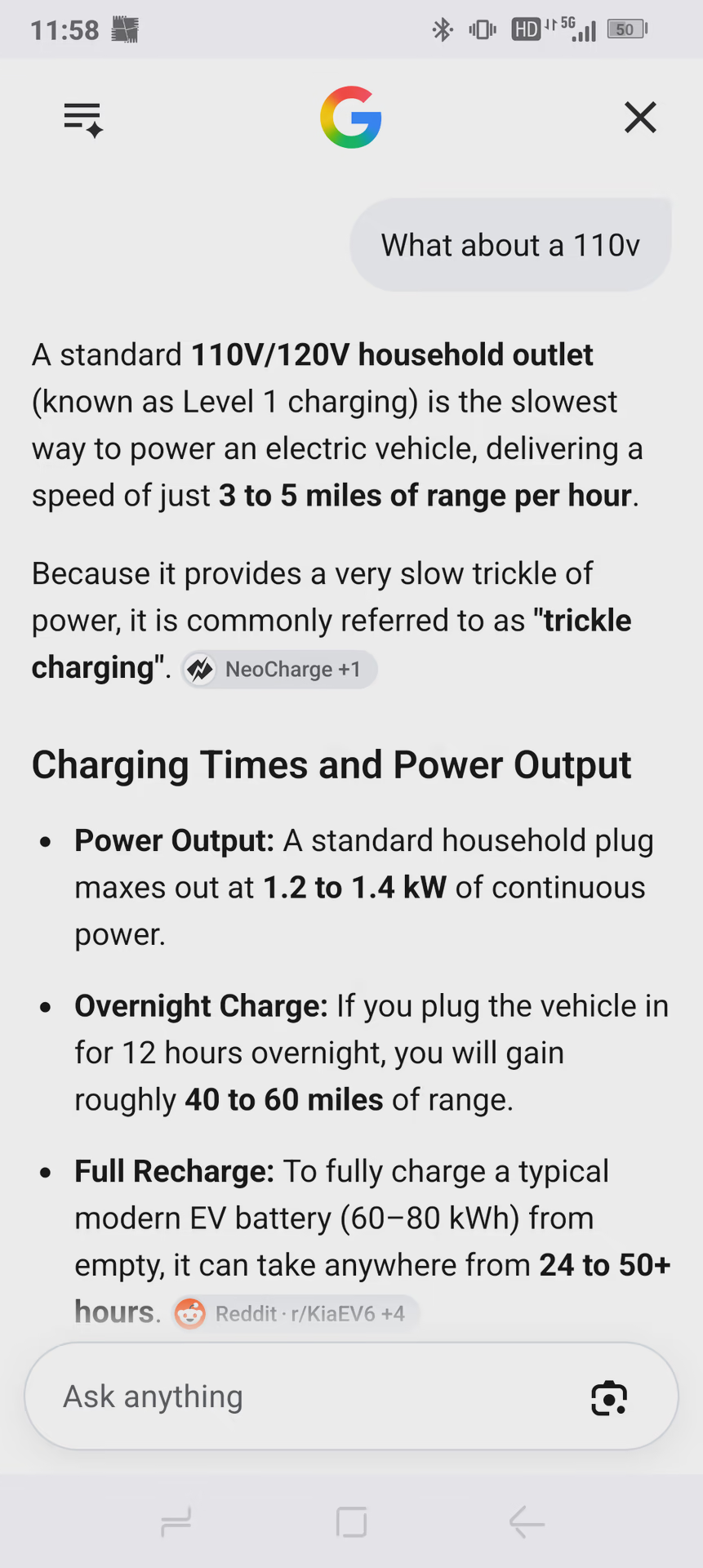
You can literally have just a simple wall plug and charge a car. It doesn’t need to be a fitted wall-mounted charging box. Yes, it is much slower and takes 24+ hours to charge the car completely but most people don’t actually use much of their battery per day anyway so if you plug in every night when you get home, you’re not going to have a problem for the majority of the time. And those are a very cheap socket run that an apartment’s body corporate could/should install.
Replying to @Mantzy81@aussie.zone
I have been an EV owner since 2018 and I have never had a “level 2” charger installed. I’ve been fine with just plugging into the wall. Now, granted, my cars have been 80-125 mile range vehicles. But it’s been fine.
Replying to @Mantzy81@aussie.zone
Not OP, but nearly every apartment complex I’ve ever been to has absolutely 0 electricity to a surface lot, and very limited/restricted access in a garage. And no apartment managers are going to change that unless there’s money to be made from it.
Fortunately, newer buildings are now including some public charging stations, presumably getting a portion of the sales.
Theres no external outlets just out in the parking lot in my complex. You’d have to run an extension cord out a door or window all the time, which would leave them cracked, and I live on the third floor
More progress really needs to be made on infrastructure for a lot, probably the majority of apartment complex dwellers
Replying to @Cris_Citrus@piefed.zip
All doable… we can route power easily enough to about any place on this planet
I agree :) all fixable problems, just things that will take time and will progress naturally as electric cars become more and more commonplace
Especially once EVs start to become like a relevant part of the used market, since I think that makes up the bulk of cars at a lot of complexes. Most of the cars parked out by mine aren’t new
Replying to @Mantzy81@aussie.zone
Which part of “apartment complex” did you misunderstand
Replying to @Cris_Citrus@piefed.zip
I live in an apartment and can neither charge at home nor at work. I just charge when I go grocery shopping. It’s absolutely viable.
Replying to @Cris_Citrus@piefed.zip
When we made laws for handicap parking, there was handicap parking everywhere, overnight.
Replying to @Technus@lemmy.zip
the vast majority of their charging at home or at their destination.
Absolutely true, which is also why I found it extremely annoying when reviewers began claiming that range wasn’t as important as fast charging speeds in daily use. Luckily most have stopped that shit, probably realizing there’s a reason most people want good range, and this is one of them. Also charging at home/destination cost way less than using a fast charger, and it’s better for battery life too.

Replying to @Technus@lemmy.zip
This, and the cheapest charging option will always be at home.
If you can’t charge at home, an EV is not worth the additional cost vs a combustion or hybrid.
Ignoring the better driving comfort of an ev, which is valuable on its own, it’s still much cheaper to charge on the go, than buying gas.
that’s not always true, its free at my workplace I just need to unplug every two hours. They do that so people don’t sit on the chargers all day. I know people without home charging, for them its 6kw charging at work, public parking and a visit to a fast charger when needed. They say its still cheaper than gas.
Replying to @0tan0d@lemmy.world
That’s basically me.
No home charger because no off street parking and fuck NJ.

Amen. The building I work at, where there’s roughly about 100 people each day, including police department and local part of ministry’s office has exactly ONE charging point built last year. One.
Replying to @Technus@lemmy.zip
My EV’s getting older now, but it’ll still do 400+km if I charge it fully overnight. If we’re doing a road trip it’s time for a burger and to stretch ones legs when it’s getting low anyways. Eat my food, get some rest and 20-30 minutes later I’m ready to go again.
I was sceptical before buying it, but I will never buy a gas car again. And I work in oil and gas

One doesn’t have anything to do with the other. Fast chargers ARE for road trips. And we can improve them irrespective of L2 chargers. Where are you seeing “messaging” that suggests otherwise?
Replying to @artyom@piefed.social
It’s for all the people that wont accept that must be able to charge to full at any moment regardless that they usually wont have to because its already full from being charged at home/work etc
Replying to @Technus@lemmy.zip
Even disregarding the fact that reliable electric cars are much more expensive secondhand than comparable ICE cars, there’s still a significant economic barrier to owning one. It’s significantly more difficult to effectively own an electric car if you have an apartment, or live in a house that only has street side parking, or live in a house that has a landlord that’s not willing to install an expensive electric car charger, which covers the vast majority of lower income housing.
Replying to @Mustachius_Grumpius@thelemmy.club
iow - charging stations can extract more revenue from drivers the longer the charge takes.
Sounds like Cutler, an engineer, has some MBA brainrot.
Replying to @schipelblorp@sh.itjust.works
Gas stations can also raise the price of gas. You are realizing that both are the same. The differentiator is the possibility of charging at home without ever going to a dedicated station.
Replying to @betanumerus@lemmy.ca
I think their point is that for a business a captive audience is a good thing. Kind of like how some grocery stores have noticed that when checkout takes longer, people are more likely to buy the drinks and snacks they put for sale near the checkout line. Likewise a charging station could have an overpriced restraunt selling low quality burgers for twice the price of the restraunts 2 minutes away by car, and customers will eat there because, they don’t want to sit around for 30 minutes, and then drive down the road and stop for another 10.
Unless I’m missing something and fast chargers charge by the watt instead of the hour, in which case that’s pretty big BS.
Unless I’m missing something and fast chargers charge by the watt instead of the hour, in which case that’s pretty big BS.
Why would that be BS? That’s exactly how you pay for any other fuel. Why should EV charging be different?
Almost every EV charger is based on the amount you charge, time is irrelevant. The only places they charge by time are areas where the law requires them to essentially be a power company to charge for the power itself. So they get around that limitation by charging for the time instead.
I’ve traveled across the US and have never been to any areas like that however. I know they exist, but they’re extremely uncommon. Nearly everything is charged by the watt.
Replying to @halcyoncmdr@piefed.social
sorry I said that backwards, meant by the time and not by the power you get. But yes IMO that’s what would be silly is I guess if there are exceptions like that where taking longer costs more, as obviously that’s largely a variable they control that doesn’t have to do with your usage, I could see with using that as a workaround with stupid laws though.
Replying to @TheFogan@programming.dev
charge by the watt instead of the hour, in which case that’s pretty big BS
Someone doesn’t understand energy metering.
You pay for gas by the minute?
Replying to @TheFogan@programming.dev
I’m always amused by the number of gas car drivers commenting on EV discussions.
Replying to @betanumerus@lemmy.ca
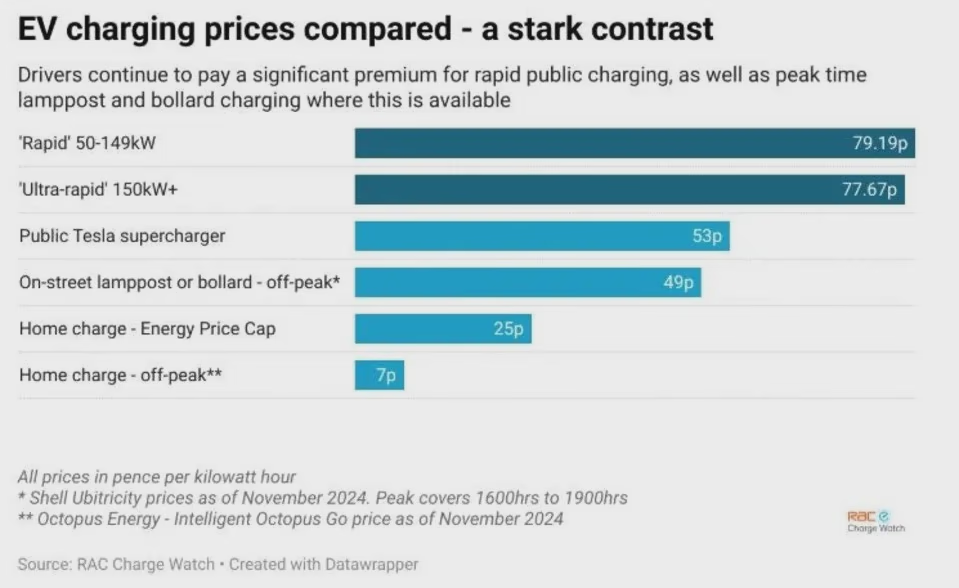
Charging at public chargers in UK is insane. £40+ for a charge.
Replying to @betanumerus@lemmy.ca
Fast charging is already expensive (often moreso than fuel unfortunately). The idea being proposed here is that if you make it slower, people get hungry and you can sell them more junk food. You lose that opportunity when charging is too fast, most people get their petrol and drive on instead of getting food each and every time. So it’s actually better to have slower charging, even if you can then charge less money for the energy itself, since you have a captive audience.
Replying to @Mustachius_Grumpius@thelemmy.club
“Nobody stops to fuel their vehicle taking gasoline, gets out, rushes as fast as possible, puts as much fuel in the car as possible, and gets back in the car and drives away”
WTF? This is exactly how I have refeuled every single time I have ever gotten gas. If I could pay a little extra for a pit stop style refuel I would. Who wants to linger around gas fumes, processed “food” , and energy drink boner pills?
A big draw of EV for me is that 99% I don’t need to stop anywhere to recharge. If I do though I want it to be as fast as possible.
Replying to @Imgonnatrythis@sh.itjust.works
I think it means specifically in the context of long road trips, the kind where everyone gets out to stretch their legs and take a piss while stopping for gas. On the other hand, I was under the impression that EVs simply didn’t have the range for such activities, so IDK.
Replying to @Armok_the_bunny@lemmy.world
Sure, maybe a few min with a family I guess. But if traveling alone it’s still quick stretch, in and out of restroom in less than 5min.
In Europe I’ll grab an espresso, add an extra min I guess for that.
I know some families will spend maybe 20-30min at such places, but ideally that’s a choice not forced by charging time. Doesn’t need to happen tomorrow, but I do think fast charging is a desirable goal.
Replying to @Armok_the_bunny@lemmy.world
It’s very possible. Aging Wheels on YouTube has a couple videos on road tripping in an EV.

Replying to @Armok_the_bunny@lemmy.world
Modern EVs have hundreds of miles of range and can easily do road trips as long as there are chargers along the route. I haven’t done any cross county trips but I have driven from NorCal to SoCal and eastern to western CO without issue.
Replying to @Armok_the_bunny@lemmy.world
I was under the impression that EVs simply didn’t have the range for such activities, so IDK.
Maybe 10 years ago that was true, but now ranges and charging speeds have gotten much better. The infrastructure of gas stations is still better for easy road trips without pre-planning though.
Replying to @urata@lemmy.world
Where I live (Denmark) there is no need for planning your charging, there are charging stations everywhere. I think the same is true for Sweden and Norway.
It’s only a matter of when the infrastructure is established enough. Scandinavia is among the more developed regions with regard to charging infrastructure, but it will be the same in other countries soon.
The same in Finland
Replying to @rants_unnecessarily@piefed.social
😀 👍
Replying to @Buffalox@lemmy.world
The US doesn’t do infrastructure. Bridges barely work.
Replying to @SaveTheTuaHawk@lemmy.ca
Yes USA is a funny country, one of the richest countries in the world, but for some reason they can’t afford basic infrastructure and healthcare for all?
Replying to @Armok_the_bunny@lemmy.world
My EV has a 330 mile range, and a full recharge at home costs me $4. It’s amazing.
If I remember correctly, the new BMW 3 series EV is like a 430 mile range.
Replying to @hydrashok@sh.itjust.works
Keep in mind the range listed, just like mileage, is based on certain circumstances. Freeway speeds (~80 mph) will drastically reduce that.
Replying to @Armok_the_bunny@lemmy.world
4 hours driving and a half hour charge while doing a biobreak is perfectly doable these days. You can keep that up a long time. Personally not a fan of that long a stretch and we’re doing more 2 hours driving and a break.

Mine, an MG4, has 400 km. Enough to make you need a stop. And it gets from 20% to 80% in half an hour or less (50KWh+)
Replying to @Imgonnatrythis@sh.itjust.works
100%. The time I spend at a fucking gas station is the time the gas is flowing + the overhead of tapping the card. Plus, if there are ads and the mute button doesn’t instantly work, leaving a 1 star review.
Replying to @DougPiranha42@lemmy.world
“If there are ads”
WTF where do you live?

Replying to @themurphy@lemmy.ml
Ads at pumps are fairly common in the US. They been around since 2019 if not earlier.
Replying to @Zen_Shinobi@lemmy.world
I think he meant this as where would someone live that it would be an if. Ads are pervasive
No ads in Europe as far as I’ve seen.
Replying to @rants_unnecessarily@piefed.social
Not as many but there are occasional posters, banners, window ads. Hard to be in a public place without them.
Replying to @themurphy@lemmy.ml
We have ads in Australia too. :(
Replying to @themurphy@lemmy.ml
They live in the US. You have to watch ads to take a shit.
Replying to @themurphy@lemmy.ml
In Latvia there is gas station chain that has no workers. Fully self service. They have screens that run ads.
AFAIK, in some countries some stations that have workers and where you have to go to pay at cash register also have pumps with screens and play ads on them. Some even have pistols with screens for the same purpose. Yep.
Replying to @Imgonnatrythis@sh.itjust.works
I agree with you. I always hurry to get out of there ASAP.
Replying to @Imgonnatrythis@sh.itjust.works
We bought an EV and it took a few trips for it to click that you don’t need to charge to 100% or even 90%. Hook it up, hit the restroom, buy a latte, then get back on the road with 50% charge.
You only need enough to get to wherever your longer parking+charge is going to be.
We also figure out the range anxiety. Getting down to 10% isn’t a big deal, especially if that last stop is going to get you back to full charge. Our EV doesn’t even have that great of range to start with.
Replying to @Brkdncr@lemmy.world
also charging 10-50% is a LOT faster than charging 50-90%.
Replying to @Imgonnatrythis@sh.itjust.works
When I had an ICE car, it was exactly the same. With our BEV however, I don’t generally need to charge “on the way” as I can start each morning fully charged, and have more than enough battery for a full day.
It’s only on longer trips we need to charge, and on those we can easily combine charge and a short break.
Replying to @Imgonnatrythis@sh.itjust.works
Don’t forget the unmutable unskippable multimedia advertisements on the fuel pump!
(Yes, I know some of them are allegedly mutable, but I have yet to find one.)
Replying to @friend_of_satan@lemmy.world
I’ve been told that a butter knife placed in just the right part of the speaker slot unveils the hidden permanent mute button
Replying to @Imgonnatrythis@sh.itjust.works
Just sounds like a CEO who doesn’t want to invest anything in upgrading anything.
Of course I want to be out of there quicker. I’m driving to somewhere and it sure as shit is not to a charging point.
Replying to @timbuck2themoon@sh.itjust.works
It’s Ionna, one of the (IMO) best options for DC fast charging.
He’s not justifying slow chargers; he’s justifying building stuff around them. Basically the “truck stop” model.
Replying to @Nollij@sopuli.xyz
All Americans should travel to Italy and have a meal at an Autogrill on the highways. It’s likely the best food you ever eat. US highway stops are all hot garbage.
Replying to @SaveTheTuaHawk@lemmy.ca
The Autogrills are absolutely great for a motorway stop but you’re over selling them just a tad. After all, you’re now comparing them to restaurants in the Italian cities at either end too.
Anyway, we’ve got 150+ kW chargers at most stops now, at least in the north. And signage for stops indicates if there are chargers. An espresso and toilet break is usually enough to keep going.
Replying to @Nollij@sopuli.xyz
I mean, I see no problem with that if they want but the fact remains I don’t hang out. Same as all that stupid Bucees garbage- I have no idea what kind of people are going in and shopping around a department store full of crap.
I’ve never understood the devotion or novelty of it all.
So yeah, that might work for some but yeah, I’d MUCH rather have as quick a charge as possible (and will go to the ones that can get me out quicker) and it seems judging by this thread I’m not alone.
Replying to @Imgonnatrythis@sh.itjust.works
Yea, I don’t get all these people who are like “yea lets get a 30 min lunch break at a gas station”. Dude, the last place I want to spend time at on a road trip is at a fucking gas station.
Replying to @hcbxzz@lemmy.world
You can charge at gas stations, but why would you? Around here, there are cafes, restaurants, and supermarkets with fast chargers.
Replying to @friendlymessage@feddit.org
And why would a Walmart be any better? Around here, no charging stations have a restaurant neaby. I just looked up all the charging stations near me and none of them have stores I would want to stop at on a road trip
Replying to @hcbxzz@lemmy.world
The point is that when every place you travel has a charging station you no longer need to ever stop for gas or to charge. Every stop just includes the charge. We can never do that with gasoline.
Replying to @jerakor@startrek.website
Unless every restaurant in town has several stalls of 75kW DC fast charging, a 30min stop during meal break won’t be enough to get you to the next destination.
Replying to @Imgonnatrythis@sh.itjust.works
You are missing out on delicious sushi.
Replying to @SaveTheTuaHawk@lemmy.ca
It damn well better have caffeinated cream cheese in it or I’ll be disappointed.
Replying to @Mustachius_Grumpius@thelemmy.club
This is pure cope from a nation that is a long way behind the rest of the world on EV technology. I’ve done some very long road journeys, 900+ km in a day, and having an EV would likely have added at least an hour to that day, even more if I was towing.
The reality: “Nobody stops to fuel their vehicle taking gasoline, gets out, rushes as fast as possible, puts as much fuel in the car as possible, and gets back in the car and drives away,” Cutler said.
This is exactly how I go about my business at a fuel stop. Maybe do a few stretches and check everything on the roof isn’t working it’s way loose, but once the pump clicks off, I’m goneburgers.
Replying to @Ilovethebomb@sh.itjust.works
Good to know you’re the overtired and in a rush driver that the defensive driving courses warn me about. Worse if you’re towing something.
Replying to @W98BSoD@lemmy.dbzer0.com
I’ve got shit to do, especially when I’m doing that type of distance.
Replying to @Ilovethebomb@sh.itjust.works
So leave earlier. Don’t put me and me family at risk.
Replying to @W98BSoD@lemmy.dbzer0.com
How is me not wanting to fart around for half an hour every time I stop putting you at risk?
Replying to @W98BSoD@lemmy.dbzer0.com
You know there can be two drivers swapping back and forth with no downtime but still well rested right? That how we do most of our roadtrips
Replying to @hcbxzz@lemmy.world
Sure; where did they state that in their comment?
If that’s the case I’ll strikeout my comment and publicly apologize.
I’ve done some very long road journeys, 900+ km in a day, and having an EV would likely have added at least an hour to that day, even more if I was towing.
You do realize that 99.999% of people don’t drive anything like that on a regular basis right?
As someone who’s had an EV exclusively since 2018, several makes and models, and not near a massive metro area like NYC, LA, etc. where infrastructure has been extremely built out for a long time. I’ve made long trips, and the total time difference across an entire day of driving, accounting for stops for meals, bathrooms, etc. that would have happened anyway with an ICE vehicle, the trips were maybe total an hour and a half longer spread across that day.
Does it take more time on long distance trips? Yes. Does it actually matter when those long trips are usually going to be entire day or even multi-day trips anyway? Not really.
I’ve found non-EV owners usually still think of charging the car like filling it with gas, full every time with all the time it takes to fully charge. But you almost never fully charge the vehicle while on a trip, only at the beginning and maybe end. The batteries charge significantly faster when at a lower state of charge, so most travel happens in the middle between 20-70%. It’s faster to charge twice for 15 minutes at a fast rate, than taking an hour or more to fully charge each time. And the built-in navigation and charging systems take that into account along your route to optimize those stops to take advantage of those higher charging speeds. I also have noticed that non-EV owners significantly underestimate the amount of time they take when stopping to get gas, use the restroom, etc. The real world time difference between those quick charges where you can let the car sit unattended while you use the restroom, grab snacks, etc. versus having to stand at the pump and then do those things, is much closer than most people tend to think.
Replying to @halcyoncmdr@piefed.social
This is a really common, and really stupid argument people make.
Someone will say “an EV isn’t right for me because I do X”
And someone will almost certainly say something stupid that starts with the word “statistically”
I don’t give a fuck about what people do statistically, I care about what I do with my vehicle. And I’m not going to buy a vehicle that does 95% of what my current vehicle does.
I’m just pointing out that the common assumptions about EVs based on reading other online comments from non-EV owners may not be accurate.
You might not have those assumptions, but from my experience talking to thousands of people over the last nearly decade is that very few non-owners have it accurately. Most people think they use their cars much differently than they actually do, and a lot of people get stuck on the one or two times they travel long distance each year for a week or two, and ignore the other 50 weeks where they’re paying out the nose for gas.
Replying to @halcyoncmdr@piefed.social
Does it take more time on long distance trips? Yes. Does it actually matter when those long trips are usually going to be entire day or even multi-day trips anyway? Not really.
Yes, but when in the rare cases when you need to make 900km+ in a day, you really need that ability. 99% simply isn’t enough because that 1% is really important.
Time on a road trip is way more important than time in regular drives. I don’t mind being 30min late getting back home from work, that happens all the time from traffic, but 30min late on a roadtrip means you’re missing daylight, or an appointment, or that restaurant you really wanted to try is closed.
Replying to @hcbxzz@lemmy.world
Yes, but when in the rare cases when you need to make 900km+ in a day, you really need that ability
So rent a gas car.
This stupid argument is why grown men drive huge pickups with pristine beds to office jobs, in case they need to move a couch every 7 years.
You can rent a van or pickup for $20.
I’m amazed no one has pulled the TOW MY BOAT card yet in this thread.
Replying to @SaveTheTuaHawk@lemmy.ca
You cannot be serious.
I’m not buying a car I can’t take on holiday with me, that’s just ridiculous. Especially considering it would spend most of the trip sitting around at a campsite.
EV cope, honestly.
Replying to @Mustachius_Grumpius@thelemmy.club
I remember one of the arguments against EV’s were that “there’s so few chargers compared to gas”.
And then you realise that chargers are literally at homes, workplaces, parking lots and ALSO at gas stations.
Which makes speed less important. The headline is spot on.
And then you realise that chargers are literally at homes, workplaces, parking lots and ALSO at gas stations.
Perhaps if you were in an apartment complex without access to a home charger, but many complexes have added EV charging as amenities. Most people don’t drive very far on a daily basis, well within the range of most EVs. Heck, I make a 50 mile round trip commute to the other end of the city and I only charge once a week at home usually, unless I’m doing a bunch of other stuff outside work.
Charging at home means you almost never need to charge anywhere else unless you’re on a trip, that most people do only once or twice a year. And for trips, charging stations along highways were some of the first to be installed.
Replying to @halcyoncmdr@piefed.social
Exactly, and if you need to go on a long trip, you would stop anyway for food, toilet, rest etc.
Fast charging is still very nice, but it’s not necessary.
Replying to @halcyoncmdr@piefed.social
Once enough EVs are common, people can lobby their municipality to make EV chargers code at apartment complexes. We could make handicapped parking appear overnight, we can do this.
Replying to @Mustachius_Grumpius@thelemmy.club
Got our first ev in august. Needed to install a lvl2 outlet right away. Now we have no issues or concerns with daily use. A road trip wouldn’t be bad as is, you can walk away from a plugged in car where you are supposed to stay by a ICE filling up. So spend the 15 minute stop walking in the station, getting a drink or taking a piss.
I’ve found many (most honestly) non-EV ownershave some pretty big and fundamental misconceptions about EVs. They’re not usually working from a point of reality when thinking about these things.
From my experience talking to people about my vehicles since 2018, most think that the car needs to be fully charged every time, and think that it takes multiple hours. They don’t seem to realize that charging speeds vary based on the charge level (even though they literally see this exact thing with their phone charging every day. That you can use that to your advantage on longer trips, and that the built-in navigation systems automatically do this planning for you.
And they also tend to underestimate how much time they actually take when stopping for gas on trips. They usually just think about the time they’re standing there at the pump getting gas, but ignore the time they take to use the restroom, get snacks/drinks, heck even the minute or two to walk into the gas station and back to the car… all of which would be unattended charging time in an EV. And those all add up quickly.
Replying to @halcyoncmdr@piefed.social
Ok, but once more idiots buy EVs, you will see assholes just parking at chargers, because America.
You already see this in major metro areas like Los Angeles. Assholes gonna asshole.
The current school of thought to counter it, is to charge them $1+ per minute they’re connected to a charger, not charging. And the municipalities making it illegal to park in charging spots without charging with hundreds of dollars in fines per infraction. It’s not perfect, but it helps a lot.
Replying to @Mustachius_Grumpius@thelemmy.club
Do you know battery swap ?

Replying to @alexquiniou@lemmy.zip
yes, NIo do. it. A great idea for small electrical motorbikes like the Gogoro, for cars its a a problem in search of a solution.
Replying to @Mustachius_Grumpius@thelemmy.club
You go inside gas stations because you HAVE to, not because you WANT to. Same with EVs.
Replying to @Mustachius_Grumpius@thelemmy.club
All those things matter:
For EVs to work you need to have adequate combination of all of them. You can’t simply say “charging speed doesn’t matter” while ignoring range, number of EVs and distance people travel. Why do people insist on focusing only one thing at a time? First it was all about range, not it’s all about charging speeds. It’s not that simple.
Replying to @Mustachius_Grumpius@thelemmy.club
We have been wanting an EV (something other than a Swasticar) for our next vehicle and think we could deal with the extended charging times required during a long drive or trip, but we ended up ruling it out.
For us the big problem is the difficulty getting parts and service. Service for the models we looked at is only available at dealers (and only some dealers), and parts are regularly not in dealer stock.
We really don’t want to risk taking a cross-county trip and having the car break down 200 miles from the nearest mechanic. With the additional real possibility of having to wait weeks (or months) for a part, an EV is not an appealing choice for us, at least not yet.

Replying to @spaghettiwestern@sh.itjust.works
What are you expecting to break down? A modern internal combustion engine plus continuously variable transmission is one the world’s most complex pieces of engineering in common use today.
An electric drive system is trivial in comparison.
Replying to @dgriffith@aussie.zone
I’d be worried about some of the electronics, modern cars, electric or not, tend to be overcomplicated with tablets and server connections and what have you. I might also worry about getting into an accident.
Replying to @Mandarbmax@lemmy.world
Hate to tell you this, but cars have been like this for about 15 years now.
Been a long time since ol Joe at the gas station could fill the tank and tune your carburetor with a screwdriver.
Replying to @blargh513@sh.itjust.works
Yes but other cars can be repaired at any mechanic rather than just at a dealer, which is the issue we were talking about above.
I am well aware of the computerization of cars, how carburetors have not been a thing for more like 30 years, and how generally electric vehicles are better than combustion ones but both are worse than public transit.
Replying to @Mandarbmax@lemmy.world
My fears are software/firmware issues or battery pack failure. It’s an impossible problem for the common man to solve and you are beholden to the manufacturer. And at what cost? Minor accident? Manufacturer declares it unfixable and deactivates it. Doesn’t even matter if you repair it. Boo!
I really want one, but I can still repair my current car myself if needed.
Replying to @PancakesCantKillMe@lemmy.world
The problem, as ever, isn’t the concept of an electric vehicle, it is the companies
Replying to @PancakesCantKillMe@lemmy.world
No, you cannot roadside repair a car with a broken timing chain or clogged catalytic converter, or broken transmission.
Replying to @SaveTheTuaHawk@lemmy.ca
What the hell does that have to do with anything? It is trivial to tow a standard car to my home and effect those repairs almost immediately. Just order the parts.
What about the EV? None of the above can easily be done.
Replying to @Mandarbmax@lemmy.world
I have a seven year old Volvo.
It cannot be repaired at a mechanic beyond simple mechanical things. Everything else has to pass through a Volvo dealer because they locked down their software (Vida) and regular mechanics COULD buy it, but it would cost them several thousand dollars a year for the subscription. Unless they are going to specialize, it’s not worth it. I cannot drop my car off at joe’s garage.
There’s no real difference between ICE and electrics in that regard. You can still do basic repairs to an electric like brakes, tires, suspension, etc.
Replying to @Mandarbmax@lemmy.world
if you get into an accident on a road trip you’re fucked regardless of what car you have.
Replying to @dgriffith@aussie.zone
This is the truth. 4 years with a Chevy Bolt EUV and so far I have only replaced the tires and windshield wiper fluid. As someone who worked on several ICE cars for 2 decades, it’s kind of a dream to have so few things that can go wrong. The number of moving parts in a EV is a couple magnitudes less than an ICE car.
People don’t account for the time I am not spending at gas stations sniffing fumes every week or getting oil changes. The handfull of times I don’t charge at home are a fraction of time spent dealing with ICE routine maintenance.
The only thing I am slightly worried about is that my car has 3 coolant loops, which is one of my least favorite repairs.

Replying to @holy_scroller@lemmy.zip
You should get the brake fluid replaced. You’re probably due.
Replying to @fyzzlefry@retrolemmy.com
Nope, manual says 5 years, 50,000 miles.
Replying to @fyzzlefry@retrolemmy.com
Appreciate it. Will check schedule.
Replying to @dgriffith@aussie.zone
Yet EVs are much less reliable than many ICE vehicles. The control module is one of the weak points. When it fails the car is down until it’s replaced.
Replying to @spaghettiwestern@sh.itjust.works
You could say that about a number of components on ICE vehicles.
Replying to @spaghettiwestern@sh.itjust.works
No
EVs averaged 4.2 breakdowns per 1,000 vehicles, while similarly aged combustion models more than doubled that rate
carscoops.com/…/new-study-shows-evs-are-more-reli…
Sorry for lazy copy/paste. 1st search result in ‘reliability EV ice’
Replying to @nibbler@discuss.tchncs.de
I figure I’d upset some EV fanboys with a dose of reality, but holy shit, you’re REALLY upset. Take your meds already.
Replying to @spaghettiwestern@sh.itjust.works
You seem to be imagining things.
Replying to @spaghettiwestern@sh.itjust.works
posts a lie
gets downvoted
shocked pikachu
Replying to @Asetru@feddit.org
Lol - not shocked at all. I fully expected the EV fanboys to shit themselves.

Replying to @spaghettiwestern@sh.itjust.works
nope I’m actually using a proper toilet
Replying to @spaghettiwestern@sh.itjust.works
I was FOAMING when I pasted this 😹😹😹
Replying to @spaghettiwestern@sh.itjust.works
What you’ve posted is cherrypicking and factually and statistically wrong argument and you’re expecting people not calling bullshit?
Replying to @nibbler@discuss.tchncs.de
Case in point: reddit.com/…/hyundais_iccu_problem_heres_what_we_…
The GM’s EV reliability is terrible. BMW, Lexus and Tesla are much better, but not looking for a luxury vehicle or a Tesla.
Replying to @spaghettiwestern@sh.itjust.works
‘Not looking for this or that’ means cherry picking… So I guess you are right in your own little world
Also kudos for posting anecdotal evidence like it would mean something. You are really cheering up my day :)
Replying to @spaghettiwestern@sh.itjust.works
Get a BYD
But, I’m assuming you are a Yank, given your attitude, so you can’t get them
But you don’t want an EV anyway
Replying to @FistingEnthusiast@lemmy.world
Is your entire life purpose whinging about Yanks?
Replying to @spaghettiwestern@sh.itjust.works
username kinda checks out?
Replying to @spaghettiwestern@sh.itjust.works
Not in the slightest
But the country is a joke and somehow simultaneously a disaster
Replying to @spaghettiwestern@sh.itjust.works
Yeah but GM can’t make any kind of car reliable.
Replying to @spaghettiwestern@sh.itjust.works
I am sure you can show us real word data
Replying to @spaghettiwestern@sh.itjust.works
As opposed to your ECU?
You’re just making shit up
Particularly when there’s less vibration, heat etc. to fuck with electronics
You’re pushing an agenda here
Why?
Replying to @FistingEnthusiast@lemmy.world
Right. My “agenda” is simple. I would prefer an EV, but when in the middle of bumfuck Nevada with no cell service when it’s 110F out, I don’t want a car that can only be fixed at a dealer and that may require a 3 week wait for parts.
Replying to @dgriffith@aussie.zone
You would think that, but Hyundai EVs are popping ICCU fuses and Tesla motors all leak coolant from the seals. There is a Tesla that went 3 million kms. Only needed 4 battery swaps, but it needed 14 motors. Coolant leaks will be problem at higher mileage.
Replying to @spaghettiwestern@sh.itjust.works
My biggest problem with my EV is that I was stupid to get the service pack as it never has any service needs. Breaks last twice as long. No oil changes. No critical fluids other than wiper fluid. The easiest to fail part is the 12v battery which is standard for any car. If something hard to replace fails it is going to be a sensor and I’ve had that happen on a gas car before and no one had it in stock because no one stocks random sensors.
Replying to @jerakor@startrek.website
The service pack better include tires replacement, and then it would make sense for people who drive a lot on roads that destroy tires.
Replying to @jerakor@startrek.website
call your dealer and ask if you can cancel the service plan for a prorated refund.
Replying to @spaghettiwestern@sh.itjust.works
How often are you taking cross country trips on the spur of the moment? Take the advantages of owning an EV and then just rent something for the trip.
Replying to @CedricWhaley@lemmy.dbzer0.com
Often enough and the trips can be for a few weeks. Checked car rental rates recently and a small SUV had a nearly $2K base rate.
Replying to @spaghettiwestern@sh.itjust.works
Sounds like a plug in hybrid would be right up your alley. Many of the benefits of an electric vehicle (regen braking and the ability to charge at home, foremost) while still being able to fill up instantly using gas. Unfortunately you lose out on the basically-no-maintenance-required part of a pure EV, but frequent road trips are basically the ideal use case for a PHEV.
Replying to @AMoistGrandpa@lemmy.ca
That’s exactly what we’re looking at.
Replying to @spaghettiwestern@sh.itjust.works
I call bullshit
Replying to @spaghettiwestern@sh.itjust.works
The only time i seen a new EV breakdown is due to…that 12v battery. It usually happened around 2 or 3 years down. Other than that i still haven’t seens any EV breakdown yet.
Also for the part availability, logically newly released car tend to not having part laying around because logically no one will expect a new car to break down and waste a storage space for it, so no matter what car you buy it will be the same. But if a new car(released only 2 to 3 years) have parts widely available, then logically speaking, is that car still reliable?
Replying to @psx_crab@lemmy.zip
EVs can break down. It tends to be less frequent but more expensive. I just had a bigger repair on mine. I’ll be crunching the numbers one of these days to see what the average cost of repairs has been.
Replying to @meco03211@lemmy.world
I was worried about that, too. My EV came with 6 vor 7 years warranty, so I decided not to care.
Replying to @meco03211@lemmy.world
No argument on that, just that it be strange to worry about replacement part for an EV that isn’t 5 or more years old. You will make as less sense if apply that to ICEV too, no new vehicle are expected to breakdown. Whatever module that might break on an ICEV will break on an EV too, but that’s not enough to dismiss the point that EV is much more reliable solely because there’s significantly less part required to run it.
You won’t find any readily available part for a newly launched EV the same way you won’t find any readily available part for a newly launched ICEV.
Replying to @spaghettiwestern@sh.itjust.works
For context, parts are as available as they need to be. IOW, parts are in stock when they are frequently needed. If a part is rarely needed, it won’t be in stock locally.
If you choose a common EV model, like GM, Hyundai, or even Tesla, you are extremely unlikely to suddenly need extensive service. Dealers (with EV mechanics) are common, with multiple in every major city, and a parts network that can have anything shipped overnight.
Replying to @spaghettiwestern@sh.itjust.works
You guys don’t have insurance? If my car breaks down away from home, I can get a rental brought to me so I can continue my trip while my car gets fixed.
Replying to @Evil_Incarnate@sopuli.xyz
You don’t do road trips much? Trips don’t necessarily go to the same location twice and it can take days of driving to circle back.
Replying to @spaghettiwestern@sh.itjust.works
Why circle back? My insurance would give me a car to continue my holiday.
Replying to @Evil_Incarnate@sopuli.xyz
The US is huge and it might take several hours to a day or more to get another car brought out if you’re in a rural area. So if possible, it’s usually faster to work your way towards wherever the car is coming from.
Use to meet up with my buddy that lived in another state every time he had to tow a car to ‘the nearest dealer’ for warranty work which was 6-7 hours away. We’d have lunch and he’d head back.
Going up to a higher comment. Co-worker was in an accident. They just got the car back from the shop after ~7 months because a part was on backorder and the car wasn’t drivable. His insurance paid for his rental for that duration but part availability is a valid concern.
Replying to @JordanZ@lemmy.world
The world is not 'Murica
My country is bigger than yours, and I love my EV
Replying to @FistingEnthusiast@lemmy.world
That’s true but your commenting on an article by a US publication, about comments from a US CEO, about the use of EV’s in the US.
Replying to @JordanZ@lemmy.world
*You’re
Some CEO from 'Murica has absolutely zero credibility
Replying to @spaghettiwestern@sh.itjust.works
I sure as hell don’t. That doesn’t sound fun at all.
Replying to @spaghettiwestern@sh.itjust.works
I think the reason they don’t have spare parts is because the motors are less complicated and, in theory, will need fewer replacement parts. An ICE motor is like 10,000+ moving parts, an electric motor is like 300 moving parts. They’re an order of magnitude less complicated.
Replying to @kestrel7_7@lemmy.world
But there are still several ways the software or high voltage system can fault leaving people stranded and that usually isint a roadside fix or even a nearest auto part store run (yet)
Replying to @Nindelofocho@lemmy.world
Hyundai ICCU failures, for example.
Replying to @kestrel7_7@lemmy.world
LOL. Tesla parts shortages are because they break so frequently. You can’t drive a car without working door handles.
Replying to @spaghettiwestern@sh.itjust.works
Better not drive a car at all…
Replying to @Schemen110676@lemmy.ml
Yep
They’re looking for problems to justify their position
Replying to @Mustachius_Grumpius@thelemmy.club
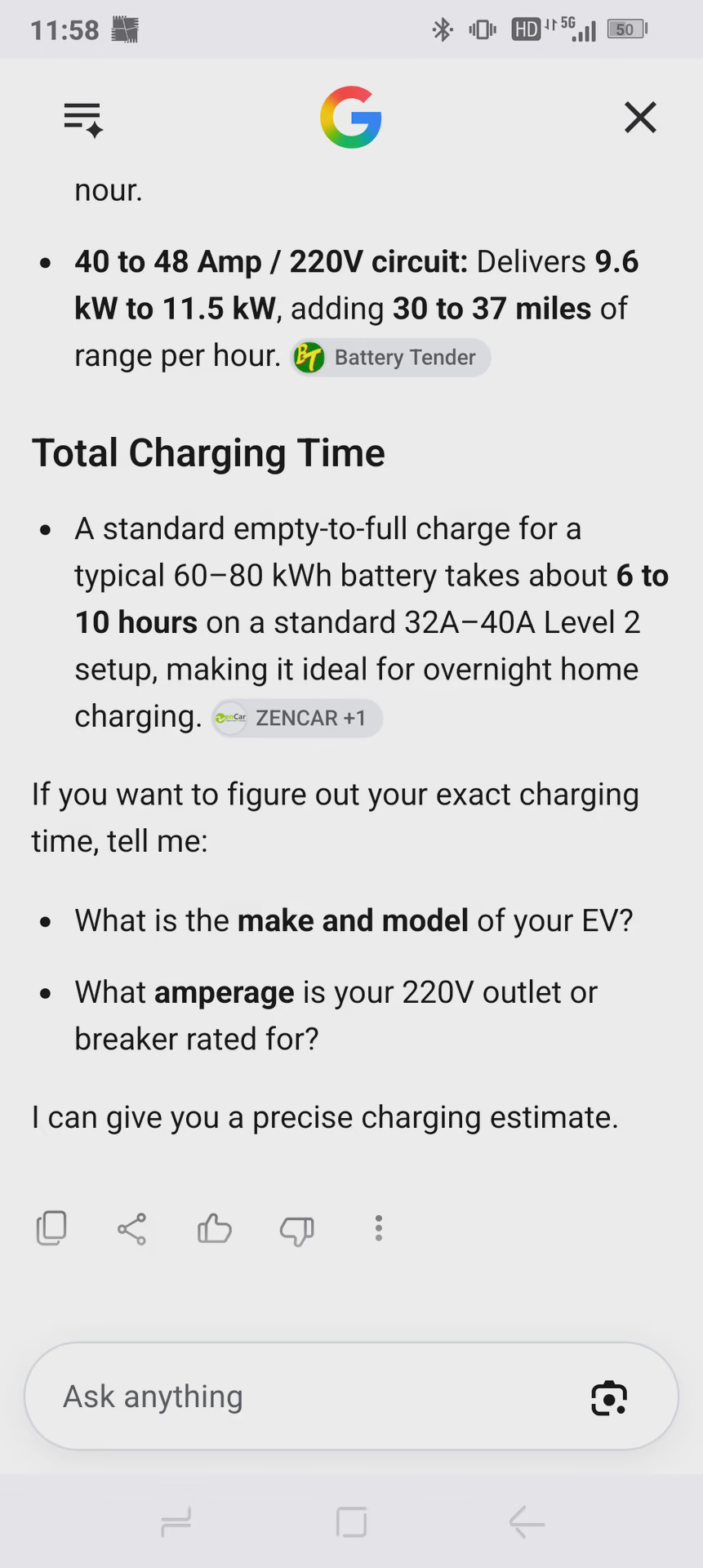
I’m in the process of running a 6-20 outlet for ev charging that doesn’t heat up mt panel or cause a huge draw. 240@16Amps is like 6+miles. Which means my commute is charged up in just under 3 hours. Yes, I could just hardwired something more exciting, but I want to slow charge my battery, but give it at least 240v to avoid the losses in winter.
The reality: “Nobody stops to fuel their vehicle taking gasoline, gets out, rushes as fast as possible, puts as much fuel in the car as possible, and gets back in the car and drives away,” Cutler said.
Say what? Outside of a long road trip, that’s very much what I do every time. I haven’t been into the store at my gas station in years. I’m hardly alone, I see plenty of other people fill up and leave.
The “charging problem” is most completely addressed by doing less driving. Obviously.
Replying to @WesternInfidels@feddit.online
Yeah, same for me. But it is true that it doesn’t necessarily apply when charging at home, overnight.
Replying to @WesternInfidels@feddit.online
In the context of EVs, your daily grind refueling is a scenario that doesn’t really exist - and shouldn’t exist. Your weekly trip to the gas station should be replaced almost entirely with AC charging, either at home or at work. DC fast charging should only be used when you are driving an extended amount in a single day. And if you’ve been driving 200 miles that day, you probably need some food and a restroom.
Coincidentally, it solves one of the biggest (and least explainable) gaps on fast charging. If you make your regular rest/food stops the same thing as your charging stops, then you’ll spend very little extra time charging on a road trip. It’s always been weird to me that fast chargers have traditionally been nowhere near amenities like food and restrooms.
Replying to @WesternInfidels@feddit.online
We just came back from a trip. Started with below 50 percent, first stop was a nice caffee for a second breakfast. Within 20 minutes, charge went up to 80, giving uns around 400 km range. The car was full before we even finished.
The planing simply changed. Instead of rushing through a gas stop, we prefer a route with places for a nice break. Or, in a pinch, nearly every McDonald’s now has a row of quick chargers.
It is becoming a non-issue.
Replying to @jagermo@feddit.org
Literally my solution in a nutshell. I’ll take a longer trip with a nice place I can stop for an hour-ish, then move on.
Replying to @jagermo@feddit.org
Went to Italy…wanted to grab an Espresso… the car was at 80 percent before I even manage to get the cup in last my hand…
Replying to @WesternInfidels@feddit.online
Yeah that sentence was bonkers. Like that’s exactly what most people do haha
Replying to @WesternInfidels@feddit.online
Yeah, that statement makes little sense in context of ICE, but the point does kinda work for EV. Ideally, outside of road trips, you wouldn’t go to designated charging areas, but just charge where you’re going anyway. I usually charge at a supermarket
Replying to @WesternInfidels@feddit.online
Obviously you made the mistake of not being born wealthy. If you had just been born wealthy, you would realize that driving long distance is something you very rarely do, or when you can’t find a trustworthy peasant to ship/drive your vehicle to/from your summer home.
Replying to @Mustachius_Grumpius@thelemmy.club
owning a BYD EV here in Australia, 80% of my charging is at home, just plug in to a wall socket powered by mostly solar from my roof. 15% is destination charging eg when buying groceries, plug in, shop, unplug and go and only 5% is charging on a road trip.

Replying to @hanrahan@slrpnk.net
I really hope there will one day be a solution for people who don’t own detached houses.
Replying to @Hupf@feddit.org
Every single parking spot should have a charger. It will happen some day.

In my country we do have a ton of public chargers but car owners report that it’s more expensive than gas. You either have a way to charge at home or it’s just not worth it.
Replying to @pathief@lemmy.world
Depends on the gas prices, but yeah, even in the US often ‘fast chargers’ would be equivalent or even more expensive than gas.
If you take fast chargers with the milage most EVs get (roughly 2mi/kwh), the per kwh price needs to be roughly $0.35/kwh or lower for electric to be cheaper (home rates essentially across the US are lower than this), but fast chargers often climb to $0.45-0.55/kwh.
Replying to @GalacticRobot@lemmy.world
You don’t need fast charging if every parking spot has a charger. You only need those for long trips.
True, but not sure how you make that sort of infrastructure a reality. Most parking lots in general don’t have electrical structure for every parking spot or even 1/10th of the parking spots to have dedicated high voltage charging.

Every single parking spot should have a charger. It will happen some day.
And then some douchey trillionaire will be there to steal that infrastructure making it completely unaffordable, ensuring no one can use it.
Replying to @Hupf@feddit.org
We don’t, I charge while shopping most of the time.
Replying to @Hupf@feddit.org
In the UK they’re installing chargers in the lamp posts, in Germany they’re installing them in the curbs. There are solutions slowly making their way out there.
Replying to @hanrahan@slrpnk.net
I love how people looking into getting a car will go crazy over range. All the while they have not driven more than 100k in a single day in the last 5 years.
Replying to @luftruessel@feddit.org
Or only gone on trips that is longer than the range like 8 times last 5 years.
Replying to @luftruessel@feddit.org
100k km is physically impossible to drive in a day, maybe you mean “in a single year”?
If you mean 100k meters (not sure why you just wouldn’t use km as an unit then), I have a few 200 km days a week, but the actual range anxiety comes from the fact that in the winter an EV loses a ton of range and if I need to use a public charger, I might as well just drive my current car instead of paying 15x as much to get into an used EV, since public charging is almost as expensive as diesel fuel.
Replying to @luftruessel@feddit.org
90% of the trips I do in a car are over 100km. For anything else I use public transport or a bicycle.
Replying to @Mustachius_Grumpius@thelemmy.club
Lets say you have a 300mi range EV. that sounds great, until you realize you can’t actually use it all.
We like to save the bottom 20% for emergencies and battery longevity, and fast charging is too slow above 80% to be worth it, so effectively, on a road trip. only the 20%-80% range is usable. Your 300mi+ range just turned into 180mi of usable range. And then factor in ~10% battery degradation over time, or range reduction in winter conditions, and you could easily have as little as 150mi of actual usable range between charging stops. And that’s assuming the charging stations are perfectly spaced apart.
That’s only a little more than 2 hours at highway speeds. And that’s not along time to be driving, even for a single person. In gas cars, we will regularly do 3-4 hours without stopping at all. And if we do stop for a break, it’s rarely at gas stations or places with charging stations. Those are typically awful places to spend the limited amount of time you have on a trip.
In practice, the charging interval is far, far less than the ideal 300mi and far more frequent.
Replying to @hcbxzz@lemmy.world
That much driving sounds miserable
Replying to @fyzzlefry@retrolemmy.com
Well, 3-4 hours without stopping is not only miserable, it is also unsafe.
Replying to @Sirius006@sh.itjust.works
Also… you can do this with most EVs already
Replying to @Sirius006@sh.itjust.works
Highway Hypnosis/ Road Hypnosis is real. In most driving manuals it’s recommend to take breaks and stretch.

Replying to @fyzzlefry@retrolemmy.com
Welcome to the US highway system.
My drive to the university from home was 152mi.

Replying to @fyzzlefry@retrolemmy.com
US people will only get out of their cars under threat, apparently.
Replying to @fyzzlefry@retrolemmy.com
Sometimes you just have to do it
Replying to @hcbxzz@lemmy.world
Except nmc batteries have no issue with being below 20 or above 80 percent soc, they have an issue with staying outside those values for longer periods of time. That’s why people say you shouldn’t charge above 80% in your day to day driving, because you’ll usually charge it to 100% and then just have the car parked in your driveway for hours with a full battery. When you’re on a road trip, you can absolutely use the bottom 20% of your battery as you’ll be charging it up immediately. You can also charge it up to 100% before starting your road trip with next to no effects on the battery for the same reasons.
So, yes, there’s obviously degradation for older cars and there’s the obvious effect of batteries charging slower the more charged they are, so I’ll give you that you won’t fully charge your car during a road (if you don’t have kids, I guess, as ours will absolutely drag out the break long enough to have the car sitting at 100%), but at the end of the day, the effects aren’t nearly as terrible as you describe, as you’d be at about 90% range for the first episode of the trip and about 80% for consecutive ones.
Replying to @Asetru@feddit.org
Regardless of degradation issues, I’m still not willing to go below 20% except for emergencies. One wrong exit on a long stretch of highway and you could be out of range for the next charging station. Yes, this has actually happened to me.
Replying to @hcbxzz@lemmy.world
20% is around 100km range, depending on your battery etc. of course. I try not to arrive at a charger with no range left, but even going to the next one shouldn’t ever be more than 20 km unless you live in antarctica… 100km is excessive.
Replying to @hcbxzz@lemmy.world
I used to think this way until I actually drove an EV long distance. This tech is mature and useful for road trips. Most people aren’t willing to drive 12+ hour days anyway and that’s the only real way to get a time advantage out of a gas car.
Replying to @kestrel7_7@lemmy.world
Most people aren’t willing to drive 12+ hour days
I like my roadtrip vacations. OTOH you can also rent for your yearly holiday, but this can get pretty expensive quickly.
Replying to @majster@lemmy.zip
You and I have very different idea of what a road trip should be like
Yeah at tail end people are spending their free time in a widely different manners
Replying to @majster@lemmy.zip
I own an EV
I have never once paid to charge it at a charging station
If I want to go on a long trip like you suggest for a few days, I can hire a vehicle (hybrid, obvs) and still be so far ahead financially that I wouldn’t notice it
Replying to @majster@lemmy.zip
Oh yeah, I regularly drive 14+ hour days myself. This is why I know that most people won’t, because most people act like I’m fucking crazy. Which is why I think most of them would do fine with an EV
Replying to @kestrel7_7@lemmy.world
I think the issue is like trucks in the USA. People buy what they think they need not what they actually they need and then underutilize it.
Replying to @Nindelofocho@lemmy.world
You don’t need it 99% of the time, but in that 1% when you need it, you really need it. 99% simply isn’t enough because that 1% is really important.
Time on a road trip is way more important than time in regular drives. I don’t mind being 30min late getting back home from work, that happens all the time from traffic, but 30min late on a roadtrip means you’re missing daylight, or an appointment, or that restaurant you really wanted to try is closed. These are not imaginary hypotheticals, all of these situations have regularly happened to me even with gas cars.
Replying to @hcbxzz@lemmy.world
And that 1% of the time is where renting is more effective perhaps even moreso with increasing gas costs
Replying to @Nindelofocho@lemmy.world
While that’s a nice and logical thought, the fact is renting a car for a vacation adds price to the vacation and if youre already committed to a gigantic payment for a new car, renting a car for a trip is a non-starter for many people.
Not saying either is right or wrong. Everyone has to make their own value judgements for themselves.
Replying to @hcbxzz@lemmy.world
This is fascinating to read because it’s completely the opposite of how I think.
If I was regularly 30 min late coming home from work I would scream. Nobody has time for that!
30 min late on vacation? Who cares? You can’t even plan any trip with that tight of tolerances, anyway. Too many factors beyond your control could delay you by more than 30 minutes, easily. As you say, this type of thing can happen even with gas cars, or trains, planes, boats, bicycles, etc.
Replying to @kestrel7_7@lemmy.world
Americans don’t get much vacation time. Which makes what limited vacation time we do get much more precious. Losing 30min out of 365 days is a bummer, but losing 30min out of a 7 day vacation is worse. If you have the choice of spending an extra 30min at Walmart vs spending that 30min at the beach or sleeping in at the Hotel, which would you pick? That is exactly the trade off you make when choosing between a gas car and an EV on a road trip.
As you say, this type of thing can happen even with gas cars, or trains, planes, boats, bicycles, etc.
Yes, but it’s worse with EVs. Why would I willingly make my experience worse on a vacation?
Replying to @hcbxzz@lemmy.world
If that’s really how you feel, I implore you to slow down and enjoy the trip as much as the destination. Who cares about an extra thirty minutes if you’re basically enjoying all of them. And you’re wasting much more of your vacation than thirty minutes if you hate the whole time you’re travelling. Perhaps you have a perspective issue, more than a propellant issue.
Replying to @Nindelofocho@lemmy.world
Speaking from embarassed experience, I live in the USA thought it would be OK for me to get a pickup truck because I literally do work in the trades. Even I underutilize it tbh, and I’m thinking about selling it. I mostly just drive it to and from work like any other car, and then move things around in the company vans, lol.
Replying to @kestrel7_7@lemmy.world
I used to believe the EV evangelists until I tried to drive EV on a road trip. I will never do it again. Why can’t anybody just admit that there are real downsides which sometimes become a deal breaker?
Replying to @hcbxzz@lemmy.world
I guess different people work differently. I’m speaking from my direct experience; I was cynical as hell until I actually tried it, and it really wasn’t as bad as I expected.
Would I prefer an ICE car for a long distance road trip? Yes. Can I take an EV on a road trip and have a good time? Also yes. Was the EV cheaper than taking an ICE car an equivalent distance? Also yes.
Replying to @kestrel7_7@lemmy.world
Yes. Can I take an EV on a road trip and have a good time?
I mean, I get it, it’s not the end of the world. But given the choice, I still would never choose an EV over gas on long road trips. The difference is large enough that it matters. Trips are the time when I have the least tolerance for hassle, and even small inconveniences add up really fast.
Replying to @hcbxzz@lemmy.world
The usable range is 10%-100%. Nobody starts an EV road trip with much less than 100%. Though you may consider cutting a mid trip fast charge somewhere around 90%. Usually for me that’s because I see that I can get to my destination without going up to 100%
Charging stations will eventually be spaced at close enough distances that you don’t have to think about where to stop. In a mature EV market there’s generally many more EV chargers than gas stations along a given route.
And if we do stop for a break, it’s rarely at gas stations
I’m not sure I’ve ever stopped at a gas station to fast charge. I stop at roadside McDonalds (we have kids), cafes, supermarkets (last stop before a trip to a cabin), etc.
How, in this day and age, could you not be aware that fast chargers are put up in more diverse places than gas stations? They’re not stinky. They don’t need to be separate from the businesses where car drivers want to spend their time.
I’ve stopped at a fast charger at a small cafe in the middle of nowhere on the top of a mountain, you could take a wonderful hike there while your car charges. You do know you can walk away from the car while it’s charging… right?
we will regularly do 3-4 hours without stopping at all
My trip to my family cabin is around 3 hours. And the last 30min is through an actually snowy dirt road up a steep climb. And I still have 40% or so left. With skis in the roof. So get outta here with your arm chair expertise.
Incidentally I don’t have to fast charge on this trip at all since we have electricity at the cabin. Super slow but I can get at least 80% which is plenty to get back.
Anyone still bringing up winter in an EV conversation should be laughed out of the room now that Norway is at near 100% market share. And no, you can’t use “Norway is small” as an argument. Road trips are common here to start with, every other family has a cabin in the mountains. But Norway is also part of Schengen. The borders in EU/Schengen are open just like the US. The first post I saw on my EV car models Facebook group was a person planning a trip to Croatia.
Replying to @skyfex@lemmy.zip
McDonald’s… the bane of every EV driver :-)
Replying to @skyfex@lemmy.zip
Nobody starts an EV road trip with much less than 100%.
That’s exactly the problem. Yes you start a trip with 100%, but that only happens at most once per day. What about in the middle? You willing to sit a fucking Walmart for 1hr to get to 100%? We’re not talking about a trip where you drive 3hr from home to the destination. I’m talking about road trips where you go half way across the country and do 5+hr of driving in a day, across multiple days.
Replying to @hcbxzz@lemmy.world
5+hr of driving in a day
5 hours of driving is nothing. This is what I’m saying, the daily time savings between gas and EV only makes a serious difference once you get to the 10-12 hours/day range, which most people are unwilling to do anyway, thus rendering it kind of a moot point.
Also, the longer distance you go, the less expensive the trip will be by EV. You don’t have to remember to change your oil before you leave on a trip, and you don’t have to worry about oil changes partway through very long trips.
You willing to sit a fucking Walmart for 1hr to get to 100%?
With the EV I was road trippin in it took like 30 minutes. I would use the Walmart bathroom, buy some candy, and read a book. I survived to tell the harrowing tale. I will say, big box store bathrooms are typically much cleaner than gas station bathrooms
Replying to @hcbxzz@lemmy.world
you don’t charge to 100% every time if you don’t need to. you charge up to 80% or enough to get you to the next charger, whichever is lesser. Charging from 80-100% is gonna take as long or longer than charging from 5-80% in most EVs
Replying to @noxypaws@pawb.social
That’s exactly what I’m saying. You go to a supercharger an you don’t reach 100%, you only get to 80%. That reduces your range. Reduced range is the main problem. Only reaching 80% is a problem.
Replying to @hcbxzz@lemmy.world
If road tripping is the primary purpose, buy a proper voltage car for the task and charging to 100% becomes a rare necessity, and takes less than an hour on the actual off chance it’s necessary.
Replying to @hcbxzz@lemmy.world
I’ll be the first to say, if you regularly do multi-day 6+ road trips, staying at places with no over-night charging options, then maybe an EV is not for you.
But even among the people I know in the US, I don’t know of even one person doing this. I think the closest is my uncle driving Norway-Italy a few times. On the flip-side I’ve seen plenty of people writing online about multi-day EV cross continent trips in Europe. Even back when charging infrastructure was much worse.
A single 5-7 hour trip is not an issue in an EV. One or two half hour stops isn’t a big deal for most people. Nice to stretch the legs and get some coffee. You dont have to do all the charging in one stop you know. It makes more sense to stop at places you think it’s nice to take a break, and do a couple more of them instead.
Last trip I took across Norway (~5h) I took more breaks than I needed charging stops (needed just one). I stopped at a nice cafe at the top of a mountain crossing where I was surprised to see fast chargers even there, but I didn’t need a charge to get to my destination anyway.
Personally I’ve had one trip that would be hard with EV. Portland-SF if I remember correctly. ~10h. But I deeply regretted not splitting the trip over two days.
Replying to @skyfex@lemmy.zip
I’m in the East Coast U.S. and with an adapter, we’re basically at the effortless point now, especially for tesla drivers. There are still some tesla only spots that make it tough for CCS cars, but it just means that the pressure on CCS chargers is lower with most people choosing superchargers if available.
Add in the fuel crisis, and even the high price at Interstate fast chargers is cost competitive with regular unleaded mile for mile, and cheaper at the right stations.
Like Bebe’s kids, Chargers don’t die, they multiply.
Replying to @hcbxzz@lemmy.world
Who cares? I drive a BEV for 6 years now and charging definitely is a none issue.
Replying to @hcbxzz@lemmy.world
Nice try, BP

Replying to @hcbxzz@lemmy.world
There’s two kinds of people who comment on EV threads.
People who say stuff like this post, and people who actually own EVs. There is no overlap.
Replying to @trk@aussie.zone
What a braindead take. I’ve owned an EV for 10 years, and this is all from first-hand experience. I will never take it on a roadtrip.

Replying to @hcbxzz@lemmy.world
That’s only a little more than 2 hours at highway speeds.
Which is exactly when you should stop because fatigue starts to kick in.

Replying to @leftascenter@jlai.lu
Fatigue after only two hours of driving? Okay grandma. Seriously, where I live two hours at 80mph won’t get you to the state line!
Replying to @Buelldozer@lemmy.today
15mn break every 2h are the official recommendations, and also mandatory breaks for professional drivers in europe. If you like to drive like an ass, that’s on you.
As for “grandma”, that sexist behavior associated with being sure to driver better than others is the number one reason people have accidents.
Replying to @hcbxzz@lemmy.world
Where did you get the 10 % degradation from? Long time studies show way less, even with older models
Replying to @jagermo@feddit.org
You will never get full range at cold temperatures.
Replying to @jagermo@feddit.org
My own vehicle. 14% battery degradation, 40% range reduction in winter
Replying to @jagermo@feddit.org
Yeah, my Volt varies a bit, but after 7 years it has about 10% loss (51mi. -> 46mi.)
Range has always been less in winter, but not 40%. On a day that never gets above -4, I can still get 29mi. off the battery.
Replying to @hcbxzz@lemmy.world
Umm, there are no EVs you should be going 75mph for hours at a time in unless you want to trash your range.
Not sure if you have ever actually driven an EV, but typically in my 300mi range vehicle, I usually stop every 200 miles, roughly every 3 hours for charging, stop for 20 minutes and am back on my way. Sure, am I often a little slow than if I had gas? Yes, but that’s ok, I also always arrive in my EV refreshed, have eaten, and not wore out.
Replying to @GalacticRobot@lemmy.world
Umm, there are no EVs you should be going 75mph for hours at a time in unless you want to trash your range.
This is effectively telling people in the US they shouldn’t own EVs.
Replying to @Prox@lemmy.world
Why? Most places in the US even recommend no more than 65mph for highway driving. And most gas vehicles are most efficient for gas usage between 55-60mph. There is a reason highway speed limits back during the 70s were lowered to 55 by Nixon. It also dropped vehicle fatality rate by miles driven in half.
Replying to @GalacticRobot@lemmy.world
All the arguments are like this. You shouldn’t do this, you shouldn’t do that. Well of course if you can avoid all the downsides EVs would be perfect, but we don’t live in that perfect world in your imagination where everything works and we always do what you think we should be doing. If EVs were as good as everybody says, you wouldn’t have any trouble convincing people to use them. Why can’t anybody just admit that there are real downsides which in some situations become a deal breaker?
Replying to @hcbxzz@lemmy.world
I think the downsides are going to be mitigated soon. There are cars that get 400-600 miles of range. There are also new battery materials that can be charged in 5-10 minutes. Once one of those solutions become widely available, adoption will pick up. Also, gas hitting European prices in the US of $10-$12/gallon would also make people switch damn quick.
Replying to @CoconutLove@lemmy.today
I sure hope so. But I think the charging infrastructure is the most challenging. To deliver a (mostly) full charge in 5-10 min requires power in the megawatt range and the current electrical grid is not setup for that.
Replying to @hcbxzz@lemmy.world
It’s typically more about momentum and costs. Funny, when you look at places like Norway, almost 100% of new vehicles are EVs. California is 25% of all new car registrations are EVs. But when you look at fuel costs, it makes sense. Same reason big trucks have been popular in the US, fuel costs have been relatively low, and when costs go up, those purchases go down.
Replying to @hcbxzz@lemmy.world
Refusing to use the bottom 20% of your 300 mile pack is astonishing to me.
I understand having some buffer in case you need to divert to an alternate charging location but most people in most parts of the US don’t live or travel places where charging stations are THAT far apart.
And there is no danger to battery health with driving down to 5% or lower state of charge. You’re SUPPOSED to go that low on long trips. The only potential impact to battery health is if you leave it parked at a super low or super high state of charge, and even then doing so for a day or two on rare occasions is not gonna be a problem. Furthermore most EVs already lock off a small portion of the pack’s range specifically for battery longetivity so unless you’re in a Tesla or are under a recall or something you shouldn’t worry about this so much that you refuse to use the last twenty percent
Use your whole battery! It’s there for you to
Replying to @noxypaws@pawb.social
Not that crazy. 20% of 300mi is ~60mi which is slightly more than when the low fuel gauge lights up on most gas cars. And most people refuel gas cars long before that light comes up, when there’s ~100mi of range left. Why is such behavior suddenly so crazy when you translate that to EVs? I’ll grant you that it’s unnecessary in most situations, but why is being a little more cautious than others about preventing a very inconvenient situation warrant the word “astonishing”?
Only last winter I was stuck in a snow storm due to traffic and road conditions in my EV. That route took an extra 10% off my battery than calculated due to running the heater. 10% is the bare minimum margin of safety I will ever accept, and I will not feel comfortable at all having only 10% buffer.
Also consider a gas car can be refueled with a can in desperate times, allowing you to get to the next gas station. EVs have no such equivalent. Best case, you’re waiting for a tow. Running out of fuel in a gas car is inconvenient. Running out of battery with an EV is devastating. Considering the difference in consequences, it is well worth the extra caution.
Replying to @hcbxzz@lemmy.world
only the 20%-80% range is usable. Your 300mi+ range just turned into 180mi of usable range.
but at the same time, charging 20%-80% is A LOT faster than charging 0-100%. a road trip plan optimized for time almost never plans charge stops above 80% for that reason. it’s better to stay in that charging sweet spot.
Also you do (or should) start trips at 100% charge.
ITT: Lots of people dont realize how infrequently you actually stop at a charger if you have charging at home or work.
Since they installed charges at my workplace roughly one year ago, I have stopped exactly 3 times to charge in a public charger:
First was when we had an issue with chargers the day before I was going on a 2 weeks holiday out of town
Second was when I arrived to my holiday destination.
Third was the day we were going back home from the holiday destination after two weeks.
That’s about it in a whole year.
Replying to @Ludicrous0251@piefed.zip
If you have a dedicated 220v outlet near your driveway or are willing to have a dedicated wire coming out of your home out of a garage or a janky window, if you don’t to drill into the siding and hard install the wire to the siding. My fiance’s aunt has a new Electric RAV 4, like the latest model and she has a 110v charger and it takes for fucking ever to charge. She gets frustrated when the charger isn’t back in when someone uses it because it takes for fucking ever.
Campsites usually have 110v and not 220v. If you want good charging speed you’re inevitably paying more for it. You can do the whole figuring out some clever way to utilize natural resources to charge an EV or have it set to a battery backup or something cute like that but even still that’s better for like if your typical way of charging isn’t working or unavailable.
Either way though, you’re not gonna get an EV to be effectively charged with any kind of speed with a 110v home charger. It could take an hour to get 5%. If you have one or know someone with an EV, you’ll know the actual struggle that people who switch from gas to electric go through, not just going along with the hive and hype.
Replying to @Hueristic_Autistic@lemmy.world
Most trips don’t eat 100%, if your commute eats 10-40% of your battery 5% an hour on 110v at home is just fine.
Probably a lot better for the batteries too.
Replying to @magic_smoke@lemmy.blahaj.zone
Significant difference between 220/240v and 110v
Replying to @Hueristic_Autistic@lemmy.world
I do 120v / 12A charging at home and an overnight charge exceeds my daily commute. But, yes, a 240v / 25A charger is much faster and an overnight charge in them can cover a daily commute I would find punishingly long.
Replying to @Hueristic_Autistic@lemmy.world
Why do you think these screenshots add anything of value to this discussion?
Replying to @noxypaws@pawb.social
Ha you’re right!
Replying to @Ludicrous0251@piefed.zip
Okay, now what about the people who don’t live in SFHs? I could charge at home most nights if I had an EV, but a lot of people literally can’t install chargers.
Replying to @boonhet@lemmy.zip
It’s so easy to install communal chargers, that no house has an excuse to not do it. It just needs to be normalised.
Here where I live, I don’t think there is a house with no ev charger at a parking space.

Replying to @boonhet@lemmy.zip
Of course your daily mileage comes into play… but
You don’t have to install a charger, if you can charge your laptop/phone at home you can charge your car at home.
It’s just an extension cord.
Of course this requires you to run the cord outside if you don’t have a garage but it’s not like you have to bury it or anything. Because again it’s just an extension cord.
And even if you want “fast” charging at home you aren’t really “installing” a charger you are just getting a 220v outlet installed in the US. If you have a central A/C unit or electric dryer as an example you already have this installed in your house you are just adding an additional outlet for ease of access.
The “real” fast chargers that are installed for public use are not being installed in your home because those are 480v or even 800v. Which is considered industrial use, as far as I am aware you can’t get that power connection in your garage because the infrastructure isn’t there.
Replying to @CorneliusTalmadge@lemmy.world
I’ll let my friends living in apartments know they can run an extension cord from the 5th floor then lol, I’m sure there’s nothing unsafe about that.
Daily mileage isn’t the only factor either. I’m not sure why I would pay 30k for a used EV if it costs almost the same to charge per 100km as a diesel car worth under 2k takes to refuel per 100 km but takes much more time to do so. EVs start making more sense for people in apartments when public fast charging is nearly free, like charging at home is.
Replying to @boonhet@lemmy.zip
Hey everyone with an electric car did you know you are wrong because if i follow this correctly.
1 .You can buy a 20 year old car for $2000. 2. This person knows someone who lives on the 5th floor.
Yeah it’s called individual choice. It’s not for everyone in every situation. Just like diesel versus gasoline or natural gas or walking or riding a bike or taking a bus.
But the point I made still stands you don’t “have” to install anything.
And yes I have seen people running cords out of windows from apartments. Is it the best option. No. Would I do it also no.
But there are options available.
Make the choice that works best for your situation.
Replying to @CorneliusTalmadge@lemmy.world
If we’re going to ban fossil fuels 100%, we need EVs to work for everyone. If we don’t ban fossil fuels altogether, people can continue driving old cars which is bad. I know I will.
Replying to @boonhet@lemmy.zip
It doesn’t have to be a binary choice. We could have regulations that require EV charging stations on new construction, from street lamp poles, etc, and still let people fill up their gas car.
The government should probably do something to combat the proliferation of huge pickup trucks, but idk what that would look like.
Replying to @boonhet@lemmy.zip
If we are going to ban fossil fuels 100% (we aren’t) but if were going to, personal vehicles would be banned for being grossly inefficient uses of space and resources to build.
Replying to @boonhet@lemmy.zip
If we’re going to ban fossil fuels 100%, we need EVs to work for everyone.
Why? We’ve made THOUSANDS of changes to society over the last century that did not work for everyone, but where a lot of them benefitted the (vast) majority. We should continue having that as the aim. The idea that a solution (for ANY problem) exists that works for literally 100% of the population is silly.
Replying to @CorneliusTalmadge@lemmy.world
So like, out my door and into the parking lot?
I’m very pro ev, but getting apartments to have charging stations is a big step forward we need to take to encourage adoption
Replying to @CorneliusTalmadge@lemmy.world
You live somewhere that allows randoms to lay trip hazards across the pavement?
Replying to @ohulancutash@feddit.uk
Allowed? No. Do people do things that they aren’t allowed to do even when they aren’t the best option. Yes all the time.
I would be willing to bet wherever you live there are things that aren’t allowed happening all the time. In fact you, just like everyone else probably participate in some of those activities regularly.
For example, since this conversation is about cars. You have never once driven over the speed limit (depending on where you are under the speed limit) or drove somewhere without a seat belt or used your cell phone with your hands while driving. How about using your turn signal to change lanes 100% of the time.
The world is full of rules not being followed.
Replying to @CorneliusTalmadge@lemmy.world
Anyone doing those things should have their car crushed.
Turning walkways into a hazard course is not an acceptable approach.
Replying to @ohulancutash@feddit.uk
With the layout of the road outside the house here there’s no pavement on our side and with the car right next to the gate there’s no cable across anywhere someone could walk unless they go through the gate. We’re usually charging from the main charger on the drive though, it’s only when we have multiple cars to charge that the extra cable comes out.
Replying to @Ludicrous0251@piefed.zip
Yup. I’ve had an EV for 6 years (in Texas of all places) and have only used a public charger a handful of times, and mostly because of the novelty to see what DC charging is like. I’ve only needed it one time on a long distance trip. So 6 years, 1 DC fast charge.
Replying to @Ludicrous0251@piefed.zip
Most EV owners do not realize that most car drivers live in apartment buildings and have no chance to charge their car at home.
I live in a building that was built in 2023 and has no underground charging stations. In fact no stations around the building either. In Germany. Berlin. Yep
Most people in western countries (Europe+US) live in houses.
I suspect, without digging up evidence, that people living in houses are more likely to be car drivers than people living in apartments (who are more likely to have access to mass transit), so the data skews even further towards houses.
Also, without digging up more numbers, I suspect many of the apartment-bound-car-drivers have consistent workplace parking that could be (but likely isn’t yet) converted to support workplace charging.
I recognize that information doesn’t help your current situation at all, but it is not in fact the majority experience.
Replying to @Mustachius_Grumpius@thelemmy.club
Yes. Because with an EV you live at the gas station.
People need to stop thinking about EVs like cars that need to be fueled. They’re more like phones that need to be charged.
Replying to @ilinamorato@lemmy.world
And you know what they keep trying to do with phone batteries? Speed up charging time. They keep trying to find new novel ways of making a charger charge a phone from 0 to 100 in less than 5 mins.
You think they aren’t doing the same for EV’s?
Replying to @Hueristic_Autistic@lemmy.world
I’m not saying they couldn’t be better. I’m saying that most range anxiety comes from people thinking of EVs like tanks that need to be filled from a special place, when they can actually be charged basically anywhere.
Replying to @ilinamorato@lemmy.world
Range Anxiety comes from living on the east coast and wide availability is not a thing, unless it’s a gas station. I mean some places are starting to roll out some more accessibility towards them but seeing a charger at Mc.Donalds, isn’t a thing as much as it is on the west cost. I’m guessing on the west coast you’ll see them in hospital garages, strip mall parking lots, fast food parking lots and of course gas stations. EV’s have always been more a west coast choice.
“Anywhere,” is broad af and isn’t true. Any home, yes. Anywhere is dependent on if a charger is available. I mean yeah, you could have a secondary charger that you have with you like a spare gas container/jerry can in your vehicle and find a spot where you can charge it but at that point you may as well go to a station. Also, if no one really uses their full tank and if 20% is the point where you’re more likely to charge it before the actual anxiety kicks in, you’re gonna want to calculate the amount of time it takes on an average speed for it to run out which makes it so that you’re pretty much screwed if you’re not near a charger, nmw.
Like someone using gas, you could be running on fumes and get to a station, when that ev battery is done, it’s done. I’m pretty sure a lot of us have been in a car and someone’s driving and saying lets see how far we can drive on empty before it runs out completely. It takes so long in a gas car that it’s miraculous and like a joke and a game at certain point; hell! There was a Seinfeld bit on that too with Kramer and test driving a car and it going empty and him and the car lot dude were seeing how far they could get on empty. I know it’s bad for the environment and stupid expensive but the seconds it takes to fill a gas tank is far more worth it to the average individual but that’s my opinion.
The one thing I can say about gas, is a gas tank takes seconds to fill via gas container/jerry can of gas and get you to a station. If you have no electrical source for the charger you brought, how are you gonna charge it just enough to get you to a station to fill it?
Replying to @Hueristic_Autistic@lemmy.world
Range Anxiety comes from living on the east coast and wide availability is not a thing, unless it’s a gas station.
Before I moved around the world, I lived in Indianapolis. The EV situation there wasn’t fantastic, but it was good enough. Grocery stores, hotels, parking garages, apartments, Costco, even some public parks had charging stations in front of them, not to mention a lot of people’s workplaces. I’m sure that New York, Boston, Atlanta etc. are all better than Indy was, and as EV adoption increases, having chargers in your parking lot will become more and more of a perk.
“Anywhere,” is broad af and isn’t true.
An order of magnitude more places than you can find gas outside a gas station.
you’re gonna want to calculate the amount of time it takes on an average speed for it to run out which makes it so that you’re pretty much screwed if you’re not near a charger, nmw.
Every EV instrument panel I’ve ever seen includes a “range remaining,” same as modern gas cars.
Like someone using gas, you could be running on fumes and get to a station, when that ev battery is done, it’s done.
This seems like a really weird objection. When you’re out of gas in an ICV, you’re done; when you’re out of electricity in an EV, you’re done. There’s no such thing as “running on fumes,” actually; engines need liquid gasoline to inject into the cylinders. When the gas gauge hits empty but the car is still running, that’s just because the sensor that reports gas capacity isn’t sensitive enough to detect the last remaining puddle of gas in the tank. That problem is far less pronounced with battery capacity. So what you’re complaining about here is that the battery state-of-charge sensor is too precise.
I mean, that’s just strange.
The one thing I can say about gas, is a gas tank takes seconds to fill via gas container/jerry can of gas and get you to a station.
There are two scenarios for running out of gas in an ICV:
one, you run out right by the pump, or in stop-and-go traffic in town. Both an EV driver and an ICV driver in that situation would do the same thing: ask for help to push it to the pump. The EV driver has an advantage, though: they can push their car into anyone’s driveway and ask the owner if they can plug in for a few minutes.
two, you run out on the freeway, far from town. Again, both an EV driver and an ICV driver in that situation would call for help to get them to a station. The ICV driver would fill up a jerry can and take it back to the car. The EV driver would save a trip, because they’d just have a truck tow their car to a station where they could charge up. And actually, just like AAA has spare cans of fuel in their roadside assistance vehicles, some of them are starting to carry around a generator or mobile power bank to get cars that last few miles they need to get to a station.
But for all of this, remember: most of the times you’ve ever run out of gas, it’s not because you misjudged a distance. It’s usually because you didn’t realize how low the tank was when you left. With an EV, you don’t have to worry about that because your battery is full when you leave the house. That or you’re going on a road trip, for which you’ll need to plan anyway; might as well just plan charging stops. Most EVs have that part built into their infotainment systems.
Honestly, I don’t remember the last time I ran out of gas. Like, completely ran out. I know it’s happened to me, but it has been a very long time. Twenty years or more, maybe. I just don’t think it’s as big an issue for most people as they think it will be.
Replying to @Mustachius_Grumpius@thelemmy.club
From someone that actually uses an EV: I don’t even have a charger at home. I charge twice a month on a station that takes around 30~45m a session to 90%. You go for a nice coffee or light meal and it is charged when you come back.
Replying to @Dalaryous@lemmy.world
Sounds like another chore I won’t wish to add to my pre-existing list.
Replying to @ksh@aussie.zone
Because you never need to get gas for your ICE vehicle?
Longer trips in EVs require one small reframing, at least when compared to how we used to do longer trips before.
In longer trips with an ICE, we would have a meal before the trip, then drive until the destination, and have a meal when arriving.
With an EV, you should plan to have a meal on the road, and charge while you eat.
I’ve had a few experiences with this recently on a 300k trip we do fairly regularly. We do it in an older EV with comparatively poor range, but still we get away with making one stop to eat and charge.
Replying to @VibeSurgeon@piefed.social
My i3 only has 200km on a good day. I truly don’t mind, even on the occasional long distance trip. I’ll drive slower (110 vs 120kph is almost negligible), take a break every 1 to 1.5 hours and just generally drive more aware and more relaxed. It’s what every driver should do, anyway.
Replying to @VibeSurgeon@piefed.social
Alternatively, take smaller stops more often. It’s so much better to stop every 100km for like 15 minutes to walk around, get a pee break, or whatever, than to endure 4 hours of sitting in one go.

Replying to @Nalivai@lemmy.world
where are there gas stations, let alone EV chargers every 100km?
Replying to @jumping_redditor@sh.itjust.works
Anywhere where people live. Which is, incidentally, where people are.
Replying to @Nalivai@lemmy.world
Cars go through places where people don’t live, and that is one of the best usages for cars.
Replying to @jumping_redditor@sh.itjust.works
That’s the magical part of population density. If a lot of people travel through the area, this area, almost by magic, develops facilities that cater to traveling people. If not a lot of people travel throuth the area, then, well, it’s not a lot of people so their experience and needs shouldn’t dictate how the rest of the world operates. The rural america from those states that nobody quite remembers the names of, in particular, is not representative even of the US as a thing, let alone the developed world.
Replying to @Nalivai@lemmy.world
That explains the lack of chargers in the Hoh Rain Forest. I thought I was going fucking nuts!
Replying to @jumping_redditor@sh.itjust.works
Well in Germany you can charge at most gas stations along the highway nowadays. And for the off chance you can’t, there are still charging/routing apps.
Replying to @jumping_redditor@sh.itjust.works
where not?
Replying to @jumping_redditor@sh.itjust.works
All over Europe basically… I highly doubt you will find any place im Europe that hasn’t a DC charger within 50km .
By law they have to be every 50km on highways but of course you dont have highways all over the place
Replying to @Schemen110676@lemmy.ml
even the russian part of Europe?
Replying to @jumping_redditor@sh.itjust.works
Idk… but recently someone drive a Tesla from somewhere in Europe to Beijing …
So definitely doable.
Replying to @jumping_redditor@sh.itjust.works
Probably the nearest 1000km or so would likely have enough to get by on.
Replying to @Nalivai@lemmy.world
A 15 minute break every 50 minutes would send travel time through the roof. I went on a trip last week, 900 miles and 12 hours each way. What you propose would mean going from 2-3 5 minute stops to 14 15 minute stops, and would increase the travel time from 12 hours to 15.5 hours.
Replying to @suicidaleggroll@lemmy.world
12 hours of sitting with 3 5 minutes stops is unbelievably bad for you. 12 straight hours of driving is unbelievably bad for you. None of that should happen, ever. Even if it’s your job. It’s bad for so many reasons. If you frequently subject yourself to this, you actually need to be forced to take more longer breaks, your body and mind will say thank you for it. 12 to 15.5 is hardly through the roof, it’s what, 25% increase? It honestly should be more.
Replying to @VibeSurgeon@piefed.social
Annoyingly, I’ve found that charging during meals does not work either. Your options are either AC charges, which are not fast enough to fill the battery over the course of a meal. Or DC fast chargers that will charge in ~20 minutes, give you a 10 minute grace, then start charging you an idling fee.
Replying to @homura1650@lemmy.world
But you can move it when it finished, and then continue your meal, yeah?
Replying to @homura1650@lemmy.world
i usually eat on the road anyway. with gas cars i’d go through a drive through after the gas station.
a 20 min EV charge is enough time to get food and eat on the road.
there’s a supermarket by me that has EV chargers for free while you shop. absolutely genius
Replying to @Mustachius_Grumpius@thelemmy.club
I would like it to be as fast as gas. But, yeah, if you can walk from the charger to a restroom and maybe grab some food, I really don’t care if it take 15-30 minutes to get back up to 80%.
I currently own a Volt and usually charge at home. My last road-trip OK->IA (and back a week later), I found it hard to find compatible charging stations so much so that I barely used them. On the way back, I did go out of my way to find one – the first one had no facilities at all (it was a dealer parking lot at the corner of two 5-lane stroads with no crosswalk signals), the second one was inaccessible behind a locked gate, the third one several blocks away from any facilities but close enough to walk to one restaurant.
I still plan to get an EV when I finally have to replace the Volt, but I gotta say the charging situation away from home is pretty bleak, IME. Maybe it’s better in different parts of the country. It is almost certainly better on DC charging; I found a few convenience store / gas station / fast food combination buildings that also had DC charging that I would have used if I could. (Volt only has AC charging.)
Replying to @bss03@infosec.pub
RIP the volt. I’m keeping mine until it dies but it’s a tragedy
Replying to @QueenMidna@lemmy.ca
Yeah, I kept my last car 15 years, I hope I can get at least 15 out of the Volt.
But, with the ranges on current EV models, I’ll be comfortable going without an ICE and everything that goes with it for my next vehicle.
Replying to @Mustachius_Grumpius@thelemmy.club
The reality: “Nobody stops to fuel their vehicle taking gasoline, gets out, rushes as fast as possible, puts as much fuel in the car as possible, and gets back in the car and drives away,” Cutler said.
I, in fact, do exactly that. I pull up in front of the pump, get out, stick my card in, fill up, and leave. It’s been over ten years since I went inside the store at a gas station, there’s nothing in there I want to buy.
However, needing to spend half an hour recharging if I were on a road trip would be fine, because on a road trip I would stop for a break from driving in any case. But, I almost never go on road trips, and 99.9% of my trips around town would be well within one charge, which I could do at home.
So, while I agree that charging doesn’t need to be as fast as gas, it’s not because of his stated reason.
Replying to @TrackenDaKracken@lemmy.world
Definitely.
Its ignoring that people’s use of their personal vehicle is actually for work purposes, commuting; and guess what? People don’t like to commute and try to get it down as quickly as possible.
His situation does work for people on road trips, but ignores the daily lives and routine of everybody that works for money.
Another instance of CEOs having immense privilege and literally cannot fathom or understand how normal people operate. I mean, just go stand outside a 7/11 for 30 minutes and start counting how many people go inside vs getting their gas and go.
Replying to @TrackenDaKracken@lemmy.world
Yeah that’s a crazy out of touch thing to say. That is exactly what every person does at every gas station.
Replying to @TrackenDaKracken@lemmy.world
I could stretch my legs for a few min, but that’s only on long trips.
Also ignores the main issue, what happens when there’s many cars and not enough chargers? It’s not inconclusive to wait for one or two people behind you for gas, that can mean 90 min total stop for EV. Ignoring that the line will be longer if more people need to charge and range is lower.
I want an ev for my next car, but I’m scared of that
Replying to @Railcar8095@lemmy.world
I have had a EV for 6 years and and just switched fulle to electric.
Not once in that time I had to wait for a charger but multiple times I had to wait for a pump.
Plus…you know beforehand if a charger is busy so you wont go to a busy charger anyways
Replying to @Schemen110676@lemmy.ml
How do you know if the charger will be busy?
Replying to @sem@lemmy.blahaj.zone
If these damn things are always-connected, always-sharing your location with manufacturer and their 1793 partners, they are able to have the vehicle direct you to an open charger.
Replying to @sem@lemmy.blahaj.zone
They are online and share their status with Google maps or the navigation software from your car.
Replying to @TrackenDaKracken@lemmy.world
It’s been over ten years since I went inside the store at a gas station, there’s nothing in there I want to buy
Wait… you dont want a tiny chocolate bar for 7 dollars?
Replying to @KneeTitts@lemmy.world
Excuse me, it’s a medium size chocolate bar for 6.59 if I got >10 gallons and a soda+hotdog, with membership.
Replying to @TrackenDaKracken@lemmy.world
Depends…lots of places do not have card readers on the outside to promote shop sales.
So… often you definitely will have to go inside and…wait.
Replying to @Schemen110676@lemmy.ml
I’ve never encountered such a gas station. I’d probably be completely confused and just leave.

Replying to @Schemen110676@lemmy.ml
Maybe I’m privileged for thinking it’s common knowledge that gas stations basically make no money from selling gas. I don’t want to provide income to that industry - so I never go inside. Like the other poster I would just drive 1 minute to the next station and never return to one that demanded going inside the markup store…
Replying to @TrackenDaKracken@lemmy.world
I have a cheap Mazda 6e with the small battery. It has on a bad day 390 km range if I run heater, in sport. For daily use I can hold over a week with that. But I have a home charger so battery is always full each morning. I only ever need to charge in a station on road trips. At least in Norway which is a mature EV market most have home charger. Only those with street parking (not that common in Norway outside perhaps three large cities) don’t have home chargers.
Agree that people want to fuel fast tho’
Replying to @Mustachius_Grumpius@thelemmy.club
Uh, the only reason I go into the gas station now is to pick up a six pack of beer.
Replying to @Mustachius_Grumpius@thelemmy.club
If the charge is 6x longer than filling, then there need to be 6x the charging points. Stations will need to have a much larger footprint which isn’t always possible in urban environments. Then the occupants are stuck there for 30min so there better be adequate security otherwise it’ll be ground zero for crime.
Replying to @ohulancutash@feddit.uk
Well that depends. In urban areas, it’s more of a problem. Side of the highway… Honestly, most fuel pumps sit empty 90% of the time it seems. Not that they don’t get business, it’s just that they’re nowhere near saturating their capacity usually.
Replying to @boonhet@sopuli.xyz
You could convert half of Bucee’s pumps to charge stations and probably be good.
Replying to @JamesTBagg@lemmy.world
the smaller older stores in tx don’t have any, but the newer ginormous ones already do have a dozen or more superchargers or other charging ports.
Replying to @ohulancutash@feddit.uk
There is an issue with your argument, fast charging is rarely used by EV owner.
EV can charge from a regular outlet overnight. So everyone with a private parking spot is charging their car overnight. Of cities can build outlets where there is public parking then only long distance travelers have to use the fast chargers.
Replying to @BastingChemina@slrpnk.net
I agree. That does mean during vacation season the peaks can be way higher
Replying to @adeoxymus@lemmy.world
You can also slow charge in hotels if they provide them.
You sleep and wake up with 100%
Replying to @bountygiver@lemmy.ml
That’sa good idea l have done this also a few times. Note that during peak season these can also be full 😅
Or sometimes taken up by non charging cars (that one is very annoying).

Replying to @Mustachius_Grumpius@thelemmy.club
Nobody stops to fuel their vehicle taking gasoline, gets out, rushes as fast as possible, puts as much fuel in the car as possible, and gets back in the car and drives away
This almost reads as satire. Like this has to be a joke, right? No way this guy can really be this stupid (or out of touch), right?
Replying to @generic_computers@lemmy.zip
It’s a banana, Michael. How much could it cost?
Replying to @generic_computers@lemmy.zip
He’s saying most folks take something like 10 minutes taking their leasurely time. So that is the goal for ev charging
Replying to @adeoxymus@lemmy.world
I mean, he’d still be wrong in my experience, but aiming for 10-15 min EV charging sounds fine. Would being as fast as gas be preferred? OF COURSE. I don’t want to spend a moment at a gas station that I don’t need to. Hell, I’ll leave if the pump is too slow and get gas sooner at a better place.
Replying to @adeoxymus@lemmy.world
I literally pump my gas looking at the time because i need to be somewhere, i’ve literally never leisurely gotten gas, i dont even know what that means. Like youre bored at home and decide to go get some gas??
Replying to @Bluescluestoothpaste@sh.itjust.works
There’s a huge difference between charging in town while you’re out for other things, and refueling while on a longer road trip.
If you’re in town with an EV, you theoretically never need to charge because you all have a full battery when leaving your house.
If you’re stopping after three hours on a longer trip, then you’ll likely need to attend to your biological needs at the same time, including just walking around and stretching your legs.
Replying to @LastYearsIrritant@sopuli.xyz
That’s fine, im still on a timer when im taking a rest stop on a long drive. Im just saying as a non billionaire, idk wtf leisurely getting gas or electricity is.
Replying to @generic_computers@lemmy.zip
This is what happens when CEOs or any of these idiots are detached from reality for too long. Who is hanging out at the gas station? At most you go in to grab a pack of gum or cigarettes or something. I honestly feel like the only job of CEOs these days is to gaslight the public and convince them that the things they say are true, when every normal person clearly knows its false.
From ‘everyone loves to chill at the gas station’ to ‘people should love data centers in their yard because it brings jobs’.
Look I know the ‘elites’ think normies are idiots, and there are plenty… but its really getting old now
Replying to @generic_computers@lemmy.zip
He is a shareholder in Buc-ee’s and sheetz and whatever large gas station chain. He wants you to spend 1-2 hours there increasing their sales.
Replying to @generic_computers@lemmy.zip
“It’s One Banana, Michael. What Could It Cost, 10 Dollars?”
Replying to @generic_computers@lemmy.zip
Obviously they are not a fan of motorsport.
I certainly don’t rush it, tho. It’s full when it’s full, and then i wobble to the checkout.
Replying to @generic_computers@lemmy.zip
I’ve done a few cross country moves where I would only try to time out a stop for all three reasons at a time: restroom, refuel, meal. I was doing pretty great with only one stop every 4-5 hours or so, 14 hours of driving per day.
As an EV owner (and a parent who now usually has kids in the car), I go at a much more leisurely pace and don’t need to do that kind of road trip anymore. But I totally get why it’s the default for a lot of people trying to get from one place to another

Replying to @Mustachius_Grumpius@thelemmy.club
It’s a dumb take on the face of it; splash n dash trips are extremely common, that’s why they put points of sale on the pump stands. It’s common enough for people to want to pay at the pump rather than ever walk into the store. Extremely common weekly errand.
Now, with an EV, likely charged at home every night thus starting most trips with a full battery, that should sharply reduce routine visits to gas stations. That leaves refueling on longer journeys. Which varies.
Me personally traveling alone, I’ll still do quick splash n dash stops on medium length journeys, say 200 miles or so? At interstate speeds that’s about 3 hours of traveling, I’ll use the restroom before setting out and one 5 minute fuel stop will do the distance.
Now, if there is a planned stop, say on a 400 mile trip, I’m gonna stop, bathroom, grab a snack and a drink, and fuel the car. That’s maybe a 15-20 minute stop to use the bathroom, grab a gatorade and a bag of funyuns from the convenience store, pay the clerk, walk back outside, then stand there at the pump while the car fills.
I will grant you, you can plug in your EV and have it charging while you’re in the store, but none are going to charge in 15 minutes. So you’re going to end up just standing there, or sitting there, while it finishes charging. With nothing at all to do. Even simulating the same behavior as with a gas car, stand there next to the charging cable staring at the price going up for ~5 minutes, the car’s not going to have taken on enough power.
I have refueled my car at night at unattended gas stations. Sitting there for a couple hours while a car charges enough to reach the next station sounds real fun.

Replying to @captain_aggravated@sh.itjust.works
EV batteries charge faster at lower percentages. the general strat for long distance driving is to recharge your car from 10% to 50% every 2 hours. this takes about 15 minutes. these stops are often at a gas stations, but can also be at grocery stores. I like using them as an opportunity to stretch my legs. i do not find it to be a hassle relative to refilling a gas car, because my long distance trips are far less often than my general commute, which starts with a full tank every morning.
I did have some anxiety before getting an electric car but after having one I think the infrastructure is fine for most use cases as long have you have a car that charges fast and has a 300 mile range.
Replying to @captain_aggravated@sh.itjust.works
With level 3 charging most vehicles don’t take multiple hours to charge an almost dead battery to almost full. You don’t fill your gasoline car through a straw, why would you choose to charge your electric car with a level 1 or 2 while on a trip (for overnight charges at home the straw actually makes sense)
For example, a mach-e on that 400 mile trip, charging at 150kw you’d need ~1hr total charge time to finish the trip with the same battery capacity as you start with. But considering you likely start with full battery, and if you finish with completely dead battery, charge time required could be as little as 23 minutes.
Replying to @ironhydroxide@sh.itjust.works
I could start with an empty tank, fill it in 5 minutes or less, drive to empty, fill it again in 5 minutes or less, and still spend less than half the time refueling as an EV. And I can much more accurately predict the range of said vehicle because ambient temperature especially cold doesn’t significantly effect range.
But by the almighty power of not listening, that can’t matter. So manufacturers can continue to not listen to customers, customers will continue to not buy their products, and dick all gets accomplished.
Replying to @captain_aggravated@sh.itjust.works
Or you could accept the extra 20 minutes time on an occasional road trip in return for never having to spend 5 minutes every week filling up. You could spend that 5 minutes every week using the almighty power of sticking your head in the sand
Replying to @captain_aggravated@sh.itjust.works
Bring a book? Taking a slightly longer break from travel fatigue doesn’t seem like a terrible idea to me.
Replying to @bitjunkie@lemmy.world
See?

Replying to @captain_aggravated@sh.itjust.works
“Nobody stops to fuel their vehicle taking gasoline, gets out, rushes as fast as possible, puts as much fuel in the car as possible, and gets back in the car and drives away,”
Emphasis mine. I think the “gets out” is the big difference between a daily trip which I think includes the “splash n dash” and the road trip.
Because I think you’re right, it’s extremely common to pull into a gas station, fill up in 5 minutes, and then drive away. But I would bet the majority of those stops come immediately after leaving or on your way home (or work). So in an EV world we could eliminate those stops completely.
I think for trips where you’re traveling beyond one tank of gas or beyond one full charge, then I think the quote is closer to being correct. At that point most people probably take a break and a 15-20 minute charge is fine.

Replying to @MimicJar@lemmy.world
I just did a road trip in an EV and the car’s range was greater than the range of our bladders. We stopped more than just our charging stops.
Even the stops where we were just standing around waiting were kind of a nice break from sitting for 3 hours, but that only happened a few times on our 3 week trip. Our longest charging session was only 20 minutes.

Replying to @captain_aggravated@sh.itjust.works
I have refueled my car at night at unattended gas stations.
Holy shit
Replying to @Eh_I@lemmy.world
I’ve had women actually gasp when told I used to shop at Wal-Mart at 2AM so I can’t tell if you’re being serious or not.
Replying to @captain_aggravated@sh.itjust.works
Many charge in 15 min. Mine takes 20 min to charge. Who the fuck charges for several hours?
Replying to @captain_aggravated@sh.itjust.works
My parents drove from Vancouver BC to Barrie ON (4000km) this spring in their new electric car. Their biggest complaint was that Tesla chargers are very difficult to use because the cable is only barely long enough to get to their charging port, they need to position the car within like 2cm to get it to reach.
Overall it was a great experience, they’re retired and aren’t really in a hurry. They liked the exploration and walking breaks.
They spent a lot more money in small towns than they did when they drove their Prius.
Biggest concern is if there were to be a road closure.
They will be driving back next week.

Replying to @Mustachius_Grumpius@thelemmy.club
Wrong.
Replying to @Mustachius_Grumpius@thelemmy.club
Gasoline cars need to accept grass if they are ever to be a viable replacement for a horse. Like, what if you’re far from a gas station but there’s a meadow right there?
Only fringe enthusiasts can own a gasoline car that doesn’t have a biofuel fermenter attached.
Replying to @gigaqps@lemmy.world
Replying to @postmateDumbass@lemmy.world
Ah yes I forgot that fusion energy has been a few years away for decades now.
Replying to @LodeMike@lemmy.today
I bet that’s what Iran was working on before the freedom fighters of Israel and USA blew up that elementary school.
Replying to @Mustachius_Grumpius@thelemmy.club
I mean. That’s kinda the root cause of Range Anxiety.
Even if it was double the time to charge when compared to filling a petrol car. That would go a long way.
Replying to @Mustachius_Grumpius@thelemmy.club
“And while China’s getting there, an executive in the U.S. aren’t so convinced that’s true.”
Why does this sentence bother me so much?

Replying to @StellarStoat@lemmy.today
Like an executive will be driving himself anywhere.
Replying to @StellarStoat@lemmy.today
Probably the grammatical incorrectness of it
Replying to @StellarStoat@lemmy.today
Does this sound better? “While China is getting there, executives in the U.S. aren’t so convinced.”
Also who the hell cares if existing execs aren’t convinced lol
Replying to @Mustachius_Grumpius@thelemmy.club
The thing a lot of these people dknt understand is that not everyone has a garage where they can charge a car. I love in an apartment, where am I suppssdd to charge an EV? My parking space is too far away from my parking spot to charge, and I’m positive that my complex would never pay to add charging spots connected to each apartments meter.
Even if they did, I wouldnt trust my neighbors to plug tjeir EV into my charger. This alsomapploesmto people in houses that don’t have a garage. An I supossed to run an extension cord to the street st night so that anyone driving by can llut into my electricity?
Replying to @AngryRobot@lemmy.world
I live in a cold climate and so my apartment stall is electrified in order to run a block heater. The way that it works here is that I am charged for power usage off of that stall outlet, but my unit has a breaker that allows me to turn it off and on. I think charging ports could operate similarly, hopefully offering some kind of smarter scheduling that allows you to only have it active when your car is in the stall and needs charging.
Replying to @ItsMeSpez@lemmy.world
And you think the apartment complexes are going to foot the bull to install that here? Every parking lot would have to be torn up to install that. Its a ridiculous assumprion.
Replying to @AngryRobot@lemmy.world
Why would a parking lot need to be “torn up” to add a power outlet
Replying to @kalleboo@lemmy.world
Because the parking lot is paved? And you have to break throigh that pavement to run power lines?
Replying to @AngryRobot@lemmy.world
You don’t need to break up the pavement to add chargers. Indoors they usually add chargers to the wall spots, outdoors add them to (solar paneled) shade structures.
Replying to @AngryRobot@lemmy.world
You can cut a small trench with a specialized tool… easy enough.
Replying to @AngryRobot@lemmy.world
Poles exist
Replying to @AngryRobot@lemmy.world
Cutting a narrow trench so you can run electricity out to parts of the parking lot you can’t get to otherwise isn’t exactly a big deal. Utilities do that sort of thing all the time. We can patch parking lots - we do it all the time. Or even just put a pole and run the lines overhead. And, in many parking lots, you can just run the trench or conduit around the edge of the parking lot. You also don’t need every space to be electrified, at least at first.
Replying to @auntieclokwise@lemmy.world
And who’s going to pay for that? I promise you, my shitty complex won’t.
Replying to @AngryRobot@lemmy.world
Won’t they? What if they can charge say $20/month + electricity cost extra for those parking spaces and pocket more money?
Replying to @AngryRobot@lemmy.world
It takes 20 mins, and many grocery stores have chargers, plug in when you do your shopping
Replying to @kuhli@lemmy.dbzer0.com
Most grocery stores here don’t have chargers. If they do, its like 6 spots and theyre always full. Now, how do I charge an EV?
Replying to @AngryRobot@lemmy.world
Hell I’ve never seen one at the grocery stores in my area. In fact in the whole city I can only think of one place that has EV Chargers it’s a shopping center that I only go to once a year maybe. Its got like 6 or so Tesla chargers. There could be a couple others, but I’ve never encountered them.
Grocery store chargers are usually Level 2. I can typically recharge enough to cover my round trip to the grocery store while I’m shopping, but you’d have to camp there for 9+ hours to full charge.
Replying to @walden@wetshav.ing
All the ones near me are level 3
Replying to @AngryRobot@lemmy.world
Not that it answers all your questions, but many EV chargers have access control. The Chinese one I have you have to tap an access card. Tesla charger allows you to limit to Tesla only or even specific Tesla VIN so you can just plug and change while others can’t.
Replying to @AngryRobot@lemmy.world
Exactly… the issue is the reluctance to install something simple as electric power to your parking space. This is not a technical issue… purely ideological nothing else.
Replying to @AngryRobot@lemmy.world
This is absolutely a valid concern.
There are various available solutions, but little incentive for landlords to bother. Either ev charger for every renters parking spot with some mechanism to lock it out (expensive) or a large pool of chargers that are shared, but you have to badge in and get it billed to you. The latter if too small barely helps and if too large will piss off gas vehicle tenants that hate the “wasted” space.
Replying to @AngryRobot@lemmy.world
most EV chargers can be locked so only you can use them (normally with a RFID or BLE tag).
Also, having chargers in apartment parkings is absolutely viable. it is more expensive to install than in a house. Not sure about the US but where I live (Spain) I know people that have them without issues
Replying to @AngryRobot@lemmy.world
It’s not a technical problem, it’s a people problem. We know how to run wires, count electrons and keep stuff safe behind locks (digital/normal).
Issue is (a) getting someone to pay for it upfront while you could pay for it in your rent (b) getting everyone in apartment to agree to a rent increase if they have a parking spot
Replying to @AngryRobot@lemmy.world
There will need to be systemic improvements to get more chargers to more people (apartments, office buildings, parking garages, etc), but for L2 charging the electrical work is minimal since all the charging circuitry is in the car and the “charger” is just a fancy wire connector and authorizer.
Ultimately as other commenters have pointed out the problem is political rather than technical. Expanding access to things without a profit motive is continuously difficult under our economic and legal system. Chasing faster and faster charging speeds is not really a solution to the accessibility problem.

Replying to @Mustachius_Grumpius@thelemmy.club
Depending on the state, I’d much rather have a bio break, snack, and stretch my legs at a rest stop. Picnic benches, shade and a view, even a pet relief area. Many have water stations to refill bottles. Does require I’ve stocked the car with meals and snacks. In general filling stations lack the nicer amenities, most just suitable for gas and go.
Source: Just did 6835.5 miles encompassing 16 states.
Edit: Dyscalculia
Replying to @Vandals_handle@lemmy.world
most of my longer drives are 500 to 600 km with one or two short stops along the way.
if there were a wagon that could start fully charged, and leave me with 250 km of range at my destination after those two short stops, I’d be interested in it as my sole vehicle
I don’t really see how it would make this work for me without that capability. I don’t do daily commuting so that aspect of charging at home doesn’t appeal to me — I already only fill up maybe every other week at most

Replying to @mrgoosmoos@lemmy.ca
Something like the XPENG G6 comes to mind.
On a ~680km trip you can make 2 short charging stops (13 minutes each) and arrive with 60% battery (>250km range).
Although I’d challenge the assumption about having to have 250km left at your destination. Just plug it into an AC charger or even just a standard AC house plug at 2,3 kW. Idle time is free charging time.
So you could actually make that trip with two short stops under 10 minutes each.
Caveat: there have to be ≥350 kW chargers available along your route
Replying to @meme_historian@lemmy.dbzer0.com
yeah I’m thinking of backcountry trips where I have to drive 1.5 hours out afterwards before I reach any gas station, and there is no charging available where I’m parked for a few days.
Replying to @Vandals_handle@lemmy.world
Imagine if you could just hop on a train to achieve the same thing. EV Charging doesn’t need to exist because personal vehicles don’t.
Replying to @PowerCrazy@lemmy.ml
I imagine the trip I just took would be a ridiculously difficult logistical nightmare. I had two seventeen foot long kayaks, camping gear including stove fuel which is a hazardous material, I visited multiple wilderness areas in rural areas.
Around home, taking a short 15 mile trip to the beach with just the 17 foot kayak is impossible on bus or light rail. I support the rebuilding of the US rail system and public mass transit but some use cases fall outside practicable.
Replying to @Vandals_handle@lemmy.world
There is a beautifully located DC charger overlooking Lake Geneva (of Smoke On The Water fame)
Replying to @Mustachius_Grumpius@thelemmy.club
The great majority of my gas stops are stop, fill up, leave. I expect those would be eliminated by having a EV I just charged at home though.
Replying to @lightnsfw@reddthat.com
For the cost of running a washing machine.
Replying to @betanumerus@lemmy.ca
Pretty sure that beats the $40 to fill my tank by quite a lot.
Replying to @lightnsfw@reddthat.com
I’ve got a Rav4. Costs about $40 to fill up. Just got a Subaru Solterra (same vehicle as the Toyota bz4x). Costs about $7 to charge, given my electric rates. Similar range (Solterra is a bit shorter). And that’s neglecting my solar.
Replying to @lightnsfw@reddthat.com
The calculation is too difficult?
Replying to @betanumerus@lemmy.ca
I don’t know how much it actually costs to run my washing machine so I cannot make a definitive statement.
Replying to @lightnsfw@reddthat.com
Like EV charging, washers and dryers run on 240V. My approximate energy use for a laundry load (washing + drying): 3 kWh. My own EV driving uses about 5 kWh per day. That’s how I got the number. Same order of magnitude is my point. At least in my case. Changing the laundry size and frequency, and driving habits, could actually make those numbers (3 and 5 kWh) close to equal.
Replying to @betanumerus@lemmy.ca
I wasn’t trying to argue with you.
Replying to @lightnsfw@reddthat.com
Me neither, just explaining what I said for everyone to understand, hoping it helps someone.
Replying to @betanumerus@lemmy.ca
Hmm. There’s many ways that could be a lie. Could I get a source?
Replying to @LodeMike@lemmy.today
A source that a car and a washing machine both use 240V? Sure you could.
Replying to @betanumerus@lemmy.ca
Voltage != power draw
Replying to @lightnsfw@reddthat.com
Yes… I see a DC charger maybe 2 or 3 times a year.
Replying to @Mustachius_Grumpius@thelemmy.club
Yeah I fucking do. I’m at Costco of BJs just long enough to fill the tank, and then I’m off.
Replying to @Semester3383@lemmy.world
Why not charge at home? You cant be making 100km trips a day
Replying to @kunaltyagi@programming.dev
My daily commute is 220 miles (110 each way).
Replying to @Semester3383@lemmy.world
At this point driving is your profession 😂 and you need a diff solution. Either fast charge or battery swap or plain old fossil fuels.
Honestly though I hope there’s stuff like park and ride or decent public transportation for people who have such long commutes (or a society where you can afford and prefer to love closer to work). Driving for hours on end can’t be healthy
Replying to @kunaltyagi@programming.dev
I’ve considered flying, since I work at an airport, and have enough land (I’m very, very, very rural) that I could land a bush plane out front. But the cost of the airplane, aviation gas, and scheduled maintenance would be pretty steep, and I’d only save 30 minutes or so each way. (Plus, av gas is leaded (!!!).) I do drive a Prius, and will likely get an EV once I run the Prius into the ground in 3-4 years.
Part of the problem I have is that electricity is very expensive in my area - still cheaper than gas right now tho - and my electric utility is making putting in a 20kW solar array a goddamn nightmare. They want to double the cost by forcing me to upgrade a quarter of a mile of primary service line.
Replying to @Mustachius_Grumpius@thelemmy.club
Most of the time, they don’t need to be anywhere near as fast as gas (most, maybe even nearly all, people have or can have a way to charge at home). But there’s lots of people that don’t do long stops on their trips and just want to stop, fuel up, and go. The EV can be a bit slower, but anything over about 15 min is going to be a showstopper for alot of people.
Replying to @auntieclokwise@lemmy.world
Many people don’t enjoy having to regularily go to the fuel station, but they have to. You do not necessarily have to do that with EVs. Habits form around necessities.
Replying to @Jiral@lemmy.world
Oh, for sure. I haven’t needed to go to a public charger since I got my EV. And I don’t forsee making very many trips to one in the future. Home charging just changes so many things.

Replying to @auntieclokwise@lemmy.world
And that’s why battery swap stations should exist.
Give me an option to quick-swap modules ;-;
It sounds way too easy to do.
Only issue I see: How to make all manufacturers agree on the battery form?
Replying to @auntieclokwise@lemmy.world
So many people will get gas then go in for snacks by the time you wait in line and get gas that’s 20 minutes alone.
Replying to @buzz86us@lemmy.world
I was arguing with my mum and she said it can take twenty minutes to recharge the car. I said, after driving for five hours don’t you want to get out, stretch your legs and have a coffee? That’s half an hour easy.
Replying to @buzz86us@lemmy.world
That’s why I figure 15 min, give or take, is low enough for it to not matter for most people. It’s not alot more than what even a quick gas stop would be. And that’s not some unobtainable thing. Tesla superchargers can already do it. Some Chinese brands are already at 10 minutes and pushing for <5 minutes.

Replying to @auntieclokwise@lemmy.world
(most, maybe even nearly all, people have or can have a way to charge at home)
What? Most people where?
I live in a fairly rich European country, and EV chargers here practically don’t exist. Almost everyone lives in apartment buildings. If you’re lucky, yours will have 1 or 2 chargers in the underground parking lot or somewhere close by outside.
It’s even worse in Eastern and Southern Europe. Outside of North America, Europe, and China, EVs, as well as chargers for them, don’t exist at all.
Are those ‘most people’ you’re talking about actually just <5% of human population that happen to live in North America or Western Europe, and happen to be wealthy enough to afford that?
Replying to @DupaCycki@lemmy.world
EV chargers need not be some special thing. Level 1 charging is more than sufficient for the vast majority of people. Can you find a regular outlet near where you park? Maybe with the help of an extension cord? Or maybe your complex could put outlets in.
Arguably, EVs work even better for places that don’t have infrastructure. Which is easier? Building a network of fuel stations (which need electricity) and keeping them supplied or putting in solar panels in people’s villages? I’d argue the second is generally easier now and is overall better for society - electricity comes with so many benefits beyond just being able to charge your car.
Then there’s upcoming EVs, like what Aptera is working on. Those will be able to add significant amounts of range each day using just the solar panels on the roof. Now you’ve got a car that needs no infrastructure at all (but can use it, if it exists).
Replying to @auntieclokwise@lemmy.world
I really don’t think charging EVs from regular outlets is at all realistic for the vast majority of people.
Unless you live on the ground floor, you’d have to drag a long ass cable through one of your windows. One of my neighbours actually does that, but just imagine everybody doing it. Not to mention the grid would most likely be unable to handle the load.
I’ve never seen public outlets, aside from USB ports in public transport, so I doubt it’s a thing.
Honestly sounds like a reasonable idea, and not just for EVs. The problem is that more and more countries are steadily moving away from public goods, so every building/complex would have to organize it individually.
Arguably, EVs work even better for places that don’t have infrastructure. Which is easier? Building a network of fuel stations (which need electricity) and keeping them supplied or putting in solar panels in people’s villages?
Absolutely, agreed. But keep in mind the fuel stations are already there, because most countries spent the last 150 years building them everywhere.
It’s an unfair comparison, of course, but it’s also impossible to make a fair one. As it stands, pretty much all developed and a lot of developing countries are already well connected when it comes to gas stations. It’s a lot cheaper and easier to keep them going, than it’d be to replace them all with EV equivalents.
Then there’s the question: does it really make sense to spend the next 50 years upgrading all that infrastructure? When, at least in Europe, public transport is already present everywhere and well developed?
Would it not be a whole lot easier and cheaper to just get rid of fuel stations, and keep expanding public transport, which emits dozens of times less CO2 per passenger than cars do?
Now, obviously, there are still uses for personal vehicles, even if public transport is great. It’s not a question which one to focus on exclusively, but which one to propritize.
Those will be able to add significant amounts of range each day using just the solar panels on the roof.
If this can be done well, then yeah, infrastructure problem kind of solved. Then you’d just need to wait for people to upgrade their existing cars, and afterwards all that gas infrastructure is basically redundant.
Replying to @DupaCycki@lemmy.world
The grid can handle the load. There have been studies done on this and the increased load from going EVs will only be a slight increase over the increased electrical generation we have to do anyway. It’s a gradual transition, not a thrown switch. The increased load can be easily accounted for. Remember that an EV charging off a regular outlet is basically the same load as a space heater and that’s only when it’s actually charging.
Wiring charging outlets for people to charge at will require a bit of work, but this is pretty straightforward stuff. Apartments can dedicate parking spots for EV charging. They’d probably pick spots where its easy to run wire from existing power infrastructure. They’d then charge you for the electricity at a reasonable markup or at cost plus a reasonable additional monthly fee. The apartment complex makes a bit more money with a small investment and the tenants get cheaper transportation. For street parking, cities are already looking into adding EV charging to their existing light poles. Worst case, they have to upgrade the wiring. But they probably already have plenty of excess capacity because they switched to LEDs, lowering power consumption. Again, they charge you for the electricity you use at a reasonable markup. The city makes money to maintain the system plus maybe a bit extra and residents get to charge their EV.
The transition from gasoline infrastructure to EV infrastructure won’t be and can’t be quick. There’s just too many gas cars on the road. But all infrastructure wears out and has to be replaced. As demand for EV infrastructure grows, gasoline infrastructure will decline as it naturally wears out and isn’t replaced. It’s unlikely it will ever fully go away, but it could decline to a point where its rare. But that’s decades away.
Yes, public transport is indeed a greener solution. It’s also entirely unfeasible for much of the US. Our cities are just too spread out for it to make much sense most places. For places with the density, it absolutely should be expanded. Even in Europe, people still live in the countryside, suburbs, small villages, etc. Public transit doesn’t make sense everywhere, even there.
Replying to @auntieclokwise@lemmy.world
I mostly agree but part of me thinks you can get away with below 80% charges to save time rather than being hung up on the time to reach that 80-100%. (shifting one’s thinking like how EV roadtripping is currently about reaching the next charger rather than a 100% fill each stop)
I say that because some gas vehicles like the two-door Bronco just have relatively poor range (in the 200’s) due to smaller tanks and I’ve seen how long folks can wait in line for gas at Costco. (having also been in line)
Replying to @rikonium@discuss.tchncs.de
Most of the DC fast charge specs are like 20-80% because that last 20% is usually much slower. Even with my home charging I don’t typically charge to 100% because it’s better for battery health not to. And yeah, alot of the planning apps don’t assume you’re going to be charging to 100% each time - they tell you what you need to charge to at each stop.
Replying to @Mustachius_Grumpius@thelemmy.club
My goal is 3 minutes or less for every gas station stop.
Replying to @Truth_Hurts@lemmy.today
That’s a weird goal. I’ve never thought about how long I’m taking at a gas station. If I’m just getting gas it’s a very efficient, straight forward process that I’ve never felt the need to time or rush.
Replying to @Truth_Hurts@lemmy.today
Great. Charge at home, then you can spend as long or as little in a gas station as you want.
Replying to @withabeard@sh.itjust.works
Unfortunately some of us drive further than a charge on a weekly basis. I travel for work
Replying to @Truth_Hurts@lemmy.today
300 mile days happen weekly
Replying to @Truth_Hurts@lemmy.today
Plenty of electric cars out there now that can do 300 miles to a single charge.
Plenty of places you could drive to, plug the vehicle in, go about your day and let it charge while you’re busy doing something else. Fuel stations meant we had to be with our cars while they were refueling. That’s no longer a necessity.
In the event that you are in the extreme minority that really cannot work with an electric vehicle shrug stick with liquid fuel until that changes. But there’s no reason to stop the other 90% of the population getting on with a better technology for the vast majority of drives out there. It takes a small change in thinking, that’s all.
My partner (in the UK) has a 110 mile a day round trip commute. Work got her an electric van with a 150ish mile range. Annoyingly she also has to do 30-40 miles a day while at work. The math just doesn’t work out. However, if her work put a charger on the house (which has tax implications) a fast charger in the work yard, it would work out just fine.
The tech isn’t impossible, the tech just needs a little refinement to cover the small percentage of uses cases left that it doesn’t work. Yet people focus on the handful of times it’s a minor inconvenience, to write off a while developing and improving technology.
Replying to @withabeard@sh.itjust.works
Would be great if it applied to me. It doesn’t that’s my point.
I have to drive long distances, and often have to tow 8000lbs for 250 miles, which no electric truck can currently do on one charge. And with a 35 foot trailer behind me, I’m not fitting in any charge station anyways lol. Not with current layouts.
Then factor in the fact that most people are priced out of owning homes due to capitalism. Which forces you to slow and expensive chargers in the public.
It’s the future for sure. It’s just not ready for the reality of 30-50% of Americans.
It’s literally cheaper for me and far more effective to use E85 fuel at $3 a gallon than to get an electric truck.
But I long for the day that changes.

Replying to @Mustachius_Grumpius@thelemmy.club
I’m fine with waiting. Thing I wonder about is, how many vehicles can charge at a station at a time? Can you just make a parking lot with plugs for each space? If so, I’m good. Where’s the snack machine—
Replying to @Mustachius_Grumpius@thelemmy.club
In three years of ownership, I have used a fast charger once. A sudden unplanned road trip when I had let my charge get low.
Charging at home is so much nicer than a gas station. It is worth the rate longer fast charging on a road trip to usually not to go to a gas station at all.
If I lived in an apartment, I think I might be pretty frustrated though.
Replying to @jj4211@lemmy.world
My apartment complex has a power outlet (and meter) at every parking location. It’s not hard to run a wire from the lamp, specially when there’s a reserved space per occupant AND high trust that your neighbors wouldn’t mooch of yours.
PS: it’s not a real utility meter, more of a bodge/jugaad but it works well enough
Replying to @Mustachius_Grumpius@thelemmy.club
The few times I’ve charged an electric rental car, I had to go pee and buy snacks or go for lunch anyway… in my opinion a longer break of a few minutes from driving is healthy and safer anyway.
Replying to @benjirenji@slrpnk.net
Right, the more you plan ahead, the more efficient you become. First, I look at where chargers are located, then I choose restaurants, grocery stores, shopping malls, hotels, based on those locations. Even sports complexes and community centres. But if you charge at home daily and stay in the same city, you don’t even need public charging at all. Highway level 3 stations are those that really matter.
Replying to @betanumerus@lemmy.ca
Of course. I only needed them for larger trips so I had to plan. Charging at home for everyday use is of course superior in many ways.
Replying to @benjirenji@slrpnk.net
We only have to plan once for each trip so once that is done, most of our frequent trips are planned ahead.
Replying to @benjirenji@slrpnk.net
For major highway corridors, we need to have chargers that are less than a 5 minute detour from the highway, at least one every 50 miles.
Otherwise someone with 250 miles of range, who prefers 50 miles of buffer (in case a charger has a long line or is broken) might need to stop every 150 miles. That’s a break a little bit too frequently.
Replying to @Mustachius_Grumpius@thelemmy.club
I prefer the idea of plug it on and go get lunch and take a piss and have a stretch, rather than have to stand there with it for a few mins and then do all that other stuff.
Replying to @rizzothesmall@sh.itjust.works
Well, I prefer to have the choice between both. But I’ll take an ev that can charge in 10min over a gasoline car. It just has to be fast enough to not be annoying.
Replying to @OriginalTangle@feddit.org
Where it becomes an issue is when there’s a line. When you’re 3 cars back in the line for a gas pump you’re still done in just a few minutes. With charging it can be an hour or more of waiting.
Replying to @chiliedogg@lemmy.world
That isn’t an issue with the car but with the station network. Gvmnts need to support more EV stations rather than more fossil infrastructure.
Replying to @betanumerus@lemmy.ca
Can’t rely on untrustworthy governments to fix everything. Supply and demand. Demand rises, supply will have to match or they lose out to the competition (granted their IS competition)
Replying to @unitedwithme@lemmy.today
I’m not talking about “untrustworthy governments” in particular, I’m talking about governments of any kind. Demand for less pollution is inherent, yet governments are not making enough efforts to reduce fossil combustion by electrifying instead.
Replying to @Mustachius_Grumpius@thelemmy.club
I mean, he’s kinda right. It just needs to charge you enough to get you where you plan to go and then you can plug in again and charge passively. Being able to have on-site charging basically anywhere the car can actually go makes it more convenient for everything except road trips, and since initial charging from low battery percentage is much more efficient, people just need to not feel the compulsive need to top off at 100%.

Replying to @Mustachius_Grumpius@thelemmy.club
I mean, good. Because it’s never going to be.
Replying to @Blackmist@feddit.uk
I dunno, we already have fast chargers that can go from 20% to 80% in 20 minutes. A full tank of gas still takes 5 to 15 minutes (big tanks).
I think it’s feasible that we could someday figure out chargers that are even faster than standard pumps, for a comparable mileage.

Replying to @Mustachius_Grumpius@thelemmy.club
So, every parking space is going to have a charger? Because those times that I’ve been to one of these big gas stations, I don’t leave my car blocking the pump while I wander around inside looking for the restroom.
Replying to @nulluser@lemmy.world
I mean yeah, that is kinda the ideal.

Replying to @luminasapphira@lemmy.blahaj.zone
I mean we kinda have electricity everywhere anyway. Unless you out in the sticks or desert there are already high voltage power lines.
Replying to @ComradeRachel@lemmy.blahaj.zone
Exactly. If you charge (even just L2) in at least one destination in your commute (work, home), you’ll be net positive on charge. Then you only need rapid charging for long distance trips, which for the vast majority of people don’t happen very often.

Replying to @ComradeRachel@lemmy.blahaj.zone
Even in the boonies you have ways to get high voltage power. Renewables and a battery bank, or even a genny is a better option than an ICE.
Replying to @nulluser@lemmy.world
Parking is an enormous opportunity cost in any sort of built up area. The cost of providing charging is going to be a lot smaller than the cost of not building something remotely useful (ie the cost everyone already has to pay every time they decide to build a parking space instead of a coffee shop).
Unless you’re somewhere that requires parking via zoning laws, I imagine that would create a lot of unwanted parking that nobody is remotely interested in investing any more in than necessary
Replying to @nulluser@lemmy.world
That’s pretty much the case in my country.
You just do your stuff and in the meanwhile you plug it in, no time wasted. And since the network is so extensive, there’s no reason to be completely recharged. Just charge for the time you’re there and move on to the next place.
Replying to @nulluser@lemmy.world
Many people here in Metro Detroit block the pumps. Makes me grumble every damn time. The selfishness of it. I move my ass and park every time if I gotta go in.
Replying to @Mustachius_Grumpius@thelemmy.club
It’s dumb and will further integrate our daily lives with data centers and centralized control. We will have things like inescapable ads, ID requirements to drive, and whatever else they want to enforce that THEY don’t like YOU doing in YOUR car (if we will still own cars or just have a cyber subscription)
They have already infiltrated our cars, now they will be able to allocate electricity for our fuel.
“Tired of waiting for your car to charge, it takes FOREVER! NOT ANYMORE! If you want faster charging, you can upgrade to a fast charge pass and be back on the road quick!”
Replying to @Yuccagnocchiyaki@lemmy.world
EVs and electricity are both easier to do DIY at home than ICE and homemade ethanol (and no one even pretends home mode petrol production is remotaly feasible). The only reason EVs are seeing the subscription model harder than ICE is: a they are newer and it’s new and b. They are HARDER to lock people into bullshit. No sweetheart deal with a dealership for biannual fleasing by lube techs they are ripping off, no guarantee that in 3-5 years the rube Goldberg explosion machine and the rest of the car are going to be so shitty that a new car makes sense.
Slate, Edison, and Mutany Motors are all examples of what new world of EV could be like instead of the bull shit that ICE and oil industry and kept us in for nearly a century of enslaving humanity.
Also also, e-motos and e-bikes because not everyone needs a ton of metal to move around cities if they are built for people and not just to extract wealth from suckers.
Replying to @Mustachius_Grumpius@thelemmy.club
Aa a European, this thread reads like it’s 2016.
Range is not an issue, nor is public charging. Yes, we drive long distances as well, it just happens to be cross-border. Fast chargers are nice for road trips, but destination charging is fine all other 350 days a year.
Replying to @catdog@lemmy.ml
Isn’t the stereotype that in Europe, 100 miles is a long distance, but in the United States, 100 years is a long time?
Replying to @sparkyshocks@lemmy.zip
Miles are not a thing here.
My longer distance single day drives in an EV were 800-1000km.