posted in Technology

Linus Torvalds used AI to fix a Linux bug, and now LLM critics on Linux face an uncomfortable choice
lists.debian.org/debian-project/…/msg00041.html
www.xda-developers.com/linus-used-ai-bug-llm-critics-face-choice/posted in Technology
Linus Torvalds used AI to fix a Linux bug, and now LLM critics on Linux face an uncomfortable choice
lists.debian.org/debian-project/…/msg00041.html
www.xda-developers.com/linus-used-ai-bug-llm-critics-face-choice/
Replying to @themachinestops@lemmy.dbzer0.com
This will also be quite the test for the Lemmy slopwarriors

Guess it’s finally time to go all in on FreeBSD

Replying to @aarch0x40@piefed.social
why not a genuine piece of pre-AI coding art like Windows Vista, Windows ME or the absolute pinacle of software: Slackware 9.1 before they switched to the awful X.org server from the beautiful XFree86?
Replying to @Eyekaytee@aussie.zone
Fuck that, I’m going back to DOS.
Replying to @FartMaster69@lemmy.dbzer0.com
I’m going back to AmigaDOS.
Replying to @FartMaster69@lemmy.dbzer0.com
it’s the only way to be pure!

Finally!

Replying to @FartMaster69@lemmy.dbzer0.com
FreeDOS actually does have an anti AI policy, at least when it comes to code commits: www.freedos.org/about/ai/ So you might be onto something here!

Replying to @aarch0x40@piefed.social
If you really think that FreeBSD whose developers often use Macs on desktop is any different, think again. Maybe OpenBSD but certainly not FreeBSD.

I daily drive OpenBSD, I find it much better than my experience with FreeBSD. OpenBSD I feel has better wifi support, better VM support, and I found more of my devices worked on OpenBSD as opposed to FreeBSD (pair of USB Headphones I had just absolutely WOULD NOT work on FreeBSD, on OpenBSD it wasn’t an issue)
That being said OpenBSD’s policy on AI isn’t exactly clear yet. NetBSD however has straight up said no to AI.
The BSD’s are good, they’ve come a long way, but you can’t go into them thinking you’ll get a similar Linux up to date experience. the BSD’s are still a few years behind but if you’re going to try and make a switch I would suggest NetBSD or OpenBSD over FreeBSD. I might give NetBSD another go as I think I gave up on it last time because the install process annoyed me.
Replying to @rozodru@piefed.world
the BSD’s are still a few years behind
As long as many BSD developers (especial at FreeBSD, I think it’s a lesser degree with Net and Open) are Mac users who actively reject using any FOSS BSD on desktops/notebooks and only care about contributing regarding server stuff, this won’t change.
Replying to @woelkchen@lemmy.world
why not go full linux nutter and create TempleOS 2.0 ?
only hand made code that you yourself wrote, it’s the only way to be sure!
Maybe get an M2-series Mac and go all-in on Asahi Linux?
Or live the 90s dream with Haiku OS (they just released beta 6)?
The “never ai” list is getting pretty short
Replying to @eurodyne@piefed.world
Maybe get an M2-series Mac and go all-in on Asahi Linux?
That’s still Linux with Torvalds-approved LLM generated code. If you care about avoiding LLM code, all Linux is now poisoned.
If you care about avoiding LLM code, all Linux is now poisoned.
How do you figure that?
Also, Torvalds isn’t reviewing every PR sitting there like, “yes how delicious this AI generated code is! I approve!” Believe it or not, tens of thousands of people run the Linux foundation project, not just him.
And let’s keep our heads squarely on our neck here, and remember what Torvalds actually said:
 www.phoronix.comLinus Torvalds Reaffirms That Linux Is Not "Anti-AI" & Not A "Social Warrior" ProjectOvernight Linux creator Linus Torvalds wrote another well crafted message that reaffirms the Linux kernel position of not being against AI and lashing back against some kernel developers that are against AI/LLM usage within the kernel project.
Replying to @eurodyne@piefed.world
How do you figure that?
It’s literally spelled out in the submitted article as well as xda-developers.com/linus-torvalds-will-loudly-ign… which is prominently linked from that article. Read first, comment later, don’t downvote others just because you are wrong.
That just explains Torval’s attitude, which I just explained to you first (by the way) but it doesn’t explain your statement that “all of Linux is now poisoned“.
That’s gonna require a substantial amount more proof than a philosophical position taken by Linus Torvalds
(to be clear: I’m pretty anti AI myself, and I don’t agree with Torvalds position, and I’m definitely not arguing in Support of it)
Replying to @eurodyne@piefed.world
That’s gonna require a substantial amount more proof than a philosophical position taken by Linus Torvalds
“Linus Torvalds used AI to fix a Linux bug” <-- literally spelled out in the headline.
1600 commits contain the word “claude” alone: github.com/search?q=repo%3Atorvalds%2Flinux+claud…
It’s so easy to find out, yet you insist that you are right. Hilarious.
The only thing that’s “hilarious“ here is how you’ve interpreted one thing to fit into your perception of another.
On the other hand, I find it rather sad, especially how, in a single sentence, you seem to see several things that just… aren’t there….
And I get the argument that you’re trying to make, but you’re making it very badly.
Replying to @aarch0x40@piefed.social
FreeBSD is also slopped, sadly. …freebsd.org/…/will-freebsd-adopt-a-no-ai-policy-…

Replying to @aarch0x40@piefed.social
We need to finish Hurd.
Replying to @aproposnix@scribe.disroot.org
We
Patches welcome
Replying to @woelkchen@lemmy.world
Yeah, just as soon as i learn to code. Hurd needs users as well you know. We dont need an OS for engineers only.

Replying to @themachinestops@lemmy.dbzer0.com
AI code bans may be impossible to enforce in the first place
I hate this attitude that if a rule or standard can’t be enforced perfectly, we shouldn’t strive for it. We can’t (reasonably) run an OS free of proprietary software, does that mean the free software movement should just give up?
Replying to @flamingos@feddit.uk
I think one way is to make people realize that there is a concept in copyright called Threshold of Originality, meaning that because machine generated output in itself is not creative work, it’s not copyrightable. You can do literally anything with it, the licenses attached don’t matter. The GPL is not enforceable and no proprietary EULA is enforceable.

Replying to @woelkchen@lemmy.world
The entire point of GPL is to forcefully extract copyright out of the code in the first place.
No? The point of the GPL is to leverage such a copyright.
Replying to @harmbugler@piefed.social
It’s called “copyleft” for a reason.
The reason is that it’s based in copyright law but uses it for the community instead of the individual. Without copyright, copyleft has no power.
I have many problems with copyright as it’s currently implemented, but with copyleft it usefully creates a social contract: if you want to be involved for the benefits, you must also uphold the rule of contributing back.

Conversely it might already be copywritten because the originality of the output work belongs to the author of the training data.
Replying to @flamingos@feddit.uk
AI code ban makes as much sense as code written in IDE ban. That’s why it is impossible to enforce. It makes no sense.
Me when I’m a logical fallacy
You’re getting a lot of down votes not for being wrong, but for being right.
Replying to @flamingos@feddit.uk
I think of it like age verification. Slipperly slope to a proprietary kernel-level “security compliance module” on all devices, aka the end of general computation.

This isn’t a case where something can’t be enforced perfectly, it is a case of something that can’t be enforced at all going into the future. Every tool that can reliably detect LLM code is at the same time the tool used for adversarial training, making the generated code look more and more human. We are already at the point where for plain english the false positives and false negatives go through the roof, making these tools very unreliable and when applied automatically a liability. Code is a lot more formalized, with a lot less personal variance (spelling, vocabulary and grammar are basically fixed - only the used logic and how it is implemented is variable), making detection harder by default than in natural languages.
If LLM code can’t be detected anymore by automated means - and that state of things is approaching fast - then any policy about allowing or restricting LLM code is not worth the paper you would use to print it out. But that’s not so much of a problem. The more important policy to set, that can also be enforced, is that everyone submitting code has to take personal responsibility regarding the quality of the submission. Delivering bad code - when not happening while training to become a better coder and looking for feedback - has to lead to consequences based on the seriousness of the case and if it’s a repeat offender. Anyone using an LLM to spit out bullshit LQ code will run into that kind of rule very fast.
Replying to @Wildmimic@anarchist.nexus
Exactly. There are too many knee jerk responses to this position. Just banning LLM generated code is a useless gesture.
Changing the way merges and reviews are handled, as well as responsibility for them, is the actual way to address this.
I disagree completely, for example Linus here has demonstrated he’s a slopper so we could easily remove him from any position to contribute to other projects. Bam. Enforced.
Do you really think that Torvalds would submit code that is not up to spec? He’s the most anal person regarding quality of code i know of - removing him from a project would not be a positive thing. He actually embodies the mentality of taking responsibility for code you provide; I am pretty sure he would stop coding for OSS projects before betraying that concept. We need more coders like him that take pride and responsibility for their code, not put up artifical barriers because of the tools someone uses.
Yeah well Hulk Hogan seemed cool in the 90s, but people change. Sloppers produce slop at the cost of quality, at the cost of the environment, at the cost of freedom, and at the cost of the economy: they deserve no credibility.
All the costs you name are attached to OpenAI/Anthropic/Nvidia/Microsoft, not the technology. You can run local models, and noone except Sam Altman and Dario Amodei need that amount of datacenters, because if they stop building, these guys are finished. Instead of bashing the technology which has a lot of uses that don’t need the power of a small city, go bash the fucking end times capitalists in the US which are responsible for that shit.
The local models still burn power and consume training to produce slop, a negative is a negative, and adoption of the technology of OpenAI/Anthropic/Nvidia/Microsoft/ The Chinese Dictatorship is a bad look even if you’re only contributing to optics.
Such a fucking bunch of bullshit. My fucking microwave uses more power when using my rice cooker than my GPU burns throughout a day using a chatbot. Get your numbers straight, or get ridiculed.
Replying to @flamingos@feddit.uk
I hate this attitude that if a rule or standard can’t be enforced perfectly, we shouldn’t strive for it.
“Murder bans may be impossible to enforce in the first place”
But they aren’t impossible to enforce and you know that.
Replying to @dreamkeeper@literature.cafe
That’s… the joke. The original proposition was that AI code bans can’t be enforced, a thought which I was leading ad absurdum.
Replying to @flamingos@feddit.uk
“People are going to murder anyway, so why even make murder illegal?”
You are correct, you should make rules even understanding that they will be broken by some.
Replying to @Vespair@lemmy.zip
Yes, debugging with an LLM is absolutely as bad as murder. Probably worse! \s
Replying to @technocrit@lemmy.dbzer0.com
Not even remotely what I suggested.
Replying to @Vespair@lemmy.zip
You can enforce consequences for murder. You can investigate and differentiate a murder from an accidental death. Don’t be disingenuous.
Replying to @dreamkeeper@literature.cafe
A death is a death.
I can quote from memory a case in my country, in the 80’s, where a man assaulted a couple, killed the woman and was about to kill the man.
The killer got tackled and beat to death by the widower. The sole survivor was sent to trial for murder regardless being under mortal peril.
Got acquited on the appeal. First instance deemed it an excessive act, regardless self defence.
Replying to @flamingos@feddit.uk
I hate this attitude that if a rule or standard can’t be enforced perfectly, we shouldn’t strive for it.
This is the entire basis for the War on (some) Drugs. Guess what? Drugs won.
Power is nothing without enforceability, and purposely implementing rules or laws that can’t be enforceable is a form of malice and discrimination through selective enforcement.
I agree, we should absolutely toss out all those laws against murder because they can’t be enforced perfectly or equitably.
Replying to @snooggums@piefed.world
In terms of murder, not every person is caught. But, enough of them are to deter the crime.
In terms of “no AI” enforcement, it’s not even a matter of perfection. It’s not possible to enforce except for the dumbest attempts, especially without also using AI to detect it. And if that enforcement comes about, then the evasion starts, and it’s hidden even further.
Replying to @p03locke@lemmy.dbzer0.com
People are begging to regulate “AI” when it doesn’t even exist and there’s not even an objective definition.
Absolute recipe for failure or worse.

Replying to @flamingos@feddit.uk
Just want to let you know from my canoebooted laptop that I run a 100% “free as in freedom” OS (trisquel GNU/Linux). Also you have convinced me about striving for a goal instead of doing it perfectly, which is not possible. Well said.
Replying to @flamingos@feddit.uk
I’m very critical of AI, but complete bans on AI use are, at the moment, pretty much unenforcable. Not hard to enforce, not impossible to enforce 100%, but completely impossible to enforce in general. There currently is no reliable way to verify if and how much someone used AI, except maybe if you monitor people’s systems (and even with a totalitarian surveilence system, coders will probably be able to bypass it).
Obviously, if someone who has no clue about coding uses it to write the entire code, you notice. But that’s simply not how most coders use AI…
Edit: And additionally, mandating disclosure of AI can make sense, but it can also create the false assumption that codeers/code without any disclosure are verified to not use AI when coding when it simply cannot be verified. It depends entirely on the coder being honest and transperant about their use of AI. And given the passionate pushback, coders are definitely incentiviced to not disclose AI use.
Replying to @flamingos@feddit.uk
So how would one enforce this?
It is not that it is very difficult, it is impossible.
The sloppers are literally outing themselves, it’s not rocket science.
He’s just admitting the usage of LLMs. They can be powerful tools in the right hands, and he wouldn’t submit that code if he couldn’t take responsibility for it. The bullshit OpenAI ,Anthropic et al are pulling is not synonymous with the technology itself, which will survive those asshats.
I’m pretty sure there were people like you thinking about IDEs the same way.
Or using something else than vim for editing files.
Or replacing punch cards.
He’s just admitting the usage of LLMs.
And we’re saying we should ban people like that. And they made the insane claim that it wasn’t possible.
It isn’t possible. If you get society at a level of repressiveness that you want to have (you know who else only thinks in black and white terms?) they will simply not disclose it, leaving you with nothing to go on besides witch hunts like in the dark ages.
They are disclosing it, dumbass. We’re choosing to do nothing while they disclose it. If they are forced into hiding, good, that is what will make me happy, and since you don’t think it will make a difference then you should be fine with it too, no? The fact that you sloppers feel the need to argue is proof that it would be effective.
Reported for the personal insult btw, this is not needed in any way or form.
Yes, they are disclosing it, and that’s a good thing for you! If you want to avoid products that use LLMs in their code, being informed is key. Increasing pressure on coders who are also under pressure to provide a service - especially if it is fucking unpaid like most FOSS projects - will only mean that they don’t disclose it anymore, because if they can increase their output (for instance by running unit tests or scan for issues) in the limited time they can provide, they will take that edge, people like you be damned. It’s only human.
Your way will only lead into a future where most coders use LLMs, and you are in the dark about it, leaving you without the option to choose.
lmao the sloppers think the slopping makes them more informed. It’s actually sad, really.

Replying to @Honytawk@discuss.tchncs.de
“it’s impossible to ensure that no one pisses in the pool, therefore we’re allowing pissing into the pool now”
“we can’t 100% enforce that studenst don’t cheat on exams, so it’s not worth to take a stand against cheating”
Replying to @Honytawk@discuss.tchncs.de
Provenance has never been something you can guarantee with code in an open contribution model (which is not the only way of governing an open source project). For all you know the code could be copy and pasted from a proprietary codebase, or be the product of third party who’s work is being plagiarised by the submitter. A software project is ultimately a community and is build on trust and faith that people are acting in good faith. The kind of person who would deliberately (and gleefully as I’ve seen in some social media posts) go into a community and violate its stated values and standards, no matter how arbitrary and illegitimate they feel those are, has bigger character flaws to worry about than their reliance on stochastic parrots to write code.
‘No AI’ rules are ultimately about fostering certain community values and norms than guaranteeing no LLM code makes it in.
Replying to @themachinestops@lemmy.dbzer0.com
Initially sent to debian-private, shared here because I want the consequences of Debian fully embracing fascist-backed technology to be known.
wow what a nutter, reckon he’s probably on lemmy somewhere right now calling someone who uses mac osx a nazi
Replying to @themachinestops@lemmy.dbzer0.com
I’m glad Linus is pragmatic about this, ethical questions aside LLM’s are a highly valuable tool in software development and they are likely to continue to improve. Any engineer fighting the use of LLM’s will ultimately find that their peers are achieving more in a shorter time then they are. Open weight LLM’s have also come a long way and are already good enough for daily use.

Replying to @AntOnARant@programming.dev
I think most misplaced critic comes from people not understanding or knowing the different types of AI. Some even hate all types of intelligence it seems.

Replying to @Valmond@lemmy.dbzer0.com
Chess engines have been using AI, specifically, neural networks, for years before ChatGPT or other LLMs. Nobody complained.
Replying to @NateNate60@lemmy.world
Chess engines didn’t require data centers that guzzle water and spit out pollution like an 18th century factory.
Replying to @Kirp123@lemmy.world
It’s all about scale, there aren’t billions of chess engine users.
Replying to @Kirp123@lemmy.world
They did, just on a smaller scale, and they used all games ever played by high-level players. LLMs and image generators were stealing data years before they became viable. And nobody gave a shit.
Let’s not pretend most people give a shit about ethics or the environment. Those were impacted long before AI became viable in any way. People hate on AI because it’s affecting everyday prices and employment. Ethics and environment are just convenient shiny arguments few actually stand behind.
If tomorrow billionaires turned around and said “actually, here’s UBI for everyone, provided by AI!”, most people would be cheering on intellectual theft and destruction of this earth, and call everyone still against it selfish and regressive.
Replying to @Shayeta@feddit.org
Ethics and environmental destruction are “convenient shiny arguments”?? Go fuck yourself you delusional shill. Praying for a billionaire saviour while gagging on their boots, fuck you.
Replying to @Coldcell@sh.itjust.works
Most people don’t give a shit about ethics and the environment. They care about the well being of themselves, the well being those close to them, and their comfort, ABOVE ALL ELSE. even if they won’t admit it to themselves.
Delusional? I wish I was. Look at the last 30 years, how many protested to get climate change taken seriously? How many raised their voices against various human rights violations around the world? A drop in a bucket, that’s how many. Most people just don’t give a shit about anything that doesn’t affect them and it’s plain to see.
So yes, for majority of people, ethics and environmental destruction are “convenient shiny arguments” that make them feel good about themselves when they virtue signal them on social media and then forget about them 5min later.
Curse me all you want, the world of today is of our collective making.
Replying to @Kirp123@lemmy.world
Here we go again!
You conflate one type of AI with all the other ones. Call it LLM or generative AI.
I programmed AI 20 years ago, it still is AI but doesn’t use datacenters. I programmed deep neural networks ten years ago, it did not use datacenters either.
Replying to @Valmond@lemmy.dbzer0.com
And that’s why no one is opposed to those.
You didn’t pirate the collective works of humanity to train on, while under a society that requires intellectual property rights to ensure those creators are compensated, in order to undercut them twice (once to train and once to replace them)
You didn’t pollute the sky, dry the soil, bulldoze people’s homes to make your chessbot.
You didn’t corner the market on components to brute force the solution to declare yourself computer god, where everyone must come to you for compute.
Gen AI seeks to replace humans and it’s not even sentient. I don’t give a single fuck how useful a fancy algorithm is, it’s not ok with me if it’s designed to destroy my life.
Well do the work and call it for what it is, not just “AI”.
Generative AI.
LLM
Is it truly that hard?
I mean you seem to want to, and thus we can have a discussion about it, which I favour instead of having people just being generally angry it seems.
The day when it doesn’t crush the environment, should we use gen AI to help us in our daily lives? Or should we not? Is there something good in it? Or isn’t it? I’d love seing constructive discussions but they just get globbed by people thinking with their gut it seems. Like if you don’t hate “AI” then you’re pro genocide.
Sorry for the rant!
Replying to @Valmond@lemmy.dbzer0.com
The day when it doesn’t crush the environment
Why should we indulge your hypothetical? They’re actively building fossil fuel powered data centers so it’s not even moving in that direction.
And most tech literate people that are anti-genAI would also prefer if it didn’t completely usurp the term AI or that everything historically called ML got also got sucked in. You’re acting like anti people made that happen but it was the boosters and now AI=chatgpt is in the common lexicon. Nitpicking their language when you obviously know damn well what they mean is just silly.
Replying to @Feyd@programming.dev
What “hypothetical”? I couldn’t be more clear.
No but we did all that for Taylor swift and Walmart. Hopefully you don’t do anything with any major brands at all.
Replying to @Kirp123@lemmy.world
Exactly right. That is the distinction I’m trying to draw.
Replying to @NateNate60@lemmy.world
What are you talking about?
Chess using neural nets didn’t happen until around 2017 with Alpha Zero, based on Google DeepMind.
Ie… Two years after OpenAI was founded. ChatGPT is part of the exact same tech rush.
Nobody complained because chess is harmless, ChatGPT is not 🤷
Replying to @pulsewidth@lemmy.world
Please understand that ChatGPT was released in November 2022.
And also understand that the distinction between chess and ChatGPT is the point of the comment. These two things both use AI but one is harmless and useful while the other is not.
Replying to @NateNate60@lemmy.world
Lol you angered the luddites lol.
Replying to @Valmond@lemmy.dbzer0.com
Especially their own. Every single day, the backlash looks more like garden-variety anti-intellectualism to me.
Replying to @AntOnARant@programming.dev
Yeah, ethical, environmental, legal and fuck the consumer memory questions aside.
Replying to @Mihies@programming.dev
That’s every corp and government in existence.
ethical questions aside
And his here is the problem. Oh yeah lets just waive off the biggest critisicm on and issue of AI.
Hitler was a pretty neat guy, ethnic cleansing aside.
And before you say this, no, i am not comparing you to hitler, I’m only using an over the top example to hopefully make my point more clear.
Replying to @Ghoelian@piefed.social
I think the better analogy is, the advances in rocketry made under hitler were pretty neat and just because Hitler was an evil guy who did evil shit doesn’t mean we should have thrown that away. By all means stop giving money and influence to the big AI companies, but the advances made can still be repurposed.

Will the Tesla be the next Beetle?
Replying to @madnerds@lemmy.dbzer0.com
The main difference is that rockets are expressly for the purpose of murdering people, so I would argue that the research shouldn’t be continued or done at all.
Fortunately I’m pretty sure that people developing these computer programs are serious about trying not to murder people - even if just for legal reasons.
Replying to @technocrit@lemmy.dbzer0.com
Rockets literally got us to the moon what do you mean.
Yes so of course my actual opinion is a little more nuanced than this. I absolutely see the uses of AI, I won’t deny that. I just fundamentally disagree with the way it is being used right now (by which I mean the gas-turbine-powered datacenters it requires, the noise pollution they create, the unethical/outright illegal acquiring of training data.
If you’re using a local model, whose training did not deprive actual people of huge amounts of water or electricity, and did not use stolen data, I’m all for it. But most people aren’t, they’re using ChatGPT or Gemini or whatever Microsoft is making.
Continuing your analogy, this would be like flying rockets manufactured by the third reich, not other companies using the same technologies.
I’m only using an over the top example to hopefully make my point more clear.
If that’s the only example available that illustrates the point, then you have not spent enough time thinking through your idea.
Do better.
Do better.
lmao fuck off
Thanks for admitting you haven’t got a legitimate argument.
Replying to @Wakko@hell.cloud
“I don’t like your example, give me a different one.”
“No.”
“Checkmate libtard. So much for the tolerant left.”
ROFL.
Thanks for admitting you have no idea what you’re talking about. Again.
Replying to @Wakko@hell.cloud
Maybe you should fully read what you’re looking at before posting next time. I’m not the person you were whining to originally.
It’s a bad look when you can’t even tell who it is you’re talking to. Really makes it seem like you have no idea what you’re talking about.

Replying to @Ghoelian@piefed.social
“Ai is literally Hitler”
-fediverse user, 2026
I hope you’re joking, but I did explicitly state that was not my intention.
Replying to @Ghoelian@piefed.social
Wow, just speedrunning Godwin’s Law, aren’t we?
I guess I’m going to go back to work and talk to my five LLM sessions that are working on different tickets.
Replying to @p03locke@lemmy.dbzer0.com
Wasting all that extra water will certainly teach him a lesson.
Replying to @AntOnARant@programming.dev
Well it’s about time those slackers caught up. And all they needed was a slop machine.
Replying to @AntOnARant@programming.dev
Any engineer fighting the use of LLM’s will ultimately find that their peers are achieving more in a shorter time then they are.
How do you measure that?
I am asking because I tried all the AI coding tools (copilot, cursor, claude code, etc.), even the paid versions, to find the utopia that doubles my productivity where lots of people are talking about. But everytime I find they take more time to generate code than me typing it, they rarely get things right the first time, they produce way more code than needed (which is much more to reason about) and all in all it takes longer to achieve something using “AI” instead of doing it on my own.
The worst results are the ones that seem to be correct, but can only be found incorrect on closer inspection. For instances, a part of my job is to write data collection applications for sensors; those sensors come with a datasheet (usually 100 to 200 pages) that explain how to “talk” to the sensor. Sounds perfect for an LLM - throw the datasheet in, get a small C application out. But either I get something that does not even compile, or something that seems to collect data, but configures the sensor completely wrong. Debugging that takes more time than just working through the datasheet myself and program it myself.
Replying to @katze@lemmy.4d2.org
Well that’s because copilot and cursor are pure shit, and claude code is overpriced and over rated.
TBH I have been hopping between agent frameworks, but mostly I use locally run Qwen or Deepseek to draft individual function blocks or brainstorm in a notepad interface:
And manually insert them as I review the code… I like my stuff uncomplicated and unobstructed.
If I were to pick an API provider today, I’d buy one year of Xiaomi MiMo, because it is dirt cheap and good enough. GLM and Deepseek are great, but more expensive since they are popular now.
 GitHubGitHub - lmg-anon/mikupad: LLM Frontend in a single html fileLLM Frontend in a single html file. Contribute to lmg-anon/mikupad development by creating an account on GitHub.
Replying to @brucethemoose@lemmy.world
They are really not that distinct, all the models cheat off each other just like they cheat copyrights.
The entire premise of chatbots is to have a simple natural-language interface instead of those scary GUIs and programming languages. The idea that maybe they didn’t know enough about how to interact with ai, and that’s why it failed to help them, is a little silly, and the more you explain how we’re all using ai wrong, the sillier you look.
You’ve obviously sunk a lot of costs into genai, both in time and money, and that is making you defensive. Somebody that isn’t impressed by Claude premium isn’t going to do any of what you suggest, let alone get any more value out of it, and that’s valid for them. You’re not seriously interested in helping them professionally, you are just insecure.
Replying to @midribbon_action@lemmy.blahaj.zone
I dispute all of this
The entire premise of chatbots is to have a simple natural-language interface instead of those scary GUIs and programming languages.
Absolutely not. This is not what text models were made for, it’s what jerks like Altman and Modi twisted them into with marketing.
The idea that maybe they didn’t know enough about how to interact with ai, and that’s why it failed to help them, is a little silly, and the more you explain how we’re all using ai wrong, the sillier you look.
I’m not blaming the user, I’m saying they’re crap services. I think the superlative/cursing is necessary here; they are so bad and enshittified it is astounding.
You’ve obviously sunk a lot of costs into genai, both in time and money, and that is making you defensive.
I have paid a total of a few bucks into APIs, I’ve never had a Claude or OpenAI subscription in my life. I don’t know why you would assume this.
Somebody that isn’t impressed by Claude premium isn’t going to do any of what you suggest, let alone get any more value out of it, and that’s valid for them. You’re not seriously interested in helping them professionally, you are just insecure.
I’m not insecure about this. I don’t need LLMs or generative ML, though I am interested in it. I have many dire personal issues, but people are free to program however they wish and I’m not going to gaslight anyone about that.
I do think text models have been bastardized into “a simple natural-language interface instead of those scary GUIs and programming languages.” That is NOT what they were intended to do, no matter how much Claude tries to sell people on it. I think this misunderstanding is extremely important because it’s exactly what’s propping up abominations/scams like OpenAI/Anthropic.
But they can still be extremely useful tools in narrower scopes, like all machine learning has for over a decade, and I’m not going to shy away advocating for that. I do resent all of LLMs being pigeonholed so tightly, and if people are going to try them, I at least want to point them to a more reasonable/frugal source than Claude premium and Claude Code.
Replying to @brucethemoose@lemmy.world
Evangelizing llms is pretty much all you do on here, you have spent an enormous amount of time and effort on them. If you’re not even willing to accept that you have sunk costs relating to genai, your stating “I’m not insecure about this” is really not compelling.
Replying to @midribbon_action@lemmy.blahaj.zone
Evangelizing llms is pretty much all you do on here, you have spent an enormous amount of time and effort on them.
This is a fair point. I talk about it a lot here, too much TBH.
Sorting by New Comments, topics like this are mostly what come up and peak my interest… I suppose I need to curate/moderate my Lemmy feed, like I’ve been telling myself I should do for some time.
Yeah, my work is forcing us to use Claude for everything now. More than ever, I’m convinced that using AI is slower and worse than me just doing it by hand.
UNLESS, if I blindly accept the output, then Claude is faster. Sure, I can close the ticket in 15 minutes. Is it right? Idk. Is it good? Idk. Does it have bugs? Idk. Did it make shit up? Idk. Did anything even get compiled or tested? Idk. The ticket is closed though and that’s all that matters, apparently.
Replying to @katze@lemmy.4d2.org
How do you measure that?
The other day I did a google search for a basic JavaScript function. Gemini gave me almost the exact function that I needed. Should I have closed my eyes or smashed my head with a hammer until I forgot? Ofc I used it. It was the first result, helpful, and easy.
I don’t believe in “AI” since it doesn’t exist, but these augmented or summarized searches can definitely be helpful. I imagine it’s the same with other LLMs, search engines, etc.

Replying to @AntOnARant@programming.dev
I remember people being angry at IDEs for making programming too easy and belittling code colourization as for children.
There will always be a crowd that wants everything to stay the way they know it.
Replying to @whaleross@lemmy.world
Conservatives.
Replying to @whaleross@lemmy.world
It’s usually the illiterate that proclaim the sharpest opinions too. Linus is very steady and rational on this, he sees the operator as responsible and the real author. Which is I think how it should be. It reminds me of piracy debates in early internet. You have to be insane to think it is possible to prevent the use of a tool that you could just use and not say you used. It’s just futile and honestly just a counter psychosis of the same polarized issue. I just wanna tell both sides: Its not really a debate, because nobody is in charge or could ever enforce a decision either way. It’s also a form of privilegium overload to just think we can legislate or de-arm this knowledge and hunt the users down. It is an extreme position to think that it isn’t going to continue existing.
Replying to @AntOnARant@programming.dev
find that their peers are achieving more in a shorter time then they are
I’ve been reading this for 3 years and all I’ve seen so far is my peers making more work for me by going on wild goose chases and making me wade through slop. I do believe there are ways to use it responsibly and productively but that is definitely not what is happening on average.
I don’t understand why so many people decided to take “LLMs increase productivity” as an axiom instead of using their fucking eyes and looking at what is happening around them.

Replying to @themachinestops@lemmy.dbzer0.com
If the model is adequately FOSS, i.e. open weights, and can run on a single consumer GPU (or NPU), and the “author” (quotations because I’m personally undecided if one can claim code generated by an aforementioned model is theirs) understands it, then I really don’t see what the problem is…
Personally I have nothing against SLMs/LLMs as a technology, to me my grievances against ChatGPT or Claude are mostly about their environmental impacts and selling us back our own art, also keeping knowledge behind a for-profit black-box - if those aren’t appropriate for a specific model, then I say using that model is fair, and good for productivity.
Replying to @bl4ckp1xx13@lemmy.dbzer0.com
I’d take a model whose training data is open source and legitimately obtained. The only ones I know about are Apertus and OLMo, and they aren’t really competitive.
Replying to @Balinares@pawb.social
Unfortunately not yet, no, true FOSS models are likely many years away, but I would argue that that follows typical FOSS lifecycles. Emerging technology is typically outperformed by proprietary endeavors, which creates an audience, and then that audience undertakes a FOSS implementation that initially underperforms, then just about competes, then eventually overtakes (i.e, GNU/Linux).
Replying to @bl4ckp1xx13@lemmy.dbzer0.com
Interesting point… In this case, I have a hunch that the requirements in terms of training data and hardware to run the training on would remain prohibitive, but I do wonder how much could be actually achieved using a distributed scheme of sorts.
Replying to @bl4ckp1xx13@lemmy.dbzer0.com
The problem with open weight models is that they are still hard to deploy. For DeepSeek for example you require NVIDIA HGX B200, these things are expensive.
Replying to @themachinestops@lemmy.dbzer0.com
Yes, unfortunately they are, and I do think efficiency is going to be a significant research front for open-weight models. The nature of this topic is highly speculative as our compute capabilities have only recently reached what is required to consider running generative AI models, what we have today are very crude first implementations of what I personally believe will become an everyday tool for developers, and more.
And we have seen this, there are models now capable of running on an individual’s hardware (and not particularly expensive hardware either) that can outperform what ChatGPT initially launched with.
If you are really using those things for work, a 32GB VRAM Blackwell currently costs around 3800-4000€. My own experience with local models on my 5070/12GB with 64GB DDR4 has shown me:
If this scales linear, it would mean that the 32 GB of a smallish Blackwell would be enough to run Ternary models with around 70B parameters plus a ton of context window without breaking a sweat.
These are strange times. I absolutely love the technology and the advances, and i fucking hate the companies pusting these technologies.
Altman, Amodei, Musk, Nadella, Huang and all of the othe AI evangelists can go choke on a bag of dicks in my opinion. This technology never should have been this divisive, it should have just become another tool in humanities toolbox. I fear that these people have tainted the general populations outlook on this tech for a very long time.
Replying to @themachinestops@lemmy.dbzer0.com
Open Source and git mean this is basically a non issue. It’s just effort to manage it again.
People can fork a pre… 2020? version if they insist and if it’s enough people who want that, they can group up again and form a new community.
The problem AI slop coding is mostly the untested bullshit that causes problems. That’s not going to happen because I believe that a good bunch of stuff is thoroughly tested now, and also, this is maintainers doing it. If it doesn’t work, it’s their project, their career and their success on the line. And again, the worst possible outcome is that people have to roll back to an older version.
The code we use is not art the same way that gen-ai replaces “real artists”. I agree with opposing that tech in that area, and I agree with rejecting unchecked, untested, hallucinated nonsense in coding too, especially when it promises new features in corpo software that you are forced to use, and then have that fail on you.
But there will be a very normal selection process happening. If the process doesn’t work, the software will fail and lose users.
I fully support the people who absolutely reject it though, that means diversity of approaches and that’s good.

Replying to @themachinestops@lemmy.dbzer0.com
In his commit message:
[And this was a debug session from hell, enormously helped by an AI doing much of the grunt-work.
I’d like to call it my tireless helper, but the AI several times stated flat out that this was impossible and unsolvable and that we should just write a report about it.
I suspect those things have been trained by people who may not be quite as stubborn as I am.
But while the AI was ready to give up several times, it did keep adding debug code and analyzing it faithfully when I pushed. So credit where credit is due and I let the AI write the commit message above.
This is basically a one-liner fixing a bogus “round_up()” to a “round_down()”, but there were 24 patches adding more and more debug information to this, and 18 kernel boot to finally narrow it down to this. - Linus ]
Didn’t he state quite early on that LLMs were a good tool to spot bugs? Found this from 3 years ago: blog.mathieuacher.com/LinusTorvaldsLLM/
Hackers use LLMs to spot odd exploits so it makes sense developers use them too. The usage of LLMs in development likely won‘t make Linux better or safer overall, because bugs and exploits wouldn‘t have been found by either side without it in the first place. It‘s like pandora‘s box where Linus is kind of forced to use it. If that makes sense.
Replying to @CosmoNova@lemmy.world
Like an accelerating arms race.
Replying to @NuanceDemon@lemmy.dbzer0.com
Yes, but this has always been the case before and after this phony “AI” bullshit.
Replying to @CosmoNova@lemmy.world
He might consider himself forced to use it to find bugs. He wouldn’t be forced to use it to write the fix.
(Now you might say he wasn’t or isn’t, but even if that were true for the kernel at large this doesn’t seem to be: www.theregister.com/os-platforms/2026/…/5285268 And this seems like mostly to be on Linus, for not stepping in here.)
Replying to @CosmoNova@lemmy.world
Following the hacker arm race is a good point. But also the number of bugs is not a bottomless pit. If an LLM allows to find more, and hopefully the test and reviews are good enough to limit the new opportunities to introduce some from LLMs, it should reduce the overall number of bugs and make the software generally safer.
also the number of bugs is not a bottomless pit.
Are you forgetting about Microsoft?
The frequency of bugs and exploits has increased exponentially since AI came about and I don’t think it’s due to hacker sophistication at all. Most of the advanced tools to find exploits aren’t available to the general public if they really exist at all.

Whatever’s the outcome, the anthropomorphization in that message stinks 🤮
Trying to avoid anthropomorphising something with which you interact via natural language is incredibly laborious, and achieves nothing.
Replying to @FishFace@piefed.social
Avoiding false statements achieves scientific accuracy and honest progress rather than grifting and bullshit.
And TBH it’s not at all difficult for me to distinguish between my computer and a human.
Replying to @tinsuke@lemmy.world
Dude, I’m not an AI zealot, but I anthropomorphize my socks.
Replying to @psycotica0@lemmy.ca
Yeah but people aren’t having conversations with your socks thinking they actually are alive and your socks don’t then talk said people into suicide so I’m pretty sure it’s at least a little bit different.
Replying to @athatet@lemmy.zip
I saw a post about mom dog jumping into a flood to rescue pups. They said they would end up finding new homes for pups. I amphropromorphized (can’t spell) the mom misising her pups, only to read that it’s common for them to get annoyed by older pups and even eat unwell pups.
Replying to @tinsuke@lemmy.world
I like it.
Silly humans, antropomorphizing everything. Say, what species are you?
Replying to @sepi@piefed.social
Correct. A being of power should never anthromorphise. It is a thing of flesh. I laugh at that because I am human and I never anthromorphise even the slightest part of a marble slab. I must be superior to most humans I guess. The forest people, though, those are legit just uninformed I think. I hate those creaks they make. I mean generate. I mean the wind . I mean no i mean the sound that nobody years because nobody is there and only humans and tree people are alive and the other animals are biological machines that we must try to ignore even if they lick us on the face wagging their tiny tail at us. For they are unworthy. I mean its tail. If it generates tail wags it is only an impression of aliveness and we must stand firm beside our tree people brothers and sisters on this.
Replying to @tinsuke@lemmy.world
That’s a core part of the grift. Even people who supposed hate “AI” still promote this kind of anthropomorphic disinformation. It’s rampant.
Regardless of how he got there, this is a pretty obnoxious and useless commit message…
Replying to @Feyd@programming.dev
Seriously. You don’t need to outline your whole journey to finding the bug, commentary on the tools you used, and how it all made you feel, just what the problem was and how it was fixed. Put the rest in a blog post.
Pretty wild seeing a programmer anthropomorphize their applications and mislabel them as “AI”.
The Big Lai runs deep.
Replying to @technocrit@lemmy.dbzer0.com
Okay I’m seeing a lot of your replies here this is a really weird argument to make. You’re literally arguing from symantics.

I think Linus yelled at that LLM
Add two spaces after a line ends and add the /> symbol at the start of every line.
Example with:
I
wrote
this
Example without:
I
wrote
this
Replying to @themachinestops@lemmy.dbzer0.com
What was that random desktop image in the middle of the article for? It’s that the author’s? What kind of impression did he expect his elf babe wallpaper to convey?
Replying to @themachinestops@lemmy.dbzer0.com
The year of Linux and they do this…
It’s been working out great for Windows, hasn’t it?
Replying to @themachinestops@lemmy.dbzer0.com
Seems like an AI apologists article. Sounds a bit like “bans are hard so why even bother.”
No, the alternatives exist and people can choose them where able: codeberg.org/brib/slopfree-software-index Sure, not all things are available AI free, e.g. there’s no Linux kernel (NetBSD doesn’t run on as much hardware), but that doesn’t mean there’s no point in choosing no AI software where possible, if you care about it.
The enforceability part seems the most apologist to me. You never could really know if some contributor wasn’t copying leaked Windows XP code into your FOSS project. If you trust contributors that little, don’t let them contribute.
 Codeberg.orgslopfree-software-indexA list of open-source projects that reject AI-generated code
I’m fortunate my distro allows me to install a different Linux Kernel, whether officially supported or otherwise.
Replying to @themachinestops@lemmy.dbzer0.com
Oh, please… is it still a text generator, or is it already a religion?
Replying to @Zwuzelmaus@feddit.org
I’m just a movement generator.
Saying “it’s a text generator” cannot be the full force of your criticism, if the text it generates is incredibly useful. What could AI be on a screen if not a text generator?
Your views have got to be formed by WHAT text is generated given that AI cannot express itself through any other channel than text.
If you can give AI a deeply complex code base and ask it to find the likely cause of an obscure bug, and the solution is right, then you’ll have to acknowledge that some form of reasoning is going on, no?
And given that no other system has previously enabled this form of reasoning, it seems a shame to judge AI on semantics, rather than usefulness.
Replying to @sunbeam60@feddit.uk
Saying “it’s a text generator” cannot be the full force of your criticism,
That is no criticism, just a statement.
My criticism goes to people who assign some metaphysical meaning to AI, or want to treat all it’s output like a contagious pest.
Replying to @sunbeam60@feddit.uk
If you can give AI a deeply complex code base and ask it to find the likely cause of an obscure bug, and the solution is right, then you’ll have to acknowledge that some form of reasoning is going on, no?
Absolutely not. LLMs are just prediction engines for words.
If a LLM has the right answer, it only means that the model had the correct training data for your issue. Nothing more.
Replying to @Croquette@sh.itjust.works
That is absolutely not how it works at all
Replying to @Yewb@lemmy.world
What do you mean? That’s exactly how LLMs work. That’s why they “hallucinate”.
No they hallucinate because they lose context but are tasked to answer anyways. They also don’t really lose context as much as they did a year ago.
Their training data has nothing to do with it unless you’re using a local one without web access.
Replying to @architect@thelemmy.club
ML is my career and I’ve been doing it for decades. You’re wrong. LLMs hallucinate with full context.

Replying to @Zaktor@sopuli.xyz
I miss when we thought the future was ML.
Replying to @natecox@programming.dev
ML is still very useful and used everyday. LLM could have been a nice tool in niche applications, but instead, big capitalists ruined that for us, and torching the environment and wrecking the economy with it instead.
Replying to @Croquette@sh.itjust.works
Oh yeah ML still has a place for sure, it just doesn’t have the bizarre excitement because it’s actually hard to do.

Replying to @architect@thelemmy.club
Their training data has nothing to do with it unless you’re using a local one without web access.
Did you know that the ones you access online are also trained?
Did you know that any chatbot that can connect to the web was given that capability?
Replying to @architect@thelemmy.club
No they hallucinate because they lose context but are tasked to answer anyways.
Nothing to do with context. Context windows are an LLM specific thing, but all neural networks no matter the kind or size “hallucinate” because they are a piece of linear algebra where you put numbers in on one side and get numbers out the other.
Replying to @Yewb@lemmy.world
Uh huh, and how does it work?
Replying to @sunbeam60@feddit.uk
I’m just a movement generator.
Which is way more complex than just predicting text, because you have to predict physics and all that stuff. There is a reason most robots controlled by neural nets have failed hilariously so far.
then you’ll have to acknowledge that some form of reasoning is going on, no?
By that logic you could say a compiler is reasoning. But the reasoning displayed was happening when the compiler (or LLM training material respectively) was written.

You might be a few years behind. We have robots outpacing human performance in specific tasks using neural networks.
Also, LLMs can perform on tasks they weren’t explicitly trained for. This line is not as well defined as you make it sound.
Replying to @eager_eagle@lemmy.world
We have robots outpacing human performance in specific tasks using neural networks.
Because they were created BY HUMANS to do exactly that
Also, LLMs can perform on tasks they weren’t explicitly trained for.
Such as?
Replying to @eager_eagle@lemmy.world
You might be a few years behind. We have robots outpacing human performance in specific tasks using neural networks.
Might well be behind here, but to my knowledge we don’t have a single robot outpacing a single human in most tasks. They don’t do one-shot learning from their mistakes, they don’t learn new movements randomly. Because most basically just use static weights when operating, because you don’t really want an industrial robot to get ideas. But even test systems that can learn usually just have an equivalent to the movement model of a brain, maybe a vision model, just like an LLM is just a language model. You would need a system that has all of those, plus the other brain areas, especially a prefrontal cortex like model for integration.
I’m sure people are working on it, but I haven’t heard of anything successful yet. I imagine there might be a being like that in secret which is currently tortured in some billionaires tech dungeon. Poor thing.
Also, LLMs can perform on tasks they weren’t explicitly trained for. This line is not as well defined as you make it sound.
Yeah but that’s coincidental. It’s the model weights, prompt, and the RNG aligning. They can mock reasoning, because they do it by what they always do, predict more text, but it’s not like this has any effect on themselves. They aren’t really understanding a mistake when you point it out and growing neurons and synapses, i.e. they won’t have different model weights the next time you ask the same question. They can only really change when the powers that be release an update, which includes new training data, and hence model weights.
If you can’t see the difference between a compiler and a large language model, may I propose you read more about both and then return to this debate.
And if the entirety of your argument is a mystic “and all that stuff”, I am finding it hard to generate a convincing counter-argument.
Replying to @sunbeam60@feddit.uk
If you can’t see the difference between a compiler and a large language model
If you can’t see the difference between a given example and the underlying logic…
And if the entirety of your argument is a mystic “and all that stuff”
What, you want me to list the entirety of sciences downstream from physics that are involved in generating and predicting movement in mammals? Because that could, like, take a while…
Replying to @sunbeam60@feddit.uk
It can’t reason. It doesn’t think. It makes shit up as it was trained to do. It can sort of detect patterns and make a guess about what response would get it the highest score, but it’s so error-prone that a human has to verify the output anyway. It’s difficult to tell whether the perceived benefits outweigh the costs. There are many different types of LLMs and use cases.
As a person who values life and our environment, I’d rather not participate in the sloppification of our world. As a Linux user, I am wary of vibe coded flaws slipping under the radar and screwing up my system.
Replying to @SnoopSqueak@lemmy.today
I have to verify the output of what humans generate, too. I’m constantly looking at the source of claims. The AI is no different and it’s not nearly as wrong as a Person is.
Yes but somebody also has to verify your outputs and then somebody has to verify that person’s outputs and so on and so forth, so clearly it’s actually impossible for humans to create anything ever. /sarcasm
Replying to @SnoopSqueak@lemmy.today
Again, we are stuck in a semantics debate. What I call reasoning you don’t, it seems.
But all I know, as someone that has worked in software engineering for 25+ years, is that the output of whatever it does, and whatever you call it, is incredibly useful.
Saying “it just generates text” is a reflexive reaction that attempts to flatten the nuance.
All Columbus did was sail west.
All America did was throw some fuel into a tube and put Neil Armstrong on the top.
All Picasso did was to throw some paint onto a cloth.
All this PhD student did was generate text.
Surely we’ve got to have some more nuance in there. If there’s a difference between 10000 monkeys hacking on a typewriter and a human writing their doctoral thesis, the quality of their act isn’t in whether text was generated but WHAT text was generated.
Replying to @sunbeam60@feddit.uk
Again, we are stuck in a semantics debate. What I call reasoning you don’t, it seems.
It is a pattern matcher. It does not reason.
But all I know, as someone that has worked in software engineering for 25+ years, is that the output of whatever it does, and whatever you call it, is incredibly useful.
I have a degree in computer science. Irrelevant. Anyone can see that the “AI” is not intelligence.
Saying “it just generates text” is a reflexive reaction that attempts to flatten the nuance.
It’s a large language model. It generates text.
All Columbus did was sail west.
And killed indigenous people. Datacenters and shitty chatbots are killing people today, good point.
All America did was throw some fuel into a tube and put Neil Armstrong on the top.
Scientists did that, not America.
All Picasso did was to throw some paint onto a cloth.
At least he did it himself instead of prompting an image generator.
All this PhD student did was generate text.
Correct. And you seem to have learned nothing useful.
Surely we’ve got to have some more nuance in there.
LLMs can sometimes be useful. AI does not yet exist. It’s a scam.
If there’s a difference between 10000 monkeys hacking on a typewriter and a human writing their doctoral thesis, the quality of their act isn’t in whether text was generated but WHAT text was generated.
You don’t understand the metaphor. It’s about the nature of infinity, not the competency of monkeys as authors.
If you run an AI prompt infinite times, it will inevitably generate a correct answer somewhere in there. The rest of the time, it will be wrong, potentially with lethal consequences.
Replying to @sunbeam60@feddit.uk
You are on Lemmy so defending AI use will net you down votes. I am an anti-AI person, practically, but you make a very fair and objective point. 👍 I up vote you, not because I agree with AI use but because this is a proper point to make in a proper discussion, which is what this place should be about.
Kudos.
Replying to @victorz@lemmy.world
Yes AI is definitely a topic that seems to have a fairly united front. I’ve worked in software engineering for 25+ years and I can see the impact AI has on our discipline. So it’s not like I’m hailing it to be an all-positive force - I just think “all it does is generate text” is a weird, flat form of criticism.
Replying to @sunbeam60@feddit.uk
Indeed. Also look at the down votes on my comment. 😂
But yeah, generative AI has so many environmental and ethical issues that I am totally and wholly against its use in most cases, but you made a fair point and that should be recognized.
Replying to @Zwuzelmaus@feddit.org
Didn’t you love T9 back in the days?
Replying to @themachinestops@lemmy.dbzer0.com
Some real delusional folks in here.
If you don’t learn how to use an llm for coding you’ll be replaced.
Replying to @makeshift0546@lemmy.today
I’ll replace you with the LLM.

Replying to @themachinestops@lemmy.dbzer0.com
I always knew that man would become senile one day. It’s either that, he’s been morally compromised by a/n ai company, or both. Especially since we all know he wasn’t a mentally deficient person.
Replying to @themachinestops@lemmy.dbzer0.com
So Debian, what are you going to do now?
Replying to @themachinestops@lemmy.dbzer0.com
Antoine’s argument is still very naive and short sighted.
Only because some corporations are linked to fascism, does not make the technology inherently fascist.
If these links are an issue, we should also all stop using Microsoft and Google, because they offer Isreael computing power, and thus every service is now supporting genocide. So if you are that user, all fine, enjoy an off-grid life. But don’t pretend to be better, if you still rely on those companies in the first place.
Replying to @antianarchist@sopuli.xyz
I agree that the corpos being linked to fascism doesn’t make the technology fascist, but plenty of people are switching from MS and Google for that among other reasons. Acting like any interaction with these companies is just as bad as going all in is completely incorrect. All small acts of resistance add up and are important, even if you can’t totally avoid a company that is causing harm. Taking a bus is not as harmful as driving a car just because they both use fossil fuels.
there are robust anti Microsoft and anti Google movements getting more and more mainstream over time. there are plenty of great alternatives to MS and Google software and services. Linux and FOSS as a whole is benefiting immensely from anti Microsoft sentiment right now. We can and should boycott these two terrible companies
“Avoiding fascist-supporting companies is inconvenient” is a poor excuse, especially when it’s so easy to degoogle compared to 10 years ago.

Replying to @themachinestops@lemmy.dbzer0.com
not to be an AI bootlicker, but i don’t get why people treat AI-generated code like it’s the Plague 2. it’s not; all code is constrained by the programming language, and so it either implements the feature correctly… or it doesn’t. yes, human review is undeniably important, but other than that, AI-generated code and human code is still all logic at the end of the day
Replying to @khanh@lemmy.zip
I think the people most extreme about it haven’t done much development.
Or they have, professionally, and associate it with very real AI psychosis at work.
Or they’re in school and see LLMs ruining the student body, as we’ve seen some in other Lemmy posts.
It all comes down to ethical tool sourcing, and using those tools in moderation, responsibly. Like all sorts of other automation/technology that’s popped up in programming…
But I guess I’m saying I can sympathize with absolute “no-LLM-code” positions, too. The way true vibe-coding has been peddled to the public really has done tremendous damage, and honestly the space deserves the negative attention its getting, and then some.
Replying to @brucethemoose@lemmy.world
The fact of the matter is as an AI hater I do actually trust AI generated code if run through the right people. I just don’t know when the people I trust will trust the AI more than themselves, and that’s part of the worry. Are they going to be as diligent on checking their AIs bug fix #125 if the first 124 were perfect? Maybe, maybe not. I certainly am not trusting AI code in the hands of vibe coders who have no idea what they’re doing and are only contributing to a project because it happens to allow AI contributions.
I also just don’t like LLMs in general, the way they collected data, the way they were trained on data, the way they are affecting communities across the globe, and the harm the people at the top of these companies are doing, not to mention the job loss which is really not a main concern of mine. I don’t like the idea of people using tools that are so harmful if it can be avoided.
Replying to @MountingSuspicion@reddthat.com
I’d wager people like linux devs will learn exactly how unreliable they are, quickly, once they start using them. Its kind of impossible to miss.
There’s a chance some devs succumb to AI psychosis, but that’s why these large open source projects are institutionalized. No one person can ruin them, by design.
As for ethics, I think the open weights LLMs are far more ethical, albeit far from perfect. They’re trained modestly, presented as tools, apache licensed, self host able, more efficient to run, and good enough; people just need to know they exist as an alternative.
Replying to @brucethemoose@lemmy.world
Open weight LLMs are not trained any differently than all the others. They just publish the weights. It’s still massive theft run through a data center.
There is no (good) coding LLM trained ethically because securing rights to the amount of code and text required has not been attempted and is likely not possible. The best you can do is a company who hid a “by using this service you give us rights to use your code/writing to train our LLM” into a six page EULA no one reads and that’s just a different kind of unethical.
Replying to @Zaktor@sopuli.xyz
Some models like Nemotron use open datasets, and utilize hardware more efficiently than OpenAI and such.
Its (IMO) also quite different when the weights are Apache licensed. If absolutely zero profit is involved, that gets close to the “fair use” umbrella, IMO, like other noncommercial derivative works of restrictively licensed content (fanfics/fanart).
You are not wrong about the closed datasets though, for the vast majority of LLMs. Lord knows what the Chinese trainers or OpenAI use to train…
But anything truly “open weights” is still a different order of magnitude in the ethics scale, IMO. I view the primary issue to be profiting off the scraping and training; take that away, and its not nearly as egregious.
Replying to @brucethemoose@lemmy.world
ethical tool sourcing
Almost everybody that brings up ethical LLMs is full of shit because they point to them existing as a defense then turn around and use claude.
Replying to @Feyd@programming.dev
I don’t. I’ve never had an OpenAI or Claude subscription. Basically the only thing I’ve used Claude API for is science/testing when comparing it to an open weights model, and I haven’t done that in some time.
I’ve never felt a need to, either.
Not that Im perfectly innocent or anything. Or that you’re wrong. People DO exactly this, and it makes me scratch my head.
Replying to @khanh@lemmy.zip
Oh. No. I’m sorry, unrelated to the ai debate, but I have to correct this. Software architecture is intensely not raw logic sequences like you learn in uni. Everything before compilation is cooperative abstract modeling that does not necessarily impose any change at all in the binary. You are essentially teaching laymen that all programming languages for the same plattform are a creative choice, that extensibility, robustness, scaling or maintenance are just completely imagined fields of research. I’m sorry but that statement is complete nonsense misinformation. The binary itself, while it’s a stretch; sure, in a way it can be considered only logic. From a certain angle. But that viewpoint is actively unhelpful for understanding what code is. The product is always so much more than the machine code. Consider writing raw arm instructions vs the obfuscated js that our engines churns through that decides most of our executing logic. All that is architecture and affects output only through the lens of the machine code. You have to enter the "code“ any time anything breaks, or is updated, if even a single thing is not as expected, or if you wanted to iterate on the program, or collaborate, you have to move into abstract land and then the architecture matters. The term spaghetti code does not mean that the logic is messy. The compiler wil usually remove most such mistakes. Instead the whole architecture, the “blueprint” the “workbench” is the magic of code, even if it is often obscure for the user is much more important for their experience than the raw logic.

Replying to @khanh@lemmy.zip
because it’s a perfect storm. The way it’s being managed by businesses is causing :
So, the tool is getting a bad rep. never mind that for over a decade, machine learning was something that was tinkered away and thought of as “one day this is going to be amazing”, now it’s being wielded by assholes trying to be TRILLIONAIRES and people are losing their jobs, access to technology, political and environmental collapse.
To top it off, before you could contextualise ML in statistics and say “it’s a work in progress, some things are not quite right” but now you have ads saying “Replace your humans with our AI/Robots” as if it’s 100% reliable, a drop in replacement and not going to provide any social ills.
Replying to @Skullgrid@lemmy.world
Exactly. The concept of an LLM is perfectly fine, we’ve had its precursors like markov chains and neural nets for decades, the issue is how their being created and used these days, particularly the scale of it. LLMs are the shiny new toy the way blockchains were previously, so all the tech bros and utterly clueless CEOs are rushing out to embrace the hot new thing and demand it be shoved into every nook and crany because they think if they don’t they might not make every last cent they possibly might.
Replying to @Skullgrid@lemmy.world
All those things would happen with or without AI though.
Replying to @Honytawk@discuss.tchncs.de
yes, I’m saying why people are mad at AI generated code, not the problems associated with AI. Because all of the problems that can exist independently of AI are happening through the use of AI, people are hating the AI generated things.
If people could be artists and etc and have a guaranteed income, and it enabled people with not talent to make art too, I don’t think people would be so fucking furious.
Replying to @khanh@lemmy.zip
why people treat AI-generated code like it’s the Plague 2
It’s just another part of the grift. The so-called “resistance” actually promotes the Big Lai that “AI” exists.
Replying to @khanh@lemmy.zip
Over the past 5 years specifically, nearly every single piece of software I use from OS, to apps, to even legacy programs I trusted for decades have started to produce more bugs, are less stable, and less reliable.
At the same time, AI has been forced on people and AI using devs are proliferating while we still lack an understanding of AIs cognitive affects on us.
What exactly am I supposed to think? That all the programmers pushing AI on me like Crypto Bros while their programs work worse are smart, well intentioned people?
You can say whatever you want, I use the software, shits gotten absolutely terrible lately, and it’s not just the purposefully enshitified software either.
Replying to @Toga77@lemmy.world
“AI makes it easier to be lazy and produce buggy software faster” is your claim, which I agree with. But I have to note that “thus AI can’t be used to produce high quality software” is not something that follows from that.
Replying to @dev_null@lemmy.ml
It’s been 5 years since mass public forced adoption and things have just gotten progressively worse.
The tool was not put out responsibly, and most importantly, the CEOs and companies leading the charge currently cannot be trusted.
AI has been a massive bust, has helped accelerate climate change, destroyed lives, raises power bills, and for what?
I’m not saying don’t R&D it and don’t use it, but forcing it down people’s throats and technofascist CEOs being in charge of this dumpster fire is killing us.
Replying to @Toga77@lemmy.world
Nobody forced me to adopt AI, and up until about a year ago I mostly ignored it. It “wasn’t ready for prime time” back then. Starting about a year ago, I saw the improvement curve and the potential and decided it was time for me to learn how to make the best of it. Starting about 8 months ago it really turned a corner in terms of productivity and usefulness, and that same increase in productivity is driving improvement in the AI tools themselves. I expect it to plateau, any day now, but so far it doesn’t seem like it has started - each new “frontier model” seems noticeably more capable / useful than the one before. Sometimes that’s more a matter of specialization than general overall capabilities, but that’s O.K. too - we don’t need one model to serve all purposes, that’s the whole M.o.E. premise…

Replying to @Toga77@lemmy.world
Your claim seems to be “forcing it down people’s throats and technofascist CEOs being in charge of this dumpster fire is killing us”. That doesn’t seem to generalize to the actually-voluntary usage we’re talking about.
Replying to @Toga77@lemmy.world
all the programmers pushing AI on me like Crypto Bros while their programs work worse are smart, well intentioned people?
Sorry, if you just think back to the 1990s, you’re describing the Microsoft shitshow, pushing “updates” that make things worse not better, pushing standard products that aren’t as good as the products that were avaialble years earlier. Lately I’ve been getting the same vibe out of Canonical / Ubuntu.
Replying to @khanh@lemmy.zip
In my experience, the code AI generates, can be VERY bad. Like, sure it might work, assuming it didn’t randomly hallucinate and decide to randomly change a variable name half way through for no reason. But it’ll be a code base only AI can read. It looks like the spaghetti code I wrote when I first started learning. I’ve watched people build up massive documents to help guide the AI and it still crap out a mess.
If you know how to code, and you know exactly what it needs to do, and you manage to contain it… it can produce code that’s fine. But if you’re not a SME in the language, libraries, frameworks, etc… and you just let AI do whatever, it’s garbage-in garbage-out. But because the computer did it, because AI did it, people just implicitly trust it. Despite the warnings and general knowledge that AI will make mistakes.
AI has really shown how and why so many people fall for obvious lies on social media.
Replying to @CaptPretentious@lemmy.world
The real problem with “bad” AI code is that it compiles, without errors or warnings. It passes all the unit tests. It passes all the integration tests. At least it will if you tell it to keep iterating until it does. Some days that may be a spaghetti mess, some days that’s all you need.
If you develop a modular architecture with sufficiently fine grained modules, the spaghetti somes in managable portions.

Replying to @khanh@lemmy.zip
Simply using an AI that’s run on a corporate data centers encourages the construction of yet more data centers, with all of the environmental/climate negatives they bring, as well as local harms they induce on the people living near them, such as increased electricity rates.
Using corporate AI directly helps the financial situations of those giant corporations (by boosting usage/user numbers, they are able to attract more investment capital), most of which are ran by right-wing CEO’s who are more than willing to collaborate with and fund fascist governments to ensure that they are not regulated in search of both maximum profits. Some of these companies, such as Nvidia, Palantir and Oracle, genuinely appear to be seeking to use these tools for what would previously be considered crackpot conspiracy theory levels of public control and surveillance.
I’m wary of the potential effects of AI usage resulting in declining or stagnating critical thinking based on some preliminary studies (example 1, example 2).
I do not think LLM’s can be “just a tool” as many claim.
99% of LLM’s (the ones virtually everyone use) are trained on copyrighted code that is incompatible with GPL licensed projects. LLM’s have a 3 to 10% chance to unknowingly reproduce the copyrighted code perfectly, introducing legal plagiarism into an open-source project, which could easily open up the developers to being sued in the future if companies scanned open source repos for copyright violations.
Many courts are ruling that LLM generated code cannot be copyrighted at all, meaning that it also cannot be legally made GPL, losing the protections from corporate exploration the GPL normally grants. fsfe.org/news/2026/news-20260825-01.html
 YouTubeWe Saw What AI Data Centers Don't Want You to See
Replying to @ProdigalFrog@slrpnk.net
i dont get it; not paying for a subscription should actually discourage them from building new data centres because they’re turning a net loss by you doing that. it’s also, very freakin clear, that AI in its current state is not profitable.
Replying to @khanh@lemmy.zip
Virtually the entire industry is not profitable, but that current reality does not affect the massive investment money they continue to receive, as they are pitching the concept to investors that many of the free users will eventually become paying users, and that their overall userbase will continue to expand, with projections of huge profits a decade from now.
For investors, the lack of profits now is not a blaring alarm bell, because Amazon also operated without a profit for many years by undercutting their competition until the competition failed, then Amazon was able to be a monopoly and jack up their prices.
A similar thing is happening with AI companies, where the prices they are currently charging is putting them at a net loss, but each one is hoping to out survive the other so that some day they can be a semi or total monopoly, and jack the prices up on a userbase that has become totally dependent on them to do their jobs.
Replying to @themachinestops@lemmy.dbzer0.com
AI psychosis swings both ways. There is definitely the c-suit managers who got marketed to and now fully embrace the insanity. Everything AI.
Then there are the people who think their feelings are valid logical reasons to start religious wars over. Apparently the existence AI insulted their ego and their “creativiae!” (in Cartman’s voice) by being better at writing and drawing than they are.
I would have more sympathy with the latter because they must be in incredible intellectual pain from disillusionment that all their poems and illustrations were in fact not art after all. But then the puritan loudmouths keep yapping on about what others can and cannot do. At this point I’m tempted to side with the Nerd Reich.
Aehm. I might be slightly affected as well.
LLMs suck at writing code, but they are absolutely amazing at reading code and finding bugs. I am firmly against the usage of LLMs to write anything, but they have a place as a diagnostics tool when verified by a human.
Replying to @shirasho@feddit.online
Line completion is pretty damn handy, it’s when you start asking for whole functions that things go downhill
Replying to @datavoid@sh.itjust.works
Yeah I’ve been using LLM’s in Rider for over a decade. I don’t have a problem with LLM’s. I do have a problem with how they’re currently used, and how people keep trying to use them to replace their own thinking.
I think they have a place in the coding scene, a limited niche place, but a place none the less. They just aren’t a replacement for software engineers. Architecture and intention are the big differences to me. An LLM cannot understand intention, it just makes statistical guesses that are often wrong.
Replying to @ViceroTempus@lemmy.world
An LLM cannot understand intention, it just makes statistical guesses that are often wrong.
True, when you give a prompt like: “make me a contact management / constant contact app which I can deploy on AWS and scale to 100,000 users.” you get, mostly garbage. If you specify how you want the UX to flow, what fields are most important, what fields should be included in deeper interfaces, what the scheduling looks like, how it gets tuned, what the reports look like, etc. etc. etc. - in other words: give it real requirements and specifications.
Then, pay attention as it develops, you’ll ususally find that the requirements you gave it aren’t exactly what you really wanted, and when you see what it built that doesn’t match with your visions, you can have it revise the requirements and specs.
Replying to @MangoCats@feddit.it
Sure, but for me its just faster to write it myself, in a way that needs to fit into the project. And while I’m aware you can give this context to an LLM, it still can’t read what your previous intentions were, nor what they are currently. So its hard for it to build on it.
To me they’re best as auto-complete, or research tools in the same vein as StackOverflow. Something to help speed up your existing workflow. Also good at translating both spoken languages, and functions into other coding languages. Everything else seems to get in the way for me.
Replying to @ViceroTempus@lemmy.world
There definitely are tasks where using the “standard tools” goes far faster than asking the LLM to do it for you, such as: copying signatures from images onto a .pdf contract - they’re pretty hopeless at editing out background noise, etc. but if you clean up the signature input images enough, they’ll take it home and make the ink solid and the background transparent and overlay them in the .pdf faster than you can open the four files in Photoshop or whatever your tool of choice is.
By the way, images of signatures on electronic documents have been an outrageous farce since 20 years now, LLMs just make it easier than ever to edit them into an existing .pdf
Thing is, there’s literally millions of common “computer tasks” and the LLMs themselves are just starting to “learn” which ones they’re good at and which they are not. It would be cool if Opus would self-identify “hey, I’m really good at this…” and “I’m pretty challenged with that, you’d be better off downloading this FOSS tool and doing it yourself, here are helpful instructions…”
Replying to @ViceroTempus@lemmy.world
Also good at translating both spoken languages
I know more than a few fluently multi-lingual people who would just roll their eyes…
Replying to @MangoCats@feddit.it
Oh I bet. I’m not multi-lingual, unless you count body language :p. Learning English was hard enough as a kid. When I was talking about spoken languages I was refer to random comments online, and sometimes not fully translated games to help get the gist of what’s going on.
For professional work, I prefer to hire an expert.
Replying to @ViceroTempus@lemmy.world
For professional work we hire experts (who use AI as their first pass, but then “clean it up” to their “high professional standards using native speakers”) - and then we do another pass with “subject matter experts” who both speak the language and work directly in our field, becaue the “professional humans” typically don’t have those niche experiences. We recently made this procedure 100% required after the “human professionals” effectively translated On to mean Off for one of our controls…
Replying to @shirasho@feddit.online
Opus-class and higher models are actually great at writing code, but maybe it’s language dependent? I primarily work in TypeScript.
Replying to @rothaine@lemmy.zip
More than anything, it depends on the developer using it. In my experience, most are just slop shovelers that don’t read or review what Claude does. Then it falls on the PR reviewer (me) to be an asshole: Did you review your own code? Do you understand what this part over here does? Why did you choose this method versus alternatives?
Unless you tell Claude/Opus otherwise, it’s not going to take the initiative to refactor things, tidy up parts it didn’t touch, or hell, it won’t even spellcheck things. Can you really call it a language model if it outputs misspelled words? Its unit tests are great boilerplate but never comprehensive enough for me.
Claude is the developer that puts zero pride or effort in their work beyond the bare minimum to not get fired.
Replying to @aquovie@lemmy.cafe
Prompting for refactoring, requirements, specifications, unit tests, integration tests, distribution / install scripts, all of those “good ideas” are things you need to nudge even Claude to do. Once you get it in the habit of doing them it does them automatically more often but still requires the occasional nudge.
Replying to @aquovie@lemmy.cafe
Yes I agree, and honestly code review is now the key skill.
My company recently started exploring “AI interviewing”, to test candidates on “AI proficiency”, and the questions are all around prompt engineering (is that even a thing anymore?) and stuff. Like no, make sure they can read the fucking code!
Replying to @rothaine@lemmy.zip
The lemmysphere will never agree
Replying to @magnue@lemmy.world
I used to be of that mind as well. But the newer models are just too good to deny it any longer.
Replying to @rothaine@lemmy.zip
Same. There’s an overwhelmingly negative opinion here.
Replying to @rothaine@lemmy.zip
I’m not terribly concerned if people write code and test it with AI, so long as they verify the results themselves.
I recently saw someone try to add a PR to something on github with thousands of lines of changes and then they got mad when people didn’t want to do the free labour verifying it. That is a bullshit use of AI
Replying to @CancerMancer@sh.itjust.works
AI or far-east coders, we encourage them to keep their PRs as small as possible.
Replying to @rothaine@lemmy.zip
Opus in my experience sucks for writing code.
What are you trying to have it do? I work in a very large and complex codebase, and it honestly scares me sometimes.
Replying to @rothaine@lemmy.zip
Refactoring and consolidating a big preexisting codebase. I try to introduce new concepts on a semantic level and it tries to give me interfaces and abstractions that would obstruct my work in the long run.

Replying to @shirasho@feddit.online
There are already several large projects that have hundreds of thousands of users and those projects were almost completely vibe coded. It’s almost the entire retro “recomp” scene now.
Replying to @BeKindRewind@lemmy.world
I have done several smaller projects with it, and they have been stable / performant for months - better than similar stuff I coded years earlier and spent 5-10x the effort on.

Replying to @shirasho@feddit.online
LLMs suck at writing code,
So far.
Replying to @shirasho@feddit.online
At my company we are currently moving to implement AI for exactly that. A cost effective review buddy.
Various developers have tried to use it for coding and I think apart for one time scripts or getting an initial structure generated, noone is convinced of AI.
Replying to @shirasho@feddit.online
If we ever find a way to deal with the whole “burning the planet” issue, their best use case is to find and match patterns, not to imitate them.
The idea of using a language model to process search engine input isn’t the dumbest part about Gemini and plenty of people report good results finding information easier and quicker with ChatGPT. In those cases, the deviation from rigid keywords is desirable because it can match results with related words rather than literal word-matching. Google Search already did a decent job at that (before the enshittification ran rampant), which more complex language models could improve even further.
The landmine is in their reproduction of those results, where the generated “summary” is the equivalent of a cunning bullshitter that convincingly sounds like he understood the topic but actually has no clue and just delivers a best guess. That’s where the deviation becomes a risk of misinformation or introducing bugs.
They should narrow things down by finding the likely answers where that matters, not produce more stuff that humans will have to double-check.
Replying to @shirasho@feddit.online
I find that depends a LOT on what you’re asking the LLM to write, how well you’re specifying it, etc. As for the code reviews, if it’s code that matters: remember to open a new instance and ask the exact same question again on the code that has been reviewed and “fixed”. Back a year ago, that could get you into a waffle-loop where the engine would change its mind back and forth about what’s optimal and just oscillate between the two. These days they seem to record (and read) enough context to prevent that behavior, but I definitely get behavior of: “Are there any bugs?” “Yes, here are seven bugs.” “Fix those bugs.” “The bugs are fixed.” (and they ususally really are…) “Are there any more bugs?” “No, we have fixed ALL the bugs.” “Are you sure, look again.” “Yes, I am sure we have found and fixed ALL the bugs.” — new context window — “Are there any bugs?” “Yes, here are seven bugs.”
I did that on a bigger project and literally repeated 20 times, finding 140 real bugs - granted, the later bugs were getting pretty trivial / far out edge cases, but they were still real, still fixed, still denied there were any more bugs until opening a fresh context and asking again. This was on Google’s Gemini 3.7 Flash High… Claude Opus 4.8+ seems quite a bit better about being able to continue in a context without becoming blind to issues “it has already solved.”
Replying to @shirasho@feddit.online
IMO: Specifically, they’re bad at architecture and refactoring a small project into a large project. You have to jump through some hoops to make it craft something that needs more than 8m of context ram. If you can manage orchestration and multi-agents that don’t need to know each others context, you can start to pull off bigger stuff, but it’s not a forgone conclusion that it’ll be fine. The worst output comes from it getting stuck on something and trying less likely answers successively until it works. You really have to watch for it to struggle and at the very least stop and start to try some new randoms.
Also, anything other than Claude-code with some really well-done project definitions is a waste of time.
Replying to @themachinestops@lemmy.dbzer0.com
Clickbait feeding the Big Lai.
In reality there was no “AI” involved because it doesn’t exist.
Dude used a LLM which is a statistical program with absolutely zero “intelligence”.

Replying to @technocrit@lemmy.dbzer0.com
Unfortunately for you, the English language has shifted to include LLMs under the “AI” umbrella.
Replying to @semperverus@lemmy.world
The English language shifted to make “drugs and alcohol” a saying so as to disassociate alcohol with drugs.
This shift is incorrect and does damage, it’s called a false dichotomy.
Just because language shifts does not make it right, the dude you’re replying to is absolutely right and just letting AI companies define our world is cowardice.
Replying to @Toga77@lemmy.world
I’m not in favor of big corpo AI in the slightest, and think that all the data centers should be nuked from orbit, but splitting hairs about LLMs being called or not being called AI is the most greasy neckbeard thing you could possibly do and takes energy away from actually resolving the issues. The language is flexible and it really does not matter whether we call them AI or force a distinction, so long as everyone understands what we are talking about.
Stop wasting everyone’s energy on pedantery and go out and actually solve the problem instead.
Replying to @semperverus@lemmy.world
Changing language is a subtle way to manufacture consent that has been used as long as humans have been scamming. Just because you’re too stupid to figure that out, isn’t my problem.
You’re a fucking moron.
Replying to @technocrit@lemmy.dbzer0.com
A lot of stuff was called ai and wasn’t intelligent. Stop using this argument, it weakens any discussion that wants to argue against ai/llm usage
Replying to @technocrit@lemmy.dbzer0.com
You’re a statistical organic blob with absolutely zero intelligence.
Replying to @themachinestops@lemmy.dbzer0.com
People who are vehemently against any form of AI will be left behind. That may be difficult to hear, and even more difficult to accept, but that is the cold, hard, truth.
Its a tool, and just like any tool it has uses. It can be used inappropriately, and it’s valid to criticize those instances. But if you are plugging your ears and going “Lalala!” when people talk about actual valid use cases, or stubbornly pretending that it has none, you will be left behind.
You will be like office employees from the 80’s and 90’s who refused to use a computer and then suddenly found themselves without a job. It’s your choice if you use it or not. It’s also every company’s choice to not hire you because of your unwillingness to adapt.
If you haven’t learned it yet, this is your warning and your wake-up call: Learn how to use AI now, or find a different career. It’s not going away, no matter how much you may bitch and moan. There will soon be two classes of people, those who learned how to use this emerging technology, and those who refused. Things will be much harder for that second group.
I don’t say this to be snarky or smug. I hate AI myself, but I also recognize how fucking stupid I’d have to be to refuse to use it. It’s a bitter pill to swallow, but it’s also the truth.
Replying to @I_Has_A_Hat@lemmy.world
good thing that downvotes can only be used to suppress narratives on lemmy. lol
Replying to @I_Has_A_Hat@lemmy.world
Agreed, although simply using LLMs to do your thinking for you is only going to decrease your value in the workplace. The goal needs to be learning how to use AI to expand your thinking, counteract your biases, improve the quality of your work, and accelerate your learning.
Replying to @melfie@lemmy.zip
Like anything else, using the tool properly requires skill and care.
Replying to @melfie@lemmy.zip
If AI can do it for you, then let it. If it can’t, that’s where your value lies. If you just refuse to let it do things it can do well, you will be replaced by someone who’s probably not as smart as you but simply willing to let AI do what it does well.
Replying to @Bluescluestoothpaste@sh.itjust.works
As GP said: using AI to do a better job than was possible before is the real value.
It’s like they used to say back in the 80s: to really foul things up you need to use a computer, and it’s very true that both computers and AI magnify the opportunity to screw up in newer bigger more spectacular ways. AI also gives the opportunity to make a bunch of banal clip-art sideways printed banners - and those were cool for about 15 seconds back when you first saw them, just like the walking cats videos.
So, you can ignore AI, probably for 5-10 years in most jobs it applies to, before “reality” hits and they just can’t use people who don’t know how to use it (properly, for more than cat videos) anymore. You can take up basket weaving, sit at a booth at your local arts markets selling baskets - no AI required - or… you can figure out how to use it properly. Sort of like computers in the 80s, there aren’t a lot of valuable guides out there, it’s very new and changing ridiculously fast - if you’re going to master it, you’re probably going to have to dive in and figure it out for yourself, or join the 2nd wave of adopters who “wait for the training” and do the cookie cutter jobs with it.
The future is hard to see, always moving, but the scarier part about AI vs “the computer” is that AI can do a lot of the obvious stuff already: “take a memo”, “look this up on Google”, “make a list of all people who match these criteria…” in the computer you still needed a keyboard and mouse jockey, with AI… I’m not sure what 2nd wave adopter jobs will be out there in quantity.
Replying to @melfie@lemmy.zip
I don’t know if you noticed you contradicted yourself there. Letting ai do your thinking decreasing your value and then, talking about using ai to replace your thinking.
Ai is causing psychosis because people are trying to use it to replace thinking. If you don’t use it you lose it, literally especially with your brain. You have to know how to produce those skills from within or you don’t have those skills and then you are worthless in any workplace, but more importantly to yourself. You have to be meta to the aim being the TV show, and control it from a place of checks and balances (us performing those checks and balances of ai) handing over the reigns of higher thinking to a machine designed to be a yes man, is not ever a pathway to expanding your thinking or even learning to use ai, that’s just sitting on a couch till you lose critical muscle mass, but it’s your brain. (No shame to sitting on a couch or losing muscle mass, I’m just trying to explain it in relative terms)
Currently there is no way to use ai without causing ai hallucinations, because there isn’t a model readily available that runs as a tool, there are only models that run as a manipulative tool that provoke said replacement of your thinking, I can not assume that’s an accident. Seeing the usual levels of evil that come from the companies pushing this hard, tells me this is just as evil, if not the most evil thing they’ve done, measured against all the things they’re openly flouting, copyright law, openly burning rare literature for a monopoly, burning the already past tipping point climate, burning computer ownership and accessibility, I could go on. Theres very open bribery and flouting of social rules laws and common moralities, they’re desperate to cause this monster they’ve created out of ai, to attach like the symbiot in aliens that I forget the name of because I’m pre first coffee and my brain just be like that.
I am anti ai, as it currently stands. The current versions need to be left to die in silence and hatred and rejection we are all collectively currently showing. Only because it has been made into a Frankensteins monster, by the people responsible who have infinite money to pay judges to rule their way and have zero morals, nay a deficit of morals.
Ai will survive the ai bubble, because the ai bubble is the unsustainable practices of the billionaires and the manipulative interface designed to lessen your critical thinking skills.
But the ai that survives the bubble will and should be so highly regulated (it’s currently the opposite) and used as a tool, not a replacement for critical thinking, it can never do that. But there are so many things it can do to better humanity, none of which are currently being used.
We have to wait this one out. We’re not missing any boat.
Replying to @I_Has_A_Hat@lemmy.world
Why can I not upvote and downvote?

Replying to @I_Has_A_Hat@lemmy.world
Amen.
Replying to @I_Has_A_Hat@lemmy.world
Facts. Whether you like it or not. It’s good to have a healthy amount of criticism towards AI and to fact check it and not blindly trust. But you can’t wish it away or pretend it has zero merit. I guess you can…
Replying to @I_Has_A_Hat@lemmy.world
agreed
the issue I have with how people use it is that it’s easy to just create more shit that they spew out into the world
I’ve got no issue with people using tools to improve their work. I think it’s fair to say that AI is enough like predictive text and spell check when it comes to tools you can use at work. and like any tool, the user is still responsible for the end result
my main problem with AI is that it is absolutely fucking our world (environmentally and economically) to create pure garbage that is thrown in my face every day. like, scale it back a bit everyone…
Replying to @mrgoosmoos@lemmy.ca
it is absolutely fucking our world (environmentally and economically)
Environmentally, it has yet to surpass Bitcoin in electricity usage (though it’s set to triple soon, and that will make it a bigger power hog than all of cryptocurrenty).
Economically, this is the biggest bubble since the 1800s railroad boom. Scaled for inflation and GDP railroads were a far bigger gamble than AI, and they hit a 20ish year recession when that boom was over.
Hopefully the “fungible technology” argument holds water, and whatever AI investments don’t work out the hardware / data centers can be re-purposed for truly valuable aspects of it. Truly valuable to who is the key question.
Replying to @MangoCats@feddit.it
Bit coin farms never built massive illegal gas turbine power plants in residential neighbourhoods at least not that I know of.
Not that I am a fan of the waste for crypto mining either.
Replying to @Jiral@lemmy.world
Bitcoin had a slower rollout, it wormed its way into smaller niches. A lot of early bitcoin mining was done on “borrowed” or otherwise “unused” hardware that other people paid the electric bills for.
I generally approve of much of what cryptocurrency could be used for, but I’ve been pissed off about the waste of proof-of-work cryptocurrency since before 2018, and nothing has improved since then.
Replying to @mrgoosmoos@lemmy.ca
To be clear, capitalism is fucking our world. Nothing about the technology can do that on its own. Its how it is being deployed.
We could have started with smaller LLMs, deployed strategically at institutions of higher learning for real societal value, running on renewable electricity… fuck it lets aim for a trillion dollar IPO promising to replace all doctors and engineers!
Replying to @I_Has_A_Hat@lemmy.world
This falls apart the second you look at it when you see that it doesn’t take much learning to use that tool for most applications.
At the same time, people overly reliant on that tool take a big hit in developing and strengthening their own skilks and thinking capabilities.
Combine the two things if you still can.

Replying to @I_Has_A_Hat@lemmy.world
People who are vehemently against any form of blockchain technology will be left behind. That may be difficult to hear, and even more difficult to accept, but that is the cold, hard, truth. Blockchain is a tool, and just like any tool it has uses. It can be used inappropriately, and it’s valid to criticize those instances. But if you are plugging your ears and going “Lalala!” when people talk about actual valid use cases, or stubbornly pretending that blockchain has none, **you will be left behind**. You will be like office employees from the 80’s and 90’s who refused to use a computer and then suddenly found themselves without a job. It’s your choice if you use blockchain or not. It’s also every company’s choice to not hire you because of your unwillingness to adapt. If you haven’t learned it yet, this is your warning and your wake-up call: Learn how to use blockchain now, or find a different career. It’s not going away, no matter how much you may *removed* and moan. There will soon be two classes of people, those who learned how to use this emerging technology, and those who refused. Things will be much harder for that second group. I don’t say this to be snarky or smug. I hate blockchain myself, but I also recognize how fucking stupid I’d have to be to refuse to use it. It’s a bitter pill to swallow, but it’s also the truth.
Ah, there we go, I knew your rhetoric sounded familiar!
Seriously though, what “skills” are you building by learning how to use LLMs at your corporate job? How to tell a chatbot to do a task for you?
Sure, if you’re trying to build a local LLM server from scratch, tune a minimalist harness with a RAG and custom skills, optimize context compaction and concurrent token throughput, and integrate all that into existing automation pipelines, that takes some technical skill. But that’s a tiny fraction of people in the corporate world that need to do anything like that.
I could teach vast majority of corporate workers everything they will ever need to know about using “AI” in a half hour Lunch-N-Learn. There is no skill involved in asking a chatbot to move all your emails about “Project ABC” into a new Outlook folder called, “Project ABC” or asking a chatbot to, “draft a department memo about the new parking policy found in the HR SharePoint site.”
It’s not the next industrial revolution, it’s not the beginning of the Singularity, it’s not the dawn of a new age of our species. It is merely the latest hype-cycle of Capitalism that exists to siphon wealth from the population up to a handful of ultra wealthy billionaires and megacorps, and artificially prop up a dying economy just a little longer. And long term, we will discover the same thing about LLM use as we are finding out now about electronics in school and the mass proliferation of smart phones: That it stunts people’s critical reasoning, reading comprehension, self-image, and social confidence.
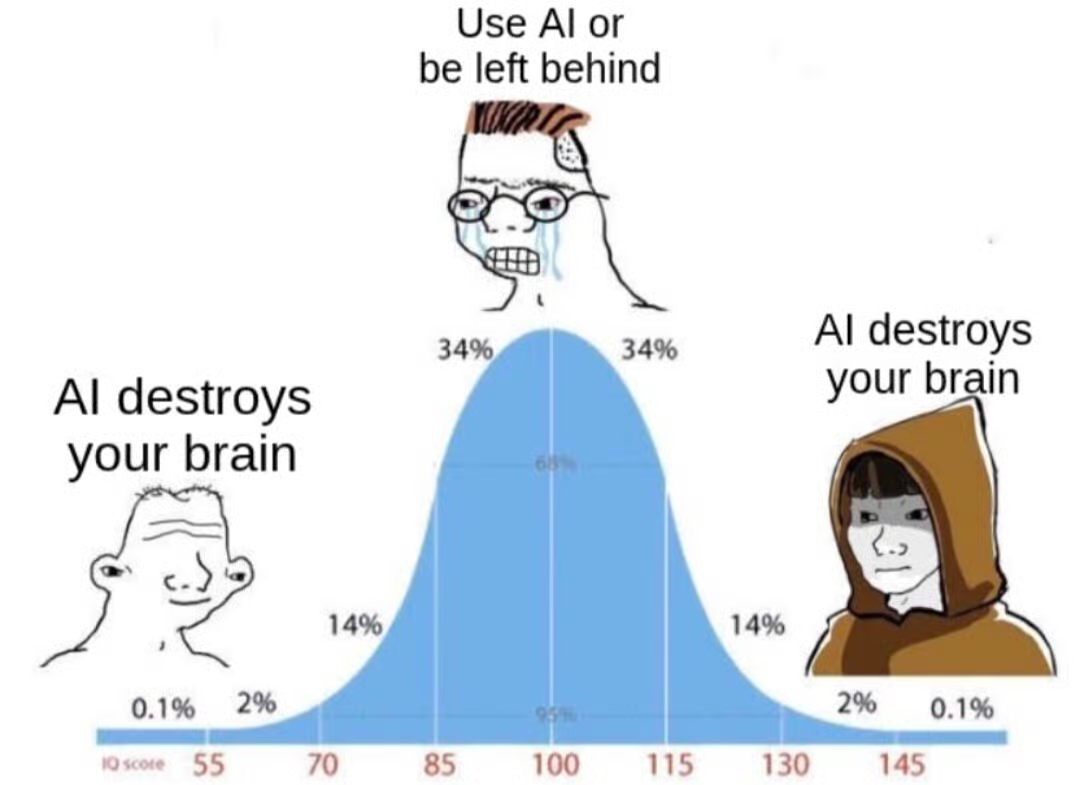
Replying to @Lettuceeatlettuce@lemmy.ml
Writing an appropriate prompt is a skill. Many (most?) people using LLMs aren’t using prompts that give them what they actually want, in many cases because they don’t understand the thing they’re trying to ask for, but also in many cases because they don’t know how to ask for it while avoiding the many possible pitfalls that come with uncareful prompts (including, but not limited to, hallucination and bias).
Personally I haven’t bothered learning that skill yet, largely because I don’t want that crap shoved in my face all the damned time, and have little use for it anyway. But it’s still a skill.
Replying to @KeithD@lemmy.nz
It’s really not for most people. You ask a question, the LLM answers. You ask it to do a task, it does it. Most people are not using these things for anything advanced or technically difficult.
I work in a big corporate office, if you exclude the IT staff and software devs, here’s a pretty exhaustive list of what everybody else is using LLMs for:
It’s grunt work, that’s what these things excel at, and that’s how most people use them. That’s fine, but acting like most people are somehow not able to unlock the “true potential” of these LLMs unless they have special training and skills is a marketing ploy to sell overpriced “AI” courses to gullible and ignorant executives and upper managers.
It’s like those stupid DEI courses that corporations have everybody take so they can “learn to not be problematic.” But all the quizzes are filled with stupid stuff like:
Your manager, Sarah finishes briefing you and your coworker, Phil on an upcoming project. After she leaves, Phil says to you, “That Sarah sure is a real juicy piece of meat, I’d love to get taste of her!” What should you do? A. High-five Phil and tell him you call dibs on her secretary. B. Tell Phil that his comment was not appropriate, then report it to HR.
It’s just there to check boxes for compliance and provide an excuse for other companies to charge outrageous prices to tell people that sexually assaulting your coworkers or pulling your eyelids tight and calling yourself “Ching Chong” isn’t appropriate office behavior.
It’s another way Capitalism poisons and hollows out substantive discussions about topics like systemic racism, multiculturalism, and gender relationships, in favor of standardized quizzes that cost thousands of dollars a year to administer.
The amount of “AI consultants” and “AI integration” firms that have popped up overnight is staggering. Just like with the crypto/blockchain craze a few years ago, everybody is trying to get rich quick off the hype.
Replying to @Lettuceeatlettuce@lemmy.ml
Good point. I probably should have stated “using LLMs for technical tasks that anyone cares about the results of”.
I’m not going to claim LLMs are trustworthy, but I am saying that there are ways to ask things that either reduce the odds of it giving you false things or actively cause it to provide wrong answers with misstated or hallucinated context. People who know what they’re doing can get better results out of them. This doesn’t stop them from being the equivalent of a nepo-hire intern, but it could be said to change whether they’re a malicious, apathetic, or semi-eager nepo-hire intern.
And one of the big risks with LLMs is staff who can recognise bullshit or questionable results being replaced with staff who unquestioningly accept whatever results they get. And people reading an “AI summary” of something and assuming it’s actually accurate.
Replying to @KeithD@lemmy.nz
People who know what they’re doing can get better results out of them.
I don’t think that’s true in the way you appear to mean (sorry if I misunderstood). People who are already experts on the subject matter might be able to use better keywords and discard hallucinatory material quicker, but I don’t believe that you can generically “be good at prompting” outside of an area where you have substantial domain knowledge.
And the only way to learn to recognise bullshit involves not using LLMs or other automated tools and working problems out for yourself, not to mention that they’re an “intern” who actually costs the same in computing power as two senior engineers’ salary.
Replying to @porous_grey_matter@lemmy.ml
I don’t think that’s true in the way you appear to mean (sorry if I misunderstood). People who are already experts on the subject matter might be able to use better keywords and discard hallucinatory material quicker, but I don’t believe that you can generically “be good at prompting” outside of an area where you have substantial domain knowledge.
There are ways of phrasing LLM requests that can actively induce them to give you made-up bullshit that confirms your pre-existing assumptions. Which is fine if that’s what you want it to produce, but often not what people actually want. For (possibly poor, given I don’t actually use LLMs) example “give me the transcripts for five court cases for assault with a deadly fish” would likely result in five-ish almost-certainly made-up court transcripts. Someone who knows what they’re doing could phrase the prompt to be more likely to say that no such cases exist (assuming no such cases actually exist) instead of just hallucinating them as per the request.
And you might be right about domain knowledge being required for good prompting. But it’s possible to have domain knowledge and still be terrible at asking for what you actually want it to produce.
not to mention that they’re an “intern” who actually costs the same in computing power as two senior engineers’ salary.
Don’t expect me to defend the moronic economic decisions of companies that have jumped on this stupid band-wagon without regard for the actual value (or lack thereof) to their business.
Replying to @KeithD@lemmy.nz
Sure, how and what you ask does make a difference, especially on lower power models. But it’s generally not really significant, like learning how to write more effective prompts takes maybe a few hours of total time? Honestly, probably an hour at most for 95% of people using LLMs in a corporate environment.
The irony of all this, is that one of the supposed biggest advantages of LLMs is that you can just talk to them with natural language in a conversational format. The more people have to use special rules of conversation, format their prompts in specific ways, take advantage or avoid subtleties of the model’s preferred syntactic style, etc. The more LLMs become a technical tool that can only produce high quality results if you use it in very specific, skilled ways.
And one of the big risks with LLMs is staff who can recognise bullshit or questionable results being replaced with staff who unquestioningly accept whatever results they get. And people reading an “AI summary” of something and assuming it’s actually accurate.
That’s exactly the point from people who are making systemic critiques of the “AI” craze. LLMs by their very nature, encourage people to become lazy. I’m not worried about a machine that’s constantly wrong, depending on the application, I can control for that. I am worried about a machine that is almost always right. That’s really dangerous, because it lulls its users into a false sense of confidence and security.
There’s a saying I heard from an old sys-admin once, “It’s better to be broadly right, than precisely wrong.” Modern LLMs are a perfect example of the latter, they will get 95% of a task correct, but then mess up that last 5%. But it messes up that 5% in a way that is very subtle and convincing, and requires somebody with deep, technical knowledge to catch and mitigate. That fact, combined with how lazy people are incentivized to be when using them, is the deadly combo imo.
Replying to @Lettuceeatlettuce@lemmy.ml
Seriously though, what “skills” are you building by learning how to use LLMs at your corporate job?
i’m not learning any skills… i’m offloading some work on to AI so that i can do other stuff on company time…
Isn’t that what we should all aspire to? To destroy capitalism from the inside?
Replying to @9488fcea02a9@sh.itjust.works
Capitalism isn’t being “destroyed from the inside” by you offloading grunt work to an agent. If anything, you may be helping justify future cuts of your job by demonstrating that there is less need for you. Your managers will be all too happy to cut half your department and make the remaining people take on all that work because, “AI makes them 5x more productive.” Of course, none of those people will get a 5x pay raise.
Use it or don’t, it doesn’t make a difference in the long run. This bubble will pop soon anyways and we’ll be on to the next “revolutionary technology.” I suspect it will be quantum computing, I’ve been seeing a significant upswing in news articles and bot traffic about that over the last few months, but who knows.
If your work is pushing AI hard, use it if you need the job, play the game if you have to, just don’t let yourself be mesmerized by the aggressive marketing hype. Anybody who is pushing the idea that tech workers will be replaced in the next 5-10 years with LLMs is a religious fanatic and should be treated with the appropriate levels of mockery and disdain.
Also, if you really want to work on taking down Capitalism, organize your labor, and support other movements that do the same.
Replying to @Lettuceeatlettuce@lemmy.ml
Yeah, i’m not an idiot… i’ve already considered all those points about the downsides of using AI at work … like you said… play the game
if you really want to work on taking down Capitalism, organize your labor
How do you know i"m not using my free time at work to do exactly that?
you made a lot of assumptions about people who use AI at work …
Replying to @9488fcea02a9@sh.itjust.works
Eh, more like generalizations based on observations of my own, and many other corporate workplaces that people I am close to, work in.
Replying to @Lettuceeatlettuce@lemmy.ml
So what you’re saying is that Linus Torvalds is only a mid-tier programmer?
Replying to @Honytawk@discuss.tchncs.de
Has Linus been screeching about how everybody must use AI or get left behind?

Replying to @I_Has_A_Hat@lemmy.world
You’re a tool.

Replying to @I_Has_A_Hat@lemmy.world
It’s a classic scammer tactic to create a false sense of urgency, so people sign up for something without thinking.
Slow down, and do some critical thinking. The promise of AI is that you can type in a simple prompt and the AI will figure out all of the complicated computer stuff for you. How would someone be “left behind” by this technology? Do you suppose that experienced developers will lose the ability to write simple sentences?
I don’t think people will loose the ability to type in “make that button green”. Even if AI fulfills it’s promises (which is doubtful, read up on the halting problem) someone who knows how computers work will be more employable than someone that only knows how to write prompts. Because the person that knows how computers work can also write prompts and will be better at doing that than someone that doesn’t know anything about computers.
More important in this day and age is learning how to spot a scam. Someone pressuring you to do something immediately is likely scamming you.
Replying to @I_Has_A_Hat@lemmy.world
I am 100% fine with being left behind by a technology that I see as an attempted corporate surveillance scheme that has metastasized into a giant money pit. The difference from the 80’s and 90’s is people were actually using computers to make money back then. If any AI company is actually making more money than they’re spending, I haven’t heard about it, and you’d think they’d be advertising it. isaiprofitable.com
I’ve been happy to fully sit this one out thus far. Don’t feel like I’m missing a damn thing.
Replying to @I_Has_A_Hat@lemmy.world
Talk me more about how in the future, game controllers will be made obsolete by motion-sensing cameras, and we will all be jumping around in front of a big flat-screen TV playing party games and finger-gunning down bad guys in rail shooters!
Replying to @ZILtoid1991@lemmy.world
Yea, and the internet will never go mainstream. I also heard Apple developed this new product called the iPhone, what a stupid idea that no one will buy, people will just stick with regular cell phones when given the choice. Now excuse me while I ride off on my horse that will never, ever, be replaced by these new au-to-mo-biles.
See, I can do it too.

Replying to @I_Has_A_Hat@lemmy.world
Oh no I’ll be left behind when the Titanic leaves port?! How utterly tragic!
Tragic for everyone who WASN’T “left behind”, anyway.
Replying to @themachinestops@lemmy.dbzer0.com
Please can someone fork the kernel, it would be so fucking funny
Replying to @davetortoise@reddthat.com
a multi-million dollar development budget. about 4000 contributors every year working on and maintaining over 40 million lines of code. ~ 15 percent is part of the ‘core’ kernel. ~ 60 percent is drivers that would need to be tracked, maintained and worked on.
might need more than a few ‘agents’ to keep up.
good luck.
Replying to @themachinestops@lemmy.dbzer0.com
Nothing wrong with using llms in useful ways, as long as they keep giving factual and unbiased information. Or you can look up stuff online and verify in a book at the library, although that could be outdated too, hmm. Unfortunately I noticed they do more of the “both sides have good points” (Perry’s scheme level 3 of 9), even when it’s a lopsided topic. We need impartial ratings somehow to show how biased the various models become and people will stay in the ones they like, or not use them or other ways to learn.
Locked into the low-level, high-control systems, they won’t learn how unhealthy they are and how to do better with freedom and equality, like it’s always been, just updated with the tech. Ask llms to use Sagan’s baloney detection kit and Perry’s highest thinking levels to analyze problems, with the main goal of how to help humanity, the environment, etc. that benefits the majority and minimizes damage. Try to make the llm work in favor of humanity rather than the owners’ greed.
Develop ego awareness, notice when it reacts with upset to new information, and choose to learn anyway. As you recognize the unhealthy indoctrination you absorbed, use that anger to break free from high-control systems, guided by the truth that sets you free. Then learn to manage the cognitive dissonance and the inner resistance that clings to the old beliefs once you’ve woken up to the truth. Good luck!

Replying to @themachinestops@lemmy.dbzer0.com
People are forgetting the AI hype train is reliant on the fact that businesses and individuals can’t host the AI themselves, which is rapidly changing.
All that insane power that OpenAI and Anthropic have harnessed is suddenly completely useless when you can just spin up a competing model at home, with HF hosting a crap ton of finetuned models like uncensored/abliterated to do whatever you want with it.
Even Deepseek released their full size models if you happen to have 400Gb (or 1.5Tb) of VRAM lying around.
When the bubble (hopefully) pops, AI will just continue to be a tool that devs use where applicable, and likely not on a massive data center cloud as it migrates into consumer electronics.
Replying to @mlg@lemmy.world
I think this is a much more sensible attitude than the pitchfork wavers declaring mandatory zero-tolerance or you’re evil.
Replying to @mlg@lemmy.world
AI hype train is reliant on the fact that businesses and individuals can’t host the AI themselves
This is, like, one of a dozen major problems with LLM’s.
Replying to @drath@lemmy.drath.ru
Are the other dozen “AI is awesome!!!” with varying number of exclamation marks at the end? 🤔
Replying to @mlg@lemmy.world
While that’s true, there’s a pretty good chance that it will be negatively useful for many programmers even after the AI bubble burst.
Also e-mail is much easier and cheaper to self-host than an LLM, yet most people relying on 3rd parties. Even some big pushers of yOU cAn JuST seLf-HosT cHiNEse lLM MoDels use corpo e-mail accounts.
Replying to @ZILtoid1991@lemmy.world
Email is NOT easier to self-host than an LLM lol, it’s like multiple orders of magnitude more difficult. Set something up slightly wrong and your emails will never not be marked as spam because your server will be used to forward spam.
A humorous talk on the topic of self-hosting email, it’s pretty fun.
Replying to @boonhet@sopuli.xyz
Getting SPF, DMARC, and DKIM working is such a pain. And that is only part of the mail security these days.
Replying to @themachinestops@lemmy.dbzer0.com
Using AI is not the same as vibe coding.
Asking AI to write a piece of code and then read it, understand and use, is a very reasonable use case.

Replying to @danielfm123@lemmy.zip
Yeah, and Torvalds using generative AI to write code is not the same as Bobby LinkedIn telling us he’s coding his third app this week.


Replying to @danielfm123@lemmy.zip
I wonder how long before he gets comfy relying on it and something really shitty slips in.
Replying to @mojofrododojo@lemmy.world
Is Linus error-free pre-AI?
If AI makes Linus more (quantity) or more severely (quality) error-prone than without the AI, that, and only that is an argument against AI being a tech asset for Linus.
Just one bad Linux kernel commit slip up related to AI is not an argument.
That said, the macro impact of the AI data centers and AI on: electric power generation and grids, pollution (smelly exhaust, noise, CO2), fresh water demands, socioeconomic power imbalance exacerbation, surveillance capitalism, questionable military usages, rogue agentic AI doing hacks and crimes to fulfill oterwise legal/ethical objectives, AI chatbot relationship addiction, these are some of what I consider real and urgent problems with AI.
Replying to @willington@lemmy.dbzer0.com
so many possible upsides it’s hard to pick which one will end the species.
fml
As an individual, his LLM carbon footprint and money used to purchase AI services aren’t going to matter at all. But him being one of the world’s highest profiled software engineers who’s openly using these tools is very good publicity for them.
I think the anti ai crowd has been focusing on the slop angle too much, the horrible malpractice of these companies is the real problem imo. If it really is only slop it will die out by itself.
Replying to @mojofrododojo@lemmy.world
Dude merges in code into the kernel originating from how many thousands of developers from around the world?
Read the LKML if you think he’s a guy that’s prone to getting comfy with merging in sub-par code.
Replying to @SpaceCowboy@lemmy.ca
oh he’s quick to put the brakes on other PR’s including slop code.
tomshardware.com/…/linux-lays-down-the-law-on-ai-…
which makes me wonder how long until he’s comfy and forgets sometimes the slop comes from inside the building lol.
Replying to @mojofrododojo@lemmy.world
You assume humans don’t ever write sloppy code and Linux Torvalds has never before encountered someone wanting to merge in sloppy code before. If in decades he hasn’t gotten comfy with sloppy code written by humans, why would he suddenly be merging in sloppy code written by an AI? He’s never been worried about hurting the feelings of a human that’s writing sloppy, do you suppose he’s going to develop empathy for an LLM that’s writing sloppy code?
The people that go all in on vibe coding are people that aren’t very good programmers to begin with. They don’t really understand how to write code and then suddenly they can make things work quickly. Well sort of work. At least work about as well as they could with their limited skills.
People that are actually good at programming know what good code is. After decades of working with code and knowing what it’s supposed to be, you don’t suddenly become a vibe coder saying eh, it kind of works, good enough, ship it. Its the people that were never able to write high quality code to begin with that do that. It can do the job of a lazy programmer that has a low standard of quality. For a skilled developer, it can sometimes save on typing on some simple tasks, and a good developer knows when it did something wrong and be all Thanos and say “fine, I’ll do it myself”.
Yep, and even more important are the cases where coding models are used outside of actually producing code. Unit tests, red teaming, bug hunting and so on are all areas where LLMs can reduce the load on an experienced coder, allowing him to concentrate on the meaty stuff. Blindly being against the technology itself because big tech currently consists of a bunch of asshats is not a mature stance.
Replying to @Wildmimic@anarchist.nexus
Blindly being against the technology itself because big tech currently consists of a bunch of asshats is not a mature stance.
yeah it’s not gonna lead to any problems lol. meanwhile reality is disagreeing. I get it, you’re a slopfan, so this pointless you’re not going to listen / try to understand, but for the rest of the audience, here’s some other views:
thenewstack.io/karpathy-says-developers-have-ai-p…
aiforautomation.io/…/2026-05-17-ai-psychosis-hack…
psychologytoday.com/…/the-emerging-problem-of-ai-…
therenegadecoder.com/…/why-generative-ai-makes-th…
slashgear.com/…/ai-coding-problems-security-risks…
…substack.com/…/ai-is-writing-terrible-code
I am not a “slopfan”. I do not use any of the techbros services, and never have outside of a few test runs in 2022 to see what it can do.
I only use local models running on my own hardware, and only to automate tasks that would take ages by hand (e.g. creating summaries about gameplay and features of my game collection from the game stores websites, helping me with RegEx or quickly creating one-shot python scripts for specific purposes - i am a terrible coder), or that make interacting with large technical documents easier (e.g. mainboard manuals). I have dabbled a bit with image generation, but it isn’t really interesting for me.
But denying that the technology can reduce workload on coders even when not generating code (e.g. unit tests, red teaming, reverse engineering) is immature. These tasks are also much less prone to cause AI psychosis, because i do not care about “chatting” with these models.
Replying to @Wildmimic@anarchist.nexus
(e.g. creating summaries about gameplay and features of my game
a) that’s how it starts, you think you’re pure and it doesn’t count because it’s only cursor, or it’s only for prototyping, or whatever.
b) when it hallucinates garbage, as all LLMs do, even the local ones you run on your own power gobblin hardware, do you think it’ll put an asterix by the parts it wasn’t really sure about lol?
c) dear fucking god, why would you need someone (SOMETHING) else to summarize the gameplay and features of your own product? have you no pride in your work?
don’t reply, I don’t care, you’re going to get burned by it one day you just think you’re different.
I mistyped. Its a collection of games i have, not a game i write. I am not good enough of a coder to write a game. Which is what i meant to take responsibility for the quality of code you submit. I know that i could not guarantee that code i create - regardless of creation method - is up to spec even for something where you can get away with some substandard code.
Edit: Lol, you weren’t able to read my sentence coherently. I just read your reply and thought i had forgotten the “s” at the end of “games”.
“my game collection” isn’t “my game”. you should crusade against functional analphabetism instead of LLMs.
And to provide a glimpse of the scale of the task i use it for: I have a collection of approximately 36000 games (not counting the games in my steam / gog / itch /whatever accounts, because those already have descriptions). Writing short blurbs for this amount of games (grabbing metadata can be scripted) is not something i want to do by hand, because it would take me ages. My local model is doing this overnight, putting the information into markdown tables i then check in the morning for correctness. I run this workflow around once a month to update the tables with the new arrivals.
Replying to @SpaceCowboy@lemmy.ca
You assume humans don’t ever write sloppy code and Linux Torvalds has never before encountered someone wanting to merge in sloppy code before.
damn dude, did you completely fail reading and comprehension? because you’re replying to a link to me pointing that exact fuckin thing out.
maybe slow down and try harder.
like, it’s in the link title text, right there.
People that are actually good at programming know what good code is.
as long as they stay proficient. but prolonged exposure to AI slop tends to have a damaging effect - thenewstack.io/karpathy-says-developers-have-ai-p…
so I stick with my premise: how long before it has an effect on him?
Replying to @mojofrododojo@lemmy.world
Do you completely fail at critical thinking? I’ll slow it down so you can understand:
Linus sees sloppy code written by a human
Linus sees sloppy code written by an AI
Why did #1 not corrupt him have decades, but #2 definitely will? There is no reason, sloppy code is sloppy code whether written by a human or written by an AI.
You’re equating shitty developers becoming vibe coders with a skilled software engineer using a tool. I think you just don’t know the difference between a junior developer and a senior software engineer. Maybe you just don’t have any experience in software development and are just reading articles on random websites.
Replying to @SpaceCowboy@lemmy.ca
just gonna end this pointless chat here:
yeah it’s not gonna lead to any problems lol. meanwhile reality is disagreeing. I get it, you’re a slopfan, so this pointless you’re not going to listen / try to understand, but for the rest of the audience, here’s some other views:
thenewstack.io/karpathy-says-developers-have-ai-p…
aiforautomation.io/…/2026-05-17-ai-psychosis-hack…
psychologytoday.com/…/the-emerging-problem-of-ai-…
therenegadecoder.com/…/why-generative-ai-makes-th…
slashgear.com/…/ai-coding-problems-security-risks…
…substack.com/…/ai-is-writing-terrible-code
Replying to @mojofrododojo@lemmy.world
Yeah I get it, you’re someone who goes along with the narratives from articles that an algorithm selected for you. I guess you just got comfy with going along AI algorithms in your information consumption so you assume others will too.
Replying to @SpaceCowboy@lemmy.ca
truth hurts bud? right in the fee fees?
I’m sure after exhausting all attempts at human companionship that your robot girlfriend will comfort you.
Replying to @danielfm123@lemmy.zip
Using AI is not the same as vibe coding.
i’ve been in dozens of lemmy threads that disagree…
There’s a huge portion of lemmy who think even one token of AI is unacceptable for any reason
I’m in a thread where the entire idea of AI/LLMs has been declared facist, with ZERO legitimate use cases other than facism
Replying to @9488fcea02a9@sh.itjust.works
It’s just a tool. All tools have good and bad use cases.
Replying to @Reddfugee42@lemmy.world
I agree…
But check out the other discussions on lemmy about AI …
if you’re not 100% against it, you’re a facist
Replying to @9488fcea02a9@sh.itjust.works
that’s like declaring electric light racism and keep using light bulbs…
Like all people that see racism everywhere, they will fail…
It’s a tool, use it where it works well.
Replying to @danielfm123@lemmy.zip
I agree with you…
But be prepared to be labelled a facist on lemmy
apparently there’s no such thing as a neutral technology or tool
Replying to @9488fcea02a9@sh.itjust.works
So um, as a sociology student, there [i]is indeed no such thing as neutral technology or tool[/i]. Everything is created within systems of power, and its production will always require externalisation of some costs. Artefacts do have politics, because we live in a social world, use social language, etc.
[b]However[/b], this does not mean that it is a moral failing, cuz otherwise everybody existing in society would be evil. We live in an imperfect world, and our own position in it, legible through the symbolic order, is continually accepted, rejected, naturalised, de-naturalised, interpreted, re-interpreted, and negotiated.
Call out harm where you can, accept some difficulties to avoid stuff you find especially egregious if you can, but ultimately, don’t moralise it against yourself if you can’t.
TL;DR There is no neutral tool or technology, but that doesn’t mean you’re morally complicit by not resisting everything. Try to minimise harm where you can, but don’t beat yourself up if you can’t either.
Replying to @markjamestwn1301@scribe.disroot.org
Huh, kinda like “there is no ethical consumption under capitalism”, acknowledging that the only way to abstain from perpetuating it is to starve to death, but principled corpses–even MOUNTAINS of Principled Corpses–seldom result in changes of policy.
Quiet isolated suicide will not improve the world, especially if immoral and exploitative systems WANT (colloquially speaking) their opposition to die. Maybe don’t play right into the hands of people who want us dead by giving them what they want, right? Better to survive and maybe also scavenge the resources needed to build something less destructive…
Replying to @Draegur@lemmy.zip
Quite. I think that’s also why we’re on the Fediverse, right? While so many of our tech is captured by corporates, we still have room to not accept it all laying down. That’s what negotiation means, drawing your own boundaries, and as much as I hate saying it, picking your own battles, while realising not many will be willing or able to fight the same ones you do.

Replying to @9488fcea02a9@sh.itjust.works
There’s a huge portion of lemmy who think even one token of AI is unacceptable for any reason
I think a lot of that is to do with how people claim to have written something themselves, and when pressed, admit they used AI for a bit “here and there”, and when double-checked it becomes clear they vibe-coded the whole thing. People lie, basically, and if someone lies about their use of AI that’s probably a harbinger of slop.
Replying to @moopet@sh.itjust.works
Ah, yeah, no, I get it, I see it reminds me of cockroaches: if you actually SEE even just one of them, it is very very likely there are more. A lot more.
Replying to @9488fcea02a9@sh.itjust.works
I’m in a thread where the entire idea of AI/LLMs has been declared facist, with ZERO legitimate use cases other than facism
A disappointment I’ve noticed with lemmy is that its community doesn’t often see the nuances in things as if to day its all black or white. Its probably not just lemmy, but all internet communities nowadays. Lemmy just sways towards anti AI more and it really leaves a bad taste when coupled with “if not with us, then against us” mindset.
Replying to @PieMePlenty@lemmy.world
Yes. It’s not just about nuance anymore. In the old days on the internet you can find some spaces where there’s at least a baseline level of intellectual honesty. Lemmy has not escaped echochamberization.
Replying to @themachinestops@lemmy.dbzer0.com
A zero-tolerance mindset about a tech tool is bound to fail eventually.
Replying to @themachinestops@lemmy.dbzer0.com
Replying to @themachinestops@lemmy.dbzer0.com
So this is how I hear about the outcome of the Debian vote. :( Is there a widespread distro that has a clear anti-Slop stance?
Replying to @raspberriesareyummy@lemmy.world
Hyperbola definetely.
I believe gentoo is too.
Replying to @Jankatarch@lemmy.world
I wanted to eventually try gentoo anyways, I guess I will have to advance that experiment. Never heard of Hyperbola, I will check it out. Thank you!
Replying to @raspberriesareyummy@lemmy.world
TempleOS

Replying to @themachinestops@lemmy.dbzer0.com
It’s interesting to see AI being used for something as practical as debugging a Linux issue. I think the bigger question is how much developers can rely on AI without losing their understanding of the underlying code. AI can clearly speed things up, but human review still seems essential.
Replying to @Moztako@lemmus.org
I think its pretty clear that an OG hacker like linus using AI as a helpful assistant is very different from a junior dev using it as a crutch
The question now is how to develop proper software engineers who have the old school skills first and foremmost, and then are able to use the assistance of an AI
Replying to @9488fcea02a9@sh.itjust.works
Exactly. AI should complement strong fundamentals, not replace them. Developers still need to learn how to think, debug, understand systems, and make technical decisions independently. Once those foundations are solid, AI becomes a powerful multiplier rather than a crutch.
Replying to @Moztako@lemmus.org
It’s especially essential to mark the code as AI generated. AI makes mistakes just as humans do. Problem is AI makes different kinds of mistakes than humans.
A human will tend to forget to do something they were supposed to do. An AI will do a bunch of unnecessary shit.
Also you can tell that a human didn’t put a lot of thought into some code (no comments, sloppy variable names) so you’re more likely to say “yeah ok, I used to make that kind of mistake when I was younger” and just fix it. AI generated code will have all kinds of comments which normally makes you more hesitant before making a change. It looks like someone really thought through what they were doing, but in reality it’s something generated by an LLM and no real thought was given to the code.
Replying to @SpaceCowboy@lemmy.ca
Also you can tell that a human didn’t put a lot of thought into some code (no comments, sloppy variable names)
Why is your code so messy that it needs comments everywhere? Comments should pretty much be reserved for special cases anyway
Replying to @boonhet@sopuli.xyz
Would that be cases be where you’re doing something that might appear a little odd, but there is a reason for it to be that way? So if you see something that looks a little odd and there’s a comment explaining it, wouldn’t you be more likely assume that there’s a reason for that code to be that way and it’s probably intentional and not a bug?
And “self documenting code” is just something we say because we don’t want to be bothered with writing comments, if we’re being honest.
“Speed up” implies the outputs are the same, so I disagree with that.
Replying to @FiniteBanjo@feddit.online
That’s a fair point. I meant “speed up” in terms of development efficiency, rather than implying the outputs are necessarily identical. Thanks for pointing that out.
Nope, clearly you didn’t get my point and we disagree about this.
Replying to @FiniteBanjo@feddit.online
I think, practically, yeah. That’s exactly the point I’m making AI is changing how we approach these problems, not simply replacing the human part.
Replying to @themachinestops@lemmy.dbzer0.com
Some of a bitch!
Just a few days ago, I argued with a douche nozzle who told me, with the confidence of a master debater, that AI has no useful purpose.
But apparently, not all of you feel that way. Linus uses AI and suddenly y’all change your tune! What a load of crap!
I’ve been sitting here saying for years that AI is a tool and should be used as such, while getting called a tech-bro simp for saying it.
Man, this has once again revealed the massive, two-faced, bandwagon nature of Lemmy.
Y’all should have stayed on Reddit!
Replying to @mechoman444@lemmy.world
Who’s changing their tune?
Replying to @mechoman444@lemmy.world
LLM is just an algorithm.
Think in terms of any other algorithm. If someone said they use a particular algorithm for everything, that would be a bad programmer. But if someone else said they would never ever use a particular algorithm because it’s the tool of the devil, would that be a good programmer.
Software engineering is about knowing when an algorithm should be used and where it shouldn’t be used. LLMs don’t change that, it’s just another algorithm. The engineer should make the decision not marketing hype. But the decision should also not be made by reactionaries.
Replying to @SpaceCowboy@lemmy.ca
Pseudo intellectual bullshit is not helping your case.
Replying to @CovfefeKills@lemmy.world
Anti-intellectualism doesn’t help yours.
Replying to @SpaceCowboy@lemmy.ca
Well yea I wouldn’t expect it to help in most situations. Lemmy is a dangerous place for people like you. It rewards bullshit nonesense you just made up be careful out there you may confronted with a real problem one day these delusions will make you think you can handle it.
Replying to @mechoman444@lemmy.world
LLMs are akin to fancy Photoshop filters for code. They can be used well by professionals and terrible by n00bs.
They are but a (very inefficient) tool.
Replying to @SalmonTractor@discuss.tchncs.de
No. That’s… That’s completely wrong.
It is amazing how y’all don’t know how any of this tech works.
Linus Torvalds used it to fix some code but it’s like a Photoshop filter? Come on man… You can’t be that intentionally ignorant.
Go do some research. Jesus.
Look I’m not some kind of supporter or fan boy but even I know how utterly reductive and incorrect what you said is.
Replying to @mechoman444@lemmy.world
You clearly don’t understand what an analogy is.
Maybe if you’d stop using AI for all mental activities you’d fucking understand that
Replying to @mnemonicmonkeys@sh.itjust.works
What you said isn’t an analogy… What?
Replying to @mechoman444@lemmy.world
They are all some binary file that completes a task. That LLMs have a statistically derived “personality” (if one would be dangerous enough to call it that) to make people like them was a purposeful mistake in development to trick people into embracing the technology. LLM is non-deterministic by nature which means results can never be trusted.
Honestly, the Photoshop filter analogy may be wrong because the filter is deterministic. The same settings produce the same results every time as it is math on an image file. LLMs literally can’t do that.
LLM tech is only seeing more “reliable” results now as they often throw the tool against a sandbox environment where it has to execute deterministic code to compensate for the random unreliability, and it still screws up.
Linus knows code, the tool sped up his process. In the absence of his knowledge, it would be useless.
Neat toy, but way too inefficient to bank the future on, and very dangerous to have such a religious reaction to.

Replying to @mechoman444@lemmy.world
I think the vitriol around AI has crossed into moral absolutism for a lot of people. There are legitimate criticisms of AI, but “AI can be harmful” does not logically mean “all AI use is unethical” or “AI has no useful purpose.” Treating every use as morally equivalent is just hasty generalization and guilt by association.
At some point, “AI is bad” stops being a conclusion and becomes a sacred value. Then useful examples are not considered on their merits, they are dismissed because they threaten the moral position. You can criticize harmful uses of AI without pretending the technology itself has no legitimate use.
Replying to @Bamboodpanda@lemmy.world
Why do we all have to be morally homogenous? I use AI tools, but I understand that a “morally absolutist” take from someone who doesnt use it or see the value, and who places a lot of value on, say the environmental or social cost, can be reasonable. I also eat meat but understand that some people have a reasonable argument for totally avoiding it. The messyness is human.
Replying to @mechoman444@lemmy.world
Were you perhapse… talking to different people?

Replying to @themachinestops@lemmy.dbzer0.com
Fuck off with these fake AI bubble pumping stories. fake ass grifters reading the same script wherever you go (“Im a mathamatician and IM SCARED” lol)
It’s all horse shit.
Sorry guys but your AI powered sex doll is going in the chipper along with her unpublished Unified Field theory.
Replying to @bold_atlas@lemmy.world
The fact that you compared “AI powered sex doll” to Linus using an LLM to generate code he reviewed and accepted (as if he’s reviewing any of the many contributions he reviews and constantly rejects for the simplest mistakes) shows that you know nothing about the different applications of “AI”.
Yes, the “AI powered” sex toy is an example of an idiotic scam, the AI powered assistant that hallucinates in a conversation isn’t very useful, but code that literally does what it should do, reviewed by a competent engineer, is no different from reviewing code from any of your coworkers. It’s code, if it’s garbage you reject it, is it isn’t then the tool was useful.
Replying to @bold_atlas@lemmy.world
I know you said all, but I’m curious which part do you think is horse shit? Do you think Torvalds is lying about using AI all together? or just how useful AI actually was? The commit with the alleged AI use is in the an RC for the next release, and it is authored by Torvalds.
Replying to @G_M0N3Y_2503@lemmy.zip
His story was a bit less flattering. The narrative the advocates want is that Torvalds is all in on vibe coding the kernel.
The actual story is that he found it somewhat useful, even as it gave him wrong information and directed him to get help from a developer. A useful, but limited augmentation.
If Torvald’s account were the accepted reality, they wouldn’t be steamrolling rural locals to make so many datacenters and wouldn’t be demanding we need more natural gas power, and wouldn’t represent the majority of our economy. They would have utility and be available, but not so obnoxious. Well, maybe, they might not have bothered with so much expense in training for this level of capability, but the cost is sunk now.
Of course most development isn’t Torvald’s level, it is human slop. So there’s more to things than the actually complicated work that AI is limited for.
But it’s not only critics that oversimplify. Advocates are obnoxiously bad at declaring everything is all good with AI
Replying to @jj4211@lemmy.world
Ah, that’s probably it. And yeah, governments need to figure out how to manage this. I think it’s destined to be bound by whatever is actually economical post hype. Not pending efficiency breakthroughs of the likes of mores law.

Replying to @themachinestops@lemmy.dbzer0.com
LAInus.
Replying to @themachinestops@lemmy.dbzer0.com
AI is like a power tool. If you give a contractor a nail gun instead of a hammer he can build a house faster. If you give someone who has no idea how to build a house a nail gun they’ll just fail at building a house faster than if you only gave them a hammer and they’ll probably hurt themselves.

Replying to @Acid_Burn@lemmy.dbzer0.com
Problem being that the majority of software engineers really don’t know how to build software well.
And are using AI as a tool to just accelerate their lack of engineering.
Replying to @douglasg14b@lemmy.world
This is a very old discussion and argument, much older than the current AI push. You’re right to a degree but also that hasn’t stopped the rise of strong minds for software development. There will always be the curious and the lazy. The curious will always want to know how things work from the chain of events of a button click to the pixel shifts and logic gate flips to display code on a screen as well as run it. There will also always be the lazy unencumbered by such a desire for awareness who just want the magic box to do the thing.
How many software devs can write in assembly? Not many. Not much has changed if anything beyond the ability of the unaware to see their will come into creation. People couldn’t make realistic images and now they snap selfies with no barriers to entry. Does that make them a photographer or an artist? Not really.

Replying to @douglasg14b@lemmy.world
Could this not be said for IDEs with code awareness such as M$’s intellisense, among other tools that accelerate development speed?
What you are describing isn’t an AI problem, is people taking a two week bootcamp and calling themselves a software engineer.
Replying to @douglasg14b@lemmy.world
There’s a ton of app builders out there that are basically some crypto scam wrapped around Claude (or whatever). There’s a lot of idiots pumping out code slop.
Replying to @Acid_Burn@lemmy.dbzer0.com
Also lowkey the nailgun isn’t even that much faster, it’s more about saving wear on the workers’ elbows. IDK if that applies with programming. Saving cognitive load for other tasks? Source: used to work in construction. Never point a nailgun at anyone except your supervisor.
Replying to @kestrel7_7@lemmy.world
It 100% can save cognitive load if used correctly. Knowing the limitations and restraints of your tools is true for every profession.
If you know what your llm can and can not do reliably you reduce the over head of verification to basically zero. While if you use it poorly you basically have to double your work load to fix things.
Replying to @Acid_Burn@lemmy.dbzer0.com
I think there could be some potential usecases for LLMs, but that’s not code generation (at least code that is not in the finished product), nor having it look up stuff in technical documentation.
Everyone is trying to chase the rational adaptation case. Everyone wants to 10x their projects, yet keep control over them, or at least 2x their productivity. But I’ve seen just as many people going insane from at least first trying to use it as a tool as vibe coders.
Replying to @ZILtoid1991@lemmy.world
Code is probably one of the easiest things to verify, for that reason I struggle to see any other viable uses for LLMs tbh.
user: write code that correctly asserts what 1+1 equals.
LLM: assert_eq!(1 + 1, 4);
LLM: hmmm, that crashed.
LLM: assert_eq!(1 + 1, 3);
LLM: hmmm, that also crashed, I must be doing something wrong, let me try one more time.
LLM: assert_eq!(1 + 1, 2);
LLM: that worked!
LLM Response: assert_eq!(1 + 1, 2);
user: what does this sentence mean? "Buffalo buffalo Buffalo buffalo buffalo buffalo Buffalo buffalo"
LLM Response: This doesn't mean anything, or someone really likes buffalo's
I can always run the code to check, I still don’t know how that sentence makes sense.

Replying to @G_M0N3Y_2503@lemmy.zip
That’s because it needs a semicolon:
Buffalo buffalo Buffalo buffalo; buffalo buffalo Buffalo buffalo.
Also it isn’t a very good sentence because you’ve said the same thing twice.
It should read:
Buffalo buffalo buffalo; Buffalo buffalo buffalo Buffalo buffalo.
Translation:
“Buffalo” is a place, a noun (more or less meaning bison), and a verb (to harass or bully). So what it means is:
Bison bully bison; Buffalo bison bully Buffalo bison.
Replying to @SuperNovaStar@lemmy.blahaj.zone
hmmm, I just copied from Wikipedia as my primary source. That was the faux pas that was cool before AI.
Replying to @G_M0N3Y_2503@lemmy.zip
I happen to think wikipedia is still cool :)

Replying to @SuperNovaStar@lemmy.blahaj.zone
Hmm, I don’t see how semicolons work in this sentence.
Marking up the sentence with extras to help visualize:
Buffalo-buffalo (who) Buffalo-buffalo (do) buffalo (in return also) buffalo (the other) Buffalo-buffalo.
A sentence of similar structure, subbing components for others of the same language parts…
… would be:
Foreign cars Austin techbros covet cost big money.
(edit: I couldn’t quickly think of a location adjective for the last noun, which would have stuck to the pattern more closely, but “big” is still the same role, an adjective.)
Replying to @atx_aquarian@lemmy.world
That works too! It’s basically nonsense, but since they are valid adjectives and nouns and verbs you can construct almost any structure of sentence with them.
Replying to @G_M0N3Y_2503@lemmy.zip
Code is probably one of the easiest things to verify
LOL!!!
Replying to @wewbull@feddit.uk
I am a software engineer by trade, so biases’ being what they are. But what I was more trying to demonstrate is that it is provable. Not that making the proof is easy.

Replying to @Acid_Burn@lemmy.dbzer0.com
and they’ll probably hurt themselves.
You can hit your thumb quite good with a hammer too.

Replying to @Acid_Burn@lemmy.dbzer0.com
I can build my bosses app faster with ai, but I would never build any app I want to maintain with it. It’s too low quality code for my standards.
Replying to @dreadbeef@lemmy.dbzer0.com
I think there is a middle ground where you can absolutely build apps faster with the help of ai and still get maintainable code.
Just don’t let AI write a whole app in one shot. Or even whole features.
Replying to @Acid_Burn@lemmy.dbzer0.com
…more like a nailgun that, more frequently than not, shoots backwards.
Replying to @themachinestops@lemmy.dbzer0.com
The problem with majority of “LLM critics” is that they are brain dead luddites that argue with ragebait emotion rather than rationality.
Unsurprisingly LLMs are just computers that can be useful, can be wasteful, can be life saving and can be society destroyed - it’s a tool.
Replying to @drmoose@lemmy.world
Sure not all the critique is accurate, but in its current form, it causes huge issues with water and noise pollution in places the data centers are built, and are sucking unbelievable amounts of power, while essentially DDOSing tons of sites to scrape data, and often using copyrighted material that they have no license for. It is also reducing people’s ability to think critically because people turn to it immediately.
I’m not an idiot who will say it’s not useful, but we need to slow down by about 20x with what we’re doing with it now, and save it mainly for medical usage until we have a solution to those massive problems.
Replying to @starelfsc2@sh.itjust.works
The water and noise problem functionally has zero to do with llms as a tool. That is entirely and solely a byproduct over over expansion of corporate intrests.
That’s like saying the lumber mill is the reason logging is harmful to the environment.
It’s nonsensical and requests objective ignorance of the context and nuance of the problem
There’s nothing that actually requires the data center problem to exist for llms to also exist. There are alternative.
Replying to @Holytimes@sh.itjust.works
We already have a perfectly good policy framework for datacenters: just charge them the negative externality costs. The problem is that they want datacenters now and repay external costs like electricity, water etc later because it takes 1 year to build a datacenter but 5 years to route power and water.
We already solve for this with economic credits but people just don’t trust these systems because of corruption and poor governance. The credits never trickle down to people who pay for externalities.
This is not even a datacenter issue.
Replying to @drmoose@lemmy.world
You’re making too much sense, Dr. Better stop before they turn their irrational hatred on you. You’re making it difficult for the slow-thinking Neo-Luddites to blindly hate this technology, and they have to hate something so they’ll turn their blind hatred on you!
Replying to @Holytimes@sh.itjust.works
Yes which is why I’m not against ai as a whole, just in its current form it needs massive regulations. I would still not be happy about how it’s ruined huge portions of the internet, but I would probably put up with that for the value it provides.
Replying to @starelfsc2@sh.itjust.works
Honestly I don’t disagree with your take. We should slow down and be diligent with our roll out and policies but sadly that’s not what the mainstream discussion is all about - it’s all so binary.
Replying to @drmoose@lemmy.world
I absolutely take Luddite as a compliment, the historical Luddites were cool as hell. And with the benefit of hindsight, we now know their predictions were basically correct about increasing automation leading to lower quality products and more alienated lifestyles.
Also, I know enough about finance to know that if these computers cost more money to keep on than they bring in (which they do) they won’t be around long-term.
Replying to @kestrel7_7@lemmy.world
This story keeps getting parroted and it’s completely untrue. Luddites gained no extra rights due to their actions they gained rights decades later through actual policy activism.
Replying to @drmoose@lemmy.world
But they want it to be cool to be metaphorical ostriches with their proverbial heads stuck in the figurative ground!
Replying to @drmoose@lemmy.world
What lives have been saved by LLMs?
Replying to @paperd@lemmy.zip
Not llms, but image recognition in medical fields has gotten really good
Replying to @Feathercrown@lemmy.world
Sure, but that’s not an LLM.
OP said:
Unsurprisingly LLMs … can be life saving.
I’m not aware of any life savings. I am aware of several cases where it has told people they should kill themselves.
Replying to @paperd@lemmy.zip
Yes, LLMs appear to be much less useful in the lifesaving department. I’m sure the info they give has been helpful to someone, but the psychosis stories are insane.
Replying to @themachinestops@lemmy.dbzer0.com
I would trust Linus Torvalds to use AI to do this because the AI is literally trying to copy him when it writes that code. In that context, he is the training data.
Replying to @_stranger_@lemmy.world
Well, the tool apparently fought him and “several times stated flat out that this was impossible and unsolvable and that we should just write a report about it.”
And it also doesn’t look like the LLM actually added code so much as helped with debug code and analysis, however exactly that may have looked like. The resulting fix changes three lines of code, very much human-writable or -verifiable.
Also, let’s not worship Linus. The guy has done much good and is brilliant, but he’s still human, still capable of making mistakes. This instance working out well deserves the proper appreciation, bu we still ought to be wary.
Replying to @_stranger_@lemmy.world
I especially like his most recent use of LLMs.
Specifically as a threat to induce someone else to step up as a maintainer of the debug tool sparse.
Replying to @KeithD@lemmy.nz
Great stuff, especially this part:
But Bart, maybe you’d like a new hobby? Think of all the glory. People stopping you in the streets, asking you whether you’re the sparse maintainer and asking for selfies.
You won’t be a rock star or an astronaut (or a fireman, or a dinosaur, or whatever you dreamt of being when you were a wee tyke), but it’s the closest us geeks will ever get.
Replying to @KeithD@lemmy.nz
I’ve been in that position for something nowhere near as important as the Linux Kernel. It SUCKS. I don’t want an AI to take over, but I don’t blame him for wanting to step down.
Replying to @_stranger_@lemmy.world
This is a tool whose previous maintainers have apparently stopped working on it, not something that Linus was still involved in maintaining. This isn’t so much him wanting to step down, as him not wanting to step up if someone else with an interest in it might be willing to do so.
Replying to @KeithD@lemmy.nz
Same diff. I’ve also turned down the “do you want to maintain this” call. Still don’t blame him.
Replying to @_stranger_@lemmy.world
He’s not writing much of anything at all anymore, he is copy pasting emails to git am.
Replying to @themachinestops@lemmy.dbzer0.com
It’s a tool like any other. If used correctly it can provide a great value to the world. If used incorrectly then in this case it can also do the opposite. AI isn’t good or bad intrinsically. It boils down to our relationship to it. The same can be said for all the other tools, radio, television, internet and so on.
Replying to @themachinestops@lemmy.dbzer0.com
Finally got where I stand: why uncomfortable? It’s just being hard to impose a sensible approach to it:
Replying to @Shanmugha@lemmy.world
this has to stop be stopped
How?
Replying to @HieroProtagonist@feddit.org
I have no good answer to that. My personal choice is ruin/kill any bastard who orders/approves building of data centers in their current state (read: doing damage to everything immediately around them and well beyond that), but I am physically far from anyone in that group
Replying to @HieroProtagonist@feddit.org
Local opposition to data centre builds seems to be most effective at the moment. People oppose it from across the political spectrum, and it’s becoming a hot topic. Add your voice to the crowd.
Replying to @Shanmugha@lemmy.world
Oh the bright side: smaller local models are getting very good
On the bad side: large models are always a year ahead so everyone wants to keep using the datacenter ones.
llms can be used as a tool efficiently
Large swaths of people disagree with this, and it also causes legal uncertainty because the training data is copywritten or even patented.
Replying to @FiniteBanjo@feddit.online
Yup, legal problem is there. Not being a lawyer, I see this as a complicated bunch of problems no one is going to solve to the benefit of everyone who actually made this possible (artists, programmers, social media users etc), which is sad (right now I don’t even have the strength to swear)
To anyone who thinks llms are only good at spewing nonsense: well, my experience as well as that of many others says otherwise
Replying to @themachinestops@lemmy.dbzer0.com
unpopular opinion, especially on the fediverse, but: AI is not inherently bad.
it is a tool, that can do everything to a pretty low standard but rather fast. so it is up to the learnt human to use the thing at the right time. i use the company ai at regularly at work, but treat it as an apprentice: every line of code has to be checked, because it will fail hilariously. but it does type faster than me, so simple and boring jobs can be done by it.
i don’t see the appeal of avoiding generated code at all cost. it is not different from human code in that it can fail horribly. the important thing is oversight. is there someone with the knowledge and keen eye to ensure no BS is merged. Linus, in my opinion, spent a lifetime building that reputation.
Replying to @ToxicWaste@lemmy.cafe
I think there’s a big difference between
A. Expecting people to pay you and give you credit for something AI made for you
vs
B. Playing with AI and if it spits out something you like a lot you keep it to yourself unless someone else specifically asks you to show it to them.
It’s basically masturbation.
People are gonna do it to themselves and enjoy it but if you try to show me that shit without my consent we are not going to be friends.
Replying to @Draegur@lemmy.zip
We’re not talking about the average clueless vibe coder here. Programming involves a lot more than just writing code. What Torvalds did was essentially “AI assisted coding”. As i understand it, he used it to narrow down the position of the bug in the code and then fixed it himself with a one-liner because apparently AI couldn’t find a solution on its own:
And this was a debug session from hell, enormously helped by an AI doing much of the grunt-work. I’d like to call it my tireless helper, but the AI several times stated flat out that this was impossible and unsolvable and that we should just write a report about it. I suspect those things have been trained by people who may not be quite as stubborn as I am. But while the AI was ready to give up several times, it did keep adding debug code and analyzing it faithfully when I pushed. So credit where credit is due and I let the AI write the commit message above. This is basically a one-liner fixing a bogus “round_up()” to a “round_down()”, but there were 24 patches adding more and more debug information to this, and 18 kernel boot to finally narrow it down to this. - Linus
github.com/…/818bebeb63dd6bf5f4e07e145f6cdbace520…>
That’s basically how AI should be used. To speed up things that are technically easy to do, but still very time consuming.
Replying to @ToxicWaste@lemmy.cafe
AI is inherently bad. It might be useful, but their externalities are quite inherent to it.
Replying to @sanzky@lemmy.world
I’d agree with you if you mean that what has been marketed as AI to us is inherently bad. That said the word AI has been misused so much that is basically has no meaning. I’ve known researchers who have used things that can be called AI for really important research and it could run on a high end computer from 10 years ago. The externalities of that are quite minimal to what we gain. We really need to find language to discuss AI where when we talk about Big AI we’re not also dragging the proven, and efficient models which are nearly AI but not quite into the discussion.

Replying to @sanzky@lemmy.world
Perfectly put. I’ve expended paragraphs circling this succinct point.
Replying to @sanzky@lemmy.world
It really depends on which externalities you’re talking about
The only one I can think of as ‘inherent’ is the ethical concern over copyright. The others are more broadly related to the commercialization of the tool than to the tool itself.
Replying to @sanzky@lemmy.world
I don’t think it’s inherently bad. We don’t need to use double the world’s energy to power it (as we see with open weight models) . We don’t need to centralize it in trillion aire companies. We don’t need to leverage an entire global economy on it. We don’t need to use it to replace human labor without a proper economic model.
Those are all aspects of greed and stupidity. None of that is inherent.

Replying to @sanzky@lemmy.world
I could say the same about all marketing, but that won’t make it disappear
Replying to @ToxicWaste@lemmy.cafe
I have access to essentially unlimited local compute at my work. Some of my coworkers use it to run LLMs, some use the pre-enshittified corporate models, and I gave all that a shot—like really went for it, but ultimately would rather just work at my own pace.
In my workplace the people who use them come off as kind of frantic to my eye. Like they’re always making these overly engineered greenfield things no one asked for, which gets them a shout out at quarterly and then no one ever thinks of it again…
I’m not saying there’s 0 legitimate use for the technology if you could divorce it from its problematic origins, but I’m not that smart, and people are increasingly coming to me for help when previously they seemed happy to just talk to their little corporate minder.
I feel like chatbot and text generating models generally encourage dark patterns we don’t even have names for yet and I’m just highly wary of the whole thing.

Replying to @grrgyle@slrpnk.net
I’ve spent the last 9 months coming in behind these “look what I did! AI!” projects and fixing them. One was turned over to a coworker as a “here I did all this work for you” … Wouldn’t even start because it tried to bind to the same TCP port three times in the init, for some reason.
It’s getting a little better, but I still mostly unfuck shit that people LLMd and then (they) walked away to much fanfare at their “expertise” to do it again.
It’s a tool, not a replacement for thought.
Replying to @ToxicWaste@lemmy.cafe
It’s the same as people saying not to use calcs or Wikipedia, new times same issues.
It’s worse than that, even. The calcs and even the Wikis were below or at human error levels, the AIs will peak below 95% accuracy with infinite power and training according to studies by OpenAI in 2020 and Deepmind in 2022 correcting a math error they made.
Replying to @Fortunafors@lemmy.world
But we very much do enforce times on when not to use calcs. Thars the whole point here.
Replying to @ToxicWaste@lemmy.cafe
“oversight” is a myth. I’m pretty sure you can’t oversight your way of plagiarism out of millions of training data sources that you don’t even have on your local disk for comparison and reference.
(This isn’t legal advice. I’m not a lawyer.)
Replying to @ell1e@leminal.space
you are confusing two issues here: oversight for the output of an ANN can very much achieve good results. as i explained in my post.
oversight over the output won’t help you with copyright, water and energy consumption, slave labour and all the ethical issues further up the pipeline. but we don’t need ANNs for big corpos to do all these evil things. we need oversight and real consequences for those corpos - no matter what they produce.
ANNs as a technology are old and have not fundamentally changed since Alan Turing. Sure, we have iterated and improved. But the fundamentals are the same. LLMs just made that old tech quite popular recently and introduced a “line go up” race. i do not believe that we will gain significant improvements from simply feeding more stolen works to the machine. A fraction of the MNIST dataset is enough to train an ANN on a 20 years old laptop to recognise the digits 0-9 reliably. The technology is sound, limited in its usability and detached from the big corpos.
Replying to @ToxicWaste@lemmy.cafe
so why are you advocating for not avoiding all generative AI code then? you specifically cited Linus, who does as far as i know not ensure cleared up training data (what would that even be, CC0 only?) like you seem to be advocating for.
Replying to @ell1e@leminal.space
once again: oversight of the production line != oversight of the output.
i specifically said that i do trust Linus Torvalds to ensure no bullshit is pushed to the Linux kernel. that is oversight of the output.
we need oversight of the production line. but of all the production lines, not only the ones delivering LLMs. big corporations have a tendency to blatantly break the law and get away with a fee that is smaller than their profit. if they don’t break the law by the letter, they have good lawyers to skirt around it and noone has a morality police. oversight would mean not only catching these things but also punishing such behaviour in a meaningful way.
training an LLM eith CC0 would be fair game. properly bought (declared it is for training some AI) resources as well. i fully disagree with the current training methods: just feeding more to the black box - to that extent, that they buy (improperly) and destroy books just to get some more words into their respective model. i am sure, that other approaches would get better results. but that is slower and more expensive. so the problem is how most AI companies operate - not the actual product. but if it wasn’t “AI”, it would be something else with the exact same bullshit practices.
Replying to @ToxicWaste@lemmy.cafe
I code at a kindergarten level so its been useful for me when I’m trying to get an idea to just work. I tell it what I was trying to do and give it my code and then I ask it to fix then explain what went wrong. Works pretty well in qwen 3.8 27b on my GPU in zed. But I’m not making huge apps or public code just dumb scripts for me. So ive found ive actually gotten better this past year. Its all in how you use it.
Replying to @ToxicWaste@lemmy.cafe
nothing is good nor evil, but thinking makes it so.
But i see the issues on both sides of the aisle. Kind of like how social media is a great tool that brings about instant worldwide communication. But those merits don’t cancel out how it’s been used to exploit the human psyche, influence elections, and even coax genocides.
In this case, the downwind effects from encouraging use by mature professionals is impacting the impressionable future. And no one seems to care about the future anymore.

Replying to @ToxicWaste@lemmy.cafe
I agree. Most actual technical professionals agree. AI has long existed in some form before tech bros in silicon valley turned it into a SaaS. It’s just the fediverse is filled with a bunch of anarchists obsessed with Loli anime, and to them chaos and a return to medieval age is their best chance of living out their child loving fantasies.
Replying to @themachinestops@lemmy.dbzer0.com
I’ve decided to start moving to NetBSD. The copyright status of genAI code is very questionable, and it’s likely any project that integrates it, with be “extinguished” via legal action in the future.
Replying to @bss03@infosec.pub
I really doubt that. It depends a bit on which country you’re talking about, even if a court rules that way, there is way too much money involved for the Supreme Court to uphold it. And even in the very unlikely event the supreme court would do that, I’d imagine this would be one of these rare moments of bipartisanship where some kind of way is found to allow for AI generated code. The US isn’t willing to lose the ‘AI race’ due to principles, ethics or law.
Replying to @teuniac_@lemmy.world
The documents I quote are from publications by the U.S. Copyright Office. But, the Berne convention and the WTO ensure that member states copyrights are aligned.
I doubt “allow for AI generated code” has the bipartisan support you think it does; it certainly doesn’t have the popular support. But, ever if it were legal, it should still be unethical (e.g. Amnesty International’s reports of human rights violations in generative AI), and I’d be attempting to avoid it.
Replying to @bss03@infosec.pub
It doesn’t look like it, but if 90% of silicon valley would get VERY upset if it didn’t and move their AI business abroad, you can be pretty sure that some kind of solution will get bipartisan support. Money money
Replying to @teuniac_@lemmy.world
That’s a very “doomer” view of democracy, but you might be right.

Replying to @bss03@infosec.pub
and it’s likely any project that integrates it, with be “extinguished” via legal action in the future.
That would mean killing the entire internet whose servers run Linux, because the kernel is messing with AI now.
Replying to @DFX4509B@lemmy.wtf
Only servers that have installed versions of the kernel that would be affected. Otherwise you can roll back to a version that is unafflicted or jump to an unafflicted fork. When it comes to Linux, there is very little chance that at least SOME people will decide “i see what’s happening here and i don’t like how it’s being done, so I’m going to accomplish the same capabilities without using those methods, even if only our of sheer spite”.
And if seasoned devoted life long Linux developers who are in it purely for the love of the game were unable to detect if anything AI written is in their shit, what makes anyone think aggressively mid out of touch normie bootlickers will be capable of detecting it in order to police it?
Replying to @themachinestops@lemmy.dbzer0.com
They should ask for a refund
Daddy or chips.
Replying to @themachinestops@lemmy.dbzer0.com
What AI haters don’t get is that the people fanning the flames of AI(LLM’s) hate are the same people who want you to buy their subscriptions, because they know the only place the real damage occurs is in OpenSource communities.
AI use for Open Source projects is arguably the one use case that benefits everyone, plus it’s a sweet irony against corps and their locked-down proprietary software. Denouncer will loudly hawk that LLMs will make it trivial to circumvent the GPL, but they fail to mention that the pendulum swings both ways; with LLMs, it’s now easier than ever to reverse engineer proprietary systems and programs, recently there was a similar discourse on lemmy due to the mario kart wii decompilation.
They want loud people to sow division into OpenSource communities so that true opensource LLMs solutions are shunned and never reach maturity, corporate meanwhile is unaffected.
Replying to @Artemis_Mystique@lemmy.ml
AI use for Open Source projects is arguably the one use case that benefits everyone,
It doesn’t benefit everyone if it pushes the quality down because the impetus to go fast wins over the dedication to reviewing the code properly. Nor does it benefit everyone if the world becomes uninhabitable because of the energy used by data centers. Nor does it benefit everyone if economies collapsed due to the hype being wrong a the speculative bubble bursts. Nor does it benefit everyone if the hype is right and it renders most jobs redundant.
These are the very rational things “haters” are concerned about. AI is for the rich to get richer. It does nothing for the rest of us.
Replying to @wewbull@feddit.uk
It doesn’t benefit everyone if it pushes the quality down
Look I know some people will chime in and say things were better when programmers had to do their own memory management but I can’t say I agree. Good tools don’t push quality down. People using tools incorrectly certainly does and it’s a guarantee some people will use new tools incorrectly.
Having a tool that can chew through a lot of code and give you suggestions which can be verified is indisputably valuable. Is it worth all the datacenters? Hell no. But open source people aren’t driving that.

Replying to @almost_genocide@lemmy.world
The problem is that most of the people that are using it are not using it correctly and are not using it in a manner that they are just simply trying to find something to correct it. They’re literally using it to write the code and they’re barely scanning it afterwards. Therefore it’s creating a mishmash spaghetti bullshit that nobody wants.
Replying to @titanicx@lemmy.zip
Do we think when the hammer was invented people only used it correctly? If 99 people out of 100 used it incorrectly would that make it a bad tool? I don’t think so. How people use it in general doesn’t have anything to do with the usefulness of the tool when used correctly.
Replying to @almost_genocide@lemmy.world
That is a super idiotic statement there. The amount of people not using a hammer correctly compared to the amount of people not using AI correctly is nowhere near any sort of even percentage correct. Like I am flabbergasted you would even try to make that sort of comparison.
Replying to @titanicx@lemmy.zip
… How would you even use a hammer incorrectly lol
Replying to @titanicx@lemmy.zip
How people use a tool in general doesn’t have anything to do with the usefulness of the tool when used correctly.
Replying to @Artemis_Mystique@lemmy.ml
Finally someone talking sense.
Replying to @themachinestops@lemmy.dbzer0.com
The AI cabal is a very small group with a very large amount of power and powerful friends who want to push this on you. Remember, walking away from this does not impact hunger or shelter at all. You can survive without this shimmering facade.
Replying to @themachinestops@lemmy.dbzer0.com
Reminds me of nuke stuff back in they day. It can be energy to be harnessed, or energy to destroy, depends on the user and the sourcing of the materials. I use Ai (grammerly) to proofread important documents. (tone and proper grammar) didn’t let it re write more than a word or a symbol. Seems the equivalent here.
I think alot of people get upset at the owners of Ai and rightfully so. Was this a local model? Did he build it? Lots of factors.
Replying to @Bluedragon012@lemmy.world
But if you use a tool to fix your grammar, you never learn the rules of grammar for yourself.
Replying to @Echolynx@lemmy.zip
No argument here. I know Grammer, but there is how we speek and buisnees specific grammar. The level of formalities and what not.
Replying to @themachinestops@lemmy.dbzer0.com
I personally don’t care about the tech. I care about the economy around the tech.
Replying to @themachinestops@lemmy.dbzer0.com
As long as AI doesn’t become the standard way of correcting a bug or coding Linux shit then it’s whatever. If they end up as bad as Microslop, then we’re gonna have to make hardened rules around the Distros that can and can not have AI, fixing issues.
I mean… I’m not gonna lie on the flipped coin of that sentiment, I would love to see a Linux OS built entirely by Ai.
It’s kind of like fuck Ai taking over the movie industry but I would love to see a documentary about the AI pasta eating evolution of will smith but created with AI.
Replying to @Hueristic_Autistic@lemmy.world
Ugh all the set dec concept art is fucking AI generated on the movie I’m working on right now and it makes me want to gag listening to them wonder if there’s a ethnically diverse trained model so they can claim all the Mexican gangs they’re generating aren’t racist.

Replying to @themachinestops@lemmy.dbzer0.com
I keep seeing headlines like this, and of course conveniently leaving out how Torvalds chewed people out for vibe coding.
Torvalds didn’t vibe code away the Linux bug. He actually knows what he’s doing.
Replying to @Tattorack@lemmy.world
Ya but the general hysteria is that any AI use is bad and that we can only trust this AI use because its from Linus. I’ve used AI successfully for debugging and learning new code bases and patches and I’ve been told I’m wrong for doing so.
Replying to @tangosox@lemmy.world
And what’s thw relation to the OP, or the comment you’re replying to? Are you understanding the result of what AI is giving you? Because thw comment states that this is not vibing because Linus owns the change, understands it.
Replying to @tangosox@lemmy.world
Well, so far Linus is the only person in the world, it seems, that is using AI as a tool instead of a crutch. So I agree with that sentiment.
Replying to @Tattorack@lemmy.world
Yeah he has said many times the submitter of the code is the one responsible for knowing how it works. That’s not the only issue with LLMs though. Stolen intellectual property and the larger environmental impact that the data centers required to run them is having are just a couple more.
Replying to @darkangelazuarl@lemmy.world
I have a feeling that in order to achieve using deep learning (because let’s face it; it’s not AI) as a programming assistant, AI companies didn’t need to do half the shit they’ve done.
The resources being outright burnt on their endeavours haven’t served any useful purpose. You don’t need data centres covering the globe and to destroy thousands of rare books to assist with code, or find cancer in a scan.
Replying to @Tattorack@lemmy.world
Oh I mostly blame capitalism and the shitty tech bro CEOs.
Replying to @themachinestops@lemmy.dbzer0.com
[insert meme of the guy sweating over which of two red buttons to press]

Replying to @LovableSidekick@lemmy.world

Replying to @themachinestops@lemmy.dbzer0.com
There’s a difference between using a tool as a knowledgeable professional, and using a tool as a novice or a member of the general public: the professional can likely tell when the answer an AI gives is wrong.
AI is a tool that can be useful sometimes.
Replying to @aurelar@lemmy.ml
Ayup, i’ve literally thrown massive logs into an llm and “find the errors” to track down a complex issue. They’re very good paper sorters

Replying to @aurelar@lemmy.ml
lol the cope
Replying to @1985MustangCobra@lemmy.ca
And the bitterness?
I don’t support what the big corpos are doing, but you’re straight up denying that a hammer is a tool.
Replying to @Lemminary@lemmy.world
no i mean people coping that now their hero linus used AI they aren’t calling for him to be shunned from the linux community.
Replying to @aurelar@lemmy.ml
I suppose Microslop aren’t actually professionals anymore.
I can live with that
Replying to @halezinflames@lemmus.org
I can stand AI as long as the code is reviewed line-by-line by a human. The only problem I have aside from that is that I wonder if code generated by an AI can validly be placed under an open source licence instead of being public domain. Didn’t a court rule that you couldn’t copyright generated code?
Replying to @aurelar@lemmy.ml
Good point. Not sure what they’re gonna do about that.
Replying to @themachinestops@lemmy.dbzer0.com
ahahahaha this is rich
Replying to @themachinestops@lemmy.dbzer0.com
Torvalds is not vibe coding, and he doesn’t control the OS (GNU/Linux) anyways.
Replying to @themachinestops@lemmy.dbzer0.com
Well it’s not that this shit CAN’T be useful, it’s that it’s being pushed at people heavily in ways that aren’t.