Well yeah getting things tailor made to meet your needs is expensive. It sounds like your going to have a really bad time paying extra for dirty gas options going forward. I hope you can keep finding someone to service your car until you can’t drive anymore.
Slate is still going to be constantly connected to the internet, feeding data back to Slate…
And it’s backed by Jeff fucking Bezos lol. Yes, it will be a nice little bare bones vehicle, but that’s irrelevant to the brain and network of the thing.
There might be less data to collect, but they’re still going to be collecting and sharing data.
Every single car in the last five years is a privacy nightmare, not just EVs. My next car will likely be an economical ICE not because it’s ICE, but because it’ll be old enough to not be a privacy nightmare.
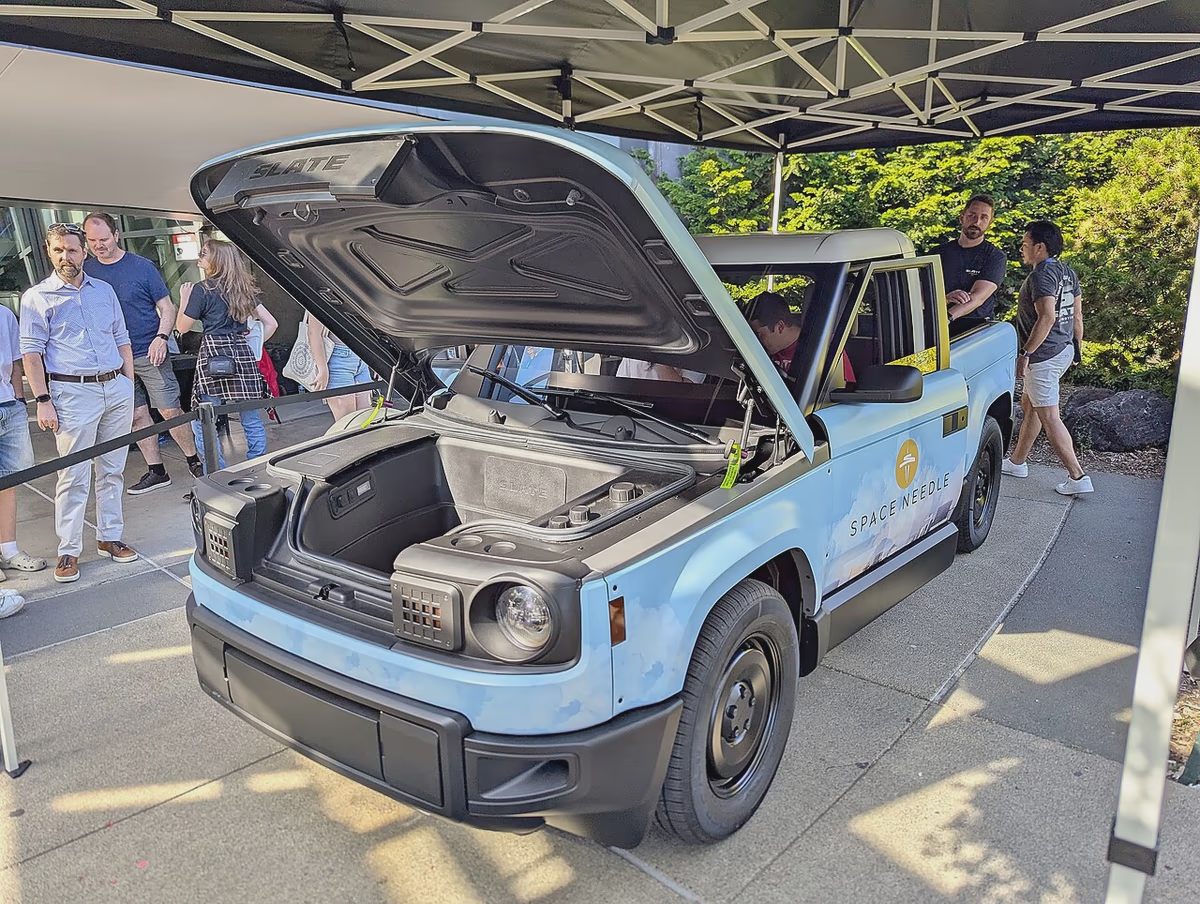
Slate Truck. I mean, the base model is also stripped of basically every luxury that’s been on a vehicle since the 1980s to bring the base price down. It does have airbags. There are no privacy issues because there is no entertainment computer, no GPS radio, no cell radio. Just a mount point for you to provide your own computer.
Designed around a starting price of US$24,950, the vehicle uses a simplified design with fewer parts and omits features such as an infotainment system, speakers, and power windows. All vehicles are to be produced with an unpainted gray plastic exterior and support customization through accessories and vinyl wraps.
The Slate’s base configuration, called the “Blank Slate”, will not include an infotainment system, speakers, or power windows. All units will be produced with the same unpainted gray polypropylene exterior, with vinyl wraps as the only offered way to change the exterior color.[13] A smartphone mount will be standard, and a tablet mount optional. The Blank Slate configuration will have fabric armrests and physical climate control knobs. The company plans to offer a large number of accessories for professional or DIY installation.[14]
There isn’t much there to have privacy implications. I haven’t looked at the (now government-mandated on new cars) tire flat detection system, whether it uses radio to talk to the wheels. Some people are concerned that vehicles that use radio TPSes broadcast a unique ID, and that that facilities ALPR-like logging of vehicles, though I’d guess that for most, that’s a pretty secondary concern to things like manufacturers harvesting data via phone-home.
That being said, it’s got a shorter range than, say, a Tesla Model 3, which could be an issue for some users.
EDIT: And just to be clear, since OP’s article is talking about the UK, I have no idea whether it’s available in the UK. Serial production should be starting in the US shortly, late this year.
EDIT2: NACS-based charging reports a vehicle’s VIN to the charging station when charging, which may be an issue from a privacy standpoint; the Slate can do NACS charging. 240V and 120V charging is a lot slower. It might be possible to do something like an NACS charger linked to a NACS->J1772 adapter linked to a J1772->NACS adapter to isolate the vehicle from the charger at the tradeoff of being limited to J1772 charging rates; I haven’t investigated this. I don’t know if someone makes an NACS->NACS device that doesn’t relay the VIN; again, haven’t investigated.
My vague understanding from past reading is that often cars that are stolen are broken down for parts, and the parts sold, which generally makes it easier to fence the stolen goods. I’d think that that’d defeat that.
There is a relatively simple solution to that problem, you can disconnect the system from the Internet by replacing its antenna connection with SMA terminators. Here’s an example with lots of details about it:
That seems like a lot to go through…though agreed, it makes it doable…and no car manufacturer has ever put a stock stereo in their vehicles that’s worth a dam anyway, so an awesome reason to rip it out.
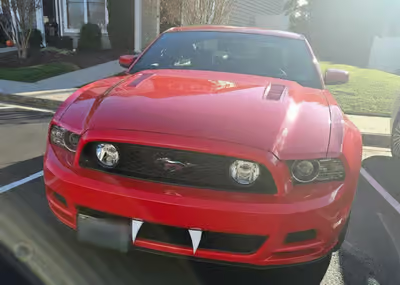
First thing I did when I got my Mustang was rip the Microsoft Sync system out of it. What an absolute piece of shit that thing is. (of course it is, it’s a Microsoft product)
It’s not even part of the stereo or radio on some cars, many will have a Telematics Control Unit that’s a separate box with those GPS and cellular data antenna connectors on it. It’s the owner’s choice to decide if they want to leave those antennas in place or upgrade to antenna terminators to permanently block cellular data.
My son has a 2023 GR Supra (BMW Z4 ish) The TCU antennas are also purposed to receive the transmissions from the keyfobs and such, so they’ve made it so that disconnecting the TCM fucks up the doors (and a number of other systems)
I know in other toyotas parts of the stereo / audio break when you disconnect the TCM.
Manufacturers need them to stay in place, because they make money selling your data…
Important to know that terminating the antennas is not the same thing as disconnecting the TCU. It’s just a “no signal” condition for the still-working TCU.
And terminating the antennas doesn’t guarantee no outbound traffic… hit the reception cone of a cell tower just right and it will get enough connection to upload it’s data…
I want it out. I ripped the Sync out of my mustang, it’s sitting on my workbench (just in case I sell it and the owner wants it back in) I don’t know that it collects data (that will then be uploaded via bluetooth connection to a cellphone) but I’m not chancing it. Micro$oft can’t be trusted.
Agreed. Even without internet connection, there still remains a ton of other stuff I don’t like about modern cars. I find them quite frustrating to drive honestly.
I’m perfectly happy with my -07 Nissan pickup and willing to drive it the next 20 years too if I have to. Just gotta try and stay ahead of all the rust.
My wife has a 2019 MDX, no internet at all. Must have been an option… We wouldn’t have bought it if it had it…
Now they have an option for bluetooth and an app if you install it on your phone… but that’s not a car connected to the internet, and we never installed the app.
My plan is to rip out their shitty infotainment system and replace it with something better as soon as I can figure out how to not break everything in doing so…
Now they have an option for bluetooth and an app if you install it on your phone… but that’s not a car connected to the internet, and we never installed the app.
From what I’m seeing its installed on all cars. The app was the primary way to interact with it, and it is indeed internet connected, including location services (so you can find your car on an internet map if you lost it) in 2019 models. The useful features required a subscription, but the basic features showing when you need an oil change (from vehicle telemetry) and being able to schedule service are apparently free for life. However, Acura disable the paid service July 21, 2025. I wouldn’t have any faith they disable the telemetry though.
The mobile phone radio is apparently in the TCU (Telematic Control Module) which was not an option but installed in all vehicles.
Ran a VIN search on the car, it is NOT factory equipped with AcuraLink. So looks like all the Hybrid’s, and all the Petrol models with the Technology package and up do, but the base MDX SH-AWD does NOT include the telematics system. Things like remote start and app based access are not available.
Thank god. I was beginning to thing we’d been lied to at the dealership (which would have resulted in us walking it back in and throwing the keys at someone). The LKAS (Lane Keeping Assist System) was bad enough (and got disabled week one). The stupid auto-engine-start-stop gets turned off as a part of the “start the car” routine since it can’t be disabled…yet. ;-)
Yeah, it’s going to get harder to avoid, seems like for some manufacturers, 2015 marked the entry of the “LTE in every car” trend, but for some manufacturers it’s later…
I swear my next car is going to have a carburetor again.
We thought about it…my wife has a short in-town commute and we considered it…but two things nixed it for us. The Internet-connected car, and the lack of physical door releases. There is no good reason the regular door-handles have to be electric, and it’s inherently unsafe.
Add that to the fact that the Condo association at our house doesn’t allow external chargers to be installed, makes it a non-starter.
I 100% agree about the door handles, but not all EVs have non-physical door releases. There are at least 6 from various manufacturers that are fully physical.
The internet connected car is every single car made today, unless you pull out a fuse, regardless of EV or ICE.
it can work, until you’re in a particularly strong cell network, then the traces on the board can pick up the signal, and everything gets uploaded in a burst.
By “nine times cheaper,” they mean the fuel for the EV can cost as little as 1/9th as much as the fuel for a gasoline / petrol car.
That’s great, as far as it goes, but depreciation per mile is usually a bigger cost than fuel. Other costs like registration taxes, insurance, and maintenance shouldn’t be expected to follow this 1/9th pattern either, of course. You’re not going to switch to an EV and find your total expense drops to 1/9th.
It feels to me like they’re telling an incomplete story on purpose.
A large portion of depreciation and insurance is fixed, not based on actually driving.
And maintenance is lower with EVs as well.
Still though, you are right, 1/9 is specific to fuel, and it’s deceiving. If it.were truly 1/9 we wouldn’t be having this conversation because all vehicles would be EVs.
Oh and don’t worry, if ICE vehicles go away, the politicians will find some way to levy an 8/9ths tax on something else to make up for not having those fuel sales.
We need to figure out how to pay for road upkeep somehow.
That’s not to say the way gas taxes are allocated to road maintenance now is perfect. Far from it. But on paper (at least where I’m from) that’s how roads are maintained.
Depending on the jurisdiction… Gas taxes go towards externalities largely. Roads are funded through general revenue. Perversely, those who don’t drive subsidize drivers.
If I could wave a wand that I dont have:
Gas tax to cover externalities
Tire tax to cover externalities
Toll fees to cover usage.
Reduce income tax and increase social assistance proportionally.
Obviously that would be impossible to sell, but it would be more fair, and incentive better outcomes.
Sales tax makes sense to cover roads because a lot of the wear and tear on the roads is caused by the trucks that deliver goods. Even if you bike to the store, you are using the roads in that way.
A vehicle tax applied to everything, based on weight, once we have switched to a majority of EVs.
Heck I would happily pay for my bikes, apply it evenly between everything, and I will pay £1 per kilo a year. Less than £40 for my bikes, but not sure many car drivers are going to be happy paying £1500 - £3000+.
Sill, a good way to get the infrastructure fixed, and maybe more people onto public transport or bikes
Im not disagreeing, it just kinda sucks that im in a VERY low paying with VERY high taxes for our area. In theory that means we should be getting better services. But its quite the opposite.
True. However as has prices rise the ‘savings’ should increase further such that the tax feels smaller compared to the fuel ‘savings’.
The other thing to consider is that high weight vehicles, think tractor trailers, but also EVs to an extent, do significantly more damage to the roads they operate on. I wonder if the proliferation of EVs will increase road wear.
If you think fuel tax is the majority cost of owning a car, you are going to be disappointed. And why shouldn’t car owners pay to maintain the roads? And how do you think that happens? If it isn’t taxes it will likely be tolls.
id hope so, currently much of it comes from general revenue and second order costs arent factored in, so for example heath care costs subsidise road use.
If it.were truly 1/9 we wouldn’t be having this conversation because all vehicles would be EVs.
“Battery-electric vehicles (BEVs) accounted for 97.8% of all new passenger car registrations in Norway through the first eight months of 2026, according to the Norwegian Road Federation (OFV).” source
“New energy vehicles (NEVs)—including pure electric and plug-in hybrid cars—accounted for a record 65.2% of new car sales in mainland China” source
Yes, strictly “to drive” (by which I assume they mean fuel only) makes sense. Medium term expenses are a mixed bag, like increased tire wear but no oil changes. Long term is a mixed bag as well, with an eventual battery replacement and depreciation, offset by the long term costs of a ICE drivetrain.
It’s clearly cheaper day to day, and overall cheaper in the long run. But it’s not all roses.
Maintenance is also much lower cost. I’m looking at upgrading the battery on my 2013 leaf. Its at about 90% capacity and it didn’t start with a lot of range. Upgrade is still under 10k.
depreciation per mile is usually a bigger cost than fuel.
OK, this might be something that a fleet manager would care about, but the average driver wouldn’t consider in a hundred years. You don’t have to swipe your card and pay for depreciation every four days. Not to mention that depreciation has no bearing on vehicle type and little connection to physical reality at all.
And if anything, EVs maintenance is lower than expectations. There is no robust recycling of EV batteries for instance because it turns out that the batteries last reliably for 30 years and most of the ones produced are still in service. Also EVs are by nature simpler, with many components being solid state. ICE are rube goldberg masterpieces, the result of decades of continuous development.
[depreciation] might be something that a fleet manager would care about, but the average driver wouldn’t consider in a hundred years
This is just so completely wrong I don’t know what to say. Have you owned a car? Have you bought a new car? Have you ever sat down and penciled out the numbers to see what you could afford? Have you spent any time budgeting for your household? Have you ever checked out a cost-to-own calculator for cars, of which there are many online? Have you perused any consumer advice on car buying?
Depreciation comes up, to put it mildly.
People who actually buy new cars* – the only people who matter, as far as the market goes – think about this quite a lot, because they’re usually planning to trade in after five years, or three years, or what-have-you. Depreciation is reason schmucks like me can afford an (old) car at all.
Depreciation is irrelevant and only brought up by combustion promoters. A car is a tool, not an investment in itself. The only relevant metric is overall yearly cost until the car dies.
Changing cars every few years, which is where depreciation matters, is an expensive luxury no one actually has to play.
No it’s valid argument as 2nd hand ev market still basically non existent in majority of the world. Solid state batteries are set to ship next year which will further depreciate all EVs while ICE vehicles have been solved 20 years ago.
EV brands tend to be less trust worthy too. For example here in Thailand 2nd biggest chinese brand (Neta) just went bankrupt tanking resale value.
Like a computer, socks or a can of fish, be the only one to use the car and you’ll never have to worry about depreciation and resale value. Trying to use it as an investment is for your own optional amusement.
Regardless, taxes and insurance are roughly the same. Maintenance on an EV is FAR less than an ICE car (no oil changes, fewer brake changes, fewer moving parts to replace over time). So if “fuel” is 1/9, and maintenance is just replacing the tires and putting in new wiper fluid, then driving is going to be much cheaper.
I don’t think they’re actually harder. Stiffer construction perhaps. If the rubber compound itself was harder, you’d be sacrificing grip, which I don’t think you’d want with a heavier vehicle with instant torque up the wazoo.
Quick googling session tells me that, on average, EV tires are a little bit more expensive (~10-20%) due to more exotic compounds used and last a little bit less (also about 10-20%) due to the weight, but they still have fairly soft compounds to retain good grip, which is good news because safety is the last thing you should sacrifice.
At the end of the day, each tire is a compromise, and you simply can’t get similar grip AND better wear AND better efficiency as an existing high-end tire unless you find some truly super exotic compounds, in which case it would have to go up in cost quite a bit.
There are also different compounds for different applications, I very much doubt a Nissan Leaf’s tire is comparable to a Model S P100D so the Leaf may very well have harder tires for better wear and efficiency, but unlike the P100D, you won’t be comparing it to a super soft sporty driving focused ICE tire either, you’d be comparing it with economy tires in an ICE vehicle that will also be somewhat hard.
Don’t teslas ship with perelli’s? Those are super soft tires…they grip really well but with the torque those things throw I think they’d last half as long…
I think thats only the “Performance” models. The Standard and Long Range originally came with Pilot Sport 4 or Primacy (which don’t last) and have since been replaced on all new shipping cars a few years ago with Hankook Ventus.
The depreciation of a car is less than the fuel costs. If a car depreciates by $20,000 over 10 years, that is less than $38/week in fuel. If it depreciates by $30,000, that is still only $58/week.
Even at today’s ridiculous fuel prices, 100 km won’t cost me more than about 15€ and that’s because I have an early 3.0 tdi, the ones made just one year after mine would do more like 12€ and smaller engines might be able to stretch 10€. Just talking highway kilometers right now, city kilometers are WAY too variable.
You can get a 60k€ EV with under 100k km on it for 25k€, roughly speaking. That’s over 35€ per 100 km in depreciation if you bought it new and sold after 4-5 years.
Even the currently ~25-30k ones might still have a few more years of rapid depreciation roughly in line with fuel costs I’d wager.
Where the market really gets interesting for the budget-constrained buyer is when actually good EVs are out of battery warranty for good. They should have reached most of their depreciation at that point, people still have a hard time trusting batteries because they’re more expensive to replace than the cars cost (yes, I know you don’t usually have to replace the entire battery and that failures are increasingly uncommon, but the average joe does not). Since actually good EVs outside of Tesla mostly started arriving around 2020-2021, that’s about 2-3 more years at 8 years of battery warranty.
Your 20k over 10 years only applies to cars that are already cheap. Which for EVs means I’d be stuck with an early Tesla model S or a Dacia Spring (actually that one can’t depreciate 20k over 10 years, it doesn’t even cost 20k). My love for turning wrenches and ability to usually repair even the most annoying problems, means that I can comfortably buy super depreciated luxury cars and keep them on the road for cheap. Equivalent comfort in an EV can’t be had in a cheap EV other than, again, a used Tesla S. I test drove an Audi E-tron and I found it lacking compared to what I can buy for just 2k lol
But a few more years and some EVs I like will have depreciated to under 20k, at which point I might as well go for it.
Where did you get this idea? EV’s go through brakes and tires faster than their ICE equivalents because of the extra vehicle weight.
Oh my, I think you just showed your hand about lack your of experience on the topic.
EVs (and many hybrids for that matter) use the brake pads significantly less than ICE vehicles because most of the braking energy is recovered from regen. I had a Prius for 9 years and sold it with the original factory brake pads still on it, with likely another 4-5 years of life on them.
My EV’s brake pads are still at 95% life even with the car being 4 years old.
I think its fair many don’t know about that. Its basically like engine breaking on ICE cars, but better as you get to recapture the energy. I have a motorcycle and often engine break.
Sounds like big oil propaganda you’re spouting. These are the kinds of talking points I hear from right-wing media.
The truth is EV technology has advanced quite a bit in recent years, and the batteries don’t deprecate as quickly as the anti-solar crowd still claims.
And as someone else already pointed out, EV maintenance is cheaper because there are less parts.
And road tax for EVs is bullshit, but the reason for it is that combustion vehicles already pay it because it’s factored into the price of gas. Or maybe that’s not the same in the UK?
Also, the headline doesn’t claim that the total expense drops to ⅑^th^, it says the cost to drive it does. That’s a very different claim from the one you’re pretending they tried to make.
I didn’t attack you, I said your talking points are similar to the ones I hear from the right-wing disinfo sphere. If you take that as a personal attack then maybe it’s time for you to look in a mirror and examine your media consumption?
I didn’t simply “not like some issue” you brought up, I disagreed on multiple points and explained why. Is that not acceptable to you?
your objection would make perfect sense if the headline was all about the cost to drive a stolen car.
Strawman argument. I never said that, and neither did the headline. It said “cost to drive,” not “cost to acquire and drive.” It did not imply that it would include the initial cost, and only a misreading could result in interpreting it that way.
Just like the “cost to run” a fridge is about the average daily kWh draw, and has nothing to do with the initial cost of purchasing the fridge.
Energy Star labels don’t start with “assuming you steal this fridge…” in fine print. They just tell you the estimated cost to run it every day.
It’s ironic that Trump’s oil war is driving decarbonisation by pushing up oil prices. But I guess him and his friends are making lots of money on US oil.
i would have already switched to ev in finland, but looking around for charging station and generally not being able to afford one holds me back. getting one used might be even more expensive if i have to replace the batterys.
i have a space on parking lot, not sure if the heating pylon can be used to charge. Though i would need to constantly go add more time to it if its slow.
Meanwhile here in California we have inflated electricity prices so much that fueling costs are almost equal. EVs edge out gas cars a little, but not by that much.
Just by googling the electricity prices in California, I’d venture a guess and say yes. Unless it’s particularly expensive to install there.
Here where I live, in Estonia, electricity is about a third to a half of the price of California if you get a fixed plan, or it gets super expensive in the winter when solar is useless, and super cheap (sometimes free energy, but grid fee still applies) in the summer when solar output is awesome thanks to the super long days, if you don’t have a fixed plan. Installing solar panels without hefty batteries wouldn’t pay off in 2026 (the only real benefit is on a fixed plan in the summer so you don’t have to use grid power at all). In comparison, California has way less seasonal variability in production and as I understand it, less seasonal variability in demand too (our heating systems haul ASS in the winter, our record peak power consumption happened Feb 5th of this year).
Unless it’s particularly expensive to install there.
It is famously expensive here.
In comparison, California has way less seasonal variability in production
It depends on where in California the installation is. We have regions that get significant sun year round, and others that are under a coastal marine/stratus cloud layer for long periods of time. We also have alpine areas that have seasonal weather like you’re describing, but relatively fewer people live in those areas.
Upside… the surfing is still good when its cloudy. :-)
You’ll have much less variability in the length of the day though. If you transported Estonia to North America, it would extend from the northern border of British Columbia and about a quarter of the way down to Vancouver. The shortest day is 5h36m in Tallin vs 9h17m in Redding, for a northern CA town. That sun will also be much lower in the sky in Tallin.
Yeah. System prices are getting more reasonable (since the end the Investment Tax Credit and the sunsetting of our sorta-favorable NEM2 net energy metering program), but new systems need a battery to be practical, so while the PV system costs are coming down a bit, the shit’s still pretty expensive.
You want me to cite an authoritative source for what? I’m just reporting my actual experience. You can cross check it against public utility rates and car efficiency if you want.
My EV is a Tesla Model 3. I average about 2.8 miles per KWh. I see claims of 4-5, but that’s not real world for my car. Best I’ve gotten is just over 3 while driving like a granny. My gas car is a Lexus hybrid, and I can get 40mpg if I drive it easy or on the highway, but I average 35 overall.
Public chargers are $0.40 - $0.65 per KWh. EVs get around 2.8 miles per KWh. If you use .50c, that’s 17.8 cents per mile.
Gas is around $5.75 to $6.75 per US gallon, and my gas car gets about 35mpg. If you use $6.00, that’s 17.1 cents per mile.
If you hunt around for the cheapest public chargers at the cheapest times (like midnight to 5am), you’re still paying about 30 cents per KWh, so 10.8 cents per mile, which is a bit cheaper than gas (but comes at the expense of your time). In any case, it’s not 2-3x cheaper, and certainly not anywhere close to your kinda crazy assumption of $10 per KWh. Maybe I’m doing the math wrong, but I don’t think so.
Maintenance on the EV has been a lot lower, so there’s a savings there.
But unfortunately when you look at the total cost of ownership the price premium you pay for an EV over it’s ICE equivalent here in the UK and the typical ownership period of 3-4 years due to the majority being “purchased” using PCP (personal contract purchase) that has a balloon payment at the end very few pay means most people will never actually make a saving.
I wouldn’t really blame the PCP. It’s not as predatory as it sounds at first, especially considering it uses the wording “balloon payment” for one of the options at the end of the term. The horrible value you’d get on a PCP is nearly the same as the depreciation plus interest you’d have on a normal car loan over the same ownership period if you were to sell. Meanwhile traditional leases are far less flexible, often not even offering a buyout option, let alone one at a price guaranteed by contract.
The bad value is in wanting to drive a new vehicle. There’s practically no upside to buying new over used, even if it’s only 30k miles or so on it.
For EV’s specifically people also drastically underestimate the battery lifespan based on early gen Nissan Leaf’s and similar early vehicles lacking a true battery thermal management system. There are excellent deals to be had for 3-4yr old EVs.
I had a coworker go on an insane rant about his hatred of EVs after somebody mentioned Teslas. I wound him up even more by saying I’m fine with EVs just not ones built by Nazis.
Poor people can’t afford cars in the first place and yet suffer most from all the negative side effects of cars. I see it where I live, the more deprived areas of town have less than 40% of households owning any cars. The rich side of town mostly have multiple and will be driving through the poor areas. Idling in their SUVs in traffic for ages generally. Ruining air quality for the people who live there.
I expect they will keep trying to hold back EVs and compete forever, so never let your guard down. There will always be someone, somewhere, wanting to pump oil and feed it to a combustion engine for money. They’ll say it’s their culture, for Jesus, for their family, to feed baby koalas, to revive a poor dead rat, or whatever it takes to burn some form of petroleum, change climate, and try to buy a yacht or an island.
I’m waiting for battery technology to improve in terms of power density and for infrastructure to improve in terms of power delivery.
My situation is admittedly unique, I want a low slung comfortable hatchback, I street park, and I need a car that can do 6 hours of road in a single day with no prior planning.
Since I don’t have a house, I can’t charge at home for peanuts. I instead have to go fight for one of the two 7.5kW stations in my neighborhood and move my car as soon as it’s done charging or get a ticket.
There’s also only one 350kW station on my way to and from work, and last time I tried it with an IONIQ 5, it took 35 minutes to charge and it was in the middle of buttfuck nowhere at a closed Ford dealership. Work has chargers, but you have to share the output with everyone else so I only gained like 3%.
To top it all off, battery technology seems to be preventing good long range EV hatchbacks from taking off. I tried the IONIQ 6, and it felt like I was sitting on the floor, but elevated. Bizarre.
I assume that electricity price sometimes goes negative when excess is produced, resulting in some providers paying you for using electricity at that time.
It’s precisely that. The winds blows and the sun shines, then suddenly the power company would rather pay their customers to use more power than pay the generators penalty fees to turn off.
That’s my main gripe with EV advocates. I can buy a 30k euros EV, or a 10k euros ICE car AND 20k euros of gas “for free” over the next 10 years (20k is 200 euros per month which is what I can afford for gas and repair).
A lot of people are poor around me, and they can only get the 10k euros car. EVs are a great idea, but it’s not for everyone right now.
People on a budget do not buy new cars. Yet EV critics sure are careful not to ever mention second hand EVs. Is that ignorance or strategic ICE promotion?
EV’s are crazy affordable, get one of the cheap Chinese imports that are a few years old. you dont live in a country that artificially restricts competition do you?
Not any more. Just bought an EV new for about the same price as I bought for an ICE in 2019 before adjusting for inflation.
They are getting cheaper as they get more ubiquitous. If you have an ICE that runs fine, don’t rush out to replace it, but if you’re in the market for a new car you should seriously consider EV.
EVs cost about the same as petrol cars these days. The two cheapest cars on sale in the UK are actually EVs. Not good EVs, but still capable of being city runabouts.
I own an EV (in Ireland). I would not say by any stretch I save that much as running a petrol car. It’s probably in the order of a third perhaps and that’s with a nighttime electricity plan where a kWh might cost 20c which works out about €4 at 15kWh/100km. A petrol car doing 6L/100km would cost about €12 at the moment. If somebody was using public fast chargers they would see very little savings.
There are other expenses like motor taxes, wear & tear (tyres, brakes), servicing, oil changes etc. which might affect the cost. The UK also has a really dumb excise on EVs where they get whalloped with 3p per mile of extra tax. So 100km (62.5miles) is £1.87 of tax to add onto the charge bill. Luckily Ireland doesn’t get it but most other expenses are comparable.
It wouldn’t be dumb if ICE vehicles were also taxed the same way but they’re not. There would be nothing to stop the UK government abolishing fuel tax and slapping 6p a mile or whatever on ICE vehicles
There’s going to be some fuzzy math hidden behind that article, I’d only expect a 9x difference when comparing lemons with melons, new small electric cars vs older non-hybrid SUVs for example. It wouldn’t surprise me one bit if they also ignored less favourable conditions like highway driving or colder temperatures. How they came by their numbers is mostly opaque, but I suspect that this source is pretty biased.
I do believe that if you need a new car and if you can charge at home, that EVs should now be a no brainer for most people. I just don’t believe this article.