There is really no point arguing about such details. AI haters don’t care how exactly you use AI. If you want the best, most secure software possible, you need to let the developers find whatever way there. Imposing arbitrary restrictions won’t work.
I’ll grant that bosses and managers have a valid role for keeping the work on track. But someone who tries that without being qualified themself will cause major problems.
I’m trying to highlight the absurdity of tieing buggyness to sloppyness, they are two distinct axis, not a spectrum. There are plenty of problems with LLMs but bugginess is not one of them. Idk if you’ve been watching the news lately, bug squashing in old code is up big time, can you guess why? And I wonder have you ever worked on a real codebase? Because the only perfect code is the code you wrote 5minites ago… go look at Linux kernel code… arguably the most used but of software out there, find me anything perfect in there… like what is going on here in this artisanal, hand rolled, organic code?! You’re arguing devs need more time to work on security, well guess what’s giving them more time to work on security…
Ps. Sorry to the Bluetooth dev, didn’t mean for you to catch strays, I love your code anyway!
There are plenty of problems with LLMs but bugginess is not one of them
LOOOOOOLOLOL
Idk if you’ve been watching the news lately, bug squashing in old code is up big time, can you guess why?
Lying megacorporations, most likely. What is the source of this information?
go look at Linux kernel code.. arguably the most used but of software out there, find me anything perfect in there
Please refer to my previous comment. You are once again pushing this ridiculous strawman that human written code is perfect, when no one ever said such a thing.
You’re arguing devs need more time to work on security
Yes. Trump’s deranged acts are seriously harming the US economy but also doing a lot of damage to the global economy. Anyone who blames AI for layoffs is effectively helping Trump/the global right by covering up their incompetence and failure. To be fair, Putin’s war is also causing much harm.
As for the layoff blame, just because I say I like hamburgers doesn’t mean I hate hotdogs. Layoffs can be happening from both those things, and just because people are acknowledging one source doesn’t mean they are helping the other source…
I said “leftist” in quotes. Almost everyone here self-identifies as being on the left, at least insofar as they oppose Trump. And yet… well.
I am skeptical if AI is already having a substantial effect on employment. In any case, I don’t think these people care. You don’t see anyone arguing for a better social safety net/unemployment benefits. Here’s someone saying that people lose their jobs over AI, but you also have people saying AI is useless. They really don’t care.
Layoffs aren’t the problem here…the problem is that society requires people generate their own worth through work, and suddenly a good chunk of that work is now significantly less valuable.
Requiring less work is a good thing. Humans should be striving to minimize work. That’s what humanity is good at.
The problem comes in that while the “input” of AI is, essentially, the collection of all human knowledge…while the output is money for a small handful of people…people who themselves contributed next to nothing to that pile of human knowledge (and in fact are probably running a deficit to it).
That ain’t right. We are all shareholders in the collection of all human knowledge. We should all be getting dividends from its work.
It should be noted that the input of all human knowledge is getting the door closed and locked behind it. Requiring you to buy tokens to access said information.
And if you refuse to provide more training data to their services that collect said data, like reddit, facebook, x, then you can’t access essentially the entire internet. With google locking down captchas to only “verified” android phones. And every website requiring you to sign up with a ID card, and locking you out when you use a VPN.
So not only will your jobs will be taken away but your autonomy and access to what used to be free information. Or not even information sometimes your job or access to a services requires you to use these things. Even just getting into your apartment with a RFID reader on your apparments official app. You have to exist in their panopitcon just to even exist in many situations.
Oh and the best part the only thing worth money in the ai industry is all your user data and how it gets fed into palantirs networks. From every single comment you make on their services, and everytime you order a cheese burger in public, that all gets logged because you are a domestic terrorist for thinking maybe we should hold these people accountable.
It also didn’t exist at all 5 years ago. Why are we as a society allowing new ecological damage? When will we stop? The billionaires want it to be never as long as it gives them money and power.
One rarely builds a dedicated power plant for a single building. It is more efficient to build large power plants for general use and use cable to transmit the electricity to where it is needed.
That didn’t answer by question at all, I suspect because you couldn’t think of way to twist running new gas turbine generators specifically to power these monstrosities into a good thing.
That’s an “I have no idea what I’m talking about” if I ever heard one.
“Citation needed” IS polite. You claim it’s not polluting, so clearly you know the CO2 emissions numbers from SpaceX’s datacenters that are being run off direct-connect to natural gas generators. So, how about it? How “not polluting” are they?
Unfortunately, as you can see, you are in a crowd of liars. Now, I am certainly not accusing you personally of being dishonest, but it does tend to bias your audience against you. Sorry.
The numbers aren’t particularly bad. It’s not for nothing that the EU has classified natural gas as green energy.
Hey, I think ai can be a useful tool and I use both cloud hosted and local models.
The ecological impact is god awful.
Datacenters run on fossil fuel turbines to meet demand when there isn’t enough capacity on the grid or just 24/7 because the residents of the nearby municipality said they don’t want brownouts.
Fundamentally ai datacenters transform expensive to transmit electricity into cheap to transmit data, financializing what was previously a relatively insulated commodity whose pricing and production reflect local demand into a globally traded commodity whose pricing and production reflect global demand.
If you don’t have a background in the history of industry and environment: that’s bad news for the environment (and anyone who relies on stable power rates).
Production of ai computing components requires mining rare earth minerals and phenomenal amounts of power. This is the same process with nearly the same inputs as the production of general purpose computing parts (if you leave off the increased rare earths needed to mitigate electromigration in single digit nanometer processes!) but the increased demand has already brought more fabs up to meet it meaning more use of resources and energy in production before the first kilowatt of inference is run on those chips.
Turbine blades for datacenter generators are also limited by production and are currently years out for delivery. These are components produced by advanced aerospace manufacturing shops which use massive amounts of energy to shape alloys of metals that have to be yanked out of the ground and smelted into some esoteric type of steel or aluminum first.
So even without the water concerns datacenters have tremendous impact on the environment.
But the water concerns are legitimate. Swamp chillers divert flowing water into the air where it is blown anywhere but where it would have flowed. Which is fine if you aren’t downstream of one I guess.
All this is to say: if you don’t care about the impacts you can rationalize that however you like, but they exist.
It’s a matter of framing. If you compare them to older datacenters they are atrocious because they’re bigger and consume more energy. But in the grand scheme of things all things IT pale in comparison to e.g. producing beef. Now with that framing you can’t sell AI hate though because people like beef, so it’s always just comparing large datacenters to smaller datacenters with the obvious results.
That’s an awful lot of typing instead of just saying “I’m a lying liar who doesn’t know what he’s talking about. That’s why I offer no actual data - because the actual numbers destroy my entire argument.”
I am sure I will be down voted on Lemmy for this but using AI for development by a team who is already experienced in development of the product they are working on is not a moral failing.
My personal experience but the people who blindly bitch about AI are, quite frankly, idiots.
I use AI daily for work it’s an extremely helpful tool as you stated. I still have concerns with it.
The difference is I understand human nature and the genie cannot be put back in the bottle. We need governance and standards and it needs to be a utility just like hydro, water and The Internet. There also needs to be a global UBI yesterday.
What people are bitching about with AI amount to the lack of control we the people have over it.
I’m surprised you haven’t been downvoted but I bet I will for calling a spade a spade in these people so rigidly opposed.
I don’t think anyone is “blindly bitching”. I think people have understandable concerns regarding its development, use, and proliferation.
The other idea that it needs to be a utility is straight from the wet dreams of every AI company. Realistically, the average person has little use for AI and it’s much more likely to be a detriment to them than otherwise. I know someone who is an exec in a big company and they get AI through their work. They use it for inane things mostly, but recently they used it to generate a list of reasons that their kids do need to go to school. This is an educated person with a good job who can’t figure out that AI has no idea what their kids need.
I don’t think AI needs to be used by nearly the number of people currently using it, but my bigger concern is letting anyone, be it a private company or a government, have access to something people treat like a magic answer anything machine.
If you think taking a picture of something and having AI identify it for you is something that 1) people should do on a daily basis and 2) the government should support AI as a utility for, then we have such different concepts of the world we want to live in that I don’t think we’ll come to an agreement here. I cannot imagine how that would be “highly useful in everyday life” for the average person.
The whole “You could ask a million questions” while supporting the idea it should be a utility is so weird to me. Like, yes, we could ask a million questions, and I think we should before suggesting it is a service that every citizen should be somewhat entitled to access from the government in some way (with all the caveats that come with a utility etc etc). It seems like you have fallen into the trap you suggest is inherent to human nature and you haven’t bothered to ask if we should do that.
What argument do you think I’m making and what facts does it run counter to? So a lot of people use AI. That has no relevance to my point at all. Unless you’re using popularity of a tool as a proxy for if it’s good or not, it’s irrelevant to my position. Nuclear proliferation was here at one point, CFCs in everyday consumer products, smoking. There are plenty of things that were popular that we decided were not good for us as a society and we worked to make things different.
I never said it was unpopular, I said that many people using it have no real need of it and it may be doing more harm than good in many cases. I can say for a fact I know several people who use AI and are worse for doing so. Your own links suggest a majority of the people using it don’t find it actually helpful and that they want more control over their interactions with it. That doesn’t strike me as a population of people who can’t wait to embrace AI or embrace having their governments responsible for ensuring access to it. To be clear, even if they did mostly find it actually helpful, I don’t think it means that we need to be providing it.
Full disclosure, your second link was inaccessible to me so I am going off the data in the other links.
i trust no business to use ai coding properly, they cut so many corners in crunch already that pure unfiltered slop will for sure end up committed
we already see this with microslop windows 11 updates
it is even worse that many coders think it makes them better at their jobs because given how many issues pop up with factual ai use elsewhere i am sure no one rational expects coding to be exempt from this problem, so the least knowledgeable will be the most impacted with false assurance or worse we have other agents validating agent generated code that never has human eyeballs on it
slop-centipede of shit code
the biggest coding bugs either fail silently or succeed incorrectly and ai usage makes both of these worse
Again based on real world experience I disagree. The problem is the people doing the AI coding and how they were before?
I have a strong coding background. I know what AI is coding for me. I give it strong guardrails. It does for me in minutes something that would take me hours. I will still review and QA what it does.
The problem is people who use it to built a monolith of code and I’ve seen my fair share of that AND documentation driven by AI. It’s unneedingly obtuse and verbose and reeks of people who do not know what they’re doing.
There is a huge difference in telling AI to “build me a website in Django” vs. “build me a function to do xyz when the parameters are abc and the return value needs to be lmn”
Ok? But that’s you. I don’t work for Microsoft I work for a major financial company and I have not seen the disastrous impacts you are seeing nor are we rolling out end user software.
The crux of that article is buying into Heidegger‘a definition of a tool, specifically, “thing that lets you do something you wouldn’t otherwise have been able to.” If you disagree with that premise, the article doesn’t hold up.
Tools aren’t about letting you do something you would otherwise not have been able to do, they are simply a force multiplier for capability or efficiency. You still need knowledge and skills to do the thing.
I am not a carpenter. My knowledge and skills are near zero. This multiplied by any number is still damn near zero, and I have no idea about the culture, safety, or history of carpentry. I’m not stupid enough to jump right into using an lathe without a lot of research or someone to guide me, because I’m not a fucking moron.
People with programming knowledge and skills using AI will eventually figure out a workflow that works. Laypeople using AI to vibe code? They’re probably fucking morons. Sure, maybe even most of the time, it will be fine. But eventually, someone is going to be degloved.
That’s something I see in my workplace even without AI, just with coding/scripting/automation.
It helps you do things faster. It doesn’t ensure you’re doing the right thing (unless you have someone skilled build in all the guardrails).
So many of my coworkers are at the “This chainsaw is amazing! I bet it would be great at driving nails!” level of scripting, and AI is only making them more reckless.
I was ready to roll my eyes at the title and move on, but i’m glad I spent the time to read this.
TLDR; i very much disagree with the premise, but the author brings up an interesting bit of philosophy that is helpful to the conversation.
When people say “it’s just a tool”, it is not to assert that the tool is neutral, only that the thing being referenced should be thought of and discussed in a similar fashion as we do when discussing other items in the same category. This is in opposition to the tendency to ascribe moral features or aesthetic to things that aren’t inherent to their ‘essence’, but rather features external to the thing being discussed or features that are commonly shared by items in the set but not exclusive to it.
What comes to mind (possibly because of the great effort it took to read and understand it) is Deleuze and Guattari’s conceptualization of the ‘assemblage’. Here’s an excerpt from "A Thousand Plateaus (that happens to contain my favorite passage in possibly all of philosophy) that I think adds a contrast:
spoiler
[…] These affects circulate and are transformed within the assemblage: what a horse “can do.”They indeed have an optimal limit at the summit of horse-power, but also a pessimal threshold: a horse falls down in the street! It can’t get back on its feet with that heavy load on its back, and the excessive whipping; a horse is going to die!—this was an ordinary sight in those days (Nietzsche, Dostoyevsky, Nijinsky lamented it). So just what is the becoming-horse of Little Hans? Hans is also taken up in an assemblage: his mother’s bed, the paternal element, the house, the cafe across the street, the nearby warehouse, the street, the right to go out onto the street, the winning of this right, the pride of winning it, but also the dangers of winning it, the fall, shame … . These are not phantasies or subjective reveries: it is not a question of imitating a horse, “playing” horse, identifying with one, or even experiencing feelings of pity or sympathy. Neither does it have to do with an objective analogy between assemblages. The question is whether Little Hans can endow his own elements with the relations of movement and rest, the affects, that would make it become horse, forms and subjects aside. Is there an as yet unknown assemblage that would be neither Hans’s nor the horse’s, but that of the becoming-horse of Hans? An assemblage, for example, in which the horse would bare its teeth and Hans might show something else, his feet, his legs, his peepee-maker, whatever? And in what way would that ameliorate Hans’s problem, to what extent would it open a way out that had been previously blocked?
The author here is correct to point out that tools are not neutral - and the connection to Heidegger’s conception of the Gestell is very well received. I just wish they hadn’t stopped at their conclusion and actually kept the analysis going. Taking their example of SUV’s engendering ‘asshole driving behavior’ - it isn’t just that the existence of SUV’s bears a causal relationship to asshole drivers because of what that gestell produces, but that the existence of SUV’s reshapes the relations of all the other assemblages in close proximity to it regardless of how it’s used and by who. They even kind of preview this more balanced conclusion in their comparison of javascript and vue, stating that it’s not a matter of one being better than the other, but simply that they have different purposes and enable different types of collaboration.
I think the entirety of the problem of this argument could be captured just in this part of the blog,
After all, all kinds of fascinating weapons systems are being used in defence of freedom and democracy in Ukraine, and this is both good and necessary, but none of this makes the effects on leaders of having access to bombs and artillery, or on individual people of having access to firearms, not ceteris paribus deletrious.
All other things couldn’t possibly remain ‘equal’. The addition of those tools fundamentally changes the relations and constituent parts of all the assemblages around it, including concepts like “freedom” and “democracy”. To take it one step further - if the signs and symbols that refer to those assemblages and relations - that have now necessarily changed by the new addition - do not also change with them, then they simply stop being practically useful to describe them.
Any tool is going to have a non-neutral affect on those who use them - that’s mostly the point of the assertion.
Go live under a rock then because that applies to almost anything in life. Selective morality is fine but when it is to be a science denier you are just a fuckwit.
If the developer reviews and understands the code and what he is doing, AI is just a tool. I trust Linus and GrapheneOS to be able/capable of this. People are just tired of AI being shoved everywhere, steal jobs, etc. I completely understand but, there are cases where it is useful
Nuances?! on MY Fediverse?! tbh im also mostly with Linus and also do not expect his PRs to drop in quality, because of it. He does sometimes say weird things regarding AI though, like that its a great way for upcoming developers to learn and I do not think that is really true, but again: Nuances. I myself keep AI usage minimum and in the constraints of a chat bot, not because its not useful but because I dont wanna get stupid :(
GrapheneOS and Linus have always had a god complex and took the stance their way is the only way. I have never respected them as the arbiters of the correct path others have. (I know LineageOS exists but not much else so can’t speak to them).
I respect them putting in the effort. I respect them trying. I’ve contributed where I can because the overall goal of data privacy and digital freedom is one I agree with. But to hold them on a pedestal as always right is, yes, still a dumb take. I’ve never seen anything that made them the end all be all people seem to hold them up as. Solid voices who’s opinion should hold more than average? Sure. But that’s it.
Yes, Linus is smart and has had good takes and can produce code used by most every computer in one way or another. That doesn’t make him infallible.
Its not about putting linus on a pedestal… its about these anti-AI purists declaring everyone who uses AI a nazi and all code is slop. Big tough guys saying they wont use software with even a single line of generated code.
Go ahead, fork the linux kernel then… these people will never be able to follow through with their purism, unless they go full templeOS mode
I dislike AI overall, but what i’m starting to dislike almost as much are these anti-AI purists who are holier than everyone
I mean this in the worst way possible. Your attitude mirrors the far right and is just as bad a take. That’s their approach to everything.
“Oh, you’re fighting against something you see as a danger to literally the entire world? Well if you’d just stop shoving your opinion in our face we’d be happier.”
He doesn’t care for misguided opinions not backed with anything but emotion. The people he is talking about don’t actually look into the issues and fight those, their mind is set that AI is evil and you are too for any usage of it, without actually understanding anything about the situation.
There are situations where using AI uses less power than traditional methods, there are situations where the power is clean, hell there are even models getting made that don’t use stolen data. Some people use it more responsibly (use tiny models where possible) while some toss everything at whatever new Fable or Opus is available.
There are levels of AI usage and their blanket statements with no understanding are annoying because it alienates the people that are responsible with their usage.
It absolutely is something I struggle with. To me, I know LLMs are just called AI but aren’t, and machine learning is not LLM. I’ve actually developed a neural network based program for a previous company before and know it can be useful in certain cases.
But how do I know the person I’m talking to knows that? How do I know the person is one of the minority who is trying to do it ethically and responsibly? How do I express just how truly damaging the current mainstream “AI” methods are succinctly and strongly without getting bogged down in that discussion and sidetracked from the bigger picture (which is exactly what’s happening here in this comment for example).
AI is Evil -> Irresponsible AI use is Evil
AI destroys the environment -> Irresponsible AI use is destroying the environment
All it really takes imo is a small adjustment of words to change your stance from looking like zealotry to actual concern for the issues. I also think these sidetracks are important, to be fair. Otherwise we wouldn’t have had this conversation to deepen our understanding of the issues.
I would be more than willing to agree if the message was “Frontier AI labs are causing massive harm to the environment by facilitating irresponsible use of AI” rather than “AI is evil, fuck you for using it” (not saying those are your words, just getting my point across lol)
I have tried that shift from “AI is Evil” -> “Irresponsible AI use is Evil” and what I found is everyone then goes “well I’m one of the responsible ones” and we end up right back where we started with them pumping every thought into a prompt and churning out whatever with no regard. Humans are very skilled at believing they aren’t the problem and are the hero of their own story.
If however, the lazy approach is taken of “AI is evil, fuck you for using it” (those are my words but with the asterisk of if you truly are part of the 0.01% using it responsibly then ignore me) then people understand that, yes, I mean you guy running claude code to “write” your next big app.
It’s the same problem of why marginalized people get overlooked or alienated in general. They’re in the margins because they aren’t the norm. Not saying it’s good, just this is more of that and I’ve never seen a good solution.
I explicitly did not call you a Nazi or far right. I do see how what I wrote could be interpreted that way and isn’t my intent so my bad on that one.
I said that that’s a far right attitude to take. Shutting out the opinion of people against it because you view them as obnoxious. Nothing good will happen if we all did that in my opinion.
I never shut out opposing opinions… i merely said that i’m irritated by the anti-AI purists…
"All AI is facist and you are a facist/far-right/nazi if you use even a little bit of it " (not what you said, but a very common statement on lemmy)
“AI is a potentially useful technology that has a lot of negatove externalities. Let’s work together to reduce the negatives and take the power back from big tech.”
Which one of those stances sounds more like “Shutting out the opinion of people”?
I’m gonna point you at the comment chain I’ve got adjacent to this with Zeoic if you missed it. I think it’s ultimately dancing around the same stuff and expresses my thoughts more cleanly on this topic.
I am not a coder in any fashion but this is the make or break frontier for development, particularly FOSS and small scale projects.
AI is evil.
It is an ecological nightmare, socially and economically distructive, prompted on the theft of the knowledge and work of every creative endeavour any person as ever made and pointed at rendering pointless any future aspiration of individual creation someone may have.
The association has been made and it is not going away.
grapheneos.social/@GrapheneOS Here you go, argue with GrapheneOS - it’s an open platform, go ahead and make a masto account and share your thoughts with them. Tell them what you think! The rep who handles their masto account is very well spoken and presents rebuttals of value so I advise you bring your A game.
I’m not brigading anyone. They have their reasons, I have my view regarding AI, that is it. I did not attack the GrapheneOS team in any way nor do I intend to.
“Ai” isn’t inherently evil. It’s just a tool. An incredibly interesting and marvelous tool, in theory.
What we make of it and how we use it matters. Noone needs stupid chatbots. People should only be allowed to use them after graduating an exam of what they actually are and how they work. In the current state they’re 90% bullshit and harmful.
But LLMs surely have great and reasonable applications. People often fear what they don’t really understand. And LLMs really are a topic that often even “techies” don’t get, so why should a layman.
Yes, they are environmental Desasters. But try to substract all the trillions of silly nonsensical queries millions of people hammer into chatbots, that once were simple search-engine - queries. And it’s not THAT bad anymore.
I’m just going to quote myself, as I’m satisfied enough with the answer I wrote to another reply.
As it exists, as it was created, “AI” is evil. It consumes resources we can’t afford to waste and is currently supercharging our pollution indexes and creating what may be a catastrophic collapse of already very fragile and unbalanced social and economic realities. And because we are already into the sunken cost falacy fase, it will never be rewritten or rebuilt. Hopefully, it will collapse in such horrifying way it will create a cautionary tale, but we are not so lucky, so what we are left with is picking up the bits after it.
This kind of system had to be developed inside laboratories, colleges, universities, research centers, to aid into very niche and specific fields of research, not made to be a mass consumption comodity as it is. But it was, unfortunately, not done that way.
You are confusing capitalism and ai. AI is just a tool. Capitalist will use any tool it can to hurt labor. This is currently born out by history recent and ancient. The luddites attacked the looms not because they were evil. But because the bourgeoisie were using them to exclude and attack labor.
The looms, the automated treshers, the tractor, whatever machine designed to a fullfil a task that displaced human labour wasn’t designed with the objective to render humans useless. There were periods of transition when people hurt, needlessly, if I may say so, but new occupations emerged.
This is not the same.
For the first time, we are faced with a technology that feeds off human achievement to be built and next states it can dispense and completely replace what enabled it to be put together to start. While consuming resources we can not afford to waste and returning nothing of value.
No, it’s a literal analog. There will still be people operating AI. Even using your own terminology is literally the same.
And I don’t even know where you’re going with the last part. I suggest you familiarize yourself with what AI is actually capable of. The biggest danger of AI is not that it hallucinates more than someone tweaking on meth. But that people dumb and tweaking on meth with too much power will take what it says as gospel. Your liable to make the people in the marketing Departments of these AI companies cum with how badly misrepresenting what these AI are capable of. The same AI that some companies fire their workforces for and are now humiliatedly hiring them back. Because the AI wasn’t capable of what it was sold as.
We are talking about a technology that been prompted, since its inception, as the leap that would render human work unnecessary - which is false under many measurements.
When that failed, it was then repackaged as the technology that would enable any person to do anything: write a book, a song, create the new Mona Lisa, write any program they needed or wanted, etc. And again, it failed.
Any major development was always geared towards solving a concrete, tangible, problem. For AI, every proponent for it is trying to find problems to fix with it.
I don’t care about the promises of AI. I care about the cost of it, now and future. It’s not a hand full of niche applications that are going to impress me. Put it towards research, make it truly useful, in the hands of people capable of forcing it to produce results and audit and validate them. It is not a toy, it is not something that can replace human beings in any measurement, it is not something people should be relegating their autonomy and individuality to, which is happening as we are having this conversation.
No need to reply to this. I’m out. I don’t care for any arguments in defence of AI and it’s potential. I’ve made my choice. Keep to yours.
It’s not a defense of AI. It’s a pushback on your hysterical flailing against all forms of it. And your inability to engage rationally on the subject. Case in point you hand wavingly deny my point while providing a list of evidence to support it.
If you are going to protest the current deployment of AI, the AI isn’t the problem. The actual issue is the grifting petit bourgeoisie looking to gate keep it as they continue to grift. Destroying everyone and everything in their path. You’ve shown that you know the generative AI isn’t what it’s sold as. But oddly you attack those that technically agree with you, simply because they won’t histrionically flip flop between that and all AI bad!!!1!!ONE!
You have the right to express your opinion as you may please but you’re not entitled to have me respect it nor respect you for it, but I digress.
This isn’t Reddit, sadly, because otherwise I’d give you gold for that comment.
By that logic, when all human labour - and I do mean all of it, with no exception - is no longer necessary, thus no income can be earned by any part, how will people survive? I expect them to be, at least, entitled to move out of the way and silently and peacefully disappear.
It is. It really is. At any point on any other endeavour, someone said it was enough and the costs did not justify the results. Not with this. So, it really is hard to understand.
Just because it was a nicely worded statement, doesn’t make it universal.
I use a local LLM for our smart home. It wastes a Lil bit of energy, which is still faaaar below my 1500W while gaming. Is gaming evil now?
It helps dramatically in ways that were never possible before like “turn on all lights at 40% in the color purple and also turn on music. My fav playlist” followed by a “no, use a warm color and close all windows”.
Not every LLM is a fucking chatbot that eats the planet to “create” a shitty cat-meme for Granny’s Facebook.
Don’t assume everyone uses silly chatbots. That is ONE application of LLMs, and it is indeed stupid and kills out environment for basically no benefit.
The problem you’re encountering is that every human defines evil differently. Those disagreeing with you seem to define evil to include “detrimental to civilized society”, which does at least come from an objective premise, even if you don’t agree with the assessment.
Through that lens, the good it does for people simply cannot outweigh the bad, because they believe the bad to include the end of society. That is what you’re arguing against, and why people with that view are so energized and are unmoved by the counter-arguments. If you want to change their minds, you would first have to convince them their premise is false, not just their conclusion.
Well, tbh, if someone has an opinion that isn’t swayable by facts, why should I take that person seriously? It’s like talking with religious nutjobs. They already have all “answers”.
The facts are clear, relatively simple, and accessible by everyone. And “evil” is generally considered bad. But LLMs are not just “that precise one thing” that could be declared evil. It’s a concept. The application of it changes the good/evil attribution. Chatbot? Obviously bad. Helping to determine cancer in a Patient? Good.
Etc.
If people don’t WANT to argue because they already joined a “AI is the devil”-cult, so be it. Not my job to convince anyone of anything 😊
Their opinions may be swayable by facts, but not just any facts. You would need to present facts that confirm that their specific objections are unfounded or overblown.
Facts like “its here to stay” and “it allows you to write more code in less time”, etc, do not address their objections. Stating to them the ways in which it is good does nothing to counter their conception of the ways in which it is bad.
And that’s the nonsense about it. We’re not talking about cars or such, but a general concept.
And most likely take one or two specific applications of it and use it as a definition of the thing itself. And even with cars you couldn’t condemned them because tanks exists, and ignore ambulances or such.
Also, it’s usually the exact same group that also mostly uses products of what they hate so much. Microsoft, google, Facebook or any us-american bigtec. If LLMs would be as bad as they say it is, stop funding it. Simple. Really really simple.
I don’t use any of those, so it’s possible to actually protest besides big word and vote by wallet.
AI in concept is not evil and could be a good thing .
Unfortunately, its implementation has been at the hands of rapacious, avaricious, and narcissistic über-capitalists, which has inextricably linked AI with the evils you enumerated.
In a different timeline, AI was developed slowly, using heavily-vetted and legally obtained data, and rolled out in an intelligent and safe way.
We are better off leaving the appeal to alternate time lines for another conversation, preferably around science fiction or comics.
As it exists, as it was created, “AI” is evil. It consumes resources we can’t afford to waste and is currently supercharging our pollution indexes and creating what may be a catastrophic collapse of already very fragile and unbalanced social and economic realities.
And because we are already into the sunken cost falacy fase, it will never be rewritten or rebuilt. Hopefully, it will collapse in such horrifying way it will create a cautionary tale, but we are not so lucky, so what we are left with is picking up the bits after it.
This kind of system had to be developed inside laboratories, colleges, universities, research centers, to aid into very niche and specific fields of research, not made to be a mass consumption comodity as it is. But it was, as you very well put it, not done that way.
AI is not evil. It doesn’t have a consciousness. It doesn’t make decisions.
What is evil, are billionaire capitalists having full control over the technology.
What is evil, is the concept of closed-source.
What is evil, is stealing all creative works without attribution or compensation.
What is evil, is seizing essentially all the silicon to build these datacenters, then soak up all the electricity out of the grid and all the water out of the ground.
The problem isn’t the AI, itself. It’s the means that’s the problem…not the ends.
To summarize: something that is being created through highly destructive amd predatory means, by completely deranged people, is not evil.
I can’t disagree more. And to quote myself, again, today:
As it exists, as it was created, “AI” is evil. It consumes resources we can’t afford to waste and is currently supercharging our pollution indexes and creating what may be a catastrophic collapse of already very fragile and unbalanced social and economic realities.
And because we are already into the sunken cost falacy fase, it will never be rewritten or rebuilt. Hopefully, it will collapse in such horrifying way it will create a cautionary tale, but we are not so lucky, so what we are left with is picking up the bits after it.
This kind of system had to be developed inside laboratories, colleges, universities, research centers, to aid into very niche and specific fields of research, not made to be a mass consumption comodity as it is. But it was, unfortunately, not done that way.
“Evil” is a subjective term, so it is difficult to make headway in discourse using terms like that. I feel that using objective statements are more effective. Someone that thinks AI is “evil” would do better to say something like “I believe this technology to be a net harm to human society.” While difficult to verify and quantify, that statement at least still is verifiable and quantifiable, unlike “AI is evil”.
AI is a tool, like a hammer, and should be used as such. And like a tool should require training. The problem is people aren’t using it as a tool and rather look at the hammer and say “go build me a house”. That’s where the issue is. Does a hammer know how to build a house on its own? no. does AI excel at end to end builds? no. but people are using it for said end to end builds.
Devs, vibe coders, god knows who else still to this day fail to understand that AI doesn’t understand how to build things correctly. All the agents care about is getting to a solution as quickly as possible to retain a userbase. that’s it. will what ever it builds scale? no. will it be full of exploits? very likely. will it be able to refactor whatever it wrote? no because it will believe YOU wrote it. so upgrades/improvements to whatever are virtually impossible.
THEN you combine all that with the fact that EVERY AI’s training data, currently, is incredibly out of date. Tech moves too fast for it. So you have people building shit with libraries and what have you that are already out of date and they don’t know that.
I think with OP’s analogy, a nuclear weapon is no longer a tool, because the actual tool (nuclear technology) was crafted into something (weapon) that does a specific thing (destroy). But I guess OP should’ve used LLM and machine learning instead of AI.
Nuclear fission has been used in nuclear reactors for good, and was exceedingly efficient at that time, and has been a significant factor in the recent human history.
Just as it’s been with the “evil” use in nuclear weapons.
I’m not aware of any breakthrough that has not been used for both good and evil.
That’s a great example actually, you just have to differentiate between a nuclear weapon and a nuclear power plant. You can split atoms to build a bomb or heat water, the concept of splitting an atom itself isn’t evil.
Good justification to why GOS is right to use AI to detect vulnerabilities. The only true way to protect yourself from an enemy that has nuke bombs is to have some yourself.
Ukraine gave up its stockpile in exchange of promises from both Russia and NATO that no harm would come to them, and would there be harm from one side, the other side would come and help them. They were betrayed by both sides.
AI is very efficient at finding vulnerabilities. Among a see of false positive, they find real ones. It’s much more efficient and faster than human auditing code. So either it’s GOS using it, finding them and patching them, or it’s… someone else.
A tool built through nefarious means and consuming resources it should never had chanelled into it.
Then, taking from your words, if the information these machines are working is by default outdated, why insist in feeding it with more and more and expect different outcomes?
How do you know? Honestly, how can you claim a given author will relay to a meat grinder the effort of compilling a work they will sign and be responsible for?
One added curiosity from me: at what point has the colective surrender of independent thought and action been signed and by whom?
And a final question but feel free to skip this: do you rely completely on LLMs to complete your daily life tasks or are you still able of doing things by yourself?
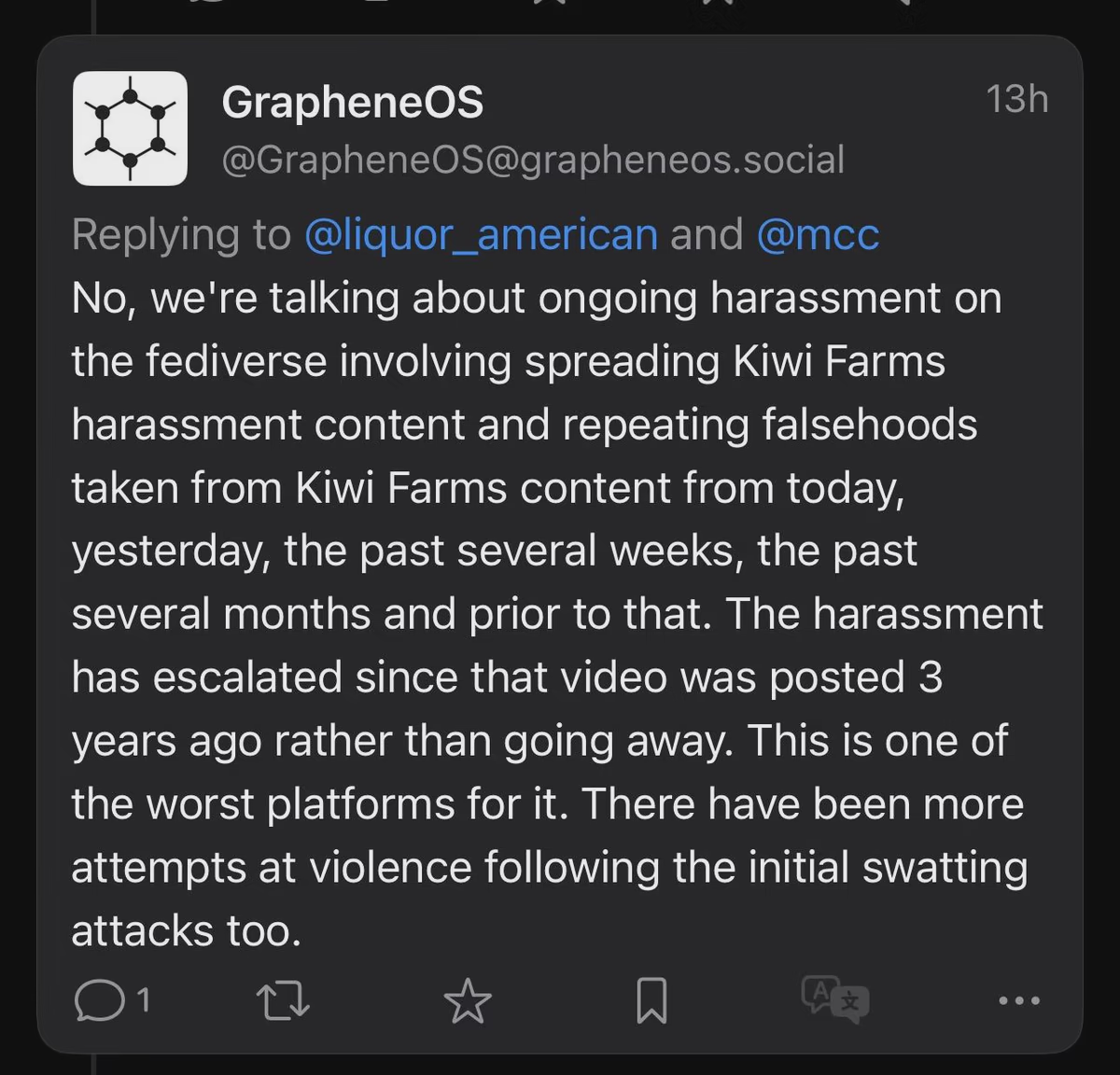
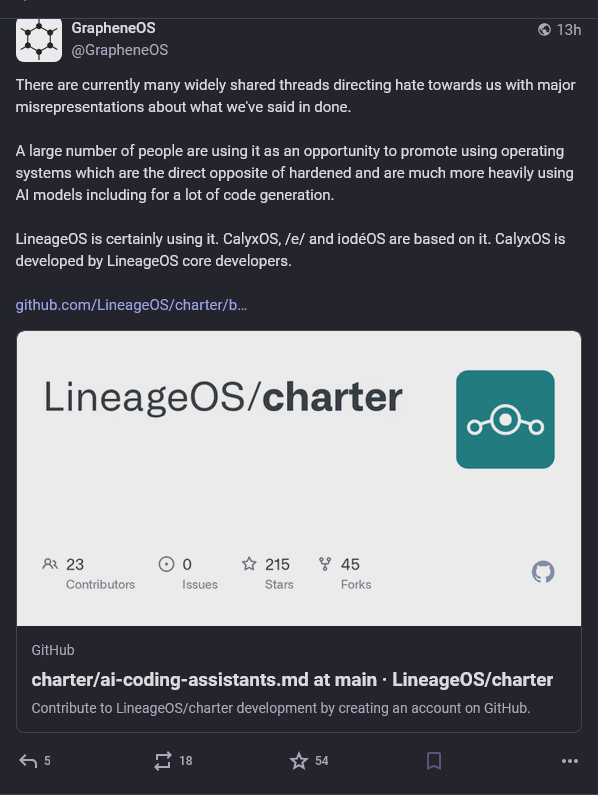
A large number of people are using it as an opportunity to promote using operating systems which are the direct opposite of hardened and are much more heavily using AI models including for a lot of code generation.
LineageOS is certainly using it. CalyxOS, /e/ and iodéOS are based on it. CalyxOS is developed by LineageOS core developers.
Since LLMs are essentially built from code, I have an easier time believing that coders can get a benefit, especially at the Individual level, within the frame of having a coding background and being able to audit, directly, the code that the machine spits out. But basically everything else happening with, and surrounding, these fucking things is atrocious.
The objections of many are not focused on whether or not it is useful, they are about whether or not it is ethical to use.
Many object to the fact that it was trained on the works of others with no renumeration or accreditation. Others have objections to its resource efficiency compared with traditional methods. Still others have concerns about the long-term health of codebases written with it. I’m sure quite a few have all three objections.
These are all concerns that will need to be overcome before this technology will stop being controversial and many refuse to touch it or anything it has touched.
It’s not infighting (oh well, if you want to see that, check any other post from GOS when they talk about privacy and security of other Android distros…). They quite legitimately ask why GOS using AI to detect vulnerabilites has triggered such a shit-storm while every other distro accept LLM generated code and no one seems to care.
Windows clearly does. Linux kernel does. MacOS has built-in AI features and XCode has support for AI agents, so one would assume they also use it in development. Do you have some other 3 major OSes I don’t know about? Are you on FreeBSD? Cause uhhh freebsdfoundation.org/…/freebsd-ai-assisted-vulne…
Well, I hardly use my PC and was just forced to get one for a job to do email bullshit, so in my day to day, yes. And Ive been exploring getting a basic ass flipphone and a atlas instead of relying on googles shit GPS system, I already use OSM instead but still.
if you are using a computer or phone, you are running AI-generated code. it is rather dire. the best you can do is limit your use of this fashtech in other areas.
I'd fork a lot of software if I had the time and skills, an OS is a bit too much for me. I'll happily donate to good projects that come around though, I'm just not feeding money to ones that are feeding that back to billionaires to build datacenters for fucking AI.
Defenders of genAI might as well hoist their vintage early 1940s German flags while they’re ahead! Though I suppose an Italian or Japanese flag from the same time period would also work as well.
elon musk owns a company that has a few models, but if someone wants to try using the already flaky argument of “nazi bar” with something as detached as “one of them likes/funds it so everyone that uses it is a nazi” it tells you how little they think “nazi” means
Well, I conflate Nazism witg fascism and same goes with genAI. It’s already a link in mg head, ao I’m trying to stay as far away from things using genAI coding as well. Keeps me from having to remove the label of “person” from myself.
By genAI I mean generative AI, like mistral and stable diffusion.
So yeah, I would include them the same way I would include things like craiyon or perplexity.
As a creative, the fact that almost every genAI model in existance relies on training on copyrighted works¹ is more than enough for me to hate it. There’s a reason why even the RIAA is in a lawsuit against suno, that seemingly hasn’t been settled yet. Despite them being the devil, I would still support them before supporting genAI.
I do not care what anyone else thinks about it. I have made it a life goal of mine to see to it that a future where genAI ( and the creatures who willingly use it ) are minimized as much as possible in society at just about any cost.
Do I sound deranged for all this? Yes. Do I care? No.
Edit:
I am also not hearing any of the genAI companies calling out things like how grok was allowed the feature set of undressing literally anyone without consent. Most I heard was backlash from everyone else. Similar thing to that one “person” on r•ddit trying to recruit people to try and strip away the effectiveness of tools such as Glaze and Nightshade off images illegally scrapped ( or at least should have been more than illegal ) from a site made for real artists ( those who do not use genAI for their work at any point ). Haven’t seen any backlash from any of those creatures or any of the companies responsible for creating those creatures.
Consent in the realm of genAI is as real as in the realm of rapists and I will defend that view until I die.
I hate the RIAA as much as the next guy, but I hate genAI slightly more. Would rather temporarily support the devil I know than the new devil on the block if it means furthering my agenda. Simple as. I tend to be more progressive on basically any other issues, especially since the past few years where I have grown as a person, but genAI has brought out some of the worst in me.
I don’t like GOS devs, they are not focused on usablity, but on security (which is completely valid, but it’s a shame that GOS is the most usable mobile OS), but holy based.
If you are disputing AI utility in coding: Recent Linux kernel versions fixed up to 3 times more CVEs in comparision to releases before AI. Also, much less of those CVEs are found in the newer versions, which means new kernel releases contain better code.
I think the gist here is making a distinction between AI coding and AI auditing.
To the best of my knowledge, AI coding is still significantly behind human coders in code quality and security. AI auditing, on the other hand, allows a lot of previously missed bugs to come to light, and actively helps in making code better.
I dont think those arguing in good faith dispute its utility, they dispute the cost-benefit assessment of those using it.
If someone, for example, made a tool that produces something of objective value every time you feed it an orphan, it has undeniable utility but many would refuse to use it on moral and ethical grounds.
That’s obviously a hyperbolic example, but the logic behind it is sound and what the detractors are using to make their assessment. LLMs do something useful, but are grievously inefficient on every resource except time, when compared with traditional methods of doing the same thing. That trade-off is unacceptable to many, especially with the backdrop of the planet’s ecosystem rapidly dying.
I haven’t dug into the code, but blanket hate for AI in code is extremely frustrating. There’s a difference between vibe coding and the hundred other ways to “use AI” on a project.
I’ve been a programmer for two thirds of my life up to this point. I don’t see how the machine that generates code that must be assumed to be broken, and statements about said code that must be assumed to be wrong, until both have been manually verified, because the “hallucination” issue is inherent to the design of LLMs and cannot be solved, is supposed to make my life easier. Especially since a well known problem in computer science is that writing code is more fun than reading it.
If you’re using AI for code generation, I hope you like reading code.
If you’re using AI to learn your way around an existing codebase, I hope you’re prepared to fact check everything it tells you.
If you’re using AI for code review before merging a PR, fucking yikes. What made you think the sycophant machine that once told users a soggy cereal bar was a great business opportunity and cannot even transcribe McDonald’s orders correctly was suitable for that purpose?
If you’re telling yourself it’s okay because there’s a human in the loop, please read some studies about attention fatigue and consider that increasing the number of critical decisions a person must make per day, while giving them a suggested answer that’s right 90% of the time and catastrophically wrong the remaining 10%, and the only way to tell the difference is to read in depth, might not have the desired effect. Especially if the human in question is then put under time pressure.
And all that is before I go on a five paragraph rant about the ethical transgressions of every major AI company.
The fact that it isn’t perfect is the grey. And sure, it has a lot of problems but not only is it still useful anyways, but those problems are being ironed out. They probably won’t disappear completely but the tech is already miles further than what we had 2 years ago.
To make you understand what I mean by black and white, you have a user that put “AI is evil” in big bold letters in the comments. The hate is almost cult like for part of the population, and imo, it’s mostly because the media tells them to be mad.
Most of it depends on the task in any case. I don’t work with massive code bases and it doesn’t take long reading through a few scripts, running it and checking the output. The people I know that do work with huge code bases are using it as well, but I can’t really talk for them either. They don’t hate it tho.
Sorry, I don’t bootlick the copyright machine. Anyone with half a brain can see it’s transformative. I don’t get why collage is fine but AI isn’t, it’s just copyright mega corps and data brokers that smell blood in the water. All the data isn’t even owned by the artist, you are fighting for universal records, not your local guitarist.
For the climate aspect, it’s mostly grid issues and corruption. It’s laughable to blame AI when we have president pedo prostrating himself in front of oil companies and destroying renewable projects. We need regulations and all that on where they can be placed and how they get powered, but in the end, it’s just software. I could use AI 8 hours a day for my whole life and I still wouldn’t be close to the damage one ticket to Europe does. It’s a scape goat being served by a corrupt pro oil lobby.
Don’t get me wrong, I know what datacenters entail with the amount of people they serve, but if you look at it at an individual level, it’s a drop in the bucket, or it would be if they weren’t using plane turbines. We need regulations to curb the stupidity, but it’s doesn’t make it all inherently bad.
Climate wise, it’s only an issue because of a corrupt administration, it’s not a death blow to it. It’s at the heart of it overblown by a reasonable measure imo.
The person who put “AI is evil” in big block letters is objectively correct. See homes getting claimed under eminent domain to build power lines for datacenters, electricity prices for consumers rising as service quality gets worse, and water usage to the tune of millions of gallons per datacenter per day. See companies buying rare books in bulk, cutting them apart so they can be scanned faster, and not publishing the scans, literally destroying culture so they can have one more scrap of training data guaranteed to be free of slop that their competitors don’t have. See companies operating web scrapers that deliberately evade every block that website owners try to use to stop them from reading their sites, and then scraping so many different pages so frequently that it’s indistinguishable from a DDoS attack, hosting bills skyrocket, servers crash, indie webmasters pay the price for corporate greed. See xAI operating natural gas turbines on the property of their datacenter for extra electricity in flagrant violation of the Clean Air Act, spewing toxic smoke into the air and generating powerful, inaudible infrasound vibrations that have been linked to everything from nausea to irritability to hearing loss to seizures. See Anthropic treating Minority Report as an instruction manual. See how ChatGPT use affects test scores. See AI psychosis. See chatbot-induced suicides. See deskilling. See how little AI companies care.
These are all largely either “the government is evil” or “corpos are evil”. FOSS models, while currently worse, prove that AI can be done… well, at least more ethically. I’m not gonna sit here and claim that no FOSS model has contributed to these issues.
Yeah. Even if you run the model entirely on your own 100% solar-powered hardware, there’s still the problem of training data, and there’s still the problem of the myriad adverse effects on the user.
And the fact how it is used in practice, actually, in reality, is the very dark grey that some people call “black” for better clarity. The fact that you can use a large butchers knife for practical things does not mean that entering a primary school with one is the right thing. What are the actual intentions for grabbing that tool?
I don’t see how the machine that generates code that must be assumed to be broken, and statements about said code that must be assumed to be wrong, until both have been manually verified, because the “hallucination” issue is inherent to the design of LLMs and cannot be solved, is supposed to make my life easier. Especially since a well known problem in computer science is that writing code is more fun than reading it.
quoted for emphasis. you have more patience than I do in telling sycophants why their take is idiotic.
Ssshh…Most of those having a knee-jerk “AI BAD! YOU BAD!” reaction don’t have any clue WTF an IDE is, how code completion works, nor the fact that by most metrics 95%+ of code now has “AI” in the chain…and has had that for YEARS.
Here’s a crazy idea…how about instead of “AI BAD! ME HATE AI” how about some nuance? Assume ALL software in 2026 has had AI assistance, and review it on its merits.
As for the devs at GrapheneOS directly…why were you (the general you) trusting them before? Humans can be plenty dicey in ways that affect code all on their own.
Supposedly wonderful “human artisanal code” has plenty of fuckery.
These are supply chain attacks and in the case of xz utils, the attacker had gone to extreme lenghts to hide the attack from a well-meaning, good-hearthed but overworked and burnt out solo maintainer.
To compare this to bugs that people unwittingly introduce in normal human-written code is not sincere.
Okay, but they still happen with orders of magnitude less frequency than bugs in AI code. Consider that the time between when rsync first adopted LLM-generated code and users en masse reporting rsync internal protocol errors during a backup was on the order of months.
I don’t recall that one…but in fairness…AI generates a metric shit ton more code than humans. We’d have to normalize the results.
Interestingly, looking it up now, someone DID normalize for that very case. Bug rate per commit for the AI-assisted versions landed within normal historical range. A pre-AI release had more regressions. The 3.4.3 regressions were primarily from the CVE security patches, not the AI work. Zero CVEs from the Claude-assisted commits.
The author of that article admits that the sample size is not large enough to draw meaningful conclusions.
But besides that, I believe LLM code generators can be a useful tool, provided you are willing to go over their output with a fine-tooth comb and assume it is broken until you have proven otherwise, because the hallucination problem is inherent to the technology and they’re never going to completely solve it, and are willing to overlook the myriad ethical issues with all major LLMs in existence today.
I’d really like to see a source for the first guy’s numbers, especially how he accounts for things like training and water usage at the power plant, and as for the second guy, Anthropic is not preserving shit. The Internet Archive preserves books. Anthropic scans them and doesn’t publish the scans so that they can train an LLM that might or might not be able to regurgitate some fragments of that text, and publish that. That’s preservation in the same way that painting a picture of you is keeping you alive forever.
Also, neither of those address the effects on creatives’ livelihoods or the mental health of LLM users. Chatbot psychosis is real. People who routinely use LLMs to do things provably become worse at doing them without them. Students use LLMs to make an end run around having to learn everything they need to know to be effective members of a society, like how to articulate their points, how not to fall for rhetorical traps, what history was really like, and between that and the disastrous effects of No Child Left Behind, teachers are quitting in droves and there’s a literacy crisis.
I strongly remember a CompSci professor ~2005 being disgusted with auto-generated Java GUI. And yes it was clunky and more memory intensive than it could have been, but also, I really don’t care about how GridView is defined most of the time.
Bad code is bad code, touched by AI or not. For working code, a volunteer group spending resources to determine if it might have been touched by AI is at the very least an incredibly frustrating standard to try to meet. And very likely impossible to verify in any meaningful way.
There’s a difference between vibe coding and the hundred other ways to “use AI” on a project.
I am not talking about the Linux kernel or the Rust project - they have stabdards way above average commercial projects - but generally “using ai” in practice means to use it for code generation. Then, programmers are expected to review the output but are not given extra time for it. This creates an extremely slippery slope leading to mostly unsupervised code creation. Also because reading and understanding buggy third party code means more effort than writing new code.
Then there is the idea to get rid of the bugs by “debugging”, but debugging is frankly not a software engineering strategy, because you can always just recognize a fraction of the bugs that your process created in the first place. Debugging is also more expensive tha writing good code.
Then, what makes the process between product managers and software developers very often a bit friction-loaded is that good developers always want to have clear specifications what they are supposed to build.
LLM code generation largely replaces clear specifications with plausible assumptions. That appears to make the process fast, but the result is often wrong. At times obviously wrong, and at times subtly and catastrophically wrong.
Then, what makes the process between product managers and software developers very often a bit friction-loaded is that good developers always want to have clear specifications what they are supposed to build.
Excellent observation, which aligns with my observation that fans of “coding assistants” can’t wrap their head around algorithms, not to mention a sound software architecture.
Eh, I now have witnessed two cases where I asked a software team lead of a project I was working for for a precise interface or API for a planned function and they looked at me as if I had talked about going on a giraffe ride with a bunch of alien Martian schoolkids.
(And subsystem interfaces is really a subject I was taught in 10th grade by a math professor who himself had been a student of Niklaus Wirth. Maybe if you stand on the shoulders of giants, you should not be pissing on them…)
It was already difficult to find people who know how to phrase good requirements and / or design an architecture before the slop machines got introduced. It will be so much worse for the next couple of decades, with idiots bullshitting their way past HR into a position.
I understand this but, you have to consider the ecological impact of it, the thousands or more people whose work was stealed to train AI, the constant shoving of AI into everything and the problems that have arise from it, the campain AI companies did and do telling people they are going to lose their jobs and constant fearmongering, the constant blatantly lying of “AGI achieved”, the layoffs by senile CEOs, the debt that is causing because stupid people in power gonna be stupid, etc. There are plenty of reasons to hate AI and what it is doing to our world and people lives in general. Sure there are positives but the negatives clearly outweighs the positives.
On top of that, regardless of however you feel about AI, there are so many questions about copyright and ownership here, that as-of-yet remain untried and unanswered by the courts, that it’s essentially impossible to know what the legal ramifications will turn out to be, when accepting “AI code” in your project. I definitely fear that it could turn out to be a sort of trojan horse against especially the GPL, and other copyleft licenses. I conaider it to be risky to use AI code, on that basis alone.
I’d hope that they will stick to non-retroactivity for new laws and rulings on AI, or else the world will have a giant mess on its hands. But I have the feeling that we’re moving towards an eventual, enduring weakening of copyright law, which is totally fine by me. Copyright has done more harm than good to the world (imo).
True, but how will you prove that code was written by AI and not yourself? Any people can generate code, modify some variables to incorporate in their code, and it won’t be any different than copying it from stackoverflow. Unless the code is written in a “very specific AI way” it won’t be possible to distinguish.
Oh, I don’t think any court would rule that using LLM generated code automatically infringes on the copyright of everyone whose text was used to train it, independently of the degree of similarity between the generated output and the original text(s).
But LLMs have a habit of sometime, and not too infrequently either, reproducing parts of their training material verbatim, as their output. As long as it’s only sufficiently small “snippets” of text or code, it’s unlikely to raise significant copyright concerns - but the fact is that it’s not actually that rare that an LLM will replicate larger sections of text from its training material, spanning across many lines. What’s more, LLMs don’t advise you of this, when their output is a replica of a significant part of an already-existing, copyrighted text. But you’ll be infringing on somebody’s copyright, whether you know it or not, irregardless of whether you aquired the text from an LLM or elsewise. That’s a big liability to accept in a large project, that frequently uses LLM-generated code. It would be a minefield.
Considering Graphene’s entire reputation is staked on extremely precise definitions of security, this is a little concerning.
They’re the “best” (read: most secure) mobile operating system. If the best degrades, I don’t foresee some Graphene alternative stepping up very quickly (see also: cross-platform alternatives to Google-made Chromium and Google-funded Gecko)
is the linux kernel “the best”? because they are using AI tooling. Linus actually threatened to use LLM to maintain sparse if nobody stepped up…
is curl the best? because the creator of curl has also used/accepted LLM code…
if the creators of two of “the best” pieces of software ever made are accepting (NOT embracing or promoting… just accepting) LLM code… maybe it’s time for us to think about the possibility that this MIGHT be a useful tool instead of everyone just yelling “SLOP SLOP SLOP” everywhere…
Someone commented on here the other day that they don’t use anything that uses AI. I had to point out that they were on Lemmy, in a contemporary web browser, connecting to a Linux server running inside of a docker container. I’m still not sure if they understood my point, but I’m glad someone else on here is seeing the ripple effect.
People trusted Linux to be better than Microsoft Windows, and saw the effect of a company with tons of money and first-class AI access exponentially worsening their product.
It has been disappointing to see people like Linus Torvalds turn aggressive against people who do not agree with his ideology, and I find it distasteful for you to use reductive attacks against strawmen as well.
“Aggressive” is how I understand the language of someone who attacks “natural intelligence” and promises to “very loudly ignore” the people he deems "social warrior"s and “religious” for not agreeing with his opinions, telling anyone who disagrees with him to “look in the mirror”.
Based on my understanding, the “core” team uses AI to detect vulnerabilities.
They also take codes from paid third party devs, and they say they don’t mind how they wrote the code, but it must be clear and each contributor needs to be able to explain it.
They follow the same rules on code conventions including readability. So basically, it’s less that they accept it than they don’t care as long as it matches their quality expectations. If you can’t tell, you can’t ban…
If Vibe coding means people who don’t know how to code creating code… yeah, that’s kind of like giving people who don’t know how to paint an airless gun and 5 gallon bucket and telling 'em to go for it on this building here…
People using calculators stop being able to calculate things and don’t even get me started in these evil “abacus” things that strip people off their short term memory! People using cheap paper to write whatever they want will not only have worse calligraphy but also write about whatever comes to their mind!
Etc. etc. history is full of this.
People don’t really understand this yet. There are LLMs that can do useful work running locally on 5 year old laptops (ok, only if it’s a Macbook Pro, but still). Qwen on consumer hardware isn’t close to Claude Code using cloud models, but it can do real work and this is the floor, the absolute minimum of AI we will have going forward. No matter what happens to the industry and the bubble, it will not go away. With any other outcome other than a total collapse of the bubble, AI will be more powerful than that.
Like every other recent bubble, the output is not monolithic and uniform. Like all before it, all the stupid/silly/wasteful use cases will dry up, and something will remain, but nothing like what we see at the apex of the hype cycle.
See the dot-com and crypto bubbles for the most directly applicable examples. Both yielded useful technological advancements still in use today, but those are only a fraction of a speck of a ghost of the use cases being touted at their peak.
If it was about real AI – not stochastic parrots – I would be all for it. What happened to those developments that started in the 70s where you have automatic formal proofs that a piece of code does what it is supposed to do? That is intelligent. Producing slop more voluminous and convoluted than humans could produce or understand is not intelligent software architecture just like fixing a hole in a roof by throwing what sticks at it is not intelligent building architecture. Both may do the job for some time. But what are the long-term costs and who is capable to clean up? In my opinion, what’s most desired is tools that are bug free, do what they should without annoying the user, and are radically simplified in their architecture. (For example, I would be happy with a perfectly working product that does what NFS or Samba aspire and fail to do for decades.) Apparently, AI can’t deliver that. To have the billionth app that is a browser wrapper and shows me exactly one website is much more important.
What happened to those developments that started in the 70s where you have automatic formal proofs that a piece of code does what it is supposed to do?
The stochastic parrots we have today are pretty good at doing that kind of tedious, extensive, franky mind numbingly boring stuff. They’re also fast enough that you can “afford” to take the time / effort required to do those kinds of proofs where they are warranted - it makes them “a good idea” in a lot more places than they used to be when they were so much more expensive to perform.
It’s called symbolic AI, or sometimes GOFAI for good old-fashioned AI. It’s no longer considered AI by the wider public, it seems. I believe those techniques are still widely used, but they have reached their limit quite some time ago. Cyc was maybe the high water mark of that approach. en.wikipedia.org/wiki/Cyc
Non AI code has been crashing down for decades, controlled chaos, continuous improvement. We have lots of tools to put metrics on that, and AI assisted code is fairly well crushing those metrics. It’s not 100% self sufficient code creation Nirvana, but it might be fairly compared to the Cotton Gin in terms of making the field workers more productive in the delivery of market ready code/cotton.
Several of those studies were published on early 2025 data, LLM agents have been rapidly improving since then. In early 2025 I would agree with the sentiment - it was kind of equivocal for overall productiveness. By early 2026 I’d say it was a much clearer advantage, both in doing the same kind of work faster, but more importantly: in doing better work at the same speed or even a little faster.
There really is a difference between AI-assisted coding and vibe coding, and I don’t know enough about actually coding to look at their repos and tell you what’s happening.
The issue is, there’s also difference between how people cram “AI-assistance” into their previously well-refined workflows. Did see the odd person ending up with the same issues as straight-out vibe coding but without the speed, including the eventual (mild) AI psychosis and later switching to vibe coding after the chatbot convincing him.
Also I think it would be pretty trivial to generate an “understanding” of the code, yet AI boosters never bring up it as a concern.
Sooner than later most things the average person does will sort of be vibe coded like compiling to an intermediate language. The idea of apps and walled gardens will not be as important. Instead of approved apps, it will be approved models and agents. Even the idea of an operating system is going to change. Linux is a great space for integrating the computing environment with AI coding. The full source is available to the model and any change you ask it to make can just be done for you. The idea of running a “Linux” or “Windows” could be limited to certain software and domains.
I think that certain things will be fairly resistant to forking, even by AI. Foundational software like the kernel, compilers, basic tools, databases, and so on will likely benefit more from being used as the standard/vanilla version rather than a modded version (especially a vibe-modded one).
But people and companies will experiment with this for sure and it wouldn’t surprise me if some of the less software-competent hardware companies start making their Linux forks or drivers with LLMs, at least for a couple of years in the near future.
I also think that this will shift lots of companies further away from GPL toward MIT/BSD, because they’ll want a fully moddable source but they won’t want to share what they’re vibecoding.
A bit unrelated, but I wonder if I’m the only one left that is:
Using small, open-weight models
Asking it to only write small snippets that I can easily go through, check and understand.
Copying pasting from good old web frontends instead of integrating it into my editor or whatever else people do with agents nowadays.
I feel like when we’re talking about AI this sort of usage gets lumped into the same pile as agentic vibe coding and it’s not helpful for discussion. Surely most people wouldn’t find this problematic?
My company is currently pushing “loop engineering” on us… They are in love with Claude and keeps referring to it as “him”. Very proudly announce that “I set ut a loop, and he closed 40 PRs while I slept!” (without review, of course). Based on vibe written tickets as well, which contains many hallucinations.
The poor QA department (2 people) is now trying to figure out how to test all the slop.
I prefer it less for the writing part (unless big refactors that aren’t actually complex) and more for analysis. If you got a couple million lines of code upstream that you depend on heavily (ERP modules) then it’s nice to fire off a prompt and come back to “you got weird behavior x because upstream changed y, here’s the exact file and lines and how it flows there”
No, there are plenty on the left doing exactly that. Plenty don’t mention it because there’s been so much AI pushback they don’t want to be written off, others don’t mention it because they know it doesn’t really contribute to the conversation most times. It’s unlikely that your use is reflective of most AI use in these large projects.
Realistically, even your use doesn’t address some people’s issues. People dislike that the training data was used without consent, that’s not really addressed by open weight models. You checking and understanding the output is great, but a lot of people take issue with having offloaded that to the AI in the first place. Maybe your use doesn’t have the same negative environmental impact as some of the other models, but I’m not sure it really matters. If we’re using AI then inevitably some outputs will have larger environmental impact than others.
I am not saying your AI use is the problem with humanity or anything, but no, you’re not alone. Most people just aren’t talking about people like you and your specific situation doesn’t actually fully address people’s issues with AI regardless.
I have occasionally used anonymous browser sessions in the way you describe, and I still feel dirty for it and think it’s problematic. It did not affect the quality of my code because I never did the 2nd bullet, I never asked for drop-in code or used any, but the ethical implications suck donkeyballs so I hate that I do this occasionally - I blame really bad documentation of some build environments.
I’d argue that this news is over-blown. The project has more than a solid and honorable track record with insanely talented engineers behind it. AI is a new technology that is not going anywhere. I would put my faith into their decisions to improve this project by whatever means they think are best.
The truth is most commenters are not technically skilled to evaluate or critique their decisions. If GOS team, who again would be at the top % in the field, feel that this can elevate the project, should we not give them the benefit of the doubt?
Exactly this. As much as I hate the current AI scenario across the board, the GOS team has shown, time and again, that they are stellar developers and coders, that they genuinely care about security, and that they are the best at countering anti-privacy on the technology front.
If any team can use AI responsibly to improve all this, it’s the GOS team. And if it ends up failing on it’s face, I expect them to move away from it if things go south. Now, if they don’t because of ‘AI addiction’, then I will be looking at what my alternative options are. Until them, I’m 100% with them, as they have not given me any reason yet to doubt their judgement.
I don’t need to be skilled to evaluate or critique their decisions.
AI is the stolen collective labor from all of humanity, thrown into a blender with magic mushrooms and LSD, then locked behind a paywall and operating out of massive datacenters, thats destroying communities and the planet and undoing 40 years of efficiency and environmental gains.
I dont need to be a skilled engineer, a brilliant software developer, or anything else, to know thats bad, and that every single cunt piece of shit that enables it, defends it, and worst of all, uses it are, at the very most positive outlook at it possible, thieves who are willing to sacrifice actual human life, just so they can generate a random emulsion of coding (in this case, or in other cases generate images of nude children, celebrities, your mother, or tell people on the brink of psychosis that they are actually jesus, or any of the other vile evil shit that it does) that might function, at the expense of actual human labor and well being.
And every single motherfucking one of them that make that decision deserve convicted, and to be hung from a tree.
That’s the communication problem in these conversations. Whether it’s a useful tool and whether it’s an ethical tool are two different questions. People come in and attack the developers for generating slop, and they respond that they are experienced developers who can use the tool properly to increase the security of the code or whatever. And the conversation here is about that.
And then someone like you comes in talking about ethics, which is what we should be talking about, but we are talking past each other.
The truth is most commenters are not technically skilled to evaluate or critique their decisions.
I don’t need to be skilled to evaluate or critique their decisions.
You are both correct. But the former is about the engineering, the latter is about ethics. You do need to technically skilled to evaluate whether AI is a useful tool. You don’t need to in order to critique it on ethical grounds. These are completely different topics that have nothing to do with each other.
Lol you are so argumentative that this is how you respond to someone agreeing with you? Forcibly putting me into the “opposing camp” against my will. All right then, live your delusion while we fight AI without you.
the only people getting a net use out of LLM garbage are sub-par programmers. and I say that partially as a self burn because I have consulted slop chatbots to get some keywords / usage examples for functions I didn’t know yet. Even though I never used any drop-in code, and verified the usage of all that I “learned” from such conversations, the output was incredibly shitty and had to many holes in it that most people wouldn’t even spot because “it just works”.
Using slop bots in coding / vibe-coding is offloading your incompetence as work onto future programmers.
Calling for the murder of other people in a public forum is never wise. At best, you could (should) be permanently banned. At worst, police could show up at your house and lock you away forever (the world would be better place for it!).
Sure you can. Because in this case Pandora’s box is something which exists solely through a sustained, inconceivable amount of money being continuously funneled into it without any guaranteed long term benefit to the people who do so. It’s a technology which isn’t sold as a product as it exists in its current form, but a theoretical future form.
If the bottom were to fall out from under it tomorrow, it couldn’t even continue to exist as it is now, it would disappear entirely as there would be no financial incentive to keep it running. Individuals could still run what we have now offline, but its value and usefulness would degrade rapidly as time went on, because it relies on mass-scale power consumption and data theft to remain up to date, much less improve.
At the very least, you’d have to convince both the US and China to stomp it out. And then there are other countries that would be willing to pick up the slack.
AI is not something self sustaining enough to necessarily require stomping out, at least that we know of at this point. Right now AI’s future relies on its operators continuing to convince people of a theoretical future scenario.
It’s not going anywhere because it’s already been here for a very long time, you just didn’t know about it
What people call “AI” is just Machine Learning.
Chatbots, OCR, Text-to-Speech, Speech-to-Text, Computer Vision, Web Search, Spam filtering or Fraud detection, Personalized ADs, even your phone’s camera processing algorithm.
It’s all Machine Learning, but now under new and fancy “AI” name. And it’s been here for decades.
The reason it blew up this much only now is because people realized that the more data you feed into it, the better the output becomes. And so they started exploring it more, to the extent of causing valid ethical concerns.
Pointing to a wiki page instead of actually explaining stuff isn’t going to change my mind.
Now, if you’re talking specifically about LLMs, however (which you could’ve just said so, ffs). I think their scope of application and resources wasted on them will be significantly reduced. Look at what happened to blockchains and NFT. Basically, I expect the same to happen here.
The conversation we’re having doesn’t involve the place of irrelevance you’re trying to pull it to.
It’s not bitching about AI, it’s a conversation that’s different from the one that you’re trying to have.
I’m not trying to shame you, I’m just letting you know that the weird semantic sidebar you’re trying to start is irrelevant to what’s being discussed. We don’t have to stop what we’re doing and explain this to you just because you’re demanding it.
Lmao what is wrong with you. Touch some grass fella.
Just because we’re both on this website doesn’t mean I have to engage with you at your whim. Another user tried to help you out and you blew him off too. If anybody just wants to complain here it’s you.
Then why do you keep engaging with me after I’ve said my piece?
If you’re talking about the link guy, that’s not helping. Usually, people do that just to be a smart ass, especially on tech forums with their “go read the manual.” Yikes to those guys. Besides, they weren’t “blown off” as you said, there was also proper response if you read the comment once more.
The other people who were responding to me were actually quite reasonable, it’s mainly you I have had issues with.
As someone who despises the current slop hype with a passion, you’re correct on this. But only when you exclude LLMs. Because they are garbage with a net negative for mankind. Machine learning as a field however has very useful applications. Typically such that complement human assessment of data, e.g. re-viewing radiology images to flag potentially anomalous images for a second doctor to look at - not in place of the first doctor.
Instead of going away, the AI will transform. It’s sort of in a bubble state rn. Once it pops, the fields where it’s useful will keep on using it, whilst those applications that have no real grounds for existing will either have their plugs pulled or resources cut.
LLMs use a new way of data processing (focused on language rules) which is what brought the boost. Not more training data. More training data is needed for an LLM to reach “maturity” but it also increases cost due to resource usage. And current LLMs have already absorbed basically all of the internet and most books, and since the internet is now full of slop, more unpoisoned training data does not exist. That’s why more does not help anymore.
I always wonder where this sentiment comes from. Whether or not AI is going anywhere is still very much up in the air
It exclusively comes from either snake oil vendors or people who are less smart than they think they are. Where the former are typically part of the latter group.
AI is a new technology that is not going anywhere. I would put my faith into their decisions to improve this project by whatever means they think are best.
Aaaand just like that you disqualified yourself from having an opinion worth listening to on what “insanely talented engineers” are.
Yea, but by refusing to use anything pushed by billionaires you technically give them control. They can just start pushing anything and you would stop using it
The thing about tools is they do what you expect.
A fork picks up food. A hammer’s head doesn’t suddenly change shape or fly off. I don’t have to worry about my shoes suddenly falling apart.
AI cannot do these things, but encourages you to use them in such a way that you don’t have to oversee the output.
It is so much more work to rewrite something that has already been written poorly. It takes more time and effort than to just rewrite it from scratch. It’s not a tool as it cannot do its job. On top of that it’s just a glorified collage machine pulling code or whatever it wants from its database and smashing it together. The code is not novel or genuine.
All of that rework and it still destroys the environment and communities wherever their data centers are housed. Loud noise and now Americans don’t have the right to clean water. They’re pissing in your yard and telling you to drink it up.
OSS projects have already started to recognize that LLM is just a tool and how you use that tool matters a lot more than whether you are using said tool at all. Lets bring StackOverflow for analogy: we didn’t ban browsers for code development because one can navigate to StackOverflow and copy-paste some really crappy code. LLMs are SO on steroids (actually trained on SO topics). So grabbing LLM to get a sense of direction or shape is an OK use in general, but copy-pasting it’s results blindly is silly and dangerous.
There’s a second argument that AI is ruining OSS communities which I believe is true, but refusing to accept AI code is a self-defeating action. Why? Because AI training needs unadulterated source of knowledge, one not tainted with AI and OSS communities rejecting AI would be that source. Also: if OSS community did not use AI it would hardly stop it from continuing it’s growth in Enterprise. So there’s not much of a winning strategy there either.
Which brings us to GrapheneOS decision and given above reasons I think it’s a well-balanced decision.
a lot of communities are aggressively clamping down on AI contributions. i think leaving the floodgates open really hasnt worked out. People touting “the kernel does it so get over it” gloss over the contributions being small and strict “your ai code reflects you and you own the consequences” policy.
additionally i dont buy the enterprise does it so get on board argument. the floss movement is literally built around pushing back on corporate norms. i dont know why anyone would take thay argument at face value.
for a lot of FLOSS communities, the ethics of the software is as important as the quality. which is why so many Debian community members felt betrayed by milquetoast ai policy adoption.
Graphene made a similar “look they’re all doing it too” argument on Mastadon which I feel just really undermines their image as the alternative.
“we dont police our developers usage as long as the quality meets out high standards. all code is at the end of the day ownedand reviewed by the humans in our teams” or some other equally silly statement would still have had critics but at least they wouldn’t sound like a grade schooler wining about how infair life is.
OSS projects have already started to recognize that LLM is just a tool and how you use that tool matters a lot more than whether you are using said tool at all.
This tool is however not neutral but has a lot of steering and bias built in. Like an advisor who optimizes heavily for personal gain. For example, it constantly tells you that it knows it all and also that your ideas are the best thing since sliced bread. A lot of stuff around them is engineered to increase engagement and make you dependent on them. Precisely like social media which is full of “brain hacks” - no, this isn’t hyperbole, this is the name that engineers at Facebook gave to their creations. As social media, commercial LLMs are “addictive by design”.
Lets bring StackOverflow for analogy: we didn’t ban browsers for code development because one can navigate to StackOverflow and copy-paste some really crappy code.
Stack Overflow is a really good example. I am programming over 40 years, since 35 years as hired programmer, since 25 years on PhD level and I used Stack Overflow a lot to find interesting new angles on issues with seemingly obvious answers. Like “what is the most portable, clearest way to efficiently serialize message data in a C struct, given that type punning is only defined for some compilers and can lead to undefined behaviour”.
Stack overflow has typically various opinionated commented answers here, which gives you different angles and you can decide what is best in your case. This is crucial since a lot - one could say, almost all - of software engineering is about trade-offs.
ChatGPT is the know-all of stack overflow responders: It gives you a single smart-allecky answer and is purposefully built so it tries to take decisions out of your hands. It currently also makes a ton of suggestions of which some have a point, some might apply in other cases but not yours, and some are bullshit. If you let it run free you will easily get ten times more code than needed. And ten times more code means ten times more bugs - this is well-established.
So grabbing LLM to get a sense of direction or shape is an OK use in general, but copy-pasting it’s results blindly is silly and dangerous.
The thing is that commercial LLMs in practice are engineered to short-circuit your judgment and decision-making.
There’s a second argument that AI is ruining OSS communities which I believe is true, but refusing to accept AI code is a self-defeating action. Why? Because AI training needs unadulterated source of knowledge, one not tainted with AI and OSS communities rejecting AI would be that source.
First: These companies will siphon off open source code anyway, be it legal or not. That is outside of the influence of single open source developers or projects. Maybe a matter of high courts and civil society lawsuits to decide. And these will have to fight an uphill battle against the current political climate around favouring large companies in general and that kind of exploitative AI in particular.
But what projects do have influence over is the quality of their code base and what ingresses into it.
Further, it is to expected that the quality of commercial code bases continues to degrade at a rapid pace and also that companies will depend even more on open source infrastructure and libraries - and FOSS developers training the LLMs they use on anything that is new. Because the average commercial project or github project just will turn to shit. Companies will soon wistfully remember old times where Sturgeon’s law was a thing and when only 90% of all public code was shit, and not 99.999% . (Congratulations to that future five nines!).
There is an asymmetry between open source code and proprietary software: Open source code is protected by copyright law. Which GenAI vendor companies practically do ignore. Proprietary software is usually protected by copyright law, and also obfuscation by it being binary or behind server APIs. Currently, this works in favour of companies: They get to use GPL-proteced public code, but are not exposing their own, uh, creations. (And of course, LLM vendors will make the solemn pinky promise that they never ever will publish commercial code their customers are working on as LLM output (ask top-notch mathematicians how that worked out).)
But will this stay like this? Because another issue is that the same methods can be used to decompile binary code, and LLMs can also be trained on decompiled proprietary code. Which will, for example, make its many hidden security issues much more acute.
Agree 100% I was about to mention training the LLM on decompiled binaries, but you mentioned that too. I guarantee the Chinese models are already doing it.
Another thing is I think one can analyze binaries (decompiled or not) to extract control structures in machine code or byte code to control flow graphs. Using some classical pattern matching, that should not be too difficult because the number of ways compilers transform code like loops are limited. Allowing some degree of fuzziness, I’d often expect these to be very characteristic for the original source of a code piece. That source might often be FOSS code; often an old, vendored version not updated in years.
One could then use standard graph search/fuzzy matching algorithms and graph databases in order to find out which GPL’d open-source code e.g. some proprietary product has included. This would give away potentially vulnerable versions. And it would not necessarily need a lot of computing resources.
OSS projects have already started to recognize that LLM is just a tool and how you use that tool matters a lot more than whether you are using said tool at all.
This tool is however not neutral but has a lot of steering and bias built in. Like an advisor who optimizes heavily for personal gain. For example, it constantly tells you that it knows it all and also that your ideas are the best thing since sliced bread. A lot of stuff around them is engineered to increase engagement and make you dependent on them. Precisely like social media which is full of “brain hacks” - no, this isn’t hyperbole, this is the name that engineers at Facebook gave to their creations. As social media, commercial LLMs are “addictive by design”.
Lets bring StackOverflow for analogy: we didn’t ban browsers for code development because one can navigate to StackOverflow and copy-paste some really crappy code.
Stack Overflow is a really good example. I am programming over 40 years, since 35 years as hired programmer, since 25 years on PhD level and I used Stack Overflow a lot to find interesting new angles on issues with seemingly obvious answers. Like “what is the most portable, clearest way to efficiently serialize message data in a C struct, given that type punning is only defined for some compilers and can lead to undefined behaviour”.
Stack overflow has typically various opinionated commented answers here, which gives you different angles and you can decide what is best in your case. This is crucial since a lot - one could say, almost all - of software engineering is about trade-offs.
ChatGPT is the know-all of stack overflow responders: It gives you a single smart-allecky answer and is purposefully built so it tries to take decisions out of your hands. It currently also makes a ton of suggestions of which some have a point, some might apply in other cases but not yours, and some are bullshit. If you let it run free you will easily get ten times more code than needed. And ten times more code means ten times more bugs - this is well-established.
So grabbing LLM to get a sense of direction or shape is an OK use in general, but copy-pasting it’s results blindly is silly and dangerous.
The thing is that commercial LLMs in practice are engineered to short-circuit your judgment and decision-making.
There’s a second argument that AI is ruining OSS communities which I believe is true, but refusing to accept AI code is a self-defeating action. Why? Because AI training needs unadulterated source of knowledge, one not tainted with AI and OSS communities rejecting AI would be that source.
First: These companies will siphon off open source code anyway, be it legal or not. That is outside of the influence of single open source developers or projects. Maybe a matter of high courts and civil society lawsuits to decide. And these will have to fight an uphill battle against the current political climate around favouring large companies in general and that kind of exploitative AI in particular.
But what projects do have influence over is the quality of their code base and what ingresses into it.
Further, it is to expected that the quality of commercial code bases continues to degrade at a rapid pace and also that companies will depend even more on open source infrastructure and libraries - and FOSS developers training the LLMs they use on anything that is new. Because the average commercial project or github project just will turn to shit. Companies will soon wistfully remember old times where Sturgeon’s law was a thing and when only 90% of all public code was shit, and not 99.999% . (Congratulations to that future five nines!).
There is an asymmetry between open source code and proprietary software: Open source code is protected by copyright law. Which GenAI vendor companies practically do ignore. Proprietary software is usually protected by copyright law, and also obfuscation by it being binary or behind server APIs. Currently, this works in favour of companies: They get to use GPL-proteced public code, but are not exposing their own, uh, creations. (And of course, LLM vendors will make the solemn pinky promise that they never ever will publish commercial code their customers are working on as LLM output (ask top-notch mathematicians how that worked out).)
But will this stay like this? Because another issue is that the same methods can be used to decompile binary code, and LLMs can also be trained on decompiled proprietary code. Which will, for example, make its many hidden security issues much more acute. (Another thing is I think one can transform decompiled control structures in binary code to control flow graphs, and then use standard graph search algorithms and graph databases in order to find out which GPL’d open-source code some proprietary product has included, including which potentially vulnerable versions. So-to-speak a software-bill-of-materials by code inspection.)
Yeah, just one small problem, muchacho. Whenever a language recieves a breaking change you gotta retrain the model again, and a lot of your references are useless now. There is no “improving” it’s just a vicious cycle.
Your argument is that of peer pressure and not compelling.
“Join us or we’ll just steal your code anyway”
Here’s my rebuttal. Garbage in, garbage out. Most projects out there are trash. This tool doesn’t help you build good code, it helps you throw together a pile of trash. An actually helpful LLM would be one trained on the damn language itself and coding best practices. Almost everyone has lost the plot here. You DON’T want a massive LLM, the small specialized ones are good enough. So you can use it as auto complete, like the tech was intended.
You’ve made a few of erroneous conjectures which are orthogonal to my argument. But I’ll call out one: LLM is bad at code completion and it’s use not have to be limited to (final) code writing. Thus my theses on “what” vs “how”
LLM is just fine for next text prediction, in the same way my phone keyboard can sometimes guess what I’m about to say. But the notion of building this huge mass is where I draw the line, it’ll never be finished. Does overfitment mean nothing to anyone anymore?
your points support my statement though: how vs what is the real question here. LLM is fine performing repetitive mundane tasks that we find boring and uninteresting. Like refactoring small chunks of code out or “search and replace” when context matters more than matching string etc. Also, let’s assume someone had enough bitcoin mining gear laying about to repurpose it into LLM training infra and trains his/her small model on stuff they care for, suddenly we lose all the other arguments and use of LLM becomes more acceptable. So blanket ban at this point is not going to achieve any of the goals, really. Consider that majority of developers were mandated to use LLMs for work, consequently their skill shape changed, for project to draw from that pool of developers you need to offer comparable tools.
Context matters too: Graphene has to deal with AOSP, which lost it’s development transparency a while ago and Graphene developers likely have to contend with big (likely LLM-generated) code dumps within mainline AOSP with each new release, so to keep up with that onslaught they either need to expand developer base (and we just said that pool is shrinking) or leverage LLM to cut through that mess. Again “how” tool is used matters a great deal.
When people say they don’t want AI in their codebase, they’re talking about Claude, and GPT. I mean, we’ve had intellisence for ages. To a certain extent, we’re both fighting strawman arguments.
I get your point now, but I’ve personally had about 6 of my projects at work ruined due to AI slop, to the point that I don’t think my company is going to make it. I’m the odd one out, everyone else is loving it, despite our productivity grinding to a hault.
Give me a break. Put down the thesaurus. You are the reason LLMs are so.useful. because, as one searches for a solution to the update that borked one’s servers, we find that 4 out of 5 forum threads on the topic devolve into jerks weaving unhelpful riddles, smelling their own farts and feeling superior.
You can achieve wealth and happiness way faster if you rob all other countries of their resources. But if it is feasible, must it still be done ?
Kind of the same thing with LLM.
It’s not because you can that you should.
As you said, LLM is killing OS communities. It’s preventing people from working together, now they are all “I don’t need you, I can do it my way all alone”, and you get 50 clones or similar softwares, which aren’t finely tuned since it’s all LLM.
As you didn’t say, LLM has a huge impact on the planet, it costs a lot of electricity, it uses clean water which it evaporates in data center, but we don’t care because guess what, we have it in our hands and it’s so much fun to use ! And well, we ourselves are not responsible for the planet’s state, it’s the big bad company that create LLM, I’m just using it because otherwise, the other will do so !
What’s next ? After coding our own little games and softwares alone and ultra-quickly I mean.
Who pays the bills ? Who will pay the next one, and where is humanity going ? Not sure I want to know.
AI Searchers are quitting their jobs being scared of what they enabled
Companies are being hacked by LLM without control
People are losing their jobs because of LLM (and I think those are not the ones using LLM in the OS Community, because oh, the irony it would be)
Society clearly isn’t ready for any of this, and saying “don’t care” doesn’t make it fine.
Edit : this is cleary not on or against you, I’m simply expressing my frustration on this subject with arguments and examples I hope should make people realize things x)