Sony Reminds PS Users They Don't Own Digital Games
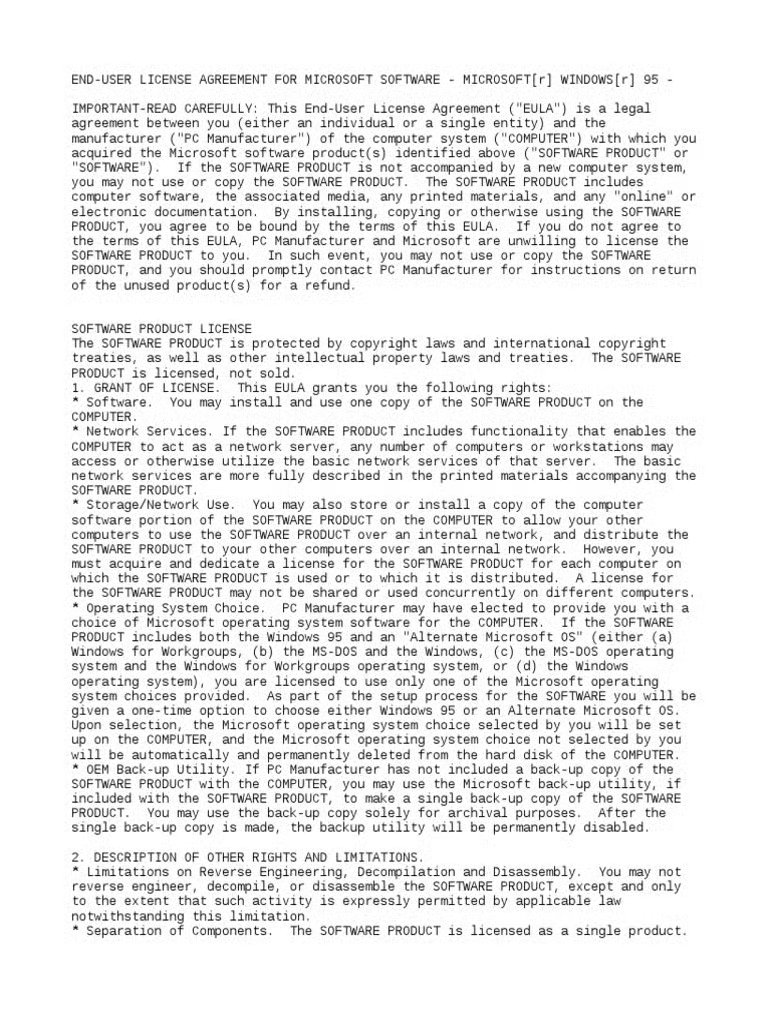
The relevant section is blunt. “The Software is licensed to you, not sold,” the EULA states. “You are granted a limited, non-exclusive, non-transferable, and personal license to play or use the Software for your private, non-commercial use on the system or device it was intended for.”
The terms also restrict renting, modifying, or obtaining games through unauthorised means. Nothing in there is new, technically. Sony’s EULA has always said this. The timing is what makes it land differently right now.
There’s always been freeware and shareware (yes, they’re different) but if you as an individual paid money for software at any point, you’ve never owned it.
Businesses can’t even justify the expense of “owning” basic stuff like Microsoft Office and collectively spend billions. “Owning” software is fucking expensive, and usually means you coded it.
It’s in the EULA for every piece of software,** including physical.**
Bolded for those that aren’t getting it.
Even if you buy a disc, that does not guarantee you can play the game in the future. Often games have to be authenticated on install, and if that authenticating server is no longer online, you can’t play the game–even if you have all the files required to play it.
Europe had a whole “Stop Killing Games” initiative that would require companies to unlock games they are no longer supporting, but that mysteriously vanished from the legislative docket after meetings with game companies that organizers weren’t invited to.
Stay mad, but you need to be mad at the right things.
Kind of funny how Nintendo was here before any of this was a problem and they’ll be here after it’s all done. You put that cartridge into your console, and you can play it. It may be version 1.0, but you can play it. And every single physical Switch game that requires a download, must state so on the front of the box, so you can avoid buying them. It’ll cost $70 a decade from now, but it’ll run after you pay it lol
Nintendo was here before any of this was a problem
Because NES locked it down at propertiary carts and still do…
That drastically increases the cost of Ninetendo games, because Nintendo is the only one legally allowed to make the blank. Even gamecube used tiny discs.
If you wanted to sell a NES game, you had to buy X amount of blank copies from Nintendo, then pay Nintendo to put the code on the blank, then pay Nintendo a licensing cut to sell…
Like, it’s not like Nintendo had consumers best interest at heart, they just nickle and dime developers at every step, which is why Nintendo versions costs more.
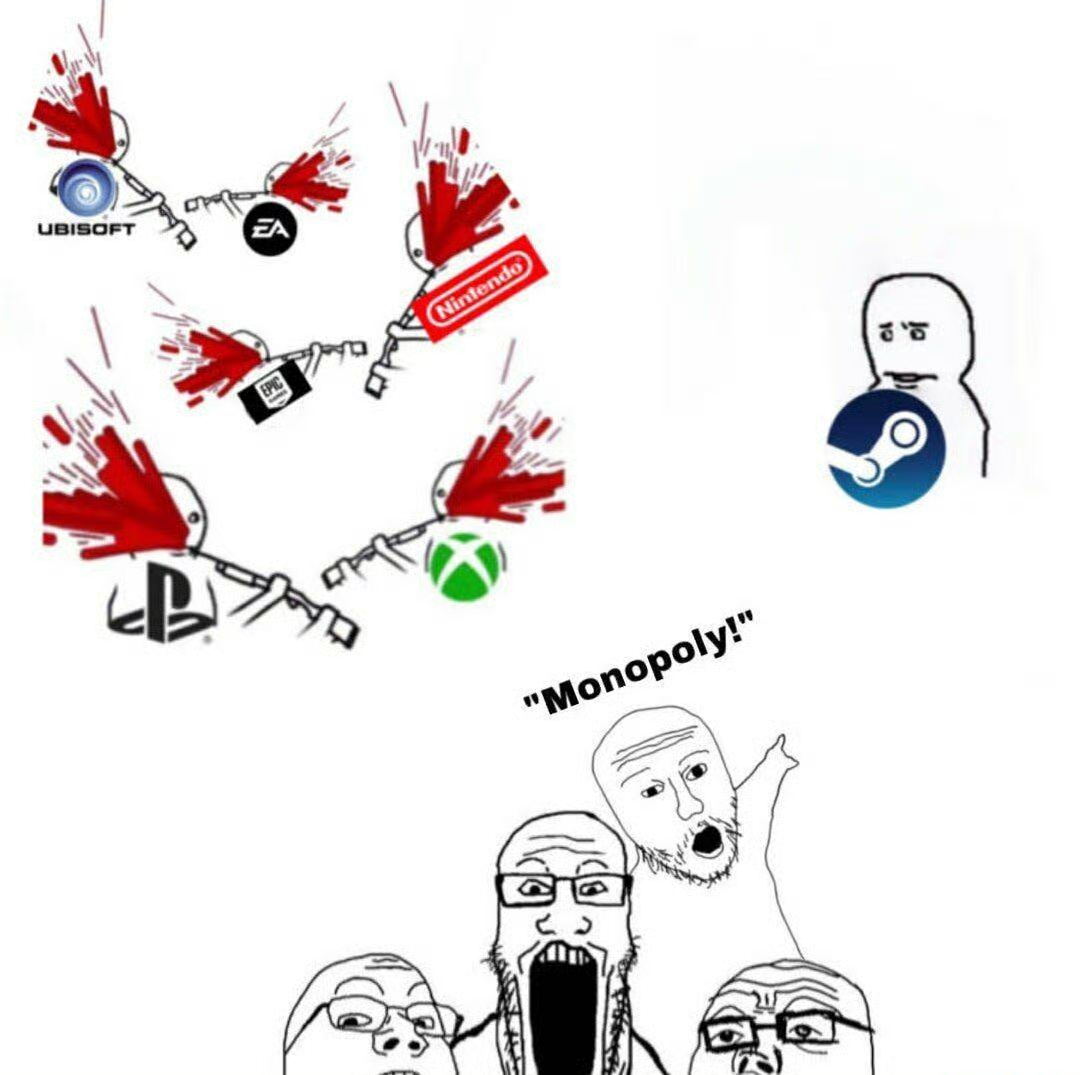
Oh yeah, I never said they had good business practices. We’re well aware of that. But, at this point, holy fuck. All they have to do is exist while Sony and Microslop repeatedly blast themselves in the balls. Luigi wins by doing absolutely nothing.
Those are all publicly traded, Valve is privately owned.
So Valve is the only one who can legally say (in America): “We’ve made enough money”.
A publicly traded corporation has a fiduciary duty to maximize shareholder returns under any terms. They literally have to nickel and dime consumers after a certain point, because there’s no other way to make numbers go up after they reach market saturation.
Long term they just have to be satisfied with existing profits and that’s the one thing most corporations legally can’t do.
Chalk it up another reason to abolish the stock market.
I will say at least with those you can still sell them, trade them, whatever. Unlike digital games.
Being able to sell/trade a specific copy of digital media kind of is the one functional use NFTs could be used for (if companies would be willing to treat digital media to be treated like physical media which they obviously like the current setup). Would also kind of need a universal industry blockchain (or some other ledger system) with better scam protections, and be used for the “new” sales for the trades and “used” sales. Which is way more effort than digital media companies would ever care to figure out (especially now) and were able to get away with not being required to treat digital like physical. And the major players don’t have to care about making their stuff DRM-free.
In the case of video media it is worse since there are so many set-top devices that don’t allow offline downloads like the mobile versions of the same apps (mostly since the boxes don’t have storage for it) or ability to use on a home media server (Plex/Jellyfin). So you may have a license to a movie/show but not have access to it if networks are down. And digital audio media has been reverting since a lot of new music can’t be purchased and only streamed. Which is sad since I had some early hope that the digital video stuff would follow how audio was working with a lot of DRM-free options Apple and Amazon managed to “legitimize”. I will give some level of credit to the UV/Movies Anywhere system that allows retaining a supported movie/show if you have accounts on multiple services and any one of them shuts down. But that still requires that stores/studios support it, AND that the core system isn’t the thing shutdown.
I think a lot of the issue is when companies no longer respect their customers and abuse the fact that software is licensed to rip that license away from customers. Valve has the exact same agreement but (most) people don’t have an issue with it because they’re much better at ensuring you have access to the games you’ve bought for as long as possible.
abuse the fact that software is licensed to rip that license away from customers
A lot of it is widely outside of PlayStation or Valves hands…
The puclishers have the same deal with them, and developers have the same deal with the publishers.
If that wasn’t there at every link of the chain, then that next person no longer has to pay anyone earlier in the chain.
We kind of see the same with in-game music. That has to be licensed from the owner of the master, and possibly a couple more people. They don’t like doing licences in perpetuity out of principle. If the Beatles let a game use a song and that game eventually sells for 10¢ or free, then that’s a loss sale even 30 years from now in the way licensing works. So after 5-10 years, songs disappear.
Or like how it took Kevin Smith forever to get actual ownership of the movie Dogma due to Weinstein being involved and everyone else just wanting to bury what he’d touched.
EULA’s and ownership is a lot deeper than software. Like, you can sell a used game of monopoly, but buying a copy doesn’t mean you can make you’re own and sell, the physical material is just associated with the license for the intellectual property.
Like ship of thesus shit, if you start with a legit paid game of Monopoly, replace every single piece over 20 years, you can still sell it as a “used Monopoly game” because at some point you bought the license. If you made every piece the same way and then sold it, that’s not legal
The Service provides users of Ubuntu with a free subscription to use the Service on up to five physical Ubuntu systems with unlimited number of VMs or containers for the eligible Ubuntu LTS versions as designated by Canonical.
That’s just Ubuntu Pro and it’s basically longer term kernel maintenance plus applies to the universe repo not just main. The only extra functionality is the ability to live patch the kernel. The base install works fine as is but some businesses require the extended support.
Arch Linux has no EULA because it is not sold software like Ubuntu Pro.
They have a Terms of Service for the online services, which you can be banned from for misuse, but this does not prevent you from using the software. You can legally obtain it through any of the hundreds of mirrors, or even compile it from scratch.
Arch Linux has no EULA because it is not sold software like Ubuntu Pro.
Right, your link is about use of online services…
The following Terms of Service contain the rules for the use of the internet Platform Arch Linux, operated by the Arch Linux Team, accessible under the domain archlinux.org and various related subdomains (the “Platform”) and the respective Services, namely provision of the Arch Linux package platform, the forums, the wiki, the bug reporting tool and a reporting tool for security issues, Arch User Repository (AUR), Mailing Lists, IRC Channels, collaboration pads and the Bulletin Board System (the “Services”) of Arch Linux (“Arch Linux”, “we”) by you as a user (the “User”, “you”).
There’s no EULA, but after reading up on it, isn’t it even considered software?
Like, it seems to really just be a command line, that straps together a bunch of individual packages, which add up to a very very lightweight OS, and then even more can be added on.
Seems really cool, and I like the idea. But my understanding is the packages themselves have EULA’s on their own and function pretty autonomously.
I think thats going to the closest anyone gets tho, thanks for linking it.
All packages published to the arch linux repository are free software that can be built from source and have permissive licenses. Non-free software such as nvidia drivers and other things are distributed separately through the AUR, and aren’t managed by the Arch Linux team.
I would consider the collection of software provided to be no different than any other OS with optional packages. There are several forks of Arch Linux like EndeavourOS that have more complete defaults.
A permissive license is a specific category of open source license. As I said, all official repository software is free and open source. If the terms of the license did not allow it to be freely distributed or was a revocable license, it would not be allowed in the arch repository.
If it wasn’t, then buying a single copy would legally allow you to sell an infinite amount of copies.
Because that’s what actually owning software means.
This. Is. A. FUCKING. Lie.
If I buy and own a physical copy of a book. I am not then entitled to set up a printing press and sell my own word-for-word copies of said book. Same applies to ownership of digital goods.
If I go to GOG and buy a DRM free game (aka I would then own that copy) I still wouldn’t have the legal right to distribute copies to other people.
That’s because copyright laws exist, and they apply to both situations I described. Shame on you for mindlessly repeating industry lies.
Never ever owned software. Even physical disks has something like buying this gives you a license to use this software. Great examples is movies. It gave you a license for private viewing only. Showing a movie you had a copy if to a group of people technically broke that.
Luckily the EULA doesn’t apply when obtaining it through unauthorized means since the EULA would never have been accepted upon a purchase that didn’t happen.
(It is though copyright infringement, but you still have more ownership over the bytes on your own disk since DRM would have been removed or neutered)
When you took the literal shrinkwrap off the box, you agreed.
Then it switched to “use eula” and the box that pops up containing the EULA that says “click to accept” and there’s no other option but to accept…
That’s the point you agree.
I don’t think it’s ever been “at purchase” at least in America. Because obviously gifts are a thing and purchasers aren’t always users and more importantly users aren’t all purchasers
A cracked game might circumvent those popups and/or screens, but I honestly don’t know why they would put the effort in or if it would matter. And if it mattered probably varies a lot by country.
EU is very adamant that you can only present contractual terms before entering an agreement (purchase) not after. All those EULAs showing up in the game before you are shown the main menu are void in EU.
If the EULA is instead embedded in the purchase flow with an “I agree” checkbox then the UsedSoft vs. Oracle case is likely still precedence to argue that you own the copy. Reason is that the purchase flow uses the “Buy” terminology and nowhere outside of the EULA it mentions rental/lease/limited/etc. This would breach the “reasonable consumer expectations” as the storefront didn’t make it clear in their purchase experience that it was only a limited license you obtained and that a normal consumer doesn’t expect “limited” when reading “Buy”. This part has though not been tested in court yet but most legal scholars agree that this would be the likely outcome should someone bring it up.
If I took home a $200 box of software in 1995, installed it, and then drove back to Circuit City in the morning and returned it, there was no way for anyone to tell.
Like, across all aspects of American media, profits skyrocketed with CDs because consumers couldn’t easily copy them. With cassettes and floppy discs, piracy was just accepted. And when they got to start over with CDs/DVDs they wanted to do everything possible to break the piracy habit in the window they could.
American Neoliberalism kicked off with Clinton in 1992, which is when all this was happening and corporate profits were prioritized over all else in the pursuit of campaign donations.
Like, this shit didn’t happen accidentally, we didn’t just stumble into it.
There’s reasons for why our shit is so fucked and it’s not in the EU.
The EULA is not beholden to copyright law. “Limited license” is in direct contradiction to European Court of Justice’s ruling that if a commoner expects a “sale” then all rights given by a sale are protected which cannot be limited by an EULA. Right now regulators are questioning whether having a “Buy” button constitutes a sale and is thus protected by the ECJ ruling in UsedSoft vs. Oracle. Nevertheless they’re trying to combat this behaviour either through interpreting current regulations or by creating new regulations to close potential loopholes.
I’m not American, so no. A contractual term can only be provided before entering a purchase agreement in EU. Copyright law is still in effect, but all the EULAs you read after purchase (e.g. during boot) are void here.
If any EULA didn’t say that, everyone who bought it could sell their own copies for $1 less then they bought it. Eventually the price of every piece of software no matter what it was, would be the hosting costs based on sheer size.
What’s wild is so many people never knew this, and are hyper fixated on the wrong part.
Back in the day updates just weren’t really a thing. There may be additional software (DLC except you bought it physical) in between editions, but for the most part the program was the program. So as long as you kept your install discs, you could always install that program.
That is what you were buying, the physical means to install the program, and that has always been just a license and definitely not duplicatable. Selling used games/software was valid because you’re handing over the physical means to install/run that software.
The parallel would be selling a “used digital game” and it disappears from your library. And Sony could even take 10% or whatever as a fee, even tho it would cost money.
Consumers could trust that any used game was 100% the exact same as new tho, there’s be zero advantage to every buying new if a single used license was cheaper.
That would be free market capitalist software, but the oligarchs don’t want.
If games are going to have DRM, collect our data through unauthorized means, and be randomly taken away without our authorization, then exactly what social contract are we upholding?
I have one and every game I own is physical, like every other console I own. Now whether the games are in a workable state in the future without access to patches is another story, but I can lend, sell, trade my games and also never use PSN again if I want. From the state of things, it looks like I won’t every be buying another console and I can live with that.
I went this route as a compromise with my PS4 years ago. Even imported some harder to find games over time. Then the drive died and I discovered Sony ties some hardware ID on it to the serial number of the motherboard and restricts service to “authorized repair shops”. So fuck all of that, I’m sticking to PC 100% and pirating the hell out of exclusives for emulation down the road. My backlog is impossible to complete anyway.
Afaik this a fairly standard software licensing model. Pretty much all paid videogames are like that, physical or not. Sony just started to act on it in the hopes of making even more moneyz
Sad really. Been a PlayStation fan since I was a kid. PS1 on Christmas w/ Metal Gear Solid is easily one of my favorite core memories. As with everything else in modern era, these companies have really lost their bearing and the spark / soul that made them cherished through most of our lifetimes.
I’ve switched to PC gaming long ago so I’m not really in their target audience anymore, but when the day comes that I want a machine for the living room it’ll certainly not be a PS.
It’s been easy enough to set up a gaming PC in the living room for both desk and couch gaming (my gaming rig automatically switches to the TV if the TV and receiver inputs are on). Sony exclusives just aren’t what they used to be, and I haven’t really cared much since the PS2/PS3 era. I sold my consoles in 2012 and haven’t looked back, still more games than I’ll ever have time to play.
And if buying isnt owning, that means you’re paying 70+ dollars to rent a game that can be taken away from you at any time… with no refund or recourse.
Would anyone be stupid enough to rent a game for 70+ dollars? especially under those conditions?
Coming from that era myself, buying a VHS tape absolutely gave you ownership of that copy of the movie. Same with music, which is why homemade mixtapes were such a popular and permitted thing.
Studios didn’t like it, but no one went after the guy with the little vinyl briefcase of 100 different mixtapes for every sort of occasion.
It’s definitely stealing. I don’t understand why people on here can’t admit it to themselves.
My guess is people here think that stealing is wrong, no matter what. They also think that piracy is moral. Because of that, they incorrectly deduce that piracy isn’t stealing.
Look up any definition of stealing, and it always boils down to: taking something that you don’t have permission to take.
No, this isn’t limited to physical items. Companies steal our data all the time.
I think people need to shift from “Piracy isn’t stealing” to “Fuck the corps, they don’t wanna play fair I’ll steal their shit and they won’t see a penny”
The argument goes that stealing involves taking something from someone, whearas pirating produces a copy. If you take someone’s car, they don’t have a car anymore, but copy their game and now you both have one.
That said, I don’t think it follows from “buying isn’t owning” that “piracy isn’t stealing”. Its a pithy slogan that captures a mood, but I don’t think it really makes sense.
Your position, I believe, is more coherent: “I don’t care if it is stealing”. It might not technically be stealing, but its a breach of the terms of the sale that you tacitly agreed to when buying.
Something similar can be said for adblocking. People argue that it is “stealing” because there is a breach of the terms of use, and the ads fund the content. It might not really technically be stealing, but it is simpler to just say “I don’t care what it is, I don’t feel bad for giant corporations”. You can also say this about shoplifting.
license to play or use the Software for your private, non-commercial use
Does “non-commercial” mean all those people who make money by playing games on a monetized livestream, posting monetized gameplay videos, or playing e-sports for prizes are filthy pirates?
By the plain text reading, yes. Would be nice to see PS streams fall to 0, but people ignore the terms and Sony doesn’t enforce them until they want to. Doesn’t matter what any of this BS says until they drag you in front of a judge… I mean private arbitrator… and say “look, plain as day, subsection 18.XXVI.xix D(13a) on page 47 where it clearly says we get to move our VP into his spare bedroom and shoot his dog”
We seriously are overdue for putting limits on so-called consumer contracts.
Reminder that the same EULA applies to the software on a physical disk, too. The difference is you will still have the disk if they decide to revoke your ability to run that disk.
They can also make it not work if you’re not connected to the internet by having the disk require a network validation every so often. A new game might even automatically install console firmware that updates the console to do this without downloading it online, from the disk.
You can run Linux and steam on ps5 but jailbreaks are as of now limited to older firmwares. The ps5 is aggressive about making updates mandatory so you either need a console someone purposely did not update in anticipation of a jailbreak break years later or one that’s been sitting around not being used for a somewhat long time
I really hope Linux on ps5 happens in a more native way rather than the USB hacks recently brought to light. I’d love to turn my ps5 into my own device.
AS A CONSUMER YOU MAY HAVE RIGHTS UNDER APPLICABLE LOCAL LAWS THAT CANNOT BE EXCLUDED, LIMITED OR CHANGED. THOSE RIGHTS TAKE PRIORITY OVER ANYTHING IN THESE TERMS.
So they’re saying we should write to our law making representatives and have that changed?
game studios will fire the devs after the game is done and then tell the players they should buy the deluxe edition for a hundred bucks to play a week early but you need to be always online and don’t own the game.
Just a reminder the Venn diagram of the G*mers spouting the “piracy isn’t stealing” and “valve is one of the good monopolies” and “support Palworld because fuck Nintendo” is a perfect circle
Valve had a massive hand in killing off physical PC releases and the sizable market of digital distribution.
There were so many different platforms out there. Some that didn’t involve having to install a third party launcher to play physical discs. IGN even had one.
Valve killed them with the same exclusivity deals you G*mer troglodytes bitch and moan about with Epic.
It says “limited” but does not define what limited is, so you legally paid for nothing guaranteed. You just give them money but they are obligated to give you nothing.
Not that this gives them a pass, but just to clarify the term: “limited” means you’re only allowed to use the software in the specific ways described by the EULA. The whole purpose of the EULA is to define exactly what “limited” means. In contrast, “unlimited use” would indicate that you’re allowed to use the software however you want unless specifically forbidden by the EULA.
“Limited” does not mean that they can just make up whatever they want later and say “well that’s what we meant when we said limited.” The EULA describes the agreement you make, and both parties are bound to exactly what is described in that EULA.
They can decide to change the EULA later and technically you are free to choose whether you want to accept those new terms, but the nasty part is that they can revoke your current license if you decide not to accept their new EULA.
TL;DR it’s a shitty deal either way, but I think it’s important to be accurate. They do define what “limited” means or it wouldn’t be a valid license agreement. That does not imply that the EULA is a good one.
To be fair, i recall Steam and GOG said that in case of a platform shutdown or if a game from your library is delisted, they can provide you a copy of the game files that you can keep and use.
There’s a lot more in the agreement but this is the start of the licensing part.
Valve hereby grants, and you accept, a non-exclusive license and right, to use the Content and Services for your personal, non-commercial use (except where commercial use is expressly allowed herein or in the applicable Subscription Terms). This license ends upon termination of (a) this Agreement or (b) a Subscription that includes the license. The Content and Services are licensed, not sold. Your license confers no title or ownership in the Content and Services. To make use of the Content and Services, you must have a Steam Account and you may be required to be running the Steam client and maintaining a connection to the Internet.
in very limited terms I think Valve might fully remove games (like the crypto miner one) from accounts but other then that if you bought it you own it as far as I’ve seen with Steam. I have transformers devastation which was delisted, and while the achievements won’t really show up on my account iirc, and I can’t sell the card drops on the market, I can still install and play it fine
Nah see my other comment. You don’t own shit on Steam. In fact the agreement specifically says you may need to use the client and be connected to the Internet in order to even play your games. Like if steam shut down tomorrow and just stopped existing it’s very possible they could legally just give you the middle finger and say sucks for you.
IANAL and there’s more to it than just the contract you have with Valve as far as the law goes but the way the contract is written you have no ownership of anything on the platform.
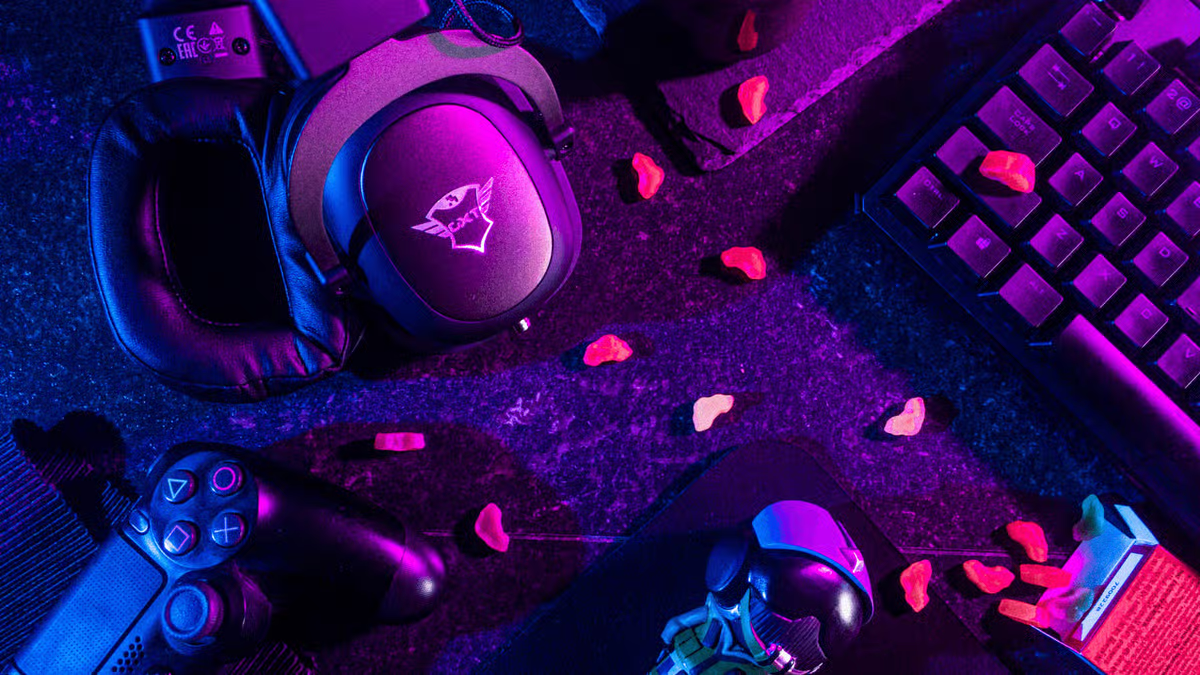 GAMES.GGSony Reminds PS Users They Don't Own Digital GamesSony's unsolicited EULA email tells PlayStation users their digital games are licensed, not owned, arriving just as the #PSBlackout boycott kicks off.