posted in Technology

Sony Reminds PS Users They Don't Own Digital Games

The relevant section is blunt. “The Software is licensed to you, not sold,” the EULA states. “You are granted a limited, non-exclusive, non-transferable, and personal license to play or use the Software for your private, non-commercial use on the system or device it was intended for.”

The terms also restrict renting, modifying, or obtaining games through unauthorised means. Nothing in there is new, technically. Sony’s EULA has always said this. The timing is what makes it land differently right now.

games.gg/news/sony-eula-email-psblackout-boycott/

Sony Reminds PS Users They Don't Own Digital GamesGAMES.GGSony Reminds PS Users They Don't Own Digital GamesSony's unsolicited EULA email tells PlayStation users their digital games are licensed, not owned, arriving just as the #PSBlackout boycott kicks off.

Replying to @⁨SnoringEarthworm@piefed.ca⁩

It’s in the EULA for every piece of software, including physical.

If it wasn’t, then buying a single copy would legally allow you to sell an infinite amount of copies.

Because that’s what actually owning software means.

And video games are software.

PlayStation:

The Software is licensed to you, not sold

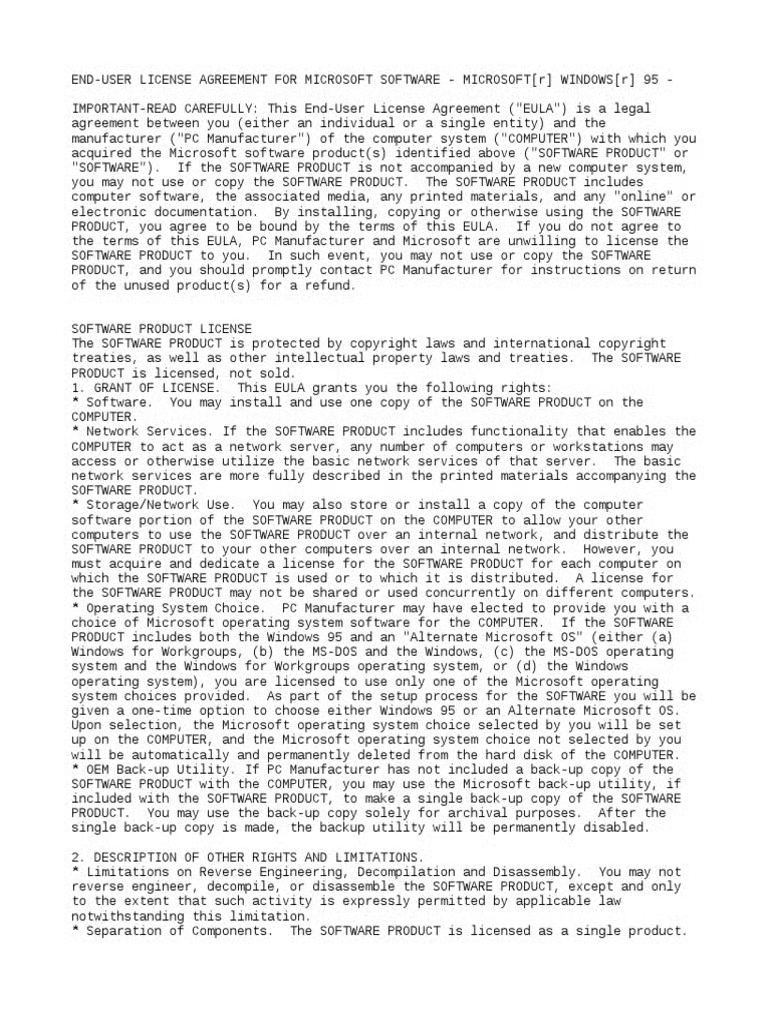
Windows 95:

The software product is licensed, not sold

www.scribd.com/…/Windows-95-License-Agreement

I know it’s a joke no one ever read them…

But you all really never knew this?

Edit:

Don’t make me wheel out the 1980s CRT TV for the class…

www.youtube.com/watch?v=up863eQKGUI

There’s always been freeware and shareware (yes, they’re different) but if you as an individual paid money for software at any point, you’ve never owned it.

Businesses can’t even justify the expense of “owning” basic stuff like Microsoft Office and collectively spend billions. “Owning” software is fucking expensive, and usually means you coded it.

Windows 95 License AgreementScribdWindows 95 License Agreement | PDF | Operating System | LicenseScribd is the source for 300M+ user uploaded documents and specialty resources.

Replying to an earlier post

The Service provides users of Ubuntu with a free subscription to use the Service on up to five physical Ubuntu systems with unlimited number of VMs or containers for the eligible Ubuntu LTS versions as designated by Canonical.

canonical.com/legal/ubuntu-pro/personal

Why would you assume to own software if you don’t even pay to use it?

You can do a bullshit fork and then sell it, but if you owned it you could sell the exact same code with zero changes

To prove your point you’d need that example: an open source program that you can sell for profit with zero changes.

Replying to an earlier post

Arch Linux has no EULA because it is not sold software like Ubuntu Pro.

Right, your link is about use of online services…

The following Terms of Service contain the rules for the use of the internet Platform Arch Linux, operated by the Arch Linux Team, accessible under the domain archlinux.org and various related subdomains (the “Platform”) and the respective Services, namely provision of the Arch Linux package platform, the forums, the wiki, the bug reporting tool and a reporting tool for security issues, Arch User Repository (AUR), Mailing Lists, IRC Channels, collaboration pads and the Bulletin Board System (the “Services”) of Arch Linux (“Arch Linux”, “we”) by you as a user (the “User”, “you”).

There’s no EULA, but after reading up on it, isn’t it even considered software?

Like, it seems to really just be a command line, that straps together a bunch of individual packages, which add up to a very very lightweight OS, and then even more can be added on.

Seems really cool, and I like the idea. But my understanding is the packages themselves have EULA’s on their own and function pretty autonomously.

I think thats going to the closest anyone gets tho, thanks for linking it.

Replying to an earlier post

All packages published to the arch linux repository are free software that can be built from source and have permissive licenses. Non-free software such as nvidia drivers and other things are distributed separately through the AUR, and aren’t managed by the Arch Linux team.

I would consider the collection of software provided to be no different than any other OS with optional packages. There are several forks of Arch Linux like EndeavourOS that have more complete defaults.