posted in Technology

Sony Reminds PS Users They Don't Own Digital Games

The relevant section is blunt. “The Software is licensed to you, not sold,” the EULA states. “You are granted a limited, non-exclusive, non-transferable, and personal license to play or use the Software for your private, non-commercial use on the system or device it was intended for.”

The terms also restrict renting, modifying, or obtaining games through unauthorised means. Nothing in there is new, technically. Sony’s EULA has always said this. The timing is what makes it land differently right now.

games.gg/news/sony-eula-email-psblackout-boycott/
Sony Reminds PS Users They Don't Own Digital GamesGAMES.GGSony Reminds PS Users They Don't Own Digital GamesSony's unsolicited EULA email tells PlayStation users their digital games are licensed, not owned, arriving just as the #PSBlackout boycott kicks off.

Replying to @⁨SnoringEarthworm@piefed.ca⁩

It’s in the EULA for every piece of software, including physical.

If it wasn’t, then buying a single copy would legally allow you to sell an infinite amount of copies.

Because that’s what actually owning software means.

And video games are software.

PlayStation:

The Software is licensed to you, not sold

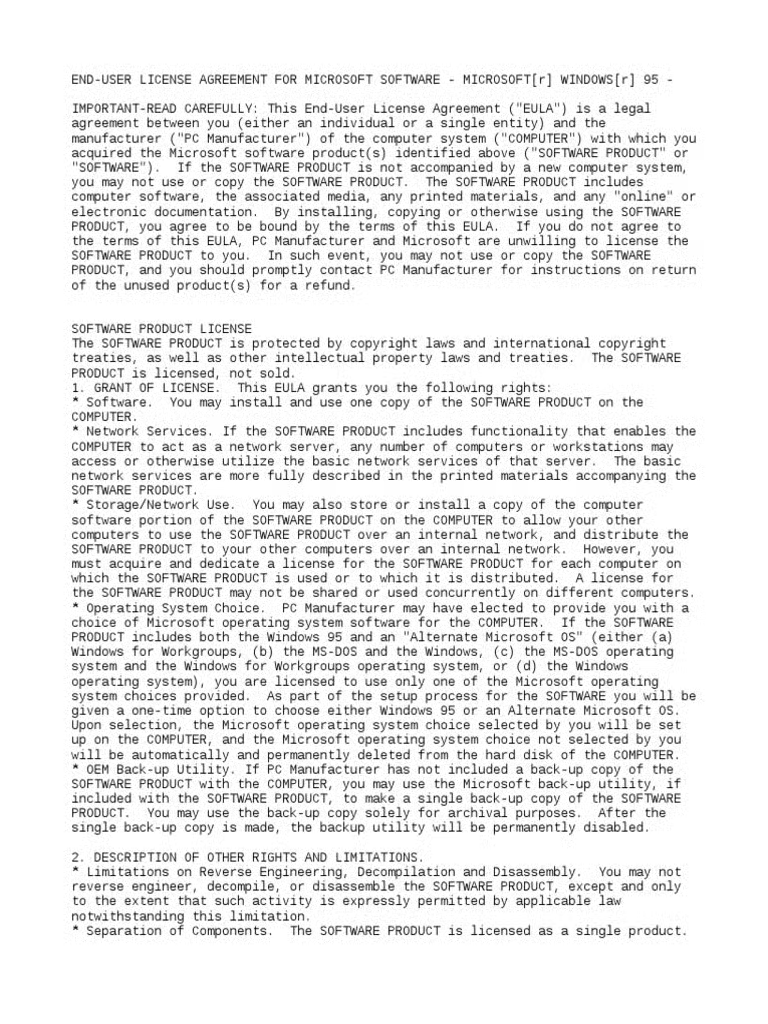
Windows 95:

The software product is licensed, not sold

www.scribd.com/…/Windows-95-License-Agreement

I know it’s a joke no one ever read them…

But you all really never knew this?

Edit:

Don’t make me wheel out the 1980s CRT TV for the class…

www.youtube.com/watch?v=up863eQKGUI

There’s always been freeware and shareware (yes, they’re different) but if you as an individual paid money for software at any point, you’ve never owned it.

Businesses can’t even justify the expense of “owning” basic stuff like Microsoft Office and collectively spend billions. “Owning” software is fucking expensive, and usually means you coded it.

Windows 95 License AgreementScribdWindows 95 License Agreement | PDF | Operating System | LicenseScribd is the source for 300M+ user uploaded documents and specialty resources.
Edited ⁨⁨Aug⁩ ⁨23⁩, ⁨2026⁩, ⁨16:55⁩⁩en

Replying to @⁨givesomefucks@lemmy.world⁩

It’s in the EULA for every piece of software,** including physical.**

Bolded for those that aren’t getting it.

Even if you buy a disc, that does not guarantee you can play the game in the future. Often games have to be authenticated on install, and if that authenticating server is no longer online, you can’t play the game–even if you have all the files required to play it.

Europe had a whole “Stop Killing Games” initiative that would require companies to unlock games they are no longer supporting, but that mysteriously vanished from the legislative docket after meetings with game companies that organizers weren’t invited to.

Stay mad, but you need to be mad at the right things.

Replying to an earlier post

Kind of funny how Nintendo was here before any of this was a problem and they’ll be here after it’s all done. You put that cartridge into your console, and you can play it. It may be version 1.0, but you can play it. And every single physical Switch game that requires a download, must state so on the front of the box, so you can avoid buying them. It’ll cost $70 a decade from now, but it’ll run after you pay it lol

Replying to an earlier post

Nintendo was here before any of this was a problem

Because NES locked it down at propertiary carts and still do…

That drastically increases the cost of Ninetendo games, because Nintendo is the only one legally allowed to make the blank. Even gamecube used tiny discs.

If you wanted to sell a NES game, you had to buy X amount of blank copies from Nintendo, then pay Nintendo to put the code on the blank, then pay Nintendo a licensing cut to sell…

Like, it’s not like Nintendo had consumers best interest at heart, they just nickle and dime developers at every step, which is why Nintendo versions costs more.

Replying to an earlier post

Those are all publicly traded, Valve is privately owned.

So Valve is the only one who can legally say (in America): “We’ve made enough money”.

A publicly traded corporation has a fiduciary duty to maximize shareholder returns under any terms. They literally have to nickel and dime consumers after a certain point, because there’s no other way to make numbers go up after they reach market saturation.

Long term they just have to be satisfied with existing profits and that’s the one thing most corporations legally can’t do.

Chalk it up another reason to abolish the stock market.

Replying to an earlier post

I will say at least with those you can still sell them, trade them, whatever. Unlike digital games.

Being able to sell/trade a specific copy of digital media kind of is the one functional use NFTs could be used for (if companies would be willing to treat digital media to be treated like physical media which they obviously like the current setup). Would also kind of need a universal industry blockchain (or some other ledger system) with better scam protections, and be used for the “new” sales for the trades and “used” sales. Which is way more effort than digital media companies would ever care to figure out (especially now) and were able to get away with not being required to treat digital like physical. And the major players don’t have to care about making their stuff DRM-free.

In the case of video media it is worse since there are so many set-top devices that don’t allow offline downloads like the mobile versions of the same apps (mostly since the boxes don’t have storage for it) or ability to use on a home media server (Plex/Jellyfin). So you may have a license to a movie/show but not have access to it if networks are down. And digital audio media has been reverting since a lot of new music can’t be purchased and only streamed. Which is sad since I had some early hope that the digital video stuff would follow how audio was working with a lot of DRM-free options Apple and Amazon managed to “legitimize”. I will give some level of credit to the UV/Movies Anywhere system that allows retaining a supported movie/show if you have accounts on multiple services and any one of them shuts down. But that still requires that stores/studios support it, AND that the core system isn’t the thing shutdown.

Replying to @⁨TrousersMcPants@lemmy.world⁩

abuse the fact that software is licensed to rip that license away from customers

A lot of it is widely outside of PlayStation or Valves hands…

The puclishers have the same deal with them, and developers have the same deal with the publishers.

If that wasn’t there at every link of the chain, then that next person no longer has to pay anyone earlier in the chain.

We kind of see the same with in-game music. That has to be licensed from the owner of the master, and possibly a couple more people. They don’t like doing licences in perpetuity out of principle. If the Beatles let a game use a song and that game eventually sells for 10¢ or free, then that’s a loss sale even 30 years from now in the way licensing works. So after 5-10 years, songs disappear.

Or like how it took Kevin Smith forever to get actual ownership of the movie Dogma due to Weinstein being involved and everyone else just wanting to bury what he’d touched.

EULA’s and ownership is a lot deeper than software. Like, you can sell a used game of monopoly, but buying a copy doesn’t mean you can make you’re own and sell, the physical material is just associated with the license for the intellectual property.

Like ship of thesus shit, if you start with a legit paid game of Monopoly, replace every single piece over 20 years, you can still sell it as a “used Monopoly game” because at some point you bought the license. If you made every piece the same way and then sold it, that’s not legal

Replying to an earlier post

The Service provides users of Ubuntu with a free subscription to use the Service on up to five physical Ubuntu systems with unlimited number of VMs or containers for the eligible Ubuntu LTS versions as designated by Canonical.

canonical.com/legal/ubuntu-pro/personal

Why would you assume to own software if you don’t even pay to use it?

You can do a bullshit fork and then sell it, but if you owned it you could sell the exact same code with zero changes

To prove your point you’d need that example: an open source program that you can sell for profit with zero changes.

Replying to an earlier post

You can do a bullshit fork and then sell it, but if you owned it you could sell the exact same code with zero changes

To prove your point you’d need that example: an open source program that you can sell for profit with zero changes.

You can, though? If you find someone stupid enough to buy it, that is.

All you have to do is change the name and remove any trademarked branding from it.

Replying to an earlier post

Arch Linux has no EULA because it is not sold software like Ubuntu Pro.

Right, your link is about use of online services…

The following Terms of Service contain the rules for the use of the internet Platform Arch Linux, operated by the Arch Linux Team, accessible under the domain archlinux.org and various related subdomains (the “Platform”) and the respective Services, namely provision of the Arch Linux package platform, the forums, the wiki, the bug reporting tool and a reporting tool for security issues, Arch User Repository (AUR), Mailing Lists, IRC Channels, collaboration pads and the Bulletin Board System (the “Services”) of Arch Linux (“Arch Linux”, “we”) by you as a user (the “User”, “you”).

There’s no EULA, but after reading up on it, isn’t it even considered software?

Like, it seems to really just be a command line, that straps together a bunch of individual packages, which add up to a very very lightweight OS, and then even more can be added on.

Seems really cool, and I like the idea. But my understanding is the packages themselves have EULA’s on their own and function pretty autonomously.

I think thats going to the closest anyone gets tho, thanks for linking it.

Replying to an earlier post

All packages published to the arch linux repository are free software that can be built from source and have permissive licenses. Non-free software such as nvidia drivers and other things are distributed separately through the AUR, and aren’t managed by the Arch Linux team.

I would consider the collection of software provided to be no different than any other OS with optional packages. There are several forks of Arch Linux like EndeavourOS that have more complete defaults.

Replying to an earlier post

If it wasn’t, then buying a single copy would legally allow you to sell an infinite amount of copies.

Because that’s what actually owning software means.

This. Is. A. FUCKING. Lie.

If I buy and own a physical copy of a book. I am not then entitled to set up a printing press and sell my own word-for-word copies of said book. Same applies to ownership of digital goods.

If I go to GOG and buy a DRM free game (aka I would then own that copy) I still wouldn’t have the legal right to distribute copies to other people.

That’s because copyright laws exist, and they apply to both situations I described. Shame on you for mindlessly repeating industry lies.