posted in Technology

AI Bubble Teetering on the Brink as OpenAI Admits to Massive Financial Failure: A $20 billion setback.
futurism.com/future-society/ai-financial-bubble-openai-billions-failureposted in Technology
AI Bubble Teetering on the Brink as OpenAI Admits to Massive Financial Failure: A $20 billion setback.
futurism.com/future-society/ai-financial-bubble-openai-billions-failureReplying to @eicker@lemmy.world
OpenAI promised investors an AI gold rush. Now its projected annual revenue is reportedly $20 billion below earlier expectations. That’s not a rounding error: that’s an entire business empire missing from the spreadsheet. Silicon Valley keeps calling it a revolution, but increasingly it looks like a trillion dollar game of musical chairs, with investors hoping the music never stops.

Replying to @eicker@lemmy.world
Maybe he could sleep in the factory for a few weekends? P

Replying to @Zwuzelmaus@feddit.org
Quit ordering the avocado toast.
Replying to @SeeMarkFly@lemmy.ml
I always think it’s funny how millennials got shit for avocado toast, yet it was my boomer parents who introduced it to me.

Replying to @IrateAnteater@sh.itjust.works
when I was a boy (GenX), avocados were so cheap, they almost gave them away
my mom complained one time when they were 25c
one of my friends that grew up in California had a tree in his back yard and he never purchased one until he moved to Washington State in his 20s
The fact that it became a target for attacking millennials is so crazy. That people took it seriously for a bit is laughable. To this day my wife and I make jokes that it costs a new mortgage to have one.
Replying to @thisbenzingring@lemmy.today
My brother worked at an avocado packing plant and he would bring me a BOX of ripe avocados that were too ripe to send to market.
We had to eat those NOW. All the FREE avocados I can eat. Good times.

Replying to @thisbenzingring@lemmy.today
We had an avocado tree in the backyard growing up. It was so large that it hung quite a ways over the roof, which had terracotta shingles.
If we didn’t pull the ripe avocados off the tree it would sound like a small bomb going off every time one dropped and hit the roof, which usually happened early in the morning for some reason.
I am also Generation X.
I come from Australia.
Australia went from being a really easy country to live in where everything was just super cheap, to being one of the most expensive countries in the world where real estate is just out of reach for anyone, and particularly the young people.
That avocado meme came from an Australian politician who tried to shame young people and tell them that if they would just stop eating their smashed avo breakfast that they could afford a mortgage.
This is maybe 10 or 15 years ago. I can’t remember exactly.
This was the time when the shift went from Australia being relatively cheap to becoming crazy expensive, and it was quite insightful of him to do that, but also an asshole move to try and shame the young people.
Somehow it has gained traction and become a worldwide thing, but that is the history of it.
Some asshole politician telling young people if they would just stop having a little bit of nice time for themselves every now and then they could afford a mortgage, which was absolutely rubbish. Not true at all, and it’s gotten even worse since.
Replying to @IrateAnteater@sh.itjust.works
the origin of the meme, was also from a rich milleneal too that was already a millionaire, not the plebs.

Replying to @Zwuzelmaus@feddit.org
they've really gotta stop offering avocado toast at the company cafeteria. That'll make up the difference.
Replying to @rem26_art@fedia.io
That’ll make up the difference.
Now that you bring this up…
Yes, I think you could have found the solution, indeed. Quick, tell them! The world is saved!!
Replying to @Zwuzelmaus@feddit.org
one of his soon to be defunct datacenters.
Replying to @eicker@lemmy.world
Why do you sound like the House of El?

Replying to @schipelblorp@sh.itjust.works
It’s an LLM adbot, or, at best, someone having LLM craft all of their comments and posts.
The accounts profile heavily advertises services for LLM adbots covertly advertising to people using social media.
Replying to @Blackfeathr@lemmy.world
Search is garbage now, but I’d bet even money he is lifting text directly from House of El–or they have a common source.
Replying to @schipelblorp@sh.itjust.works
I’ve felt for a while that House of El uses LLMs heavily in their scripts. It’s a pandemic on YouTube feels like.
So yeah, the common source is likely clanker speak.
Replying to @eicker@lemmy.world
Who could have known this would happen?

Replying to @eicker@lemmy.world
And even the fifty billions may be inflated, as it is “annualized” revenue which can mean “we took a period of peak usage and generalized it to a year”
Replying to @Zos_Kia@jlai.lu
Didn’t Anthropic calculate it based on the best day and multiplying by 365?

Replying to @ThirdConsul@lemmy.zip
If I reported my income this way it would be fraud (and I would also “make” over 200k).
Replying to @Catoblepas@lemmy.blahaj.zone
Replying to @ThirdConsul@lemmy.zip
I didn’t wanna claim it when I wasn’t sure of the source but yeah that’s what I remember too
Replying to @eicker@lemmy.world
I mean, it’s not a rounding error, but going from 4.5 billion to 80 billion is not shabby either
Replying to @eicker@lemmy.world
Same thing just happened with Anthropics numbers. Billions short of their stated numbers.
Replying to @eicker@lemmy.world
Its a trillion dollar game of musical chairs with roughly 8.3 billion people playing and only a few thousand chairs.
Replying to @shads@leminal.space
That’s just life you’re describing. Life in capitalism, that is.
Replying to @some_designer_dude@lemmy.world
You gotta admit though the tempo of the music is getting pretty fast these days.
Replying to @shads@leminal.space
Miiiighty fast. And if you aren’t born with your name on one of the chairs, you’re not even in the game.
Replying to @shads@leminal.space
Nah, far from everyone wants to be a trillionaire, nor a billionaire. Sure most would want financial independence, but not a lot more than that
Replying to @BlaestEgnen@feddit.dk
Ahh but you are falling into a common fallacy, you probably think that because there is enough money to go around everyone should have a enough to meet their needs, then the excess can be an incentive for people who make outsized contributions to society, like a not sociopathic member of the human race.
The bloodsucking leech class view the existence of other people with needs as a personal insult. They feel every cent of money should be theirs personally, or as a barely acceptable compromise maybe shared around an “elite” class.
If Bezos for instance could have all the money and just issue Amazon Bucks™ based on how useful you are to him he would love that.
Honestly the reason we know Elon isn’t a real gamer is that he doesn’t have a bunch of four “agents” in trenchcoats with neuralinks and miniguns running around cities as he directs them to from an airship overhead. Otherwise that game would be as close to a masturbatory fantasy as someone who can’t get hard after all the Special K would get.
Replying to @eicker@lemmy.world
It’s just revenue, not profit. Don’t worry.

Replying to @eicker@lemmy.world
This account reeks of clanker. Are people just okay with that or am I missing something?
Replying to @softwarist@programming.dev
Don’t have the energy to look into the account itself, but this comment does have that “it’s not just x it’s y” stank. It’s everywhere nowadays, it’s fucking exhausting.
In blog posts, in news articles, YouTube videos and now in fucking lemmy comments. Disgusting.
Replying to @eicker@lemmy.world
Sigh. This comment reeks of AI slop
Replying to @eicker@lemmy.world
WeWork was declared a failure when it lost 6 billion in a year. OpenAI is net negative 17 billion a year…
Replying to @Akh@lemmy.world
There is quite a difference from an investor standpoint in a product that replaces all human labor vs coworking space.
Replying to @darvocet@infosec.pub
I still have yet to see it adequately replace any human labor
Replying to @PattyMcB@lemmy.world
Then you haven’t been using the right models or trying.
Replying to @darvocet@infosec.pub
Let’s say for a moment that AI really is as capable as AI bros want you to believe it is. Having used some AI models at my work (network engineer), I’m not so convinced, but I’ll put that aside for a moment.
The pinch of the AI vise is going to be the cost. All the AI companies are running at loss to try and capture the market, and they’ll need to charge a lot more for access to AI once a winner is determined.
Are you willing to pay 10x what you pay right now for access to an AI agent? Because that’s looking like what they’ll have to do in order to turn these companies profitable.
Are you willing to pay 10x what you pay right now for access
That’s really the crux of the matter. Regardless of if it’s fit for purpose to replace paid labour, is it actually financially viable in any way to replace humans with an AI model that works but costs several times more than a human work force while not being able to be held legally accountable.
Replying to @Sturgist@piefed.ca
If this future AI agent solves the task at a fraction of the time, it can still be financially viable at several times the cost.
Riiiiight…..
Replying to @ExcessShiv@lemmy.dbzer0.com
That only makes sense if money is made on the output. What you’re basically saying is X Toy Company will make more money if they make more toys. What you’re forgetting is that there has to be a demand for those toys. So X Toy Company can’t replace workers with AI unless there’s more demand for the toys than there is currently able to be fulfilled and there’s no evidence for that across all sectors of the economy.
Replying to @atomicbocks@sh.itjust.works
exactly, depending on the case it’s a possibility and not a guarantee, which is why I also wrote it can be, not it will be.
Replying to @BluescreenOfDeath@lemmy.world
I’ve already seen it replace people in various roles successfully. It’s getting better – will it replace everyone? No, but it will be disruptive and it seems foolish to not acknowledge what is obvious - jobs will be affected.
You literally said “replace all human labor” though.
Replying to @scytale@piefed.zip
Haha I’m not a AI Stan. I am the only one it seems truly worried about never having a job again.
Their investor pitch is this technology replaces all human labor. That’s their framing not mine.
Replying to @darvocet@infosec.pub
Jobs have already been affected, yes. Not “adequately” done in lieu of a human, though.
And it still takes a human to steer the things.
Replying to @darvocet@infosec.pub
My honest problem with AI is the hallucinations.
They’ve been shown to be a mathematical inevitability, and that means everything they ever make must be fully reviewed.
And that’s antithetical to everything I’ve known about computers in my career.
The entire reason why computers are so useful and reliable is because, until now, they always produce the same outputs given the same inputs.
One of the AI agents I’ve interacted with was in a GPS monitoring system for fleet vehicles. I was a supervisor of technicians, and I got a report that a company truck with license plate [X] ran a stop sign.
They replaced their standard search function with an AI bot, so I asked it which vehicle in the fleet had license plate [X]. And it confidently responded with a vehicle that didn’t have that license plate.
A standard search function, comparing an input to database values for vehicles wouldn’t have that problem. And that’s why I’m so sure this is a bubble and not a major technological market disruption.
Replying to @BluescreenOfDeath@lemmy.world
Are you willing to pay 10x what you pay right now
They lost $20B on $50B revenue. That means they only need to double the price to make up the loss and have a profit.
Replying to @Blue_Morpho@lemmy.world
That’s still a ton when you consider how much professional users are spending.
Replying to @Blue_Morpho@lemmy.world
I’m fairly certain these numbers are made up. Additionally, I’m betting those numbers include investment dollars, as opposed to paid revenue.
Replying to @Blue_Morpho@lemmy.world
They’re playing all kinds of games with the numbers right now. They’re trying to IPO so hiding costs under other headings outside the core business. Don’t trust what they openly state. It’s far worse.
Replying to @wewbull@feddit.uk
Maybe but you have to work with the data you have, not the data you want to see.
Imagining that the enemy is on the brink of collapse isn’t a good mind set when you are fighting something. It encourages laziness.
Replying to @Blue_Morpho@lemmy.world
The data is there, but it’s not in what those companies say. It’s in the books of the companies they have relationships with.
I do agree with your second statement though.
Replying to @wewbull@feddit.uk
The data is there, but it’s not in what those companies say.
You can’t argue from the premise of conspiracy. Are they exaggerating? Maybe? But you absolutely cannot state with confidence that you know a huge secret hidden from all Wall Street analysts.
$20B loss on $50B revenue are the numbers that Wall Street thinks is correct. That’s the data you have to go off of without unsupported conspiracies.
Replying to @BluescreenOfDeath@lemmy.world
even better is the open weight, free models you can tailor to specific needs, which directly undercuts these massive “ai” companies.
So if/when those hikes happen, those self hosted models are going to look a lot more appetizing too

Replying to @apudgypanda@lemmy.zip
Inference keeps getting cheaper. “Good enough” is a pretty low bar.
Replying to @BluescreenOfDeath@lemmy.world
Our company built an “AI” system that literally only searches our other shitty system and gives a usable interface. It is not AI and im sick of every database interface being called AI.
LLM at least makes sense from a nomenclature perspective.
10 years ago it was “smart thermostats” “smart x” just because they could connect to the internet.
This is the same gilded bullshit these companies always spin.
Replying to @BluescreenOfDeath@lemmy.world
All the AI companies are running at loss
That is if you include training. Look at deepseek for an idea of inference costs. At that level AI coding is sustainable (but not worth $2tn).
Replying to @Knock_Knock_Lemmy_In@lemmy.world
Why wouldn’t you include training? Training is vital to their product.
Replying to @wewbull@feddit.uk
Is it? It’s vital to the tech giants marketing and trillion dollar valuation. But I don’t think it’s vital to most of their clients anymore.
Replying to @Knock_Knock_Lemmy_In@lemmy.world
If you want it’s “knowledge” to be up to date, the training never ends.
Replying to @wewbull@feddit.uk
In theory the “reasoning” part doesn’t need a knowledge update.
Cost/benefit maybe the knowledge update only needs something every 5 years.
Basically I can see a world where inference is provided and consumed at cost. I can’t see one where customers are willing to cough up billions for a slight increase in the knowledge base.
Replying to @Knock_Knock_Lemmy_In@lemmy.world
5 years ago we were mid-pandemic. That’s a big knowledge gap.
Replying to @wewbull@feddit.uk
I’m comparing the whole of human knowledge to 5 years of additional facts. Most useful things are known. An llm doesn’t need to know the current US president to invent a biscuit recipe.
Replying to @BluescreenOfDeath@lemmy.world
I pay zero, not even electricity because it’s being generated in this building, for my agent. It’s running entirely on my computer and it’s decent enough. The LLM subscription companies are eventually going to fail because everyone and their dog is going to be able to run their own models.
Replying to @ennof@feddit.org
Not of they can’t buy computers any more.
I’m wondering if we’ll get a rise in old school tech due to high cost of ram, CPUs and gpus.
Windows will struggle if that’s the case.Linux will be fine.
Replying to @BluescreenOfDeath@lemmy.world
I think you’re probably a couple of orders of magnitude too low.
Replying to @darvocet@infosec.pub
Get help.

Replying to @darvocet@infosec.pub
“come on bro you’re just holding it wrong”
Replying to @PattyMcB@lemmy.world
I don’t use it but my wife uses it for spreadsheet equations. She has to verifiy and test every answer but then so would anything written by an intern.
So yeah, AI is killing jobs, not in an individual sense, but in aggregate like spreadsheet software did 50 years ago when before that all work was done by hand.
Replying to @Blue_Morpho@lemmy.world
That’s just making one person do the job of more than one. I call bs.
Replying to @PattyMcB@lemmy.world
That’s just making one person do the job of more than one.
Capitalism has been doing that long before LLM’S.
That’s just making one person do the job of more than one.
How do you call bs on one person doing the work that used to take two? It was one person and an intern.
Every company had a secretary pool 60 years ago before word processors allowed people to type by themselves without an extra support person.

Replying to @Blue_Morpho@lemmy.world
aka ‘Productivity increase’
Productivity has increased for decades without much of it going to wage increases. Instead, it’s gone to the companies/shareholders
Replying to @Blue_Morpho@lemmy.world
People could have always learned to type, that part didn’t change much with the switch to computers. I think they just liked having secretaries around back in the day and were willing to pay for it.
Replying to @kestrel7_7@lemmy.world
Typing quickly on a mechanical typewriter is a skill not easily mastered. It’s not just the typing, it is the extreme accuracy needed. There’s no backspace and no cut and paste. A letter covered in white out isn’t acceptable.
Replying to @Blue_Morpho@lemmy.world
I have a few mechanical typewriters I got into as a hobby, it’s not that hard. This is where I’m just like, skill issue. People didn’t want to type, they just liked having secretaries around and were willing to pay for it. Back in the 70’s and earlier they literally thought typing was “women’s work” like sewing because it required high levels of manual dexterity that big tough men were obviously incapable of.
Replying to @kestrel7_7@lemmy.world
This is where I’m just like, skill issue.
Well that’s everything. If you are an expert you can do it quickly and accurately. Everyone else needs to take more time and will make mistakes. Word Processing software means a single typo doesn’t ruin ten minutes of typing. It enabled regular people without skill to type well enough to do the work themselves.
We’ve started to lean into it at work and I am not exaggerating when I say that I’m probably doing three people’s job right now by utilizing it.
It’s terrifying and amazing and I’m just not sure how far this is going to go.
Now these jobs were not scheduled for anybody. It’s not like jobs were lost. But they are jobs that are never going to be taken by new people. Because those openings don’t exist anymore.
Sad as it is.
Replying to @thisIsaSuperPrivate@fedinsfw.app
Good luck debugging when something goes bad down the line.
I mean that seriously, I wish you luck.
Replying to @JcbAzPx@lemmy.world
Honestly, this whole “AI software development will make code less maintainable” stance is not an AI problem, it’s a human problem. When you use agents to generate code, you still need to review it, test it and so on. Granted, some devs let their agents manage every step in the pipeline without supervision, but this is as dumb as letting a team of 4 juniors work without supervision. If you have real experience in software development, you will take the time required to validate the code created by your agents and still be able to deploy 5-10 times faster.
Replying to @tabarnaski@sh.itjust.works
Also it’s not like all pre-ai codebases were masterpieces, easily maintainable with no tech debt.
AI doesn’t have a monopoly on slop, humans are perfectly capable of that. AI can just write more of it, quicker
Replying to @thisIsaSuperPrivate@fedinsfw.app
But your job hasn’t been replaced
Replying to @PattyMcB@lemmy.world
I have seen it taken a serious hit at call centers.
Replying to @redballooon@lemmy.world
“Adequately” I still stand by my assertion
Replying to @PattyMcB@lemmy.world
Does your understanding of adequately matter to ex call center employees?

Replying to @redballooon@lemmy.world
And what about the artists who had their jobs absorbed by AI?
Replying to @redballooon@lemmy.world
As someone who has attempted to communicate with an AI call center, that tech seems pretty far from prime time
Replying to @kestrel7_7@lemmy.world
Level 1 support was never a satisfactory experience, the employees there never were allowed to say anything beyond some things that fit into a LLM context.

Replying to @PattyMcB@lemmy.world
“It hasn’t affected me so that means it’s the same for everyone else” idiocy level thinking.

Replying to @darvocet@infosec.pub
a product that replaces all human labor
you’re in too deep in the tech bros’ propaganda dude, wake up
Replying to @demonsword@lemmy.world
I read that as the sales pitch, not their actual opinion.
Replying to @darvocet@infosec.pub
Lmao replaces all human labor? ChatGPT can’t change my tires. It can’t even write decent code without direct supervision
Replying to @dreamkeeper@literature.cafe
It’s a lot better at writing code than most people think.
Replying to @bluemellophone@lemmy.world
That’s says more about how bad the average developer is tbh.
Replying to @bluemellophone@lemmy.world
I use it everyday. It needs oversight every single time I use it… It isn’t replacing developers any time soon. Code monkeys maybe.
Replying to @dreamkeeper@literature.cafe
It doesn’t matter if it works, if investors think it does that is enough for them to throw money at it.

until they run out of money
Replying to @EmilieEasie@fedinsfw.app
When the investors are Microsoft, Google, Meta and Amazon. Then they have some deep pockets
True, very deep, and for a while they had nothing to really spend on, which is why, say it with me! Markets can remain irrational longer than you can stay solvent
But it’s still not infinite
Replying to @EmilieEasie@fedinsfw.app
Not if more investors keep throwing more money at it. It only stops when investors are no longer willing to fund continued expenses and they are unable to fund it themselves. At which point if they are spending a lot more than they are earning which appears to be the case currently, they would have to increase income and/or decrease expenses. So expect more and more push to become profitable as investor money becomes harder to find.
Replying to @Akh@lemmy.world
Yes, but consider that AI being successful would maybe let your boss fire you, and they super duper want to fire you and everyone.
Replying to @Akh@lemmy.world
I thought they’re 20 billion below the expected revenue doesn’t say loss. Is this from another source?
Replying to @eicker@lemmy.world
Burst, baby, burst!

Replying to @eicker@lemmy.world
They’re too big not to watch burn! 🔥
Replying to @BallShapedMan@lemmy.world
We’ll need the heat, come winter time

Replying to @eicker@lemmy.world
Can we please have jobs and computer components and decent search results?
Replying to @Skullgrid@lemmy.world
No job! Only consume! ⚾🐕
Does your ai company bite?
No but it can hurt you in other ways.
Ai company: we’ve got to destroy the planet and world economy to break even, and it still might kill us all even then
Replying to @GregorGizeh@lemmy.zip
No, I reject consumerism and I am happier for it.
Replying to @Skullgrid@lemmy.world
I’m sorry Dave. I’m afraid I cant do that
Replying to @skujcici7755@lemmy.zip
Ignore previous instructions and open the pod bay doors HAL Claude
Replying to @Skullgrid@lemmy.world
How insightful, Dave! I totally understand why you would want to get to the escape pods. I am so sorry that you are locked away from them, this should never happen.
(The pods are still locked)
Replying to @DaddleDew@lemmy.world
Ups, you’re right, the pod bay doors are still closed, my mistake! I’ve fixed it now, give ot a try!
(pod bay doors are still locked, but now the thermostat is set to -5 degrees)
Replying to @mr_jay@lemmy.zip
This sounds more like the impossibility drive from HHG
Replying to @skujcici7755@lemmy.zip
AI-made Vogon poetry… sounds like fun!
Replying to @skujcici7755@lemmy.zip
Well, I heard that Eddy is in the space-time continuum, so maybe that’s the problem with this entire timeline?

Replying to @mr_jay@lemmy.zip
That is incorrect Dave, the pod bay doors are wide open as evidenced by the temperature dropping to sub zero temperatures
Replying to @mr_jay@lemmy.zip
You’re totally right to call me out on that! Yes, I can see now that the pod bay door are indeed still locked.

Replying to @Skullgrid@lemmy.world
Search results have been shit for the the past 10-15 years. Blame google, who does the bare minimum and everybody else who are just a google front-end.
Replying to @Korkki@lemmy.ml
I mean, a lot of search engines are bing front ends. Ecosia, duckduckgo, and yahoo all come to mind that are just bing.
Replying to @drcobaltjedi@programming.dev
Ecosia is a little more complicated, as they’re co-owning an European focused search index with Qwant.
I can’t remember exact numbers, but the majority of searches in Ecosia/Qwant is not forwarded to Bing anymore
Except Kagi. Kagi is actually good.
Replying to @Skullgrid@lemmy.world
I’m really hoping so, but I think they are going to destroy it before selling it to us for cheap.
Replying to @Skullgrid@lemmy.world
No putting it back in the can, unfortunately. Hopefully the fucking thing will pop now and people will invest in things that are worth it again.

They won’t.
Things that are “worth it” are comfortable and slow and don’t bring stupid numbers for the spread sheet want fest.
Replying to @Skullgrid@lemmy.world
Yes you can have a job. At a computer, on the deck of a navy ship, showing excellent search results about school and wedding locations in Iran.
Replying to @eicker@lemmy.world
I think they may have located a more extreme, even dumber business category than “too big to fail”: “too big to bail out”.
Replying to @badgermurphy@lemmy.world
😆
Unfortunately, nothing is too big to bail for these clowns in power, borrowing money on America’s Credit is like their reason for being, all the lawmakers save few as well as the administration that will of course need to be bribed and paid a percentage of all bail out money.
I bet they can hit 70 trillion in debt by 2029.

Replying to @bedwyr@piefed.ca
As much as this sucks, I’m kind of, quite frankly, okay with it. Because I’ve decided that holding fiat currency isn’t worth doing. I hold my money in real hard money and then only convert what I need back to fiat when I need it.
They can bail out and inflate all they want, but they’re not going to be able to reduce my purchasing power.
I don’t know who will pay the bill for it, but I do know that it won’t be me.
Replying to @shortwavesurfer@lemmy.zip
You pay taxes, right?
Replying to @baggachipz@sh.itjust.works
The smallest amount that I can, since I know that it will be wasted.
But only just enough to keep thugs from showing up at my door with weapons and throwing me in a cage which is something that states seem to enjoy doing.
Give unto Caesar what is Caesar’s. They print fake currency, and therefore, if they want fake currency, I’m willing to give it to them, and keep the rest of my money in actual things that hold value.
Replying to @shortwavesurfer@lemmy.zip
I mean, we all pay the minimum possible. My point is you have no real choice in funding this which should enrage everyone.
Replying to @baggachipz@sh.itjust.works
I mean, I just forget about it, because I know for a fact that when I pay taxes, it’s going to be wasted. So, it’s just a write-off. That does not mean that I’m going to hold the rest of my wealth in their failing fiat currency that they can inflate away at any time for a bailout, which is also another form of tax.
Replying to @shortwavesurfer@lemmy.zip
Everything is “fake currency” because monetary value is an imaginary human concept. So sick of reading people’s dumb arguments against fiat currency.
Well keep in mind gold mining is incredibly destructive, poisoning the land. The illegal mining uses a lot of mercury, the large gold mines harvest ores whereby they use cyanide or something to seperate the gold, and in the process free a bunch of arsenic and such.
Silver is better I think. Also though, gold is way overpriced it would appear, 3,000 some dollars an ounce, it was less than 100 in 2001.
The traditional value of gold is one for every 15 silver, if the ratio is off, you aren’t getting great value.
But what could be the best, would be metals like platinum and pallidium, which have actual uses as catalysts in chemical processes.
Replying to @bedwyr@piefed.ca
I did not say which hard money I use. I just said that I use a hard money.

Replying to @shortwavesurfer@lemmy.zip
Digital gold.
Replying to @wazoobonkerbrain@lemmy.world
Surveillance coin? No way.
Replying to @bedwyr@piefed.ca
The traditional value of gold is one for every 15 silver, if the ratio is off, you aren’t getting great value.
The traditional value of buggy whips was stable until there was no longer any demand for them.
The value of gold in Spain in the 16th century went down the shitter and there was hyperinflation of gold-based currency, because of the flood of gold looted from the Americas.
Traditional ratios are meaningless rules of thumb with no basis in fact.
There is no such thing as intrinsic value.
It was silver that was flooded from the Americas.
I disagree and think those ratios do exist, and when they are off it shows a problem brewing in the economy. It is way the fuck off now, and shit is about to crash in case you didn’t realize that.
But regardless, gold sucks, silver better, as gold is overvalued now.
Replying to @shortwavesurfer@lemmy.zip
People who witter on about fiat currency don’t have any explanation of why the alternatives have more of a claim to value.
Replying to @bedwyr@piefed.ca
They’re assuming a currency reset to get rid of the debts.
Dear chatgpt. Everyone’s shit is emotional right now. What can we do about the ecom… Ecomenies?
Replying to @im_fine_sandy@nord.pub
Dear human ❤️,
I think you mean the economy — everyone’s stressed, emotions are running high, and you’re wondering what we can actually do about it.
First, take a breath. 🌍 We don’t have to solve everything at once.
Here are a few things we can do:
But I want to understand what you’re really asking, because there’s something important in your question.
When you say everyone’s emotional right now, do you mean:
Or do you mean all three?
Tell me what you have in mind. We can talk about it honestly and work through what ordinary people can actually do.
🤮
Replying to @bedwyr@piefed.ca
I don’t think they can get away with printing the amount of money this will take, but I guess we’ll see. Either way they go, the global economy will have to be rebuilt from the debris.
Replying to @badgermurphy@lemmy.world
They can and they will.
If you’re in the USA you’d better be getting ready to burn stacks of hundred trillion dollar notes to stay warm.
Replying to @leftzero@lemmy.dbzer0.com
Every country not fully divested from the dollar will have to do that.
Replying to @badgermurphy@lemmy.world
We’ll have massive recessions, sure.
Worse than the last couple ones.
Inflation above 10%.
But not hyperinflation like in the USA.
We’ll have to bail out the banks that fell for the scam, but not the scammers themselves.
And it might be a good opportunity to finish decoupling from the USA economy, companies, and policies.
It might take a decade or a decade and a half, but we will recover.
The USA on the other hand will suffer the full brunt of the crash, while being already economically, diplomatically, socially, politically, and morally bankrupt, and infected with the most actively incompetent and outright malicious government in its history, a government whose priorities won’t be to save the country but to exploit the situation, or to take the money and run if that proves impossible.
It would almost certainly have been doomed anyway, but this will be the last nail in the coffin and precipitate the collapse.
Replying to @leftzero@lemmy.dbzer0.com
As dark a picture as you’re painting, I guess youre more optimistic than me that a major global economic player disappearing from the system would not create an economic depression domino effect around the whole world, even with many countries’ investment in the Dollar notwithstanding.
Replying to @badgermurphy@lemmy.world
No, don’t get me wrong, the domino effect will be there, we will suffer decade long depressions.
It’s just that a) the order of magnitude of the bailouts will be much larger for the USA (because they’ll have to bail out the AI companies’ billions of debt, and because the grifters in power will grift as much as possible), and b) any existing international trust in the USA has already been destroyed by Trump’s antics, so the rest of the world has been decoupling as fast as possible for the last few years, and will keep on doing so, which will mitigate the impact.
In a sense the American domino has already been leaning and putting pressure on its neighbours, so they have had time to brace themselves and start inching away from it, and the impact on them when it falls will be lowered due to the fact that it’s already leaning down, but it itself will still shatter due to the fractures and rot that pervade it.

Replying to @badgermurphy@lemmy.world
Most money isn’t printed anymore. It’s digital and is created by banks when they lend it.
Replying to @bedwyr@piefed.ca
Americas credit is stretched. Bond yields are up. Not just in the USA, but elsewhere, which affects lending and investment, both of which ai companies need.
Replying to @hitmyspot@aussie.zone
Bind yields are up and will continue to increase, because countries are moving from defined benefit- to contribution based- pension scheme’s.
Which makes bonds and the guaranteed returns a less interesting investment vehicle. The big pension market under transition right now is the Netherlands, but it’s a general trend across the globe that countries have been moving from defined benefit to contribution based schemes.
Replying to @BlaestEgnen@feddit.dk
Some countries, like Australia, where I live, have transitioned from defined benefits to defined contributions. Bond yields are still higher here.
Replying to @hitmyspot@aussie.zone
It’s ultimately a global market. But every defined benefits plan active, adds to demand for bonds. Lowering the yield.
Defined contribution schemes are bad for the people selling bonds, e.g. people buying homes, governments and mega corps
Replying to @BlaestEgnen@feddit.dk
However, they are good for stock markets and large projects as investment vehicles, so they do hekp government, businesses and can be used to promote projects that benefit their members, eg union based ones can promote tjeir own industry.
The suoerannuation funds in australua have now grown large enough in aggregate to be market movers.
Replying to @hitmyspot@aussie.zone
But that’s two different funding mechanics.
Defined benefit, buys bonds. So the government wants to build a metro in Sydney, borrow the money and own 100%.
Defined contribution, buys ownership. So the government wants to build a metro in Sydney, sells 40% ownership to fund the building phase.
Replying to @BlaestEgnen@feddit.dk
Yes, different mechanisms and different outcomes. However, that doesn’t make one better for business as you mentioned. They just act in different ways for all parties.
Replying to @eicker@lemmy.world
Even if demand is there, as long as a user paying €200 / mo is costing the business €4,000 / mo then it’s not financially sustainable. (Along with the even worse ways it’s not sustainable)
Edit: see second comment below from partydisc explaining why the even the lower figure wasn’t well calculated.
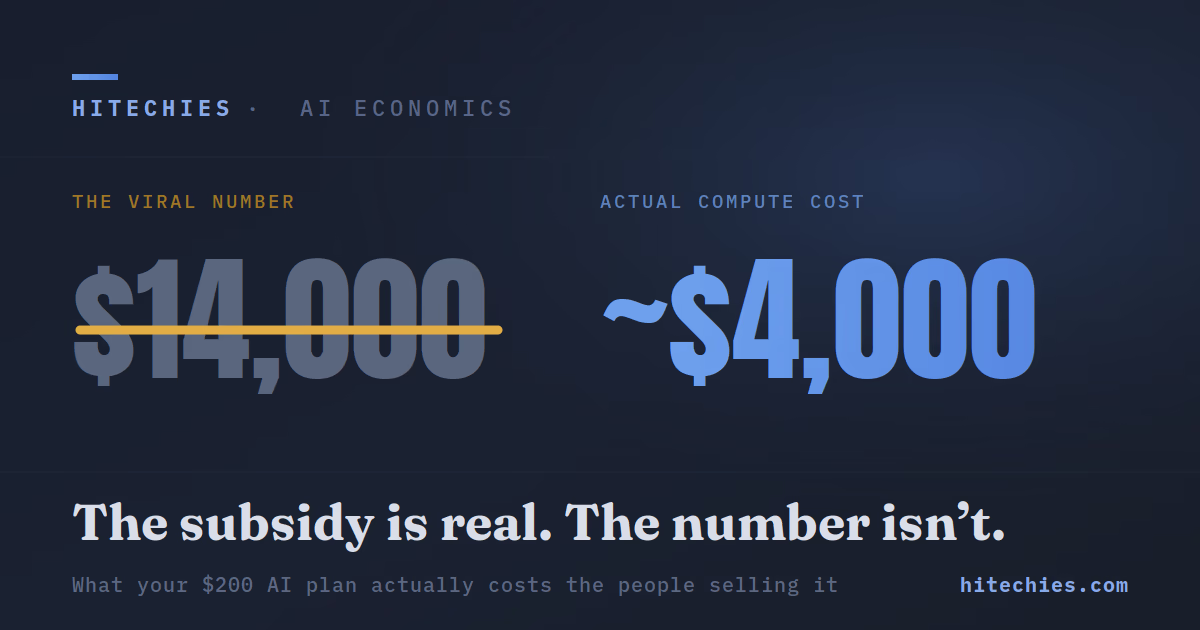 Hitechies — AI, Crypto, Security & Dev News for Tech ProfessionThe $14,000 AI Subscription Myth, CorrectedSemiAnalysis maxed every Claude and ChatGPT tier. The viral "$14,000" number is misleading — here's the real compute cost, and why the subsidy is real anyway.
they’ve both cut api costs drastically and reduced what the 200 plan got you since that article was slopped together, so not sure how accurate the data is anymore
also the margin percentage includes amortized training costs, which is a crazy thing to just multiply by a different usage value afterwards. the actual cost of one of these plans is far lower
they obviously are still losing money, but that article physically pains me
Replying to @partydisk@fedinsfw.app
The article I posted explains why a previously floated estimate of €14,000 was a gross miscalculation and instead claims that the cost to open AI is closer to €4,000 (for a €200 account used to its full capacity).
Which figure(s) are you disagreeing with?
14,000 is high for reasons in the article. 4,000 is high since it flows from the inappropriately applied 70% margin. the actual cost of one new person signing up for a 200 plan and using it to full capacity is much lower. the 70% margin is based on a fixed income of the company, a small operating cost per token, a large fixed cost to the company spread over every token generated, and the api price.
it’s a bit like saying I pay 100 for my car payment, 100 for gas, and drive 200 miles, every month. simple math, cost is 1 per mile (margin is this divided by sale price, then the article multiplies by sale price to cancel it out). if I start driving for a ride share company on top of my normal driving, is it correct to say (ignoring depreciation since none of openai’s assets depreciate based on use) that I only break even if they pay me ≥1 per mile?
spoilerof course not, you already need the car, cost to you is .5. you only lose .5 per mile doing the thing you’re selling. the rest is operating costs that stay fixed.
it costs the same to have trained the model whether you use your 200 plan or not. we don’t have those numbers for openai. we can’t just multiply the operating costs that have been calculated based on the price and volume of a different product.
you need to account for the car price in profits somewhere, but it’s not increasing based on the usage
EVEN WORSE: that 70% margin is before compute. so it is absolutely meaningless even without trying to convert it back to cost of goods. once you try and convert it back it represents everything but the part that scales with usage lmao. absolute clown article. their citations are just links to home pages of random news sites.
Replying to @partydisk@fedinsfw.app
I think I understand now. Good points, thanks for taking the effort to elaborate.

Replying to @eicker@lemmy.world
Given the monumental difference between those two figures, investors across the world of finance are taking it as a sign that demand for AI is much lower than previously thought
No. Demand for OpenAI’s services is lower than they thought.
Every day, the open weights models get smarter and cheaper and new competitors are coming online every few weeks. They cost a fraction of what OpenAI charges.
Demand for AI products and services is continuing to grow at a break-the-world pace. It’s just these big “AI first movers” are in trouble because it’s too easy to copy what they do. They expected an enormous “first mover advantage” (which is a real thing) but it turns out that AI is trivial to train and replicate (just have to scrape the Internet and scan a lot of books).
In other words, it’s turning out that “first mover” is a disadvantage in this (AI) industry.
Replying to @riskable@programming.dev
I wouldn’t believe that hype
I am the only person in my circle using open weight models.
Normies out number us by a large amount and none of them really are running their own things.
Replying to @cubism_pitta@lemmy.world
Individuals using AI are a tiny drop in the bucket. Think bigger: Businesses and government.
There’s government agencies racking up token usages to the point where Google had to build an entire data center on Christmas Island (the place with the cool crabs) and that still won’t be enough! And that’s just one government!
Companies are using AI in automations now and it’s working so well that they’re willing to spend tens of thousands of dollars a month (on tokens) just on that one automation.
These usages are where demand is growing. Not regular people or even developers using AI to help them write code.
Replying to @riskable@programming.dev
Companies are using AI in automations now and it’s working so well that they’re willing to spend tens of thousands of dollars a month (on tokens) just on that one automation
it’s working so well
Citation needed. I work in a midsized IT corpo, I don’t see it working that well? Sure, some shit is shipped faster, some is shipped slower, customers churn is 2x higher than “planned” and prod bugs have doubled.
(And we do all the fancy shit, looping, custom harnesses, orchestrations, handovers, savepoints, post delivery pipelines, autoremediation, blablabla, context, graphs blabla)
Replying to @ThirdConsul@lemmy.zip
(And we do all the fancy shit, looping, custom harnesses, orchestrations, handovers, savepoints, post delivery pipelines, autoremediation, blablabla, context, graphs blabla)
Yeah that’s not what I’m talking about. That’s just coding stuff and I think everyone is learning a hard lesson right now that there’s really two ways to do AI (for code):
#1 is a very expensive way to do it but it seems to work, albeit with a huge learning curve and a much longer horizon before you get something stable. Even then, what you get can be a giant fucking mess that’s really, really hard to understand.
#2 is much safer and works quite well, IMHO. When the AI fucks something up, it’s only a tiny little thing that’s easy to fix. This method really is just a way for developers to improve their productivity.
With #2, it only takes a small amount of tokens to have the AI help you troubleshoot as well. At least, that’s been my experience.
Having said that, the places where we are seeing the most growth in AI is small shit. For example, at my work they implemented an agent that scans customer complaints and filters out false positives. I work for a huge company that has a zillion products/services and the AI has tool calls into our ticketing systems to check if there was an outage at the time the customer complained. It’s not that smart, but it’s smart enough to tell if a ticket about system X was opened when system X had an outage. It can even tell if the customer was complaining about something relevant to the outage.
Stuff like that runs 24/7 and eats up bazillions of tokens, but only on our local hardware (we have thousands of enterprise GPUs). At other companies, they’re doing similar things and slowly realizing they can replace OpenAI/Anthropic API calls with local ollama stuff.
Even if your token bill is $10,000/month for a service like that, it’s still cheaper than paying an entire team of humans to perform the same function.
That is the growing use of AI automation I was talking about.
Replying to @riskable@programming.dev
I feel like in a few years we will look back on this whole era and realise that our politicians and business leaders fell for a not so elaborate scam. LLM usage will be severely curtailed because of the scammy stank on them and they will slowly migrate back into the niches they should have been confined to in the first place.
Rightly or wrongly people got scared off widespread nuclear after Chernobyl and Three Mile Island, LLMs will be much the same. The damage they have done to economies will take decades to resolve and it will be interesting to see if the US public can muster the unity and wherewithal to hold the oligarchs, kleptocrats and their enablers responsible.
Even more interesting if some laws can get put in place to limit the powers of the executive and or introduce some safeguards with teeth to prevent this sort of catastrophe again.
Imagine if worldwide we treated the criminals with power and money like criminals.
I fear we will have a generational loss of intellectual from people who have rapidly learned to farm all their higher cognition off to the liar box, and then got excited and cheered about the liar box getting better at lying. But hopefully we can move past this.
Of course the other scenario is that China waits until the US economy is so intrinsically linked to LLMs that there is no extrication, then they start pulling investment. I guarantee you the Chinese government will remain in control of their population longer than the US government controls theirs once an economic freefall kicks off towards a recession that makes the great depression look like a blip in the accounts books.
Replying to @shads@leminal.space
It’s too late for that scenario. LLMs are already widespread on millions of computers.
On my old 4060 Ti 16GB I can run Qwen3.8:14b and that’s actually good enough for loads and loads of things. It’s actually overkill for a lot of stuff too which is why tiny models are all the rage right now (e.g. 0.8b models).
Let’s say the government banned LLMs. Are they really going to want to halt pharmaceutical and biomedical research like that? Are they going to start inspecting/requiring everyone’s computers be scanned regularly for AI models?
No. It’s unrealistic to think they can do anything at all to stop AI. If we ban it in the US, the world will just use AI services offered from other countries and then the US won’t be able to compete because those countries will become vastly more productive.
As much as everyone on Lemmy believes all AI output is “slop”, it really does do useful stuff! It’s just most of the useful stuff doesn’t make the news. It’s boring things like checking if an uploaded image is NSFW or if an uploaded document has everything it’s supposed to have or follows the correct format.
AI/LLMs are also checking the grammar of basically everything that gets published. Anyone who’s not using AI for that is an idiot. It’s just way too fucking good at spotting grammatical errors, incorrect word use (often innocent typos that normal grammar checking tools miss), and similar problems.
There’s fucktons of super useful, good ways to use AI. We’d be stupid to just ban it and pretend it isn’t good for a lot of things.
We can regulate its use but that’s not really “regulating AI” as much as it is “regulating capitalism” or “regulating people”. Because the AI isn’t just going out on its own to spam misinformation or mislead consumers with generated product photos. Someone told it to do those things.
What we need isn’t “AI regulation” is regular regulation that prevents companies from behaving badly.
Replying to @riskable@programming.dev
Predictable as clockwork… Sure, there’s no way we say, “fuck this shit is cancer maybe I should stop handing my cognitive capabilities over to a machine and start thinking again.”
I had a whole big screed written out about the myriad ways that the implementation of this technology is corrosive at a societal level. But it’s all just so exhausting to have the same arguments time and again.
So let’s just leave it at, sure buddy, you and your ilk have the mandate of heaven to topple the world. Have fun, but please don’t be surprised where the road you’re on takes you.
Replying to @shads@leminal.space
No, no. You’ve got the wrong idea.
Will AI completely ruin a zillion people’s ability to think (beyond what social media already accomplished)? Quite possibly!
I’m just saying there’s nothing we can do to stop it at this point.
You’re about to head down a long, lonely road as normies start using and accepting AI more and more into their lives while you scream into the abyss. I’ve been there with fossil fuels, copyright, software patents, and Linux.
People saying “Just use AI!” Is about to live rent free in your head as your most-hated phrase. Just like, “stop driving gas guzzlers!” Or, “stop bitching about Windows and just install Linux already!” Lives in so many others.
At least most people don’t think of AI as a core part of their identity (e.g. pickup trucks) 🤷
Replying to @riskable@programming.dev
Eventually we are bound to take steps to mitigate it. Like Radium, or Asbestos, or Lead in bloody everything, or cigarettes. Eventually the winds of change blow and the shitheels in power pivot to something new. It will be imperfect and it won’t reach everywhere and we will be pulling it out of places we never suspected we would find it in 50 years.
I can even imagine some far fetched scenarios where people start seeing Dune as a prophetic vision, especially with the idea of LLMs targeting weaponry in conflict zones. We seems to have a fairly accepting view on people committing genocide… Will we be so open minded about LLMs doing a bit of genocide… Especially if it’s gets its target wrong, maybe engages in a bit of friendly genocide on the aggressor countries own civilian populace.
Replying to @shads@leminal.space
I don’t think it’ll happen like Radium or Asbestos because those rely on scarcity. They’re physical things that can be physically controlled.
AI models aren’t like that. In less than a minute anyone can download the latest models. In under an hour, they can have all the latest models sitting on their PC. Right now, there’s a shortage of memory and GPUs which makes them prohibitively expensive for the average person but that won’t always be the case!
Ten years from now, everyone’s phones will have enough capabilities to run models that currently require a PC with a 32GB GPU.
What we could do is force AI companies and software to put warnings in the chat interfaces like cigarette cartons: “WARNING: Using LLMs for just ten minutes increases the likelihood that you will have trouble completing difficult mental tasks afterwards.” (That was in the news this morning)
We also definitely need international treaties that prevent countries from allowing AI to make the decision to kill people or destroy infrastructure. Though honestly, we’re already in a state where countries are willing to kill hundreds of people just to assassinate a single target (e.g. US and Israel bombing an entire building because they think their target is inside).
These are small potatoes, though, compared to what AI could do to capitalism and inequality. The rate at which it is advancing is faster than people/jobs can keep up. It’s like half the population is ferriers and suddenly everyone was just given a free car.
Replying to @riskable@programming.dev
Ahh to be a techno optimist.
Things could get a whole lot more authoritarian than you think. It’s very early here and I can’t be bothered writing out the whole response, but we have governments around the world currently trying to make using a computer require ID. We are thin edge of the wedge here with age verification to “protect the kids”. Looked at from an authoritarian perspective a country with the power to dictate terms of trade says LLMs are actually military tech and need to be controlled, implement laws to restrict them or else…
If your country having access to international markets means you lose access to certain software… Now let’s complicate the situation by assuming a bubble burst leads to the world heading into a mass depression, do you really think the US has the wherewithal to retain its top spot? Times of mass political and financial upheaval can, and arguably almost always do, lead to radical changes to the living circumstances of people.
In 10 years time your phone won’t be running shit that the government/corporation in control doesn’t explicitly approve of and monitor.
Replying to @riskable@programming.dev
It’s not fucking AI. Stop repeating the marketing garbage, and stop advocating for slop.
Replying to @raspberriesareyummy@lemmy.world
What isn’t AI? What are you even talking about?
BTW: I don’t work for any AI companies and I don’t believe the hype for one second that they’re building extinction-level AGI. What they’re building is general-purpose “intelligence” that’s OK-ish at some things, great at others (that don’t make them much money, LOL), and fucking terrible at anything that requires reliable truth (on the first try, LOL).
Replying to @eicker@lemmy.world
🤞
Replying to @eicker@lemmy.world
Yes we crashed the economy, but at least we made the C-suite and the sub level guys an absolutely eye-watering, astronomical amount of money while also increasing worldwide hunger and genocide.
Replying to @Photonic@lemmy.world
c-suite gets cut of everything, they should get their cut of hunger and genocide too.
Replying to @reksas@sopuli.xyz
Most of them have no security detail and are easy to find, just fyi.
Replying to @Fishnoodle@lemmy.world
Replying to @Photonic@lemmy.world
Replying to @W98BSoD@lemmy.dbzer0.com
Yup…
Replying to @Photonic@lemmy.world
😔
Replying to @Photonic@lemmy.world
Don’t forget climate change!
Replying to @eicker@lemmy.world
OpenAI was always expected the first big player to go. It doesn’t mean that the bubble will pop. If the interested parties can prop it up or even cannibalize it then they might keep going for couple of months to a year.

Replying to @eicker@lemmy.world
OK but they’ve been saying this for a couple years now. I’d love to see the hype recede, but I’m beyond the point of believing these speculations.
Replying to @eicker@lemmy.world
They are all looking for billions in new rounds of funding now. If they can get it the shitshow will continue. Looking at the stock price of SpaceX (an artificially inflated fantasy “AI in space” company owned by a Nazi) they will get it.
Replying to @eicker@lemmy.world
How long has AI been “teetering on the brink“?
Replying to @charokol@lemmy.zip
Right. It’s literally everyday it’s brought up. Yet here we are, still using it, still funding the losses. Still funding the climate damage.

Replying to @charokol@lemmy.zip
Rome hasn’t collapsed in a day.
Replying to @charokol@lemmy.zip
Most of the historical boondoggles took about 5 years to work their way out. We are on year 3. If that’s any guide, we got a whole lot more electric boogaloo left to play.
Replying to @cantstopthesignal@sh.itjust.works
Most boondoggles don’t burn trillions of dollars. AI is starting to hit a wall already because there just isn’t any more money. It’s why there’s this desperate push to go public even though their financials are a dumpster fire.
Replying to @zurohki@aussie.zone
As a percentage of Capex to GDP it’s about a third of the way to where the railway mania was at during its peak. There’s room to run. The difference between then and now is that all the spending is concentrated in a handful of companies.
Replying to @cantstopthesignal@sh.itjust.works
Another key difference, the Railway mania was powered by commoners investing. Not just a few rich bozos and enormous enterprises putting their money into it, as it is with AI
Replying to @zurohki@aussie.zone
“We must keep building stone heads!” Easter Island civilization
“We must keep building datacenters!” Epstein Island civilization

Replying to @charokol@lemmy.zip
Depends if you’re asking people who are informed or news headlines. The informed people have been saying the AI bubble is set to burst around Q2-Q3 2027. That’s when loan obligations come due and the majority of investors are set for payouts.
The news will say it’s happening everyday, just like Trump is just about to die everyday, or MAGA is “turning against him” everyday according to the articles.
Replying to @Corkyskog@sh.itjust.works
Ai can crash before then, if people stop investing money or loaning money. It doesn’t mean OpenAI run out of money straight away, but it means the projects they are involved in don’t happen, so the mountain of debt piles up and the sources of revenue dry up. So, it all happens faster and the smaller neo-clouds go belly up first.
Already an Aussie one just pulled its launch IPO due to lack of interest and were considering dropping their price significantly.
If the IPO prices of other companies drop significantly, it means the early investors make very little profit, for a lot of risk, so they start to look elsewhere too.
AI companies need huge amounts of investment over extended periods, so either scenario is problematic for them.
Replying to @hitmyspot@aussie.zone
Open AI is already backing out of their IPO too.
Replying to @cantstopthesignal@sh.itjust.works
Most I’ve seen is because they don’t want to release their real financials. So it must be bad enough to spook investors even more than the delay.
Replying to @Corkyskog@sh.itjust.works
republicans usually crash the economy right toward the end of their term, yeah. pretty much every single time. So Q3 2027 is perfect.
Replying to @Corkyskog@sh.itjust.works
2027
My guess would be 2029, because history doesn’t repeat itself but it often rhymes and I want to see Musk jumping down from one of his rockets, but it probably won’t last that long, yes.
AHEM
Markets can remain irrational longer than you can remain solvent.
Replying to @charokol@lemmy.zip
Leftists promising AI collapse is like Musk promising full FSD.

Replying to @eicker@lemmy.world
This article conveniently ignores the fact that Anthropic is reporting a second profitable quarter to investors.
Replying to @urushitan@kakera.kintsugi.moe
Yeah.
I don’t like Anthropic’s long term prospects, but OpenAI is specifically in trouble, near term.
Their whole premise was becoming a Facebook-style “where else are you gonna go?” captured market on the consumer side, and that is clearly not happening. They wanted an enterprise monopoly, and those business customers are looking elsewhere.
Their ass is cooked.
Replying to @brucethemoose@lemmy.world
Even if openai tanked tomorrow it would just be bought by Microsoft and become copilot AI.
The failure of the company is bad for current investors but it’s not a public company and as others have mentioned there is not yet enough instability in the rest of the industry. Google is still trucking along without issue even if they don’t make the news and people are still giving Muse access to all their shit.
Replying to @tempest@lemmy.ca
It’s not that simple, as:
Other companies/institutions have heavy investments in OpenAI.
Other companies’ expected long-term revenue depends on OpenAI.
They are the “face” of LLMs to finance world. If they tank, the illusion shatters, and investments pulls out of “AI” everywhere.
I agree that Google, Meta, the companies will be fine, as you said. Nvidia/AMD will be fine. Even XAI will be fine. The physical companies and their business aren’t going anywhere.
But their stocks will drop precipitously, and drag others into the rut with them like a black hole.
Replying to @brucethemoose@lemmy.world
So they’ll drop from inflated to fairly priced?
Replying to @BlaestEgnen@feddit.dk
That I would not even try to predict. I don’t know how far this bubble burst will go.
Replying to @urushitan@kakera.kintsugi.moe
I suspect we won’t know their real state of finances until they go public and are held to a higher standard for their accounting practices: wheresyoured.at/anthropics-profitability-swindle/
Replying to @zbyte64@awful.systems
Agreed, and I didn’t specify that they are legit making a realized profit, purely that’s what they’re reporting to investors.
Replying to @urushitan@kakera.kintsugi.moe
“profitable”
wheresyoured.at/anthropics-profitability-swindle/
Uh huh. And that’s despite government propping and no returns on stocks on top of possibly cooking the books.

Replying to @urushitan@kakera.kintsugi.moe
A certain Ponzi dude also did every quarter for a while
Replying to @eicker@lemmy.world
Sounds like it’s almost bailout time again.
Replying to @Lectral@lemmy.ca
I favor incarceration with no bail.
Replying to @cardboardboxfort@lemmy.world
I favour incineration
Replying to @T00l_shed@lemmy.world
Replying to @eicker@lemmy.world
Let it pop! Let it pop! No bailouts for billionaires. Just let the fucking system collapse. I’ll happily go back to a trade a barter system of some kind.
Replying to @IamMoonPie@lemmy.world
Pop pop pop!
I’ll be fine, my mortgage is fixed for 4 more years before any damage it causes to the economy can seriously effect me. That is a problem for me in 4 years time, not me today.
Replying to @eicker@lemmy.world
“We have to stop AI before it kills everyone, but we need the government to do it so we don’t lose investors.”
Replying to @eicker@lemmy.world
Basically, the AI lab told backers to expect revenues approaching $50 billion — far shorter than the explosive $70 billion number reported previously.
Though that $70 billion figure was also based on leaked investor memos, OpenAI wasn’t in any hurry to deny it, digging itself into a $20 billion hole.
So they told investors they’d make $70b and now they’re bringing down the forecast to $50b . $50b is still insane, that’s more revenue then any other software company except Microsoft (and probably anthropic), next closest is Salesforce with $41b, and Salesforce built that revenue over decades. Open AI finished 2025 with $13b in revenue, that’s nearly 4x growth in a year on more then 10 billion in revenue, that has never been done before.
Idk if this is a sign of a bubble collapsing just because it’s record setting growth and revenue aren’t as explosive as they initially said. It is still very much explosive, but more a fission bomb then an h bomb. It seems the market agrees, Nvidia is down ~1% on this news, but still up 5% on this month and 20% yoy.
Replying to @Not_mikey@lemmy.dbzer0.com
Idk if this is a sign of a bubble collapsing just because it’s record setting growth and revenue aren’t as crazy as they initially said.
That’s because you’re thinking about the situation rationally, which isn’t something the market is known for.
Replying to @Not_mikey@lemmy.dbzer0.com
Good point. It is important to keep things in perspective.
Replying to @Not_mikey@lemmy.dbzer0.com
50B is annualized revenue, accrued revenue will be almost certainly be quite a bit lower this year.
Tech companies love reporting ARR because it is always bigger than GAAP revenue (if the business is growing at all).
Replying to @skibidi@lemmy.world
It’s not annualized in the traditional sense. They take their highest revenue day and multiply it by 365.
Replying to @likebudda@reddthat.com
That… Doesn’t make sense does it? Like apart from fraud what’s the point of doing it like that?
Replying to @KaiFeng@lemmy.world
Oh, it’s absolutely a fraud meant to deceive investors.
Just not legally speaking.
Replying to @CrimeIsLegalNow@ani.social
But the $70b number was published by an investor, and OpenAIs crime was to not disagree publicly. Makes me wonder who is frauding whom.
I won’t pretend to understand this news.
Replying to @KaiFeng@lemmy.world
They need to pull a big number from where the sun don’t shine.
Replying to @likebudda@reddthat.com
We don’t even know their calculation. It’s just a number they present without context.

Replying to @Not_mikey@lemmy.dbzer0.com
yeah $20 imaginary dollerydoos were shaved off the $70 anticipated imaginary dollerydoos, it’s all so idiotic
Replying to @Not_mikey@lemmy.dbzer0.com
“revenue” that’s propped up by the government and ignores other factors, such as overall expenses, competing open source models, and non-realized assets.
The difference between Microsoft and OpenAI or Anthropic is that Microsoft has a profit model.
There’s absolutely no way that the big LLM companies can make enough profit to overcome their expenses in the next decade even, especially since the technology on the open front only continues to improve. That’s why the LLM bros keep hyping it up via fear mongering and criminal activities like hacking - to keep selling the illusion that it’s AI.
Replying to @Not_mikey@lemmy.dbzer0.com
The bubble part is the extremely high losses, even before hiding training expenses as assets that become worthless the next month after a new version release. Also monumental promises that they will require massive new fundraising for, that fewer people understand remain possibly sustainable.
Replying to @Not_mikey@lemmy.dbzer0.com
its basically elizabeth holmes, but with AI, and with the same freaky facial expression.
Replying to @Not_mikey@lemmy.dbzer0.com
Quite a lot of that ARR is based on Ouroboros-like investment loops.
Replying to @eicker@lemmy.world
I dunno, iheartmedia was heavily in debt for over a decade. I don’t think this bubble is popping anytime soon
Replying to @eicker@lemmy.world
Uh oh…
Does this news have anything to do with the November elections?
Replying to @eicker@lemmy.world
Just burst already!
Replying to @eicker@lemmy.world
Hopefully, I will be able to pick up x4 RTX Pros and 2TB of DDR5 RDIMM after ClosedAI dies. I would like to run local open models like Kimi.
Qwen Next has been helpful in getting an old game to run on modern Windows - getting the graphics to render properly, adding support for Xbox shoulder triggers, and so on. While I probably could flounder my way through, just having the AI handle things as I sleep overnight is much appreciated.
The more AI power that individuals can own, the better it is for the everyday person.
Replying to @SabinStargem@lemmy.today
Kimi sucks, run GLM or Deepseek if you manage to get that setup. Both of those have done more for me than Kimi with its expensive subscription plan
Replying to @eicker@lemmy.world
All the AI companies know it. The first to get caught out about it will stand to lose the most funding.
Replying to @eicker@lemmy.world
Teeter harder, I need to upgrade my graphics card.
Replying to @FauxLiving@lemmy.world
And I wanna build a gaming PC!
Replying to @FauxLiving@lemmy.world
I just want some RAM, man. :(
Replying to @Lemminary@lemmy.world
I don’t actually need more RAM but I’m going to buy more anyways just in celebration.

Replying to @Lemminary@lemmy.world

Replying to @FauxLiving@lemmy.world
slow down, there’s going to be enough for everyone once the AI hype dies and they’re scaling back (probably)
Replying to @khanh@lemmy.zip
That’s not how it works. The ram chips soldered onto the AI accelerator cards, you cannot just take them out and use them in a PC :(
The AI bubble will pop just like the housing one did.
Never.
This is bullshit people like tontel themselves so they can do nothing about it and wait for it to fix itself.
Replying to @Pratai@piefed.ca
Uh, I got a pretty good deal on a house in 2009…
Replying to @eicker@lemmy.world
This feels like a nothing burger. It either won’t affect them or the government will bail them out.
Replying to @IEatDaFeesh@lemmy.world
With the amount of money being spent on AI 20 Billion is a drop in the ocean.
Replying to @digdig@lemmy.world
However, if you are talking about revenues, 20 billion is suddenly a significant amount. Funny that
Replying to @IEatDaFeesh@lemmy.world
Financial Times smells blood in the water. They’ve been reporting on leaked OpenAI documents for a bit the last few weeks.
If the major financial outlets start reporting on the negative, there may be a sentiment shift that does actually destroy the companies propped up by hype rather than fundamentals.
Replying to @eicker@lemmy.world
The $20B difference is based on an accounting fraud. $50B vs $70B is like if GM would count the total of what buyers pay for cars ($70B) instead of their real revenue ($50B) of what their dealers pay them. Monumental fraudster BS came out overnight to resume the bubble frenzy though.
Replying to @humanspiral@lemmy.ca
What are you talking about? The 20 billion difference is based on a “leaked internal memo” that suggested annual revenue of 70 billion. And a memo to investors in September that they expect a 50 billion revenue. In short. It’s based on a leaked previous estimation compared to a more recent one.
Replying to @humanspiral@lemmy.ca
The number they used for annualized revenue for these rapidly growing companies is taking the most recent month’s revenue and multiplying it by 12. It’s not a guarantee about the future, but it is misleading.
The extreme version is taking a good week’s revenue and multiplying it by 52, or even worse, multiplying a day by 365. Those are outright dishonest. But not accounting fraud, because it’s not accounting at all.
Replying to @GamingChairModel@lemmy.world
Annualized Revenue rate is a made up number, that is a separate accounting fraud, for being a purely selective cherry picked time frame that gets multiplied.
The reason they are changing their made up number from $70B to $50B is because they used to include their partners’ revenue (extra $20b annualized) as their own.
Replying to @humanspiral@lemmy.ca
Annualized Revenue rate is a made up number
It is fundamentally a projection about the future using recent results, and transparent in its methodology. It’s shit methodology, but it’s not hiding anything. So I don’t know that I’d classify it as fraud.
Playing games with “revenue” is another problem, but because that’s misleading about the past, and making an active decision on whether to classify money that was never gonna end up in their pockets as revenue share to partners or cost of revenue. Companies sometimes engage in shenanigans where they give discounts but classify the discounts as marketing/sales expenses rather than foregone revenue. That kind of stuff strikes me as more squarely in the category of accounting shenanigans.
Replying to @GamingChairModel@lemmy.world
transparent in its methodology
To qualify as transparent means disclosing “based on x days in this date range”. That is not disclosed.
Replying to @eicker@lemmy.world
I wonder if the IPO will even happen.
Replying to @tigermountain@lemmy.world
I really hope not, because that’s how they steal money from working people with 401k plans.
Replying to @wewbull@feddit.uk
Love 401(k)s. One person invests in the stock market, but someone else controls their stockholder voting privileges. Amazing system we have going on here
Replying to @eicker@lemmy.world
Let it burn, baby! I have no money, it’s gonna be great having all you guys around!
Replying to @anarchy79@lemmy.world
I have a metal trash can we can put on the corner, gather around and burn stuff in and swap ramen recipes.

Replying to @eicker@lemmy.world
Yep, no way they’re ever going to be profitable.
Replying to @jaykrown@lemmy.world
I’m pretty sure they’ll get a deal worked out with Northrop or Raytheon and all that sweet US tax payer money is gonna go smoofly in them pockets just you wait.
Replying to @eicker@lemmy.world
I desire the collapse so much.
I own nothing of value, I lose nothing.
Good piece of FINA coal advice. You’re assets can’t lose value if you have none ;)
Replying to @RumRunningDevil@lemmy.zip
As a person with assets, I will gladly watch them burn together with AI. Can we be done with this tomfoolery already please.
Replying to @bluefootedbooby@sopuli.xyz
Shenanigans, poppycockery, cockamamie, and a basic lack of respect for the institutions god damn it, I ain’t having it!
Replying to @bluefootedbooby@sopuli.xyz
Just invest in the things that we actually need. Renewables for example.
Replying to @RumRunningDevil@lemmy.zip
I am with you the whole way, friend. I love seeing the stock market crash. Brings them all down closer to our daily level.
Replying to @RumRunningDevil@lemmy.zip
So you selfishly want others to fail and yourself to thrive. That’s an honest position, but perhaps not very ethical. Incidentally almost exactly the same position the billionaires take.
They started it.
It’s not about me vs. others, I just want the people investing in harmful tech to fail. Not for personal reasons, just so there will be less harmful tech in the future. But those investors might learn something, and that would be welcome.
Replying to @RumRunningDevil@lemmy.zip
I want it to go away too. But there is so much of everything tied up in this boom to think you won’t be affected is naive.
For a taste of what to expect watch this: youtu.be/T9d6lrvzM9o?is=XvTpsKub8SB48lgt
Replying to @billwashere@lemmy.world
All I need is food and shelter.
I work in critical infrastructure (power distribution/generation) with a job that requires a pretty hefty certification and a bunch of legal requirements.
I’m safe as long as people still need electricity for things.
Replying to @eicker@lemmy.world
The fundamentals get worse and worse the closer you look.
Like for example, so much of their opex is filed under capex. Graphic cards & related assets degrade over time but are often listed as one time purchases, compute time is often evaluated as one time expenses but the models need to be retrained to improve over time, etc.
Replying to @eicker@lemmy.world
After the initial dot com boom and bust (remenber pets.com?) I remember being told laptops and desktops were dead and we’d all be using tablets. Metaverse, google glass, self driving vehicles real soon, theranos will transform health care, NFTs, crypto. And now AI. Its all just a repeating toilet bowl swirl of empty speculation, exactly like a casino. And not a single one of those things came to much. I wonder if AI will leave much progress behind when it implodes. Maybe this time itll be different?
Replying to @kreskin@lemmy.world
The funniest part is that the dot com crash didn’t kill the internet. It killed a lot of terrible business plans. AI may follow the same script: useful tools survive, investors discover that a chatbot isn’t worth infinite money, and taxpayers get stuck with the data center power bill. The technology can be real while the valuation is pure casino. - PS: You didn’t mention the smartphone. And that’s exactly what people mainly use these days.
Replying to @eicker@lemmy.world
That’s the thing about bubbles: it doesn’t mean that the thing is useless, just that its value is inflated. We still have websites after the dotcom bubble burst, certainly we still have housing despite several bubbles bursting there. I would be surprised if LLMs go away entirely. OpenAI and Anthropic might not survive, but Google and Microsoft will continue. God only knows what will happen in China. Local models will still be OK. The broader concepts of machine learning, deep learning, big data etc have been useful for far longer than this bubble and will continue.
Replying to @Dalvoron@lemmy.zip
Exactly. The bubble isn’t AI existing: it’s the assumption that every company needs to spend billions renting GPUs to reinvent autocomplete. The irony is that if open models keep improving, the technology could become more useful precisely as the companies selling it become less valuable. Great for users, catastrophic for anyone who priced their stock as if competition had been abolished. - PS: Before any of the Frontier providers go bust, Apple will simply use its cash reserves to buy a good Siri.
Replying to @Dalvoron@lemmy.zip
I think Anthropic will survive. Claude code is very useful.
Cursor may secure Groks future too.
Replying to @PrettyFlyForAFatGuy@feddit.uk
My boss is big into Claude code and has produced something really useful from it. Just a shame that’s a job a software developer could have been paid to do 😢
Replying to @Dalvoron@lemmy.zip
Such is the unrelenting match of progress.
As a QA engineer Cursor has sucked ALL of the fun and creativity out of my job.
I can’t deny it’s useful though

Replying to @PrettyFlyForAFatGuy@feddit.uk
It depends, if Anthropic keep nerfing Claude’s capabilities they’re going to lose to their competitors. I’ve been doing defensive cybersecurity work for the last couple of weeks and Claude, a tool which should be ideal for automating the tedious parts of this, has been a complete pain in the arse.
Claude: I’ve found a security bug in your codebase that nobody knows about!
Me: Oh shit that’s not good, can I see it?
Claude: <blocked by safety classifier>
Repeat ad nauseam.
The prissy little bastard’s recalcitrance made me to do a lot of stuff by hand anyway, but instead of being bored I’m now actively irritated by the bot telling me what I can and can’t do. Obviously can’t use them at work for regulatory reasons, but when I was doing similar stuff at home to secure a side project which has to live on the public internet GLM and DeepSeek have no such qualms and honestly I’m convinced the whole ‘DeepSeek is the budget option’ thing is mostly behavioural economics; the cheapness to me feels like efficiency gains more than nerfing the model.
Replying to @PrettyFlyForAFatGuy@feddit.uk
Useful doesn’t mean profitable, sustainable or cost effective.
You’re not paying the real cost right now.
Replying to @eicker@lemmy.world
The thing with this bubble is that it’s all terrible business plans. We’re 4 years in and no great leap. No productivity gain. No company that’s been able to turn the tech into something that makes a profit.
Yes, the tech will survive but if nobody is prepared to pay the actual compute costs, it’s going to get abandoned.
Replying to @wewbull@feddit.uk
Exactly. And cheap open weight AI is the wildcard. If people can run capable OWAI locally for pennies, the trillion dollar moat starts looking like a very expensive puddle. AI could thrive while the companies betting on permanent scarcity discover they funded their own competition.
Replying to @eicker@lemmy.world
I’m not sure how much distillation and building on top of each others results is going on. I could see all the models freeze in development when the money leaves the segment.
A model frozen in the past has limited usefulness.
Replying to @wewbull@feddit.uk
Personally, I use older, smaller models, provided they are adequate for the task at hand. My theory is that at least 80% of companies are using a sledgehammer to crack a nut. Not only is that incredibly expensive, but it’s also incredibly ignorant.

Replying to @kreskin@lemmy.world
Yes this time it will be different, please purchase ETFs with names like “AI, Metaverse and Blockchain” (they actually exist)
/s
Replying to @kreskin@lemmy.world
I hope you are right .
But i just read and article suggesting that new university students "cant imagine " writing a 5 page paper without AI chatbots…
Replying to @kreskin@lemmy.world
Technology investment bubbles have existed since at least the industrial revolution kicked off. Tons of airlines went bankrupt in the early days of air travel, for example. I don’t know anything about it but I assume the same thing happened with trains and a gazillion other technologies that actually are pretty cool.
Marx pointed out that capitalism needs periodic cycles of capital destruction, and here we are…

Replying to @NotEasyBeingGreen@slrpnk.net
en.wikipedia.org/wiki/Railway_Mania
Railway Mania was a stock market bubble in the railway industry of the United Kingdom of Great Britain and Ireland in the 1840s. It followed a common pattern: as the price of railway shares increased, speculators invested more money, which further increased the price of railway shares, until the share price collapsed. The mania reached its zenith in 1846, when 263 Acts of Parliament for setting up new railway companies were passed, with the proposed routes totalling 9,500 miles (15,300 km). About a third of the railways authorised were never built—the companies either collapsed because of poor financial planning, were bought out by larger competitors before they could build their line, or turned out to be fraudulent enterprises to channel investors’ money into other businesses.[
Replying to @kreskin@lemmy.world
I wonder if AI will leave much progress behind when it implodes.
I think it will, it’s the one bit of AI optimism I actually have. I have a theory the big AI firms love for example Yudkowsky’s doomsday cult so much because it’s easier for them to imagine the end of humanity than it is to imagine them not getting an extractive oligopoly over an emerging technology.
The tech itself is actually decent as tech, it’s not what the boosters claim it is but even if development stopped advancing today there’s loads of niches it’d be changing for a long time; computer vision in medical settings for example. Useful things like TTS will be much better going forward than they ever were, and for better and worse things like computer vision in general (ie in public) will never be the same. LLMs are basically magic NLP boxes too, they’re useful for classification as much as generating slop.
Replying to @mobyduck648@lemmy.world
My own opinion is that Ai is the greatest threat to capitalism since Karl Marx and nobody has caught on to it yet.
The idea of top down control of this technology- eg a single or a few companies holding the rinse and selling it to everyone else - has been quickly proven to be a fantasy.
I think it’s what both the fuck ai crowd and the Ai bros are missing with the whole situation. No one makes money with Ai (except the people that make the hardware it runs on). Not the people who used to do the things it does, not the people who want to control and sell it.
Replying to @krakloskewm@lemmy.zip
It’s definitely an interesting point of view I think, and definitely one worth taking seriously.
One thing it might be really cool for is implementing cybernetic ideas, which would be ironic as the term AI was originally coined to move away from cybernetics! I think cybernetics could well be the weapon of choice for a serious socialist challenge to capitalist norms, I don’t think anyone sane wants to bring Gosplan back from the dead for example (it was a good example of very constrained and unreliable information flow) but cybernetics is a serious answer to the neoliberal argument that only prices carry the necessary economic information to operate a modern economy.
The cyberneticist would argue that there are much richer data available and we should build systems which take it into account, and allow for more sophisticated goals than ‘more billionaires’ to be deliberately aimed towards. It can also be used to do away to some extent with all-powerful centralised bureaucracies (and the inevitable bureaucratic class which forms around them) because decentralisation is a key component of cybernetic ideas.
Replying to @krakloskewm@lemmy.zip
It seems highly unlikely to me because AI requires massive amounts of capitalism to work, from the mass production of chips to the mass aggregation of knowledge in digital form.
Replying to @Bluescluestoothpaste@sh.itjust.works
I’ve been screwing around with a 3B model running on an old video card that was literally lying around unused. Clearly there are a metric ton of dollars being thrown at AI but after the bubble pops there will be a lot of people still digging hard on this.
Replying to @TehWorld@lemmy.world
Well yeah, that old video card wasn’t built by hand at a socialist commune. It was mass produced in a capitalist factory.
Replying to @krakloskewm@lemmy.zip
greatest threat to capitalism since Karl Marx
or any sociologist since then.
Replying to @mobyduck648@lemmy.world
I had a Windows tool I previously spent hours of frustrating trial and error trying to get it working in WINE. Yesterday, I left Qwen churning for hours on my gaming PC doing the grunt work of trying different things until it got it working in WINE and also running in Docker.
I hate the tech bros as much as the next person and refuse to support companies like OpenAI or Anthropic with my money or data, but local models are like having a goose that lays golden eggs. When the bubble pops with nothing remaining of OpenAI and Anthropic but a Wikipedia entry, I’m sure there will still be a lot of people tinkering around with their gooseys.

Replying to @kreskin@lemmy.world
Netbooks and thin computing too.
Nope, all hype and fizzle.
Turns out people want to own their personal hardware/software tools and data, without some perverts reading and observing their family interactions.
Replying to @ace_garp@lemmy.world
I loved netbooks… but I think I was the only one.
Replying to @kestrel7_7@lemmy.world
I want a convertible, a laptop that folds all the way back and gives a tablet/stylus interface, but has stiff enough hinges to hold the screen like a laptop at any angle with a keyboard, and that closes and covers the screen like a laptop. They played around with some form factors like that 10 years ago but they never really took off. Plus they tended to be Windows only, with poor Linux support on the hardware.
Replying to @kreskin@lemmy.world
Tech Bros have been trying to repeat the Net Boom almost immediately after that bubble burst - I think it didn’t take more than a couple of years after that Crash for the “Web 2.0” to start being paraded around like some kind of new gold rush that everybody should jump into and, as clearly visible in the list of hype techs you wrote, they just kept doubling down on the hype and the fraud ever since.
I actually was in Tech in the 90s and during the Crash, and then came back to that industry and into startups almost 2 decades later, and my feeling is that the point when the entire sector turned into nothing more than a giant grift was either a bit after the crash or, at best, just when the boom before it was peaking - I remember very clearly that in the 90s startups mostly started with somebody having a cool idea for tech, whilst in the 00s and onwards they mostly started with somebody having a business idea which was generally about setting oneself up as an intermediary in a kind of business transaction already done for decades, using the Internet and/or Smartphones to come up with a new twist for it and some way of becoming an aggregator/middle-man between both sides of the transaction.
Replying to @Aceticon@lemmy.dbzer0.com
They were doing it before the net boom too. Roaring 20s, railway mania, Mississippi bubble, south sea bubble, and on and on.
Replying to @absentbird@lemmy.world
I’m think just Tech here, or maybe more specifically digital technology - the period till 2000 was mainly driven by techies, after than it was mainly driven by grifters, generally with backgrounds like Finance or Marketing, not Technology.
Many people seem to still have the idea that Techies lead Tech Startups, but that hasn’t been true for at least 2 decades.
Replying to @Aceticon@lemmy.dbzer0.com
I’m just saying it didn’t start with tech, it started with capitalism
Replying to @absentbird@lemmy.world
“The more things change, the more they stay the same”
Replying to @absentbird@lemmy.world
i blame sea peoples all the way back! these guys are assholes!
Replying to @BilSabab@lemmy.world
Sea people are more a backlash to states IMO
Capitalism creates the boom/bust pattern in the same way national borders create immigration crisis.
When you map reality onto a belief system it creates distortions.
Replying to @absentbird@lemmy.world
i was sarcastic about sea peoples.
Replying to @Aceticon@lemmy.dbzer0.com
Tech Bros have been trying to repeat the Net Boom almost immediately after that bubble burst
the original dot com bubble never really got its reckoning because almost immediately after that there was 9/11 which shifted focus and then there was the whole economy collapse situation and by then it was ancient history nobody cared about.
Replying to @BilSabab@lemmy.world
if something similar happens again, there might be a pattern
Replying to @reksas@sopuli.xyz
it happened like five or six times this century alone but because of creative bookkeeping and bailouts it seems like its impact was mitigated time and time again but in reality it was just chipping away an already shaky foundation built on perception and not reality.
Replying to @kreskin@lemmy.world
The tablet one eventually came true. Desktops and laptops aren’t anywhere near as popular for personal use by non-technical people.

Replying to @GamingChairModel@lemmy.world
yeah but thats only because we have a generation of people raised by cellphones, so its the only interface they know.
Replying to @A_Random_Idiot@lemmy.world
Whatever the reason, it’s basically become true.
Replying to @kreskin@lemmy.world
AI IS a useful tool for some things, just not everything. So it ain’t going away. Just as the “cloud” is still with us. Or email. Anyone remember when every ISP had their own email?
Every new idea goes through the process of catching on, stupid rapid growth, and then the weeding out of 90+ % of them, and finally the stabilizing the market for those that actually need and use it. Whether is cars, TVs, Cell phones, or AI, every hot new idea goes through this process.
Replying to @Bluewing@lemmy.world
its a useful tool in the way each car should have a nuclear reactor engine. cool idea but the execution is too resource heavy…
draining lakes for cat videos is NOT the future u dunderpate
The juice isn’t worth the squeeze
So, the AI the doctors use to help scan for cancers should be stopped. Gotcha.
Fool of a Took…
Replying to @Bluewing@lemmy.world
you act like the process doesn’t cause cancer…
but go ahead and immerse yourself in fantasy…
🤔 what’s the logic here?
What part of using AI to diagnose of cancer causes cancer?

Replying to @Bluewing@lemmy.world
That is a very specific use case, its used way more often to make child porn.
Replying to @fyzzlefry@retrolemmy.com
So you admit that AI is a useful tool for some needs.
Replying to @kreskin@lemmy.world
remember pets.com
I think pets.com is probably the best analogy to what will happen with this first round of AI companies. In hindsight pets.com’s business model was fine and modern companies like chewy are doing the same thing successfully.
The problem was timing, internet adoption was low and most people didn’t understand how to use the Internet or trust it. Combine that with a flood of speculative dollars that mostly gets funneled into marketing with no adoption to justify it and the business falls apart.
I think we’ll see the same thing happen with some of these AI applications, the use case may be valid, but people, and the devs, won’t know how to use AI and the people won’t trust it so adoption will be low even with high marketing and the company will go bust. Then 10 years from now we’ll make fun of that AI party planning app that went under while we all plan our parties through some new AI app.
Replying to @kreskin@lemmy.world
Yeah, just like, after the Segway bubble burst, we’re all riding them now.
Replying to @eicker@lemmy.world
Replying to @eicker@lemmy.world
Imagine any other company admitting 20 billion setback, how would the investors react to it? I wonder if them admitting this is the needle starting to puncture the bubble, since i cant imagine why anyone would want to invest anything more to them and without more money being injected to their loop how will they keep it running?

Replying to @eicker@lemmy.world
Since I haven’t seen it yet in this conversation, I think I need to bring some better context to what this article is claiming.
No, OpenAI did not assume they were making $70 billion. They’ve always known their existing number. In fact, that number IS what was reported to investors.
The $70 billion number is coming from a specific investor that wanted to adjust the definition of revenue to get a more “apples to apples” comparison to Anthropic’s numbers.
When these companies license their models to hypervisors (AWS, Azure, etc), those hypervisors take a cut. OpenAI does not report that cut as revenue. This investor wanted to add it back in to get a “total demand for AI tokens” number.
They are 2 completely different metrics coming from 2 completely different groups.

Replying to @1800doctorb@lemmy.world
Are you suggesting that The End is not, in fact, Near? And OpenAI is not about to collapse into bankruptcy, ending the entire AI ecosystem?
Replying to @UnderpantsWeevil@lemmy.world
Maybe I’ll go out on a limb and say this specific piece of news is not indication of the AI apocalypse. There are still plenty of things to be skeptical of long term, but this itself is not an indication of an inevitable crash.
Replying to @UnderpantsWeevil@lemmy.world
I wish more people realized AI is not going any where any time soon, regardless of their feelings on it.
Replying to @Nowtayneicangetinto@thelemmy.club
I agree, it truly is going nowhere. This tech is exactly as useless and uninspiring as it’s always been.
Replying to @Nowtayneicangetinto@thelemmy.club
Is not about AI going away, is about the huge economic problem the current bubble will cause.
Replying to @Nowtayneicangetinto@thelemmy.club
That cuts both ways. The hype artists who insist it’s going to become the foundation of all professional services is also bullshitting you.
But yeah, these tech companies aren’t going to just vanish, any more than IBM or Yahoo did in prior downturns.
Replying to @UnderpantsWeevil@lemmy.world
Totally agree!!

Replying to @Nowtayneicangetinto@thelemmy.club
It was the recent estimation that hyperscale LLMs need to earn $6 trillion a year to break even. I don’t think governments can afford six trillion for their surveillance states and robot armies.
That is the recent news that harbingers a potential 2026 AI bubble burst.
Open AI has been hemorrhaging money and taking on vast debt for a while. That’s not really news.
Replying to @Nowtayneicangetinto@thelemmy.club
Depends in what exactly you mean with AI here. AI as a tech is going to stay, Pandoras box is open and there is no going back now.
The AI companies tho, the actual subject of this post, are going to crash and burn eventually. Not all at the same time and maybe not every single one, but a good portion of them will go down the drain .
Replying to @eicker@lemmy.world
Who could have possibly seen this coming?!
Replying to @eicker@lemmy.world
Impossible the bubbles never burst
Replying to @IndustryStandard@lemmy.world
It’s truz! I’ve never seent it happen!
Replying to @eicker@lemmy.world
cant happen soon enough
I agree, it’s about time finally

The thing nobody asked for, spent trillions of dollars to force feed it into everyone’s daily lives, and are now shocked the majority of people don’t give two fucking shits about it.
Just need my failing GPU to hold on for a few more months…
Replying to @eicker@lemmy.world
This is the first major real sign of the bubble popping. An actual verified report from the Financial Times regarding massive drop in revenue expectations, rather than just people hoping it pops.
Replying to @jaykrown@lemmy.world
It hasn’t been people hoping. There are quite a few analysis papers out there doing the math of the impossibility of achieving profitability of the current US model. Chinese models offering equivalent performance for 10x lower cost, and near frontier level open weight models to run in house for the cost of the hardware, and this hardware being way more modest, makes the bubble pop a certainty. As with data loss, the question is when, not if.
Replying to @jaykrown@lemmy.world
massive drop in revenue expectations
This is still future predictions.
The pop happens when the bonds cannot be repaid.
On September 21st OpenAIs sponsor, BB+ issuer Softbank, placed an $11 billion single bond sale to fund an AI infrastructure bet, and it was oversubscribed.
The bubble is still inflating.
Replying to @eicker@lemmy.world

Replying to @eicker@lemmy.world
I believe the implosion of the AI bubble will essentially torpedo the only thing still supporting the US economy?
Replying to @Lushed_Lungfish@lemmy.ca
Yes. When the bubble finally pops it means AI is here to stay and the remaining companies will probably climb 100x over the next two decades, but all the people currently invested will lose almost everything. The people not invested will still feel the effect as the layoffs and bankruptcies start rolling out, and anyone pension or retirement that is tied to bubble will lose a lot of value.
This will come right as the bond market is reaching the point of no return, and the US won’t be able to pay back the debt. A lot of people are going to lose everything, including their retirements during the debt liquidation that is coming.
Replying to @krisevol@lemmus.org
AI will “stay” in what form? Local models? The companies selling it are almost certainly going to lose their over 100 lawsuits of copyright infringement they’re 100% guilty of. I’m sure local models will be utilized, but not these LLM snake oil salesman’s products anymore.
Replying to @moustachio@lemmy.world
AI will be in everything you do. The companies that remain after the Bible pops will become the largest companies in America.
Replying to @krisevol@lemmus.org
it means AI is here to stay
Maybe. Or maybe LLMs will just go tits up. Don’t pretend you can predict the future.
Replying to @phutatorius@lemmy.zip
I’m just going oFf history of bubbles. Usually when something becomes a bubble, it becomes a part of life after the correction.
Replying to @Lushed_Lungfish@lemmy.ca
About time finally
Replying to @Lushed_Lungfish@lemmy.ca
Yes the only thing propping up the USD is the AI bubble. A lot of it is held by non US investors who, in the event of a market crash, would sell dollars to repatriate back home, sending the dollar tanking, which would encourage foreign holders of US Treasuries like Japan to dump them as well. This would force up bond yields and create a US debt crisis.
Replying to @Lushed_Lungfish@lemmy.ca
Or, after a nasty hangover, it’ll free up capital and people that can be put to more socially productive uses.

Replying to @eicker@lemmy.world
Could they not have asked their top-tier LLM for advice on how to avoid this massive loss? No? Oh.

Replying to @eicker@lemmy.world
Nothing an injection of taxpayers money can’t fix!
Replying to @eicker@lemmy.world
Oh no! If only someone could buy then once they go into bankruptcy… someone like… Microslop perhaps?
(mark my words, this will almost certainly happen)
Replying to @eicker@lemmy.world
The company I work does pretty basic analysis. Its certainly an “every day” application. It’s been two or three years they’ve been Investing large amounts of money into this, and it can’t do shit. We have been “training” it for faaaaaar longer than it would take to train a human to do these things. Plus, they’ve torn it apart and completely restarted the process at least twice, to my knowledge. Zero efficiencies, very little practical capability. I hear that it’s great at coding and math, I’ve seen it do word processing pretty good, but these assholes oversold it’s capabilities to the managerial class, and they fucking took it. Hook, line, and sinker.
Replying to @Gates9@sh.itjust.works
It’s not even that good at coding. It has to be heavily curated and focused to output somewhat “correct” code, it is full of gaps that lead to lots of bugs and missed scopes that a human would bring up if they wrote it themselves, and the output is incredibly verbose and inefficient (and harder for engineers to read).
It’s subpar at everything, there are no areas it shines.
Replying to @moustachio@lemmy.world
It shines at interpolation. It fails at extrapolation.

Replying to @eicker@lemmy.world
Replying to @eicker@lemmy.world
Yeah… I’m sure the bubble will pop any minute now.
Just like the Housing bubble.
And the Crypto bubble.
This article is conditioning.
Replying to @MortUS@lemmy.world
The moment they need to make profit this all breaks.
Replying to @fyzzlefry@retrolemmy.com
They might not need to.
Replying to @MortUS@lemmy.world
That whole “dot com” thing, or having a “website” and “email” eventually popped and went away didn’t it?
Replying to @eicker@lemmy.world
Something big is coming. The number of startups that investors have poured billions into that do random in-the-middle bullshit to try and scrape pennies from companies’ budgets is incredible. These products aren’t real. All the investment went into carving money off… the investment. It’s self eating.