posted in Technology

AI Bubble Teetering on the Brink as OpenAI Admits to Massive Financial Failure: A $20 billion setback.
futurism.com/future-society/ai-financial-bubble-openai-billions-failureposted in Technology
AI Bubble Teetering on the Brink as OpenAI Admits to Massive Financial Failure: A $20 billion setback.
futurism.com/future-society/ai-financial-bubble-openai-billions-failure
Replying to @eicker@lemmy.world
I think they may have located a more extreme, even dumber business category than “too big to fail”: “too big to bail out”.
Replying to @badgermurphy@lemmy.world
😆
Unfortunately, nothing is too big to bail for these clowns in power, borrowing money on America’s Credit is like their reason for being, all the lawmakers save few as well as the administration that will of course need to be bribed and paid a percentage of all bail out money.
I bet they can hit 70 trillion in debt by 2029.

Replying to @bedwyr@piefed.ca
As much as this sucks, I’m kind of, quite frankly, okay with it. Because I’ve decided that holding fiat currency isn’t worth doing. I hold my money in real hard money and then only convert what I need back to fiat when I need it.
They can bail out and inflate all they want, but they’re not going to be able to reduce my purchasing power.
I don’t know who will pay the bill for it, but I do know that it won’t be me.
Replying to @shortwavesurfer@lemmy.zip
You pay taxes, right?
Replying to @baggachipz@sh.itjust.works
The smallest amount that I can, since I know that it will be wasted.
But only just enough to keep thugs from showing up at my door with weapons and throwing me in a cage which is something that states seem to enjoy doing.
Give unto Caesar what is Caesar’s. They print fake currency, and therefore, if they want fake currency, I’m willing to give it to them, and keep the rest of my money in actual things that hold value.
Replying to @shortwavesurfer@lemmy.zip
I mean, we all pay the minimum possible. My point is you have no real choice in funding this which should enrage everyone.
Replying to @baggachipz@sh.itjust.works
I mean, I just forget about it, because I know for a fact that when I pay taxes, it’s going to be wasted. So, it’s just a write-off. That does not mean that I’m going to hold the rest of my wealth in their failing fiat currency that they can inflate away at any time for a bailout, which is also another form of tax.
Replying to @shortwavesurfer@lemmy.zip
Everything is “fake currency” because monetary value is an imaginary human concept. So sick of reading people’s dumb arguments against fiat currency.
Well keep in mind gold mining is incredibly destructive, poisoning the land. The illegal mining uses a lot of mercury, the large gold mines harvest ores whereby they use cyanide or something to seperate the gold, and in the process free a bunch of arsenic and such.
Silver is better I think. Also though, gold is way overpriced it would appear, 3,000 some dollars an ounce, it was less than 100 in 2001.
The traditional value of gold is one for every 15 silver, if the ratio is off, you aren’t getting great value.
But what could be the best, would be metals like platinum and pallidium, which have actual uses as catalysts in chemical processes.
Replying to @bedwyr@piefed.ca
I did not say which hard money I use. I just said that I use a hard money.

Replying to @shortwavesurfer@lemmy.zip
Digital gold.
Replying to @wazoobonkerbrain@lemmy.world
Surveillance coin? No way.
Replying to @bedwyr@piefed.ca
The traditional value of gold is one for every 15 silver, if the ratio is off, you aren’t getting great value.
The traditional value of buggy whips was stable until there was no longer any demand for them.
The value of gold in Spain in the 16th century went down the shitter and there was hyperinflation of gold-based currency, because of the flood of gold looted from the Americas.
Traditional ratios are meaningless rules of thumb with no basis in fact.
There is no such thing as intrinsic value.
It was silver that was flooded from the Americas.
I disagree and think those ratios do exist, and when they are off it shows a problem brewing in the economy. It is way the fuck off now, and shit is about to crash in case you didn’t realize that.
But regardless, gold sucks, silver better, as gold is overvalued now.
Replying to @shortwavesurfer@lemmy.zip
People who witter on about fiat currency don’t have any explanation of why the alternatives have more of a claim to value.
Replying to @bedwyr@piefed.ca
They’re assuming a currency reset to get rid of the debts.
Dear chatgpt. Everyone’s shit is emotional right now. What can we do about the ecom… Ecomenies?
Replying to @im_fine_sandy@nord.pub
Dear human ❤️,
I think you mean the economy — everyone’s stressed, emotions are running high, and you’re wondering what we can actually do about it.
First, take a breath. 🌍 We don’t have to solve everything at once.
Here are a few things we can do:
But I want to understand what you’re really asking, because there’s something important in your question.
When you say everyone’s emotional right now, do you mean:
Or do you mean all three?
Tell me what you have in mind. We can talk about it honestly and work through what ordinary people can actually do.
🤮
Replying to @bedwyr@piefed.ca
I don’t think they can get away with printing the amount of money this will take, but I guess we’ll see. Either way they go, the global economy will have to be rebuilt from the debris.
Replying to @badgermurphy@lemmy.world
They can and they will.
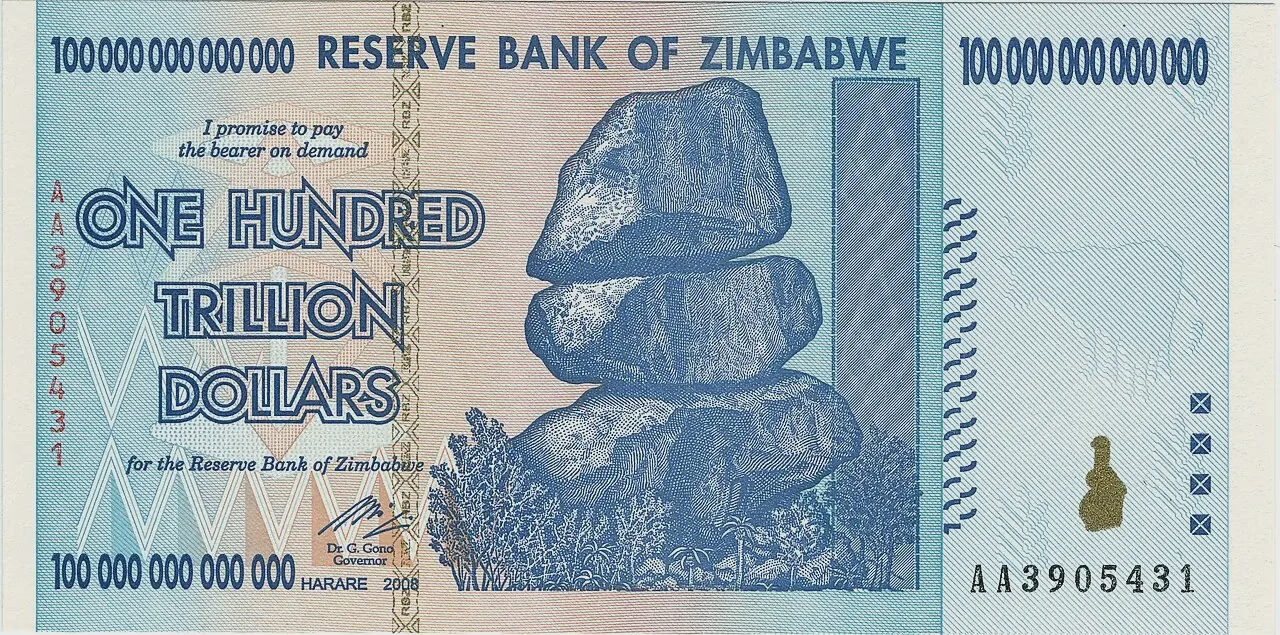
If you’re in the USA you’d better be getting ready to burn stacks of hundred trillion dollar notes to stay warm.
Replying to @leftzero@lemmy.dbzer0.com
Every country not fully divested from the dollar will have to do that.
Replying to @badgermurphy@lemmy.world
We’ll have massive recessions, sure.
Worse than the last couple ones.
Inflation above 10%.
But not hyperinflation like in the USA.
We’ll have to bail out the banks that fell for the scam, but not the scammers themselves.
And it might be a good opportunity to finish decoupling from the USA economy, companies, and policies.
It might take a decade or a decade and a half, but we will recover.
The USA on the other hand will suffer the full brunt of the crash, while being already economically, diplomatically, socially, politically, and morally bankrupt, and infected with the most actively incompetent and outright malicious government in its history, a government whose priorities won’t be to save the country but to exploit the situation, or to take the money and run if that proves impossible.
It would almost certainly have been doomed anyway, but this will be the last nail in the coffin and precipitate the collapse.
Replying to @leftzero@lemmy.dbzer0.com
As dark a picture as you’re painting, I guess youre more optimistic than me that a major global economic player disappearing from the system would not create an economic depression domino effect around the whole world, even with many countries’ investment in the Dollar notwithstanding.
Replying to @badgermurphy@lemmy.world
No, don’t get me wrong, the domino effect will be there, we will suffer decade long depressions.
It’s just that a) the order of magnitude of the bailouts will be much larger for the USA (because they’ll have to bail out the AI companies’ billions of debt, and because the grifters in power will grift as much as possible), and b) any existing international trust in the USA has already been destroyed by Trump’s antics, so the rest of the world has been decoupling as fast as possible for the last few years, and will keep on doing so, which will mitigate the impact.
In a sense the American domino has already been leaning and putting pressure on its neighbours, so they have had time to brace themselves and start inching away from it, and the impact on them when it falls will be lowered due to the fact that it’s already leaning down, but it itself will still shatter due to the fractures and rot that pervade it.

Replying to @badgermurphy@lemmy.world
Most money isn’t printed anymore. It’s digital and is created by banks when they lend it.
Replying to @bedwyr@piefed.ca
Americas credit is stretched. Bond yields are up. Not just in the USA, but elsewhere, which affects lending and investment, both of which ai companies need.
Replying to @hitmyspot@aussie.zone
Bind yields are up and will continue to increase, because countries are moving from defined benefit- to contribution based- pension scheme’s.
Which makes bonds and the guaranteed returns a less interesting investment vehicle. The big pension market under transition right now is the Netherlands, but it’s a general trend across the globe that countries have been moving from defined benefit to contribution based schemes.
Replying to @BlaestEgnen@feddit.dk
Some countries, like Australia, where I live, have transitioned from defined benefits to defined contributions. Bond yields are still higher here.
Replying to @hitmyspot@aussie.zone
It’s ultimately a global market. But every defined benefits plan active, adds to demand for bonds. Lowering the yield.
Defined contribution schemes are bad for the people selling bonds, e.g. people buying homes, governments and mega corps
Replying to @BlaestEgnen@feddit.dk
However, they are good for stock markets and large projects as investment vehicles, so they do hekp government, businesses and can be used to promote projects that benefit their members, eg union based ones can promote tjeir own industry.
The suoerannuation funds in australua have now grown large enough in aggregate to be market movers.
Replying to @hitmyspot@aussie.zone
But that’s two different funding mechanics.
Defined benefit, buys bonds. So the government wants to build a metro in Sydney, borrow the money and own 100%.
Defined contribution, buys ownership. So the government wants to build a metro in Sydney, sells 40% ownership to fund the building phase.
Replying to @BlaestEgnen@feddit.dk
Yes, different mechanisms and different outcomes. However, that doesn’t make one better for business as you mentioned. They just act in different ways for all parties.