Turns out the commute, fluorescent lighting, constant interruptions and performative desk sitting weren’t secretly essential ingredients for human happiness after all. Shocking. Next study: 7,700 managers discover that seeing someone in a chair is not actually a productivity metric.
And 7,600 of them discover that aside from micromanaging and degrading the well-being of their employees, they have no other substantive job duties, and their employment is completely pointless.
I became a manager about a year ago. Now that I’m part of the “inner circle”, I can see firsthand what I suspected for the past 20 years.
There are 2 types of managers.
There are cunts bosses who treat their employees as property for their personal gain and advancement. They demand productivity at all costs (see: LLM-cogsuckers), punish for mistakes and pressure people into responsibilities they should take. They are the ones who want RTO to exert control on their employees. They are the ones who “joke” you must take a half-day leave if you need to go before 6PM. They are the ones who openly shit on their employees (or other teams employees FWIW) because they’re not benefiting them enough. They are not part of the team, they feel and act above everyone in it.
The second type, which I strive to be and most of my closest “manager friend” are, are servant-leaders. They want to get shit done by easing roadblocks and making technologically informed decisions. They understand that productivity is a consequence of a functional team and happy employees. They take on responsibility for mistakes and push the team towards finding solutions to prevent them. They understand that Life^TM^ is more important than work. They are an integral part of the team, they’re not the boss but a full member with a different role and different responsibilities, like a PO or a data analyst.
As a tech lead first and a trained Scrum Master second, I feel much more comfortable in the second role. I help the team internally and report and manage external roadblocks with other teams. It’s what I already know. I hate the hierarchical part of the job.
Most of my managers have been the second type, although how effective they are at it has varied a lot. Some are very passive and that has been good and bad, being left alone is great when things are going well. But when you need help they are useless.
The best have been the ones that know a decent amount about the job, they can either help you directly or know exactly where to point you for it. That or they understand the pain and you can both cry together for 4 days with a SQL database and increasingly vague error messages.
I had 2 such 2^nd^ type bosses in over 20 years.
You really notice they’re how you described when they’re gone - the deluge of shit begins almost immediately.
Good job. You’re one of the 100 out of that 7,700 managers who actually do something productive and manage properly.
Obviously, that number of 100 is arbitrary to make a wider point. To be fair, it’s probably a significantly higher percentage than I provided in my hypothetical. But holy shit are there waaaaay too many of the type 1 and far too few of the type 2 that you outlined.
Keep at the good stuff, managers with a functional brain are rare. Best of luck keeping sane with all the dumb politicking and other “inner circle” BS.
There’s a guy in my team. I need to push him into a more advanced role. Because he deserves it, and because otherwise I might lose him. I brought him in from another team where things were going bad. Real bad. Turns out, all he needed was a human working with another human, not an type 1 cunt demanding output from a walking, breathing toolset. He already fits and fills that role within the team, but I need to make it official. Better pay, more perspectives. I know I’m gonna get cockblocked by the fuckers who still hate him for the wrong reasons. Career reviews are at the end of the year and I already dread it. I need to get involved in politics and I’m terrified of it.
Politics is a nice word made up to make convincing (or manipulating) others to take up your perspective sound nicer. A silver tongue is a hard earned but quickly lost skill. It sucks but this is now part of your job. Hope you started with or put some points into charisma.
Of course. In this case productivity is a shorthand for obedience. If you do everything I tell you to do, when I tell you to do it and have it done before I need it so I can look good to my managers, then I will deem you productive. Meanwhile, their requirements are completely fucked up and impossible to implement as is, and the deadline is impossible to achieve.
I’m about to support a satellite launch later this month. Guess what, I have supported the development from my house for the last 5 years. Surprise surprise, butts in seats aren’t necessary.
Yeah it’s interesting to think about. I’ve been 100% remote for more than SIX YEARS now. Since the first days of COVID. And I’m so deep into it that I’m suffering the ill effects of remote: lack of social interaction with coworkers. Feeling shut up at home all the time. Having to work with people in crazy times zones because remote means you work with whoever, wherever. Zoom fatigue. Lack of separation between work and home life. There are definitely downsides. And some of them are pretty serious. The isolation has really eaten at me, especially.
I would like to have the option to assemble at an office when we want to, but our company embraced remote so completely that they let a bunch of leases expire and closed whole regional offices. Saved a ton of cash. But it does mean that I never see even my coworkers who are in the same metro area. And that’s a bit of a bummer.
To some extent, work has always been a way to make friends, and that’s also completely off the table now. There just aren’t those spare moments at the water cooler or drinks after work to be the basis of that. I’m older so this is hardly a dealbreaker for me but if I think back to my younger years where I was still building myself and my life, it would be a serious deficiency.
Copy: »Based on two decades of experience: As a general rule, there should be regular in-person team events (around two a year and just for fun). In addition, there should be joint training sessions (also around two a year). … Cooking together is brilliant: just two days ago we held our summer strategy meeting at a cookery school, where we cooked and enjoyed a three-course meal together. Basically, anything that encourages plenty of interaction and offers a completely different setting to the usual one is ideal.« We (the company) pay everything. It’s a »regular« workday.
Ah so straight up team building days. We dis a lot more of that when we were still in-office, sadly. It fell off during Covid for obvious reasons and after that we were in layoff mode.
Do they pay to fly people out for this twice a year? An activity isn’t necessarily too expensive but the flights & hotel sure can be.
Well that’s definitely the way to go. Glad your employer does it right. It seems to me that the massive amount of money saved in real estate, office staff, and daily meals should easily pay for the kind of thing you are describing, many times over. I wish more employers thought about it that way.
And 7,600 of them discover that aside from micromanaging and degrading the well-being of their employees, they have no other substantive job duties, and their employment is completely pointless.
Still, Johnson said face-to-face interaction can play an important role in helping coworkers build relationships, especially if they are just starting out in their careers.
“Remote works better after you know people,” she said. “So there is still a benefit of having some face time.”
So, it does rather beg the question, what should one do if someone is joining an existing team?
Based on two decades of experience: As a general rule, there should be regular in-person team events (around two a year and just for fun). In addition, there should be joint training sessions (also around two a year). New staff members require a great deal of attention from their team, both at these events and when working remotely, particularly at the outset.
Also if there’s an option to go to the office, that works too. I’d like to have an office to go to once a month or less, just for the social, meet people irl, etc, but wouldn’t give up remote work for it.
In your experience, have any online social things worked well? We’re always looking out for stuff where I am.
Cooking together is brilliant: just yesterday we held our summer strategy meeting at a cookery school, where we cooked and enjoyed a three-course meal together. Basically, anything that encourages plenty of interaction and offers a completely different setting to the usual one is ideal.
A former manager had team lunches every month. It wasn’t mandatory but it was a day that we could go in and team members would be there. It was also not a day taken up with general business update meetings and the like, so we could get work done.
The key is ensuring that people know when they can go in and see other people they know, not just the marketing team.
A step further it should be more than twice a year I would say once a quarter would be more preferable. There should also be one day a week everyone on the team should be expected to be in the office. Beyond that max 3 days a week none of this minimum bullshit.
If more are needed, just give it a try. We’ve learned that organising more than 3-4 a year is very time-consuming, particularly when it comes to scheduling them for the whole team.
Which is bullshit, I joined and have worked for a remote only company for over a decade now and I’ve never met any of my coworkers, but I chat and have calls with them daily and we all have the office banter and even talk about outside work stuff as well. You don’t need to know people to magically work remote, that’s just an excuse to stuff people into a building together.
I’m all for as much remote work as possible, but I would love a study to include commute length and mode of transport. When I lived a 20 min walk from my office it was great and didn’t mind being at the office full time.
I moved away and it’s now a 30 min car drive which I really hate, a 1 hr bus journey, or 45 min bike ride.
I wouldn’t mind the bus journey so much, as I can read a book on my way, but the unreliability makes it feel so much worse.
And despite being longer than the drive, I much prefer to cycle into work, and I’ll usually do extra days in the office during the summer as an “excuse” to be on the bike.
I‘ve read a study somewhere that compared car and bike commutes. I turned out that people were much happier riding bike and have real life interactions with people at the streets than sitting alone in an iron box and drive a car.
Despite this, having the same times as you, I enjoy riding bike more because the commute time is always the same. Nobody can stop you on a bike. No traffic jams, no accidents that blocks a road, no rush hour stress.
I enjoy riding bike more because the commute time is always the same. Nobody can stop you on a bike. No traffic jams, no accidents that blocks a road, no rush hour stress.
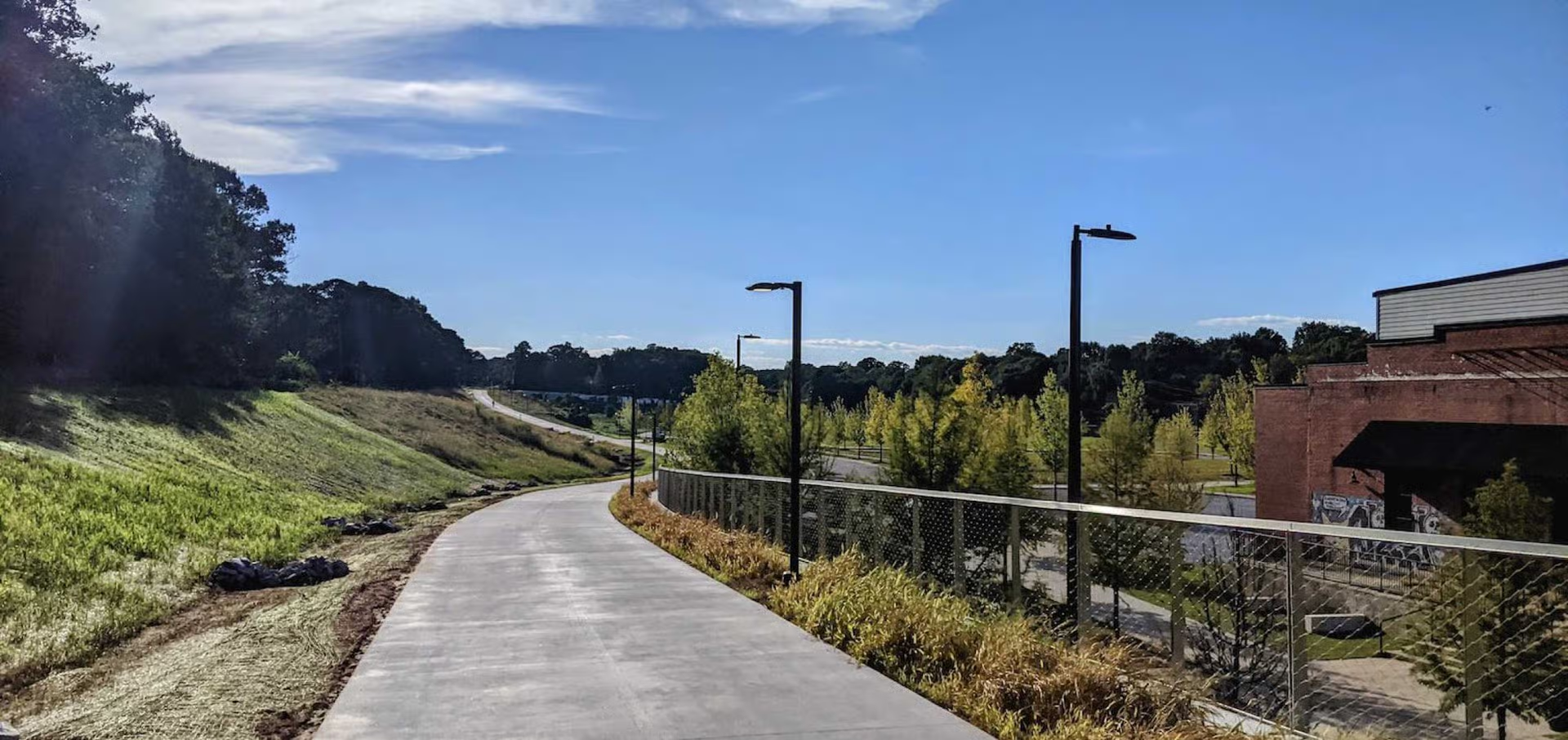
At a previous job, I used to commute on the Atlanta Beltline Eastside Trail. Because Atlanta is so starved for bike and pedestrian infrastructure, it was actually popular enough that it managed to slow me down with foot traffic sometimes. (And that was on weekday afternoons; it’s even busier on the weekend.)
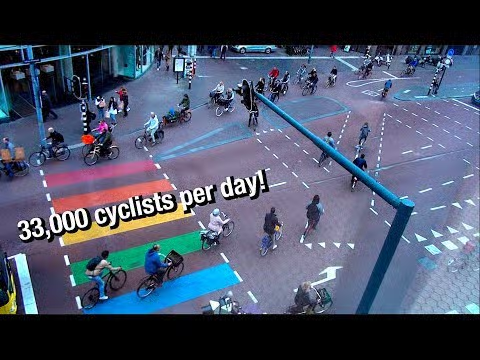
Not my video and I don’t know what day of the week it was filmed, but it’s pretty representative of ‘medium’ weekday afternoon traffic (even though the video title calls it “heavy”). Like I said in my previous comment, weekends are worse.
(I don’t endorse trying to ride as aggressively as they’re doing in the video, BTW.)
However, as European it feels sort of standard traffic mx. In our city centers are many pedestrians and bikers.
If you want to get the real feeling, try a bike highway in the Netherlands. Never did it myself. It’s still on my bucket list youtu.be/ynwMN3Z9Og8?is=oK8XCSuHsf6hgP1n
They even have bike traffic jams sometimes ;-D
I’m literally one of the mods of !fuckcars, which is to say, I am painfully aware of how much better Europe in general, and the Netherlands in particular, is at this stuff.
The difference with Atlanta is that path is kinda the only one like that we have in the entire metro area. We have other trails in a network that’s gradually becoming more connected, but that’s the only part of it that’s more-or-less fully built out with pedestrian-oriented surrounding architecture, which makes it far more popular than any of the others.
Other trails look more like:
Beltline Southside Trail
___
Stone Mountain Trail
___
Silver Comet Trail
___
Don’t get me wrong: they’re nice, in their own way. But they don’t have nearly the appeal or ridership of the only trail with proper urbanism.
I see. And even understand this conflict. For me the best way is to accept pedestrians and slow down the speed. The other way, insist or enforce „your rights“, will lead to agression. We have this situation already in some dense city areas, where cars, bikes, and pedestrians kind of fight for the small space. It’s just stressful for eceryone.
Do you know this one? It’s a disused railroad track in a hilly industrial city Wuppertal/ Germany with some bridges and tunnels. A community effort turned it into a bike & pedestrians trail along the city. A nice ride with many nice views.
youtu.be/G5rTdihmagk?is=_0YkMt4Fek7_NLlE
Quit my last job over being asked in once a week. It was the commute rather than the office that I really wanted to avoid but it was also an awful open plan hotdesk office for a company of hundreds of people I didn’t know or care about.
New role is office based but I don’t need to drive or take public transport and teams have their own rooms to work in. Much smaller company too, under 30 people. Banter is far better here and that helps quite a bit.
Lack of commute is the only reason I took an in office job again too. I’ve spent like 7 out of 8 years of my career working from home and I really didn’t think I’d ever be convinced to go back but my new job’s office is under 10 minutes away by bike and I get at least one day a week to work from home. It’s officially 4 days a week in office but my manager is really relaxed about that requirement if my work is getting done
Also because commercial landlords demanded it. In Canada the biggest push for it was from Oxford Properties. They even managed to get the Mayor of Toronto, Olivia Chow, who is about as liberal as we’re gonna get up here to push for it. Never voting for that corporate shill again.
Stop this bullshit, if you want me to work from home you have to considerably increase my salary so that I can rent a place with an office and setup the office.
I can’t believe how much more I get done when I’m left alone and focused on the task at hand.
I don’t feel particularly isolated. Everybody is different but a once-week team chat and seasonal social lunches fill my cup.
Turns out when you can do errands and meet non-work friends for coffee as you please you don’t need to lean on your office family so much for connection and purpose.
I have daily voice calls, usually several times a day.
Seems like my country has mostly moved back to offices now though and finding remote contracts is tough. Man I miss the pandemic. Not the death and suffering, just the compassion some people showed others. Sure there was a lot of people who just lost their minds entirely, but I feel like the overall sense of community was better back then.
Yeah not a problem at all for many. The ineffective remote workers are the same ones ineffective in the office, the ones on 15-minute side chats in the cube rows (loud of course) every hour. Great collaboration on the latest sportsball match, glad we were able to bring that back.
We actually have the recommendation too: oif you need to do something like sign for a package, let a contractor in for an hour to fix something, etc, then use a vacation day (with 2 weeks prior notice, of course). The flexibility goes both ways though, “can you do this quick thing Wednesday night”?now gets escalated to find approval for after hours work. Payroll/HR is not very flexible or responsive.
Who TF is using up an entire PTO day so they can sign off on a package when they are literally already home?
It takes me longer to take a shit than it does to sign for a package.
And It definitely takes Debra in Product Management longer to get to the point than it does for me to let a plumber in, and out.
This honestly doesn’t sound like much flexibility at all. If you need time to take ahit - you use your 4 days of PTO. If the company needs time to take a shit on your head - you work late.
Sorry I mean in the new RTO mandate, that is what is now done. Not allowed to WFH for one of those days, to take care of a ~15 minute interruption. Now it costs a PTO day (and the resulting delays of business stuff by an employee off for a day, doing 0 work).
It absolutely is not flexible. And it will harm the business as a result.
When we got a new CEO one of the first things he mandated was RTO. He said the alternative was to shut the office down, and that he was fine with that (I highly doubt that) but a decision had to be made. And so RTO it was, because that had better vibes or something. It’s fascinating, the leadership has during several meetings mentioned how much nicer it is now that people are in the office, but none of the “grunts” I’ve spoken to like it.
Our CEO started talking of RTO while he himself was at home, not even a Teams background to try and hide it. Haven’t seen him in any office during any of the subsequent townhall meetings either. He’s just one twunt in a massive circlejerk
Yeah, we’re in a similar boat with new CEO, RTO, etc. The increased collaboration is amazing: now instead of video calls, we have in-person in a cubical video calls because our team and department is scattered across multiple physical locations. Additionally, the increased collaboration from non-team “pop-ins” is a much-needed break from doing the work we’re brought in to do. Not tomention, all of the systems we manage are now much closer in case of emergency: colocated the same 50+ miles away or “cloud”. Maybe /s maybe I’m pro-CEO.
we have in-person in a cubical video calls because our team and department is scattered across multiple physical locations.
You’ve got to insist everybody be at the same location for collaboration. Demand management to arrange conference room, flights or travel and hotel rooms. It might cost a pretty penny and effort but think of the synergy created.
Even before COVID/WFH, this was the case of being spread out. CEO basically eviscerated on town halls, with a dead-eye blank stare in reaponse, then continues to champion RTO in the face of direct conflicts of their own words.
There aren’t enough cubes for the full timers, there aren’t enough conf rooms or other reservable meeting spaces, there isn’t distribution of needed equipment (headsets with ANC, decent mics or computers that can do noise supression without making the computer uselessly slow.
Mentioning these things are ignored though. The CEO and others continue on. Performing remote work for maintenace, patching, etc. outside business hours got a lot more obnoxious to “the business people”, now that we seek approval for outages during business hours to do the work inthe office, as mandated.
There aren’t enough cubes for the full timers, there aren’t enough conf rooms or other reservable meeting spaces, there isn’t distribution of needed equipment (headsets with ANC, decent mics or computers that can do noise supression without making the computer uselessly slow.
HR drone always talks about how nice it is to see everyone collaborating in the office when we come in for quarterly meetings.
Nobody is getting work done. We’re all “collaborating” about sportsball or coffee machines or whatever it is, or just trying to tune it out. It’s a full day of productivity lost for nearly everyone there. Not to mention the early rise for a commute, cost of the commute, missed workouts, and exhaustion on the return home.
Here’s the actual study if anyone cares to read it.
Skimming it, a couple things I noticed: This was a study of over 7,000 people across all departments at a large healthcare system. They found on-site workers skewed younger with shorter tenure and remote workers skewed older with longer tenure.
One potential pitfall: They didn’t control in any way for department or role, and so floor nurses and housekeeping staff who must work fully on-site are being compared to tenured nurses working utilization review or revenue cycle staff whose job is billing/coding and who don’t have to interact with anyone in their roles. In-person and remote jobs in healthcare tend to be very different jobs. I don’t know how well this study could be generalized to other types of job settings based on this info
That domain is “Frontiers In”, but it would be so much cooler if it were “Frontier Sin”. I want to stay apprised of all the latest developments in crimes against morality
I feel like this is a pretty useless study, this is going to be entirely subjective what you prefer.
Optionality gives a lot of upside, more than either extreme.
Personally I prefer being in the office, better for my focus, my likely (undergoing diagnosis) ADHD as fuck brain, but I also have dynamic work hours so I can simply avoid peak traffic.
That being said, if I was required to be in the office everyday at a set time e.g 9 to 5 I would fucking quit.
This is the problem with academics. They do a study, find something is logically better, then assume humans will act logically.
Unfortunately, most CEOs don’t give a shit if their employees are more happy, productive, and less likely to quit if they work remotely. They just want to feel like they have control over people’s lives, which is why we’re seeing more return to office initiatives.
As the other reader says, the point of studies is to develop objective truth.
After one generation, this new objective truth starts getting ingrained in people’s minds. That’s usually because after one generation the people who held old beliefs are out of the scene and new young people who believe in obvious things come to be part of the scene.
That’s how society changes over time. Not people changing their minds, but new people with a different way of seeing the same things.
I’m very fortunate to have a job with a very small company (literally 4 people) where we get to set the rules.
It is funny to see the ingrained notion we (collective “we”) once had that working from home could never work. I started this job in 2018, and I often suggested we do a work from home day each week since we all had laptops. My bosses (co-owners of this company) always shot it down. “Oh we’d never get any work done!”
Then, of course, COVID. And while I certainly would rather COVID not have happened, it did convince them that working from actually works. And, of course, they loved it as well. So since 2020 I have not had to go back to the office. We still have office space for some minor things, and once in a blue moon we might gather there. But in six years I’ve probably spent six days in the office.
Heck, I’m fortunate enough to finally have convinced them we should take Fridays off, too. We piloted that program two years ago over the summer, and it, of course, stuck because everyone likes that—though we actually just take every-other Friday off. But still. Hard to beat.
Benefits are actually kinda bad, honestly. We have insurance but insurance companies don’t want to give good insurance to really small businesses like this. No vision or dental.
I secretly despised people at my company that wanted to demolish remote working completely after COVID on the pretence that people are traumaticed by the solitude and need to get back on the horse 100%.
Eventually only max. 30% remote was allowed and became company norm.
Even then some of these pieces of shit actually forbid remote working from their subordinates.
Those subordinates then gave them absolutely garbage employee reviews and made their worklife hell. Now they are in some other company torturing some other poor souls.
It was everyone’s golden era. And then the owner class pressured the political class to memory hole the period so we forgot all the lessons we learned.
It’s why we need to bring unions back to forcibly make sure those lessons are applied.
Even if they do understand that, I’m not sure it matters. I’m an introvert so I know how easy it is to think of extroverts as annoying, overbearing sausages. However they have needs just like I do. Isolation genuinely harms them just like over stimulation harms me. I think it brings some realism to this topic if we remember that maybe they aren’t doing everything they’re doing just for the sake of shoving extroversion down your throat: maybe they are just trying to meet their own needs. It’s like the flip side of what introverts always say: don’t take it personally if I need to withdraw from you, I’m just meeting my own needs. Can you make the same allowance for them?
While i much prefer 100% remote, i won’t force anyone to do the same (the inverse doesn’t happen).
However, to me the real contributor to my well-being is motivation.
I worked on site for 4 months before my remote work was approved and it was literally the most unfulfilling life I had
I would work 9 to 630, come home so tired that all I could do is throw something quick to eat and watch TV (didn’t process what I was watching) then later fall asleep and rinse and repeat
How anyone is able to do this lifestyle is a testament to humanity’s ability to adapt
I was in the same boat for about a year. It was beyond fucked, and now with hindsight my wife and I call that period “the great fog”, because I was so absent even when I was home and “rested”.
It was like I was living as a ghost, unable to perceive much beyond the feeling of fatigue.
The assholes at HR were doing everything they could to make the process harder. And even more insulting the company had the entire workforce remote for building maintenance they chose to do on a building they didn’t even own.
So it’s OK to work from home when the business needs us to do so, but not when our disability needs us to do so? Hypocritical motherfuckers had no line they wouldn’t cross.
I’m so grateful I can work from home. I did the whole 930-6 type day for many years. The only downside for me now is that, living where I do, limits the companies that I could apply for a job with. At least in terms of the companies that interest me.
Whether it’s a mix of control or egos, I think it is mostly about the fallacy that they are leaving unspent productivity on the table. Yet, COVID proved that people can be effective at home. It’s nonsense to assume that you won’t do the job and then somehow get paid for it. It’s a strawman.
That is why, after all logical arguments were made, and bad faith responses dispelled, they chose to say it was about culture. That undefinable metric exist solely in the validation of HR and management. Pizza lunches, recognition events, and captive audiences.
those in upper management need us to see them there, in front of us, IN CHARGE.
That’s all it’s about. They need you to kneel and scrape and fucking bow, and for that, you gotta sit in a car ten hours a week and work in an uncomfortable open-space cubicle where you can hear everything, including Betty from finance chewing.
All day, every day, so that Brent the VP can feed off your collective energy admiring him like he’s a big shot. That’s why he’s the only asshole who wears a tie to an office of business casual colleagues.
Can confirm. How Money Works talks about it (Here on YouTube) regarding the recent mass layoffs by big tech, first, by pressure through RTO mandates, then blaming layoffs on AI, only they got rid of too many people and their businesses couldn’t run.
So why did they do it? Vindictiveness. Because of the great resignation during which workers had some negotiating power, and the C-suite resented that and wanted to show everyone who’s boss.
I’ve been following the trend since the early 2010s when we realized that crunching development teams is useless for meeting deadlines, but dev companies crunch anyway, traumatizing the team.
I’m pretty sure billionaires aren’t especially bright, rather started with generational wealth and then got richer through luck and ruthlessness, to the point that they only failed upwards. (There are a few exceptions who understand the social contract, but they really are exceptions.)
And they surround themselves with sycophants so that their psyches are completely comfortable. They stop actually considering data or news that might hurt their feelings, which means they make bad decisions that cost their companies money.
It’s more the canteen and coffee shops onsite I think.
Our place guarantees minimum revenue to the canteen.
The company has to pay extra if the staff aren’t there.
Then there’s all the other businesses in the area. I imagine they come under pressure from local government to bring workers back to save those businesses
I betcha a nickle that the fines paid to the canteen would be more than offset by the increase in profits due to worker productivity.
It’s like the time theft myth, the belief that workers will intrinsically slack unless you micromanage them. In fact the opposite is true, when workforces are allowed to chat with loved ones and surf the internet their productivity improves.
Curiously, when a company mandates that 15-minute breaks are taken and lunch is eaten during lunch break (even when workers are obsessive and want to work through breaks) then their productivity improves even more.
But the upper management of companies don’t actually want to manage in a way that data shows maximizes profits.
If they would get rid of these terrible open plan offices, where people can hear the silent fart you try to squeeze out gently, and go back to offices where you at least would have a smidgen of privacy, this would improve office attendance.
Capitalism as we know it, isn’t about effectiveness nor efficiency, it is primarily about power. So long as this remains the case, workers will continue to be abused for the amusement of the higher ups.
For me it seems true. Most of the jobs are straight stressful unnecessary bullshit in your face. Like a cocaine addict, fryed brain, retarded millionaire fucks up everything. Then you handle the customer complaints and die worn out after only some years. Even there is case and purpose as the original aims were noble and good.
Doing some social service, you already did that with your idiotic parents, adorable kids. Beautiful wife and the dog and the cat and the hamster. Sucking your blood dry like a bad vampire.
People celebrating the opposite of it should try this instead of being virgin lesbians in commie flat. Also I am happy they are happy. But often hearing like zombie like entity on this night train, is like a baseline. I am glad they can make a minimum wage and could choose me as the third one for a lesbian climate collapse mourning threesome.
I have an unusual situation - immaterial commute, flexible hours - and enjoy working in the office more than working from home. Have done both and working from home is a drag.
Doesn’t mean I’d force others to come in! But the only thing worse than a meeting is a teams meeting, and there is a lot of value for me getting that space back in my house, and in the incidental learning I both receive and provide to others when we are in person. Also it’s entirely possible I’m too introverted to happily work from home.
So as long as work provides a common space to work I am happier here. I do think the environment benefits from fewer commuters but I don’t drive to work because it’s so close.
Yeah I am very,very sensitive to commute time, and recognize my situation is uncommon (arranged on purpose though - I won’t take a job far or more than one city bus away) I wonder how the answers would change if the office was in the same building as your apartment, or within a mile as mine is. I really don’t want any part of my home life to be my employment.
Worked from home for 8 years, and routinely finished projects ahead of schedule which left me with a ton of time to work on furthering my education, personal projects, home maintenance and hobbies. Work life balance!
Been working an in-person role for 2 years now, have zero time during the day to do anything else, couldn’t do most of those things at the office anyway, and I make no additional money. These last two years have felt like my life has largely been on hold.
Rto does a great job of scaring off talent that has options.
You get to keep all the losers who can’t get a better job. You also get to waste a ton of money on rent and office space.
My company went rto. Then they closed a downtown office and forced everyone out to their exurban campus an hour from the city.
Anyone with an ounce of talent left. My remaining team is mostly duds. I need to gtfo, but the money is good–which means they are paying (me at least) a high premium.