Replying to @⁨return2ozma@lemmy.world⁩

I like Hank, and this is a shitty article.

That aside he should be facing a revolt.

Hes supposed to be a credible source, hes an educator, hes the modern day Bill Nye. It’s very hard to take anything he says as objective truth when his research and fact checking consists of asking an LLM. Considering hallucinations and straight up lies are not only common but not even unexpected for an LLM you can’t believe anything that comes from one nor can you believe anyone who uses one.

Replying to @⁨brianary@lemmy.zip⁩

I find that a frontier bot pointed at the internet does a lot better job of answering the question than I do when searching on my own. I mean they’re always going to be wrong about some stuff, but aren’t people? I think that’s generally a better metric. And at this point they’re far away from what they were just a few years ago. But you’re correct in that there is an element of brute forcing them or at least shaping them that has to occur that I can’t blame anyone for tapping out of.

Replying to @⁨7101334@lemmy.world⁩

Golf courses use 30x the water that data centers use. Lawns, 100x. Standby mode for appliances costs more energy, by a lot. I wonder how much carbon emissions are offset by people no longer driving to work at call centers and the like.

Out of curiosity do you eat meat? .2% of water is used on data centers. 9.8% is used on beef. For carbon emissions one pound of beef consumed is equivalent to about 640,000 prompts.

AI is an environmental concern but the way people act about it is straight up ridiculous.

Edit: I am very proud of all of the vegans who unplug their appliances who are downvoting me. I, too, am a vegan who unplugs their appliances.

Replying to @⁨TheLegendaryAssholeOfJushinLiger@sh.itjust.works⁩

I don’t have a golf course or a membership so

thanks for that irrelevant factoid

and yes I am vegan, but eating meat is, in many cases, a culturally ingrained practice which people need time to understand the harms of. AI is not culturally ingrained for anyone with an actual culture. People need to eat - it shouldn’t be meat, but I’m not going to shame people for not seeing their harm yet. People do not need to generate slop. I am going to bully all AI users.

Replying to @⁨7101334@lemmy.world⁩

Do you think AI is mostly generating slop? Only like 5% of AI use is private individuals.

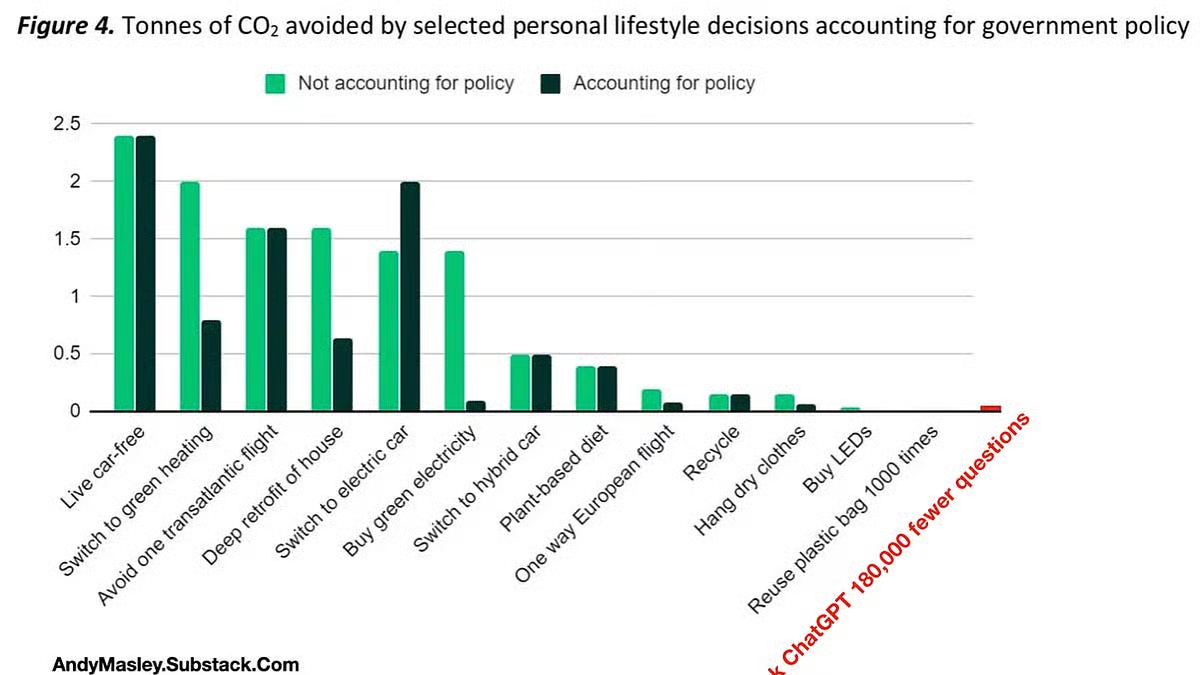
The point is that this is not actually an ecological hazard the way people say it is, and that there are much, much more pressing issues if we’re going to fix the environment. Literally all we would have to do to solve global warming is stop eating meat. You see anywhere near as much about that as you do datacenters? Which cause less than one percent of the environmental issues of meat?

Replying to @⁨TheLegendaryAssholeOfJushinLiger@sh.itjust.works⁩

I know all AI is an ecological hazard and none of its use cases aside from very narrow medical and scientific applications justify using it at all.

People have been eating meat longer than humans have had languages. Your whataboutism is boring and irrelevant. Just because there are other, larger, necessary steps to take doesn’t mean we need to act as unpaid apologists for technocultists shooting our species in the foot while we try to get there. Fuck your AI.

Replying to @⁨TheLegendaryAssholeOfJushinLiger@sh.itjust.works⁩

Just in defence of your point:

I prefer to self host, and am in the process of setting up my entire system to run off solar (tiny 2x250 watt solar array, 3 deep cycle 100Ah marine batteries and sundry equipment).

End to end, my AI rig - a BC-250 (a cut down PS5, basically) consumes 50w standby / 200w on inference and can run Qwen 3.6-27b (Ternary Bonsai specifically, about par with Sonnet 4.6 on the AAII) at good speeds (~30 tok/s)

With a smart power plug and Raspberry pi (uses about 5w) as the pilot fish, I can run my entire system “off grid”, to say nothing of the excess solar that accumulates (several days battery back up to run home router, pi server, hard drive array and 2-3hrs daily of inference).

For $1500 AUD, “Poor man’s Sonnet 4.6 at home” ain’t nothing to sneeze at.

Outside of folks such as myself, this blog post may be of interest -

blog.andymasley.com/…/individual-ai-use-is-not-ba…

blog.andymasley.comUsing ChatGPT is not bad for the environmentAnd a plea to think seriously about climate change without getting distracted

Replying to @⁨7101334@lemmy.world⁩

seems likes barely useful outside of medical field too. in that article/study, they had to use alot of scans from different people, and doctors reviews to even get a “diagnosis”, seems like a fluke they even found the “surprise cancer”. i dont think patients/ people are ready to let an AI diagnose people, on off chance it makes a fake diagnosis,. which is why we barely hear stem use of it.

Replying to @⁨muusemuuse@sh.itjust.works⁩

They tend to work much better when you point them at things. Hallucination rates go way, way down when they aren’t pulling from their “memory.” They are, also, like you say, wrong in ways that are noticeable and often “interesting” in the Ibsen way. I also doubt that you could get the same experience for less money. I’d have to go back to college to get the education I’m getting with AI. At least community college. It’s a lot of near-experts at once. And when you point it at expert literature it basically is a senile college professor. But yeah the senile part of that statement is pretty important.

Replying to @⁨sem@lemmy.blahaj.zone⁩

But why? If you try to be objective, how is this any different from an op Ed or other published article? Those are good starting points as well, but also shouldn’t be published as your work or trusted as is.

The problem with LLMs is not when people use them as a tool, but when they use inappropriately, blindly trust them or treat them as a final result instead of thinking, reviewing, or adding value.

Replying to @⁨sem@lemmy.blahaj.zone⁩

I can’t speak for all LLMs but the ones I use

  • web based LLM cites its sources. You can just click
  • coding LLM tends to have obvious sources (for example if I tell it to use a vendor API to do something, I know there’s API documentation as the source of truth and the script is just like the example I would previously have found on StackOverflow.com).

And yes, I frequently check its work and iterate through telling it to