posted in Selfhosted

DC UPS for router?

Hi y’all looking for advice here

I selfhost a nextcloud server and a NAS for backups, and one of my challenges has been data corruption after power failures.

I went and bought some consumer UPS units about 5 years ago, which helped, but now the batteries are starting to fail, and I’m not protected from power outages until I replace them.

I have the router on UPS as well so the computers can communicate with each other that the power has failed and it is time to gracefully shut down (using NUT).

However the router itself uses quite a bit of power and I am hoping to make a smarter decision this time around when getting a UPS.

The router’s power supply is 12V5A with a barrel style jack, so i have been searching for “DC UPS 12V 5A” to try and find something compatible that wastes less energy converting from battery DC to AC for the power supply to then convert back to DC.

But the only thing I’ve been able to find are these units designed to power electric doors: https://www.amazon.com/dp/B0D8VLPRN2/

I’m not sure if this would even be safe to use with a router, and i don’t know how i would wire it up to the router either.

I think i just don’t have enough knowledge to know how to shop for an appropriate DC UPS, or if such a thing even exists.

Anyone been in a similar situation?

enPage

Replying to @⁨voyagertest@retrofed.com⁩

How much loss is there for a converter? I always thought that for the most part they were pretty efficient. Unless you've measured and found a difference, you might be trying to solve an issue that isn't a huge one.

I've been very happy with my Cyberpower setup, and the smaller one is powering my router and monitors. It's still 650VA, so will roughly match the time the larger one would keep my computer alive. I'm not running a server though, so it might still be low for you, but 12V 5A doesn't seem like a large pull.

Replying to @⁨voyagertest@retrofed.com⁩

What router? 12v5a is 60w max, which is not an unreasonable amount of power. A 1500va UPS should power it for like two hours or more.

You could easily wire it up to something like that. Take the power cable, cut off the wall wart, connect the positive wire (usually red, could be white) to the positive terminal, the negative to the ground terminal. Cut off the head of a power lead, connect the live, neutral, and ground to their terminals on the AC side. Plug your battery in, the power lead into the wall, and you’re done. Check everything with your multimeter before actually wiring it up if you’re not sure. You do have one and know how to use it, right?

Replying to @⁨deadbeef79000@lemmy.nz⁩

Yea, small business routers (think old Cisco boxes) use a 5A laptop-style power supply. I suspect this is what OP’s using, as I’ve never seen a consumer model with such power specs. Consumer stuff is built around the cheapest hardware they can get away with.

Thing is, I don’t doubt the Cisco box (or similar business units) may need that much juice at times. Put your hand over one that’s not connected but powered on and they get hot.

Stuff like that they really don’t care about power consumption during design, just capability.

Replying to an earlier post

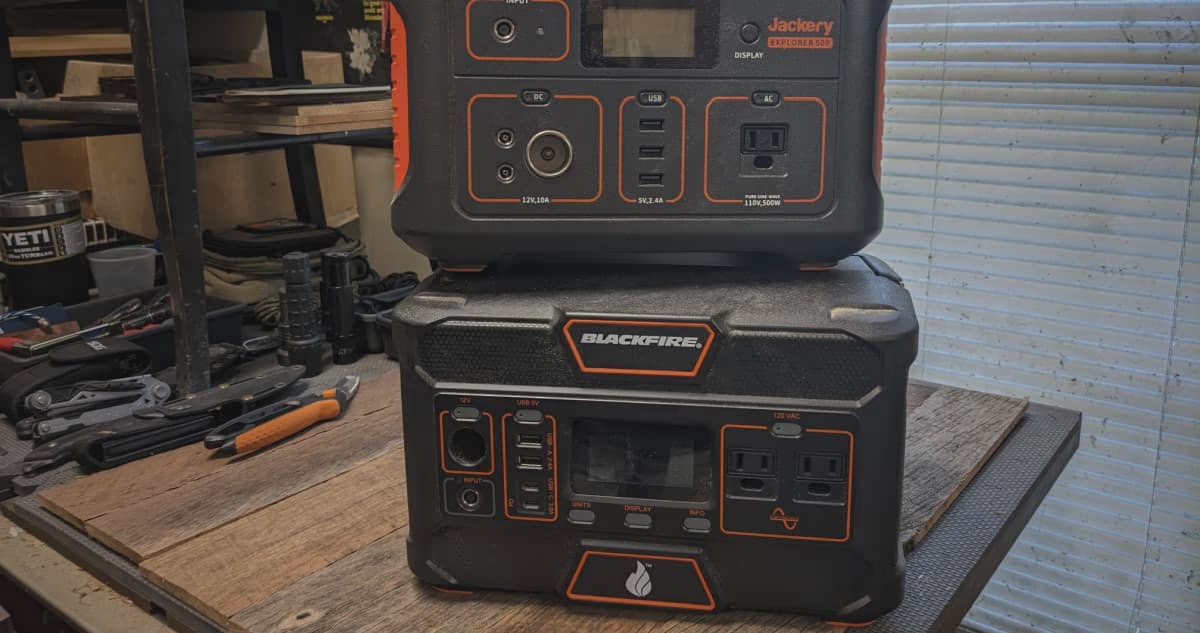
How about a portable power station? Basically a huge mobile battery with AC input. Some can switch over on power failure like a UPS. Some has USB PD (get 12V DC with the right cable) or car lighter socket (12V DC) or direct 12V DC output.

I’m talking about these, just a random article from my search:

https://techwriteredc.com/best-portable-power-stations/

Tech Writer EDCThe Best Portable Power Stations | Real-World Picks I Actually Trust & UseThe best portable power stations for camping, storms, and outages—tested in real life. No hype, just honest picks I actually use and trust.

Replying to an earlier post

If you’re going this route, you may want to pay attention to the switchover time. For most consumer hardware, it can handle 10-20ms of switchover time. However, enterprise grade stuff is more sensitive to power fluctuations and sometimes needs near instantaneous switchover. It can get very expensive if you want LiFePo4 (like many of these portable stations) while also being “on line” (meaning instant switchover).

There are middle ground options which have switchover timing of 5-8ms that are also LiFePo4. LiFePo4 is great because the chemistry doesn’t have a huge fire risk and it can do more cycles than a lead acid battery.

Anyway, my bad for rambling.

Replying to @⁨poVoq@slrpnk.net⁩

Hey, I have a lot of appreciation for the infrastructure you maintain so don’t take this the wrong way: you’re very confidently overcomplicating this one all over the thread. People run nominal 12v stuff direct from battery all the time and it’s fine. It’s the norm in RVs, boats, and off-grid housing. There’s usually quite a bit of wiggle room. The router I’m using right now won’t actually cut out until ~8v and sees almost 16 during my ancient lead acid battery’s eq cycles. It’s completely fine and has been for years. Not industrial or automotive grade by any means, a low-end Netgear from the thrift store.

You also state “while there is DC power the battery in a UPS isn’t used”. Assuming you mean AC that’s still not quite correct, it’s always being charged at least a little and tapping it for DC is perfectly fine.

That’s my advice to op, and a setup I’ve run before: replace the 12v battery attached to their existing UPS and wire the router/any other 12v devices right to it. A UPS is just a nicely packaged battery charger/inverter/transfer switch. Wiring them to larger/cheaper batteries that don’t happen to fit their casings is also entirely viable, as is running either of their outputs to a load panel. Sky’s the limit :)

Replying to @⁨poVoq@slrpnk.net⁩

I haven’t had access to grid power in over 10 years and am pretty familiar with this stuff as part of day to day life. I do now have solar. Really don’t think me and everyone else I know have been getting this consistently “lucky” for this long across such a wide range of devices. The 11-15v a nominal 12v battery system normally experiences is not a huge amount of fluctuation, and I have yet to encounter a 12v device that couldn’t take it. On the contrary, I’ve tried much dumber stuff and gotten away with it. There’s a 9v piano keyboard and a 19v computer monitor wired straight into that same battery. The only time I’ve actually killed something is by reversing polarity. Voltage too low=won’t turn on, voltage too high=gets hot, and all these years of wiring up random scavengings to see what happens have taught me most gear is surprisingly tolerant/resilient

e: for SBC stuff, automotive USB charger makes a great 5v rail. My “homelab” was at one point a pi 3b and a 5v Buffalo wifi router running dd-wrt plugged into a cigarette lighter

Replying to @⁨voyagertest@retrofed.com⁩

I mean, there are 12V native battery systems out there, stuff like vehicle stuff.

Assuming that the 12V power supply on the router is permissive enough to take a certain amount of variation, I imagine that you can probably just put a 12V deep-cycle battery on the thing on the thing and directly hook up a 12V charge controller in parallel.

I dunno whether there’s some sort of voltmeter that you can connect NUT up to.

Personally, my position is that if NextCloud or whatever can’t handle power loss without corrupting data, that’s a bug with NextCloud. I mean, sure, it might not be able to complete an operation if there’s power loss while it’s running, but that shouldn’t result in corrupt data.

Replying to @⁨voyagertest@retrofed.com⁩

Same way existing systems work. The charger just moves the voltage somewhat up above 12V. Under normal use, the battery drops slightly below 12V. You have the things that draw on the battery wired in parallel with the charger. That’s why I’m saying that the power supply on the device would need to be tolerant enough to handle a bit of a range.

An inverter’s power supply will be able to handle that range, but you’re saying that you don’t want the overhead from that. A DC power supply that’s tolerant of that range will also work.

EDIT: There are also gonna be 12V regulated DC input power supplies that you could externally insert.

searches

www.amazon.com/…/B081RG8XP5

DROK DC-DC converter input voltage range is DC 9~36V (12V); output voltage is DC 12V; output current is 5A; output power is 60W.

Conversion Efficiency: >90%

Would have to compare to the existing efficiency of your inverter and AC-to-DC power supply.

www.amazon.comAmazon.com: DROK DC-DC Stabilizer, 9V-36V to 12V Boost Buck Converter 5A 60W Waterproof Auto Step Up Down Voltage Regulator 12V Volt Transformer for Car Audio Solar Power System LCD Television LED Display Screen : ElectronicsAmazon.com: DROK DC-DC Stabilizer, 9V-36V to 12V Boost Buck Converter 5A 60W Waterproof Auto Step Up Down Voltage Regulator 12V Volt Transformer for Car Audio Solar Power System LCD Television LED Display Screen : Electronics

Replying to @⁨voyagertest@retrofed.com⁩

While there is DC AC power the battery in a UPS isn’t used. It’s not a constant AC-DC-AC conversion, that conversion only happens when there is a power outage.

The problem is that lead-acid batteries are a really shitty technology with high self discharge rates and short overall life span (their only advantage is high burst capacity that’s good for starting motors).

I would look for 12V LiFePO4 batteries in a standard lead-acid form factor that are meant as drop in replacements. Those are somewhat more expensive (like 2-3x the price) but will likely last a quarter century or more.

I am currently using an interim solution where my solar inverter has an seperate emergeny power outlet that works even when power is cut. Sadly it doesn’t switch to battery fast enough (like half a second delay 😓) for it to work as a UPS directly. But in combination with some old regular UPS that have spend batteries that only last a few minutes it works ok. But yeah, not the most efficient option conversion wise, but solar power is free 🤷

Replying to @⁨voyagertest@retrofed.com⁩

I did this once with a router. I just bought a 12V SLA battery (a UPS battery) and a car float charger (sometimes called a “battery maintainer”). The charger was always connected to the battery, so it was pumping about 13V into the router. The router could withstand it. It’s easy enough to get a voltage regulator if it’s an issue, but most hardware already does it to an extent. It was DC all the way.

If I want 5V, I get a car USB charger and stick it inline.

Replying to @⁨voyagertest@retrofed.com⁩

Acronyms, initialisms, abbreviations, contractions, and other phrases which expand to something larger, that I’ve seen in this thread:

Fewer Letters More Letters PSU Power Supply Unit PoE Power over Ethernet SATA Serial AT Attachment interface for mass storage SBC Single-Board Computer ZFS Solaris/Linux filesystem focusing on data integrity

5 acronyms in this thread; the most compressed thread commented on today has 10 acronyms.

[Thread #112 for this comm, first seen 25th Sep 2026, 15:20] [FAQ] [Full list] [Contact] [Source code]

Hachyderm.ioImran Nazar ~ عمران نزر (@Two9A@hachyderm.io)3.05K Posts, 306 Following, 284 Followers · Front-end #typescript developer and general keyboard tapper; author of Internet RFC 7168 (Hypertext Coffeepot Control Protocol for teapots); occasional plumber, more than occasional #c64 #retrocomputing enthusiast, terrible at classical #piano. Header photo is a verdant scene looking over the landscape near Buxton, England, taken from a single-track country road.