posted in Technology

Xiaomi Has a Luxury SUV for $31,000 That All Western Brands Should Fear
www.wired.com/story/xiaomi-has-a-luxury-suv-all-western-brands-should-fear/posted in Technology
Xiaomi Has a Luxury SUV for $31,000 That All Western Brands Should Fear
www.wired.com/story/xiaomi-has-a-luxury-suv-all-western-brands-should-fear/Replying to @GolfFoxtrotLima@sh.itjust.works
They’ll be banned faster than you can memorize the spelling of Xiaomi. At least in the US, where we make sure the old inefficient companies stay afloat despite their incompetence.

Chinese cars are heavily subsidized by the state. The reason they’re so cheap is because China bets it can squeeze the competition out of the market before charging basically whatever they want.
I’ve seen Starbucks do the same thing to independent coffee shops.
Edit: This is a post about real car companies like Nissan, Volvo, Mercedes, Renault, whatever. I don’t care about America. Nobody has for decades.
Oh yeah, because US car companies are NOT subsidized at all /s
Replying to @notalannister@fedinsfw.app
Sure, but try launching a new auto startup here. It’s a lot harder than in China.
Replying to @QuandaleDingle@lemmy.world
Wrong. US manufacturers have effectively been shut out of China. But not before they made investments that China basically stole.
Replying to @randompasta@lemmy.today
Who would want a US made car?
Even Americans don’t want them.
Replying to @ms_lane@lemmy.world
I worked in the government for a bit, national park service if it matters, we were only allowed to use US made vehicles.
Constant recalls, constant breakdowns, overall unreliable. These were all vehicles that were less than 5 years okd
I have a 2007 toyota today that refuses to die and has barely needed any work. I’ll probably have it at least another 3 to 5 years at this rate.
American cars are shit
American capitalism has rendered companies incapable of producing anything that’s not crap at a scale because they need to maximise profit at all costs, while quality doesn’t mean shit. Every company is Boeing.
Replying to @arrow74@lemmy.zip
It’s very possible your Toyota was made in the US.
Replying to @randompasta@lemmy.today
Except for the design and almost all the parts. Probably was assembled here
Replying to @arrow74@lemmy.zip
Many GM and Ford parts are made outside of the US. Possibly only the design and headquarters really separates them. It’s a global supply chain for all companies.
Replying to @randompasta@lemmy.today
But Ford is responsible for bad designs like EcoBoost and trucks with plastic oil pans. Peek under a Bronco, many of the steel parts aren’t even painted and body seams are not sealed. Peak 1970s manufacturing.
Replying to @SaveTheTuaHawk@lemmy.ca
Plastic oil pans save weight, who even uses metal anymore?
The only time I ever got a hole in an oil pan was a metal one and it was my ex who somehow hit a rock and hid it from me. The one car I had with a plastic pan never had any issues, but it also had a skid plate that makes a larger difference than the material of the oil pan itself, since loose debris would just bounce off. Plus the skid plate helps reduce wind resistance so it’s a necessity in this day and age anyway.

Replying to @boonhet@lemmy.zip
There are always trade-offs. All polymers deteriorate when exposed to that kind of thermal cycling and chemical exposure. A metal alloy fit for the job can last forever.
Replying to @randompasta@lemmy.today
Where car is made is irrelevant. How it is designed and engineered matters. Toyotas made in North America outlast anything designed in Detroit.
Replying to @SaveTheTuaHawk@lemmy.ca
My point is that there’s really not much difference now. I’m betting many car manufacturers are starting to have AI design some parts. So where something is designed matters a lot less.
Replying to @randompasta@lemmy.today
Your point doesn’t make any sense whatsoever. Different companies have different approaches to engineering and quality control, and it absolutely makes a massive difference for how long their products last. This is very obvious in the car market.
ML will likely play a massive role for engineering going forward, but again, it’s up to each company or organization to decide how to use it. I wouldn’t be surprised at all if some companies try to have LLMs weigh in on engineering matters, where they shouldn’t. AI will amplify bad engineering.
But responsible companies will make proper use of ML and their cars will be better for it.
Replying to @arrow74@lemmy.zip
Worked at an oil refinery in the US. All the company cars were Ford. They all had various issues such as lights not working, the reverse beeper not working, constant engine light. We would get a loaner ford to replace our fleet ford and the loaner would fucking die. It would be comical if it wasn’t my safety being jeopardized.
Replying to @ms_lane@lemmy.world
Depends on what you mean by American. Most assume you are referring to Ford or GM. But Tesla and Rivian are US made. Many are built in the States by non US companies. BMW, Volvo, Toyota, Honda, Nissan, Hyundai, Kia.
Replying to @randompasta@lemmy.today
Tesla and Rivian are US made
Chinese batteries and many parts from Canada and Mexico.
Replying to @SaveTheTuaHawk@lemmy.ca
Just like every other vehicle made anywhere in the world. It’s a global supply chain.
Replying to @randompasta@lemmy.today
Tesla is a toxic brand due to Elon.
I love the idea of Rivian but they don’t want to sell in Australia and the R1/R2 have too steep/bulldozer blade of a front to sell in EU (no pedestrian rollup protection)
Replying to @ms_lane@lemmy.world
The dumb ones do
Replying to @randompasta@lemmy.today
effectively been shut out of China.
Because Chinese won’t buy massive thirsty trucks. Wtf…Tesla was in China before they even started making EVs.
Replying to @SaveTheTuaHawk@lemmy.ca
Where does en.wikipedia.org/wiki/History_of_Tesla,_Inc. say Tesla was in China first?
Replying to @SaveTheTuaHawk@lemmy.ca
There’s a lot of protectionism going on in China, most western manufacturers aren’t allowed to sell their own cars without a Chinese company owning the majority of the partnership. Most countries don’t really enforce that.
The Chinese actually LOVE big cars. Every other European manufacturer makes long wheelbase versions of their midrange sedans for China exclusively. Space in the back is a status symbol more than comfort up front apparently. And there are a ton of big Chinese crossovers out now. I won’t call them SUVs because they’re not really off road capable, much like most western “SUVs” aren’t these days.
Replying to @notalannister@fedinsfw.app
Both statements can be true at the same time. But the scale of one is many times larger.
China’s MO from rare earths and magnets to cars to silicon follows the same plan. Take IP, Subsidize the industry, Research, once you have a monopoly use it to squeeze adversaries.
I will say at least China is willing to kill off underperforming companies.
The US needs to let a lot of legacy companies that aren’t performing die off. It also needs to break up oligopolies in many industries. Why compete when you can buy up the future competitors and set prices with a handful of competitors. The financialization of our economy is choking us.
And yet even at 2-3x the price, the Chinese EVs provide a better value than the handful of the American options they would compete against.
This SUV would be competing with the likes of a high end EV option like Lucid or Tesla. The Lucid Gravity starts a around $70k, and the Tesla Model X (now discontinued) was around $92k.
The Xiaomi SU7 (the car the Ford CEO has driven since 2024, despite being banned in the US) starts at $32k and clearly is targeted to compete the Porsche Taycan at $112k.
The vehicle in this article has heated floors, a projector, a pop-up roof, a fridge, swiveling seats, and over 1,000 miles of range. Functions western companies consider “luxury” are basically just standard in the Chinese market like heated and ventilated seats. They don’t even bother to advertise things like that because it’s a minimum expectation. There are zero western options that come close to something like that. The options available in the US suck, even taking industry subsidies into account.
Replying to @halcyoncmdr@piefed.social
heated floors, a projector, a pop-up roof, a fridge, swiveling seats,
Never have I once thought I needed any of that bullshit.
And yet there it is, along with basically every other “luxury” feature western companies save for high end models… all for the price of a base model SUV here.
Replying to @halcyoncmdr@piefed.social
Those aren’t luxury car features (minus the fridge), those are camper van features lol
The point is that what western car companies consider “luxury” features they charge extra for, like heated seats and that sort of thing, are basically standard there. So the luxury features they include to separate these models from the pack are these more niche things.
Replying to @SaveTheTuaHawk@lemmy.ca
it seems to want it to be like a compact RV rather than a SUV

Replying to @halcyoncmdr@piefed.social
High-end EV options
Ok
like Tesla
…fucking WHAT?
I see you forget about the first 3 models that Tesla made that were $70k or higher when they were discontinued, and all launched at $90k+
Replying to @halcyoncmdr@piefed.social
They were only high-end EVs because the EV market was dogshit then. They’ve never competed with high-end cars in general.
Unfortunately it’s a race to the bottom and high-end cars are doing the same Tesla bullshit of a minimalist interior with a huge display instead of physical buttons with heft like they used to.
Replying to @cabbage@piefed.social
Frankly, american cars could use a knockdown. Tesla was our only real hope, and we would have glided into a strong Tesla and EV empire if conservative dems didn’t bail out GM, Chrysler, and Ford. Additionally, Tesla wouldn’t have been in a position to get bought by a dumb nazi.
I’d say, let their stuff in. Lets get some good cheap and subsidizes vehicles from China on the condition that they don’t raise car prices by more than 2% a year.
American companies will more than likely fall on their face and hopefully die. Making room for a new american car company to take their place.
Replying to @cabbage@piefed.social
Chinese cars are heavily subsidized by the state
Detroit has received $88B in subsidies and loans since 2008. That’s why we have so many cheap EV options?
Replying to @SaveTheTuaHawk@lemmy.ca
Heavily subsidized by misery, as well.
Detroit pays union wages and has to respect worker rights (at the top end of the supply chain). The “communist “ state seems to escape these limited obligations in big parts of their supply chains.
Replying to @SreudianFlip@sh.itjust.works
Workers in Detroit might get paid union wages, but many auto factories have relocated to the South where they can underpay and abuse workers much more easily. I just did some quick googling and it seems like being a factory worker in China isn’t bad compared to in the US. They work in highly automated, clean, air-conditioned spaces like would be found here. Dirty conditions and manual labor are no longer compatible with today’s automotive quality requirements. Low level workers make modest wages, but they employ a bunch of engineers and technicians just like here in the US, and they have subsidized cafeterias and some provide housing or stipends for housing. You might criticize the expectation of working significant overtime, but I’ve worked in factories which had mandatory overtime in the US, so that sort of structural coercion isn’t unique to China. Compared to a “right to work” state, Chinese workers have stronger protections from being laid off or fired. The main downside seems to be lax enforcement of safety standards. If the government doesn’t notice something unsafe on its own, there isn’t a Chinese version of dropping a hint to OSHA.
Now further upstream in the supply chain? No thanks. That’s where you’ll find abysmal working conditions. Just remember there are good reasons our government wants us to believe everything sucks for workers in China.
Replying to @adjectivenoun@lemmy.world
Oh yes, and even plum union jobs for floor workers in Windsor or Brampton can be kind of shit too, especially in some of the parts factories.
I expect that from hypercapitalist oligarch-run societies. I don’t expect it from vanguard countries. It’s a betrayal.
Replying to @SreudianFlip@sh.itjust.works
Good news, the Vanguard are just capitalists by another name.

Replying to @cabbage@piefed.social
Chinese cars are heavily subsidized by the state. The reason they’re so cheap is because China bets it can squeeze the competition
Used to be, to get them going, robotics, innovation and vertical integration is most of the reason now. An example, BYD have their own roro ships and have ordered another 10,
…com.au/…/byd-orders-10-more-car-carriers-export-…
and the new ships will be built in China
they make their own batteries, electric motors etc and have massive robotic assembly plants.
To suggest the reason why is because it’s not a level playing field is ludicrous, the US spends many billions subsidizing car manufacturers on top of the billions us consumers spend in subsidizing them. directly.
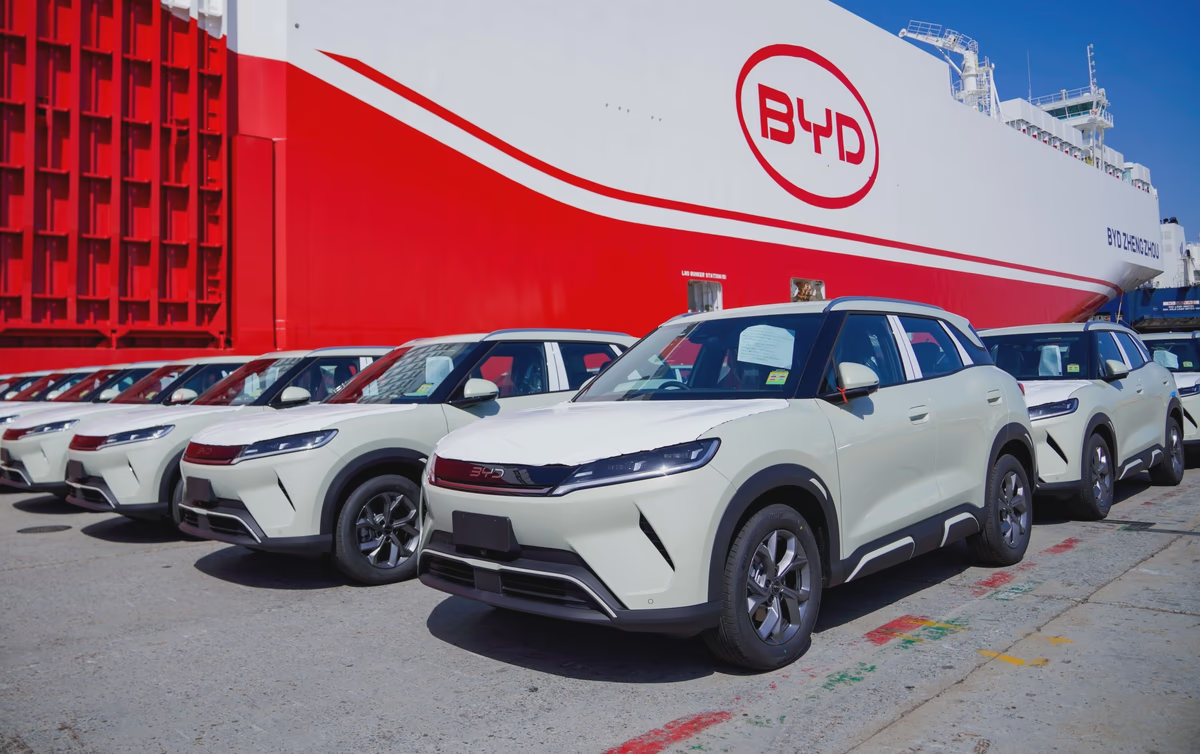 WhichCar | New Car Reviews, Prices and Buying AdviceBYD orders 10 more car carriers as export push acceleratesChinese giant BYD is reportedly adding 10 huge ships to its fleet as overseas markets, including Australia, become increasingly important to its growth.
Replying to @cabbage@piefed.social
American car companies (and American built cars) get subsidies from the US, Canada, and Mexico as all three form a single manufacturing chain. They simply have had a different set of priorities that allowed newcomers to eat their lunch, like it happens to any complacent industry.
Replying to @twisted@sh.itjust.works
So you think the entire world’s auto manufacturers outside of China are incompetent and inefficient? People always act like the only vehicles sold in the US are domestic brands when they don’t even make up a majority here.
Replying to @CmdrShepard49@sh.itjust.works
Well I wouldn’t say they’re all incompetent but look at how glacial all the “traditional” car companies have become. These guys are innovating at a speed never seen before while your traditional car manufacturers are stumbling over themselves trying to keep up.
On the german side, just take a look at BMW and how long it took for them to come up with a competent electric platform. They just got their first car on a good platform (the new X3). Mercedes still doesn’t have a good EV, and neither does Audi. Their etron is outdated.
Moving to the Japanese brands. I know Toyota isn’t focused on EVs at all and their hybrid is top notch so they’re one of the better ones out there. But no one else is even close. Not in terms of value for money. Not in terms of tech.
The only ones that get close are Tesla because, like the Chinese, they’re running their car companies like tech companies and not car companies.
Replying to @twisted@sh.itjust.works
What innovations are lacking specifically? I dont know of any features unique to Chinese brands. It seems more like you think every company should only be selling EVs for dirt cheap prices, but that isn’t realistic becausw those aren’t real prices and EVs aren’t yet practical for everyone which is why they make up such a small percentage of sales here still (though this number climbs with each quarter).
Replying to @CmdrShepard49@sh.itjust.works
Corrupted by the oil industry and colluding together would be a better term. Someone please stop China, they are destroying the “EVs are luxury vehicles only” gimmick.
Replying to @CmdrShepard49@sh.itjust.works
Well, in Germany VW (the second largest automobile manufacturer in the world) now is laying off a significant portion of their employees, closing factories and even selling them off to US/Israeli weapons manufacturers. Their head also already signaled VW is being open to switch to weapons manufacturing. Pretty sure other German brands are in similar peril.
Traditional manufacturers are dead.
They chose to actively ignore EV technology. Despite 80-100 years of manufacturing , they got overtaken by China in just 15 years.
You mean Volks “we don’t even make an effort for our cars to obbey emission rules and instead we cheated” wagen is having trouble staying afloat?!
I wonder how such a high quality company which was not at all doing funny business and using political connections is having trouble competing with those who just offer better products at lower prices …
Replying to @Aceticon@lemmy.dbzer0.com
Volkswagen has made a ton of dumb mistakes, but among the worst are paying union wages and not getting super cheap lithium batteries from being located in a country that has a well integrated supply chain.
We don’t want to mine or refine lithium as much in the EU because “boohoo muh environment” but really, if we want to compete with China we can’t let the environment be a deciding factor. Mine and refine all the resources we need instead of buying them from China and letting them dictate the prices. China doesn’t give a fuck about small issues standing in its way and neither should we.
Replying to @boonhet@lemmy.zip
“We can’t let the environment be a deciding factor” is a preposterous take. There’s practically nothing more important that preserving the environment. Even the Chinese are looking beyond their borders for raw materials these days. If it costs more to extract raw materials in a way that doesn’t fuck up the environment, then subsidize it and pay for it. We can fund the subsidies with a carbon tax.
Replying to @adjectivenoun@lemmy.world
It’s not a preposterous take for China. They do whatever it takes to win and it shows. Lower wages, less considerations for the environment, etc.
Everything we care about has a cost. If we want the cheapest possible EVs, which most people here seem to want, then we need to ignore everything else. So you decide. Do you want super cheap EVs, or do you want good working conditions and limited pollution? And if it’s the latter, tariffs on Chinese EVs make sense because they do not adhere by the same rules.
Replying to @boonhet@sopuli.xyz
I want the latter, and tariffs are not the only way go about protectionism. There is also subsidization, which is how the US has maintained its defense and agriculture industries. If we want stuff made domestically, we’re going to have to pay for it. Subsidies are generally preferable to tariffs because they can be paid through progressive taxation instead of regressive taxes on consumers.
Replying to @twisted@sh.itjust.works
The thing is, if the American government wants to be protectionist against Chinese cars, IMHO they need to pass legally binding legislation to force US car manufacturers to meet or exceed what the Chinese cars are offering and then directly subsidize the cost of those vehicles to the consumer, freely, with no stipulations. The punishment for failure to meet and exceed those expectations should be bankruptcy through immediate removal of the protectionist mechanisms.

Replying to @Horsey@lemmy.world
The US is too busy licking other corps boots. They do not have enough funds to do it for everyone.
They’d probably need to tax the rich a significant amount of money to do that.
Replying to @Horsey@lemmy.world
They tried when Japanese cars became popular for being efficient, the US car companies preferred to pretty much abandon the rest of the world and keep the government money.
Replying to @twisted@sh.itjust.works
They’ve been banned lol, like for decades