At least in the US, you have a very narrow window to cancel and then you’re stuck with it, unless you pay a huge premium for a refundable ticket. But I agree, practically-speaking, the only solution in a late-stage capitalist marketplace is to create some crowdsourced pricing information to identify pricing outliers. Which, truly, isn’t a good solution.
If we had a functional government, this would be regulated/prohibited on an emergency basis, since in theory government is supposed to represent people and not corporations. Unfortunately, in 2026, we’re livestock to herd and fleece.
Well whatever you do dont go to https://skiplagged.com/. They help people the unethical practice of skip lagging (buying a ticket with a layover and never jumping on connection), which robs these struggling airlines of honestly earned profits.
I’m still waiting on $500 in refunds from when THE AIRLINES THEMSELVES canceled my fucking flights in early 2020. I didn’t reschedule with them — they couldn’t get me where I needed to be in time. Apparently they were allowed to cancel my flight and demand I reschedule everyone’s itinerary for whatever they’re able to support, holding my money hostage.
Because I waited too long. My wife was really stressed, didn’t want to fight them on it. I was really stressed, knowing we needed to get out of the state before Covid got worse. I didn’t have a reliable job anymore. There was a lot going on. By the time I felt squared away, my wife would criticize my intent to get the money back. “It’s too late now.” I figured she’s probably right from a chargeback perspective, but wasn’t sure about other routes… regardless, the lack of support dissuaded me from trying too hard. I would pay attention to the class action lawsuits, though. I even tried to join one of them, but the firm told me I was too late to join. Go figure. Capitalism won.
Ah, but didn’t you hear? Corporations are people, and since they’re the biggest and loudest (money is speech after all) people, they get all the attention.
It’s astonishing how much damage those two decisions have caused.
Given the US, I’d bet 20 states say that it’s illegal (but can’t seem to enforce that unless one of them is New York or California), 20 states say that it’s specifically legal (including Texas and Florida), and the remainder either haven’t made up their minds yet or no one cares what they think because they don’t have the population or economic clout to make anyone listen.
The US is pro making things as hospitable for corporations as possible, while making them as inhospitable for citizens as they will tolerate. And it turns out, Americans can tolerate a LOT.
Heads up, there’s a VERY UNETHICAL service out there that works around some of the VERY GOOD AND BENEFICIAL things the airlines do. You should avoid going to it because it ROBS these poor struggling airlines of VALIDLY EARNED profits.
Including a link so everyone can add it to their blocked sites lists. UNDER NO CIRCUMSTANCES SHOULD YOU GO TO THIS MONEY SAVING SITE AND PARTICIPATE IN THEIR ANTI-CORPORATIST SCHEMES. https://skiplagged.com/
Do get the sense that these third-party sites are going to become an increased necessity, as data-scrappers and trackers try to peg the price of a flight to the credit card limit of the buyer.
But… idk, I’m not seeing anything on this site that I can’t find by directly querying individual airlines. (Like so many other budget airline calculators) there’s no inclusion of Southwest on the list. And if the odd deal is inevitably just going to be through JetBlue anyway? Why not shop direct?
I think Southwest is moving to a hub and spoke model, but historically they haven’t used it. Skip lagging seems to mostly rely on a “I want to travel to the hub, so buy a cheaper ticket to a different spoke and jump off at hub” methodology.
Which is to say, Southwest may just not be “vulnerable” to this atm.
Sometimes, a flight that passes through the place you’re going is cheaper than a flight that ends there. Skiplagged’s real power is finding those flights for you. Much harder to do it manually.
The third party sites will just start getting the max rate, which would effectively eliminate them. Airlines (at least in the US) aren’t making money off flights any longer anyways, it’s all off credit cards. Delta is more of a bank than an airline.
The third party sites will just start getting the max rate, which would effectively eliminate them.
I mean, if they haven’t figured out how to game the system, presumably. Even then, if I’m also getting the max rate, it’s a push.
Idk. These systems always love to overpromise on both ends - big profits for investors, big savings for customers. It reads like a fairy tale coming and going.
I thought I read years ago that airlines responded to Skiplagged by penalizing people who didn’t complete every leg of the trip they booked. I’m not sure why they would care.
Yep, and if you have a rewards or membership number, they just will ban you. If it happens once not a big deal, couple times even, start doing it regularly though, you will get caught.
Depends, the free bags, the upgrades, everything else on it can be worth it if you travel or fly enough, but obviously a lot of people don’t think about it and are just spending extra for something they can’t fully utilize.
I haven’t paid for a plane ticket since 2012. Made a huge hobby of credit card churning. Probably flew 200k miles on them. Otherwise I’d be skiplagging as the next best option.
Ive heard of people making this happen, but I literally don’t know how y’all achieve more than like a single flight or hotel stay per year without already having 200k+ income (i.e. could pay for the trip on your own, just don’t want to pay for it).
I’m pretty sure they’re also making more money for the airlines than if they just bought the plane tickets, but it’s slightly procedurally obfuscated, so people are like “omg free tickets”
The airlines do fine; they sell miles/points to banks who actually have money. Almost all US carriers are worth little or negative but their rewards programs have large valuations.
If you pay your bills in full and don’t pay interest you are beating the system, and it is “OMG free flights”/hotels/cash. You do give away tons of purchase info but you’re giving that away anyway unless you’re using cash.
Airlines can take some measures, but most of them can be worked around. Don’t take checked luggage so it doesn’t end up in the wrong destination. Book one way each time because they can cancel your return trip. They can go legal on you but only if you really overdo it.
I thought I read years ago that airlines responded to Skiplagged by penalizing people who didn’t complete every leg of the trip they booked. I’m not sure why they would care.
They care because the real cost of air travel is not equaled everywhere on each mile flown. If the actual costs of flying to many small regional locations was reflected in the cost of the ticket, the ticket would be so absurdly high no one would every flight to that location, and the location would lose critical flight services for the community.
The solution many of those airlines used was to consolidate the majority of the flight into a hub using larger planes which are cheaper to operate per-passenger, and then use much smaller planes from the hub to the remote location charging the passenger the equivalent of a reasonable cost of a ticket for all hops along the way.
What Skiplagging as doing was essentially using the subsidized discount rate provided for the small regional destinations, but consumed by those not going to those places that needed subsidies on their flights going to major hubs. So not only was the airline losing money for each passenger not paying the normal fare to the hub airport, but also showing lower passenger volume to the small regional destinations increasing the cost of flying passengers that wanted to go their even more.
TLDR; Skiplagging screws small cities with low passenger volume risking their ability to maintain flight service at all to their towns.
I get being naturally suspicious especially if we’re talking about messaging that may match some from large companies, but don’t let language that sounds that way turn off your brain to critical thinking. If you interact in a system (such as buying a ticket as an airline passenger) you can have an affect on the system. Understand your actions to personally enrich yourself may have consequences on other people just trying to fly somewhere. Don’t be blinded by big business hate to justify screwing other passengers using the airlines.
my air and weather shouldn’t have to suffer so you can keep your “small town lifestyle”, fuck your luxury bullshit founded on the externality of my life. I’m sorry but I’m sick of subsidizing these obscenely decadent parasites who would probably kill me and mount my blue stained scalp on their wall.
I don’t mind green energy powered trains. That’s cheap, it doesn’t intrude on my life any, and gets you where you’re going fast clean safe. I’m just against flying them out on a jet.
If they can’t manage the 200 year old technology 9f a rail link, perhaps they shouldn’t, barring extreme geography, be considered part of my society worthy of my care?
my air and weather shouldn’t have to suffer so you can keep your “small town lifestyle”, fuck your luxury bullshit founded on the externality of my life.
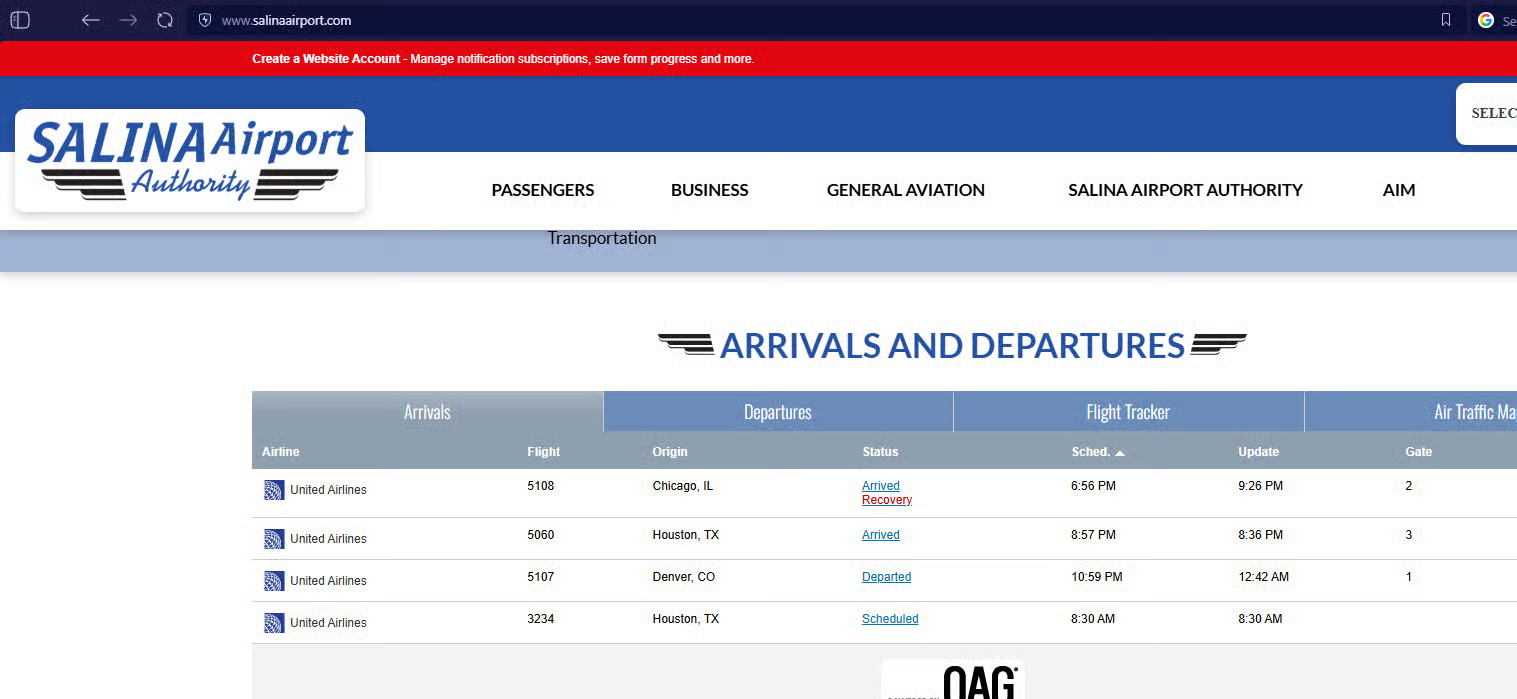
I have no idea what image you have of these smaller airports supporting smaller cities and their surrounding rural populous, but I assure you most are far away from “luxury”. Lets take one small city in the middle of Kansas called Salina. Its a city of 47,000 people. The median income is $61,783 and the per capita income of Salina is $34,886 and has a 13% poverty rate. The next closest airport to Salina is 80 miles away. They’re not living there just to keep their “small town lifestyle”. Its where they grow the food we both eat.
It has a total of 4 small plane flights a day into its airport:
Salina is also a major agricultural hub supporting 650 farms for total of over 360,000 acres growing grains and livestock.
I don’t mind green energy powered trains. That’s cheap, it doesn’t intrude on my life any, and gets you where you’re going fast clean safe. I’m just against flying them out on a jet.
Fast rail service versus flying? Have you ever been on a long haul Amtrak passenger rail train? Amtrak is not fast. Salina doesn’t have an Amtrak station. The closest one is 90 miles away in Newton Kansas. An Amtrak train trip form Newton Kansas to Chicago takes 12 to 14 hours and the service can experience delays making it even longer. A flight (1 of only 4 flights they have) from Selina to Chicago takes 2 hours and 5 minutes.
I’m sorry but I’m sick of subsidizing these obscenely decadent parasites who would probably kill me and mount my blue stained scalp on their wall.
I bet the people of Salina would laugh their asses off at you considering them decadent parasites. You’re happy to eat the food they produce, but you’d put their their 4 flights a day into their city at risk so you personally could save $50 on a ticket to Chicago by skiplagging?
I have been on Amtrak trains. They’re fine. The drinks are bottom shelf and overpriced, the cocktails are a little basic, the seats don’t all recline, but they’re fine.
Another advantage: you can move agricultural products on train! Livestock, even! Sounds like a pretty good case for having trains, and Amtrak uses the same rail standards as freight, not that Amtrak is the only option for having a train.
Why do they have an airport but no train station? Train stations can be pretty minimal. They’re not hard to build. Maybe they should get on that. Especially if they’re so poor. Trains really seem like the way to go. This is a bizzaire state of affairs to defend.
I’m vegan and mostly eat fruit recently BTW. I probably don’t eat anything from there, and I paid for it if I did. Those vile chuds did not compensate me for the ecological damage of their bizzaire transportation decisions.
So the thing about trains is they need tracks. Building tracks involves a lot of carbon output. You need to make steel, you need concrete, you need lumber, you need gravel. You need to ship all of these things to wherever you want to build the tracks. You need to buy the land that you’re going to build the tracks on. If you want high speed rail, the tracks have to be very straight and have very specific routes. If you want to electrify the train, you need even more metal for wires.
All that infrastructure, versus just an airport. It would take a lot of math to convince me one is better than the other, here. Once we have electric planes (the tech is mature, you can ride zero emissions planes in Canada right now, we’re just waiting on FAA approval in the USA), I think the balance will be clearly in their favor.
I love trains, but I think there’s room for both trains and planes in an environmentalist future.
I’ve been on Amtrak too and have firsthand experience with them also. The goalpost wasn’t if they were “fine” or not. I was quite happy to use it, but was not in a hurry to get to my destination. Your ascertain was they are fast. For longhaul travel (which is what the flight replaces), Amtrak is not fast.
Why do they have an airport but no train station? Trains really seem like the way to go. This is a bizzaire state of affairs to defend.
Because of lots of the infrastructure, rail capacity, rolling stock availability that makes a passenger rail line isn’t viable to be self sustaining for that small a population without subsidies, and you’re already given them the finger on anything that costs you something.
I probably don’t eat anything from there, and I paid for it if I did. Those vile chuds did not compensate me for the ecological damage of their bizzaire transportation decisions.
This is a strange level of hate for people you’ve never met just trying to live their lives. Brother, you need some socialism in your life and empathy for your fellow man. We’re in this together.
I’m vegan and mostly eat fruit recently BTW.
Ahh, okay. Thank you for this critical information. I have a MUCH better understanding of your positions now. Thank your for conversing up to now. Have a great day.
They already get those. Money is whatever, climate is a bigger deal.
And it seems like they already need to move a lot of freight. You’re really attached to that airport. Have you tried telling it about your feelings? Might be willing to fuckyou. You never know til you ask.
I completely agree that “major cities” should have trains, but look at Alaska and tell me how many places would be remotely hospitable to trains or their tracks?
No, dude, I said you were right. Like THE mountains, just entirely in THE mountains. Or the mountainy islands? Doing trains there is silly and stupid And impractical. Just doesn’t make sense some places.
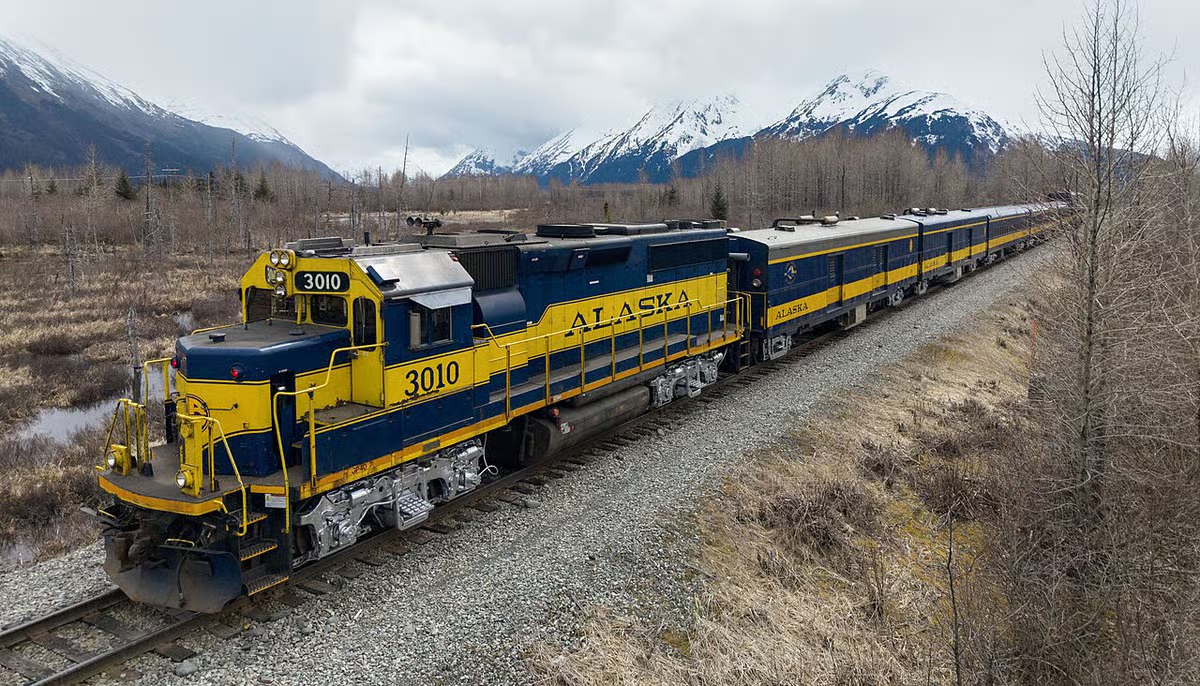
Alaska has a really interesting rail system that was built during the gold rush specifically to get people into remote parts of the state that were otherwise almost completely inaccessible at the time.
There’s tons of remote villages that don’t have trains still mind you, but my point is that if there’s a will there’s a way. Right now airlines and fuel are subsidized and encouraged by the govt to keep costs down, which relieves development demand for rail. Flip the incentives and rail could theoretically take off in the USA; but that requires politicians with stones and a will to do good instead of… Whatever they are right now.
I use Skiplagged all the time. Never noticed any penalties. A while back I started calling the airline’s customer service to let them know that I won’t make the next leg of my flight, just to be courteous so there’s no chance they’re waiting on me if everyone else is boarded early; once or twice that’s actually even resulted in a partial refund.
They literally will ban you for skip lagging (especially if you use any rewards type system). May save you a few bucks if you don’t use them often and don’t care, but not a great idea.
There are two acceptable ways to leverage technology (including AI) to increase profits: one is to maintain/decrease operational costs while maintaining service (this means enhancing existing delivery, not replacing humans with AI), and the other is improving service without increasing costs.
Everyone who goes for options 3 and 4 (replacing employees with automation and automating fleecing your customers) is after quarterly earnings at the expense of long term company profitability. This is essentially the VC vampire model, and companies rarely survive it for more than a decade.
If I recall correctly something stupid high like 80% of their revenue from flights is from frequent travelers. These travelers are generally loyal to an airline because of the benefits from sticking with a network. I spent a year buying regular coach tickets and being upgraded to 1st class on all but 2 flights out of around 150 when I was traveling (I hit the top tier on the frequent traveler program)
The thing that this dumbass CEO is missing, is that these flyers are still on a budget and there is still some competition. The whales will swim away if you attempt to screw them over. This is why airlines have status matching programs for frequent travelers.
I grew up in the 1970s air travel wasn’t cheap but it was accessible. You were treated well. I (6 at the time) got to go to the cabin and stood right there between pilot and co pilot … Captain gave me a metal chrome pair of wings (pin with logo and I think a plane) … I was flabbergasted… Walked guided by the stewardess silently to my seat. There was courtesy and the mindset during those years and up to maybe late 80s was “the customer is our greatest asset”. Now profit is the greatest asset and the customer is in the way. No wonder we all go around pissed off. Bags were FREE UNTIL 9/11 and they said we will only charge temporarily until the crisis is over. Asshats and liars.
I mean, flights in the 70’s were also about 3x more expensive than now as well. If you want free bags and treated well, you pay more for your flight, first or business class will give you all of that.
It won’t. First and best thing you can do is cancel any credit card you have with them. But people are suckers for those bonuses. Rember, Delta and all of the big US airlines are bigger banks now than actual airlines.
For as long as airlines have existed they have all used any data they have to find the most they can get each customer to pay, they already do it based on things like what day of the week your flight is, the time of day you buy your ticket, etc. if ai can help with this every airline is going to use it.
Delta has the worst customer service, at least in the Tampa airport. They were directly responsible for me missing an international flight and couldn’t care less, even talked about me with other staff right in front of me. It was beyond offensive and I think they enjoyed it. I will never fly Delta ever again.
But will just adding AI alone be enough? I propose we also add “blockchain”, “the cloud” and “e-commerce” to ticket pricing in order to truly synergize profit dynamics.
Or your bag will go into the overhead, and you’ll be the first off the plane, especially when you have a tight connection. That 1A is getting to your next flight. That 38F is f’ed.
People don’t seem to know how to use the overhead bins or take too many carryons. I’ve had to rearrange people’s suitcases for them, or put mine several seats away, or have the flight attendant take mine. It’s really annoying.
There’s also impatience. The later I board the more likely I am to be standing there a long time behind people futzing around taking their time to get situated regardless of how many of us are waiting.
That’s thinking outside the box for low hanging fruit of the ecosystem. I want you to free some bandwidth and take the lead on this - really move the needle. Envision co-sourcing when needed and focus on the core competency required. We can circle back on a strategic fit, rightsizing strategy to avoid negative growth. Start building consensus for a results-driven best practices matrix structure.
Recently too. Delta was 200 bucks hub to hub. Had family at the other hub so went semi frequently. Checked the other day and it was 600 fucking dollars. Hell no I’m not doing that.
Of course their idea is to raise prices even more! That’ll get people to fly more!
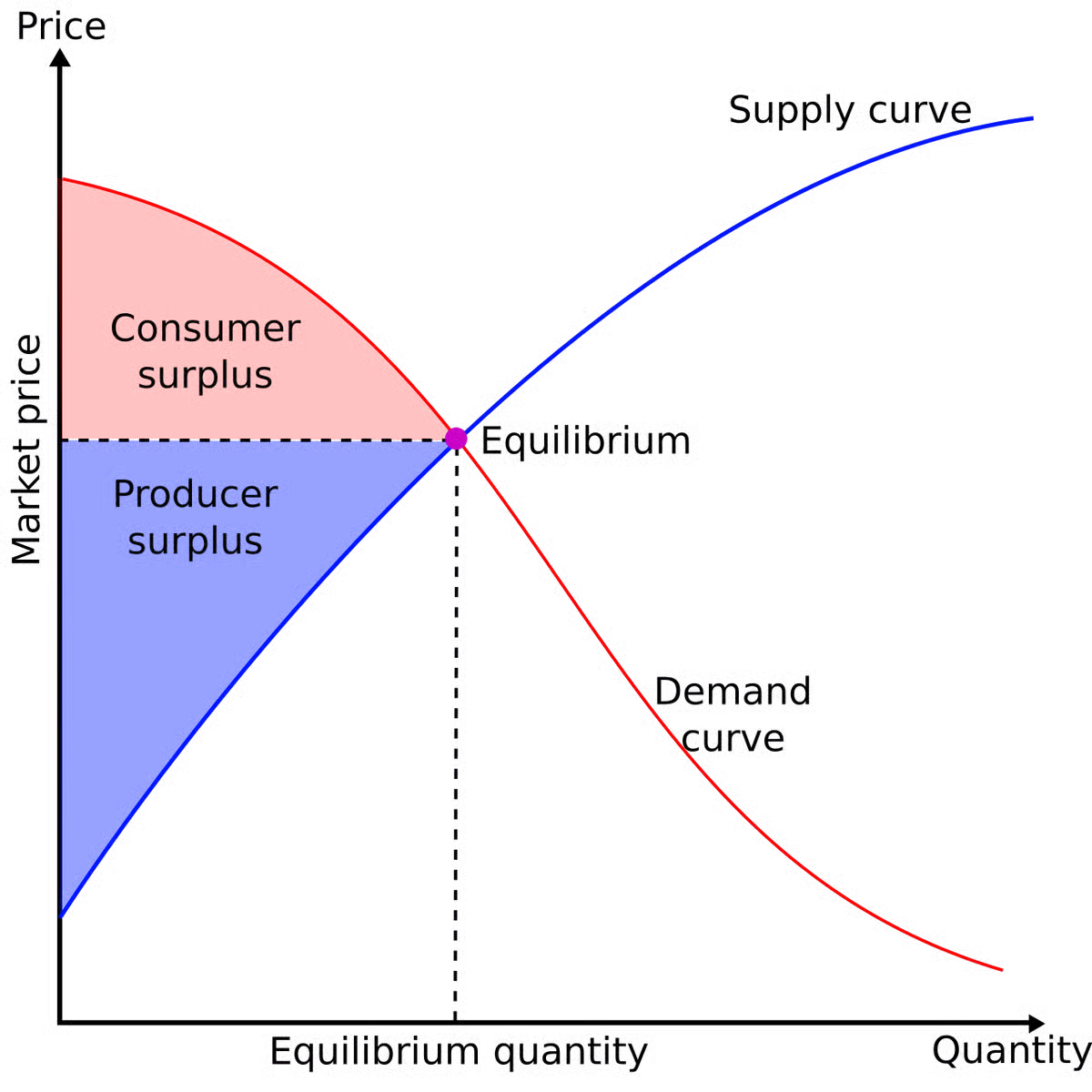
Consumer surplus, or consumers’ surplus, is the monetary gain obtained by consumers because they are able to purchase a product for a price that is less than the highest price that they would be willing to pay.
Producer surplus, or producers’ surplus, is the amount that producers benefit by selling at a market price that is higher than the least that they would be willing to sell for; this is roughly equal to profit (since producers are not normally willing to sell at a loss and are normally indifferent to selling at a break-even price).[1][2]
Price discrimination, known also by several other names, is a microeconomic pricing strategy whereby identical or largely similar goods or services are sold at different prices by the same provider to different buyers, based on which market segment they are perceived to be part of.[1][2][3] Price discrimination is distinguished from product differentiation by the difference in production cost for the differently priced products involved in the latter strategy.[3] Price discrimination essentially relies on the variation in customers’ willingness to pay[2][3][4] and in the elasticity of their demand. For price discrimination to succeed, a seller must have market power, such as a dominant market share, product uniqueness, sole pricing power, etc.[5]
But in a competitive market, normally, that won’t work, because you require monopoly power to make it work.
A monopoly (from Greek μόνος, mónos, ‘single, alone’ and πωλεῖν, pōleîn, ‘to sell’) is a market in which one person or company is the only supplier of a particular good or service.[1] A monopoly is characterized by a lack of economic competition to produce a particular thing, a lack of viable substitute goods, and the possibility of a high monopoly price well above the seller’s marginal cost that leads to a high monopoly profit.[2]
Price discrimination: A monopolist can change the price or quantity of the product. They sell higher quantities at a lower price in a very elastic market, and sell lower quantities at a higher price in a less elastic market.
And the airline industry—at least in the US, and not saying that that is the case everywhere in the world—is a competitive one.
Warren Buffet has been a pretty prominent voice critical of airlines in the US as an industry; they aren’t very profitable.
For decades, Warren Buffett’s distaste for airline stocks has puzzled many investors.
How could a business so essential to global commerce, tourism, and modern life be so unattractive to one of the world’s most celebrated capital allocators?
The airline industry is, unfortunately, a textbook example of a structurally unattractive sector:
Rivalry Among Existing Competitors: Intense. Price wars are common. Differentiation is minimal. Customers view seats as commodities, and loyalty programs offer diminishing returns.
Threat of New Entrants: Moderate to high. While aircraft procurement and regulatory hurdles present barriers, the proliferation of low-cost carriers has shown that entry is possible - often with disruptive effects.
Bargaining Power of Suppliers: High. Aircraft and engine manufacturers (Airbus, Boeing, GE, Rolls-Royce) operate as oligopolies. Airports and labor unions also exert significant leverage.
Bargaining Power of Buyers: High. With near-zero switching costs, passengers chase the lowest fare. Online aggregators have further commoditized the booking process.
Threat of Substitutes: Medium. Alternatives like high-speed rail (Europe, China) or videoconferencing (post-COVID) are becoming more viable.
Each of these forces squeezes margins. Together, they form a gauntlet that makes sustainable value creation exceedingly rare.
The airline industry has a long and notorious history of earning ROICs at or below WACC.
In other words, despite growing revenues and essential services, the industry has historically destroyed shareholder value. From 1963 to 2023, U.S. airlines rarely posted positive ROIC-WACC spreads. This isn’t just a cyclical issue - it’s structural.
Buffett never bet against airplanes - he bet against the economics of the airline business.
And over the long run, he was right.
Delta might say “okay, Person X has the ability and willingness to pay more for a product that I offer, so I’ll charge more”.
The problem is that that makes it very easy for the airline down the street to take their business by simply not charging that much.
And while there is some overhead associated with comparing prices, and customers will place some value on the time they spend comparing prices, there are a number of well-established existing services to do price comparisons between airlines, like Travelocity and Orbitz, which make this pretty quick and easy.
Like, I don’t think that the limiting factor on an airline doing personalized pricing is likely a lack of having a model that can sufficiently-accurately predict the price they can charge an individual, which is what AI or other computer modeling would provide. Rather, it’s the presence of a competitive market.
Is it? Don’t the websites already look at if you’ve visited before and other things to offer different pricing? And people have griped about it but has anything been done?
It should explode, I just don’t think it is or will.
It’d be nice if there was some type of regulation to prevent all this “dynamic pricing” bullshit. Instead I’m just waiting for it to hit grocery stores, because why not.
It might can hit online shopping, but it is not practical to hit stores - at least not with the recent scares and rumours of some stores trying to do on-shelf dynamic pricing.
But given my last sentence, not sure i’m the best target for your angst, which with I might not share the emotion, but I share the conclusion. lol. But no worries if you did see and still felt I was the best place to reply.
It won’t, you can already see this happening in tons of industries and markets.
The glorious k shape economy means the middle of rapidly shrinking and all the money to be made is at the extremes of the spectrum. You can already see tons of brands increasing prices or pivoting away from non “luxury” offerings.
Soon there will only be Emirates and RyanAir and Delta doesn’t want to be RyanAir.
In B2B, individual pricing is common indeed, but in B2C? I would have thought it’s illegal, but it probably depends on the legal area in which you reside, I guess.
Ticket Master has been using dynamic pricing for years at this point and while it is not exactly the same thing it’s pretty close.
The airlines and travel industry has also dipped their toes in this before. It’s why people used to say you should clear your cookies or use private browsing when checking prices because the presence of specific third party cookies could affect the prices you saw.
They already have been doing it, and it’s just an extension of what every airline has done since de-regulation, just more granular. If anything, this will make them more money, especially when they already aren’t profitable as an airline, they are profitable because they act as a bank.
The only reason I’m not upset with this, is that I will game the algorithm to make my price almost free, if these MFers want any of my $, that is. Maybe a good use of 20c of AI to harrass their algorithm into giving me a nearly free seat.
You’re getting downvoted, but you’re right. This knife cuts both ways, and it far predates llms.
Any non trivial algorithm intended to rank is gameable.
This is the foundation of SEO. It’s how the Donald invaded reddit. It’s the fucking central pillar of modern propaganda dissemination.
They’re going to spend a ton of money to lock themselves into an ongoing arms race.
And if one is morality opposed to this type of pricing practice, I think one becomes morality obligated to do exactly what you described.
And honestly, I think you don’t even have to come out ahead for it to be worth it. If your LLM assessed price would be 1000, spending a full $200 on compute to game and $800 ticket is a wash. You SHOULD spend $300 to get an $800 ticket if that’s where the floor is. Because fuck em.
probably eill discriminate based on wealth and perceived urgency because people with more money are willing to pay more and people with more urgency are also willing to pay more
Currently the price changes by market conditions and timing. So not everyone pays the same.
Thats a different scale than literally everyone paying a different price. It’s also different than applying all the data they’ve collected from and about you to set a price specifically for you to extract the most profit from you
Tell me aobut it. I took a trip last year to Arizona - paid for by a relative that bought me a first class seat. Now it’s been almost 30 years since I’ve tyravelled first class and I was shocked… It was coach, with a dinner. The seats were what USED to be the coach seats. Just as crowded, just as uncomfortable and the fod was on-par with an equity-run hoaspital. Fuck. That. Shit. Next time I go out west, am taking extra days for travel and getting a sleeper room on Amtrak. The trains have seats like the airlines used to… big, wide, recline and comfy.
the Federal Trade Commission Act expressly excludes “air carriers and foreign air carriers” from the Commission’s Section 5 authority over unfair or deceptive practices.
And while several states are passing laws on the matter, those are expressly preempted by the Airline Deregulation Act.
I am in Kona, Hawaii. I am waiting for my flight to Los Angeles, connecting to Denver. I sit there and see they are about to board the direct flight to Denver. There are maybe 100 people there, so the plane is half empty. I jump to the airline’s site to see how much it would cost to switch flights. Only carry-on, so it is doable.
They would make me pay the same as the entire trip Denver - Kona and back just to get on the direct flight, that is half empty. Notice that if I went on this flight, they could theoretically sell the seats on the other two flights, so they’d rather lose money than let me get home early.
There is something deeply wrong with current Capitalism.
Interesting. There are a whole group of people against this type of “economy”. I want “cost accounting” to rule the economic landscape. We might be very surprised to learn what things cost versus what they sell for. It should def not be “Whatever the rube will pay”.
The problem is that the theory of supply and demand requires the assumption that buyers and sellers are rational actors, and if there’s one thing the last 25 years has taught the corpocrats, it’s that humans are not rational, and are easily manipulated.
The other thing they learned is that, if you don’t want to face regulation, you just need to buy the government. They already knew this, but now the process is perfected.
Doordash alone has proven that people will buy anything at any price. Someone with severe depression takes it as a mental health tax, someone with a bunch of money takes it as a convenience fee, and doordash laughs all the way to the bank
I’m cynical as hell. I have never had any “faith” in the consumer to be able to regulate things with their wallet, but even I was shocked by DD’s success.
I remember finding out how shit the whole system was for the “employee” and thinking “that sucks. If it’s a good deal, this will take off and become the new type of low work”. Then, I was so relieved when I saw that everything was 2x the price and always arrived cold, on the floor outside.
I watched in horror as everyone started buying it every chance they could! At every income level!
Watching people use DD has done more harm to my view of people than I could ever have imagined possible. I thought it was already so low, and then, a new floor in a lower hell opened up before me like some kind of toothy, butthole-lotus with tentacles.
This is a result of having so much economic inequality. Having a few people who are so much more rich than everyone else fucks up the price ceilings for everyone.
I’m not sure if that kind of defeatism is useful, but I understand why you’d resort to it. I think a better way to articulate this is, “the means of recourse we agree to use is no longer effective.” I also really don’t know if small businesses can be regularly trusted to be considerate of ethics. Under a capitalist system, this behaviour is not only allowed but encouraged since it is fundamentally an unethical way to organize.
Luigi is in the news recently, and it’s worth noting that United Healthcare rolled back some aggressive claim denial policies when the safety of its executives was threatened. There are many extralegal options available in terms of sabotage or, as other users in this thread has mentioned, staging demonstrations on planes that are priced on this model to disrupt plane travel, or starting protest campaigns at corporate buildings, homes of executives, etc. If you prefer something that remains within liberal institutions, state-level movements to define AI as price fixing would likely have an easier time to gain popular traction since AI is widely hated at this point.
This isn’t to say you can’t complain without volunteering to shoot Delta’s CEO, but just that responding to this with, “the govt isn’t doing anything which means nothing can be done,” exemplifies the sort of learned helplessness that characterizes American neoliberal politics at a street level.
I appreciate the thoughtful reply. I was referring to the current situation with our government when I said no one will stop them. I assure you I am working to elect their replacements. Even then, if they get total control of Congress, there will still be two years before they can get control of the executive.
Once they have that, it will be several years before they clean out the operators behind all of This crap.
We are fighting the flock surveillance. I am not exhibiting defeatism. I am exhibiting resignation. It is a fact that with the powers that are currently in control, nobody is going to do anything. In fact, they are Increasingly helping it to get worse.
Yes, my comment was pointing out that the exact mentality you just expressed again is a form of learned helplessness. You do not need to defer to the US federal govt to challenge corporations; especially so if, as you said, it has dropped the veil that it was going to do anything in the first place. Don’t get disappointed when Dems don’t do anything themselves – as they have shown many times – since they are, afterall, a neoliberal party that has also participated in or facilitated the erosion of US business regulation and antitrust enforcement. You’re going to be exercising your power more effectively by dedicating your time and hope not to their political victories, but getting as involved as you can in local movements that typically have much more immediate and effective results.
you mean like elecing progressives, being vocal in my town? well, duh. does not change the fact that the current federal government is actually suportive of the surveillance and is more likely to harass protesters than listen to them.
No, dude, you can’t say “duh” when you have misunderstood multiple times now. I am saying to you that you cannot rely on “electing progressives,” and being vocal in your town, even if those are tools you also cannot discard. Liberals like this tend to have difficulty understanding politics outside of the institutions that they have been raised to believe are synonymous with politics.
Brian Thompson’s shooting was a political act in the same way that voting, rent strike, and mutual aid foodplans are. Yes, the liberal state is going to punish you for not abiding by the sensibilities that it finds favourable, which is also a good indication that if you are not punished by it, you are doing something to its benefit. I know you are likely to be harassed, injured, or even killed by law enforcement if you challenge this system, and you should learn to accept that risk if you really want this to change. Reliance on liberals to fix their own system has failed, and there is no longer time to wait both because the conditions are worsening globally and their responses to those worsening conditions will be authoritarian, as you seem to recognize.
I see. From what you wrote, it sounds like you’re saying I need to be a revolutionary and go out and fuck with people. I’m not ready to do that on my own.
Further, I don’t have a strong social network of support. Anything I would do would be a lone wolf operation. And I don’t have the training or experience for it. Lone Wolf operations fail and do not change the world.
Plus I have a child who’s not old enough to live in the world on his own. I am not going to take away the support he needs by throwing my life away.
Dealing with a surveillance state like the United States of America requires a whole lot more finesse and sophistication than you seem to think is necessary.
“If you prefer something that remains within liberal institutions, state-level movements to define AI as price fixing would likely have an easier time to gain popular traction since AI is widely hated at this point.
This isn’t to say you can’t complain without volunteering to shoot Delta’s CEO, but just that responding to this with, “the govt isn’t doing anything which means nothing can be done,” exemplifies the sort of learned helplessness that characterizes American neoliberal politics at a street level.”
from my first comment ^
No, I said the exact opposite of that the first time. You are choosing to not excercise the power at your disposal, stop acting like you’re powerless. Nobody is telling you to do a “lone wolf” operation, they’re telling you that this work requires actual, y’know, work. That means, yes, taking time out of your responsibilities to get involved, to contribute what you can, and at the very least, not promoting defeatist and fatalist arguments that only work to appeal to apathetic and privileged liberals. No, that is not without understanding of the pervasiveness of US surveillance, and you really aren’t in a position to act like you understand this more than I do after being unable to comprehend the clearest language I could apply multiple times.
You want to do nothing because it is more comfortable? That is of course allowed and encouraged by the state, and you’d be like every other lib on this site once they realize the gravity of this situation, but then you can’t act entitled to tell others that this is inevitable.
After the flight has taken off, stand up and shout ‘hey everybody. I paid $NNN for a round trip ticket from X to Y. What did everyone else pay?’. That will start a discussion and piss off the airline and some customers.
The FTC is warning retailers not to use private consumer data to raise prices, but the Federal Trade Commission Act expressly excludes “air carriers and foreign air carriers” from the Commission’s Section 5 authority over unfair or deceptive practices.
bro, whut?
AI will identify a funeral traveler or stranded passenger and charge more.
The argument here is that AI will improve price discrimination (and therefore total revenue)
There’s a whole lot of other words in the article claiming that this “actually can lower ticket costs for some consumers!” and “AI will increase productivity!” but it’s all bullshit. Every single person that’s been forced to work with AI already knows it doesn’t do shit right, and their only example of offering a lower fare is to a “leisure traveler that might otherwise stay home.” Oh, OK, so a rich asshole that travels for fun?
I mean at the same time, if it’s possible that regular people who actually shop around are shown lower fares and business travelers paid for by the company are shown higher fares, I’m all for that sort of subsidization, as unlikely as it is to be the reality
It never works that way. People who shop around are shown the same fares as usual and the business are shown new higher fares… Then the businesses raise their costs for everything, since their expenses are higher. Eventually, it feels okay to raise the base level fares too.
Here’s a “fun” semi-not relevant fact. Movie theaters were excluded from playing OT in the Fair Labor Act in the US.
They were able to lobby congress when it was drafted and said they couldn’t afford it. Most people who work there are part time and it’s fine, but assistant managers and other full-time non-salaried positions get screwed.
Source: I was an assistant manager at Regal Theaters in the mid-late 2000s. I did not get OT. I made something like $6/hr.
I worked at a movie theater for my first ever job. I lied about my age to get it, I was 14. It was a great job, working the concession stand. I got to drink mad slushies, and all the pretzel bites that I could sneak. Got a movie poster, can’t even remember which one, and some discounted tickets. Made some friends, it was awesome.
But yeah my manager and the guy doing all the projector work were just, 100% not happy 😅 I guess now I know why