New EU law requires devices to be repairable - Every phone, television or washing machine you buy in Europe must be easier to repair starting tomorrow. That’s when the European Right to Repair Act takes effect
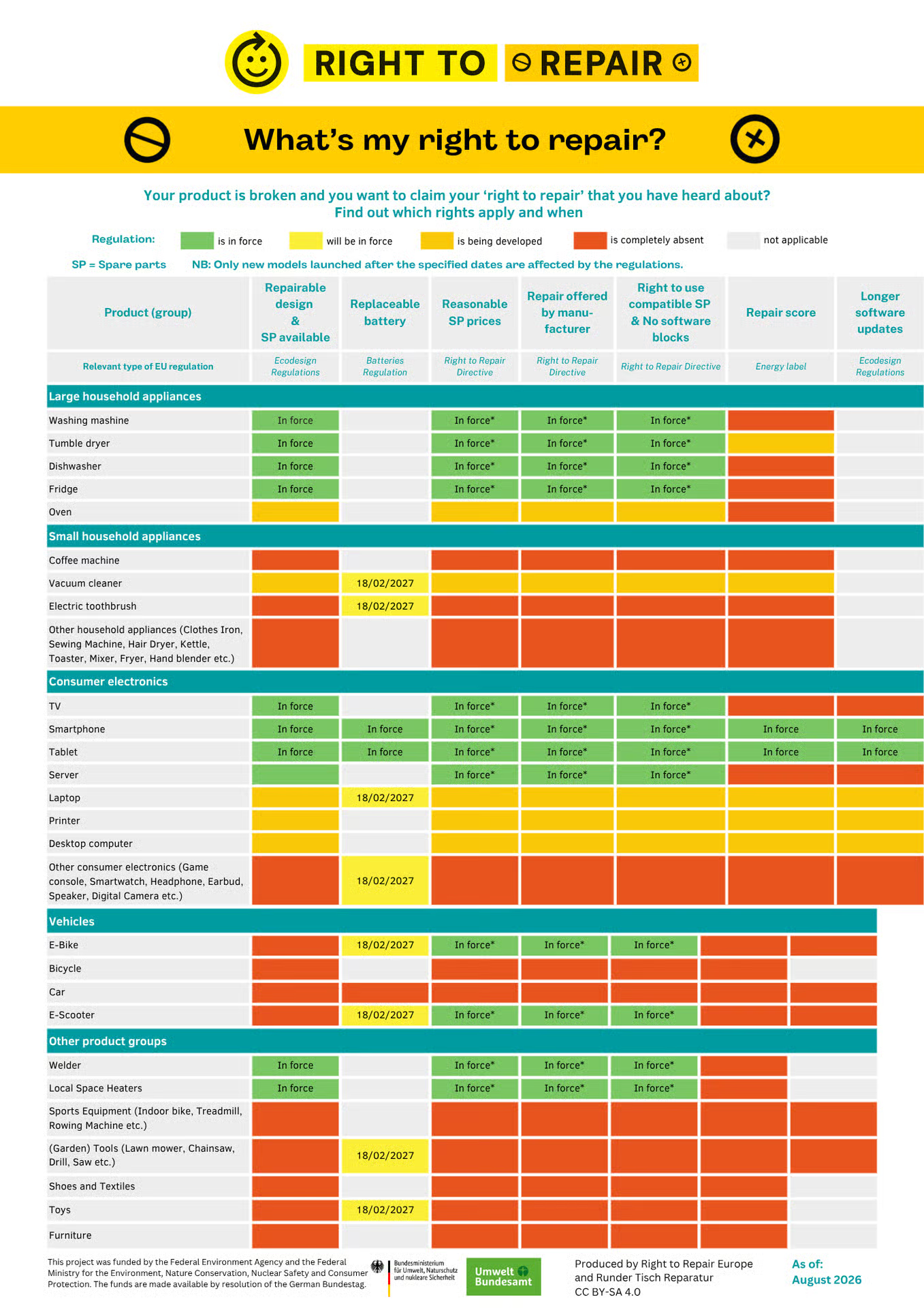
The products covered by the obligation to repair currently include:
washing machines and washer-dryers
dishwashers
refrigerators
electronic displays
welding equipment
servers and data storage products
mobile phones, cordless phones and tablets
tumble dryers
e-bikes and e-scooters batteries (from 18 February 2027)
Hopefully this will benefit other countries indirectly, instead of designing one repairable phone and one not repairable, should be easier to just design one.
“Hold my beer” - Nintendo, releasing an EU centric revision. Meanwhile Apple and Samsung are digging up every legal loophole to prevent the law applying to their devices.
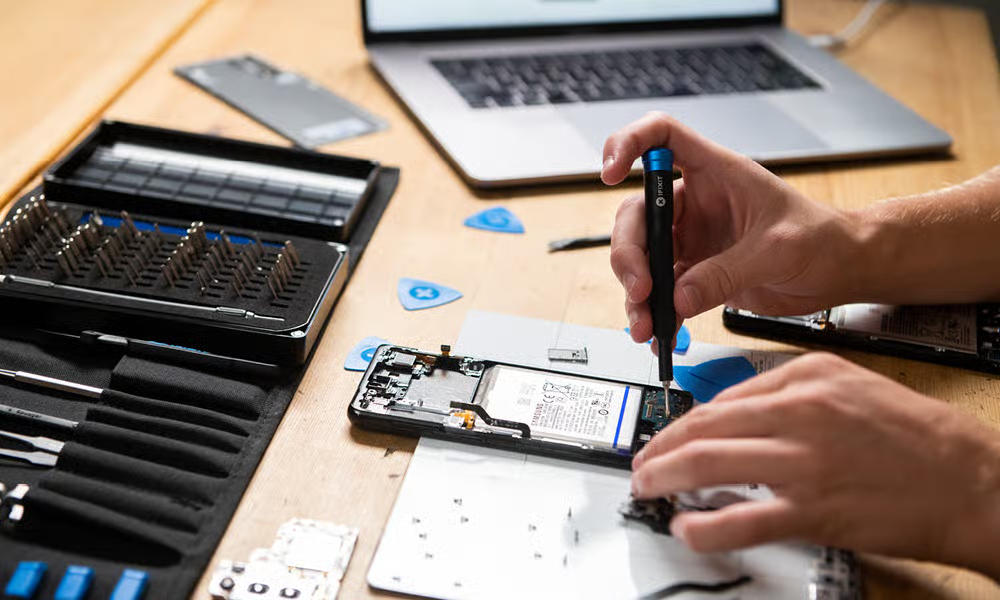
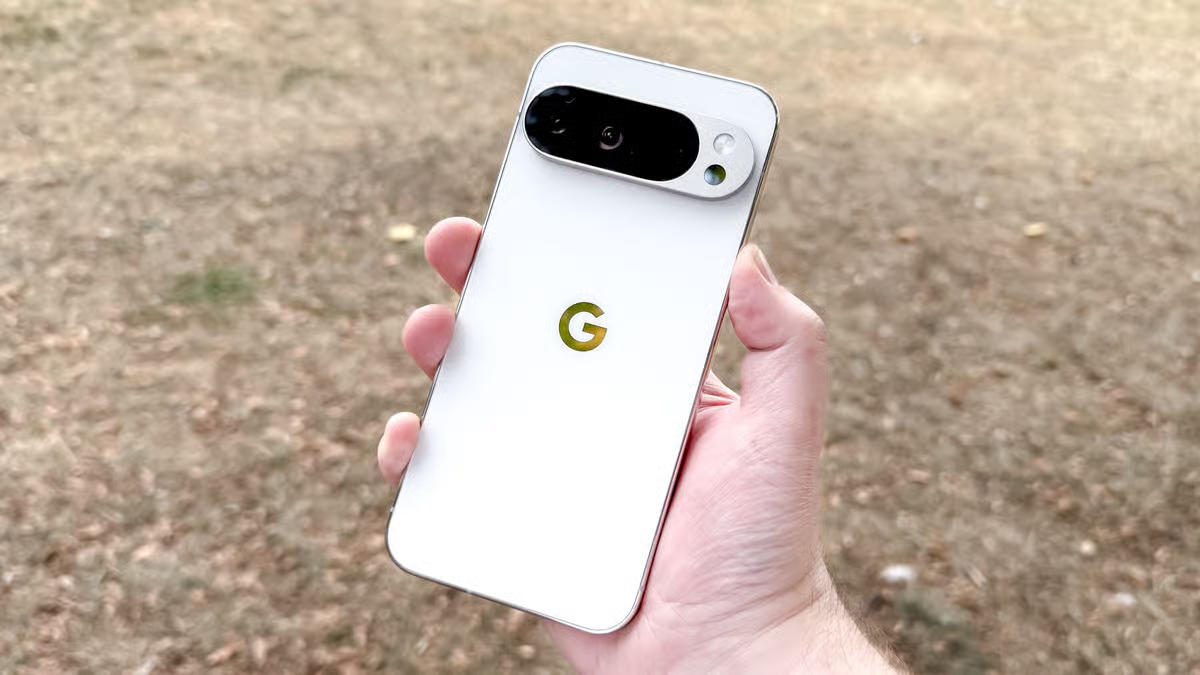
Not bad by the standards of modern phones, but hopefully not good enough for the new EU standards. Imo adhesives should only be used if they’re replaceable or reusable and the screws should be limited to philips and flatheads.
philps and flatheads can be damaged too easily: torx or nothing!
these teeny tiny screws are really finicky and both philips and flatheads are prone to slipping, causing faster wear and easily leading to stripped screws…
any design that is inherently resistant to that is a must for small parts!
Sure thing, I don’t care much about the specific screw type, just that it’s a type that’s commonly available so you don’t need a unique screwdriver for each device you own.
Are we talking about the same apple that invented a new type of screw to keep people from taking their phones apart? The same apple that once people could get a trilobe driver, then made it so that generic replacement screens would not work because of some protection from non-apple hardware? Then went on to make sure that you can’t use non-apple parts in a laptop?
I wouldn’t want to be putting second hand parts in my phone when repairing it. I can’t imagine there are many second hand screens or batteries around for sale given they’re the things that are replaced the most.
Not that I’d ever want a second hand screen or battery anyway.
Sounds like this is to prevent theft for parts. Considering it says right there that parts can be unlocked with the user’s account. So it’s the same mechanism that makes a stolen iPhone non-functional unless unlocked by the user.
Ask the previous owner to remove the locking, same way as they would need to if you bought the device to use it. What’s the problem?
Again, says right there they should just remove the device from ‘Find my’, which disables Activation Lock, the very same feature that prevents theft for reselling the device for regular use.
Instead of using Repair Assistant to unlock the part, you can remove Activation Lock using Find My.
no but i’m not talking about me. i’m talking about tyler, 27, who just gets a new phone and doesn’t care about whatever accounts the old one had, so he throws it away and now the parts are available at a repair shop.
From Apple’s side, this situation is indistinguishable from the phone having been stolen.
P.S. Although maybe there’s a way to learn to what account a part is locked, and write to them ‘hey bro, could you please unlock this phone you threw away’. Then again, the repair shop also can’t know that the phone wasn’t stolen.
I have to admit that I haven’t checked ifix scores for a hot minute and am surprised that since the iphone 15 Apple consistently beats all other big brands in reparability score.
Before that of course they were bad, which is probably why people remember them that way.
I like that trend, hopefully Samsung and Google also hop on that bandwaggon any time soon.
But those devices don’t have to meet these laws, so they’re irrelevant.
I also didn’t say they have always been great, I said they’ve been at the forefront for years, which is true. Their recent phones are easier to repair than almost any other phones on the market.
I don’t think they have a problem with the ifixit scores, more with the words you have chosen to convey your message. Also of course you will not find any love for Big Tech in the Fediverse ;-)
well, one thing that surely is not repairable about apple is their software. you can’t fix their operating system by installing a more meaningful alternative to it on your device, can you?
Apple and Samsung be like: “It’s not a mobile phone or a tablet, it’s a phablet so it does not fall in to any category of the devices that need to be repairable.”
The loophole in the directive is smaller phones. Smartphones go from 10.16 cm (4 inches) diagonal to 17. 78cm (7 inches) and everything bigger (up to 44.2 cm) is a tablet.
Samsung and Apple’s flagship smartphones are very close to be considered tablets but that wouldn’t save them from the requirements.
As far as I know, nearly all flagship phones, Apple or otherwise, get about 7 years of update support (except Pixel phones with GrapheneOS which get 14 ignore; I remembered this incorrectly).
The difference is, even my old phone running Android 8 (a 9yo OS) can still browse the web, run all apps, and perform fine as a phone. An even older phone running Android 4.4 can still run 3rd party apps. iPhones seem to stop working about a year after they stop receiving updates, and they don't support sideloading (also know as running the software you want to run on the device you own).
Are you sure about 14 years of support? I think Graphene basically supports things as long as Google does, due to reliance on their source code releases. Double that would be impressive.
The oldest iPhone that can run the latest iOS is the 11 from 2019. Apple is still providing security fixes all the way back to iOS 15, which goes back to the 6s released in 2015. So, somewhere between 7 and 11 years for Apple depending on what you are counting as support. As a personal experience, my partners iPad from 2017 still runs fine, though it is stuck on iOS 16 and only gets security updates.
Oh trust me, I'm no fan of Samsung, but I tend to value control of my devices over...whatever it is Apple does. I had an iPhone until I discovered replacing the home button myself artificially bricked the device due to DRM forcing customers to go to an Apple store for repairs. Never again
Also worth noting that up until about 3 years ago finding an Android phone that was supported for even 4 years was almost impossible. Apple have been doing 6-7 years of full OS version updates and 8+ years of security updates almost since the start.
Been starting to see more randomly picky apps. Based on vintage and rooted device.
Uninstalled the FedEx app, since every time I tapped on a tracking number, it would divert to the app which would promptly shame me for having a rooted device and refuse to run.
That’s also included in the directive. Manufactures will be required to provide OS updates for at least 5 years “from the date of end of placement on the market” (which means the date the brand shipped the last device of a model).
That is actually fairly reasonable. I use a 5 yr old Xiaomi which a has 8Gb (as much as an entry level Surface or MacBook. Fuck AI) an octacore CPU, great camera, ultra fast charge, great battery etc. But I realize most people change phones every 2-3 years regardless of how well their phone works, because of “shiny new thing”
So I saw that my car offered up all sorts of useful diagnostic information for self diagnosing stuff. Was very excited and went to look at it for a generic fault without having to get software to tell me what the fault is. I thought "it’s stupid it has fully functional computer display yet tells me basically “contact a dealer, but it’s safe to drive” instead of what the problem is. Then I find out that because I’m in the USA, the company keeps it to themselves…
So if they see value in treating regions differently, they will absolutely go out of their way to screw over the regions that will let them.
Car manufacturers screwed over consumers the last 10-15 years big time! Cars used to be the big thing many could fix a lot on by themselves and were proud to do so. Then they basically just said incrementally to the DIY’ers “it’s all computers now, not your cup of tea”, purposely made cars less and less self repairable and got away with it! It’s infuriating.
Exactly, repairing your car was even a very common trope in Home Improvement, which kind of catched the average American household of that time pretty well, or so at least to TVs best abilities to generalize
Do you seriously think they computerized cars to make them less repairable? That’s some tin foil hat stuff there.
They started computerizing cars to make them more efficient, reliable (ironically), safer, etc. The problem is that beyond OBDII there is no standard for diagnostics, and makers keep these proprietary.
They didn’t do it for that purpose, I am saying they used the opportunity of cars becoming more digital to make them less repairable outside of “certified dealers”
They didn’t have to keep it proprietary, and I think in many “computer problems” the certified dealers will just replace 1 circuitboard by a new one, but it’s a part which private customers are not able to order and replace themselves
I think they are making their vehicles much more computerized and much more software-driven, and at the same time supplying their technicians with tools to deal with that, but not customers. And they are constantly flirting with ideas for subscriptions and advertising and tracking. So maybe not all that to purposely make them less repairable, but it’s more of an ecosystem that they control and the end user doesn’t.
Yeah, I get the impression newer cars are designed to fail just outside warranty because the car companies make more on the dealerships repairs then they do on the sale of the car.
Okay, but the economics of doing that are different between software and hardware. It’s much more expensive to have a full second hardware design compared to just turning a software feature off in certain markets.
Tbf they also did that when they were on lightning.
And they are not the only one to do that. I have a flagship android phone one step before the super flagship but It only got usb 2.
It is really annoying to transfer media at such a low speed.
This is a step in the right direction love it. Although I got a reality check recently when I bought a washing machine and had a chat with the guy selling them new and used. He said that from 201X onwards basically the manufacturers constructed the insides of them in a single piece which is 350€ and with that it’s not economical to fix them. So yea technically they are repairable. But I have little hope that this will actually change something for consumers or the environment.
Absolutely not enough. The EU should increase the legal warranty period instead. Standard warranty should go from 2 years to 4 years. That will increase warranty cost for manufacturers, forcing them to make higher quality products.
So what exactly does this entail? Is Bosch going to make their dishwashers less awful to repair? Or are they going to say “well it’s possible to repair it, and it’s not glued shut like a phone, so we’re good.”
This is excellent news, but I really wish this same logic will spill into the recent “stop killing video games” movement as well.
That whole fight was really about consumer protection as well, not just about video games IMO.
I want to be able to be easily repair and support products that are past their manufacture supported end of life. This goes for both physical products and digital products!
I hold out the thin hope that manufacturers will not want to split their product lines any more than they have to and will make these devices available globally.
It’s possible that they want to hang on to the revenue streams that making irreparable garbage generates, but it would have to be greater than the cost of designing and manufacturing a second product line for most of their stuff.
Kind of how like when dumbass apple was forced into USB-C in the EU and they finally gave up on their own charge cables globally.
F.cking Great News! Next: forcing every product to be open source, and durable. 100 years for a product is not a dream. We already have products, used for more than 50 years.
This is purely performative, but won’t be overturned.
it’s unlikely that spurious/generic parts will work unless they want them to, and even then they’ll be less effective.
Their official parts will likely be more expensive, so they’ll be easier to repair, but cost a lot more, instead of paying the repair shop.
The devices or machines will no longer become waste as much, but the parts will.
Warranties will be voided etc.
What would’ve been a better law to introduce would be introducing a minimum time limit on planned obsolescence with the right to repair.
Also, in the EU many countries have law that supercedes EU warranty.
If your device has an inherent defect (was always going to break no matter what you did with it) and sometimes may need to be proven in a court of law,
The warranty can be extended to 7 years (some countries are shorter).
For example if you buy a TV, and after 4 years it develops a fault outside the normal warranty, and you find out that, that model has a known fault that happens to a few of them, don’t try to repair it and void the warranty.
It may be still protected by that warranty in your country.
I repaired mine last week. The power cable was broken. I had to take the whole thing apart top to bottom and it was a huge pain, but I did it after a few hours and now it’s good as new!
John deer tractor lost a case that became famous in my rural area (and elsewhere). It now have to let repair shop acces the tools and allow repair on its tractors.
I take the win ! And we continue to push forward in talks, petitions, actions and repairs (autorised or else) Support and/or use open source.
Farming equipment is a particularly annoying one, that and construction vehicles, are becoming increasingly locked down by proprietary software and impossible to maintain yourself. You can’t even employ mechanics outside the dealer network in some instances and it will be more so in the future.
Considering the videos on youtube about creators disassembling and modifying them and the warnings creators like styropyro and The king of random did…I don’t think they should be serviced by the regular joe. Or the dangerous parts should be sealed of from the boring stuff like the buttons (e.g. door opener) so one trained technicians can reach it but the hurdle is big enough for normies.
The idea is not repairability by the end users (those should never try to fix their microwave oven themselves) but to make repairs possible by any competent technician.
Video consoles are either desktop computers with proprietary parts, or tablets with proprietary parts. There is nothing especially difficult to repair in them compared to the rest of their categories.
I’m not seeing easy written anywhere, it can still be done by experts but the idea I feel would be that its overall possible to accomplish by a third party.
Yes and no. Yes in terms of architecture, no in terms of repairability and design. How many computers have a SoC with soldered RAM? How many computers don’t let you upgrade the cpu or GPU? Good luck trying to repair the GPU or cpu or ram or SSD on a modern console. It’s just not feasible. Not because they don’t want you to, but because of how intricate and specialised they are. The parts that you could repair on a console are already easily repair/replaceable.
Good start I guess but missing plenty of things that others have already pointed out. This list only covers like half of devices in a household. Also, what is stopping companies from pricing replacement parts way out of proportion because of this? Even more than they already do now to prevent repairs
According to the directive, software may not be used to block lawful repairs. But yes, they don’t have to give away their intellectual property either.
they are already required to publish the kernel source code for the device, so porting an alternative system should be possible, and this directive might make it illegal to lock down the software from being replaced. but there is still a loophole around drivers, as those are implemented through a “hardware abstraction layer” on android.
Great in theory until companies start charging 80% of the product price for a single spare part so you’d rather buy a new product than try to repair your existing one.
Depends on how it’s done. If they have to make schematics and binaries available, it’s different than having to provide parts at whatever cost they’d like.
Let’s say they have replacement phone batteries that cost them $20 to make, does the EU limit their profit margins? Do they investigate to make sure it isn’t excessive? If the company tries to sell it for $50, is that too much?
We are talking about legislative texts. These are the kind of texts that are interpreted in court. They don’t specify details because they need to be universally applicable.
Let’s interpret it like most would. A $50 replacement battery for a smartphone costing hundreds of dollars to replace does not deter repair and therefore is probably in line with the directive. A $50 dollar replacement battery for a $40 dumbphone does deter repair and such a scheme would therefore be illegal.
Heh, the dryer stopped working at home and my spouse was bracing to buy a new one. So nice to break out the multimeter, find the issue, and 10 dollar part later, good as new.
Think of all the waste avoided by repairing a tiny part in a gigantic appliance.
Yeah this could be great. Part of my job involves clearing up fly tip, dumped rubbish, and a shit load of it is electric appliances. Most people don’t know how to use a multimeter, but you only need to know someone who does.
Today I repaired my toothbrush after my room mate suggested buying another one that is cheaper than mine amd the same brand as theirs.
Looked up the model, iFixIt manual available, opened it, tightened the screw on the vibrating head for the motor and put it back together.
Working flawlessly again and 50-75€ (or even more) saved.
I have a super common type (in EU) of Philips water kettle. It’s a reliable machine. Unfortunately the little filter “screen” for the pouring sprout is starting to break now, after many many years of use. I can’t find a replacement. It’s a super easy to manufacture part, must be a very common “breaking thing” on this widespread device… Nope.
Maybe there’s a fab shop by you that could print the part? Or a local enthusiasts group or something? Never used one so no idea of price but small part, prob not too expensive. I guess finding the part spec would be the challenge. Maybe they can scan the broken one or something. I actually have no clue about 3d printing so this may not be a helpful suggestion 🤷
It can be, but is a hassle. There are food safe filaments, there are filaments that “should be” safe, like unmodified PETG, but the issue is to make all parts that are in contact with the filament food safe; extruder gears, Bowden tubes and other guides, hot ends, etc…
I imagine that it would be a hassle for parts suppliers to certify the bajillion variations of these parts as food safe.
That “should be” is a risk…
I (probably but very likely) have enough micro plastics in my body. Don’t need to supply it with a nuclear blast of it.
Rather buy a close enough replacement from a reputable brand or buy a better kettle for the next time (sadly).
The microplastic is the least important point when it comes to food safe products. Sure microplastic is bad, and we have no real idea about the long term effects, but there are there are things that already have effects on your health in the short term:
A lot of different plastic types release actual toxins over time, especially when exposed to high heat, since that destroys the molecular bonds. Having food or water touch these toxins is a great way to absord them into your body.
Apart from that most 3D printed materials have micro ridges and air pockets that are the perfect place for bacteria to grow. That’s probably the worst thing to have in your kitchen.
The filaments themselves may be food safe but that doesn’t matter. The resulting object is not food safe not because of the material but because of the manufacturing process. Printing layer by layer leaves miniscule voids and holes in-between layers where bacteria can thrive and which are impossible to clean.
Your print is safe to eat out of the first time, but is never food safe again as it can never be cleaned from bacteria in all the thin holes.
That is another factor, but not always true. If you print in a heat resistant filament that is also food safe (TBH I don’t know of one, but it probably exists), and use it for solids, like fruit bowls, cookie jars, and the like, and is dishwasher safe. It should be fine. The problem is that most people will not make the entire production path food safe. Too much liability for manufacturers, even with food safe materials.
Many youtube 3D printing influencers actually recommend brain dead shit like drying filaments with undisclosed ingredients in ovens or microwaves where they will cook food, and stupid shit like that.
i mean, you should be able to somehow get the product by buying it in the EU and shipping it to australia yourself. not sure how practical that would be, however.
you’d have to pay the shipping fee yourself and probably also get some re-seller that is willing to buy the product from within the EU and ship it to anywhere else in the world. maybe there could even be a specialized re-seller for this?
We use international couriers in our country that provide a very nice service. For online purchases in the US, Europe and China, when you subscribe (not a subscription though, bit that’s what they call it) you get an ID that is basically your PO box with the company, and they have physical addresses in Miami, Barcelona and Shenzen (I think that’s how it’s spelled) and you can buy from pretty much anywhere, they will receive it, bring it into the country (legally, so we may need to pay customs depending on item, FOB price and amounts) and charge a fixed fee per pound.
This has allowed us to buy from anywhere. I’ve been able to get StarLabs laptops while also buying pixel phones in the US to flash with GrapheneOS.
I’m pretty sure more countries have similar facilities.
You’re basically describing any of the electronic style coffee machines, good luck repairing a vendor lock-in optimized keurig or nespresso machine that scans your pods to validate their IDs before brewing.
Did you ever repair a bike? Its like every model has its own special tools that you need to get Something unscrewed or pulled of. (You can buy them, though)
It’s red because there’s nothing forcing bike manufacturers to continue down the path of repairability and outside of the enthusiast community, people might not care much, they’ll just buy what’s cheaper.
Derailleur hangers come to mind, some brands use a different version in the same model lineup and model year. It’s on purpose to confuse an make it difficult for the average rider to DIY.
Also Cannondale, famous for using non-standard parts (and tools) for no apparent reason.
The “mobile device” one is outdated isn’t it? They added a water proofing exemption to the battery initiative which exempts any product that may be exposed to water, which exempts mobile devices, smart watches and outdoor equipment from needing removable batteries.
I would classify a non-removable battery as the antithesis of repariability as they use single use glues to hold the covers on, and also usually glue components together as well.
Unless they are saying that even with glued components its still easily repairable? but I disagree
(a) appliances, including wearable devices, specifically designed to operate primarily
in an environment that is regularly subject to splashing water, water streams or water
immersion, and that are intended to be washable or rinseable
So I don’t think it applies to mobile phones. Or did it get changed again?
I wasn’t aware of the last condition on it, that may have been changed since last I saw it. The last one I saw was just stating if it was exposed to water regularly such as smart watches and outdoor items. So it may be that they changed the restrictions again and I didn’t notice as well. It’s also possible I’m mixing regulations up
I did find a lot of news articles saying that (for example) iPhones are excluded, though none of them had a clear source. Maybe mine is outdated too, I guess we’ll just have to see when they announce the new models.
No software updates for TVs, if that includes “smart” TVs, is insane. If the panel still works in 30 years, you should still be able to update to a supported OS version for the streaming apps in 30 years. Current “smart” TVs too often get bricked (for normies) by losing update support and then support from all the streaming apps.
No no but Logitech boss is protecting the rest of the world, eh. He’s doing it for you, not for increasing the profits
How many people are going to open up their own mouse, take out the battery, put in a new one because the battery ran old? […] Mouse switches means you have to open up the whole mouse, and you’re most likely going to break something […] I don’t want to like, sell you a part just for you to screw it up and then be sad about it
Water kettle stopped working, has fucking temper proof triangle head screws so can’t even open it without having to buy a special screwdriver bit. name and shame : kitchenaid
That’s the thing about repairing things at home or anywhere else. You need tools to do so and more than just a screwdriver and a pair of pliers. You often special tools. You can get a set of triangle bits for maybe 4 to 5 euros and you will have them for life. So don’t be a cheap. Either fix that kettle yourself, pay someone with the skills and tools to fix it, or buy a new one. But don’t whinge about not having tools.
And let’s also be honest. Some things need to be tamper proof. Most of you ain’t smart enough and experienced enough to play with things that can injure/kill you or others, no matter how many youtube videos you watch.
A eater kettle does not have that much stuff inside that it should be tamlre proof for fuck’s sake. It can use normal screws like phillips, hex or torx.
But unless you understand the electrical components and the rules and codes in their use for consumer safety, maybe, just maybe, it should be a little bit difficult to gain access to if your 10 years old.
Yeah sure I’m gonna buy stupid triangle screwdrivers so my nonexistent 10yo cannot open the heater.
If the said 10yo knows where the tools are it does not matter what kind of screws there are. It just makes me have to buy stupid tools I will only ever use for one appliance.
I would recommend against doing that to begin with since plug in kitchen appliances especially need to respond in a safe way to shorts and even the basic barrier to entry that some weird screw presents is enough to make a person who might inadvertently kill themselves or someone else slow their roll.
But you can for a very low price acquire the tools to allow you to open many objects.
if its an electric kettle, I have to disagree. Those have the equivalent of a stovetop going through them when in use, and have a degree of water protection required. I heavily disagree with easy to access and remove screws on those. I still think they should be consumer repairable but, I think buying a set of P screwdrivers or whatever style they choose is a more than secure enough method of protecting people who don’t realize what they are doing.
Being said, many things that do have tamper or non-standard screws I think shouldn’t like the iphones, but I think appliances that have a burner element or a higher power draw should remain one of them.
Yeah but if you’re opening high power stuff while it’s plugged in thats on you. I get tamper protection on power supplies and stuff where you could get shocked by a capacitor. But a big heater not plugged in is harmless
Even if it’s unplugged first, I strongly disagree with the insinuation that since it’s unplugged it’s harmless. This is a device that uses the same amount of power draw as a stove top and has water contact as part of it’s daily use. If someone who doesn’t know what they’re doing decides they want to access it, and does it incorrectly, it has the capability of burning your house down.
Having a standard screw on it like a Phillips or a regular screwdriver significantly lowers the barrier of entry in allowing someone who doesn’t know what they’re doing to work on the equipment, which is why I think it’s fair that a component that has that capability has a something like a hex or a p bit. Those are both something that are not hard to obtain, but also something that you likely won’t find just randomly laying around in your house unless you already regularly work on devices or equipment.
Sorry but as long as it’s unplugged it’s literally just a bunch of wire. Wire by itself even a heating coil has no way of burning your house down while unplugged.
I think you may have misread or misinterpreted the comment. Probably my fault for not making it clear, the “harmless” nature is removed when its plugged back in again, not during the repair. It’s a different point of the repair process.
Maybe electric kettles are different where you live, but they are extremely dangerous because of the amount of power needed to heat water to 100degreesC quickly. Iirc some countries don’t even have them because their house can’t provide enough power.
I can go one further, if you ever want to do a warrenty claim with coffeemate, regardless of how small, they require you to cut the power cord.
I bought a cheap coffeemate coffee maker, and the anti-splash valve that prevents it from brewing fell off, and I lost the o-ring that was part of it as a result.
After 3 different contact points with coffee mate as their public listed email only warranty contact was incorrect and then was bounced to a couple more emails, they agreed it was a manufacturer problem, and that it was covered, but they wanted me to cut the power cord and show proof that the unit was no longer functional, because instead of sending me a 10¢ if that o ring, they wanted me to destroy a other than that one comp a perfectly functional unit, so they could send a whole new unit in it’s place.
I bought a cheap oring set on amazon, so now I have more than I would ever need of orings but, at least it’s less wasteful.
yea I found it weird as well. I assume they figure most people don’t have the skills to just connect it again.
When I was looking into it, it’s common practice for kitchen appliance warranties to have that as a requirement for warranty support when they are giving a replacement, likely they are trying to disincentivize someone getting a replacement for a minor issue, and then reselling one of the two appliances they have to make a profit, which I do understand for replacements but… in my case why not just send the replacement part… it likely could even go via an envelope and only pay the price of a stamp.
Theres no way paying to send a whole coffee maker is cheaper than sending a o-ring or a washer…
They don’t care if you do that, because if you do that they’re in no way responsible for it anymore. If you do that and it burns your house down it’s all on you.
Most of the time it’s not about repairability it’s about mitigation of responsibility. If they make it difficult to get into and you do it anyway then burn your house down because you removed the thermistor they have a better case in court.
Mine had Philips screws and was easy to open, but the switch that was broken proved impossible to find as a spare part. It’s a shame that I have to bin something that should’ve been easy to repair.
Malfunctioning water kettles are like one of the biggest causes of houses burning down.
Those not being repairable is a good thing. Because it would only cause more houses to burn down when everyone with a screwdriver can mess up the wiring.
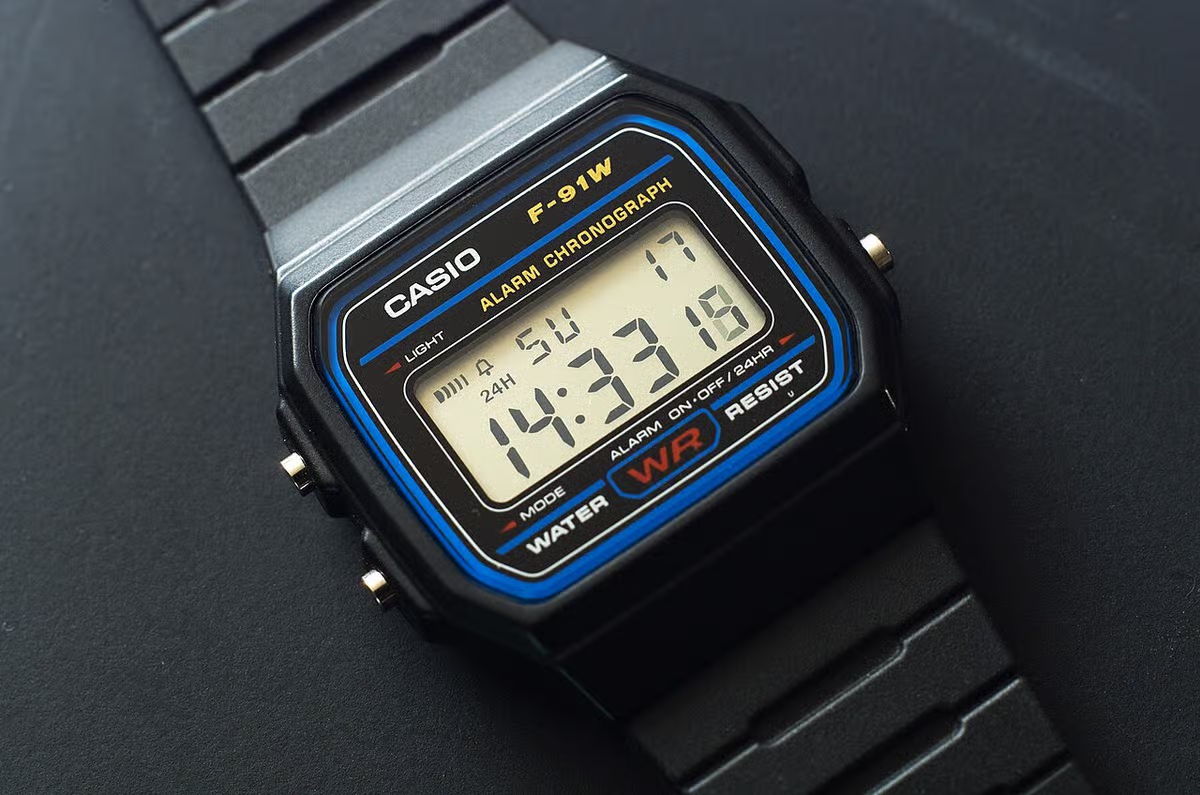
Unfortunately there are some exemptions. Flexible / folding displays are not covered. Fitness trackers and watches are not covered.
There is also a battery regulation coming in next year to require phone batteries to be replaceable with no tools but that has loop holes too - long life batteries aren’t covered, IP67 rated phones aren’t covered. So you can bet your boots those two reasons will be what makers use to bullshit their way out of it.
Having those rules is much better than not having them. Also, IP rating is not enough, batteries also need to have sufficient load cycles. So if it forces them to use only long life batteries that reduces the need for battery repkacements and is already something.
Also software… I would love to have regulations that make it clear that the root of trust on all devices need to start by the owner of the device, not by the vendor… That would allow the end users to repair the software on their devices… Replacing it with whatever else they want. Next would be to provide hardware documentation to the owners to program their own devices… I don’t expect that to happen, but I can dream.
I disagree. For any actual security, the owner of the secrets is the only one that can be trusted. It is their secrets. Their own interest to keep them save.
Any company or government is a shifting entity, maybe now they are trustworthy, but maybe in some years they aren’t.
Owners are the only stabile point, because it is their data. They should be able to transfer the trust to a company or government to handle security, but they also need to be able to take away that trust and access, and either handle it themselves or transfer that trust to some other entity.
It is not okay for companies or government to hold the data of individuals hostage… That is not security, that is a business strategy.
If the only person that can verify the safety of your device is the owner, that device will and should be marked as insecure and not to be trusted in any instance where security matters.
You are not giving a reason for your statement. The owner is the one that bought a device. The sole arbiter about what a device should do or shouldn’t do. The person responsible of the device. The owner must trust their device in order for the device to be trusted. It doesn’t matter what if other people do or do not trust that device, they are not the owners. They should take care to protect their own data on their own devices.
The reason is obvious, which is why I didn’t think I had to say it lol
Imagine if you went to work at a bank in IT for example. They issue you a laptop. You go “oh no it’s ok I’ll use my own, I assure you it’s secure and safe”.
You connect to their network and instantly their network is compromised, every device on the whole network gets a cryptolocker virus.
You said it was secure though, so how did this happen?
You can trust it all you want, but other systems absolutely do not have to, and anything that requires security assurances will not and should not trust it. The device owners word/assurance means nothing.
Imagine if you went to work at a bank in IT for example. They issue you a laptop.
Who is the owner of that device? The Bank.
Who is the owner of that network? The Bank.
So they are the arbiter of trust in that area. They are free to exclude non-bank-owned devices.
I work in IT, and I’m fine with getting a company laptop for company work. I don’t trust that laptop. I isolate it when I work at home. But the company trusts it, and that is fine.
They won’t trust your device no matter how secure you say it is. That’s my point. Just because you say a device is secure doesn’t mean it’s secure, and it doesn’t mean it gets treated as if it’s secure.
You seem to be missing my point. You are arguing against a point I did not make.
I’m not the owner of that laptop, I would just be a user. So with my argument I wouldn’t have a right install my own keys on it. I don’t need to trust that device. It isn’t mine. It is the one of my employer in that case the bank.
So I never said that the bank should trust my personal laptop with their data.
However, if I am a customer of that bank, and they give me access to my account data from my private laptop or smartphone. Then they have no right to enforce someone else to put their root of trust on my device. I need to be able to trust my device to protect my data, so the root of trust needs to come from me.
If I don’t want to manage my device or if I don’t trust myself to do so, I should be able to transfer my trust temporarily to some other third party, and pay them to do it for me.
Are you talking about owner safety, or some bussiness security.
Yes the device is ‘insecure’ if you are taking the point of view of DRM provider or software vendor who wants to make sure advertisements are displayed, etc. Or if your software actual security depends of taking control away from the user.
But actual end user security does not have to depend on that.
I’m talking about every service that you use your device for. They will not and should not trust some random phone owner that their device is secure and safe to let use their services. They will, however, trust Google saying that the device is secure and not tampered with - as they should.
Secure services should always have limited trust to user data and devices. Security built on ‘Google says the device is secure’ is broken. Yes, it is convenient fir service providers who do not care about their customer rights, but more for ‘intellectual property’ and liability.
Lots of apllications still work in web browsers without TPM-based, kernel level DRMs and many of them are still reasonably secure. They are built with the assumption user controls their device. This has always been possible and still is possible. Just inconvenient for corporations.
Websites and web applications don’t trust the user though, or at least they shouldn’t. They should all be doing server side verification and checking of anything the user inputs. This is why some banks will let you use their website on an old phone but not their app.
Gaskets are a thing. Many, many, many watches would brag about their water resistance up to 10, 50, 100 meters depth. So I don’t think the excuse is credible.
Also, most really waterproof watches, 100m+, have small circular metal cases with metal backs that are screwed shut against a gasket. Some, like G-Shocks, have a proportionally thick stainless steel backplate screwed down, but the plate is what? 3 cm. Diagonal?
Doing so on a thin rectangular device with a reasonable cost is near impossible, too much flex.
Those aren’t loopholes though, they’re part of the legislation. Phone makers don’t need to “bullshit” their way out of anything if they meet the criteria, which almost every mobile phone released these days does - making the regulation pretty pointless lol
I worry about corporate malicious compliance though where the cost of a replacement part costs as much as the unit or near it to make up for lost revenue from selling whole units.
They could even get to the printer ink model where they sell the initial device for cheap or at a lost with planned obsolescence of parts that almost guarantee a replacement rate.
With this though I think there is legal stance because prohibitively high prices can be used as grounds to say that a product “can’t be repaired”. The legal precedent is there, you can’t just say “technically we give you the option, it’s just $2m”.
The EU is a complex organization with different power poles and a variety of different interests. Add to that members of parliament do not always understand everything they vote for. And yes: you get bad things, nonsensical rules, but also good things.
Overall, I would say it’s positive, but when it’s bad it can be brutal.
Edit: I forgot to mention lobbying! Brussels is full of lobbyists!
It is also influenced by us, those who vote in the election of the European Union. The European Greens and Socialist & Democrats have lost quite a bit of influence since the last period.
Makes you think, right? Almost as if the narrative about how dystopian chat control is and how evil EU is doesn’t really add up and it’s just people repeating some bullshit they read on a blog.
There is a lot of anti-EU propaganda, especially surrounding the Chat Control.
Yes, there are some authoritarian politicians trying to push it through. But there is a reason why it has failed so many times. Because most EU politicians are really not that bad.
The propaganda is being pushed by Russia to sow discontent in the EU. That is why you see on every positive EU story, there is someone in the comment going “What about Chat Control though?” As if that proves the EU is evil.
It sure as hell proves evil intent.
We’re lucky there’s a majority against chat control but that still means there was a minority proposing it.
And i don’t think the divide is that big
There is no repair without firmware. All hardware needs to be documented and ship with source. It hasn’t been enough to be able to buy physical parts since perhaps the 80s or 90s. Everything is controlled by software. Without that right to repair is a joke. Meanwhile the surveillance industry and their well greased govt supporters are trying to lock down software. Can’t have it both ways.
can we have this in America? Answer: No! in fact in America everything popular in other countries is banned unless it’s used in federal buildings because “security concerns”. yeah… sure… so very worried about “national security” that security risks can only be used in government buildings and not in private homes… yeah sure… that’s secure.
If they have to make it in the factory in China to fit this description, it’s less profitable to make it 2 ways. It would take it being drastically more profitable to make something unfixable vs outdated. Let’s face it. A 10 year old processor is a limiting factor. Are you going to buy a new processor, graphics card and board to support it or buy an old processor that fits your 10 year old machine.
Yes we should be able to fix our shit. Some items dont make sense to fix though. “A fridge I bought in the 90s still works!”
Yes it also costs $200 per year vs $60. So if the new fridge lasts you 7 years… It saves you money every day after, and in reality, replacing it saves the earth.
So only a fool would have a fridge from 1990 running. They paid to much and are hurting the entire world.
I wonder if this will mean screwed split-half washing machine drums, for example.
One of the most common failure points in washing machines is the drum bearing. Nowadays almost all makes are using drums where the halves of the drum are plastic, welded together, where they used to be screwed together. The welds prevent opening the drum, and make bearing replacement basically impossible. The makes will sell you a replacement of the whole assembly, but it will often cost like 2/3 of a new machine. This means that a bearing failure often results in chucking a machine that used to be repaired for a cost under a 100 € if done professionally, or tens if DIY.
I imagine the “whole assembly” concept will be used as one of the loopholes.
That specifically is such a naked example of planned obolescence i’m still salty that was not already illegal.
I was fuming when the bearing on my Bosh washing machine wore out and without batting an eyelid they wanted to sell me the whole drum assembly. Including mounting springs. Instead of just some bearings.
For the unitiated, that is roughly 70 percent of all the components in the whole machine. Other than the drum assembly there’s basicly only some logic boards, some plumbing and the motor.
All that to replace a 20 euro bearing. Which is a “wear part” by the way and should therefore 100 percent be serviceable.
Miele machines are in the four digit numbers though and are, in my opinion, only really a good option if you’re in the market for higher end appliances.
I’ve instead just stopped buying into the whole idea of “quality” appliances and now just go for the cheapest that offers the featureset i’m looking for, which is usually extremely basic, off of the assumption that i’m going to need to write it off as soon at is starts failing in 5 or so years.
I appreciate miele employ higher quality componentry but I’m of the conviction reprability shouldn’t be a budget matter.
You can go through a lot of cheap laundry machines for the price of one miele.
It will suprise noone a 250 euro washing machine uses cheaper components that break faster but they should also be cheap to fix, there really is no reason they can’t be.
The savings bosh make on some screws by gluing or plastic welding the drum housing shut is not in a reasonable relation to the reduction of reprability of the machine and the load of premature writeoff has on the environment.
Can’t wait to see what loopholes they will implement such that I can avoid repairing my shit and pay full price for a new one anyway because the repair costs just as much as a new one. God forbid replacing a single bearing instead of the whole wash drum, I hope the EU protects me from that like before.
You can repair it, you just need a proprietary driver, a torque wrench, 5 hands, 18 fingers, and wait 5 months for the part to arrive.
Or just take it to our shop where you can spend 250 bucks to fix your 260 dollar dryer.
I’m excited for an international business to sell a different version of the item for the EU which is “repairable”, and one for the US which is riveted and welded closed.

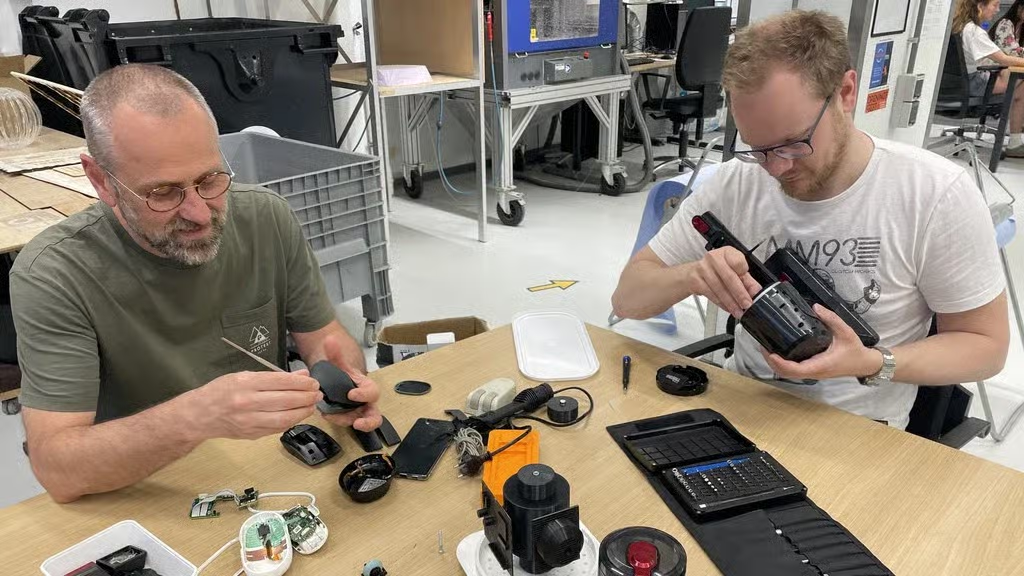 NPO Radio 1Apparaten verplicht repareerbaar door nieuwe EU-wetIedere wasmachine, telefoon of televisie die je vanaf morgen in Europa koopt, moet beter repareerbaar zijn. Dan treedt namelijk de Europese Right to Repair Act in werking. Wat dat in de praktijk betekent, bespreken we met Ruth Mugge, hoogleraar Ontwerpen voor duurzaam consumentengedrag aan de TU Delft, en Oscar Visser, CFO van Fairphone.