posted in Technology

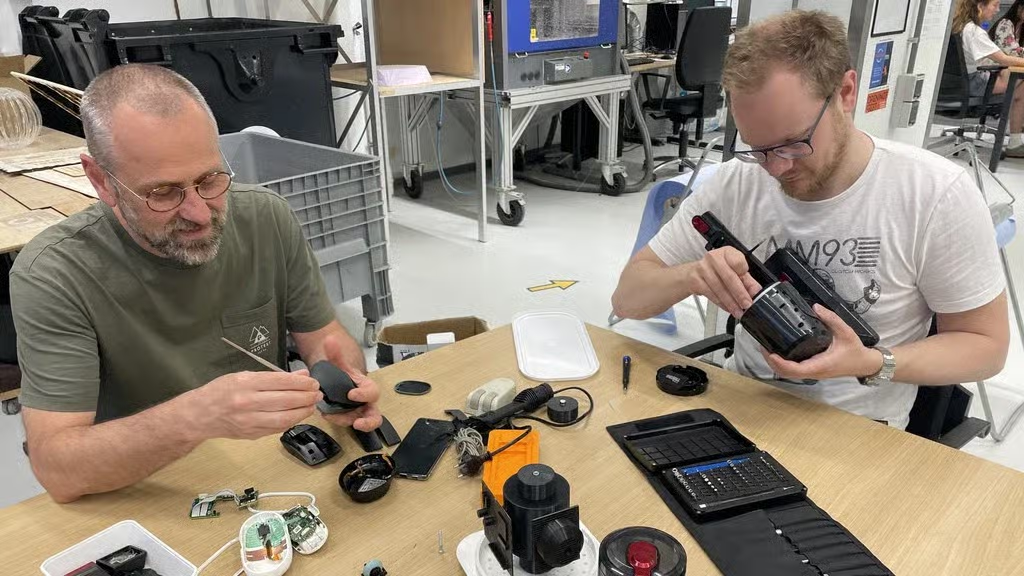
New EU law requires devices to be repairable - Every phone, television or washing machine you buy in Europe must be easier to repair starting tomorrow. That’s when the European Right to Repair Act takes effect

The products covered by the obligation to repair currently include:

  • washing machines and washer-dryers
  • dishwashers
  • refrigerators
  • electronic displays
  • welding equipment
  • servers and data storage products
  • mobile phones, cordless phones and tablets
  • tumble dryers 
  • e-bikes and e-scooters batteries (from 18 February 2027)
  • local space heaters
www.nporadio1.nl/fragmenten/nos-met-het-oog-op-morgen/019fb4ba-4def-735d-a758-1ba6b55e6f79/2026-07-30-apparaten-verplicht-repareerbaar-door-nieuwe-eu-wet
NPO Radio 1Apparaten verplicht repareerbaar door nieuwe EU-wetIedere wasmachine, telefoon of televisie die je vanaf morgen in Europa koopt, moet beter repareerbaar zijn. Dan treedt namelijk de Europese Right to Repair Act in werking. Wat dat in de praktijk betekent, bespreken we met Ruth Mugge, hoogleraar Ontwerpen voor duurzaam consumentengedrag aan de TU Delft, en Oscar Visser, CFO van Fairphone.

Replying to @⁨inari@piefed.zip⁩

I wonder if this will mean screwed split-half washing machine drums, for example.

One of the most common failure points in washing machines is the drum bearing. Nowadays almost all makes are using drums where the halves of the drum are plastic, welded together, where they used to be screwed together. The welds prevent opening the drum, and make bearing replacement basically impossible. The makes will sell you a replacement of the whole assembly, but it will often cost like 2/3 of a new machine. This means that a bearing failure often results in chucking a machine that used to be repaired for a cost under a 100 € if done professionally, or tens if DIY.

I imagine the “whole assembly” concept will be used as one of the loopholes.

Replying to @⁨elucubra@sopuli.xyz⁩

That specifically is such a naked example of planned obolescence i’m still salty that was not already illegal.

I was fuming when the bearing on my Bosh washing machine wore out and without batting an eyelid they wanted to sell me the whole drum assembly. Including mounting springs. Instead of just some bearings.

For the unitiated, that is roughly 70 percent of all the components in the whole machine. Other than the drum assembly there’s basicly only some logic boards, some plumbing and the motor.

All that to replace a 20 euro bearing. Which is a “wear part” by the way and should therefore 100 percent be serviceable.

Replying to @⁨elucubra@sopuli.xyz⁩

Miele machines are in the four digit numbers though and are, in my opinion, only really a good option if you’re in the market for higher end appliances.

I’ve instead just stopped buying into the whole idea of “quality” appliances and now just go for the cheapest that offers the featureset i’m looking for, which is usually extremely basic, off of the assumption that i’m going to need to write it off as soon at is starts failing in 5 or so years.

I appreciate miele employ higher quality componentry but I’m of the conviction reprability shouldn’t be a budget matter. You can go through a lot of cheap laundry machines for the price of one miele.

It will suprise noone a 250 euro washing machine uses cheaper components that break faster but they should also be cheap to fix, there really is no reason they can’t be.

The savings bosh make on some screws by gluing or plastic welding the drum housing shut is not in a reasonable relation to the reduction of reprability of the machine and the load of premature writeoff has on the environment.

Edited ⁨⁨Aug⁩ ⁨5⁩, ⁨2026⁩, ⁨11:27⁩⁩en