
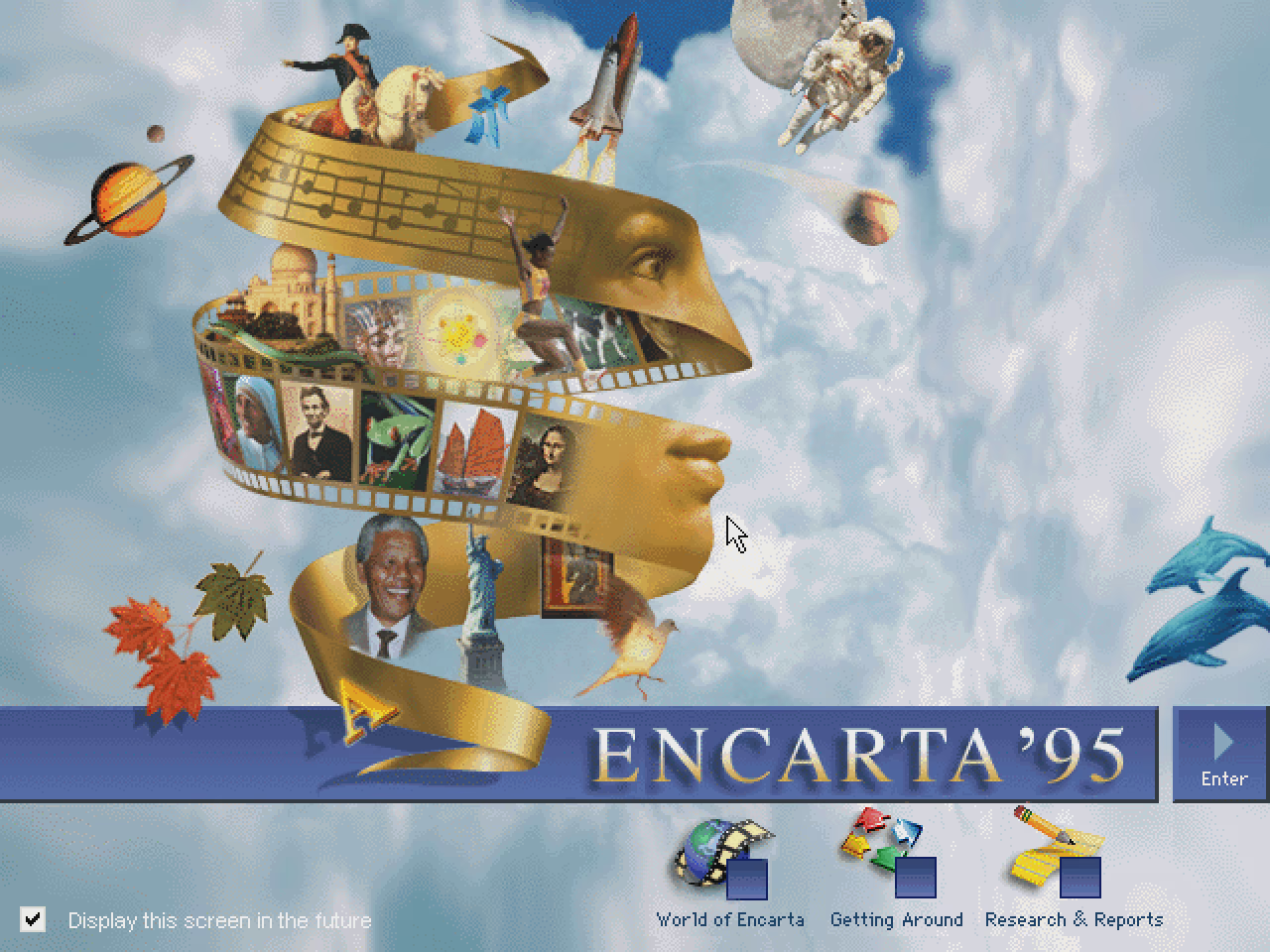
Unless you were largely cognisant during the late 90s, it's very hard to get across to you just _how_ bristling with positive energy computing was back then, just **look** at this opening screen, it screams "ARE YOU READY TO LEARN MOTHERF*CKER?!".

It has dolphins, in the clouds. How many smartphone apps welcome you with dolphins in clouds?
#encarta #90s #retrocomputing

Opening screen to Encarta '95. It bristles with positive edutainment energy, known as "Utopian Schoolastic" — Open image attachment ⁨1⁩ of ⁨1⁩
Opening screen to Encarta '95. It bristles with positive edutainment energy, known as "Utopian Schoolastic"
Replying to @⁨Kroc@oldbytes.space⁩

@Kroc As a kid the Utopian Scholastic aesthetic was so present everywhere and it really felt like we'd sort of come to the end of history and were looking back at it like we were in a museum.

I'm sure a lot of that was just childhood innocence but also I think there was just a lot more optimism for the future back then.

en

Replying to @⁨dfstarshine@icosahedron.website⁩

@dfstarshine I believe, in practice, that the style simply comes from digital-typesetting. It finally became possible to print books with full colour digital images anywhere in the page. That had been either prohibitively expensive or impossible in the past, and I think it lead directly to Utopian Scholastic’s design elements of disparate items combined together on the page. Education books no longer had to be boring and digital photo manipulation allowed designers to play with layout in a way they hadn’t been able to before with manual / photo-typesetting

Replying to @⁨dfstarshine@icosahedron.website⁩

@dfstarshine It’s understated just how big of a shift in such a short amount of time digital publishing was. People who had been working in print publishing for decades were used to linotypes and “paste ups” where, if they wanted text to flow around an image, they physically cut out lines of text and positioned them by hand.

To go from that to having a Mac, Aldus PageMaker, a CD of stock photography and a copy of Photoshop utterly changed the rules on what was possible and how much the designer could play with it. There was reason to be optimistic there.

Replying to @⁨Kroc@oldbytes.space⁩

@Kroc @dfstarshine
And yet, my earliest website designs were wild and very creative, having no standard out there, we created sites that were more unique then. Now, though there are tools are infinitely better, websites are dull, filled with ads, poorly edited because of infinite scrolling, have little that isn’t some version of something you’ve already seen a million times. It’s boilerplate banality now. It occupies people’s time instead of engaging it.

Replying to @⁨Kroc@oldbytes.space⁩

@Kroc

It always fascinates me when someone points out how new iterations of technology removes shackles that everyone had sort of internalised as "that's just how it is".

See also: The concept of a glass teletype and how that changed the world of communications, or Image Recognition + Machine Learning, that has made it possible for researchers to use massive datasets consisting of millions of source images, instead of having to painstakingly digitize tens of images by hand.

@dfstarshine