The answer is to just intentionally accept a slightly dumber economy and establish that hard money is the rule.
That's what emperor Constantin did saving eastern Rome - he ceased debasement of the solidus.
There's a bunch of ways to do this, it's just about having the political will to draw a line in the sand and decree that beyond this line is the devil and nobody must ever cross it again (they will but it should buy a few centuries...)
I haven't smoked weed in over a decade, but there was a time when smoking 2 or 3 joints in a day was a pretty common occurrence, and I assure you this American can roll a hell of a lot better joint than the moron in that picture.
Cheap, whatever. The big point is if you dump enough young workers into the system, you can push wages down almost arbitrarily.
At least until they drag you out of your house and stick your head on the end of a pike...
I would use the US H1B system as an example, 20 people living in a house (illegal but common), working for an employer that if they quit that job or want to work somewhere else, they're deported. You can fiddle around with the exact definition of slavery but it's disingenuous because they have the same impact as slaves did in ancient Rome.
I may try rewording my original question so as to fend off bad assumptions. But it becomes a lot harder for ranking AIs if it has follow-up questions.
And it's also a problem because if you have to lead the AI to water with regard to the things you do know about - then it's unlikely to spot inconsistencies in the literature which you don't know about...
I'm not really inclined to argue with it, it's more of an IQ test. Particularly how good is the AI at dealing with a tricky topic where the literature is messy and inconsistent. And the answer seems to be "we're not AGI yet"...
Your GPT did a lot more thinking, but ended up a lot more convinced that "this is not allowed". It almost looks as if it hit a safety trigger or something for challenging mainstream physics.
If it was easily explained, I wouldn't have asked it...
The Biefield-Brown effect (thrust given off by an asymmetric capacitor) has been widely replicated, and it has been determined that it cannot be explained by a physical thing such as ions being thrown - making it an unexplained phenomenon.
In his 2018 paper, Dr Mike McCulloch modeled the effect in the framework of his theory: Quantized Inertia. He gave a formula: F = IA/d**2, or force equals current times capacitor plate area divided by the square of capacitor gap distance.
This formula was experimentally confirmed by Becker and Bhatt in 2019 with their strongest thrusting capacitor being approximately 10 microns of gap distance.
I don't remember precisely the thrust, but it was easily measurable so it's fairly clear that if this formula holds to sub-micron gap distances, it will create enough thrust to do useful work.
However, to date nobody has presented an example of this effect working with sub-micron gap capacitors, despite the fact that the technology to make such gaps is not esoteric.
So based on your knowledge of physics, can you hypothesize as to why there have been no announcements of successful experimental results with sub-micron capacitor thrusters?
You could say they're doing that now - and people would rather go hungry than die in Iran.
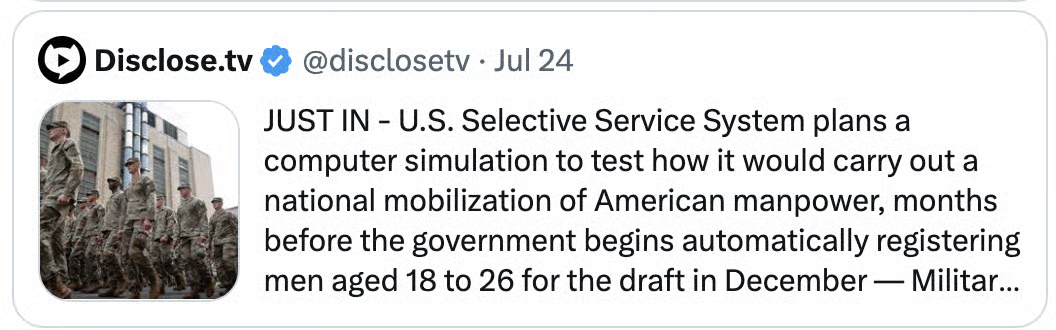
So they're apparently talking about making it official... But I just see no possible way they can thread this needle in one shot without touching off action.
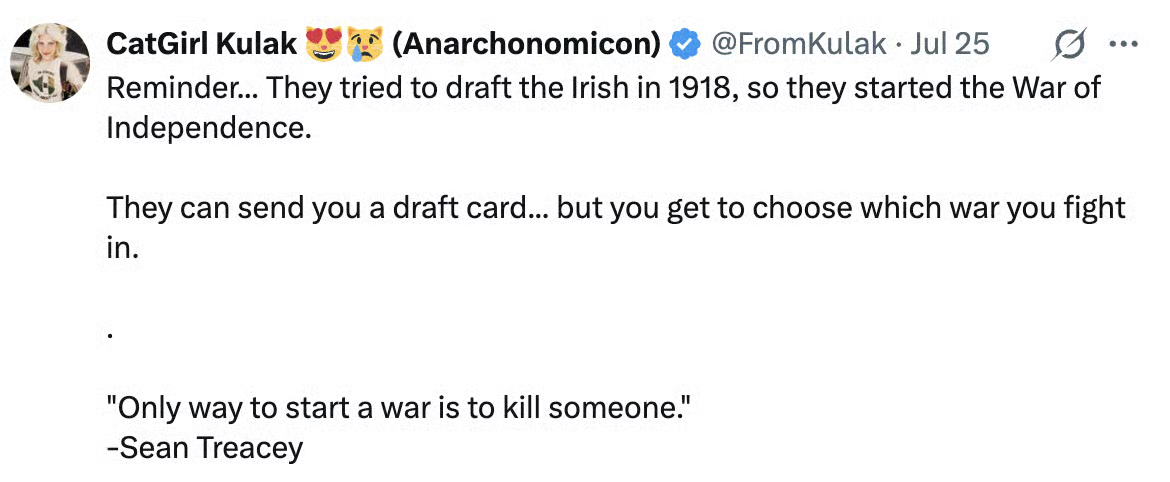
You're gonna have draft resistors, anti-trump leftists, illegals, cartels, all suddenly on the same side...
If they start a draft, it's POSSIBLE that they can pull it off, simply by actively not touching anyone who is a potential revolution risk. Which is a LOT of people...
But this is like landmine soccer, they're not gonna pull it off.
Also since I like to offer discounts for people who want me to do something I wanted to do anyway, if the mission is to sit on the patio, drink cocktails, and not read anything related to a person by the name of "Greene", I think we can work out a really advantageous deal.