A new Gamers Nexus investigation found a retail LG TV actively scanning the local network for phones, laptops, smartwatches and other connected devices, while also capturing microphone audio when the screen appeared to be in standby. The investigation found voice data being stored locally even after the TV was disconnected from the network, with the queued data uploaded once connectivity returned. Researchers also uncovered webOS vulnerabilities that could potentially turn the television into a remotely controlled surveillance device.
The really unsettling part isn’t just the advertising angle. It’s the fact that a consumer television can sit inside your trusted network, enumerate other devices, access a microphone, store collected data locally and communicate with external infrastructure. Put that same device in a corporate office, hospital, hotel or conference room and the security implications become considerably more serious.
I went through the investigation in detail, including the network scanning, microphone behavior, ACR, webOS attack surface, offline data collection and practical mitigations
And according to the article the data collection runs even if it’s disconnected. So, don’t ever connect it to the network. As soon as you do everything gets uploaded.
You edited your comment but rereading did not clear up what yaroto is saying, which is that it will build up a collection of recordings, not send any when not connected. Upon connection, recordings will then be sent.
i should just let other ppl be wrong on the internet
It’s not sending them, just collecting them. Then it sends them the moment you connect. They even transcribe speech to text via mic, according to GN they send about 4GB/month… IN TEXT FILES!
This would’ve worked just a few years back but due to shitty “age verification” laws, even TV manufacturers willl force users to create an account the very least for the TV to even start up. They may also implement an always-online model and they’ll justify that it’s necessary to monitor users for “age verification purposes”. ATP better to get a good monitor and use it as TV cuz cable or satellite boxes are either way gonna be provided by the network companies so that’s there
What emb said. When in the history of the universe did consumers reject a product like that? You do realize Alexa and Google speakers are still very popular and tons of people wear watches with GPS, sleep tracking, heart rate tracking and always turned on BT?
This would’ve worked just a few years back but due to shitty “age verification” laws, even TV manufacturers willl force users to create an account the very least for the TV to even start up.
Surely only for “smart” features but without enabling any of that shit, you shouldn’t get any age verification prompt.
I’d love access to diagnostic data. Is the filter starting to clog? Is any part not working as intended? I’m a big fan of preventative maintenance, but also really bad at sticking to an arbitrary recurring schedule (e.g., clean the filter every 6 months). This could also be accomplished with Bluetooth and an offline-only app on the phone.
In the real world? Nobody provides this, and the privacy risks aren’t worth it.
I do have my dishwasher on a ZigBee power meter to 1) track energy use and 2) give me a good-enough estimate of time remaining by starting a 2h timer after it starts.
You CAN do this with a few products of diff companies with the help of home assistant and plugins BUT many companies are pulling off support OR restricting features to its own app and giving free access to the bare minimum voa protocols like matter and all. I read somewhere on reddit that a robovac company had matter access technically but only the vac on off switch access was there and none of the other basic functions. For that you need their app. But again, still some companies do support all it’s features on home assistant. Many light fixtures, switches, ACs and much more support it. So yes you can run them locally BUT it all depends on the manufacturer how much control they are willing to provide openly
Why wouldn’t a company this dedicated to advertising just install a cheap cell network modem in them? You’re talking pennies on a device that costs hundreds of dollars.
While this is possible, ongoing network costs are involved with that. Also, hard to hide a cell network modem.
Not so sure if that is done when many people connect their device to their WiFi anyway, if they are forced to because some settings can be changed only with the app?
I was at my parent’s house, trying to add some items to the smart TV. They started listening to these awful AI interpersonal dramas read by AI, on YouTube.
My thought was to add some podcasts and their Audible account, for more selections. Maybe they’ll still only listen to that, even so. You can’t add much to a smart tv. No podcasts. No podcast app. A pretty spartan selection of apps. Even something as large and mainstream as Audible. No go. Libby? Yeah, right.
I don’t get it. What’s the point? Just buy a monitor, jack it into a PC for media, and have everything you want minus this telemetry.
My TV has no Internet connection, but does connect to my gaming desktop. I agree with you. There’s no reason TVs should not just be dumb displays. I do also have the Apple TV, but it never ever shows ads and is a one-time purchase. The day it starts showing me ads is the day it meets the bin.
Once again I’m reminded of Season 1 of Black Mirror. Second episode? Worker drone is “home”, “relaxing” in his sleep cubby and the walls are a barrage of ads. Occasionally he taps to pay credits to shut one down as the rest continue, as casual as anyone scrolling in boredom.
Or a shut down golden retriever in those old, now illegal learned helplessness experiments.
Ah doesn’t matter. Dont use windows. Use a pi and something like LibreELEC or even you can run debloated android on it with the TV interface and a remote. Just get a BT remote or an IR receiver plug into the usb port. Either of them are pretty cheap
Even a proprietary streaming stick like FireTV would be an improvement because it only collects telemetry from the stick itself and not devices connected to other HDMI ports.
But they require dark room. Where I live in summer it gets dark at 23:00 so you need great curtains or you can’t see anything most of the day. If you have curtains you have to watch everything in complete darkness. This is fine for a movie night but people like to watch news or watch a game with their friends over some food. You also need extra device to handle apps like Jellyfin. Things like BT can be more complicated to set up (my TV handles multiple BT devices nicely).
Projectors are basically great for one or two things (home theater and gaming) but are bad for everything else.
Yeah and consumer oriented ones have their own apps and Google TV integration and the like, so no idea how a different image displaying tech would be a solution to privacy invasive TVs.
They can connect to open (and hidden) networks without your consent.
That’s a wild claim and either I accidentally skipped a paragraph in the article or you should cite a source. Quick googling doesn’t show up anything of that sort for me.
I don’t have any specific evidence on hand, but I do know a lot about the technology and companies involved from working in adjacent fields (cloud architecture) and it is absolutely plausible that they can and do. If they are not doing it already (and I believe it is highly doubtful that at least some devices do not already do this) then it is certainly on their roadmap. Many consumer IoT/media devices have invisible, hidden wireless networks built in and have for years. If it’s advertised, it may boast some sort of “quick connect”, “auto configuration” or other convenience feature, it may be genuinely required for low-latency/quality-of-service (for example on most modern TV services which supply the channels by IPTV behind the scenes), but it’s always on, it’s always listening, and it’s only a friendly partnership agreement away from being used for whatever “legitimate” purposes a company may dream of.
Tech surveillance is extremely out of hand and has gone so far beyond anything would consider reasonable, I understand that you would instinctively reject it as too extreme to be believable. But in the industry it’s completely normalized and they don’t even give it a second thought, it’s just business as usual.
My LG TV is blocked from my network and always has been. However, the andriod tv connected to it is a different thing, so it’s more or less lost cause anyways and I haven’t had enough incentive to block the android box from the rest of network since it’d need some tweaking so that casting and other occasionally used features still work. And even if I’d block the android tv box there’s still our cellphones gathering all the data, so I’m pretty much just running things on hopium that EU offers at least some protection on my data.
Not sure. I suppose if the code expects a response that’s more than just a 200 OK, the app could determine that it’s been black holed and try to connect to other networks.
Mine is several years old by now, I doubt that the firmware on that has all the options enabled. And also I live in a pretty rural area, there’s no open networks around.
But something LG has achieved with this, I’m going to look for other brands when I’m on a market for new TV. Which I hope will be many years in the future, maybe there’s a change on products while waiting and something better is available by then.
Not to be disrespectful but your very particular case as an individual is irrelevant. I just wanted to share information regarding how scummy these devices are. If some people are not affected, good for them. However, that’s not the case for a lot (if not most) people.
Really makes one wonder…How many fucking data points do these assholes need telling them we’re too fucking broke for their game and want their heads on pikes?
That social credit works only as long as you want to buy shit. If you’re like me and don’t even own a credit card, these assholes have zero power over any aspect of my life because anything they own/co tril, I wouldn’t want to use anyhow. They are only professional capitalists because the public are amateur consumers.
The issue is that they don’t care, they sell the data to others and they get to spin it while doing it. Its not selling data (that you are broke) to an advertiser, its the idea of that advertiser falling behind if they don’t buy your data (that you are broke).
If you are going to have smart devices, put them on their own VLAN. They should not have access to the rest of your network. TVs shouldn’t be connected at all. Use a PC or android box if you want to stream stuff.
The issue in this case is that they apparently use text to speech locally, store that information on the device itself, and then if at any point in the future gets connected to the internet for any meaningful length of time (be it by a subsequent owner) it will then be sent on to LG… for safekeeping of course /s
In that case, it should be disposed of like an SSD that contains sensitive information. Find the flash chips and either drill holes through them or smash them into dust with a big hammer.
“We own the glass, we own the TV, we own the living room. We know who is in an LG home.”
–LG President of Ads
These are the Gamers Nexus videos these articles are referencing btw. Support them and their work. Get some cool shirts and physical media while you’re at it.
Also keep them off wifi/network and you should be good unless they’re smart enough to try to connect to any open network they can find like some sort of malware
unless they’re smart enough to try to connect to any open network they can find like some sort of malware
Uhhhhhhh, bad news there. Many companies have been found to have their stuff make hidden networks and share info these days. I am sure you could figure out a work around if you are savvy enough, but the normal dood? Fucked and pretending this is normal.
Yeah maybe there’s way to make a file explorer for them. Maybe there’s ways to jailbreak them. We focus on phones a lot, webos was on the hp bought out palm phones back in the 2010’s.
We find out the operating systems, we jailbreak them and completely remove their programming and then, in-turn we can mess with hardware settings.
So let’s start making a TV Linux that doesn’t suck or make an Ubuntu TV version or a KDE TV version.
They can’t force people into using their OSes forever. The only thing I know is it’s like Pandoras battery trying to disable the wifi from the hardware.
Every device with a CPU, WiFi module, and microphones are vulnerable to this. If you don’t want to be vulnerable, build your own hardware, software, and network. There’s no other option.
Or just don’t allow corporations to put microphones and wifi into literally everything so that we CAN have some options. Even a no frills basic TV wouldn’t need a CPU if it just uses analogue connections. Those are still being made for now. So yeah it’s possible to have a TV and not have to live in fear of it spying on you.
Possible that they are piggy backing on other hidden networks. I remember there was a whole thing with Samsung years ago with their stuff doing something like that, and there are a few patents around that propose hidden networks from the “internet of things” days.
I just don’t want to even truck with this nonsense, where the fuck is the line before we just stop using these things? I know there must not be a line, since we are talking about circumventing our shit spying on us like it is normal.
All of this needs to be illegal, but piggybacking especially does. Circumventing the will of the end user (aka the person who should be considered the owner) as for what the product in their possession, home, and use does shouldn’t be tolerated
You can simply put it on a guest WiFi network that cannot see any other networks and just put a password on your main network, it is not that difficult.
I don’t care that companies thought they’d get away with this, the problem is have are the people buying this shit! This should’ve been enough to get people to just refuse to buy it but no.
And the bigger problem isn’t what we know they can do, you have to think about what it ‘could’ do.
Even if you never connect this stuff to the internet, they could still track all this stuff locally. Once that happens, which no doubt it will if not already, what happens if suddenly you get arrested for something, they confiscate the TV, download all the stuff tracked, and oops, something even more incriminating… maybe you watched an illiegal movie on jellyfin! 😲
Look at all the “People will never let it happen” that has happened pretty much unchallenged… you’ll have no privacy, and you’ll all be paying for it!
The problem is not that people are buying this willingly, it’s because they don’t know. If you present them two rougly similar options, but one of them is a spying machine, people will choose the other one. This stuff should not be legal in the first place.
That’s true, but the law should be the first line of defence against practices like this - you can’t expect every person to do thorough research on every appliance they buy.
Yeah, caveat emptor worked in an era where there were a lot of sellers and not that many ways to screw over customers, especially as most people weren’t buying a wide range of products. I should be able to assume that my appliances aren’t working against me, especially when it’s becoming more difficult to purchase ones that don’t
The majority of people do not realize how much information is being recorded and what it’s used for. If there was an easy way to track down how a telemarketer got your information, a lot more people would freak out and demand change.
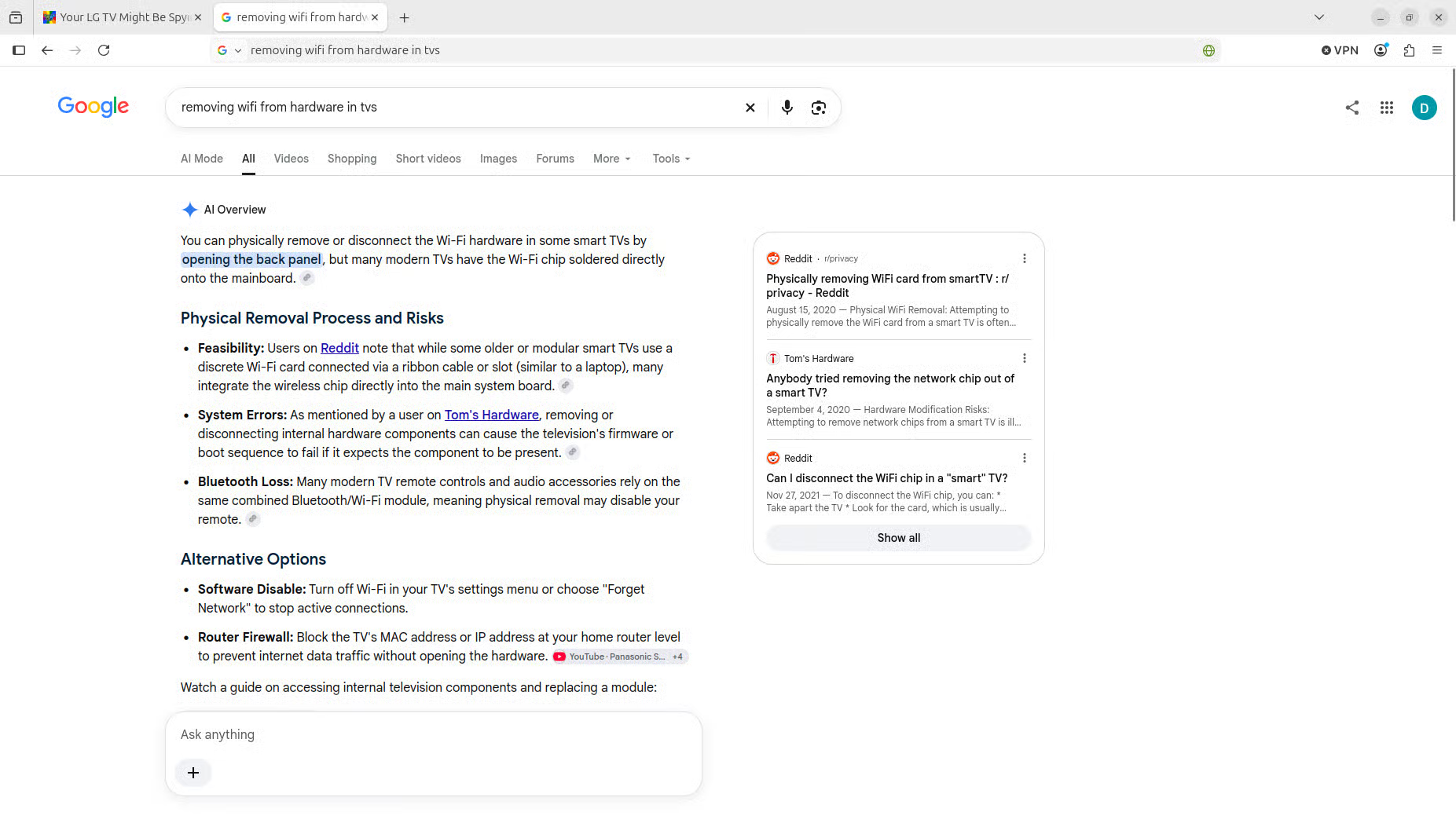
modern ones are soldered directly to the board and integrate bluetooth into the same chip and removing that chip form the board could remove the ability to use bluetooth functions and the remote, however!!! most have usb ports!!! lets make new operating systems and fucking delete their file system, load a new os that lacks the abilities these manufactures have.
The hardware is whatever but if we remove the file systems that its preloaded with it won’t be able to load any of its preinstalled shit. If we mod the operating system we can mod some of the shit the hardware is capable of doing through the software and coding. Kinda like how windows 11 is known for lowering ram speed.
Could connect the tv to the guest wifi network which would prevent it from accessing your local network.
Plug in an android tv box of some variety and connect that to the network and you can cut the tv off f4om internet entirely.
If you set the pihole as your primary DNS on your router then all network traffic goes that way anyway. Set up google as a secondary in case your pihole goes down. Or configure a second pi hole for resilience and set that as the backup.
Fuck that, become ungovernable. If the pihole is down, the tv is down.
Build your own router and
Redirect all port 53 to your pihole
Block port 853 on that vlan
Block these ips on that vlan github.com/dibdot/DoH-IP-blocklists