posted in Technology

€2.99 or €3.49? Proton VPN's Pricing Test Exposed

cross-posted from: lemmy.world/post/50434194

Proton VPN’s pricing page exposed an ab-test identifier linked to two VPN Plus prices: €2.99/month (70% off) and €3.49/month (65% off). Repeated testing produced B → A → B → A → B, with the variant matching the rendered price each time. €12 difference over 24 months.
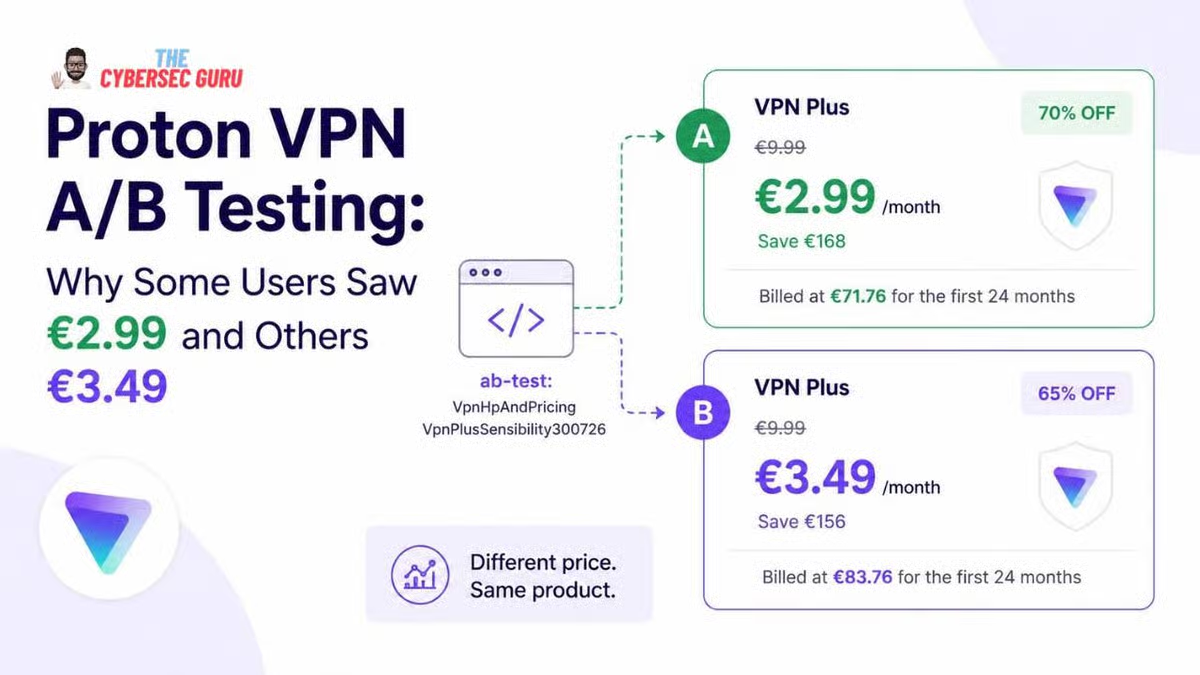
thecybersecguru.com/news/proton-vpn-ab-testing-price-difference/
Proton VPN AB testingThe CyberSec GuruProton VPN Is Showing Different Prices: Inside Its €2.99 vs €3.49 A/B Test | The CyberSec GuruAn investigation into Proton VPN's pricing page found an A/B-test tag linked to two VPN Plus prices: €2.99 and €3.49 per month


enPage

Replying to @⁨UnLocoPoco@lemmy.world⁩

Way back when, the observed ABAB sequence could be explained by one server using outdated data and another having the new data and visitors being round-robined to each in turn. I have investigated issues like this and this has happened. Not sure how many companies still use a setup like this, though. It’s been K8s clusters everywhere I’ve worked for many years now. This does indeed look like a proper AB test, the HTML already looks pretty clear.

Replying to @⁨mabeledo@lemmy.world⁩

oh they came back in February. they were inactive before that for a year, shortly after the republican drama

mastodon.social/@protonprivacy

MastodonProton (@protonprivacy@mastodon.social)1.44K Posts, 13 Following, 54.8K Followers · Official Proton account, creator of Proton Mail, Proton Drive, Proton Pass, Proton VPN, Proton Wallet, Proton Meet, and Lumo. Support queries are handled by our Customer Service Team: https://proton.me/support

Replying to @⁨abacabadabacaba@infosec.pub⁩

I agree except you can’t have something be “several times shorter”. Yes, I know what you mean, but “several times” can only be longer. It’s like saying “500% less”. You can’t do that. The best case scenario is that means “20% of the original” but arguably “500% less” would mean you take five times the original amount and subtract it from the original, leaving you with negative 4 times the amount, not twenty percent.

Anyway. This is just a light-hearted pedantic pseudo-rant, although I also do stand by the truth of what I’m saying. But I’m not intending corrections, just being silly about a pet peeve of mine. heh

hmm… that article might be better off being -4 times its original length, come to that. heh

Replying to @⁨sem@lemmy.blahaj.zone⁩

OK, either I don’t understand you or you don’t understand me, because that’s what I’m also saying?

Your example “twice as short” works.

The original comment wasn’t about your example.

The original comment was “several times shorter”.

As you used twice in place of several times, I also put twice in there to make the difference to yours more obvious.

Twice shorter isnt the same as twice as short. You talked in your first comment about something different than the other comments talked about. That is what I wanted to express.

Replying to @⁨Wrufieotnak@feddit.org⁩

I don’t think we understand each other.

To me, several times shorter makes perfect sense, and twice as short is a special case, where it is two times as short. Thus, several times shorter includes:

  • two times shorter == twice as short
  • 1.5 times shorter == 1.5 times as short
  • five times shorter == five times as short
  • several times shorter == several times as short (the “as short” construction sounds clunky to me here in this case)

As i write these out, i realize what you were trying to say: X times shorter is equivalent to X times as short for me, so equivalent that I didn’t realize when I was using one or the other.

You are saying that for some people, the “X times shorter” construction doesn’t sound natural. I can respect that, but it doesn’t seem like a part of mainstream English to me at least.

“Twice shorter” isn’t what anyone is talking about. That isn’t how you combine the words, at least to me.

Replying to @⁨sem@lemmy.blahaj.zone⁩

Language is generally workable if it communicates the intended message. In that sense, I acknowledge that it is generally understood what something means, but not always.

However, it is semantic gibberish, and fuck anyone who supports that gibberish.

But yes, it’s fine enough in the same way that when someone says “could of” we know they meant “could’ve” or “could have”. It doesn’t make it correct. And it is still grating.

Two asshats disagreed with my comment above enough to downvote. This is also grating because it means they actively support WRONG. And it is WRONG.

It’s fine, but it is irritating when people are willfully ignorant.

Replying to @⁨UnLocoPoco@lemmy.world⁩

Yet again Lemmy shows that much of the userbase is young and has little general knowledge. A/B testing is quite standard, and there is nothing shady about testing different prices to see what consumers will purchase more.

A couple of times I’ve been walking in a mall (dating this anecdote back a couple of decades or so. heh) and got asked to participate in product testing where I was shown - in the case I remember better - two cans of soda with different designs. Strawberry soda - one pink can, one red can - which one I was more likely to purchase.

A/B testing is quite common as companies figure out how to sell you more. Assuming it’s randomized, it’s completely ethical.

Replying to @⁨tabular@lemmy.world⁩

Randomised is not what makes it ethical. It’s what makes the AB test statistically valid such that you can test your hypothesis.

Ethical would be to run the test, gauge the click through rate to checkout to find a winner, then for all those you charged the higher price to give them a discount code such that everyone gets the product at the same price. What you’re testing is the click through rate of a price advertised further up the funnel.

Maybe later you can say ok the rates didn’t drop off people seem ok with the higher price. Higher price for all. Or not as the AB test would reveal.

Replying to @⁨UnLocoPoco@lemmy.world⁩

Can someone articulate what is wrong with this? It intrinsically feels wrong to me, but when I think about it I dont really have any good reasoning why this would be bad.

We expect a standard price and it feels bad when we find out someone else got it cheaper.

But the consumer should be operating the same, they review the deal and if its a price they are willing to pay they go through with it.

Replying to @⁨Fizz@lemmy.nz⁩

It’s because despite what economists believe, prices are not determined fairly by the market but are dictated supply-side. So this kind of “testing” is one of the more blatant ways in which consumer trust is violated in the name of maximizing profits. It makes it obvious that you’re not paying a fair price for a service or product, but a price that was dictated for someone else’s convenience without taking your interests into account at all, violating the social contract.

Replying to @⁨Peruvian_Skies@sh.itjust.works⁩

IF the testing was purely random assignment of price points to gauge the markets ability to support a higher price, I think that is capitalism operating normally.

Now, on the other side, if the pricing changes were based on using the customers own data and spending habits to determine what a specific customer could be squeezed for, it is unacceptable and should be boycotted.

Replying to @⁨UnLocoPoco@lemmy.world⁩

Is this article AI generated? It seems to wander and repeat itself instead of being well-structured like a standard three-part article (background, analysis, conclusion).

Whether the poor quality was a result of humans or machines, it still leaves me wondering “who cares, why does this matter?” A/B testing, including on pricing, is a standard practice. (But usually you keep it consistent per person instead of switching back and forth. If a refresh gets them a cheaper price, they’ll do it and spoil your data.)