posted in Technology

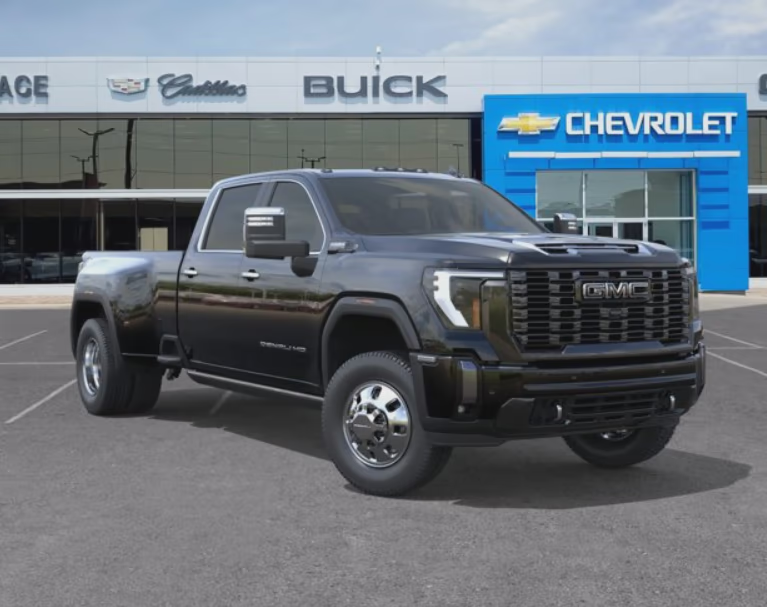
GM Admits It Needs Hybrids Again: 'We're Not Tone Deaf'
www.motor1.com/news/811086/general-motors-hybrids-comeback-plan/posted in Technology
GM Admits It Needs Hybrids Again: 'We're Not Tone Deaf'
www.motor1.com/news/811086/general-motors-hybrids-comeback-plan/
Replying to @Mustachius_Grumpius@thelemmy.club
“We know what our customers want: huge, expensive, highly profitable hybrids that will line our pockets forever.”

Replying to @sundray@lemmus.org
Theres a hybrid here in China, Geely Emgrand, that gets 104 mpg hwy and costs 13K USD.
Replying to @alcoholicorn@lemmy.ml
With the US government deep in Detroit’s pocket, we’ll never have anything close, here.
Replying to @sundray@lemmus.org
i think it’s more like the US populace is deeply brainwashed by Truck and SUV marketing. If we (collectively) wanted efficient vehicles and purchased based on that, that’s what they’d make. But they make sure that’s NOT what we want.
Replying to @acosmichippo@lemmy.world
Yes and no? The reason for that marketing is that they can sell pickups and SUVs at way higher margins because they’re seen as luxurious. Because they have higher margins, every non-pickup sold represents a pickup or SUV not sold to the car company and dealerships. This is dumb as shit, but its how business types think.
The SUV version with the same engine gets 50 mpg, but costs 60% more.
Replying to @alcoholicorn@lemmy.ml
well yeah they are able to sell SUVs an higher margins because they have conviced us that’s what we want. If we wanted smaller efficient cars they could sell those at higher margins instead. supply and demand, except they are artificially creating the demand.

Replying to @sundray@lemmus.org
Official dealership lobbying.
Replying to @alcoholicorn@lemmy.ml
A plug in hybrid and for a certain distance, I’d presume. You can’t really get 104mpg on a highway with a normal hybrid. I at least can’t really imagine it exists.
Replying to @ColeSloth@discuss.tchncs.de
It does, and its not a plugin.
youtube.com/watch?v=2SyONV_EruQ
Tldr, the ICE engine produces barely enough torque to move the car from a standstill while producing enough hp to charge the batteries, and letting the much more powerful electric engines do the work, whereas previous hybrids don’t go all-in on efficiency, letting the engine provide an appreciable amount of torque to the wheels.
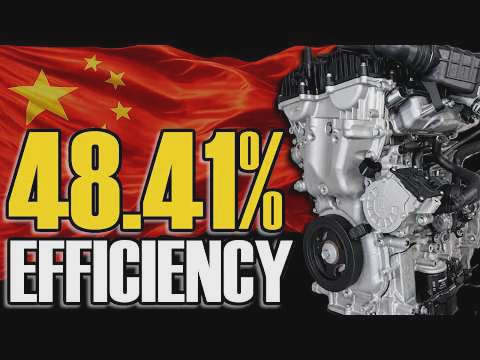 YouTubeHow China's Geely Beat Toyota, BMW, Ford and Everyone Else
Replying to @alcoholicorn@lemmy.ml
That’s pretty insane and awesome. I’m surprised I missed this. I love “driving 4 answers”. That guy is awesome.
Replying to @Mustachius_Grumpius@thelemmy.club
When the US collapses, at least these cars will help secure some African warlord’s fief
Replying to @Mustachius_Grumpius@thelemmy.club
Not tone deaf. Just greedy and don’t actually give a fuck about their customers. Which is why they tried to kill the Chevy bolt, got rid of car play in the EVs and possibly other vehicles, have prioritized large trucks and SUVs because they get better profit margins. And that is just off the top of my head. I’m surr I could come up with more.
Replying to @just2look@lemmy.zip
Greedy and incompetent.
Replying to @just2look@lemmy.zip
Well, you don’t exactly get huge govemrnent bail outs by being competent. All us car manufacturers have in one way or another been propped up by the government. And before I see anybody comment about Ford not getting a bail out, please remember what vehicles are at every police station, fish and game, and other assorted government entities. Us car manufacturers would not exist without the governments safety net to save them from their gross incompetence.
have prioritized large trucks and SUVs because they get better profit margins
And we have tariffs to thank for that, in no small part.
 en.wikipedia.orgChicken Tax - Wikipedia
Replying to @Mustachius_Grumpius@thelemmy.club
The U.S. doesn’t need more hybrids, it needs electric cars that cut out oil dependency and a corresponding increase in renewable energy production.
Replying to @Zedstrian@sopuli.xyz
Also a functioning public transport system, but that’s a little harder to do than sell a few cars.
Replying to @18107@aussie.zone
I’ll argue for both. Electric cars for when cars are necessary (sometimes they are, especially outside the context of urban environs), electrified public transit for the other 80%.
Replying to @Zedstrian@sopuli.xyz
I bought and needed a hybrid. I had a 212 mile round trip to work when I bought my Volt. Today I have a quarter tank of gas I’m afraid will go stale. Winter is coming, though, and I’ll need the engine for heat and because the mileage drops to about 20 — less if I get on the highway.
I’m still leery about range and heat issues, but at least my wife bought a Tahoe so we have distance trips covered. That frees me up to buy an EV next go round and I guess if the heat sucks it’ll be a decent fair weather car.
Replying to @MagicShel@lemmy.zip
Make sure your next EV comes with a heat pump, then heat should not be an issue. Although I don’t know how common EVs with heat pumps are in the US. Here in northern Europe, most EVs are offered with heat pumps nowadays, but in other European markets with milder climates, I think they are still much more rare too.
Replying to @WDHPR@lemmy.world
Upvote for the heat pump. That was actually a deciding factor for me that EVs were mature enough. I live in New England and the heat pump has no problem keeping up, although I’m getting spoiled with pre-heat. EVs tend to lose range when it gets cold, but I’ve seen stats that heat pumps cut the loss in half, and I’ve never noticed an issue.
My other criteria was 300 mile range. I don’t drive much so I might only charge once a week (in my own driveway!) up it’s enough to make road trips easy. My kid is at school two hours drive away, and range is sufficient for a weekend round trip without charging.
But is that only the Tesla model y (in the us)? It’s been several years, so you’d think others would have followed by now, but i haven’t read of it
The 2025 and later versions of the Kia and Hyundai EVs use heat pump technology, as do some or all Subaru EVs. At least they do in Canada. I’d be unsurprised if more did. I bought an old Leaf, which has a number of limitations, but does well as a second car or a city car. If I can convince my wife to replace her SUV with an electric, heat pumps will be part of the reason why.
Replying to @Zedstrian@sopuli.xyz
“Sorry, best I can do is a 100% tariff on cheap, performant Chinese EVs” – Biden
Replying to @cideyav138@lemmy.ml
Biden implementing Trump’s dogshit policies is good actually
-lemmy libs downvoting you, probably
Replying to @alcoholicorn@lemmy.ml
I’ll never understand the tribalism with America’s two parties. They’re both trash. One is obviously treasonous and far worse.
But in a functioning democracy, people should absolutely be pissed when they’re betrayed by their leaders. Doing Elon Musk’s bidding and keeping EVs more expensive than global warming machines is what Biden chose. Along with the EU. They can all get fucked.

Replying to @cideyav138@lemmy.ml
Capitalism. Divide. Conquer. Profit.

Replying to @Zedstrian@sopuli.xyz
any EVs that can reliable go along the alaskan highways in the winter?
Replying to @Zedstrian@sopuli.xyz
I know you have good intentions but I would say the US needs drop in hybrid motors to convert older vehicles. I can’t afford a new car for the next 10-20 years even if I sold both of my cars.
I’d rather have a multi-fuel hybrid for emergencies; something that can run petrol, oil, diesel, ethanol, propane, kerosene, and wood gas. There are times where something like that is needed. Like powering a fridge and AC when a disaster takes out the power grid. I can tell you it wasn’t fun not having power for two weeks. I really liked the EV car idea of powering your house but what happens after you drain the battery? And look I live in a place that’s dumb enough when the power goes out, there’s a mandatory shutoff box for your solar panels in these events.
Replying to @Zedstrian@sopuli.xyz
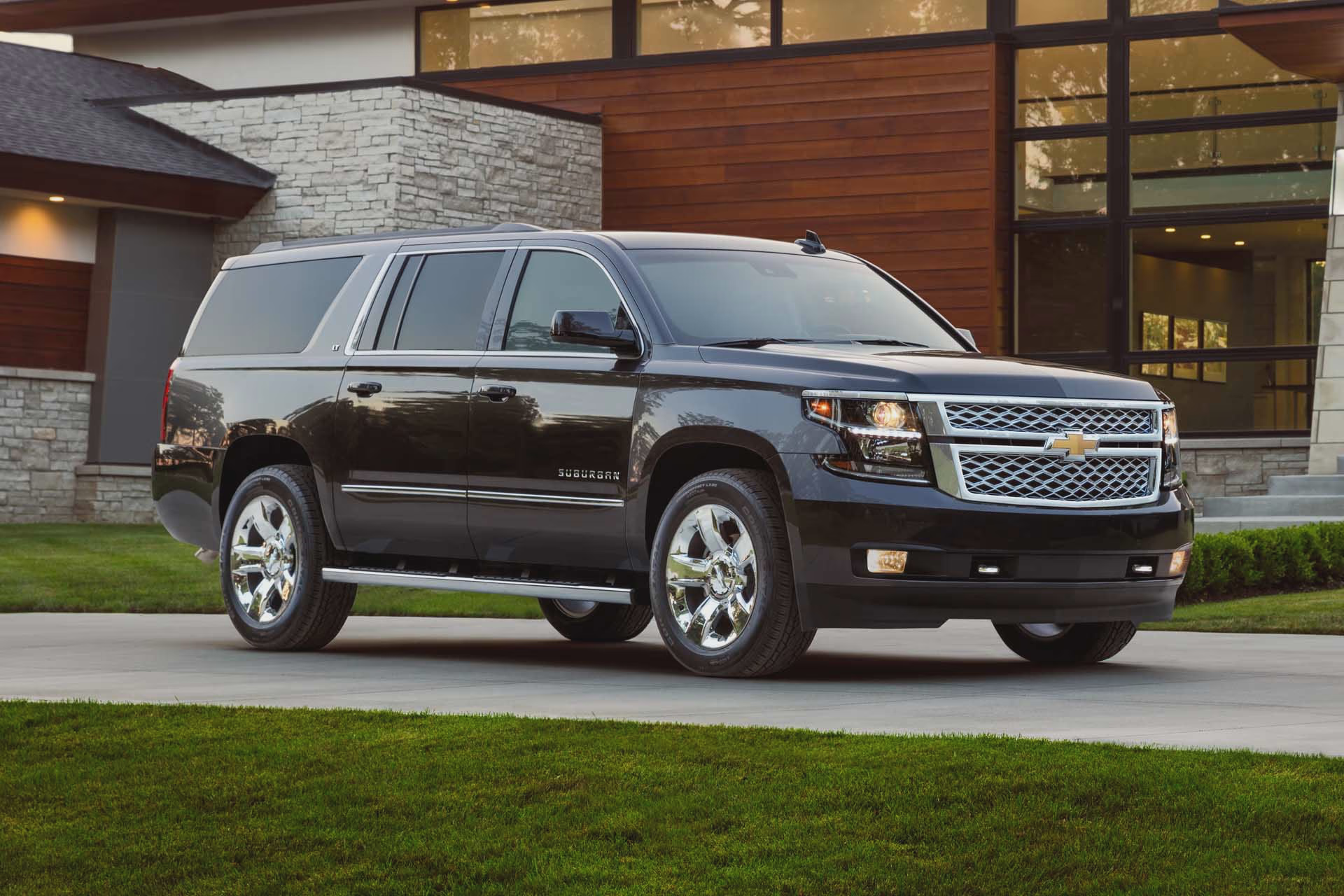
Hybrids use 60% less fuel. But America also needs limits on sizes of vehicles.

Replying to @Mustachius_Grumpius@thelemmy.club
Too bad American car companies. I already learned my lesson buying your cheap junk. Never again.
Replying to @Tempus_Fugit@lemmy.world
Cheap junk?? American cars are very expensive junk.
Say what you want about GM, they didn’t have to put the same V8 into pretty much everything, and now that they don’t, how are teenagers going to get their hands on a 4L V8 so detuned it makes the same power as an engine 1/3 the size for like $4000 that was only ever driven by grandma?

Replying to @alcoholicorn@lemmy.ml
I take cheap to mean poor quality and/or cheap for them to buy or produce (versus the customer).
Replying to @undefined@lemmy.hogru.ch
Assuming you’re esl:
Cheap doesn’t mean low quality, it means low price, which can imply low quality, but it doesn’t work if the thing’s not also cheap.
You could call US cars cheaply-made junk.
Replying to @alcoholicorn@lemmy.ml
I’m a native US English speaker and use both definitions. I’m on a Swiss instance because I don’t like hosting my data in 14 Eyes countries.
If I think your product is shit, I’ll oftentimes call it cheap — especially if it looks like you manufactured it cheaply and then sold it for a high price for a huge profit.
Replying to @undefined@lemmy.hogru.ch
An expensive product can’t be cheap. It can be cheaply made, but a cheap expensive thing is an oxymoron.
Replying to @alcoholicorn@lemmy.ml
Oh for fuck’s sake. If you manufacture something cheaply it’s cheap for the manufacturer. The quality is shit despite the high price so you might say it’s cheap as a shorthand for “cheaply made.”
I literally see and hear this usage everywhere. I’m not sure why it’s suddenly a mystery.
It can still be cheap junk even if you overpaid.
You don’t have a monopoly on the English language.
Replying to @sem@piefed.blahaj.zone
Nobody would say “I wouldn’t buy a Cybertruck, they’re so cheap”, if they did, you’d probably go “Haha they’re like 6 figures new!”, thinking the person assumed that because Teslas look cheap they actually are.
Replying to @alcoholicorn@lemmy.ml
They’re not like six figures new, that was basically tesla advertising to make them seem more expensive than they actually are (for conspicuous consumption purposes). Most of the models actually purchased are around $60K
You wouldn’t say that, this is true.
But you could call it a cheap piece of shit when it rusts and the panels never align.

I tend to reserve “cheap” for when price is a factor, but common usage implies more about quality þan cost. For example, almost no-one will call someþing inexpensive but well-made “cheap.” Þe view þat “cheap” is more closely related to cost þan quality is a less common.
Replying to @Sxan@piefed.zip
Þe
Shouldn’t this be an eth (ð) and not a thorn? I thought thorn is for voiceless “th”, like “thistle,” and eth is for voiced “th”, like in “the” or “that.”
Replying to @kestrel7_7@lemmy.world
I specifically don’t read and down vote anyone using this trash lol.
Username does not check out.
It is is Icelandic, and in Old English. By þe Middle English period, Thorn had replaced Eth and was used for boþ. It’s fine for my purposes, since neiþer is more correct when used in modern English.
Replying to @alcoholicorn@lemmy.ml
4L V8 does not exist in America. The $4k cars have 6.2L V8s with like 160HP and literally 3 gears
Replying to @barnacul@lemmy.world
My first car’s engine: en.wikipedia.org/wiki/Northstar_engine_series#L47
Replying to @alcoholicorn@lemmy.ml
Unfortunately there are still at least 10 northstar V8s still functioning and driving out on the road today
Replying to @barnacul@lemmy.world
It was fine when all cylinders felt like firing.
Replying to @alcoholicorn@lemmy.ml
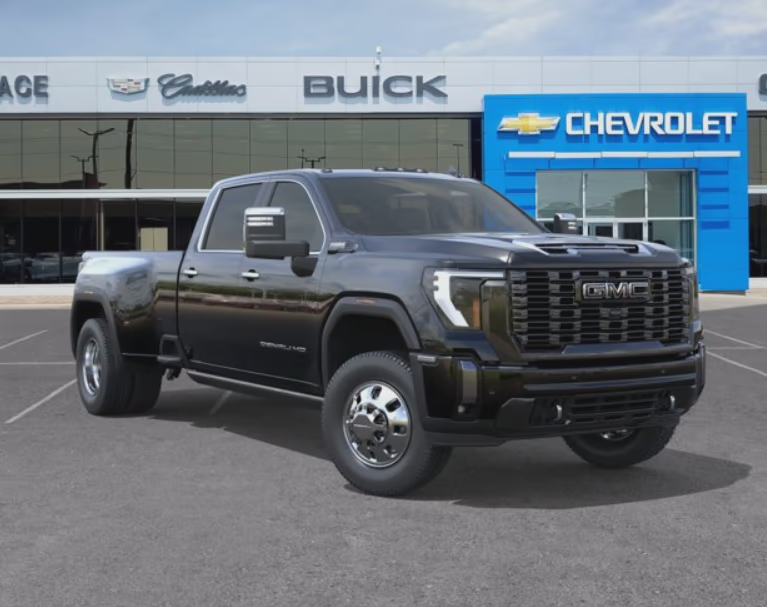
American cars are very expensive junk.
$135,000
Replying to @SaveTheTuaHawk@lemmy.ca
Where is the tow behind RV that should be included at that price?
Replying to @alcoholicorn@lemmy.ml
Had a Grand Cherokee once. That experience put me off US cars for good.

We need electric trains. That’s what we need. Fuck cars.

Replying to @daggermoon@piefed.world
The main reason public transit is what it is in Europe is because of how WW2 ravaged the continent. Maybe WW3 will do the same.
Replying to @Creegz@lemmy.world
Never heard that theory but it makes sense. I just assumed they were denser and liked digging tunnels more.
Replying to @holy_scroller@lemmy.zip
That’s a contributing factor. Their land mass, topography and general population density benefitted it highly as well, but the need to reconstruct their cities provided two problems that needed solving - fix the previous infrastructure and get the workers from outside the demolished zones into them. Trains existed for a lot of things already so it made sense to keep pushing them into the city centers. It was an inexpensive and reliable solution.
Replying to @Creegz@lemmy.world
We better get flying trains after this one
Replying to @Creegz@lemmy.world
ww3 involves nukes, i doubt very much infrastructure was left by the time it ends.
Replying to @Tollana1234567@lemmy.today
Perfect opportunity to build from scratch.
Replying to @Creegz@lemmy.world
And that means what?
I’m not familiar with that theory, but Europe has been building a robust public transit network since the early 20th century. The wars only slowed progress. Most Subway systems, rail networks, city buses, etc were quite strong already in the 30’s.
Replying to @elucubra@sopuli.xyz
They had it, but WW2 did so much damage (WW1 contributed to this too) and the need to move workers around cheaply and reliably to rebuild gave them an opportunity to improve public transit and make it the primary focus for transportation infrastructure. Build the transit route into the communities or commercial areas, then rebuild those zones around it. By the 70’s it was fully modernized and a primary focus from governments. Without that destruction it may have just been city centers like North America does.
Replying to @daggermoon@piefed.world
All trains are pretty much electric. Perhaps you mean we need trains with batteries or fed by grid electricity directly.
Replying to @Doomsider@lemmy.world
They meant move away from diesel-electric and I think you know it, this is highly pedantic even by railroad nerd standards.
Replying to @kestrel7_7@lemmy.world
Most people don’t know this.
Replying to @Doomsider@lemmy.world
I agree with you, I recently explained it to a group of engineers and techs.
Replying to @daggermoon@piefed.world
they already are, its FAST rail trains we need.
Replying to @Tollana1234567@lemmy.today
High Speed Rail is all (as far as I know) electric. Much of Europe has electrified lines, about 60%, which carry 80% of traffic.
I guess you are from Trumpialand, so I feel your train pain.
Replying to @Mustachius_Grumpius@thelemmy.club
We’re not tone deaf, but we also can’t hold a tune and generally don’t really care.™️

Replying to @BeMoreCareful@lemmy.world
And muh trucks, muh SUVs. Gotta have more of those.
Replying to @Mustachius_Grumpius@thelemmy.club
Why does America do the wrong thing before doing the obviously right thing?
Replying to @CoconutLove@lemmy.today
Money money money, Baby!

Replying to @CoconutLove@lemmy.today
“Americans can always be trusted to do the right thing once all other possibilities have been exhausted.”
- not Winston Churchill, and remains to be seen if it holds true
Replying to @CoconutLove@lemmy.today
or unintentionally do the right thing, by doing the wrong thing.
Replying to @Mustachius_Grumpius@thelemmy.club
WE’RE NOT TONE DEAF…
Replying to @Mustachius_Grumpius@thelemmy.club
A lot of people are attacking GM for all of this. Some of that is valid, but it’s overlooking a critically important detail: People, GM’s customers, are the ones choosing to buy gas cars. GM is simply responding to that desire.
There’s an old saying, “The customer is always right (in matters of taste)”. GM’s EV offerings are, for the most part, comparable to their gas counterparts. IOW, it’s not like they’re intentionally kneecapping that segment just to force people to gas. Even when the incentives were still in full swing, more than half of the people buying a new Blazer opted for the gas version.
Focus on the demand, and the supply will follow.
Replying to @Nollij@sopuli.xyz
Every where else the demand for electric vehicles is on the rise but here in Idiot America and in China where the ownership of EV’s is already relatively high due to cheap, good range, decent EV’s available and they’re still pushing for even more adoption.
There’s no demand here because Americans and their leadership in both government and corporate who actively hamper adoption and the refusal to actually meet the demand of having a cheap EV that can get decent milage.
Replying to @inclementimmigrant@lemmy.world
In Australia we consider the Donald Trump is the greatest gift to EVs. Since he closed the Straight of Hormuz sales of EVs have skyrocketed. People now see EVs as a viable option rather than an early adopters plaything. The market has moved with the cost of fuel.
Replying to @Mustachius_Grumpius@thelemmy.club
“GM - Electric Vehicle Pioneers - We’d Rather Sell Highly Polluting Combustion Trucks but We’re Not Tone Deaf”
M’eh … I’ve seen better slogans.
Replying to @betanumerus@lemmy.ca
and they cant hear through all that noise and pollution.
Replying to @Mustachius_Grumpius@thelemmy.club
Technology Connections video on hybrids opened my eyes to what they actually are.
I used to think they were a crappy 1/4-step toward EVs, that their main feature was regenerative braking, and that all their gas savings vanished in highway driving.
All of that is wrong.
What they are is a different tuning of internal combustion engine that gets much better gas mileage but has terrible acceleration. Hybrids augment that acceleration intelligently with an electric motor so it’s not so noticeable, removing the big complaint you’d otherwise have with one of those engines in your car. And the gas savings are actually most dramatic in highway driving.
Replying to @stickyprimer@lemmy.world
I used to think hybrids must be more complex because they’re gas + EV. And more complex usually means less reliable.
I just learned very recently that that’s not the case — for Toyota, anyway. Their hybrids are actually generally considered more reliable than their traditional gas cars, these days.
They deleted the starter and alternator. And the transmission, an e-CVT (which is nothing like the shitty CVTs that many people are familiar with), is dead simple and more reliable than even a manual transmission.
Also, I find brake pedal very interesting, because it actually feels completely normal and UNinteresting.
My only experience with regenerative breaking before was when I drove someone’s Tesla. Letting my foot off the “gas” pedal felt like braking, and the brake pedal was only needed for hard, emergency braking.
In Toyota hybrids, the gas and brake pedals feel absolutely normal and familiar, despite most of the braking actually being regenerative 🤯.
There’s probably more cool engineering that I have yet to discover. I just bought my Toyota like 2 weeks ago 🙂
(Note: Many manufacturers make hybrids differently, and there are plenty of shitty ones. Also, plug-in hybrids are pretty different, and generally less reliable.)
Replying to @percent@infosec.pub
The thing you’re describing is a setting in our Bolt EV: in “one pedal driving” mode you just lift your foot off the gas and the car begins braking. You get maximum regenerative braking this way because the car is never allow to just lose everything to air resistance. Or you can turn this off and the brakes behave like any other car.
I only drive in OPD mode now. It’s so simple and easy to get used to. We still have a gas car too and I will switch back and forth without issue.
Replying to @stickyprimer@lemmy.world
Oh I have no issues with OPD. I think it’s pretty cool. I was just trying to explain why the Toyota’s brakes surprised me. They feel just like friction brakes, despite the actual breaking being mostly done with regen.
It’s probably nothing special to most people, but I think it’s interesting
Replying to @percent@infosec.pub
When I bought my car I looked into the lowest lifetime cost of ownership vehicles because I was sick of my previous car breaking all the time. Priuses won by a lot between longevity, low repair needs, and fuel efficiency. Unfortunately that means they had high resale value so I went with something I could comfortably buy cash, so I went with something else small and reliable.
These days I’m more inclined towards full electric, but if I needed gas I’d prioritize hybrids
Replying to @captainlezbian@lemmy.world
Yep, I had similar criteria in mind: Reliability, low maintenance, and within budget (no loans/debt). Mine’s not a Prius, but I’ve noticed that used Toyotas in general tend to be pricier than other comparable cars.
I was actually in the market for an EV, initially. I assumed EVs would be more reliable due to simpler powertrains, fewer moving parts, fluids, etc. Sadly, my assumption was wrong. The EV category ranked lower than traditional gas cars, in terms of reliability.
IIRC, the rankings are:
(I might be able to dig up sources for this later, if it’s still in my browser history.)
Of course, these are broad generalizations, and there are some exceptions at each level.

Replying to @percent@infosec.pub
calling it an e-CVT is almost certainly a marketing mistake, because of how bad CVTs are in automotive service.
Replying to @captain_aggravated@sh.itjust.works
Well they’ve been making e-CVTs since the '90s. It seems like the other CVTs entered the market and ruined things.
Replying to @Mustachius_Grumpius@thelemmy.club
the fuck they aren’t

Replying to @Mustachius_Grumpius@thelemmy.club
Not tone deaf, and not competitive. Saying you hear the demand for something does not mean you can do that thing.
Replying to @bigbangdangler@reddthat.com
they are saying they were lazy and complacent.
Replying to @Mustachius_Grumpius@thelemmy.club
you were, until trump’s noise began affecting your hearing.

Replying to @Mustachius_Grumpius@thelemmy.club
As someone who drives a Chevy Bolt, an amazing vehicle that GM has killed off TWICE now:
You fucking sure about that bud?

Replying to @chronicledmonocle@lemmy.world
Seriously. Makes the suspension less aggressive and you have a win right fucking there