posted in Technology

[Opinion] Apple CEO Tim Cook's Legacy Is Dull Products And Spineless Capitulation
cross-posted from: lemmus.org/post/25140646
karlbode.com/apple-ceo-tim-cooks-legacy-is-dull-products-and-spineless-capitulation/posted in Technology
[Opinion] Apple CEO Tim Cook's Legacy Is Dull Products And Spineless Capitulation
cross-posted from: lemmus.org/post/25140646
karlbode.com/apple-ceo-tim-cooks-legacy-is-dull-products-and-spineless-capitulation/Replying to @GolfFoxtrotLima@sh.itjust.works
Tim apple is such a fruit.

Replying to @GolfFoxtrotLima@sh.itjust.works
Timothy Donald Cook (born November 1, 1960) is an American business executive who served as the chief executive officer (CEO) of Apple Inc. from 2011 to 2026, and has been the company’s executive chairman since September 2026.
www.macrumors.com/2025/…/tim-cook-gift-to-trump/ en.wikipedia.org/wiki/Tim_Cook

Replying to @pelespirit@sh.itjust.works
s/gift/bribe/
Replying to @GolfFoxtrotLima@sh.itjust.works
Such a bottom.

Replying to @GolfFoxtrotLima@sh.itjust.works
Anche most likely the device you are using right now as well
Replying to @GolfFoxtrotLima@sh.itjust.works
Tim was great for the shareholders and not so much the customer.
I feel like most services got worse, hardware got worse before the M series, but post M I haven’t seen much innovation — just a lot of recycled parts for peripherals like Studio Display, which is premium price but sub premium quality (camera, panel itself, and ports/support).
Phones have massively homogenized under Cook
And software has taken a massive nose dive. As much as I try to like swift, it sucks. And it was a mistake to lose Chris Lattner, because without him Swift has had basically no focus or direction other than boosting SwiftUI.
Nobody has ever managed building production software with Swift outside of app dev, which I think says it finds a poor compromise on real performance vs ergonomics vs safety. I do not think Rust is better, I think Swift makes it too hard to do the right low level things.
AI/Siri has been embarrassing. Shipping cadence is worst in the business, there’s no reason so many updates are tied to OS updates, it’s simultaneously too rapid for trans to build robust software, and too slow to fix bugs and make QOL adjustments.
So when I look back on the last several years of Apple I kinda just see a bunch of departments duct taped together and drifting away from each other, and then the finance team driving all the decisions.
Replying to @panda_abyss@lemmy.ca
Having tried both Swift and Rust - you can hardly compare them. For me Rust is in a different league. Swift is a modernization and a step forward compared to ObjC, but Rust is a different paradigm altogether. Swift has IMO done a great job for Apple as a platform, but has not achieved universality and had not transcended the platform. Rust has achieved universality, but has not captured any platform in particular yet. Both have not and may never replace C/C++, though my biased opinion is rust may have a chance (at least with C++)
Replying to @fluxx@mander.xyz
I pick on Rust because of the “write everything in Rust” crowd and just personally I don’t like how the language feels.
I don’t think rust has found fit in the GUI sphere, though it’s getting some adoption from tools like zed, and hopefully some native gui tools get better with it. Swift has some fit there, but it’s not a fair comparison because it’s forced. Swift has nice ergonomics though with callbacks and lib dispatch plus combine that work well for GUIs.
Swift also suffered from poor versioning tools, and platform code differences which have hurt it even if they’ve been patched over.
Replying to @panda_abyss@lemmy.ca
I agree on everything you’ve said. Rust hype is a bit annoying and can be off putting. AI bros seem to have amplified the effect and I strongly dislike it. GUI is probably the worst area of Rust, but given the universality of Rust, I think it’s expected. I found egui easy to use, though, but far from swift ui, still.
Replying to @panda_abyss@lemmy.ca
Honest question: how can you make your mark on a product that is already perfect? At some point, software goes from meeting the needs of its customers to meeting the needs of the egos in charge.
Replying to @schipelblorp@sh.itjust.works
You have low standards if you think Apple products are perfect.
Replying to @takeda@lemmy.dbzer0.com
I’m speaking theoretically about the software cycle. At some point, the product does what it’s supposed to do as best as it can. Then what happens? People in charge feel they need to make their mark, so things just kind of drift around for no solid design reason worth customers getting used to.
Thanks for explaining the downvotes, though.
Replying to @schipelblorp@sh.itjust.works
That’s a different thing though. It is driven by marketing people, they want each iteration look different to give people impression that they aren’t purchasing the same product every year.
Apple does that too for example each release of their phones has a bit different look.
Replying to @schipelblorp@sh.itjust.works
There’s always a bundle of people in threads like this that are eager to downvote even vaguely pro-Apple sentiment
Replying to @panda_abyss@lemmy.ca
simultaneously too rapid for trans to build robust software
Multiple assumptions here.
Replying to @JustRalph@lemmy.world
That is a typo
Replying to @panda_abyss@lemmy.ca
I think you underestimate the power of the socks.
Replying to @GolfFoxtrotLima@sh.itjust.works
As an aside:
There will be some quick tells as to whether incoming new Apple CEO John Ternus is more of the same, including seeing whether or not Apple follows Google’s lead and buckles to our mad king’s obsession with trying to rename large bodies of water to feed his gargantuan ego.
John Apple is a spineless fuckwit and immediately capitulated

Replying to @gravitas_deficiency@sh.itjust.works
I heard they are hiding behind explanation that their maps update data automatically from USGIS databases, though that is lame explanation as they can easily override it, like MapQuest did.
When he was changing name of Gulf of Mexico they didn’t have problem to make it show only four US audience.
Replying to @takeda@lemmy.dbzer0.com
like MapQuest did.
MapQuest didn’t really do anything, it uses OpenStreetMaps which is a community effort and doesn’t have localized place names the way Google and Apple maps do. E.g country names for me in google maps aren’t their local names, nor the GNIS names you’d see in the US, they’re names in my own language. In Google on particular, there’s literally no “United States” on the map, only “Ameerika Ühendriigid” for me, Apple has fewer localizations but still shows many things in Estonian to me. There’s a large degree of automation there for them to do this in I’m assuming 100+ languages for anything they can (i.e country names and large bodies of water as well as many cities are in Estonian for me, but most other places are just global defaults). Once you start adding manual overrides, shit like this gets way too difficult to manage for little reason.
When he was changing name of Gulf of Mexico they didn’t have problem to make it show only four US audience.
So same as Lake Ontario. Because when you’re in the US, it pulls names from GNIS as far as I know, and in other places it has other sources or just static datasets of their own. I still see Ontario, the global default, in both Google and Apple maps.

Replying to @boonhet@sopuli.xyz
you’re mostly right, but OSM does have local overrides. official_name:en-US="Lake America
Replying to @Aatube@lemmy.dbzer0.com
Ha, didn’t know that. Interesting then that it shows me neither Lake America, nor any of the Estonian localized names anywhere. Perhaps it’s an opt-in somewhere on the OSM website.
Replying to @GolfFoxtrotLima@sh.itjust.works
MacOS was so much better when Steve Jobs was in charge.
Tim Cook REALLY made it worse. Steve Jobs made sure the user experience was generally good, although admittedly there were many times when he was pigheaded. On a personal level, Steve Jobs was a terrible person, but he made the operating system very good and very consistent.
And Tim Cook didn’t care about any of that, and macOS is now SUPER inconsistent and much less user friendly. It’s still better than Windows, but MAN is it so so so much worse.
Replying to @obvs@lemmy.world
admittedly there were many times when he was pigheaded
Arguably, he’d still be alive today if he wasn’t so pigheaded.
Replying to @Almacca@aussie.zone
Behind the Bastards had a good one on Jobs, where they went into a little bit how he believed in this mucus theory, it was pure madness. And it’s why he died.
Replying to @obvs@lemmy.world
It’s still better than Windows
The problem there is that Windows has been lowering the bar for a decade now.
Replying to @obvs@lemmy.world
Engineers made the OS good. Steve didn’t do shit.
Replying to @JiveTurkey@lemmy.world
Well that’s not correct.
Engineers are great at developing a product.
But having someone at the end who’s using the product and insisting on consistency because he’s anal-retentive and a pain in the ass will mean the product is consistent with the evaluator’s goals.
macOS used to have a lot of underlying features that worked consistently no matter which app you were using, and Apple destroyed that.
Either Jobs was having an effect, or it’s a damned strange coincidence that the severe reduction in consistency in macOS started just at the point that he died.
Replying to @JiveTurkey@lemmy.world
Yeah, Apple were doing so great with their engineers until 1997, and then Jobs came back and ruined things.
Replying to @obvs@lemmy.world
At least he gave us some basic window management features. It’s still miles behind what Windows and Linux has unfortunately.
Replying to @obvs@lemmy.world
I like the word inconsistent. It’s been over a decade since I stopped using macs — so I don’t remember exactly what it was that bothered me — but one of the biggest reasons why I stopped using macs was the inconsistency. Within the OS, between apps, between iOS and macos, etc…

Agreed. The new CEO isn’t off to a great start, either. Bending the knee in your first few days is not a good look.
Replying to @GolfFoxtrotLima@sh.itjust.works
RIP Tim Apple. You embarrassed a once innovative brand but at least you made a lot of money.
Replying to @Imgonnatrythis@sh.itjust.works
Cook diversified Apple’s product lineup, overseeing the introduction of many new products such as the AirPods, Apple Watch, Apple Vision Pro, AirTag, Apple silicon in its Mac lineup and expanding its services business.
Replying to @GolfFoxtrotLima@sh.itjust.works
I read that as “spineless copulation” and was both confused and a little intrigued as to how that could be
Replying to @NedRyerson@lemmy.ml
Plenty of nonchordate animals reproduce sexually. Tapeworms, for example.

Replying to @GolfFoxtrotLima@sh.itjust.works
To be fair, once we reduced electronics to black slabs and tiny earbuds there’s not much more we can revolutionize
Replying to @Semi_Hemi_Demigod@lemmy.world
We could have not done that, or we could have at least made the software better.
I remember thinking things like rollable screens and shit would be fun, but even that shit no one wants to risk anymore

Replying to @Mynameisallen@lemmy.zip
We could have not done that, or we could have at least made the software better.
Blame jobs, not cook.
Also, fuck jobs, the liver stealing psycho
Replying to @Skullgrid@lemmy.world
Blame jobs, not cook.
Why not both?
Replying to @willington@lemmy.dbzer0.com
fuck em both, but Cook wasn’t the one that started the enshittification trend with the ipod
Replying to @Skullgrid@lemmy.world
Yea, fuck them both.
Replying to @Semi_Hemi_Demigod@lemmy.world
That’s why I’m confused by this article. It just seems like attacking Apple for the sake of attacking Apple. I say this as someone who used to be a Apple hater because Apple products were far more expensive than their competitors (now everything is just expensive) and I couldn’t afford them back then.
People expect constant revolutionization, but 1) that’s not feasible and 2) what are they looking for exactly? What do they want to see done?
People say how bad the software has gotten on Mac, but I don’t see it. Sure, they have bugs around the time the next big OS update rolls out (much like any other OS including both Windows and Linux), but 1) you don’t have to upgrade to the latest version as soon as it updates and 2) they fix the bugs soon after that.
The only good point the article seemed to have is the Apple Vision Pro VR part, I will agree with them on that. Other than that, it seems just like an attack article, and done by anger, and like fair enough, but that doesn’t mean they don’t have good products.
I dunno, this is probably an unpopular opinion anyway, and I never expected I would be an Apple defender in this sense, and I don’t even have an iPhone because I prefer Android’s development ecosystem, and on my PC I have been daily driving Linux for the past 9 years anyway.

Replying to @GolfFoxtrotLima@sh.itjust.works
The main thing I remember about Tim Cook was him making me realize how wealthy white cisgender gay men were hardly different from wealthy white cisgender straight men.
The whole article has always been really worth a read, seeing how a techbro tried to turn a classic magazine into a tech company somehow. Besides that though, these passages always stuck out to me, because it feels deeply like these wealthy men exploit their sexuality to justify avoiding critique of their actions outside of their sexuality.
www.newyorker.com/…/inside-collapse-new-republic
In 2014, Hughes’s personal life and business life became increasingly intertwined, in ways that would coincide with changes at the magazine. His husband, Sean Eldridge, was running for Congress in a district that spanned the Catskills and the Hudson Valley, but his political campaign was not going the way he had hoped. Eldridge and Hughes had bought a two-million-dollar home in a district in which neither of them had ever lived, and Eldridge began investing in local businesses in what was widely seen as a transparent effort to influence the race.
Ioffe dates the abrupt change in mood to late summer, shortly after Foer’s birthday party—the period when, as many current and former T.N.R. employees noted, Eldridge’s expensive campaign to win a congressional seat started looking hopeless. “We all liked him; he seemed to like us,” she told me. “Everything was going great. Then, in the summer, something snapped, and he started talking to me about money and how we’re losing money and he’s tired of it. And then he became just downright contemptuous and hostile toward us.”
Hughes’s eroding relationship with the staff took on an ideological edge. On the morning that Tim Cook, the C.E.O. of Apple, announced that he was gay, MacGillis wrote a note to “the Plank,” T.N.R.’s internal e-mail listserv for writers and editors. “I see the celebration of his announcement, while entirely justifiable, as another sign of what’s happened to liberalism today, where rights/identity liberalism trumps economic liberalism,” he wrote. “This is, after all, a guy who embodies so much of what’s amiss in the age of inequality—pulling down $378 million in 2011 alone; Apple skirting taxes more brazenly than anyone else—yet those revelations have caused barely a stir.”
Hughes responded to the note six minutes later: “I think those are valid issues, although Apple has acted squarely within the law,” he wrote. “The law itself is fucked up. But I don’t think you can underestimate the difficulty of his decision or how tone deaf that argument would be today.”
The other editorial employees on the list were surprised by the response. It was an internal listserv for writers and editors, and the staffers didn’t realize that Hughes, who had relinquished his title as editor-in-chief when he installed Vidra, was on it. MacGillis responded by saying that he would hold off on writing, but added, “Just for the record, though, it is not so clear that Apple acted squarely within the law. The law’s a mess, but Apple pushed the bounds of it more than anyone.” He pasted text from a piece in the Times that questioned some of Apple’s practices.
Billionaires aren’t people in the same sense that we are, Cook has turned his back on the queer community, so he can say whatever he wants about himself, but he’s not gay in the same sense that the rest of us are.

Replying to @turtlesareneat@piefed.ca
Yeah. Billionaires are not people. Good point.
Replying to @potato_lemon@feddit.nl
Their biology is the same. What’s missing is common cause.
Replying to @SnotFlickerman@lemmy.blahaj.zone
because it feels deeply like these wealthy men exploit their sexuality to justify avoiding critique of their actions outside of their sexuality.
Not Gay, so don’t know about that angle, but they are ALL some high level of Pscho - just to have ended up where they are. There is simply no way you can be the head of a big Corp and not have trampled on workers, co-workers, customers as well as more fair-minded smaller corps and anything in between. ‘Competition’ is a white-washing word for ‘eternal economic war’ that at that level always spills over to law-fare, info-wars, political corruption/manipulation, psy-ops and any dirty trick in the book - all in the name of ‘Competition’ and being “successful”.
These sick people would sell someone else’s mom as slaves if they could get ahead on that move, but will always appear lovely, friendly etc, simply because that is the image they want people to see, and that is the image they are paying big money to other corps to create.
It is pretty cringe to see people worshipping these disgusting sub-humans in charge of big corp…

Replying to @SnotFlickerman@lemmy.blahaj.zone
I actually saw a similarity in him with powerful black corporate women. The world wants them to fail. If they do, it’s because it’s taboo for them to succeed so they deserve it. Tim masked heavily and succeeded in doing exactly what he needed to do, generate momentum for the next guy.
Replying to @SnotFlickerman@lemmy.blahaj.zone
The main thing I remember about Tim Cook was him making me realize how wealthy white cisgender gay men were hardly different from wealthy white cisgender straight men.
Same with Bessent, or maybe even worse.
They want us to flight because of color, gender, sexual orientation etc. so we don’t notice that the real war is a class war.
It’s sad that so many people still don’t see this.

Replying to @takeda@lemmy.dbzer0.com
Ain’t no war except class war.

Replying to @GolfFoxtrotLima@sh.itjust.works
What about Apple Silicon?
Replying to @aarRJaay@lemmy.world
Its not a shiny in your face thing so people dont care, but its something amazing that happened under him.
They also got their first modem, the C series, as well which is quite an achievement. Already got 2 iterations and a 3rd coming out in 2027.
Replying to @GolfFoxtrotLima@sh.itjust.works
I’ve liked Apple since the early 80’s, Apple was great under both Steve and Tim and I’m sure Ill continue to like it under John.
Replying to @GolfFoxtrotLima@sh.itjust.works
15 years later and the Photos app on iOS is still the same nearly useless pile of shit.
Replying to @AgentSeven@lemmy.zip
That is absolutely untrue. Apple has spent tons of time and money in ruining that app and it is a pinnacle of useless trash today thanks to those efforts. Respect.

Replying to @AgentSeven@lemmy.zip
Your just not using it the Approved Apple Way™ that’s all.
/s
Replying to @AgentSeven@lemmy.zip
It exists to sell iCloud subscriptions, and by that measure (the only one that matters in this world) it’s a huge success.
Replying to @GolfFoxtrotLima@sh.itjust.works
His tenure is that of a businessman, not an innovator or visionary. Good or bad, Jobs was all three.
Replying to @minorkeys@sh.itjust.works
Vissonary maybe but innovator?
IPhones & MacBooks were well built & marketed but neither was really innovative.
Replying to @RIotingPacifist@lemmy.world
Yes and no, the first iPhone was innovative, but after that, it just became refinement.
Replying to @Smokeless7048@lemmy.world
It wasn’t innovative. They took existing products, and polished and marketed them. Apple has always been a lifestyle brand.
Replying to @Smokeless7048@lemmy.world
What was the innovation in the iPhone?
It was worse in almost every way except marketing than the n900.
The technology had reached the point where you could have smartphones by then, I don’t see what was innovative about iPhones.
Replying to @RIotingPacifist@lemmy.world
iPhones literally were visionary. The whole industry was trying to imitate blackberry and overnight apple made them completely irrelevant. Android changed to what it is from what was originally a blackberry interface.
MacBooks, yea, it’s a laptop. They had some really good ideas in there, sure. MagSafe and touchpads that didnt royally suck ass were welcome features. The M-series lighting a fire under intels ass was exactly what the entire industry needed. Love them or hate them, even when Apple is bad, they create good trouble in an industry that needed to be proven wrong from time to time.
Replying to @muusemuuse@sh.itjust.works
What was the innovation in the iPhone?
It was worse in almost every way except marketing than the n900.
The technology had reached the point where you could have smartphones by then, I don’t see what was innovative about iPhones.
You can call it visionary, sure because he spread his vision for a locked down phone, but where is the innovation in the iPhone?
Replying to @RIotingPacifist@lemmy.world
the n900 was released two years after the iphone. it was modeled on the iphone from the start, like the entire industry was. (and the n900 still didn’t support multi-touch, which Apple patented.)
Replying to @Aatube@lemmy.dbzer0.com
The n900 was an interation in the n800, but sure how that can be modeled on the iPhone without time travel.
Is the iPhones invocation patenting things?
Replying to @RIotingPacifist@lemmy.world
the n900’s changes to the n800 were modeled on the iPhone. the n800 is completely different: for one, the touch screen is activated by pressure, not touch. Are you arguing that the n800 is better than the iPhone 1?
Replying to @Aatube@lemmy.dbzer0.com
No I’m pointing out that the n900 with it’s full keyboard was not modeled of the iPhone.
Replying to @RIotingPacifist@lemmy.world
every new phone back then was actually new. the ideas for n900 (and all its radical changes, radical as in for the n800 not for the industry) were clearly about the iphone. i’ll agree that the n800 was not.
Replying to @RIotingPacifist@lemmy.world
And the apple mac, the iMac, iPod, and the iPad, and cofounding apple. Even the concept of iLife and the market targetting strategy. Yes, innovator.

Replying to @minorkeys@sh.itjust.works
The Apple Macintosh wasn’t innovative. Here’s how you “innovate” an Apple Mac: Take an existing product of your company, the Apple IIGS. Make that worse by reducing the processor clock speed so your new product will be superior in some way, because your new product is going to lack backwards compatibility, internal expansion card slots, color graphics or multi-channel audio.
The iMac wasn’t innovative. It was an evolution of their existing product line in trendy packaging.
The iPod wasn’t innovative. Even the UI was taken from Creative. Rio beat them to the market by several years.
The iPad wasn’t innovative. I was handed a Dell tablet PC a full decade before the iPad hit the market.
Apple was innovative twice in its very long history: The Apple II was the first microcomputer that combined color graphics with internal expandability, and the iPhone had a capacitive touch screen. The most innovative thing Steve Jobs ever said in his life was “You can just use your finger.”
Replying to @captain_aggravated@sh.itjust.works
The Apple II was the first microcomputer that combined color graphics with internal expandability
The first computer I ever used (not counting punch cards or the VIC-20) was an Apple IIe, and I can confidently say that color was green. Later versions of the Apple II had full color, but that wasn’t “innovation” by Steve Jobs, it was just the technology for it becoming affordable.
Replying to @ChickenLadyLovesLife@lemmy.world
That was a limitation of the monitor you were using, not the computer. All models of Apple II to include the Plus, e and c had color graphics. But it was common practice to pair them with monochrome monitors, first because they’re cheaper than color monitors, but also…the way the Apple II achieved a 16 color palette was through NTSC artifacting. It only ever tried to send something like six colors over the cable, but when you put two dissimilar colors next to each other, they get smeared together somewhere in the analog domain and they come out some other color. It allowed them to achieve 16 colors, but it had a drawback: Text that was supposed to appear black and white would have green and purple fringes, which made it blurry and hard to read. So if you were using the machine for business or something you might choose a monochrome monitor to get sharper, easier to read text. Apple’s first party monochrome monitors were indeed green.
Replying to @captain_aggravated@sh.itjust.works
Huh, interesting to know. Ninth grade me didn’t give a shit about things like that.
Replying to @ChickenLadyLovesLife@lemmy.world
I’ve kinda known that most of my life because my elementary school had a lab of IIes, most of which had color monitors, a couple of them had monochrome monitors. So there were a couple of them that were inexplicably “just green.” Most of the rest of that I learned from The 8-Bit Guy on Youtube.
That Wozniak guy’s a good electrical engineer. Clever dude.
Replying to @captain_aggravated@sh.itjust.works
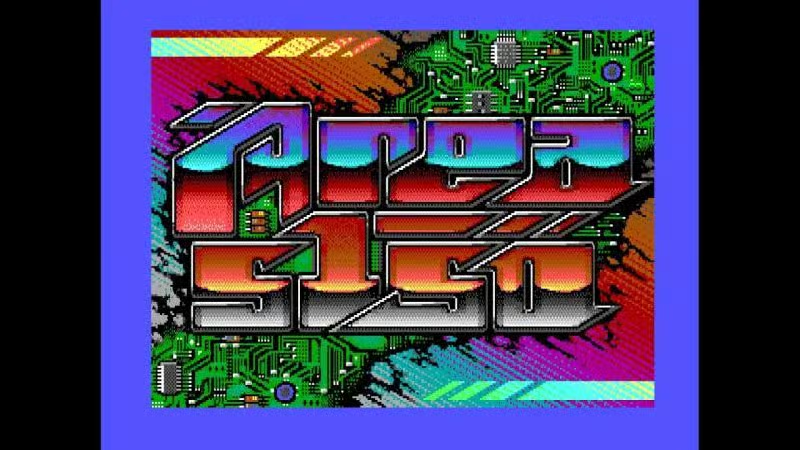
Demoscene groups CRTC & Hornet recently got 1000 colors out of the original IBM CGA card using this technique.
Replying to @f4f4f4f4f4f4f4f4@sopuli.xyz
The CGA card used that technique anyway. The IBM CGA card had a 9-pin RGBI digital output and an RCA analog NTSC output. There was a 16 color text mode, rarely used. Color graphics were usually done via the 4 color mode, which chose between four awful pallettes: light and dark variants of white black magenta and cyan, or yellow black red-orange and yellow. So they appeared kinda terrible on an RGBI monitor, but by dithering the colors together and using the analog output, you’d get other colors.
Replying to @captain_aggravated@sh.itjust.works
That’s right. They got more colors on-screen for slightly better graphics than I remember on IBM 5150.

Replying to @f4f4f4f4f4f4f4f4@sopuli.xyz
Those are impressive, and unique. They have an aesthetic to them that reminds me of the Amiga? out of an IBM CGA card? Trust the demo scene to pull that off.
Replying to @captain_aggravated@sh.itjust.works
capacitive touch screen
The first phone with a capacitive touch screen was the en.wikipedia.org/wiki/LG_Prada the iPhone was built with the technology that was around at the time.
People credit the iPhone with creating smartphones but much like Tesla’s the tech was ready and they launched at the right time. I guess Apple patented multitouch slowing down adoption of multitouch on laptops by decades, but I’d credit Apple with that not Jobs.
Replying to @captain_aggravated@sh.itjust.works
The [Creative] Zen patent (6,928,433) covers the aspect of the user interface where a user can select at least one track in an MP3 player using at least three screens to browse for that track in a hierarchical method. As the Creative press release states: “One example would be the sequence of screens that could display artists, then albums, and then tracks. When the user selects an artist, the player displays a list of albums for that artist. Selection of one of the listed albums then displays a list of tracks on the album.”
I don’t think Apple stole UI from Creative.
Replying to @Aatube@lemmy.dbzer0.com
No, I’m pretty sure they licensed it, and so did Dell. Go look at Dell’s MP3 players, damn near identical interface.
Replying to @captain_aggravated@sh.itjust.works
Being able to browse songs by album/artist (the sole focus of the Creative patent dispute) doesn’t seem to be a major factor for the iPod (or its success, disregarding marketing). The innovations were elsewhere.
Replying to @Aatube@lemmy.dbzer0.com
Elsewhere as in the companies and idividuals not employed by Apple that actually invented the things Apple sold? Correct.
Replying to @captain_aggravated@sh.itjust.works
No.
Replying to @minorkeys@sh.itjust.works
A computer, an MP3 player, a tablet, starting a business.
How are any of those innovations?
I’d say killing yourself by ignoring medical advice for an easily treatable desies or pretending your daughter isn’t yours were innovations, but royals have been doing that for centuries.
Like what did he do that was innovative?
Replying to @RIotingPacifist@lemmy.world
Apple found that existing digital music players were either “big and clunky” or “small and useless” with user interfaces that were “unbelievably awful”.[10]
The iPod wheel is pretty iconic.
Replying to @RIotingPacifist@lemmy.world
There were way more than 2 things that Apple produced under Jobs…
Replying to @chewypoops@lemmy.world
Ok and none of them were innovative.
Replying to @RIotingPacifist@lemmy.world
We can accurately point out that the technologies of the iphone (processors, cellular telephony, cellular data, GPS, touchscreens, bluetooth, cameras, etc) were not invented by Steve Jobs.
But his company took those parts and put something together that a few billion people decided was far more valuable than the sum of those parts. And they all decided to start carrying all these tools and using them fifteen times per hour, when they didn’t before.
It’s really hard to argue that’s not innovative.
Replying to @VinegarChunks@lemmus.org
How do you define innovation?
I don’t consider being in the right place when the tech fell into place, innovating (see also Tesla, MS-Dos, etc).
I think he was a visionary in that he had a vision and made it reality, but what was the innovation?
Replying to @RIotingPacifist@lemmy.world
Innovative marketing of a product users couldn’t break (easily).
Replying to @minorkeys@sh.itjust.works
jobs was not an innovator, hes good at marketing, he as ruthless as a business as any other.
Apple is a garbage company. Better than google is not an acceptable measure, and they are only performitiely better than google anyway, they pretend to not kowtow a bit before they do. Google just deepthroats authority because they are the worst.
The only solution is here is to go open source. Tech is an existential risk to society, and already it’s late to stop them. We can stop them though, together.
Replying to @bedwyr@piefed.ca
Better than google is not an acceptable measure
I remember when that would be a pretty high bar. It’s a bit of a distant memory at this point though. It’s crazy how bad tech has become.
Replying to @bedwyr@piefed.ca
I don’t even think they can be called performatively better than google. Has google personally gifted Trump tacky golden shit? Feels like apple has kissed the ring a lot more.
Replying to @bedwyr@piefed.ca
Honestly if there are good alternatives to apple, I would switch to alternatives, I am seriously considering buying a fair phone
Google pixel phones above I forget 3 or 5 can carry graphene os, you can get a used one on swapp or elsewhere for about 300 dollars. Idk about ubuntu.
Who the hell designed that rainbow?!

Replying to @nelly_man@lemmy.world
“I dunno about no Rob Janoff, but I know all about how to Rob Juanoff, if yaknow what I’m sayin”


Replying to @Zozano@aussie.zone
Flawless.
Clearly you don’t need no instructions to know how to rock
Oh. I see.
Replying to @nelly_man@lemmy.world
dude can’t even design a website that scrolls properly and he’s responsible for billion dollar company logos‽
Replying to @GolfFoxtrotLima@sh.itjust.works
Applle is…cooked

Replying to @darkmogool@feddit.org
Willing to bet $10 the next guy drives it straight into the ground harder and faster.
Replying to @GolfFoxtrotLima@sh.itjust.works
I never owned an apple product because of their “killing batteries from afar” fiasco. Once I saw Tim Apple giving trump little golden trinkets on television I knew my decision was right. It reminded me of putting money in the collection plate.
Replying to @melsaskca@lemmy.ca
For me it was “forced integration of your music library with Apple music” when the ipod was all the rage.
Replying to @johncandy1812@lemmy.ca
That was the death knell for me as well. I think it was around when I had my last iPod, the… Nano?
Replying to @GolfFoxtrotLima@sh.itjust.works
Fuck this guy give the gross pedo gold gifts, what an absolute piece of fucking shit.

Replying to @GolfFoxtrotLima@sh.itjust.works
“I just fell so blessed to be able to socialize with you and hear such good words you make, and wife, Mr. trump… This is a gold bar I’m laundering to you, and it has a piece of glass worn your name and an army man made it I think!”
Replying to @GolfFoxtrotLima@sh.itjust.works
Opinion? That’s a fact. We use androidified version of iOS just because the guy was just after profiting.
Replying to @lemmelemmy@feddit.org
The fuck is that last sentence supposed to mean?
Replying to @diaphragmwp@discuss.tchncs.de
i think it means ios is basically Android software with less features
Replying to @toxicbubble@lemmy.world
Android features with a UI as dumb as facebook so they can slap their proprietary mix of stupid gestures and menus and where the fuck are my files located and how are my photos on the cloud already I didn’t want to do that, who the fuck made this shit, why is my phone facetiming my boss on accident wtf is going on, why does everything feel like a Tim Robinson skit. Ya but if I don’t have the checkmark then I’m the loser or something.
Replying to @GolfFoxtrotLima@sh.itjust.works
Fuck apple. I’ll never forgive jobs for nuking the internet. When jobs killed Flash in order to herd users into his app store, the internet was never the same.
Replying to @redditStinksSuperBad@lemmy.world
Flash was a buggy piece of shit and was blocking development of HTML 5. Adobe was the monopolist in that scenario not Apple. Sorry about Newgrounds and Strongbad but Flash had to go.
Replying to @olympicyes@lemmy.world
lmao thanks for the laugh. HTML / JS is still a buggy pile of slop. Apple and Google both dropped support so they could stop Flash from providing app experiences through the browser and forced people into their own app stores. Flash was installed on 99% of computers around the world. It was top tier web and it STILL hasn’t recovered. The current web experience is complete garbage in comparison.
Replying to @redditStinksSuperBad@lemmy.world
HTML / JS is still a buggy pile of slop.
In what world is JavaScript considered buggier than Flash, either in the actual content in the wild or the client-side software rendering/running that content? It wasn’t true when Flash died and certainly isn’t true today.
Flash was a security nightmare, with all sorts of kludges patched on to try to deal with fundamental flaws in how it handled privileges. If you want to go back to the days where zero click exploits can take over your machine just from a browser visiting the wrong URL, leave the rest of us out of that vision.
The current web experience is complete garbage in comparison.
Mm, and what makes you think that handing Adobe the keys to control everyone’s web experience would make it better?
Replying to @GamingChairModel@lemmy.world
“In what world is JavaScript considered buggier than Flash” if I have to walk you through this then this conversation is over lmao
Replying to @redditStinksSuperBad@lemmy.world
No, you’ve got it all wrong. Flash was buggy and insecure proprietary software written for proprietary OSes. I’m glad it died, after several years of trying to fight its normalization on the web, where you’d need to install shitty plugins like gnash on Linux to try to see the same web that people were seeing on Mac or Windows.
The web should always be built on open standards, and Flash was the biggest barrier to that ideal at the time that iPhones came out. Flash deserved to die, and I celebrated when it did.
Replying to @GamingChairModel@lemmy.world
nah hard disagree. Flash was the core of the web and it got gutted so Apple and Google so leach their 30% cut from their app stores. HTML / JS is still a buggy piece of crap that depends on what the major browser makers declare is valid, no better than adobe had with flash. Flash was the browser in the browser and they hated it.
Replying to @redditStinksSuperBad@lemmy.world
Well, now we have Safari holding things back, being it’s the only browser engine on iOS (other iOS browsers are just Safari reskins). It’s the buggiest and most outdated of the major browsers, but you can’t ignore it because the iDevice market is too big. It’s pretty much the new IE6.
Replying to @toddestan@lemmy.world
could you elaborate on “buggiest”?
i love Safari due to how little memory and battery it uses
Replying to @GolfFoxtrotLima@sh.itjust.works
Don’t forget the further entrapment in subscription hell with Apple one.
Replying to @GolfFoxtrotLima@sh.itjust.works
Is this where we share all of our Apple woes?
I had to use an iPhone for work the other day. The up arrow to send a text message was present but not responding.
Oh, the autocorrect has highlighted a word it thinks I misspelled, and I’m guessing we can’t send because a word is highlighted?! OK, tap elsewhere on the message to cancel highlight; it still won’t send, WTF? Tap AGAIN elsewhere on the message, and now it can send.
Lots of reaching up to the top of the screen for no reason, too. Why are there controls up there when my thumbs are already at the bottom for the keyboard? I have to reconfigure my grip on the expensive device I don’t want to drop, just for basic user interactions.
iPhone always leaves me wondering who approved the software working like this, have they ever used a computer before; and how is Android going to degrade in an attempt to copy this behavior?
Replying to @f4f4f4f4f4f4f4f4@sopuli.xyz
Honestly if there are good alternatives to apple, I would switch to alternatives, I am seriously considering buying a fair phone
Replying to @GolfFoxtrotLima@sh.itjust.works
I only buy cheap Androids with Snapdragon and degoogle. Yeah, Android is also starting to suck but at least you are currently allowed to take out the trash.
I learned today that connecting a child’s Google account to a device completely neuters the ability to install or manage apps from anywhere other than Google Play. As in: I, the parent, can’t even temporarily allow F-Droid to be able to install an app. Fuck Google, too.
Note to self: Lemmy/Voyager ate this comment; I can’t see it outside of my comment history but someone else saw it…

Replying to @GolfFoxtrotLima@sh.itjust.works
Seconding the motorola suggestion, but hold a little longer until the GrapheneOS compatable models drop.
Replying to @Bahnd@lemmy.world
I’m on a pixel 9 with Graphene OS and it’s fantastic
The first Motorola handsets to support Graphene will be very expensive, but a slightly older Pixel from eBay is a fine option
Replying to @Scirocco@lemmy.world
Correct. But I hope that motorola makes a second one. So ill be shouting from the rooftops for people to get their soon to be legally problematic computing equipment sooner rather than later.
Replying to @f4f4f4f4f4f4f4f4@sopuli.xyz
I remember trying to get some online account activated that was in the apple ecosystem so I try to do it from my PC and it doesn’t work. Call up customer service and they say use your iphone to do it. I’m like, dafuq does it matter what device I use, it’s the internet it should work with any device. So i try again with Chrome (which is my default because the safari search or whatever apple uses sucks balls). Still doesn’t work. Turns out I not only have to do it on an iphone, but I have to do it using safari browser on an iphone. That’s the day I realized that Apple built their entire company on trapping the tech illiterate and keeping them that way. None of the UI makes sense and a lot of the users act like these byzantine features are completely intuitive and superior to all others. No they aren’t, you just don’t speak any other languages but Apple. Most users probably don’t even know what a file is and far fewer could tell you where the data files in their phone are actually located because from what I can tell the user interface just babies you to whatever you’re looking for with a crappy search function.
Replying to @f4f4f4f4f4f4f4f4@sopuli.xyz
You’re describing all of modern computing AFAICT.
Replying to @HugeNerd@lemmy.ca
Modern mainstream computing, surely! I moved my household to Linux years ago so I may be a bit out-of-the-loop. Everybody can still do what they are trying to do, and more. It’s brought back some of the feelings of wonder and fun about computers that I missed from the 80s.
Replying to @f4f4f4f4f4f4f4f4@sopuli.xyz
I am overwhelmed by everything now. It’s so complex and convoluted, and even people trying to help leave things out that they assume you know.
To me computing is now plugging small black rectangles that look all exactly alike into another larger black rectangle that all look the same to get indistinguishable results for things I don’t even need or want.
And when I don’t want it it gets shoved down my throat anyway.
Replying to @HugeNerd@lemmy.ca
To me computing is now plugging small black rectangles that look all exactly alike into another larger black rectangle that all look the same to get indistinguishable results for things I don’t even need or want.
I don’t know if I’m mad that this description is really wrong, or more mad that it is really on point.
Modern computing to me is slicing up a big computer to have it pretend to be lots of smaller computers.
Replying to @Bytemeister@lemmy.world
I’m just old. I remember going from cassette to 5.25" to 3.5" to hard drives, while watching graphics go from 8 color blocks on a blurry TV to full motion video in HD, while programs went from text editors to desktop publishing.
I feel like I could identify the changes, how they work, what they did for me.
Recently I had to install a SSD at work. I was confronted with M2, SATA, PCIe. What does any of this mean? I was handed two black rectangles and I was supposed to know that a tiny notch on the connector was the difference?
What difference does any of this make? Computers are just magic boxes now that spew out video and audio on command, and I can not tell the difference from one to the other. I don’t play video games. I don’t care about hoarding petabytes of pirated content, or generating fart videos with AI (although if someone else does it I laugh my ass off), arguing over pointless differences in hardware (that I feel these nerds don’t really understand anyway), spending more money on equipment to correct the problems that the first computer caused, endlessly updating things I never use, being forced to subscribe, share personal data, get notifications on my phone, I just do not fucking care about any of this endless treadmill of landfill we are supposed to have in our lives.
It’s all meaningless. It’s lost its hold on me, there’s nothing new or interesting there. I fondly remember typing away on a VIC-20 and being fascinated by the cursor on the TV changing color, and trying to program a game, learning BASIC commands from the little spiral-bound book that came with it.
Barfing up a prompt so an AI can hork up some fluid-filled abscess of code it weaved together from all the world’s code according to trillions of parameters is just futile, tiresome, overwhelming, unrewarding, and ultimately a joyless roller-coaster ride into an open grave.
But have a nice Labor Day weekend anyway.
Replying to @f4f4f4f4f4f4f4f4@sopuli.xyz
Why are those controls up there
FWIW you can swipe down on the home indicator (the strip at the bottom of the screen) to bring the screen down

Replying to @GolfFoxtrotLima@sh.itjust.works
Apple, you buy one, you regret it for the rest of your life. Never ever again.They were the best when competition was Windows 95 and immature Linux or when iPhone was the only phone with usable UI. But in 2026 Apple is just an “Idiot tax”.
Replying to @GolfFoxtrotLima@sh.itjust.works
OK but what about the profits? Isn’t that the only important thing?
Replying to @GolfFoxtrotLima@sh.itjust.works
Fuck Tim Apple and his gifting of trinkets to a shit demon.