posted in Technology

[Opinion] Apple CEO Tim Cook's Legacy Is Dull Products And Spineless Capitulation
cross-posted from: lemmus.org/post/25140646
karlbode.com/apple-ceo-tim-cooks-legacy-is-dull-products-and-spineless-capitulation/posted in Technology
[Opinion] Apple CEO Tim Cook's Legacy Is Dull Products And Spineless Capitulation
cross-posted from: lemmus.org/post/25140646
karlbode.com/apple-ceo-tim-cooks-legacy-is-dull-products-and-spineless-capitulation/Replying to @GolfFoxtrotLima@sh.itjust.works
His tenure is that of a businessman, not an innovator or visionary. Good or bad, Jobs was all three.
Replying to @minorkeys@sh.itjust.works
Vissonary maybe but innovator?
IPhones & MacBooks were well built & marketed but neither was really innovative.
Replying to @RIotingPacifist@lemmy.world
And the apple mac, the iMac, iPod, and the iPad, and cofounding apple. Even the concept of iLife and the market targetting strategy. Yes, innovator.

Replying to @minorkeys@sh.itjust.works
The Apple Macintosh wasn’t innovative. Here’s how you “innovate” an Apple Mac: Take an existing product of your company, the Apple IIGS. Make that worse by reducing the processor clock speed so your new product will be superior in some way, because your new product is going to lack backwards compatibility, internal expansion card slots, color graphics or multi-channel audio.
The iMac wasn’t innovative. It was an evolution of their existing product line in trendy packaging.
The iPod wasn’t innovative. Even the UI was taken from Creative. Rio beat them to the market by several years.
The iPad wasn’t innovative. I was handed a Dell tablet PC a full decade before the iPad hit the market.
Apple was innovative twice in its very long history: The Apple II was the first microcomputer that combined color graphics with internal expandability, and the iPhone had a capacitive touch screen. The most innovative thing Steve Jobs ever said in his life was “You can just use your finger.”
Replying to @captain_aggravated@sh.itjust.works
The Apple II was the first microcomputer that combined color graphics with internal expandability
The first computer I ever used (not counting punch cards or the VIC-20) was an Apple IIe, and I can confidently say that color was green. Later versions of the Apple II had full color, but that wasn’t “innovation” by Steve Jobs, it was just the technology for it becoming affordable.
Replying to @ChickenLadyLovesLife@lemmy.world
That was a limitation of the monitor you were using, not the computer. All models of Apple II to include the Plus, e and c had color graphics. But it was common practice to pair them with monochrome monitors, first because they’re cheaper than color monitors, but also…the way the Apple II achieved a 16 color palette was through NTSC artifacting. It only ever tried to send something like six colors over the cable, but when you put two dissimilar colors next to each other, they get smeared together somewhere in the analog domain and they come out some other color. It allowed them to achieve 16 colors, but it had a drawback: Text that was supposed to appear black and white would have green and purple fringes, which made it blurry and hard to read. So if you were using the machine for business or something you might choose a monochrome monitor to get sharper, easier to read text. Apple’s first party monochrome monitors were indeed green.
Replying to @captain_aggravated@sh.itjust.works
Huh, interesting to know. Ninth grade me didn’t give a shit about things like that.
Replying to @ChickenLadyLovesLife@lemmy.world
I’ve kinda known that most of my life because my elementary school had a lab of IIes, most of which had color monitors, a couple of them had monochrome monitors. So there were a couple of them that were inexplicably “just green.” Most of the rest of that I learned from The 8-Bit Guy on Youtube.
That Wozniak guy’s a good electrical engineer. Clever dude.
Replying to @captain_aggravated@sh.itjust.works
Demoscene groups CRTC & Hornet recently got 1000 colors out of the original IBM CGA card using this technique.
Replying to @f4f4f4f4f4f4f4f4@sopuli.xyz
The CGA card used that technique anyway. The IBM CGA card had a 9-pin RGBI digital output and an RCA analog NTSC output. There was a 16 color text mode, rarely used. Color graphics were usually done via the 4 color mode, which chose between four awful pallettes: light and dark variants of white black magenta and cyan, or yellow black red-orange and yellow. So they appeared kinda terrible on an RGBI monitor, but by dithering the colors together and using the analog output, you’d get other colors.
Replying to @captain_aggravated@sh.itjust.works
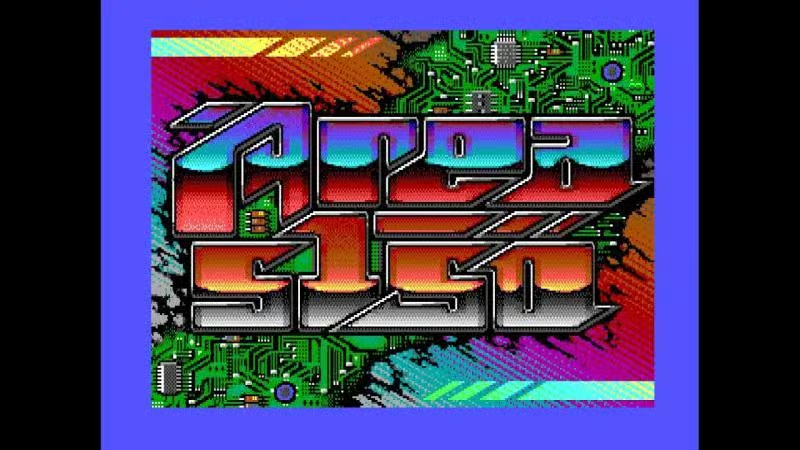
That’s right. They got more colors on-screen for slightly better graphics than I remember on IBM 5150.

Replying to @f4f4f4f4f4f4f4f4@sopuli.xyz
Those are impressive, and unique. They have an aesthetic to them that reminds me of the Amiga? out of an IBM CGA card? Trust the demo scene to pull that off.