Regarding what Gamers Nexus recently disclosed regarding LG TVs in their latest video I think its finally time to do what I can to mitigate it.
I cant root it since the firmware is too new and I cant afford a new TV either. My best bet would be blocking all LG IPs network-wide and disconnecting it from the network. (Although I understand even that might not be enough, its the best I can do right now)
I was thinking of using an old Raspberry to atleast access youtube and my media server, however I dont know what would be a good OS/distro to run this on. Preferably I would want to use something like an old PS4 controller as the remote.
Anyone here who has any suggestions or living room setups to suggest? Any and all tips are welcome.
We personally have the whole TV on a Vlan, so it can’t acces anything at all. While our server/HA can still send a WOL command to it, and jellyfin can stream our movies to it. I run all of it on top of TrueNas, most as an app or else an VM.
I have never tried to set something up for YouTube specifically, since that runs on a Chromecast (for now…)
A raspberry pi running Kodi has been serving me well for years.
Easy install paths include LibreELEC and osmc. I believe both are based on debian.
FWIW I chose and have been happy with osmc.
Regardless of the choice, Kodi has a plugin system for things like YouTube, you can access your media via the jellyfin plugin/app, or by pointing Kodi at your media. It has a remote app available on android and iOS, and for the most part just works.
I couldn’t find a working YouTube app on Kodi, nor any of the streaming sites (besides Disney plus oddly) nor Plex. It kinda felt like a real debrid frontend and graveyard of plugins.
Counterpoint: do use YouTube if you care about your privacy but want to use YouTube and understand the risk.
It’s like those people who say “I couldn’t be vegetarian because I can’t give up bacon”: ok great, be vegetarian plus bacon. Save a shit ton of cows and chickens in the process.
LibreELEC is definitely not based on Debian. I’m using CoreELEC and it works great too (same thing with different hardware support). It takes some time to understand the UI initially I admit.
You’ll want CatchUpTV and Youtube addons (the latter breaks regularly as Google is preventing adblocking).
For people like me who don’t want to sail the high seas, how do you watch Netflix, Paramount and other subscription services with Kodi?
Isn’t it just easier to use a browser at this point?
Browser would be simplest. Even though I prefer Linux and do run it, Windows might be better in your case with it having the DRM support and apps to run those services at higher resolution and HDR that sticking with browser might not allow.
For my case I picked up a cheap MiniPC and install Fedora on it to use instead of the TV interface.
I have a steam deck plugged in to the TV. I might just use that. The Steam controller is good enough to use as a remote.
I might run into the 720p limitation though. I remember hearing Netflix not supporting higher res on browser anymore
Please keep in mind that I haven’t used these for years and can make no comment on whether they still work. There are also some inherent limitations. Quality will be caped at 720p for example because widewine Linux bullshit
I’ve also been running Kodi on a raspbery pi and have been happy with it. Only issue I’ve had with the pi is I can’t get the overscan settings to work with retropie. But kodi has adjustments for the screen size so it works fine.
Network isolation/DNS blocking - put the TV on a VLAN and only permit specific ports through to a media server (whatever the TV will support). If you lack VLAN capability, run PiHole as your DNS server (it works best as DNS and DHCP, but that’s just my opinion for things I like, such as proper name resolution for all devices).
Second option: (your idea with a Pi) disconnect TV from network entirely, then run something like Kodi (or whatever media center you prefer) on an old laptop, mini-PC, whatever, and have that device connect via HDMI. HDMI can passthrough the navigation controls from the TV remote (not guaranteed, but it’s part of the standard). I looked into this a long time ago but the performance wasn’t there yet. Today I’d probably try any distro and run Kodi on it.
Even my POS Samsung passes through enough of the controls to navigate Kodi on a 2017 laptop, while retaining power, volume, settings, etc for the TV itself.
My current setup is a Jellyfin server and Jellyfin client on the TV. I run PiHole with a blocklist for all the Samsung BS which has had the side effect of making the TV menus faster as it doesn’t retrieve any “what’s new” info from Samsung. Its actually kind of fun to monitor the FNS log and see the domains the TV hits, click Deny and see what breaks in the TV. On average about 30% of all DNS requests on my network get denied, and nothing of value has been lost. That’s how much crap is being sent all the time.
Before I fully understood what pihole was doing, it does not block out going things, it was amazing to see how much ad poop was trying to get to my TV. As I got more and more into this very inexpensive hobby of home labing /s I decided just to remove the TV from my wifi and my pihole went from blocking in the high 60% range to something more like the mid 30% range.
Not a popular answer, but Apple TV is the best out of the box experience. Zero ads, massive longevity. Mine is like 7 years old and still running the latest tvOS.
If you have the cash and inclination, Nvidia Shield is the hackers choice. Zero hardware upgrades in years tho, but software aplenty.
Just don’t let your smart TV access the internet in any situation, there’s no need. It’s just a stupid display.
If anything I’d imagine they’re one of the hardest companies to block, considering most apple users have a thousand idevices that could smuggle messages, even with all communications turned off.
They’re still a public company, and Im sure the heat is on their C suite cause they haven’t had any successful hardware releases since the M series processor was first released.
Not selling “anonymous” data would look to shareholders as thrown away profit, which they’re even able to sue for.
So I’d be insanely surprised if they weren’t surveiling their users - but unlike google and all, they own their entire closed-source software and hardware empire, so the likelihood of catching them is also valuably low.
I could be from alpha centuri for all it matters, storing your data in an american companies servers is still subject to american laws, that was kinda the whole point of the cloud act.
A European company on the other hand isn’t subject to such laws, and is why many tech companies open up in France/Switzerland, they have laws to protect their citizens privacy instead of outlaw it.
People do pick up Pixel phones to install GrapheneOS on. How many people pick up Apple phones/tablets and are able to install another OS on it and have it as functional as GrapheneOS?
Same with smartwatches which from the Android side can be used offline with apps like Gadgetbridge to retrieve data without giving your watch internet access and not using the official apps.
Apple is very account and OS centric wanting to funnel everything through them. Exception has been MacOS devices which has had better luck with stuff like Asahi Linux.
I got an even better question for you: Is that relevant here?
Cause I don’t think it is at all, but to answer anyways I think DEI is a valuable tool to assist picking the best person for a job, independent of race - as there is a racist bias in many hiring positions. I don’t think its perfect, but honestly I don’t think anything in US is.
And I think apple cares about DEI cause their marketing team said it makes money. Full stop.
People love when their obsession might align with their morals, but its important to remember if 2028 goes Republican in US they probably won’t even do a logo change that pride month, cause all rainbow capitalism ever is is marketing.
Yes, it’s relevant, because DEI inherently limits what the company does, and yet the shareholders voted to keep it. Apparently Apple’s shareholders aren’t bigoted idiots.
if 2028 goes Republican in US they probably won’t even do a logo change that pride month
Nice job showing your ass here, because Apple never ‘changed the logo’ for the pride month. Where the fuck are they supposed to change it, on the Macbooks?
“Find My” network is pretty strict by its nature, if you’re talking about that. Realistically speaking, I wouldn’t be scared of it, because I can’t see any vector from which it can be dangerous to the end user.
Nonetheless, “Find My” is an optional feature and can be fully disabled. Other Apple web-services can be blocked on a network level, if you want it for some reason. But, IMO, at this paranoia level, the only right option is OSS with a strict firewall.
What ”launcher”? The TV app? You can just move it away. There is no launcher anywhere, every service along with AppleTV+ is just a separate application
There are builds for Android TV lineage os for the raspberry pi. If you are willing to put in some work for alternative apps it’s a great interface with no Google integration. I’ve used kodi before i moved to jellyfin always found the kodi -> jellyfin integration to be clunky. Google TV would be much cleaner
I could never get those Android TV builds to work with CEC which kind of defeats the purpose for me. I’ll try it out with the next update. Librelec had no issues.
If you have nay knowledge of networking (or want to learn), start setting up restricted VLANs to isolate your smart devices. Only allow them access to specific services/devices like your media server.
For dedicated hardware, there are plenarily of options. A Raspberry Pi will work to start with, there are Linux images with Kodi such as LibreELEC and osmc (I have used both in the past and they worked fine), and Android TV images also that can run apps. I suppose you could also set up a generic Linux install and run the Jellyfin client or similar - not sure if there any turnkey options for that.
We have a couple of Apple TV boxes and they perform well, the Jellyfin apps for them have really improved in the last year or so too.
My answer is… excessive. So keep that in mind. If its just you or you and another adult, just set up kodi in some form.
I wanted something that would have profiles for my kids, a remote, and easy access. Where I am currently is:
Flex Launcher - 10’ UI. The same person started Big Launcher after but never completed. I’m hoping to finagle Plasma Bigscreen into doing what I want, but I’m not there yet.
Logging into the machine also auths against JF, so its per user at the OS level for each member of the family. Currently working on NFC for login so my kids can tap a toy or something to get their account logged in, rather than me or my wife doing it.
PC is an industrial pc I picked up, its light on usb ports but I added a wifi/bt card from another machine, bumped up the ram with some spares I had.
I have a usb soundbar and usb audio processor, all audio goes through there, managed via pipewire.
I couldn’t get CEC working well on it, so I made use of an overly expensive video switcher for this purpose that I picked up a while back. Corp conferencing switcher. Now I can send CEC programmatically.
Current remote is just an older android tablet with lineage on it. I want to replace this with a keyboard/remote combo, but haven’t found what I wanted to yet. This will just get broken accidentally by a kid, so I’d prefer a remote.
The experience is pretty decent, just login and browse. In any case, this is the (overly complex) way I’ve addressed things for me. That said, a few notes / to-do items:
No streaming platforms (I will not use them anyway)
I still need to stand up a youtube front end (I don’t use it much so low on the list, more for my wife)
I want to set up something to show family photos from immich as the background
I need better controllers for gaming. I have one 8bitdo pro wired, an old 8bitdo NES controller, and a gamecube usb adapter (but my gamecube controllers have all gone to crap now, so thats useless). I also connected up the balance board from the wii, but haven’t gotten much use out of it yet.
I want to get my AudioBookShelf on there as a dedicated setup with login by desktop account automatically, haven’t even started this yet. May have to do something a bit different here too as I want a read-along style for the kids.
I would never buy all this stuff, I used things I picked up on the free or cheap via hardware replacements through my work and tech liquidation/"recycling” companies.
I have a setup very similar to this. Although I’m fully on the Plasma Bigscreen bandwagon. But then again, I don’t have many custom services such as NFC login/custom background image logic like you do, and I doubt Plasma Bigscreen would play nice with that stuff. A couple of things I learned through my many attempts of setup:
HDMI CEC doesn’t work on pretty much all x86 devices except for like some particular mini PCs, the Framework desktop, and the Steam Deck dock. Most ARM devices do though which is how I got around this by just using an Orange Pi 5. Another option is tunneling over DisplayPort if your device has a DisplayPort and you have a supported DP-HDMI adapter. Then finally, there’s also the PulseEight USB adapter if nothing else works.
I’ve been using Waydroid for any application that doesn’t support Linux natively like YouTube or most streaming services (although I only use YouTube and Jellyfin for all of my content). You can use Waydroid Android TV which launches a near-native Android TV translation layer running Lineage OS which is de-googled and privacy protecting by default. You can launch the normal Android interface which has the entire Android TV UI, or you can enable multi window mode and just launch specific Android apps directly from whatever Linux launcher you use and they launch and work like normal Linux apps with TV controls. Very useful since Android has a much larger TV app ecosystem.
When companies decommission their hardware, they go to a large scale “recycler”. Most of the time that means pulling the drive on the PCs and maybe dropping another in before reselling it for less.
Some companies also recycle things like digital signage players, which could be purpose built hardware and mostly useless or purpose built software and fairly useful if you know what to check for. Or sometimes speakers, audio dsp’s, monitors, etc.
Other times when a company is being liquidated (like being sold off to pay for debts), it’ll get auctioned off. You don’t get to look at the details much (maybe one device pulled out in front of the crate the rest are in), you are buying in quantity, etc, but there can be good finds there.
I’m big on making use of perfectly good hardware with just a few years on them.
@curbstickle@Epzillon What's the "overly expensive video switcher" that you're using? I have an android TV with broken CEC (a Pi running Libreelec works fine one my other tv, but not this one).
Conferencing hardware from lightware (upstairs) and crestron (downstairs). Not something worth bothering with though, just get a CEC adapter like the pulse eight.
I wonder what kind of hardware to best run this on to watch YouTube, Jellyfin, Disney+…
I do have a steam machine on the TV anyway. Is it possible to run this on Steam OS? And without having to fiddle so much when just wanting to watch TV?
That’ll be expensive so I don’t think it’ll be happening. They’ll be OK with collecting data from the 95% of their customers who don’t know how to block the TV from having internet access.
I’m still using an old Apple TV. I’m not happy about it but haven’t found a good replacement yet.
There’s a few interesting options for software in this thread. In terms of hardware - maybe a NUC or something? Would have to be small, quiet and relatively cheap.
I use ONN Android boxes. Fairly inexpensive, but I think it’s difficult to set up without a Google account (you can create a dummy account on the setup).
Side-loading is trivial. Some favorite apps: TizenTube to replace YouTube (or any of a dozen or so frontends), Projectivy launcher to replace the awful default. Add an always on VPN.
Yeh, agree. But for a lot of people they are the easiest option after Amazon/google/apple etc
Not everyone is techy enough to have means to pull components together and configure, And then put up with semi reliable solutions. People need to a knowledge this rather than downvote. It’s weird.
For the real “TV feeling”, try ErsatzTV. It basically creates multiple real-time streams of TV shows and movies from your media library. You can switch between them like channels.
Huh. Must have gotten someone to take over, last I’d heard the maintainer was archiving it. At least according to Chris on Linux Unplugged a couple months ago.
I know people here will hate this but i used GPT to write a custome Kodi addon to do this for me. Breaks the days up into various programming blocks that i can configure with shows from my library. It comes with a website used to configure it and an import json system for the programming so i can give my list of shows to any ai and just tell it the kind of channel i want and it will configure one for me that i can import. The programming blocks come in three types: shows, movies and music. Shows allows for sequential, random or tagged play (for holidays and seasonal events). Movies and music also come with various search and random play profiles for things lile age, genre, tags and various other terms. Took about 2 weeks to get it to the point where i can turn it on and let it run without issue. Currently working on adding network ids and bumps to extend shows to their time frames so the sequencing doesnt get so off the clock after a few hours of watching. And i miss the adult swim bumps
Me personally, I just use a Linux distro (ive used Ubuntu and popos, both have been fine) and use whatever flavor of streaming service I can access. Sometimes you’re hit with lower resolution but I’d rather that than get spied on and be fed ads by my hardware.
Ive also gone back to physical media and use a DVD player. I’m just buying series I like one by one.
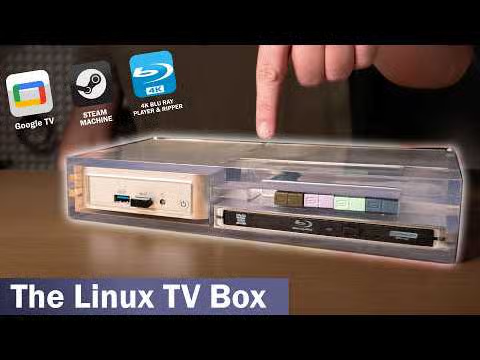
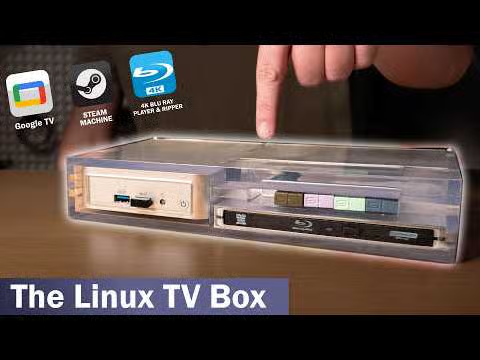
This video used a combination of physical media and streaming services. They relied on waydroid and with some workarounds, it worked well for them:
Acronyms, initialisms, abbreviations, contractions, and other phrases which expand to something larger, that I’ve seen in this thread:
Fewer Letters
More Letters
DHCP
Dynamic Host Configuration Protocol, automates assignment of IPs when connecting to a network
DNS
Domain Name Service/System
NUC
Next Unit of Computing brand of Intel small computers
PiHole
Network-wide ad-blocker (DNS sinkhole)
Plex
Brand of media server package
RPi
Raspberry Pi brand of SBC
SBC
Single-Board Computer
SSD
Solid State Drive mass storage
VPN
Virtual Private Network
Also, looking towards the future or for people that can find one at a decent price:
Not a raspberry pi but an Orange Pi Plus or Pro. They have a rockchip that has AV1 decoding (along with standard others) which is probably going to be the future (it is for corpo streaming already).
Put plasma big screen on it and get a Bluetooth wechip remote or something
Any Linux distro with Plasma Bigscreen. My TV box is an old laptop I got for free from work running Cachy OS. I have a remote-sized keyboard/trackpad that I use to control it. I mostly just need the arrows, but the whole keyboard is there if I need to go in to the desktop OS.
I could use a recommendation for a big-screen ad-blocking YouTube app though.
@Epzillon I have been using Plasma Big Screen for a while now and cant be happier. I use Jellyfin as my main media source, Fred TV for my IP TV service and PWA for Youtube and Netflix. My TV has been disconnected from the internet for a while now and I dont feel my kids know the difference. I also use the Rii bluetooth remote to access Plasma Big Screen interface.
Does Fred TV work with a remote? Jellyfin was great but I couldn’t find an IPTV service that worked well with a remote. Fred TVs interface is also not great compared to something like Tivimate
My living room set up has been TV not connected to internet and hooking up a minipc running Fedora. Could run Windows if DRM content from streaming services is important to you.
Im on a 2013 m93p thinkcenter tiny. Still goes hard
Heh. That’s my gaming machine. Win 8.1, 2x4 GB sticks, i5-4785T, 2x Xbox 360 controllers, SSD.
I can play retro games, emulation (Wii, Gamecube, PS 2 era), indy’s and PC AAA upto about 2015ish. Boots in under 5 seconds, smooth 60fps @ 720p (which is good enough for me). For a $100 “piece of ewaste”, it goes hard AF.
Keep your GTA 6; Lego City Undercover local co-op is where it is at.
I also have KDE Connect on both my phone and TV so I can play/pause media from my phone at any time and send files (like new launcher wallpapers) easily without adb.