posted in Technology

Ubuntu stopped being the lightweight Linux distro, and Linux Mint filled the gap it left behind
www.xda-developers.com/linux-mint-is-the-best-ubuntu-replacement/posted in Technology
Ubuntu stopped being the lightweight Linux distro, and Linux Mint filled the gap it left behind
www.xda-developers.com/linux-mint-is-the-best-ubuntu-replacement/
Replying to @Crumpled6273@lemmy.ca
I don’t recall Ubuntu being a lightweight distro or ever aiming to be. It was always Debian with more stuff.
Replying to @zeppo@lemmy.world
yep, user friendly, easy install, gooey install, proprietary drivers; extra stuff.
i think they were aiming to loss lead, capture user base and ultimately get some b2b sales - oh well :(
OP author even ignores stuff like Lubuntu and Xubuntu, which i assume canonical have at least some contribution to.
OP gets downvote from me, worthless article.
Replying to @bryndos@fedia.io
Ubuntu is the enterprise distro if you need something Debian based you can get a proper enterprise support contract for.
Replying to @zeppo@lemmy.world
They have had light official flavors (Lubuntu, Xubuntu, Netbook remix). But primary distro that has always been either Gnome or Unity has been fully-featured. It’d only consider it “light” compared to Windows.
stopped
It never was.
Ubuntu used to be the obvious choice for reviving old systems that couldn’t run Windows
It didn’t.
Whether xfce and cinnamon require less resources compared to other DEs is questionable, but the question itself is dumb. Environmemt by itself has little value without programs that run inside of it, and most of those aren’t cinnamon or xfce specific or adapted to them.
Replying to @esc@piefed.social
Ubuntu used to be the obvious choice for reviving old systems that couldn’t run WindowsIt didn’t.
It was though. You are living in a bubble. For five years all I ever heard was “You gotta switch to Ubuntu! Windows is awful!” Except this is when I was still using Windows XP, so from my perspective Windows wasn’t awful. It was just out of date. From 2006-2011, that’s all I ever heard was Ubuntu Ubuntu Ubuntu.
Finally I looked at Ubuntu, and instantly realized I hated it, but that’s because of personal choice. For the masses, Ubuntu=Linux at one point. If you knew enough to dispute that fact, then you’re already in the Linux ecosystem enough to have your own opinions.
But for non-Linux people, I’d say Ubuntu was the default Linux experience for most people for 15ish years. I’d say around 3-4 years ago it started shifting towards Mint.
And now Mint is the default experience. The problem is Linux users are very opinionated. Their distro is the best distro. Their distro “just works”. And these opinions are on a spectrum. I don’t mean autism, I mean the opinions are literally a whole spectrum. You could have someone who has almost an identical set-up as you, except they use a different file browser. So, slightly differrent. On the other end of the spectrum you might have someone who uses Arch. Or if you use Arch, maybe they use vanilla Debian.
Whatever the specifics, that’s not the point. The point is Linux is a whole range of visions, which is why your vision will never be THE vision for Linux. Because regardless of your opinions, no matter which stance you take, there’s going to be thousands of people who want to tell you how stupid your setup is, and how much better theirs is.
But the default Linux experience is just the one that the majority gravitate towards. 90% of normal PC users never change any settings, or try different distros. The difference is that most Linux users aren’t the typical PC users. Linux users like to customize their PC. Most PC users don’t even change the theme. That’s why Windows has such a monopoly. The user buys their PC, plop it on their desk, and the factory settings are good enough.
The other thing I find most Linux users do, is they want to grow the Linux base. So they introduce the “easiest” distro, and that becomes the default. For a very long time that was Ubuntu. I actually like Mint, so I personally see this as a good step for being the default.
And if you don’t believe that there are users who don’t change their PC or customize things, I’m running ZorinOS, as my first Linux full time use case. The only thing I customized was putting a custom taskbar at the bottom of my screen. Outside of that, my PC hasn’t been updated, or changed in any way since 2023.
And if all of this sounds like horror to you, then that just means you have opinions that I don’t have. But you’re also one of the advanced PC users who use linux easily. I still struggle with this. If Windows wasn’t one massive privacy invasion, I’d still be on Windows despite all the things you hate about them. For me it was the spying. Linux just does it’s thing, and isn’t controlled by corporations, so it doesn’t spy. That’s literally the only difference for me. I don’t even update firefox. I’m running 133.0.3. I think firefox is somewhere near version 200.
Replying to @Lost_My_Mind@lemmy.world
Came here to say this bit you said it better.
Replying to @Lost_My_Mind@lemmy.world
For five years all I ever heard was . . .
Are you sure you know who it is in the bubble?
I dunno where you live but when i hear the same thing three times, i usually try to move my ears a bit.
Replying to @bryndos@fedia.io
Living in a bubble refers to a situation where a person is isolated from different ideas or experiences, often surrounding themselves only with like-minded individuals and avoiding exposure to diverse perspectives.
In context they should be sure, because they’re right.
There was a period where, if you went looking for a “lightweight” Linux distribution as a layperson, everything pointed to Ubuntu. Actually, that period saw Linux and Ubuntu be synonymous to those same laypeople.
It was one of the popular new flavors of the time but anybody who knew to dig deeper would’ve easily found Mint recommended as a truly lightweight distro.
Replying to @Lost_My_Mind@lemmy.world
I think you’re both interpreting the original quote in different ways. It was the obvious choice only because it was popular, but it wasn’t popular because it was the best at reviving old hardware. There were many better options for squeezing performance out of old systems, and they would have been more “obvious choices” than Ubuntu for anyone with any knowledge of the Linux ecosystem.
Replying to @Lost_My_Mind@lemmy.world
It was though. You are living in a bubble. For five years all I ever heard was “You gotta switch to Ubuntu! Windows is awful!” Except this is when I was still using Windows XP, so from my perspective Windows wasn’t awful. It was just out of date. From 2006-2011, that’s all I ever heard was Ubuntu Ubuntu Ubuntu.
ubuntu’s early popularity had nothing to do with it being ‘lightweight’ (because it really wasn’t)… but rather simply because it was ‘new’ and ‘easier’, and everybody was jumping on that bandwagon. that’s it.
xubuntu came around with dapper (june '06) and quickly became a popular recommendation for older or low-spec hardware. ubuntu itself was never that choice. ever.
I’d say around 3-4 years ago it started shifting towards Mint.
linuxmint has been going strong longer than ‘3-4 years’. a lot longer.
my PC hasn’t been updated, or changed in any way since 2023.
I don’t even update firefox. I’m running 133.0.3. I think firefox is somewhere near version 200.
it is your choice to ignore updates. you know your software is out-of-date and vulnerable.

Replying to @adarza@lemmy.ca
but rather simply because it was ‘new’ and ‘easier’, and everybody was jumping on that bandwagon. that’s it.
No, for 15-20 years, it was pushed as the “Linux on the desktop” option. It was the primary distro people were pushing as a replacement for Windows. In fact, there wasn’t a lot of options for a desktop-focused Linux. There were just a bunch of Linux distros that happened to have all of the packages for X11/KDE/GNOME. Maybe RedHat was slightly more desktop-focused, but it was still very much a server-heavy distro.
Although, I don’t remember anybody claiming it was the “lightweight” option. For a time, it was the only “desktop-focused” option.
linuxmint has been going strong longer than ‘3-4 years’. a lot longer.
Maybe, but it only had a resurgence as the new de facto option from the mass exodus from all of the Windows 11 bullshit. Mint has a strange history with the desktop distro wars. Even now, there’s a lot more desktop options, so you can’t really call Mint the de facto one. But, I think it’s one of the straightforward options for a first-time conversion from Windows.
 ZL Labs LtdUbuntu's Popularity Over the YearsIs Ubuntu in Decline, or More Exciting than Ever?
Replying to @p03locke@lemmy.dbzer0.com
In fact, there wasn’t a lot of options for a desktop-focused Linux.
You got it right, here. I used Ubuntu 20 years ago because it was the only Linux distro I found that gave a GUI at all on out-of-the-box on an average consumer video card. I still dual-booted for games, OFC.
Replying to @Lost_My_Mind@lemmy.world
7 years ago I installed Linux Mint as my main driver and never looked back. Even back then it was recommended as a really good option
Cool story, again ubuntu was never lightweight or defaultchoice to revive old hardware.
Replying to @esc@piefed.social
About six seven years ago, when I went to refit an old laptop for university, I definitely got the impression that Ubuntu was the way to go, and it did the job well, so idk what you’re on about
Replying to @Lost_My_Mind@lemmy.world
Just wanted to say this, it’s usually not a good idea to not update the browser you daily use. Instead you can switch to something like Firefox-ESR (extended support release) which is updated slowly.
Replying to @Crumpled6273@lemmy.ca
Maybe Xubuntu or preferably Lubuntu, but never Ubuntu.
I’d even have a hard time saying Linux Mint is going to be lightweight.

Replying to @Peffse@lemmy.world
Lubuntu definitely seems about the lightest weight desktop environment for it for sure. I suppose Ubuntu server can be pretty light… But so are most linux servers, that’s kind of their selling point.
Replying to @SnotFlickerman@lemmy.blahaj.zone
I’d argue AntiX or PuppyLinux… but if we’re talking about stuff a normie can just use, I agree with you.
DietPi (headless) is ~ 300mb fully resident in memory.

Replying to @Crumpled6273@lemmy.ca
Any Linux distribution based on KDE or GNOME is not going to be lightweight. It did have the LXDE option for stripping it back somewhat, but the repos were still mostly filled with software that requires KDE or GNOME.
Mint is kind of like LxUbuntu back in the early days; still no lightweight, not even by desktop standards, but it’ll bloat up quickly if you want to get anything done with it.
I mean, Puppy Linux and DSL are still around. Anything based on Debian could claim to be stable or enterprise ready, but not lightweight.
Replying to @adespoton@lemmy.ca
I feel like this was true maybe 10-20 years ago, but any semi-recent desktop or laptop can run KDE or Gnome fine. If you are running an SBC with limited RAM, then maybe you should look at another desktop GUI.
Replying to @pizza_the_hutt@sh.itjust.works
Any semi-recent desktop or laptop has no need of a lightweight Linux. That’s for embedded solutions, rPis, and other resource constrained systems.
Having said that, in 2026 and going forward, we may have need of lightweight desktop distributions again. 64GB storage, 4GB RAM style.
Replying to @adespoton@lemmy.ca
3gb ram is plenty for current KDE. A browser has become the biggest enemy of resources these days.
Replying to @Crumpled6273@lemmy.ca
Ubuntu used to be even more demanding with Unity. I love Mint though. Been installing it a lot lately
Replying to @Crumpled6273@lemmy.ca
#! was, and still is, where it’s at. There is even still a 32-bit x86 version.
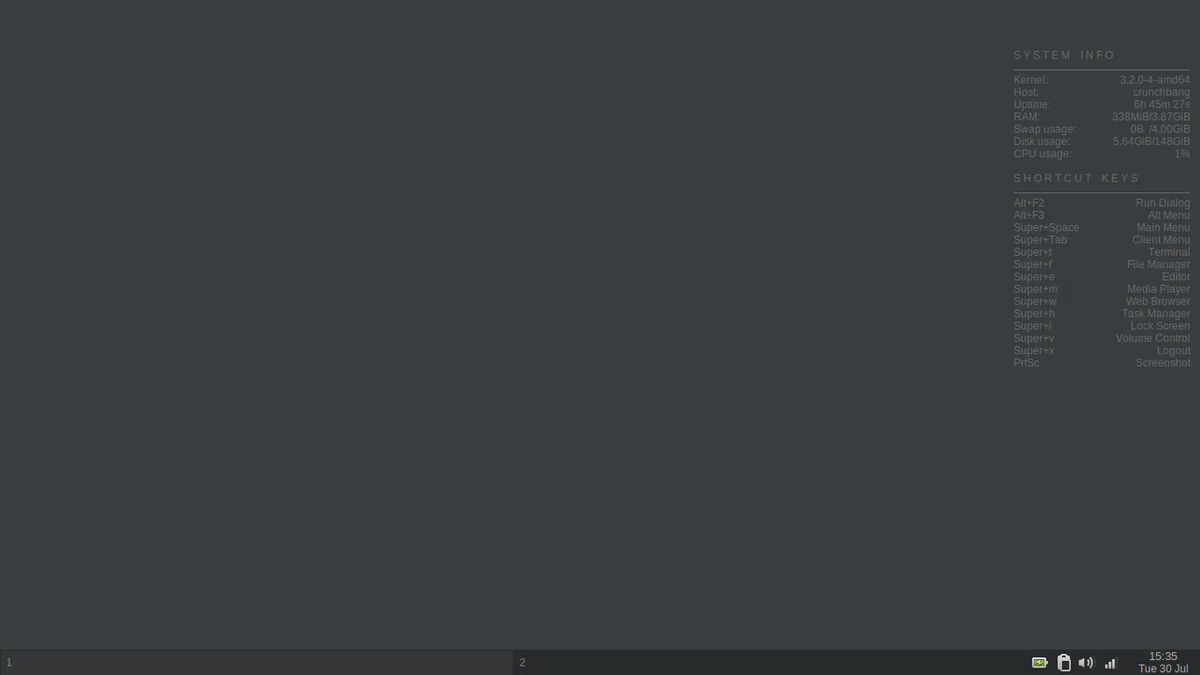 en.wikipedia.orgCrunchBang Linux - Wikipedia
Replying to @MattBlackAlien@lemmy.world
The distro that hasn't seen an update in 13 years, according to Wikipedia?
Replying to @fonix232@fedia.io
There are a couple continuations of it, up to date. You’ll have to use a previous version for i386 though as Debian upstream dropped it as a target.
Replying to @Crumpled6273@lemmy.ca
clear debian is the solution
Replying to @2pNza@lemmy.world
Not for modern hardware from my experience. Instead of suggesting one distribution, I would say Debian for some old hardware models and fedora is the sweet spot for modern hardware.
Replying to @Crumpled6273@lemmy.ca
In my opinion, Fedora is too close to bleeding edge. For me, tumbleweed is the sweet spot
Replying to @tmjaea@lemmy.world
Tumbleweed is good but everytime I debloat it via the myrlyn in installation window, it breaks and fail to boot. Have issues with ctrl+alt+f2. No built in recovery tools like fedora or maybe i can’t find it if it’s there.
The packages are updated as a group which means no matter how much i debloat, it will always return. I fear using addlock can cause any dependency issues also.
Replying to @Crumpled6273@lemmy.ca
You can tell the author hasn’t spent much time in the Linux world.
More like Ubuntu was the beginner friendly distro and Mint has taken that place years ago, right?

Replying to @Crumpled6273@lemmy.ca
ChatGPT, write me an article about Linux that gets traffic.
Replying to @avidamoeba@lemmy.ca
So XDA developers page too is affected by AI Slop.
Replying to @Crumpled6273@lemmy.ca
Yea they got bought out recently, right?
Replying to @ayyy@sh.itjust.works
Not recently I think. It’s around in 2022. Acquired by Valnet Inc.
Replying to @Crumpled6273@lemmy.ca
Ah, that explains why everything I see from them is clickbait now.

Replying to @Crumpled6273@lemmy.ca
You are all falling for the rage bait
Yup
Replying to @whaleross@lemmy.world
Sure, why not? Isn’t that the whole point of the internet?
Replying to @Asfalttikyntaja@sopuli.xyz
God, I hope not
Replying to @whaleross@lemmy.world
Same for you.
Replying to @Crumpled6273@lemmy.ca
I mainly use Mint as my desktop distro, but it’s not lightweight, it’s batteries included. If lightweight is what you want, there are better options.

Replying to @Crumpled6273@lemmy.ca
I use xubuntu just because I like xfce better
Replying to @llama@lemmy.zip
🐀

Replying to @Crumpled6273@lemmy.ca
Ubuntu was never a lightweight distro lol
Replying to @Crumpled6273@lemmy.ca
Neither have ever been lightweight.
There wasn’t a single second between now and 1970 where even the most delusional people could’ve seen Ubuntu as “lightweight”.

Replying to @realitaetsverlust@piefed.zip
Back when they were still fucking around with upstart and mir its was light enough. Today its just another windows.
Replying to @muusemuuse@sh.itjust.works
It’s basically bearing the brunt of Windows heads using Linux. It’s a very common disto on WSL.
Replying to @realitaetsverlust@piefed.zip
Not saying lightweight but Ubuntu 10.10 booting was fast at least even on HDD.
Replying to @muhyb@programming.dev
Compared to what “heavyweight” distro at the time?
Replying to @markstos@lemmy.world
Compared to Ubu…
Replying to @realitaetsverlust@piefed.zip
When they first started, they had a list of promises. One of them was to always fit on a 800meg CD.
Replying to @Crumpled6273@lemmy.ca
Unless they’re comparing to LMDE, they’re mostly similar about being lightweight.
Wow. I’m impressed… Loads of comments and no one had to chime in and say “Arch is the best” 😂
Replying to @aproposnix@piefed.social
Arch is as lightweight or heavy as you want it to be. Except for the Systemd stack, that locks you a bit in. That’s where Artix comes into play.
Replying to @Crumpled6273@lemmy.ca
why would it stop when it never was to begin with? lol
Replying to @keithan@lemmy.zip
My exact thought. Always been at least mid weight, if not flipping heavy as.
Replying to @hereiamagain@sh.itjust.works
IMO that’s why it became popular at the time. It was a Linux distro anyone can install and use right away after installation.
Replying to @muhyb@programming.dev
Right, it had everything built in and ready to go
Replying to @muhyb@programming.dev
Easy install with drivers included and a rich guy willing to mail you installer CDs in a nice jacket for free. Every computer club in any school had a stack of them to give out.
Replying to @keithan@lemmy.zip
When they first started, they had a list of promises. One of them was to always fit on a 800meg CD.
Replying to @ki4jgt@feddit.org
Is it kind of weird to respond to every thread with this same claim? A CD iso with full gnome desktop and openoffice wasnt minimal at the time.

Replying to @Jason2357@lemmy.ca
Bot
Replying to @YouTalkinToMe@lemmy.world
No, probably just a really passionate human determined to tell people where that alleged “lightweight” claim comes from. Don’t underestimate how persistent nerds can be when they think they’re right.
Replying to @luciferofastora@feddit.org
Yeah, possibly. One might ask what the difference between such person and a bot is…
Replying to @YouTalkinToMe@lemmy.world
The same as the difference between my rambles and AI slop: One is natural, the other artificial. One is organic, the other mechanic. One is passionate, the other soulless.
Replying to @luciferofastora@feddit.org
True, true. The one-dimensional layer of text forums covers up the means to differentiate.
Replying to @Crumpled6273@lemmy.ca
Nope. Ubuntu is a lightweight distro. If one wants to call it a Linux at all. I freshly installed Kubuntu 26.04 a few days ago “with everything”, but that did not even include a gcc.
Replying to @Treczoks@lemmy.world
Not light weight. Also not Ubuntu.
Replying to @Crumpled6273@lemmy.ca
Sometimes I feel like Linux Mint has a low-key marketing budget or something lol
Replying to @prole@lemmy.blahaj.zone
I don’t think they do, it’s just a good plug and play option for people just wanting to get away from Microslop. It’s not really meant for power users, but people that want as little tinkering as possible (while still having the option if needed). Though I think they should do marketing, and get more people off of Microsoft products.
And for the record, I am still waiting for my check from Linux Mint for this ad.
Replying to @Crumpled6273@lemmy.ca
Ubuntu stopped being a viable desktop distribution 15 years ago, light or heavyweight.
Replying to @elbiter@lemmy.world
GNOME 3 and afterwards didn’t help. And Snap was the last nail in the coffin.
Replying to @Crumpled6273@lemmy.ca
Linux mint sux, Ubuntu sux, use arch instead, or Debian

Replying to @Crumpled6273@lemmy.ca
I recently abandoned windows for Linux on one of my machines (not my first, won’t be the last), and I chose Debian specifically because it’s the leanest by reputation.
Replying to @Lucidlethargy@sh.itjust.works
I’ve just deployed a full debain active directory business network. We’ve had suppliers in the last 2 weeks installing equipment and I’m now bored of explaining to people why our infrastructure is so fast and just works.
Even the 2 windows 11 machines we require to run some lab equipment have drawn some comments because they work so much better in our local environment without being bogged down connecting to MS cloud garbage.
I’m doing this for my partner as I’ve been out of IT for 15 years. I’ve never had this level of interest and enthusiasm about a business network I’d installed back then
Replying to @Crumpled6273@lemmy.ca
Alright ubuntu was the most preferred in companies and startups. At least for south asia.
Every college, and companies had ISO setups, cause it was the easiest software to install from boot. So i agree with this. The article is dumbly written tho

Replying to @Crumpled6273@lemmy.ca
When was Ubuntu “lightweight”? I’m not saying it was always bloated, but it was never supposed to be minimalist either. It was just an easy works-out-of-the-box Linux experience.
Replying to @communism@lemmy.ml
When they first started, they had a list of promises. One of them was to always fit on a 800meg CD.
Replying to @ki4jgt@feddit.org
In the early 2000s, that wasnt particularily lightweight. I believe it came with openoffice and the full gnome desktop. That was not really minimal in any way.
Replying to @communism@lemmy.ml
It was only lightweight in comparison to Windows, but every other OS is.

Replying to @Crumpled6273@lemmy.ca
Did someone mentioned Ubuntu was never lightweight yet?
Replying to @Yerbouti@sh.itjust.works
When they first started, they had a list of promises. One of them was to always fit on a 800meg CD.
Replying to @ki4jgt@feddit.org
That wasn’t “light weight Linux” for 2004. Back then I would have probably been looking at Slackware or some other era appropriate minimalist distro if I wanted a minimalist Linux.
Back in 2004 USB thumb drives were realtively new, and Ubuntu would have failed fitting on any available on the market. Yet a handful of minimalist distros could (depending on if the minimalist distro had a DE or not, and the overall package goals).
Replying to @Crumpled6273@lemmy.ca
As others have stated, Ubuntu was never a minimalist distribution.
When Ubuntu first came out, most common CD drives could only work with CDs of a about 700Mb capacity, but assuming that the tech would keep improving, it was reasonable to suggest this. It was never because Ubuntu was touted as “lightweight”, though. Then writable DVDs became almost ubiquitous, and they eventually migrated to that. In the meantime, USB flash drives were getting cheaper, and Linux installer tech was also improving, so eventually (quite early actually) these were supported too. But this was simply a logical progression of tech development and catering to the predominant baseline capacities of storage media.
If you want a proper minimalist, try PuppyLinux or DamnSmallLinux. If you want to run on a Raspberry Pi (or one of their other supported SBCs) try DietPi.
Replying to @cybervegan@lemmy.world
Even better for a minimal system, try tinycore linux

Replying to @Crumpled6273@lemmy.ca
I’ve never heard of ubuntu being described as light weight.
only thing it was ever described as, is as an easy to use distro for first time linux users… and even thats not entirely applicable anymore
Replying to @Crumpled6273@lemmy.ca
I don’t think I have ever heard of Ubuntu be described as anything other than the “default Linux” distro that you use or give to someone if all you/they care about is good first and third party support.
It is the iPhone or Samsung Galaxy of the Linux desktop OS world.
Replying to @Crumpled6273@lemmy.ca
Hasn’t ubuntu always been the “non-tech friendly linux distro”? Their market niche was not being light weight.
Replying to @Crumpled6273@lemmy.ca
The current version of Ubuntu recommends 6GB of memory and a dual-core processor
4 GB.
Ubuntu doesn’t have other lightweight options, but Linux Mint offers XFCE and MATE editions.
Wrong. XFCE and LxQt versions are offered - Lubuntu and Xubuntu.
Snap is a packaging system that includes every possible file or runtime that the app needs to work.
Yes, so it actually works at proper containerisation. That is actually the whole point of containerisation.
Flatpaks frequently fail to work because of library incompatibilities.

Replying to @ThomasWilliams@lemmy.world
I ran hundreds of flatpaks and they never failed to run even once, what do you mean with “frequently fail to work”?
Replying to @Crumpled6273@lemmy.ca
I’ve never heard Ubuntu claiming to be lightweight.
Ubuntu’s initial claim to fame was a normie (non-techie) could install it and the stuff they wanted to work would Just Work- there’d be a little option during install ‘do you want to install closed source or proprietary or patent encumbered shit?’ and you’d click yes and then your graphics card would work and your MP3s would play and your sound card worked without having to fuck around with kernel modules and command lines.
If you want lightweight install Xubuntu (xfce environment).
Replying to @Crumpled6273@lemmy.ca
Mint has always been the better Ubuntu.
Prove me wrong.
Replying to @Solrac@lemmy.world
And Zorin is above both
Replying to @Crumpled6273@lemmy.ca
I’ve never understood the point of these articles.
What does anyone gain by attacking other linux distro’s? It’s not like people don’t give Linux Mint a chance… I’m not a fan of Snap, but, there are many who are…
Ubuntu also offers SLA’s to companies (15 years support) and Linux Mint doesn’t offer paid support, and there are likely many other reasons to use Ubuntu over LinuxMint.
Use what best suits your requirements.
Replying to @auzy1@lemmy.world
It is an essential aspect of being Linux users that we claim our preferred distro is the absolute best and others are garbage not worth using. It’s in the terms I’m pretty sure.
Replying to @zoltanshields@lemmy.zip
Theo De Raadt, is that you?
Replying to @Crumpled6273@lemmy.ca
Neither are lightweight. If you want lightweight then get debian
Replying to @pineapplelover@lemmy.dbzer0.com
How debian is lightweight ? Isn’t it have too many bloats pre-installed ?
A distro i can build myself is actually lightweight. Like Arch or Void.
Replying to @Crumpled6273@lemmy.ca
Both arch and debian fresh out the box is minimal. Debian minimum requirement is 1160MB for Hard Disk, I’d imagine something similar for arch. From scratch, neither comes with bloat. You’re probably conflating debian with ubuntu or linux mint out the box.
Replying to @pineapplelover@lemmy.dbzer0.com
By bloat I mean specifically those kde applications and games that almost all beginner friendly distros bundle in.
Replying to @Crumpled6273@lemmy.ca
Yeah no, you install it and it’s a black screen. There’s no de on fresh debian or arch, they’re very comparable.
Replying to @Crumpled6273@lemmy.ca
What year is this? 2008?