Letsencrypt is under US jurisdiction. Is there a free-er alternative?
I know that I can simply make my own private certificate authority that only I and my family trust. But is there some public provider like letsencrypt that is in a free-er part of the world than the US?
I don’t think anyone’s going to solve the problem in general, to be honest.
Like, Let’s Encrypts goal is super novel, but also expensive as shit to actually run, and requires a lot of coordination because it needs to be a trust authority. If this ever happened, it would probably be at the backing of some government structure, because I don’t see many people wanting to jump at that as an expense.
This is why I never even started using Letsencrypt; looking at the fine print, you actually enter into some kind of contract with some US entityunder US law, which I don’t want even if it’s the coolest of all FOSS foundations.
I used to pay €40/year iirc.
I suspect it’s gotten more expensive though.
edit:
oh looks like ZeroSSL are doing it letsencrypt-style with Acme protocol for €0.
edit2:
No, not more expensive. Some of the providers in the above link are labyrinthine and I couldn’t even find a Pricing section - usually a sign that it’s too expensive at least for a normal consumer - but others offer yearly certs for as little as €30 (taxes not included).
edit3:
Yeah some people are going to have a hard time accepting that a contract with a for-profit company under EU jurisdiction might be preferable to a contract with a non-profit under US jurisdiction.
They do sound good, but it’s worth pointing out that for a LE equivalent, unlimited 90 day certs, ZeroSSL would cost 180 Euro per year, that’s 15 per month. I couldn’t find another registry with a comparable offer. They always follow the ancient model of paying for every cert or getting a wildcard cert you have to manually install everywhere. To me, that model is dead. Automatic provisioning and renewal of certs is a must.
Oh, no, I was talking about the price. I saw that they have ACME. From that European registry list they seem to be the only ones. But the plan that offers unlimited certs over ACME, equal to LE, costs 15 Euro per month.
I assume you are correct and anybody can get a cert (with max. 1 wildcard presumably) for (again presumably) one site for free?
This @state_electrician is very insistent; do you have any idea what exactly costs €15/month (according to them)? What could they mean by “LE (LetsEncrypt) equivalent”?
They seem to claim that the free cert offer is only for a limited time?
edit:
no, they explained themselves. Apparently LE gives as many free certs for as many domains as you want to any one user.
Under the section “ZeroSSL Certificates” it says for the free tier “3 90-Day Certificates” and for the cheapest paid option at 15 Euro per month “∞ 90-Day Certificates” (∞ being the infinity sign). The latter is what I currently get for free from Let’s Encrypt. So to get the same kind of service, I would have to pay ZeroSSL about 180 Euro a year. Which is something I am currently not willing to do, as all my ~40 certificates are only for myself.
I think there is some confusion because I have had more than 4 domains at one time and they did not complain about it. 2 of them were wildcards. Possibly a “90 day certificate” is something specific that they are offering?
I’d be interested in that too; I’ve always avoided ZeroSSL so far because I have 80 (sub)domains.
I manage 7 root domains as wildcards and 6 as individual certificates—that always sounded like it would be unaffordable for me.
ZeroSSL costs 180 per year for unlimited 90 day certs. I get the independence from US-based services, but I don’t want to drop that kind of money on my toy domains.
I think you misunderstood something there; they’re very explicitely offering free certs.
I just went 90% through the process (I might need them anyhow later this year), it’s like this:
What you say is a PRO feature, unlimited certs with one account, is not meant as “unlimited in time” but “unlimited number of certs at any given time”.
Yeah, that’s what I meant. An unlimited number of 90 day certs, automatically renewable through ACME. That’s what Let’s Encrypt offers and that’s what I’d need in another cert provider.
Can’t speak for OP, but for me it’s important that with e.g. Letsencrypt, I’m entering a contract under US law, and with ZeroSSL it’s under EU/Austrian law.
Usually they make money with extended certificates where they not only offer a certificate for example.com but also certify that it belongs to Example Ltd.
Those extended certificates used to show the company name next to address bars, but I don’t think browsers do that anymore.
It’s actually to prove that a web server belongs to (or is trusted by for delivering their content) a specific website.
qualified certificates go a step further, by proving that a web server belongs to a specific company or a real person. but that’s costly, because verification is inherently more difficult.
Also the controlling party in Italy is practically neo-fascist and Austria is also sliding there again with their Nazi party like AfD in Germany and VB in Belgium getting a huge portion of votes.
I don’t see how it is that much better than a US non- profit.
I think the core thing is that you have to know of a bunch of different CA options and switch when necessary or on a compromised CA.
The thing is, the US is already fascist. Austria (current day) would be an improvement.
Also, you know the downfall of Autistici/Inventati - No - check my post history. One of the events that happened is that US owned PIR removed one of the domain names since they own .org. One less US entity, one less point of failure.
Both Italy and Austria are EU member states , fall under the GDPR AND NIS2 and while both government(even under the FPÖ) have their downsides neither has legislation that is even remotely close to what the US even have today (and had for decades) and unlike the US both countries still have a very well working judical system and the ECJ.
So. Yes. While not perfect, their situation is massively better than a US non for profit. Total different league. Not even in the same ballpark.
It is. Most EU countries build on a strong legal system of separation of powers etc. that makes it hard to dismantle democracy with the alacrity MAGA is currently doing it in the USA.
But nevertheless, we’re all aware of the rise of fascism in Europe and are extremely worried.
@Sibbo I do not see any problem with Letsencrypt. Any CA which is widely trusted has to follow the same rules. This rules are set up by the CA Browser Forum. Which metadata does LE collect? My server's IP address, domain and subdomain, mail address. These are logged in the CT logs. Every CA has to log all certificates in a public CT log. Regardless which CA I choose, these data are public. There are not any critical data or metadata that LE can collect.
ICANN can (theoretically) not force anyone to deregister your domain. If your stack is all outside the US, and everyone collectively decided to disobey the US, the Internet’s decentralization would be true.
The hard part about building a decentralized network is finding out where to hide the centralization.
For the Internet, the centralization is hidden in the IP block and DNS Zone delegation. After this is done, that region is decentralized. A/I’s problem was that the registry for .org is a subsidiary of IANA.
With EU servers, EU DNS and a EU domain, EU clients cannot be prevented from connecting solely from the outside. The US would need a collaborator.
That is all well and good, but we have many instances of domains being pulled from people because of court ruling and your register is not going to defy a court ruling for your €17/year domain.
There are authorityless blockchain-backed name registration services. In general, it is important whether you can localize a resource. If you can easily find it, the name doesn’t have to human-readable.
The root (haha) of needing better DNSes is because the ones that are are tied to technofascists and their ilk: techbros, nazis, psycopaths. So using something with blockchain sounds quite missing the point.
You do understand that a P2P proof of work backed global store is just infrastructure? And as egalitarian as DNS servers? And it doesn’t have the storage/compute footprint of a full bitcoin node.
The space of human-readable names is quite small, so proof of work is needed to protect it from being flooded. An alternative is to have your servers have names to be or derived from their public keys, or dissolve content from its location. Which brings its own problems.
Is this accurate? Like, I know what you’re meaning, but I’m pretty sure it’s not ICANN doing it, and more so your domain registrar handing it over to the US government.
I think the most control that ICANN has over it is they could theoretically, if they wanted to, delete an entire top level domain. Since they do control the DNS root, but that is the most that they control from what I understand.
I don’t know if they have the ability to delete or transfer control over an individual domain on legal request. I think that’s outside of what their actual system allows for.
Actually the problem is that they are too widespread. if something happened, and they started creating fake certificates, for outside force or otherwise, they can’t just be blocked because literally half of the internet or more breaks. what’s worse, if browser vendors trued that, people would be downgrading their browser to the last version accepting it, and become exposed to publicly revealed security vulnerabilities. not all because its a bit complicated, but enough would do to have it cause an even greater problem.
You do make a good point. However, Let’s encrypt is run by the IRSG which is a non profit focused on improving internet security. They are the ones who are pushing for shorter certificate lifetimes among other things.
The biggest contributor to TOR is the CIA. They funded it’s creation and are primarily responsible for maintaining it to this day.
The CIA maintains TOR as a way for spies to pass information over the internet. They make it public because if only spies used TOR it would be trivial to catch them. So it’s in their interest that it be public and secure. It’s open source and security experts agree you can trust it.
The core principle of Tor, known as onion routing, was developed in the mid-1990s by United States Naval Research Laboratory employees, mathematician Paul Syverson, and computer scientists Michael G. Reed and David Goldschlag, to protect American intelligence communications online.
So since this, according yo you, is a fact, I do suppose you have evidence to this claim? And I’m talking evidence that can be corroborated, not a Facebook post or something from a conspiracy sub, and not “oh man, everybody knows this!” because everybody doesn’t know this.
There’s a thing called search engines, it takes about 20 seconds, much less than waiting for a reply you asked for in a mocking tone. What about “security analysis tor protocol”?
What risk are you trying to mitigate, specifically?
If it’s the CA taking over your site, control over your CA specifically doesn’t really give any advantage to an attacker (they would have to hijack traffic and provide a new certificate - nobody will notice if the certificate is from a different CA).
Note that your CA cannot decrypt the exchanges between your server and its clients.
Are you sure they can’t decrypt? They have your certificate after all. Besides, if the Orange has a bad day, he can ban certificates export or just for a single company or individual.
Edit: First two sentences were stupid, I apologize.
The CA cannot decypt: they don’t have the secret key which only the server has. When requesting a new certificate from the CA, the server generated a secret key (aka private key) and then generated a derived public key that goes into a Certificate Signing Request (CSR). The CSR is what the CA receives, not the secret key, and then the CA returns the certificate file to the server, which has been endorsed by the CA and thus trusted by the user base.
Phrased another way, a certificate is the instrument that confirms that a purported public key can in-fact be safely used, and that no MITM attack is happening (assuming you trust the CA that signed the cert). But once you’ve confirmed the public key, the rest of the cryptography is public key cryptography, meaning the secrecy of the secret key is the whole game.
The certificate is only used for authentication. The actual data is encrypted with a temporary symmetric key that is generated via a diffie-hellman exchange
Even if they had your private key they still wouldn’t be able to decrypt the data
If they have access to communication (how would they encrypt anything if they don’t), they would be able to decrypt granted they eavesdrop from beginning, won’t they?
A MITM doesn’t require decrypting. It just requires telling a convincing enough lie to each side of a conversation that they think they’re talking to the other party. Then you end up encrypting to their key which they can just read. That’s different from breaking the encryption.
Are you sure they can’t decrypt?
No, and none of the state actors who do that kind of stuff will ever tell you. Watch The Imitation Game for a good/bad time and some context.
If you had a break for the modern crypto schemes and published it right now you would shut down all digital commerce, a lot of the spy traffic if not most of it^1^, and nothing could be started back up again until everything was redone from scratch. Best hope would be that the post quantum algorithms^2^ the cryptographers have aren’t succeptible to whatever you did to break the existing algorithms. It’d take a bit to get the software implementations and keys in place, etc. The hardware stuff would take longer.
[1] The stuff using One Time Pads would still be fine, but its limitations wouldn’t take the place all of all the rest of it.
[2] The rollout of post quantum algorithms is going on now on a more accelerated schedule than originally planned.
Quantum computers only threaten asymmetric ciphers, so every symmetric cipher is still safe, not just one-time-pads but things like AES and ChaCha20 aren’t affected at all.
which is still there if you are not using lets encrypt, because they can strongarm them to make a fake cert for your domain, and install a proxy repackaging HTTPS traffic with the fake certificate. all browsers trust the lets encrypt root certificate, so they won’t see anything suspicious.
the only thing there today to detect this (but not avoid) is certificate transparency logs. all modern certificates are required to be added to this log, for the CA to remain compliant. but browsers are not checking the logs, that would be a lot of additional traffic and how do they decide if a certificate was created maliciously? also, lets encrypt could afford being noncompliant, browser vendors can’t realistically just distrust their root certificate, many sites would become inaccessible.
tl;dr: Either the attack is ineffective against some browsers that check the certificate transparency logs (like Chrome), or the attack is visible and the CA will lose all its credibility (hopefully being removed from the browsers).
This information has a 10 week expiration time. That is, if 10 weeks have passed since the information has been updated (typically by updating Firefox itself), the implementation will no longer enforce certificate transparency.
this also means, it can’t truly verify SCT’s that were issued since the last browser update?
apparently certs can have a cryptographic proof of having been included in the CT logs. but what do browsers do if the letsencrypt cert has no such proof?
Edit: no, it doesn’t. Looking at the comments below, it’s public key crypto.
Original comment:
The problem is that if that is your threat model, then the VPS provider, ISP, and literally everything between you and letsencrypt can pull a conpromised key fro letsencrypt.
This actually happened btw, an xmpp server was attacked this way, they compromised not the server itself, but the VPS provider MITMed their traffic: www.devever.net/~hl/xmpp-incident
If your threat model involves this, then the only solution is Tor, which eliminates these requirements of trust.
Acronyms, initialisms, abbreviations, contractions, and other phrases which expand to something larger, that I’ve seen in this thread:
Fewer Letters
More Letters
CA
(SSL) Certificate Authority
DNS
Domain Name Service/System
ISP
Internet Service Provider
VPS
Virtual Private Server (opposed to shared hosting)
4 acronyms in this thread; the most compressed thread commented on today has 4 acronyms.
I just self-host Bitwarden. I’d rather not allow the CIA to snoop on my passwords, and if law enforcement serves me a warrant, then I can furnish a list…though, I’m sure they’d just go to the service and ask them because “fuck you” of course.
Nope, America bad! CIA has magic that let’s them break modern encryption because they employ John Hackerman!
The amount of FUD in this thread is nuts, but I expect that from Internet people with very strong opinions about topics that theyre not particularly well informed on.
I’m not going to argue the USA is good at all, but yeah that was my point. People are freaking out because of the FUD going around about the capabilities of spy agencies, and the basic lack of curiosity to understand something even on the most basic level.
Like honestly, people should be more worried about the owners of their browsers, since they actually can mark a certificate or chain as untrusted and have it mean something.
That the U.S. government can arbitrarily take down websites by revoking certificates issued by let’s encrypt? How obvious can it be?
I wondered the same thing as OP months ago. We need european alternatives. I think there are some, have some bookmarked somewhere.
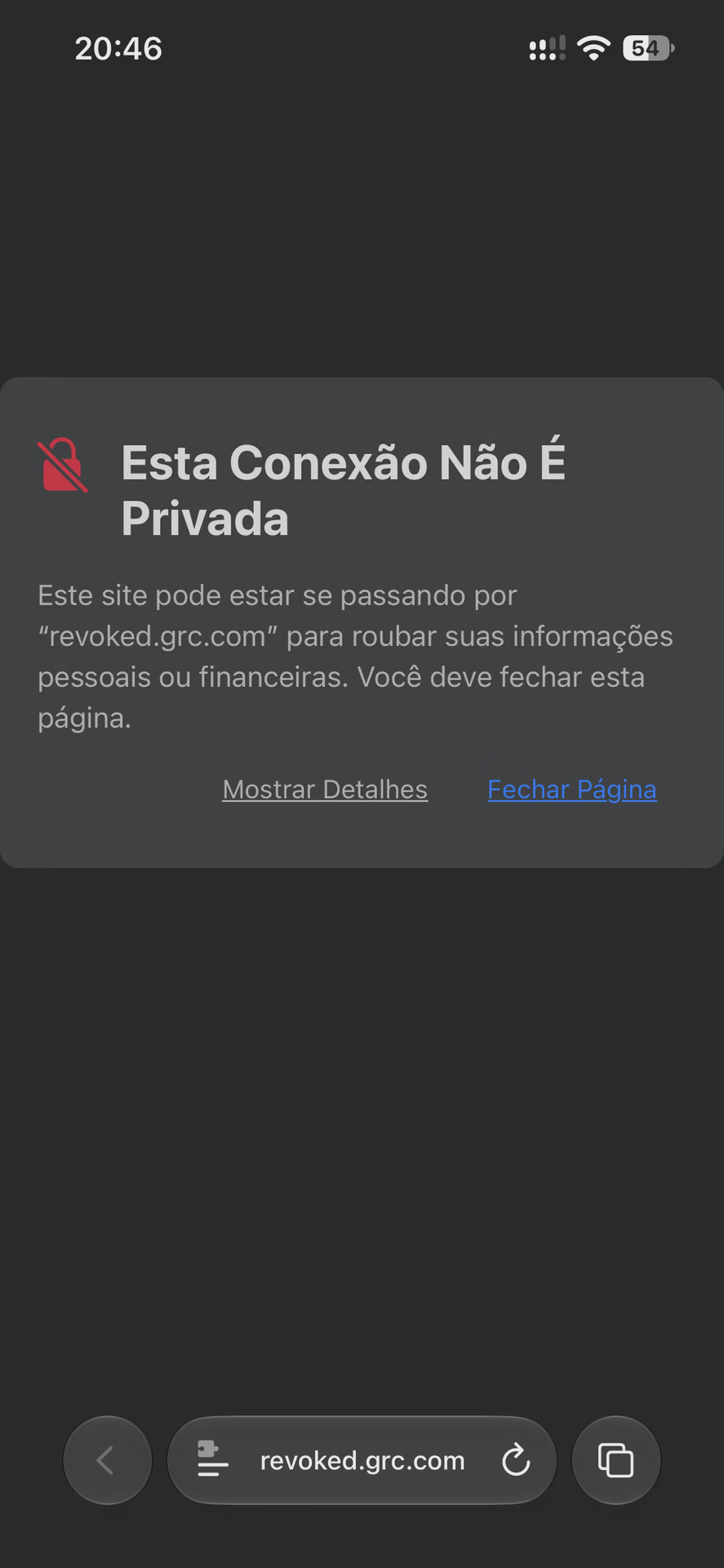
Orion browser (maybe safari?) on iOS detected the revoked certificate, and asked me to confirm before accessing the website while warning about the dangers.
Does regular safari show the same prompt? Afaik, browsers on iOS are safari reskins, so I’m curious if they added his cert in directly again, or if the onion browser actually follows standards the os browser doesn’t.
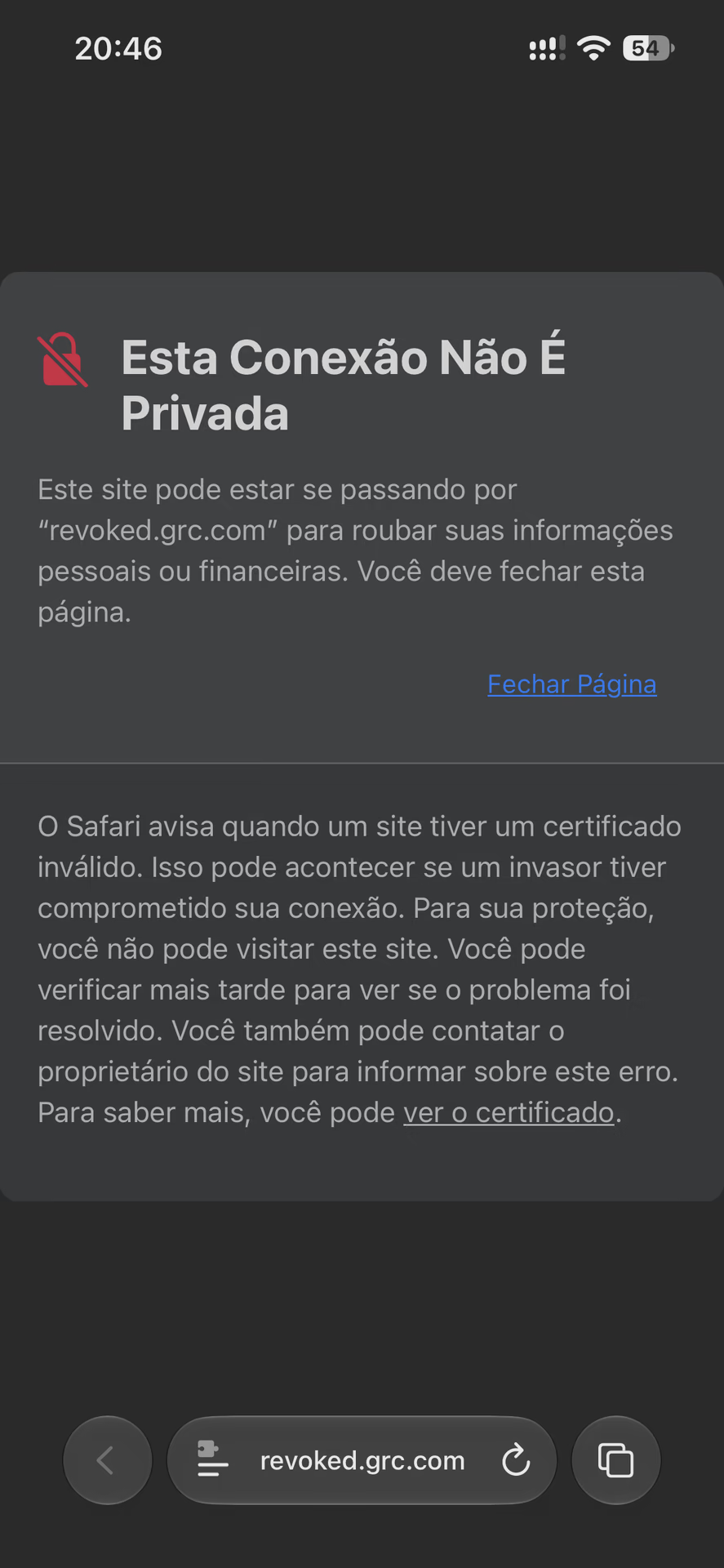
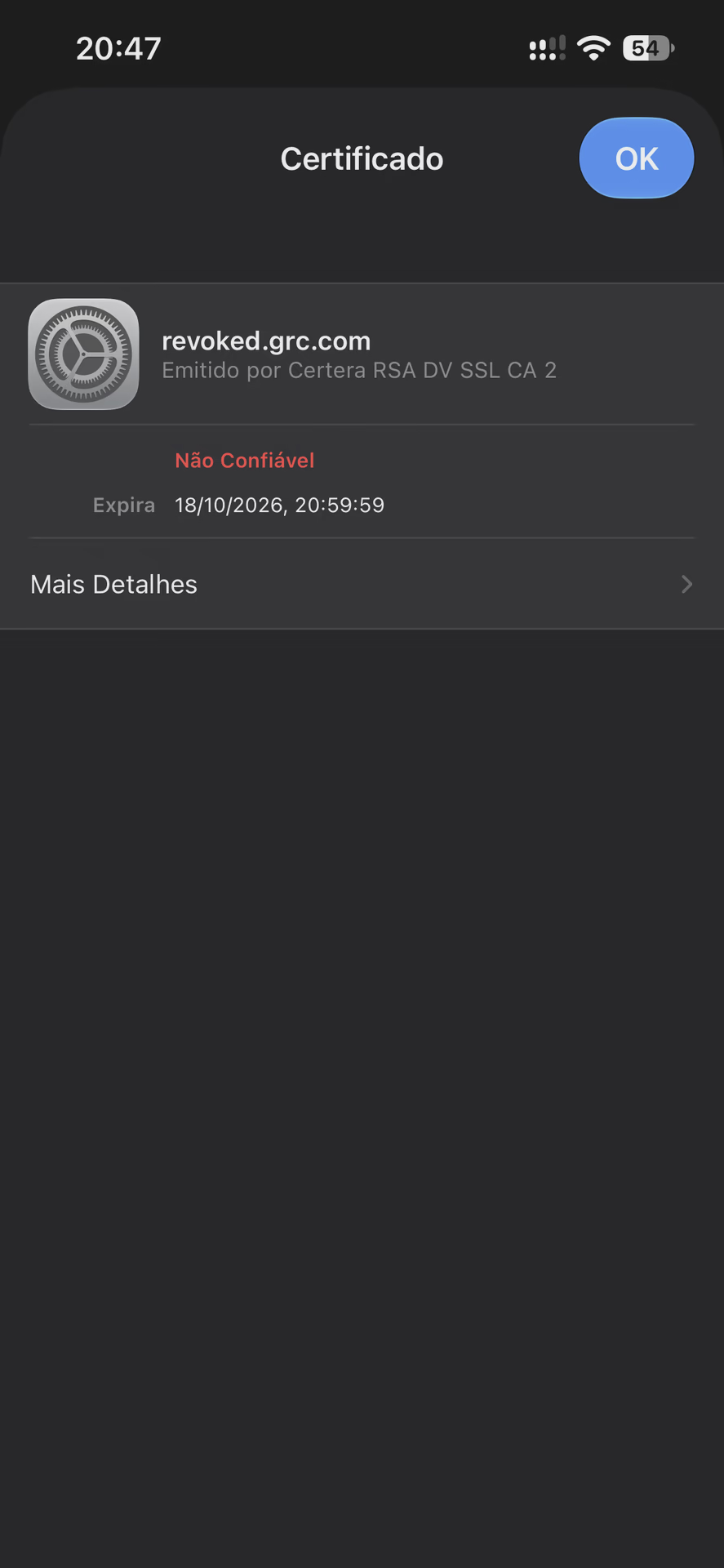
Clicking on more details, only allows me to check the certificate:
Here’s the translated details:
Safari warns you when a website has an invalid certificate. This can happen if an attacker has compromised your connection. For your protection, you cannot visit this site. You can check later to see if the problem has been solved. You can also contact the site owner to report this error.
Are you trying to solve a technica, or political/moral problem? Let’s Encrypt doesn’t create, see, store or log your private cerficates. So, even if they are in the US, I don’t see a risk, and otherwise, the other parts you use in general are probably vulnerable to the problem even if non-US.
For ex. the US could simply order browsers stop validating any certificates not issues by US companies in browsers. And whoosh. Having a non-US certificate won’t help much there either.
@flandish@possiblylinux127 Letsencrypt just has the public keys, no private keys. If Letsencrypt gives my public keys to sam, it does not matter, because public keys are public. My private key is under my administration only.
@flandish Which backdoor? When I request a CA for a certificate, I send the public key to the CA. The CA does a validation and signs the certificate. The CA does not see any traffic from my server. A man-in-the-middle needs my private key, which is under my administration. If I loose my private key, it does not matter if the certificate is signed by a US based CA or an European CA.
@flandish If US authorities want to fake my server, they can use any CA, regardless which CA I originally used. Of course, US authorities can force Letsencrypt to revoke my certificates and block any renewing. This is very unlikely to happen. If it happens, I have to change my CA. There would be a downtime for my private services, but there is no data corruption or data loss on my servers.
Said backdoor isn’t possible with the current day key exchange process. Without the servers in use private key, the most law agencies can do without acquiring the private key is force the CA to revoke a cert, which will disallow properly configured clients from accessing and transferring data with the server.
LE doesn’t have enough information to recreate the private key based off the public key, the only key distributed during the CSR process is the servers public key via a certificate signing request which is signed using your private key, which the CA then signs with it’s own intermediate key (which is signed by it’s root server certificate) and hands back to the private server.
The CA doesn’t have the ability to create that private key, and as such doesn’t have a way to decrypt traffic that is using that key. There is no concern for a backdoor in that process.
In order for the “backdoor” to exist, they would need to either copy the private key as part of the signing process (which it doesn’t), or somehow force the server admin to use a new private key (that the CA also holds) or somehow compromise the servers key generation process to allow for an escrow on the private key when it was generated which would allow the CA to be able to recreate the private key using the master & public key.
Now don’t take me wrong, you can still have a MiTM impersonation attack or a full impersonation bypass by the CA issuing a new certificate and having the DNS registrar have the web address go to a new server that is using the new key but, that’s not something the CA alone has the capability of doing, and any traffic that is issued to the original server still wouldn’t be compromised, its just clients visiting your site will end up at the other site and as such will end up using keys that the other side generated instead of your own keys and additionally said new keys would also be appearing in Certificate transparency logs, or modern day clients would refuse to use them.
The transparency logs would mean that any rouge certificates created would leave a paper trail not to mention there is nothing stopping them from issuing a certificate for any domain of their choosing
I think Let’s Encrypt will stay safe for quite a while, but unfortunately because of the political climate we’re in right now, it may not stay safe in the future.
Any Govt agency with sufficient power can go to LetsEncrypt and have them either decrypt everything or issue specific certificates that can be decrypted and transparently allow man in the middle monitoring. That so much of the internet is using LetsEncrypt makes it highly likely this is all going on. It’s technically possible and the Govt wouldn’t allow LetsEncrypt to operate without being able to do this. Really this is true with all devices and encryption allowed to be sold. Unless you secretly meet all their demands they control all the required certifications and access to be able to sell your products, list them on the app stores, etc. It’s just a good rule of thumb to consider everything has this starting point unless you design and build the entire hardware and software stack to ensure nothing like this can be done. But you’ll never be able to sell it.
The private key is created on your server, not by Let’s encrypt, and it’s never transferred to them. Nobody can decrypt your data.
Certbot (the official ACME client) is open source, but you’re also welcome to use any other client of your choosing, or make your own. The secrets never leave your server.
Unless the NSA has working powerful quantum computers that can break public key encryption, that they are successfully hiding from the public, they wouldn’t be able to break let’s encrypt certificates backed public key encryption, the math just doesn’t math. It would still take the most powerful super computers millions of years to break RSA 2048.
There’s a reason they want to make encryption illegal, instead of just letting us trust it like sheep. Thankfully, we don’t have to trust anyone, it’s all verifiable math.
You’re not understanding Certificate Authorities or what certificate pinning does to stop man in the middle impersonation of firewall traffic. You have no understanding of what the Government is able to do to your devices and internet connection. You don’t have to take my word for it, I don’t care what you think. You just haven’t been a target to understand.
That loophole is Google and probably cloudflare. Google has their own DNS service, a script tag on nearly every website, half the mobile phone market while being the default search engine on the other half, and provides email to the majority of people. Even if you try not to use their services, they still have an enormous amount of information about you.
Or use a ca, vps and dns provider that’s hostile to the west.
It’s not a question of supporting “freedom” and if you insist that it is, I will gladly provide all those services to you for a slight markup (price of freedom!).
It is surprisingly easy to add a custom CA to phones and laptops. When I migrated to services using one with names like thisservice.lan I thought it would be a lot harder. I just have a generation script that makes a new cert and I throw it in NGINX.