posted in Technology

Japan tried to build an operating system for the entire world, then the US government intervened
www.xda-developers.com/japan-tried-build-operating-system-entire-world-us-government-intervened/posted in Technology
Japan tried to build an operating system for the entire world, then the US government intervened
www.xda-developers.com/japan-tried-build-operating-system-entire-world-us-government-intervened/
Excuse me what?

Once again fuck America

Replying to @20cello@lemmy.world
I’d say US/USians, as America is more than just the US. America is composed of more countries like Canada, Mexico, Brazil…
You can downvote me all you want, it doesn’t change anything.
South America, North America, and North North America

The US could mean Mexico though.
How?
Probably referring to Mexico’s official name, Estados Unidos Mexicanos.
Thanks! I never knew it had a longer official name.
People who are adamant about “America is too confusing” are very rarely in agreement with “Afro-Eurasia”, such that if someone says “Colombians are American”, they’re unlikely to say “French people are African” or even “Afro-Eurasian”.
It’s a cultural/language thing, rather than an objective one. There’s no reason that (most) English speakers who don’t call Peruvians “Americans” are any more incorrect than Peruvians who don’t say “Spanish people are Africans” are wrong. But it’s become a whole thing on the internet to say that “USians are dumb and wrong” for not having the same language concepts as other cultures. There are just different numbers of continents taught in different cultures.
But as a tourist, does anyone from outside the US say “I’m American” when they’re asked where they’re from? Canadians at least sure as fuck would never say that.
Nobody is saying it’s too confusing. They’re saying “stop claiming that word for yourself”.
Your examples are incorrect. The equivalent would be if France was called The United States of Europe, and used the word Europeans to refer exclusively to themselves.
Then, naturally, Germans would stop using the word European to refer to themselves because others would think they were referring to France (The United States of Europe in this example).
The USA is one of the few countries on earth to use a continent name as part of its country name. Yet you don’t see too many people saying South Africa should refer to the entire southern part of the continent.
People also don’t seem to have a problem with using “US”, which overlaps with Mexico aka EUM (or USM in English). Like I said, it’s mostly a language and cultural divide. Are you advocating that Canadians or Mexicans should say they’re American, even if they don’t want to? In the English speaking world no one other than the USA says American.
People regularly talk about Europe when they actually mean the EU or the other way around. I think that’s the closest there is, and it’s also annoying.
Replying to @tigeruppercut@lemmy.zip
I read a biography of a Brazilian guy who lived in France during the late 19th century/early 20th century. Everyone in Europe called him an American, and he referred to himself an American when he was contrasting Brazil and France. At one point he went off about how hopeful he was about new plane tech coming out, because it would help “unite Americans across our various countries.” However, I think it’s fallen out of fashion to talk this way in recent years, partially because of USA supremacy, which is I think why people are salty about it.
No idea why you’re getting downvoted for this very valid point.
Because it’s pedantry. I checked 4 dictionaries for america or american. Or just type “america” on whatever search engine First thing for 3/4 dictionaries was the US or its citizens. If anyone ever means to refer to the continent they usually say north/south America or “the Americas”.
Go to any country other than the US and ask a local “Are you american?”. They’re all gonna say the same thing. “No, I’m Mexican/Canadian/Chilean/etc.”
Whenever a word has multiple meanings, you’re supposed to use context to figure out which one is being used. Well, the article title mentions the US government. It’s also a very common phrase with a well established meaning. Check out Green day’s american idiot, for example.
Really doesn’t take a genius to understand what op meant.

Check every dictionary for america or american. Or just type “america” on whatever search engine. First thing is always the US or its citizens.
Exactly! It’s always the first! Let’s check the renowned and proud American dictionary Merriam Webster:
Oh. Huh.

My apologies, my fault for only checking the first 3 links that my search engine gave me, which were Cambridge, dictionary.com and Collinsdictionary.com
And there’s also this. .
But I guess you got me there. I’ll edit my comment to rectify this huge mistake.
Now why would they be referring to Mexico?
America is not just North America you know. It’s a whole ass continent. America isn’t a country, the US is. So when you say America when you actually talk about only the US, it’s as is you were talking about Mexico, Canada, Brazil… as well as the US. Which is… dumb? False? Erroneous?
Literally a hate crime 💀 good looking making sure nobody got confused
Replying to @SuperFola@programming.dev
getting mass downvoted for caring about accuracy because it doesn’t fit the European mindset… what a time to be alive.
Something similar happened to Slovene Iskra Triglav computer which was quite advanced for the time (capable of running three different CPUs) but then caught in between US-Soviet cold war/embargo while trying to sell them to Soviet Union.
Three CPUs with different architectures on one device sounds crazy. That’s amazing.
PS3 comes to mind
Though in embedded, thats fairly normal.
I’ve got a $1 linux embedded SoC that has a 64 bit riscv core, a 32 bit riscv core for running realtime stuff and a low power embedded 6502 on it too because why not.
Cool, which SoC?
SG2002/SG2000 and the CV1800B chips by MilkV
Thank you!

Yeah, RP2350 in Raspberry Pi Pico 2 also has 2 ARM cores and 2 RISC-V cores.
Which reminds me, I purchased one a month ago to play around with as it has good documentation, yet I haven’t used it once so far.
Its actually not seperate cores, they’re RISCV or ARM, based on a switch. MilkV does that too with one of its chips. They’re mostly the same architecturally, theres something like 10% that gets enabled/disabled with each ISA selection.
Replying to @greyscale@lemmy.grey.ooo
But you can still run both at once. RP2350 datasheet
From section 3.9 Arm/RISC-V architecture switching:
There are two processor sockets on RP2350, referred to as core 0 and core 1 throughout this document. Each socket can be occupied either by a Cortex-M33 processor (implementing the Armv8-M Main architecture, plus extensions) or by a Hazard3 processor (implementing the RV32IMAC architecture, plus extensions).
From section 3.9.2. Mixed architecture combinations:
The
ARCHSELregister has one bit for each processor socket, so it is possible to request mixed combinations of Arm and RISC-V processors: either Arm core 0 and RISC-V core 1, or RISC-V core 0 and Arm core 1.Practical applications for this are limited, since this requires two separate program images. The two cores interoperate normally, including shared exclusives via the global monitor: a shared variable can be safely, concurrently accessed by an Arm processor performing
ldrex,strexinstructions and a RISC-V processor performingamoadd.winstructions, for example
My point it isn’t 2x arm and 2x riscv. They recycle most of the silicon used.
Haha look at this dumbass, he thinks being stupid is aspirational.
Low effort. Try harder.
Hope he keeps going, I want to see how many he has…

OSX (now MacOS) was built and running on PowerPC and Intel for years before Intel Macs were released. I assume the same was true before they released the Apple silicon chips.
Yeah but they weren’t running both in the same device at the same time.
PPC -> Intel they just recompiled their OS and fixed it up for the x86 platform, then the same for Intel -> ARM
They did not have a laptop with an x86 processor and a PPC at the same time… though there are some hillariously bespoke accellerator cards from back in the day to do all sorts of strange things.
That said, laptops are full of microcontrollers with firmware, lots of those will be atmega, st32, 6502 and the like. Things like a WLAN or WAN card will be a little ARM soc of some flavour.
So it really depends on where you draw the line. If its executing the main workload, I’d say thats the CPU, everything else is a microcontroller enabling it to do that

6502 to play C64 games of course.
Replying to @greyscale@lemmy.grey.ooo
Original Nintendo DS had two different ARM CPUs for DS games and the same CPU the GBA had for direct compatibility.

The second CPU is the GBA CPU, but at twice the clockspeed (which can then downclock for GBA games). You're double-counting it and making it sound like the system had three.
The 3DS is the real funny one, adding its own new CPU alongside both the DS and GBA CPUs. So that's actually three.
I was probably thinking of the z80 then but that didn’t get included
Soviets did a lot to harm Eastern Block tech. Bulgarian Pravetz was a clone of Apple ][. Nothing impressive but cheap, functional, domestically produced. Can’t really be exported towards west due to blatant IP violations, but the production capabilities were good enough to produce and export hard drives.
Except the trade deal with Britain was blocked by Soviets because it was seen as a security threat, and an industry died in its infancy.
Replying to @hayvan@piefed.world
There’s another future where Yugoslavia is the birthplace of a free software movement, and homebuilt PCs lower the barrier of entry to anybody with some time on their hands, with software distributed by radio and powerline until the advent of internet.
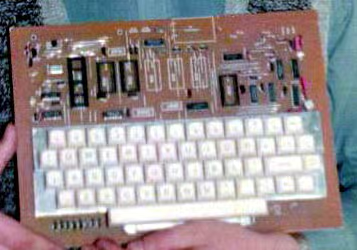 en.wikipedia.orgGalaksija (computer) - Wikipedia
Ah yes, I recently learned about Galaksija, it’s fascinating!
yugoslav.
slovenia wasn’t a country back then
Iskra Delta was a Slovene (republic) company, even within Yugoslavia. But if you nitpick, then technically it would be Yugoslavia as country.

The Socialist Republic of Slovenia was one of the six federal republics forming the Socialist Federal Republic of Yugoslavia, if you want to be technical about it.

Replying to @Mihies@programming.dev
that computer sounds awesome, imagine something like this existed today(like a computer with a RISC-V,Arm64 and X86-64 CPU) .
Developers: 😰
Japan: We are not a vassal state (no really they say this in an argument with the Japanese Communist Party).
Meanwhile Japan:

I’d encourage everyone to read the article. It paints a far more nuanced picture than the headline suggests.
Nuanced yes, but it largely being driven by a Japanese guy who wanted to sell US software and US companies who didn’t want to compete by actually selling compatible hardware is no less damning.
Yeah. That guys “nuance” comment made me read the article, and I’m glad I did, but the end result was my expectation going in; the profit motive of capitalism killed a FOSS OS that could have nullified Americas tech dominance before it even started.
There’s no way to know how it would’ve played out, but I could see Bill Gates’ connected family greasing the wheels of geopolitics to scare the Japanese out of implementing it, or being the catalyst promoting exclusive US proprietary tech rights to Japanese capitalists, or the CIA/NSA arguing that a Japanese controlled FOSS OS would make it harder for them to influence tech standards. Basically, like most things I’ve learned about history, it’s likely that morally and ethically bankrupt, sociopathic, criminals had their hands balls deep in the clusterfuck of a horror show, in many more ways than one.
According to the article it was royalty free and published open standards, but they do not make any claim to this being an FOSS system.
Per Wikipedia…
TRON does not specify the source code for the kernel, but instead is a “set of interfaces and design guidelines” for creating the kernel. This allows different companies to create their own versions of TRON, based on the specifications, which can be suited for different microprocessors.
It’s not even a software project as we know it. It’s a specification like POSIX, and presumably, anything implementing the spec can be certified if it passes a test suite, like UNIX.

It would have been a completely rigged game for a US company to try and sell and TRON products in the Japanese market.
This is exactly why it was protectionism and could have caught trade sanctions had it been more widely adopted.
It gives more details, but it doesn’t particularly make the US not look like a bunch of dickholes whose definition of “free market” changes to shape whatever suits them from one moment to the next.
And people laugh at Rockstar for not showing footage before the leak.
People are sharks. It’s best not to ever preview what’s going to happen. Then you can’t lose.
Sad but true.
Hl3 when.
Next time don’t tell anyone until it’s out.
HL3 is in beta… true story
And I wonder if it was a Unix-like operating system
If you can’t read, guess you’ll never know.
Then no
Replying to @inari@piefed.zip
It’s funny because I trust the Japanese government even less than the American government.
I suppose I’m not that up to date on Japanese government and politics. Can you elaborate?

They have a weakness for the sneak attack.
They paid for that already and your comment is disgusting but expected from an american.
I am not an American, your own prejudice seems to be showing. But of course you overlook that.
They absolutely have not paid for a single atrocity committed during WWII. The government refuses to admit they happened, let alone take responsibility.
I guess getting blown up by nuclear weapons is not enough for you, you must be an american.
Ew, no.
War crimes don’t fix war crimes.
You know they didn’t punish any of their generals or scientists after the war? There was no Japanese Nuremberg.
They refuse to admit all the horrible things the country did during WWII.
I know web design isn’t really related to what the article is about, but if modern Japanese web design is anything to go by, good. Here’s some random product (a phone case) I clicked on from the biggest Japanese online store (Rakuten), roughly the equivalent of amazon. Let me know if the product info seems well organized and easy to read, and tell me how long it takes to find the section that you can choose a different color and model (hint: it’s not at the top or bottom of the page).
Japanese customers genuinely do like it like that. Rakuten do A/B testing up the wazoo just like every other big ecommerce company.
I dunno, amazon japan doesn’t look anything like that and I’m sure they do just as much testing.
It looks exactly the same as Amazon in every other country. That’s a not a good counterpoint.
So amazon doesn’t do extensive testing in countries other than the US?
Replying to @tigeruppercut@lemmy.zip
see now you’re just being argumentative and indulging in petty pedantic point-scoring mental gymnastics for its own sake.
Replying to @skisnow@lemmy.ca
how
ed: Allow me to expand: you think rakuten, a company with billions in revenue, does testing in the Japanese market, but amazon, another company with billions in revenue, refuses to do so? Who’s doing mental gymnastics here to preserve their idealized image of Japan?
No the point is that a Japanese focused company can optimise for a design that works best in Japan without having to consider how other people would interact with it.
A multinational like Amazon has to balance what works best in a particular market with retaining a consistent identity across markets and having shared functionality between different locations.
A multinational like Amazon has to balance what works best in a particular market with retaining a consistent identity across markets and having shared functionality between different locations.
Why would this be the case? If they want to maximize sales in Japan they’d surely provide the best format for the Japanese market, as any views from other countries would be minimal. Maybe if it were in Europe or another site that serves markets that are in close proximity to other ones, but no one’s ordering things from an isolated island with a high population if other options are available. And even with varying options the format doesn’t need to change.
I remember awhile back looking for hot sauce (as in something that’s actually spicy instead of like tabasco bullshit, which is (or was at the time) uncommon in Japan), and the amazon options just listed sellers from the US with high shipping costs. So when Japanese people want foreign goods, why wouldn’t amazon provide a format that “people want”, while still pulling from other markets?
The fact that they don’t do this leads me to believe that the rakuten layout isn’t the only way to profit in Japan, and in fact might not even be the layout that most Japanese people prefer.
It’s almost like they have another culture than North American or European…
And that culture is “random shit thrown all over webpages”? Japan still used a lot of faxes up until about 10 years ago. Maybe it’s just that old people are mostly in charge of things and the society is still largely catering to the whims of random old men who aged into their positions rather than earning them.
I don’t really understand what you’re trying to say, here. Why does Japanese preference for web marketing bother you that much?
What do you mean by “web marketing”? In most countries they’ve moved onto web 2.0, but Japan is still mostly stuck in the past and lots of their sites look worse than random angelfire webpages from 30 years ago.
Have you considered that Japanese consumers like it that way?
Have you considered that they don’t? Microsoft and google are all about anti consumer in service of ad revenue and selling user date in their products these days, but not many people are arguing that US consumers enjoy spyware and less functionality than we had 20 years ago.
Did someone ruin your day or something? What is your problem with web pages from another country? Why do you care?
Lol I live in Japan and the fact that their web webpages suck is a relatively constant thorn in my life here.
I live here, too, and I had a relative visit me from the states. He said the biggest shock was the information density of signage, so it’s not just websites lol. Living here it has become invisible to me, but him telling me that made want to formulate a theory, something like: separate from literacy rates, literate people in Japan are somehow more literate than their literate counterparts in the US, so designers trust their audience not to be overwhelmed by high information density. On the other hand, websites and signage in the US look clean and sleek and simple to the point of feeling dumbed-down.
It’s an interesting theory, but it’s not so much the information density that bothers me, it’s the explosion of graphics everywhere, which feels dumbed down to me in the other direction. Like on the rakuten page I linked, it’s not good enough to list “3 awards” with bullet points and a small graphic, they need 2 screens worth of huge text next to trophies and stars. It’s like they don’t trust their customers to read something unless it’s got giant text the size you’d find in books for literal toddlers and exciting or cutesy graphics to grab your attention. I get standing out in marketing, but it feels unfocused, like they couldn’t decide on the couple things to highlight so you have to scroll past more than a dozen flashy banners to just click on the thing you’re already on the page to buy.
On a separate somewhat related note, the literalness or overexplanation of the information also feels too much. Like they can’t just have a simple title for a movie, manga, or webpage, they have to give a synopsis of the work in the title. Like how Pixar’s Up becomes “Old Man Carl’s Flying House”. Or a site about the history of chocolate isn’t just “History of chocolate and cocoa”, it becomes “What’s the history of chocolate? Also an explanation about the origins of cocoa”. There’s no extra info in that title, it’s just longer.
I get that it’s largely cultural, but if I could posit a theory it might just be like that because it’s always been like that, rooted in how Japan is so slow to change. Ad company shacho rejects ads that don’t barf colors because that’s what he saw in ads when he was growing up. If I could make a somewhat skewed analogy, US TV shows through the 2000s had laugh tracks, but now if a show does that it feels lowbrow, almost bordering on insulting.
Yeah, that was pretty half-baked, lol. I totally agree about domestic titles for foreign movies. To pick another Pixar example, “Ratatouille” is like the perfect punny title, but “Remy’s Delicious Restaurant” is so brain dead it makes me cringe…

If you view it on mobile its right at the top under the price

Yeah on mobile I think it’s okay. Still a bit overloaded but a far cry from what Japanese web pages can be like on desktop browsers. Sometimes they’re like web design stopped in 1999 and since then all they did was add more blinky banners around the actual content.
Every other Japanese site I’ve looked at had a lot more information density than this. Looks like they’ve been plenty affected by crappy modern design.
I dont speak Japanese. is it this?

Yeah that’s it. They like to put it in the middle of the page for some reason.
After dealing with MS’s shit UX all day, that looks pretty good. It seems pretty average for a shopping site.
As a Japanese guy with a Western upbringing, the Japanese website bother me too, but it obviously doesn’t bother people here enough that the companies need to change it. They just grew up with a different way of processing visual info.

Interesting how many TRON Association members were also adoptees of the MSX standard, which had similar (but less ambitious) goals to be "the" world computer interoperability standard. i wonder if that was why they jumped off the project at the first sign of trouble, thinking it was a good thing they didn't keep all of their eggs in one basket. NEC likely ended up outperforming them both with the PC-98 anyway
Is it available on the internet archive or a computer museum site to try out the UI?
And once upon a time there were more than three PC graphics card makers. The paranoid schizo US really fucked up scientific and technological progress.
They rose to the top because they were the only country that could still build things after the rest of the world got flattened in World War II. Then the rest of the world rebuilt itself so the only asset the US had left was economic inertia. They then proceeded to spend decades doing everything they could to increase the value of that inertia by using their influence to encourage policies that resulted the rich getting richer.
And when the Eastern Bloc dissolved, government owned corporations got sold off to western ones, for pennies, all to be shut down in a few weeks. If not, usually they got boycotted, because the kids finally could buy western brands, which made you look cool among your peers.
Eastern Europe sold its stuff away mainly because of local corruption. Local factories would get sold as scrap by one wise guy and a couple of his friends in the budding government fresh after a revolution because they could make a quick buck and set themselves up for more similar opportunities. Also “scrap” claim would take a long time to be investigated and never amount to anything.
And now it’s over, well it might take a decade or so but Europe is rebuilt and the USA is shitting its pants(not because they’re scared, just because it seems).
There also were more than two PC platforms (and we barely have two now; Apple was pretty close to going away too). I miss being the Atari ST guy in a circle of people who all had different types of computers. It didn’t last very long but it was way more fun.
have you heard of Macintosh? you’ve heard of Mac’s right.
little company called Apple? lol sheeeesh
Apple only makes garbage

I don’t use apple products, but I understand their M1 chips are good.
Replying to @inari@piefed.zip
That tracks.
The more I learn about American history the more frustrated I become with our species in general. Our country could be so much more livable now, but for a handful of vulgarly wealthy people who only ever cared about number going up at any cost.
And to make it worse I’m reading a biography of John D. Rockefeller, so I’m about to hate our species just a tiny bit more.

All of our lives could be so much better. We should stop making dystopian futuristic movies, and start making hopeful ones that help people imagine how much BETTER things could be.
We aren’t making any moves. We sit here and let them do it. They’re only human we can stop them
Yeah let me find 20 million dollars to make that movie

It only costs like a few million, the rest is for embezzlement and fraud.
You can just vibe-direct it with AI for the irony! And the lulz!
(/s, please no one do this 😐)
Solarpunk instead of Cyberpunk!
Yeah but nobody would watch it

on behalf of humanity, we aint claiming those shitheads
While you’re in that mood check the documentary Hypernormalization from BBC. Explains a lot.
And when it ends check the year it came our for extra oof.
“Capitalism breeds innovation.”
Also capitalism:
One of the biggest lie to keep the current system in place.
Private corporations parasite themselves into R&D paid for by the government and act like they invented the fire again.
The Internet is built on FOSS and got captured to be sold back to us.
Capitalism breeds innovation just like people leave their partner when they finally have enough to be abused.
No this was capitalism in action. Capitalism bred the innovation in TRON.
Governments getting involved and putting their thumb on the scales to control the economy is the opposite of capitalism.
Say the line!!
“That isn’t REAL captialism”
Lmao
Just like the dumbasses say “the Soviet Union wasn’t REAL communism”?
Except I’m correct. A government implementing protectionist policies to control economic sectors is not capitalist.
It is capitalism. It’s all part of the system.
Except I never said you were factually incorrect, since that seems to be the most important thing for you to get out of this exchange.
Government tipping the scales to help their capitalist mates seems to be exactly how capitalism works.
And North Korea is definitely a democratic republic 🙄🙄
Yes it is - capitalism demands that in fact. You’re thinking of free-markets. Capitalism inevitably destroys free markets.
Replying to @Terrorphin@thelemmy.club
Yes it is - capitalism demands that in fact. You’re thinking of free-markets. Capitalism inevitably destroys free markets.
Lets see if we can agree on some definitions.
What you’re describing as “free-markets” I know as laissez-faire capitalism. This definition came from, unsurprisingly, the French in the 18th century and was used heavily by Adam Smith in the book The Wealth of Nations. I think we all agree there are very few, if any, true large scale laissez-faire capitalism in operation today.
What have in most places is regulated capitalism where there are government rules that change the outcome to a different outcome (sometimes better/sometimes worse) that would have occurred under laissez-faire capitalism.
Are we in agreement with these definitions or do we still have discussion needed to arrive at the same place?
OK sure - if we’re being strict and academic about this - perhaps it would be more accurate for me to say that capitalism in the pure platonic sense doesn’t really exist, and tends always towards crony or state capitalism where the power of the state is used to funnel money and power towards the holders of capital rather than to provide a free and fair playing field for economic actors.
perhaps it would be more accurate for me to say that capitalism in the pure platonic sense doesn’t really exist,
I agree with this without any reservations.
and tends always towards crony or state capitalism where the power of the state is used to funnel money and power towards the holders of capital rather than to provide a free and fair playing field for economic actors.
I take exception with “always”. In the USA for example, there have been many notable exceptions where state capitalism implemented protections from abuses that pure laissez-faire capitalism would have allowed. The National Labor Relations Act was a state action that allowed for collective bargaining of workers. More recently the Consumer Protection Financial Bureau acted as an agent against uncheck capitalist forcing a fair playing field.
I’d probably agree if you changed your word to “frequently” though.
fair - I agree ;)
Replying to @partial_accumen@lemmy.world
Wealth concentration is problematic.
Capitalism on its own doesn’t have any guaranteed and deliberate, measured, studied, tested and understood anti-concentrationist dynamics.
What we get from the cappies instead is a head fake like this: “Check out this example of a corporation losing wealth and its competitor gaining wealth. Now add the magical invisible hand. Therefore, capitalism magically balances itself out.”
But while there is always a rags to richies story to be found, and also an occasional redistribution from one cappie to the next, at the macro level we see a totally different picture.
At the macro level property/wealth holdings concentrate. Reliably. If left alone. More and more is owned by fewer and fewer hands.
And ownership isn’t just about the balance sheet. The owners tell nonowners how to live. It’s about power and dominance.
The landlord tells their tenants how to cut grass, how to aqcept and not accept guests and for how long, what to keep and not keep inside the appartment/flat. Etc. The employer tells the worker how to dress, when to show up and where, what to do, how to do it, and what you can and cannot do on your time off, and it doen’t stop there because there is no line where the cappie says to hirself, “ok, this is plenty of dominance for me, I am satisfied, I will stop making additional demands.” So the cappies tell their workers how to vote, how to organize or not organize, how to share or not share certain information (like about their own salary), etc. Doesn’t matter if it’s legal or if it is enforceable. It works often enough that it makes it worth it to cappies to keep pushing the line.
So not having the wealth is bad enough on its own, but when every aspect of life is tightly managed, including how to think and not to think, capitalism rapes your soul in addition to either keeping you poor, or forcing a neverending hassle, a neverending energy drain on you, unless and until you yourself become a cappie.
That is criminal.
And capitalism doesn’t value anything not denominated in currency. Thus the commons get raped, science is only OK if someone somewhere is profiting, etc.
You get cities that are dirty, dense with money making properties, and little to no space to kick back for free, etc. Anywhere it is not like that is because people pushed back! And not because the cappies prefer ample parks or open land.
Just the fact that the accounting books are almost always the most closely guarded secret of a cappie, that alone, if you are knowledgeable about how power works, should tell you everything about what kind of relationship exists between the various people under capitalism. Workers are roped by the system into projects the details of which they aren’t welcome to know. And the government is also not welcome to audit anything.

No this was capitalism in action. Capitalism bred the innovation in TRON.
Governments getting involved and putting their thumb on the scales to control the economy is the opposite of capitalism.
did you read the article? TRON was heavily backed by the japanese government.
Government getting involved and putting their thumb on the economy is as capitalist as it gets.
South Sea Trading bubble, East India Company, Lake Eyrie Canal, trans continental railroad. Teapot Dome.
The government has ALLWAYS had its thumb on the scale for big business interests and if you think that’s not true I have a bridge in Alaska to sell you.
Right next to some beachfront property in Arizona.

I don’t understand your comment.
You’re listing things and going “BAD” so Capitalism is bad.
A trading bubble is really just economics. Can’t really say Capitalism causes that. The East India Trading Company is mercantilism which as evil as that specific company was the idea of trading goods from one country to another is like the core of our entire economic trade system today. Teapot Dome was flagrant corruption which happens in any economic system, the Canal and the railroad are more examples of labor exploitation which you can easily argue was less bad than the labor exploitation that came before it and led to better labor laws in the country.
It’s like you’re pointing at a gun and saying “FIRE MADE GUN, FIRE BAD!” because guns kill people. It’s pretty caveman.
I mean, capitalist do the same thing with socialism every day. It takes a lot of propaganda to get people to believe that caring for your neighbors = bad.
As someone who supports socialist movements I 100% agree. But I really think the big problem in the world right now is the misunderstanding of capital basically. People think capital or money or anything that involves government is capitalism? Or something? I don’t really understand.
But just because people we might call capitalists pearl clutch about socialism doesn’t give someone the space to do the same back, or really just lie/be ignorant. We can definitely discuss the flaws of economic systems or the system we live under and some solutions. But stamping “CAPITALISM BAD” or “SOCIALISM BAD” literally gets us nowhere.
Hard dissagree, the average American reads at a 5th grade level.
If you want to have a higher level coveraation, sure, but for general messaging: CAPITALISM BAD is the only thing that will get through.
Capitalism breeds protectionism.
Competition breeds innovation. Commercial pressure can be one source of such competition, but isn’t the only one.
Capitalism abhors competition. It breeds innovation only if it serves to eliminate competition.

Absolutely correct, Capitalism will incentivize innovation only as long as it’s profitable to do so. Once a company becomes a dominant player in their industry, innovation actually becomes largely unprofitable.
We can see this play out all the time, this is why industry giants almost never try to outcompete smaller start ups by innovating their products and services, instead, they either crush them out of the market via a bunch of different methods. Or they just buy them out, kill off their IP, or if it’s way better, they just brand it as their own, and usually fire most of the old staff.
In a Capitalist system, this actually creates a whole new incentive structure where start ups will try to grow as fast as possible with the sole intention of getting bought out by an industry titan, making the founders of the start up filthy rich.
lemmings blaming everything on capitalism
also lemmings: scrolling on their apple iphone that also had a gui decades ahead of its time in the 80s
I don’t think I’ve ever seen a profile with a comment history this bad. Ever stop to ask yourself why you have such unpopular opinions?
replaced the tree-structured directory hierarchy with an arbitrary directed graph.
TBH that sounds like a total nightmare
I dunno, I kinda fw it. Like having a tag-based system for grouping files instead of nested folders does give me less anxiety in organizing everything, and it lessens the bloat due to duplicates
Look up what a hard link is

A hard link is an ugly hack compared to this.
Replying to @chunes@lemmy.world
Yeah this OS would suck as soon as the 00s hit with the global Internet. This OS seems completely incompatible with how the world actually works and would probably collapse under its own design by the year 2010. A file is an arbitrary string of bytes. Removing the ability for the user to handle them like this is so obtuse. The reason why we can poke modern OSes the way we can is to prevent requiring a man-year of work every time we need a major new feature.
The idea was that every layer, from silicon to user interface, would be designed together, with no compatibility debt to existing platforms.
And then infinite compatibility debt to itself!
Replying to @LodeMike@lemmy.today
A file is an arbitrary string of bytes. Removing the ability for the user to handle them like this is so obtuse.
Per the article:
According to the BTRON3 specification, the first two halfwords of an application ID are the data type it applies to, and only the third distinguishes rival handlers for the same type. When a document contained writing, a table, and a figure, opening those parts made the system launch each one’s registered handler to draw its own content inside the parent document’s window. If no handler exists, or the handler fails to draw, the system strikes a diagonal line through the region where the content should have been.
That’s a window manager with application/file associations, with the ‘window’ that the application draws to being embedded within a hypertext document. So, you’d be able to attach arbitrary hypertext to a file and when you open it the window manager presents that information along with the application window. That’s not any less flexible or more limited than any other desktop OS.
EDIT: now, it sounds like you could embed multiple ‘windows’ within the same document, and maybe do something with transclusion, but I haven’t read enough about how BTRON worked to say much about that. Still, that doesn’t fundamentally change what I wrote above.
That sounds like hell. The .DS_store problem but 100 times worse.
Replying to @LodeMike@lemmy.today
Every single mainstream operating system has metadata and index stores associated with its files and applications.
Linux has locatedb and .desktop files, and many other files that determine how content is presented to you in a desktop environment.
Windows has NTFS alternate data streams, the registry, multiple appdata folders, and a bunch of other kludges.

So you’re saying the US saved the world from Japan for a second time?

did it handle anything other than documents?
No, sorry, that will take 10,000 hours of labor to implement and will not support video codecs that were published a decade ago :3
Linus Torvalds: “I’m about to end this government’s whole career.”

Japan tried to walk where Terry Davis was running laps

Replying to @inari@piefed.zip
Was it because of this guy?





That’s reminded me, I should watch steamboy again…
It’s time for other countries to create their own operating systems again
Make other countries create other operating systems again
We’ve been doing it for a long time. Linus is from Finland.
Currently, Linux Foundation resides in the US, though.
what counts as an “operating system”? is it enough to just create another linux distro? is it enough to just fork the distro and add a new visual design to it?
Replying to @gandalf_der_13te@feddit.org
(Sign) I just want other countries to create good operating systems again
I’m tired boss
Be honest, you just hope that the sheer amount of resources will lead to some country finally finish en.wikipedia.org/wiki/GNU_Hurd
Replying to @plyth@feddit.org
Yeah, I just want another decent os
MOCCOOSA
Bless you
Fish is good to eat
Bring TRON back!

Reminds me of Microsoft killing Nokia and their new Linux phones.
I doubt it would’ve won anyway. There were loads of OS’s at that time, most not having the issue of the US government intervening, and none of them won either.
Had the japenese not been spooked by the sugestion it waa a threat(which was cleared up as not being one) it totally could have been adopted nationwide, as it was ready to deploy to their schools.
And today we have BSD as the basis of Apples OS.
Microsoft has gone from say 85% market share down to the 60s now I think.
Maybe we will see a day MS loses to Linux since that hit 10% use last month, and has over 15% use in India.
MS certainly is not helping themselves win lately.
Replying to @BCsven@lemmy.ca
You’re including Android, server, and embedded numbers for Linux right?

gs.statcounter.com/os-market-share/
…steampowered.com/…/Steam-Hardware-Software-Surve…
I cannot find a source for the 10% claim, highest I found within a minute of searching was ~7%
There are reports from March 2025 that show 2% however I did not see how that number was reached.
On Wikipedia they show 3.9%(rounded) and a giant unknown number. en.wikipedia.org/…/Usage_share_of_operating_syste…
I’m convinced that it becomes much harder because every operating system has a different name for the user agent.
My speculation is that most data is just pulled from cloudflare. However I got bored at this point and only found macro statistics like Mobile vs Desktop or the browser application used.
radar.cloudflare.com/adoption-and-usage
Pretty cool information though.
No Desktop only. There were articles about the 10% recently. India has been 15% for a while. Steam Deck and SteamOS seems to have given a boost to Linux adoption in the last 2-3 years
Could have? Maybe. Likely would have? No.
Based on what?
Are you assuming a threshold moment, would happen the same under different circumstances?
Replying to @BCsven@lemmy.ca
Burden of proof bro. I’m not the one claiming that it likely would have.
Replying to @jama211@lemmy.world
But changing events changes outcomes. They were poised to deploy in schools. That is the number one way to get user adoption for life.
Replying to @inari@piefed.zip
I remember seeing it somewhere ages ago, might not be correct.
It was saying the reason why Microsoft was dominant on OS market right now because it was Sony didn’t wanted to invest in operating systems back then.
Turkey tried to push Pardus (a debian based distro developed in Turkey) in its earliest days as a national OS alternative that on a proposed law would be required to be listed as an option you can choose when buyjng your computer, then Bill Gates stepped in to have talks with the government and that law idea stopped.
Currently they’re on another push by having it be taught on computer lessons and forcing it on smart boards, but the effects it could’ve gotten back then would be crazy.