posted in Technology

Fairphone Is Finally Selling Its Repairable Phone in the US
www.wired.com/story/you-can-finally-buy-a-fairphone-a-sustainable-repairable-smartphone-in-the-us/posted in Technology
Fairphone Is Finally Selling Its Repairable Phone in the US
www.wired.com/story/you-can-finally-buy-a-fairphone-a-sustainable-repairable-smartphone-in-the-us/
This is incredibly exciting news. It will hopefully be quite some time before I need a new phone but I’ve always wanted the option of this brand when I finally do.
Now make it for Graphene

Preferably before my Pixel 6 is EOL later this year…
You either have to wait for Motorola or get a new Pixel.
Replying to @EvergreenGuru@lemmy.world
I’d choose any other company over Google tbh.
My last few have been used off ebay. Pixels really are mediocre phones these days. And the deals on used A series aren’t as good as I remember.
Pixel 5 was the last good one.

Replying to @EvergreenGuru@lemmy.world
For my Pixel 6 Pro I think I’m going to wait for Motorola or the low chance that a Linux phone becomes daily drivable, and even then considering my budget I don’t think I’ll switch until enough stuff breaks. Although I wish they’d extend updates for at least the few months before their phone releases so people aren’t left hanging

You’ve got a month, FYI…
Does official pixel eol affect grapheneos?
yes, they only support devices still supported by Google updates. When a pixel is eol’d, graphene stops supporting the device
Wow, thats dumb.

Graphene is only on pixels, why not their /e/os?
Why not posmarketOS?
All of the above, preferably

That’s definitely possible, although it will take some work, because the processor is different from the Fairphone 6, which is currently running post-market OS already.
It won’t take any work, Luca has confirmed the image works on both Fairphone 6 and Fairphone 6+
wiki.postmarketos.org/…/Fairphone_(Gen._6)_(fairp…
its on the wiki now too
Oh sweet, thanks

I love Linux as much as the next guy but I’ve got PostmarketOS as well as Ubuntu touch running on a Fairphone 4 and the experience is far from polished, postmarket doesn’t even do VoLTE.
Not saying it sucks - I love it. But it’s not for everyone and unlikely to replace android for most use cases at the moment unfortunately.
postmarket doesn’t even do VoLTE.
Well do i have good news for you!
Yeah I think it just doesn’t work on the FP4 yet. At least I haven’t managed to get it working. On Ubuntu touch it also took years (although that community is also very… special)
they got the camera kinda working on the 6+ yesterday too catcrafts.net/…/fairphone-6-postmarketos-working-…
I want postmarket so bad.
They did actually get a camera working for fairphone 6+, yesterday, kinda, mostly catcrafts.net/…/fairphone-6-postmarketos-working-…
I need an ok camera, ok video, gps, volte, sms, and ~18 hours of battery life with maybe 6-8 of it active.
Graphene is only on pixels
Only because Pixels have met their hardware requirements. They are going to start working with Motorola now.
why not their /e/os?
From what I understand, the two OS are not aiming for the same objectives. /e/os is a degoogled OS and that’s its main purpose. GrapheneOS is focused on hardening security on AOSP.
/e/ os is not degoogled.
On some technical level you may be correct, but their site claims that /e/os is degoogled.
/e/OS is a “deGoogled” version of Android OS. It has an open-source Android OS core, with no Google apps or Google services accessing your personal data.
- Google default search engine has been removed from the OS everywhere and replaced with our new ethical search engine: Murena Find
- Google Services have been replaced by microG
- Connectivity checks do not use Google servers
- We do not use Google’s Network Time Protocol servers
- We do not use Google’s Domain Name System servers
- Geolocation uses BeaconDB Location Services in addition to GPS
So I would love to know more about what you’re talking about.

This comparison chart shows which parts of /e/OS are not deGoogled:
https://eylenburg.github.io/android_comparison.htm
their site claims
Yes, they lie. GrapheneOS is the only fully degoogled android based OS, full stop.
Yes, they lie. GrapheneOS is the only fully degoogled android based OS, full stop.
What are they lying about? What part of their OS is not degoogled?
Awesome thanks for the link
Buy a Pixel or wait for Motorola to release their GrapheneOS compatible smartphone.
I haven’t heard of this. Looking into it there’s at least a year wait. I’d consider it - though my Edge 2022 battery may not make it until then. Damn thing was crap from day 1.
I am pretty sure Motorola plans to sell flag ship devices with GrapheneOS preinstalled. They won’t support old devices. Also the manufacturer needs to still ship firmware updates for a specific duration for GrapheneOS to support it.
I meant more like if I am forced to get another phone before it comes out. I should at least try to put a new battery into my edge and I’ve done it for several phones but there’s always that 10 percent chance you might bork your phone.
GrapheneOS already announced a direct partnership with Motorola, so they clearly already figured that out officially.
Motorola also promises 7 main Android version updates for their phones now, like Google for their Pixels.
I thought the deal was they shipped with normal OS because of existing deals with Google over Android but that they would have unlocked bootloaders so that the end user can install it.
Also it’s limited to their very high end so expect $1000+ USD.
Been burned too many times by Motorola. They always promise but I have rarely seen them deliver.

I thought Fairphone was one of the few supported phones. Perhaps I’m thinking of a different phone OS.
No I think you are thinking of calyx.
It wasn’t just the update cycle either, it’s that they don’t have the physical hardware chips to support Graphene’s minimum requirements for security, which would severely weaken any benefits you actually get from GrapheneOS.
not any, but some benefits, and GrapheneOS maintainers are perfectionists
Entirely lacking disk encryption for typical users due to not having a secure element is a pretty major flaw.
It’s also missing hardware accelerated virtualization which is necessary for much of GrapheneOS’s sandboxing, has weak security for other keys in the OS keystore, is missing hardware memory tagging which makes it much easier for apps to use overflow attacks, doesn’t have proper verified boot support once a custom alternative OS is flashed, and leaves exposed debugging APIs even when the phone is locked.
This breaks:
At that point, GrapheneOS can’t physically provide you essentially any security anymore.

It really depends on what security level you want out of a phone. Most people are concerned with a pickpocket stealing and being able to access everything. Most of the world doesn’t need the security level required to pass through the united states border control. Which they will just force to put the pin anyways or put you in jail for even having a secure device.
Well sans duress password being a good idea now, when you get to the border, you can either unlock it or they’ll just confiscate it. You don’t get to be on their list and go through with a phone because they can’t manage to decrypt it.
It really depends on what security level you want out of a phone
It does, but that’s exactly my point. GrapheneOS will provide you essentially no more security than any other alternative Android operating system, should it have to operate on a Fairphone with all those features not supported by a Fairphone stripped away.
Unless Fairphone adds more hardware security features that are standard on most other phones, and highly supported on Pixels, installing a heavily crippled GrapheneOS on a Fairphone would get you essentially none of the benefits of GrapheneOS in the first place.
once again, that is completely false. I’m fed up with all the people pretending that all grapheneos adds is hardware security.
If the features you want are still in software like degoogling, you have other options available
I am already using a custom rom that is somewhat similar, but there are a dozen of unique features in graphene and nothing else that I have listed in another comment in this thread.
Then ask for them to get ported
Entirely lacking disk encryption for typical users due to not having a secure element is a pretty major flaw.
all android devices have been using file based disk encryption since several Android versions now.
the others are all good to have security features, but lets be honest, a proper sensors permission toggle does not require any of that, just like a dozen other features only GrapheneOS has. storage scopes, contact scopes, pin scrambling and the requirement of fingerprint + pin for unlocking the lock screen, duress pin, the user profile improvements
all this does not require any hardware support.
all android devices have been using file based disk encryption since several Android versions now.
All Android devices are supposed to support it, but not all do. (or at least, not all do effectively without compromising the cryptographic root of trust by not implementing proper hardware security chips)
I’ll grant it to you on the scopes, PIN changes, etc, but realistically I just don’t think anyone can justify GrapheneOS being something that should be supported on Fairphone given how absolutely desolate the phone looks with regard to any attempt at all to hardware security.

While that is true yes, their whole brand is built on being secure.
If they release to Fairphone it won’t be long before the news is flooded with “Police easily bypass supposedly secure GraphoneOS”
And that’s not a look they’d want.
I like their stance on All or Nothing.
Motorola is shipping with GraphineOS soon.
While that is true yes, their whole brand is built on being secure.
but if calyx would take their features they would be screaming loudly how unfair that is
If they release to Fairphone it won’t be long before the news is flooded with “Police easily bypass supposedly secure GraphoneOS”
that part I can understand. maybe release it under a different name, but they are probably not interested in that.
their code is open source, but they were so hostile with every other part of the free android community that nobody wants to deal with the shitstorm that would happen if they took patches from graphene.
This is news to me, how were they hostile?
I would think they’d be happy if others also implement security features
initially the founder had issues with an old project member, who founded copperhead os, a competing rom. allegedly he took all the code from graphene for use in copperhead, without attribution, and it even involved money some way. these two were suing each other for a long time, there was brigading in chat rooms and forums and whatnot. then somehow the rage extended to other projects too, like f-droid and calyx os, which they also accused of brigading and more, so that anyone mentioning calyx os in graphene rooms gets banned from there on sight.
I don’t have enough information to be certain about which projects were actually hostile to graphene and which not, but people have been calling the graphene founder paranoid for thinking everyone wants to destroy their project. the founder was writing a lot on twitter and other places, mostly (but not only) with tye official graohene os account. he stepped down from being the project leader a year or two ago.
You are correct.

There’s one dev who’s been hard at work making postmarketOS work for FP6:
It doesn’t sound possible on the FP6 or FP6+. But maybe in the future? If people keep asking them (politely!) they might consider adding support for the 7 or 8
It’s never good enough
I’ve “read my last free article”.
Fuck you, Wired

No, see it was meant as a threat.
You read your last free article, kid.
Sorry you got twisted up in this scene.
From where you’re kneeling, must seem like an 18-karat run of bad luck.
Truth is, the game was rigged from the start.
Wish I had the time for another playthrough…
Wired subscription is pretty cheap and they do good work.

Have to learn that somehow, but hard paywalls make it impossible :/
They also had a data breach of all their users a few months ago so…
Removepaywall.com
I just used it to pass that bullshit message for a different article
Just disable javascript. Ublock can disable it for specific sites
Not worth the effort imho
Well, it’s less effort than opening another site to remove the paywall

How dare they try to figure out how to stay employed
If you clear cookies all the time, every read is your first read
Rather just not read it

has no one here ever heard of anti-paywall filters or bypass paywalls clean filter? perfect with ublock origin on firefox btw.
$650 and no Verizon service
Replying to @thagoat@lemmy.dbzer0.com
There is Verizon service, you have to buy from the US store. But then it is Android and not /e/OS … it took me a while and a fair number of AI tokens to full figure that out.
trl;dr it is a hardware cert problem why the EU version is T-Mobile and the US is VZW/ATT. I still couldn’t figure out why the US-VZW/ATT version can’t have /e/OS but it still smelled like obtaining certification is the problem and there doesn’t appear to be any public statements on a timeline for it.
If you want privacy, buy a pixel and flash GrapheneOS.
If you want modularity/repairability buy a Fairphone.
Is the bootloader on the US version not unlockable? If so you can put whatever OS you want on it.
Yes you can put whatever COMPATIBLE OS you want on it. Sadly GrapheneOS isn’t one of them. But again, you’re not wrong. I was just highlighting what I found about the options and their trade-offs.
Replying to @jumperalex@lemmy.world
According to the fairphone website, the reason it’s incompatible is because the hardware does not support the lte channel that us Verizon service operate on, leading to unreliable service. No Ai tokens necessary.
It doesn’t ahve all the hardware needed for all the channels. It DOES however have enough to actually work. Verizon certification is a well known difficulty.
And none of that explains why the US Verizon version doesn’t come with /e/OS
I use mine on Verizon, but it gives 4G only. It’s unlocked, so you can switch anytime.

That’s exciting. Does anyone know how /e/os compare to stock android or graphene? And should we be worried about Murena messing it up, or is it a solid company?
I’ve been using the Murena fairphone for about 8 months now. Has its ups and downs, it uses microG to simulate play services. Most things work except for my Samsung watch and the wallet. Feel free to send questions my way
Cool, any issues with annoying apps like banks requiring play protect or something? Is there an Android auto equivalent or an emulation to allow use in a car?
No issues with banking apps in the Netherlands, Android Auto works!
So far so good with banks, haven’t had any bank apps not work (and do use some large and small ones). Honestly haven’t tried Auto yet though
I’ve been using /e/OS for 1.5 years. It’s okay.
Murena seems to be a bit overwhelmed with the project. Slow security updates. Slow bug fixes, even with privacy bugs. Slow customer support. A cloud outage. Community support forum and chat work fine (unfortunately the chat is on proprietary Telegram).
We can help Murena hire more developers by buying devices and Nextcloud service from them.
AOSP-derivatives depend on Google’s development of Android and can be sabotaged by Google. The sustainable solution is something else, maybe a real Linux such as Jolla Sailfish OS, PostmarketOS, etc.
oh that bank list is great, thanks for the analysis!
I have FP6 /e/OS since last November. In begining I noticed issues with battery usage but the issues are resolved now. Banking works for me. And that is pretty much it. I like not having spyware in my pocket, nice feeling :)
€600 is the minimum for a Fairphone. A new cheap one by a major brand would be €150. I’d definitely like some privacy on my phone but damn.
It’s 150 because they’re subsidizing the phone so you’ll pay for service, addons, and so they can sell your data and bloatware. Fairphone isn’t expensive, the other phone is artificially cheap.
You’re right. They do get us with all the bloatware and other nefarious stuff. Time to start saving.
They’re kinda comparing apples and oranges, fairphone doesn’t really have a budget phone.
They just have one model, which they gradually upgrade the hardware of and gives a new number.
Right now there’s barely any sellers of a Fairphone 4 as an example, and you’re able to get it for ~400 euroes from refurbished condition sellers.
Most brands, continues to sell old models. Which ends up as the budget phone 3 generations down the line. But fairphone doesn’t, they only sell a fairly powerful phone from new condition.
It’s the cheapest they have, but not really a cheap model. Those are pretty decent specs for the price. Unfortunately I don’t know any smartphone selling for under 200$/€ that doesn’t suck.
Unfortunately I don’t know any smartphone selling for under 200$/€ that doesn’t suck.
Tbh, I was going with prices from years ago when I bought mine. It cost me €150 and still runs today’s apps and the battery lasts a day. Problem is no more updates from the vendor (and lack of privacy).
Replying to @eager_eagle@lemmy.world
FF3 can be bought for under £200 second hand and that doesn’t suck. FF4 if you are lucky may fit into that price range too.
What’s ff3? I only get final fantasy stuff
Fairphone costs cheapest in carbon footprint and disruption caused to copper mining communities.
It’s more expensive for you, sure, but it’s the least costly option in grand scheme of things.
If you are looking for budget phones, get a FF3/4 second hand. That is what I did and its great.
What phone can you get for 150 that has a user replaceable battery, that is made with sustainable materials and that pays the workers over minimum wage?

Ha. Most of the fairphone community is pretty meh about it.
I have one though and my biggest complaing is lack of the national payment app.
Biggest problem with mine is it keeps smacking into walls and doors in my pockets when I walk around the house. It’s so big, often falls out my pockets too.
Probably more of a problem with my pockets tbh, but its all my shorts.
It is huge, as all are these days. If I wanted a tablet, I’d buy one. I’m seriously at the point where I’ll soon get rid off my smartphone and stick with only a dumb phone and PC. (And once they get through with the ID laws, the PC might lose it’s internet priviledges as well…) I just want a small phone??
Cool! I bought mine through Clove several months ago. This is great news! The Fairphone 6 is a pretty good phone. I’m happy with it.
The power button + volume buttons are in the perfect place…. for accidentally taking screenshots!!! :( That’s the one thing I don’t like, but everything else is good.
Oh, and I wish I could use either SailfishOS or at least Graphene. But, still. I don’t miss my old Pixel.
Oh yeah I have so many screenshots from picking up my phone
yeah thats super annoying. my only other gripe is it will randomly decide to switch to some european mode and restart itself. that might be an e/OS/ issue though.

Cool. But, which repair centre has the contract for bricked phones. In Europe only one place has the vendor key thing if you fuck up while flashing the device, they won’t let users or other repair places have it so I assume it works the same in the US.
If I needed a new phone, I might get one of these. Repairable phones are cool.
WOOHOOO
I can’t wait to get mine!
I’ll be that guy. No headphone jack, no sale. As others have said, I’d love GrapheneOS as well, but I know why that isn’t in the cards.
Is it not worth repairablity and potential headphone jack upgrades? Their pr is really moving quick now… 🤔

How would they sell a headphone jack upgrade?
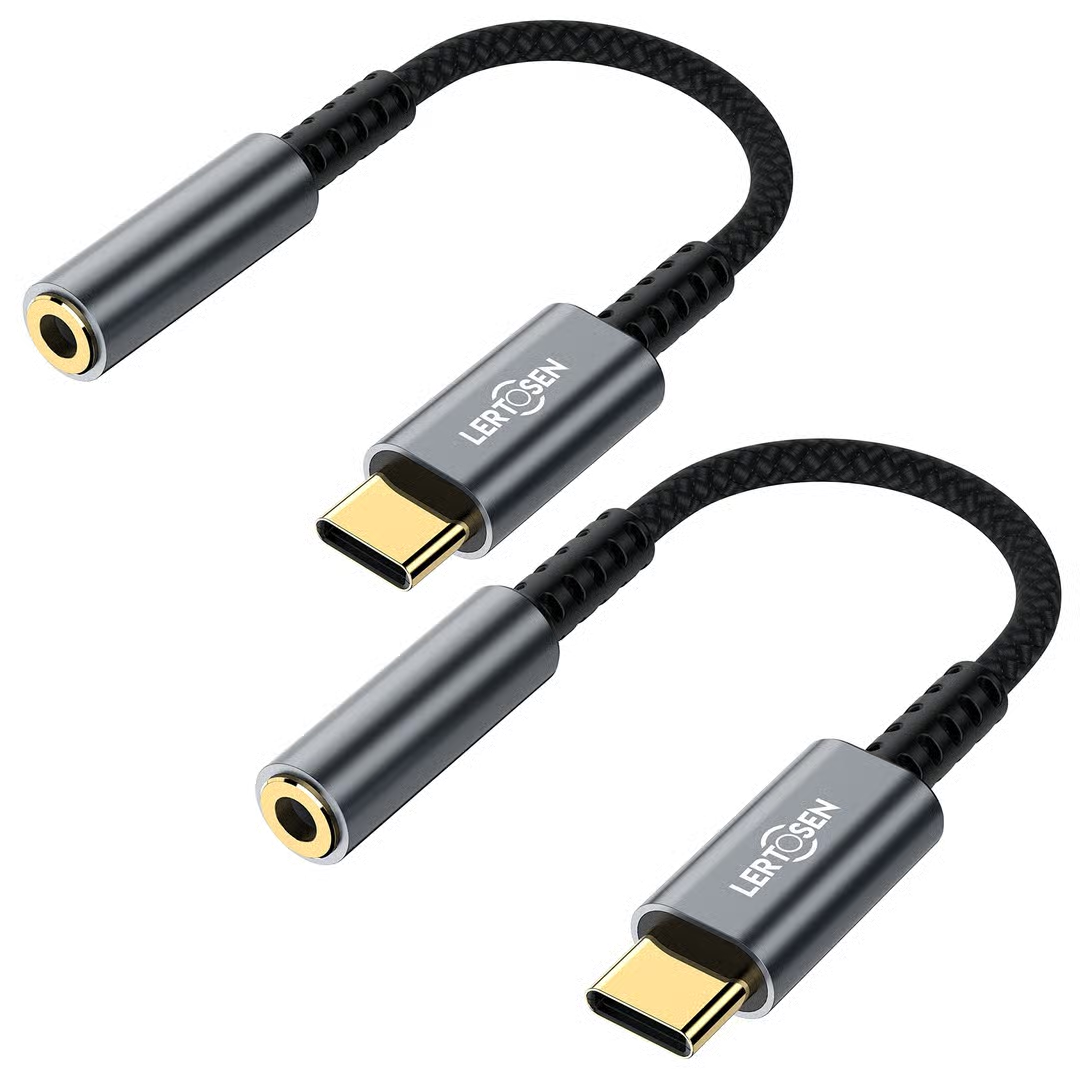
That’s not the same thing. There’s also nothing worse than being on a long journey wanting to listen to music but needing to also charge your phone before you reach your destination.

they make em with a usb-c + 3.5mm -> usb-c still not the same, but a way to get by
I use one of those every night and they're awful. I buy them 5 at a time because they're not very durable, and you end up with this especially irritating tangle of cables.
it’s always something.
Listen man, if the phone doesn’t have a 3.5mm jack, IR Blaster, FM radio receiver, pop out rotating 6mp camera, micro SD slots, 2g compatibility, Native flash support and a physical keyboard that pops out like the fucking matrix, then it’s a complete piece of corporate shit and you’re a complete neo liberal bum bandit if you think otherwise…
don’t forget the nipple blasters, bidet, shower squeegee, AM radio, FM radio, CB radio, xray, zray, and replicator.
Screw that microSD slot, give me the full fat SD slot like my Treo 650 had back in 2007! The spring loaded kind so I can lose yet another SD when I pull the phone out of my pocket and the card snags on my jeans and goes flying and I don’t realize it until I’m 30 minutes away from where it happened, and now some guy in the AutoZone parking lot has my dog photos and Space Trader save files.
Space Trader
Uuuh, space trader, that’s a name I haven’t heard in a long time. I played it on my Palm Zire back in the day.

I mean you’re obviously being sarcastic.
but why cant phones have a radio receiver? That would be super useful, and something I’d use often.
Some phones do have built in radio receivers. If that’s genuinely a feature you want, they’re available.
I’m not sayin it doesnt exist, to be clear, but the only phones I’ve ever seen that had built in radios were, like, asian market phones. Nothing that’d work on my area.
That’s fair. There are some available in other markets but they’re definitely fewer and further between.
Well, bluetooth, wifi and cellular are radios, so my guess is it depends on what frequencies you wanna cover and how much extra you are willing to sacrifices in price & space.

Do you have phone recommendations? I like your list.
Okay but I sure miss having a phone with an IR blaster. Was quite fun to sit in the corner of an empty restaurant and change the channel on the TVs that show the menu back when I was a drunk gremlin
Well the phone’s modular for a reason…
I don’t think it’s modular in that way
I suppose you’re right. :(
Replying to @zod000@lemmy.dbzer0.com
Yeah, no jack no thanks …
Not a deal breaker for others but it is for me. Their rationale saying that the USB-C is more resilient than the jack is weird because I’ve never had the jack fail and even if it does isn’t that why you’re selling a repairable phone to me …?
Anyways, I see they’re selling earbuds so I’m going to assume that that’s their main motivator.
I’ve had several 3.5mm jacks fail. I’ve yet to have a USBC port fail, but I’ve also had fewer USBC ports and for fewer years.
I’ve had them both be problematic. Nothing deoxit can’t fix.
Headphone jacks have a hell of a lot of leverage on that port. An IP68 headphone jack is honestly pretty bulky.
I’d rather have one. I also also like us to go back to phones that are 1cm+ thick and just fill it out with battery.
Yeah it’s pointless having a super thin phone if the camera array is still an inch thick

Oh oh oh I can do this one.
6 USB-C port failures in my 1.75 years with the phone.
Fuck HMD Global (then Nokia brand) and their absolute trash USB ports.
6 USB-C port failures in my 1.75 years with the phone.
That’s wild.
I had a micro USB charging port give me an issue once, but I’ve never had a program with a headphone jack or USBC port. Wow.
Whatever reason q company give for now headphone jack is always bs. Its plain and simple they wanna sell you their wireless earbuds.

because I’ve never had the jack fail
Interesting, when I was still using wired headphones I’ve never had a jack survive the lifetime of the phone, and only on my Nexus 5 was I able to replace it
I’ve had GrapheneOS for a little bit now, and while it’s great that ‘Google’ has been stripped from it, but the giant warning that you can’t avoid when restarting the phone, so many services simply breaking, it feels a lot like the old days of custom ROMs. Maybe for certain people it can be a daily driver, but goodness it’s difficult to diagnose and fix bugs when it all comes back to Google permissions and services that you really can’t get around.
I’ve been using it for almost a month and I’m a big fan. I was planning to wait for the Motorola phone but my screen on my old phone was rapidly becoming unusable.
I’m using it to divorce Big Tech. I created two secondary profiles, one for work and one for Big Tech. The Big Tech profile is where I’ll enable Google services and permissions. I don’t let it run in the background so once I switch back its like I turned off Big Tech. I can still use all the apps and services I’m used to, but I added enough friction that it’s causing me to explore alternatives every day.
My owner profile has Play and Play Services totally disabled. I get push notifications for Signal using Sunup for UnifiedPush. I get apps mostly through Accressent, Obtainium, and Aurora. If apps complain about missing Google services too much, they get relegated to the Big Tech profile while I find an alternative. Most of the apps that complain about it (like Ring) still work fine. Most of the “apps” I use are just PWAs that run in Vanadium and have icons on the home screen.
The biggest issues I’ve had were around RCS messaging. I was able to get it to work in the Owner profile, but it’s a known issue that it doesn’t work in secondary profiles. I’m just not getting group texts from iPhone users anymore. Oh well, everyone who matters will contact me on Signal or SMS directly. I was never able to get E2EE working over RCS with iPhone users anyways, even though my carrier supposedly supports it and the iPhones were updated.
It’s also exposing just how much I depend on Big Tech. I’ll probably be switching to Proton for mail, calendar, and VPN. My one gripe is they don’t have a way to sync contacts to my phone. Still, Ill happily pay $10 a month for storage and services that don’t spy on me for advertising instead of paying $3 a month for a service where I can’t expect any privacy.
I’m still using Big Tech while driving unfortunately, haven’t explored alternatives to Maps and Spotify yet.
You really should consider dropping Ring for something that doesn’t automatically and enthusiastically give your recordings to cops without a warrant or even a subpoena. I wish I could recommend something cloud based but they all suck; right now I’m planning to install PoE IPTV cameras around the outside of the house so the feeds stay within my network, with a remote access tunnel for myself and family members when we’re not home.
Proton is not the paragon of privacy they claim to be; they have been caught lying about log retention and have volunteered subscriber info to authorities with zero resistance. I use Fastmail for email/calendar/files, I know they don’t advertise themselves as “the one true privacy service” like Proton does, but they have a strong privacy policy and I’ve had almost 100% uptime from them over the past decade. They are also less expensive than Proton, though they don’t offer a VPN. They don’t sell your data or run any advertising in their apps and services, and they haven’t jumped on the “AI” bandwagon like Proton and other similar services have. Their mobile apps are top notch and their desktop app, while just an Electron-wrapped thing, is still pretty damned good and works great on Linux. The web app itself is 100% compatible with Firefox and its far superior forks like Librewolf and Waterfox; it’s my main working environment even in OpenBSD where I spend much of my day.
A good alternative to Spotify is Tidal, a little less expensive and they pay artists much more than the other services, plus they offer independent artists an easy way to distribute their own music, similar to Bandcamp.
Maps is a tough one, Google and Apple have cornered the market there. HERE Maps used to be great, especially a decade ago with Windows Phone devices, but I haven’t looked at them lately.
It’s only going to get more difficult to get Big Tech out of our lives over the next few years, so there’s never a better time than right now to start. I wish you success and freedom on this journey, my friend.
I use Organic Maps very often. It’s not perfect. It wrongly identifies a shop next to me. It also occasionally gives less than ideal for my taste directions. However, it is subjectively 99% good and right about the map objects and the directions. It is reliable, basically.
Google’s app has given me issues too in the past. It’s not like Google is without its chinks.
So I am happy with it and would recommend it at least for a spin. For me it’s a daily driver app.
I use Organic Maps very often.
Apparently a bunch of lead devs for Organic Maps split off (and forked) to make CoMaps. I don’t know much beyond that, but CoMaps is getting regular updates
Thanks for the tips. Amazon/Alexa/Ring are next on my list after the de-Google.
Fastmail seems like it’s worth a try. Privacy from data brokers and ad companies is my main goal so Fastmail gets a green check mark there. It doesn’t seem like they claim E2EE but they do claim encryption.
I guess I was thinking Proton because the E2EE “we can’t even see your data” claim is appealing in an age where corporations are hungry for data to train their AI models.
I am also interested in the bundled VPN with Proton, but yeah the price is a little off-putting and it seems like it is going up.
Been meaning to check out Librewolf, but Vanadium has been pretty good so far.
I forgot to mention as an alternative to Fastmail, Disroot.org. I have an account with them and it’s functionally very similar to Fastmail and Proton, though their backend is based on Nextcloud and it has that baggage so it may not be your thing. Definitely worth checking out though as it’s free and the only hurdle to signing up is passing a human review (as in, real humans making sure you’re a real human). It’s run by a group of folks who have strong positive positions on privacy and decentralization.
Librewolf is great, and you can self-host Mozilla Sync if you choose to use that feature (Librewolf disables it by default). I know some people prefer Waterfox, and I used it in the past before Librewolf existed; I feel they are both great alternatives to Firefox and far superior to any Chromium-based browser.
Comaps is really good but I haven’t found anything that provides traffic data… So also using google maps for driving
I’ve used Proton for quite a bit, and it’s well worth it personally, just the VPN blocking ad’s is pretty fantastic, along with storage and everything else. For Maps, I haven’t found a ‘great’ solution, and instead of Spotify, I just run a Navidrone server at home, and that easily allows me to stream all my audio at the bit rats that I want.
/e/OS is that middle ground between GrapheneOS and stock Android, and it has most of the benefits of the former while stripping away most of the deficiencies of the latter. You also don’t have to use Murena’s cloud suite, but it’s pretty good for what it is if you do want or need that part of it.
And a bonus is that /e/OS runs on every device that can run GrapheneOS in addition to other devices, and the Fairphone 6+ is one of them.
I can see it not working for everyone, but I already used custom ROMs and I don’t use basically any services on my phone. If you’re using GrapheneOS and using Google Play Services in a sandbox, it does get quirky and break some things. I didn’t want Google anywhere near my phone anymore. As soon as I can use the OS without a Pixel I’ll be doing that since I hate that I am even using their hardware.
Magnetic ink screen, that’s my make or break. It’s so damn nice to just look at my phone in broad daylight, and it keeps me from wasting time on youtube.
Headphone jack is a close second though. Shame, maybe we’ll see what the fairphone 7 looks like
They have a great team, sadly they continuously aimed for a broad target audience in lack of support for degoogled OSes (only doing the bare minimum) and the headphone jack indeed. Also, sadly, the long life thingie is a joke when you are a cautious user and you don’t break your phone. 5-7 years after purchase, spare parts are no longer available :/
Replying to @raspberriesareyummy@lemmy.world
Even if you don’t have the need for spare parts, don’t forget that they deliver security updates longer than any other manufacturer that I’ve heard of. So longevity is not just about the hardware.
EDIT: Also, they just newly stopped selling fairphone 3 spare parts. That’s 7 full years of stocking parts. Not bad IMO. And you can probably still find them in stock at resellers. I see display modules on ebay (from china) and at least one german eshop
They deliver security updates for the pre-installed OSes they support. Those updates are no good for most users that load their own flavour of OS. What counts is hardware that has open source drivers (Also - holy fuck - the homepage almost gave me a seizure and I am not an epileptic). Where they are doing OKish, but not great.
As for “7 full years of stocking parts” - the first 3-4 years are next to useless, almost no phone breaks that fast unless physically damaged. And it only becomes relevant for most people who take care with their phone after 5+ years. And that’s exactly when the support period ends. Which is unfortunately, the opposite of the “sustainable phone” that they promise.
As said, they do have a great team, and they do do Fair Trade, and they do engage with the community - all good things. But I am quite disappointed in the “by the time you need a replacement part, it’s out of stock” lesson learned.
Having worked in a smartphone after market organisation, I can assure you that phones do break due to user error also in the first few years. Screen breaks, phones are dropped, charging ports are subject to user violence… while this is apparenrly not true for you, there are probably hundreds of thousand of fairphone users, so I think their spare parts availability is really good. And as I said, even now you can buy spare parts for discontinued fairphone models from ebay and other 3rd parties.
Having worked in a smartphone after market organisation, I can assure you that phones do break due to user error also in the first few years. Screen breaks, phones are dropped, charging ports are subject to user violence…
Having not worked in a smartphone after market organisation, I can assure you that is pretty much exactly what I wrote up there.

Like Samsung, pixel and iPhone have headphone jack bro! But yea, stick with iPhone, pixel and Samsung
I am stuck with a shitty pixel with no headphone jack right now since my previous pixel, which DID have a headphone jack, finally died. I am not buying a new smartphone without one. Fairphone touts repairability and longevity, but by forcing people to either use shitty bluetooth headphones or put double duty on the charging port using a dongle is going to cause more waste. I am using a DAP for music right now so i can use my headphones, but it honestly sucks needing to use two devices when my phone would be perfectly capable of doing it had they not followed Apple’s greedy lead.
This is exactly why I just keep buying the cheapest Motorola on the market. Battery that lasts 3 days, quick charge on USB c and a aux port. Reliable, works every time, and if I loose it only only out a couple hundred bux. Just wish graphene os was on it, but supposedly that might be in the works. Here’s to hoping it’s out before I need a new phone!
From what I just read, initially only the top end Motorola phones will support GrapheneOS starting in 2027. So chances are all the existing phones won’t get support. Also, this sadly means it is unlikely that they’ll have a headphone jack. I am truly gutted.
$650 is less bad than I thought it was going to be.
Especially considering that is with 12gb of RAM instead of the previous 8

Now of they only manage to fix that fucking known issues within the lifespan of the phone it would be great
2 total software issues?? The horror
rookie numbers. I create at least 10 issues per hour on the software I write.
That’s why you’ve got to write your code with Claude. You could be making 10 bugs per minute, at least.
Man, I would love if the software project I worked on had this few bugs. Need to add a couple more orders of magnitude to reach the same ‘heights’.
Surprised to see that the 6+ with its 12gb of ram has lower price per gig of ram than the regular old 6. Guess I’ll upgrade my pixel 7 to the 6+

YAAAAAY

Bluetooth is fine for mobile.
Excellent! Hoping for Jolla someday too!
(The company is also teasing its next-generation Fairbuds 2 wireless earbuds, launching later this year, which it says set “a new bar for repairability and performance.”)
I wish they could figure out a type of earbuds that wouldn’t require batteries. Sadly, it seems that technology is either unachievable or lost to time.
I see many people complaining about phones not having an audio jack anymore. But really I don’t think it would make that much sense add one to the phone. The only thing I could see is to make the usb c modular like framework did.
One good-ish reason is that In A Certain country the Bluetooth connections are monitored by Flock cameras and all, so you will be identified if you have Bluetooth headphones on in a public place. And that’s likely to spread other places too eventually…
Correct me if I’m wrong, but isnt broadcast done only manually? I.e. when you begin pairing? I guess it depends on device.
Yes however you can still see the signal and probably identify the mac address or something.
Bluetooth is not secure.
This is a phenomenon that is easy to demonstrate with monitor apps for airtags, pervert glasses, and even Tesla automobiles (yes, they constantly send out a Bluetooth signal your phone can pick up).
Mh true. An usb c Adapter with aux and usbc inside of the case of the phone would be cool I think. Then you can easily add it to the phone where most people won’t need it. And you don’t have to redesign the whole phone for the audio jack
Maybe, that sounds good imo. But those adapters break easily, so either it should be very good adapter or easily swapped design.
Does Flock have any technology to read radio waves coming from wires, or is that not a thing?
“I don’t care about this, so fuck everyone else”
Nice attitude dude.
That is not what I meant.
I don’t see the reason to add it back for a few people. While most don’t ever will need it
Why do you think “most” bought bluetooth earbuds in the first place? What’s the source for your data regarding how many people want the jack back? Also, not sure where you live but in the EU it’s very common to see people wearing wired earbuds/headphones.
Again, you’re defending corporations taking away options from consumers while also (presumably) being a consumer yourself. Adding the jack would not make the phones more expensive and would also not take away any of the features you want. Why would anyone in their right mind be against this? What a joke.
Do wired usb-c headphones not exist? Don’t get me wrong, I hate that everyone has dropped the jack and buds can fuck right off, but they’re just advertising those buds as an adjacent product, they’re not locking anyone in.
Yes they do.
The big problem for me is that there is only one port, so you can ether listen to something, or, charge the phone, not both. Just having two ports would solve this.
Also, not something I really care about but a lot of people do, the headphone jack is an analog output, where as the USB-C is a digital output, and you need an analog signal to run a speaker. So they need to have their own DACs (Digital-Analog converter), and many of the USB-C headphones have poor quality DACs that loose detail. Used to be the DAC was just in the phone, and was generally of good quality.
Replying to @megopie@lemmy.blahaj.zone
Do you have evidence for the Apple USB-C DAC, that is about 10€, losing details over commonly built-in DAC with in ear monitors? That is not my experience nor have I found any reviews reporring that.
Depending on the headphone you want to use, that dongle is insufficient. My kiwi ears astrals sound worse with it and the koss ksc75 are rather quiet. This is with the EU version of the dongle, which has half the power of the US version.
It’s also another damn thing you need to carry around and that can break. There’s no reason not to include a headphone jack. Stop defending greedy design decisions that actively screw you over, it makes you look quite dumb.
Replying to @potustheplant@feddit.nl
I have yet see the need to use iems with excessive power requirements where they end up “rather quiet”, my Kiwi dongle DAC can blow my ears out if I were to long for it. If you do have a need for that, just upgrade the DAC to your extraordinarily high power reqirements. Lighter sized DACs pack a much stronger punch and can facilitate your early deafness if that is your preference. USB-C gives you that flexibility. All of those solutions are perfectly portable, you also don’t need to carry a separate part, just keep it connected.
I am not defending a"greedy decision", the only downside for most people is a bit more wear on the USB-C port and that is a minor issue given how reasonably priced the replacement part is and how easy it is to install.
The ksc75 is not an IEM. You’re also mentioning a completely different (and more expensive) dongle than the one in the comment I reolied to.
And no, more wear on the usb-c port is not the only downside. In some places (e.g. where I live), you simply can’t buy most dongles. I always have to travel or import stuff. You also have one more thing that you need to buy, carry around and that can break.
Stop being a corpo simp. Makes you look dumb.
The kiwi dongle is pretty much the same price as the apple dongle, about 10 EUR. More powerful DACs in the lighter format are more expensive but they are also more powerful than what you’d usually find in a phone with headphone jack.
Yes, the ksc75 is not an IEM, I had to look it up. I was only talking about IEMs before.
In the age of the internet buying DACs is a non issue.
Where I am right now it costs 23EUR which isn’t that much less than the cost of the ksc75. I don’t think that making a dongle requirement is ok. Specially when there’s literally nothing stopping manufacturers from including it.
In the age of the internet buying DACs is a non issue
You clearly don’t know much about the customs processes and restrictions in other countries then.
Replying to @potustheplant@feddit.nl
I don’t know where you are but in the EU 23 EUR for the AD1 is a ridiculous price. Even Amazon.de (that ships most of its stuff across the EU) charges not more than 18 EUR something and that already includes shipping.
The Linsoul store sells them for 8.09 EUR netto. For orders above 17 EUR without shipping fee. What you pay depends on how it is handled (assuming you are im the EU). Worst case is 10 EUR incl. VAT + 3 EUR small purchase tariff, the latter is less than shipping within the EU. So yes, the AD1 us absolutely in a comparable price league as the Apple dongle.
K dude, have fun being a corpo simp I guess.
Replying to @potustheplant@feddit.nl
Ok, so no argument left and going straight to ad hominem.
I don’t even own a Fairphone, nor any iOS, Android or Android based phone. But I guess I am a corpo simp because I am fine with the jack and DAC real estate being rather used by a bigger battery.
Replying to @Jiral@lemmy.world
My argument is very simple and you’re too thick to get it. Having more options is alway better, having a 3.5mm jack has literally no downsides. There’s no excuse to defend its exclusion. If you can’t understand that, then I have nothing else to say. If you like to get fucked over, you do you man.
The battery increase goes from negligible to null. There’s even a video from the StrangeParts channel where the guy adds the headphone jack to an iphone without having to remove anything at all. You drank the kool-aid my friend.
I don’t know why you have to resort to ad hominem.
I already pointed out a downside of a headphobe jack. It needs soace, as a fairly large socket, also the DAC reqires space, even though less so. Now it is entirely reasonable to think that it is totally worth that and I do support having that choice but I personally have no need for it, I prefer using that space for a larger battery.
You consider the battery increase insignificant but even if it is just 1%, it makes more sense to me tgan having a feature I don’t need.
It’s not fairly large and the hypothetical battery capacity inpact is negligible, if it even exists at all. I have a Sony Xperia 5V that has both a headphone jack and a micro sd card, while also having a (at the moment) top of the line processor, 5000mah of battery and being smaller than most (if not all) flagships. So yeah, I have to “resort to ad hominem” because it’s the only explanation for you to choose to die on this very small hill where you’re choosing to get screwed over.

@megopie technically you can buy an adapter that has two connectors, one for charging and one more, either a headphone jack or one more USB. But I agree with the sentiment, a second built in port would be neat.
I’ve tried a few of those, I always get a buzzing or it gets weirdly hot, one just blew out my headphones. So I don’t really trust them at this point.
“SPEND MORE, BUY MORE”
Yeah, no thanks. I’d rather just have a headphone jack. This is a problem that has been solved for quite a while.
So a lot of people are pissed because they launched their fair buds immediately after removing the headset jack from their phones. Seems more profit motivated than sustainable motivated.
If this thing ran grapheneos I’d get rid of my pixel tomorrow

Only if…
Replying to @sunstoned@lemmus.org
It can run EndeavorOS, which is deGoogle’d. Not quite as private and secure, but it’s better than stock Android.
There’s also a user on here who’s been working to make Linux drivers for the FP6 as well, and they’re making good progress

And like that, I have a new path for a phone. Thanks, friend.
Replying to @mnemonicmonkeys@sh.itjust.works
It can also run LineageOS, iodéOS and /e/ OS at least, so there are a few options for a degoogled OS with this phone.
Wait … EndeavourOS? That’s arch linux, a PC operating system. Did you confuse something?
Tbh, I thought /e/OS was EndeavorOS.
Why the fuck did they decide to call their OS something unpronounceable? I’m mad now
I thought we would see more custom Roms honestly. CalyxOS shows upcoming but still seems to be unavailable. What really concerns me about fairphone is their delay in Software updates. The FP6 releases June of last year, the same month as Android 16. It took them until March of '26 to release Android 16 for the FP6. That is quite a large gap. Software support is as important as hardware support and unfortunately not a single manufacturer seems to nail them both.

This is perfect - my wife and I have both been limping along on old falling-apart phones, and have been looking for something new that doesn’t make us feel gross for supporting a major company, and isn’t overloaded with so many nearly-useless features. Decided to take the de-google plunge at the same time, and grabbed the eos ones!
It still sucks for security. If you own this phone you should consider that the authorities and pretty much anyone who really wants to can get into it at will. I wish they could meet Graphene’s hardware requirements.
You probably aren’t safe from Pegasus but at least you are not streaming your location and IRL contacts to Google 24/7.
Just don’t bank on it.
Why? I’m not sure what am I missing?
Look, at least this way I don’t have to worry about all the software back doors phoning home.
I just don’t take the phone out with me when I think I’m going to be arrested or something.
How do you break into it? If it’s not hard then why doesn’t everyone do it.
Everyone? The group of people that includes those who can’t use their computer after their desktop icons get sorted?
It still takes some skills, but those skills might just be “desoldering chips to stick them in a chip reader device” and doing that on the storage chips. Or maybe tapping a trace to read the signals that are sent over it to grab a key or something. “Not hard” doesn’t mean “you don’t need skill to do it”, it means “someone who has some skills won’t have difficulty applying them”.

This
My dream phone is made by Fairphone, runs Graphene and has pin-board power switches like the Pinephone (its got good ideas, but its running a 2013 chipset, its a dev device for making linux mobile work better)
… Wishful thinking.
Samsung hardware
Fairphone sustainability / repairability
Pixel / GrapheneOS privacy
Chinese prices
Dream phone of mine.
Aren’t Graphene’s hardware requirements “be a Pixel”?

nah. grapheneos requires open source drivers and immediate security updates from the oems as well as an unlockable bootloader. pixel just happens to be the only one who fits the bill for all of those. as an example, the Samsung I had before my pixel wouldn’t get security updates for months after an Android release which was really annoying. Motorola will soon comply with these standards too, but they have their own line of flock camera alternatives so I won’t be touching their products with a 10 foot pole.
But you touch Google?
Those cameras are from Motorola Solutions, which is a seperate company to Motorola Mobility.
That’s two entirely different unrelated companies. They split ages ago
Replying to @lightnsfw@reddthat.com
No lol, they have a list of specific hardware security requirements for a device to have, the biggest one being a secure element. Without a secure element there is no hardware-backed key derivation throttling, so it’s much more possible for an attacker to brute force your phone’s PIN.
Support for using alternate operating systems including full hardware security functionality
Complete monthly Android Security Bulletin patches without any regular delays longer than a week for device support code (firmware, drivers and HALs)
At least 5 years of updates from launch for device support code with phones (Pixels now have 7) and 7 years with tablets
Device support code updated to new monthly, quarterly and yearly releases of AOSP within several months to provide new security improvements (Pixels receive these in the month they're released)
Linux 6.1, 6.6 or 6.12 Generic Kernel Image (GKI) support
Hardware accelerated virtualization usable by GrapheneOS (ideally pKVM to match Pixels but another usable implementation may be acceptable)
Hardware memory tagging (ARM MTE or equivalent)
Hardware-based coarse grained Control Flow Integrity (CFI) for baseline coverage where type-based CFI isn't used or can't be deployed (BTI/PAC, CET IBT or equivalent)
PXN, SMEP or equivalent
PAN, SMAP or equivalent
Isolated radios (cellular, Wi-Fi, Bluetooth, NFC, etc.), GPU, SSD, media encode / decode, image processor and other components
Support for A/B updates of both the firmware and OS images with automatic rollback if the initial boot fails one or more times
Verified boot with rollback protection for firmware
Verified boot with rollback protection for the OS (Android Verified Boot)
Verified boot key fingerprint for yellow boot state displayed with a secure hash (non-truncated SHA-256 or better)
StrongBox keystore provided by secure element
Hardware key attestation support for the StrongBox keystore
Attest key support for hardware key attestation to provide pinning support
Weaver disk encryption key derivation throttling provided by secure element
Insider attack resistance for updates to the secure element (Owner user authentication required before updates are accepted)
Inline disk encryption acceleration with wrapped key support
64-bit-only device support code
Wi-Fi anonymity support including MAC address randomization, probe sequence number randomization and no other leaked identifiers
Support for disabling USB data and also USB as a whole at a hardware level in the USB controller
Reset attack mitigation for firmware-based boot modes such as fastboot mode zeroing memory left over from the OS and delaying opening up attack surface such as USB functionality until that's completed
Debugging features such as JTAG or serial debugging must be inaccessible while the device is locked
Until the collaboration with Motorola produces a device, only the recent Pixels meet the requirements.
Fairphone is also one of the worse OEM’s when it comes to how slowly they patch and releases security vulnerabilities, and they are known to be quite sloppy, in the past they have published their private keys. I wouldn’t trust keeping anything remotely private or sensitive on a Fairphone.

Can they get in remotely? I would love to read more about it if you sit on some sources since I am just a novice.
Edit: Saw the comment about updates now.
(If I recall there was a reply from some devs about that update claim, and I got my impression changed after e/OS presnted some statistics.)
I think I found the reply to the accusation:
https://community.e.foundation/t/e-os-and-security-updates/72384
 /e/OS community/e/OS and security updatesAlthough /e/OS is not a hardened-security mobile OS, Murena is taking security issues seriously. Therefore we have decided to comment about /e/OS security updates practices and also to answer misleading claims that are posted on the web about /e/OS security. Industry practices First of all, let’s consider security updates policy in the mobile industry: when a security issue is discovered, it is unveiled in an AOSP security bulletin, along with a source-code fix. Then, this fix is integrated by...
The peasants in the USA will learn what a repairable phone is!
The new Fairphone is available on Amazon and at Fairphone.com for $650, and it’s officially certified to work on T-Mobile and AT&T’s networks.
Fail lol
Yeah what a bunch of losers getting certified for 2 of the 3 largest US carriers.

Phones need to be certified for carriers in the US? How does that work?
In the EU, you just buy any phone you want, any sim card you want, put the sim card in the phone, and that’s it.
Kind of. GSM (which all but Verizon and formerly Sprint used) let most any phone on the network. CDMA let carriers pick and choose compatible devices. In the early 2010s when Verizon was attempting to buy more spectrum for its 4G network, Google put themselves as a potential buyer, but they wanted the FCC to set a rule for the spectrum that said any phone compatible had to be allowed onto the network. Verizon won that auction and since then Verizon’s been way more open on what they allow.
And with Sprint being purchased by T-Mobile, it would make more sense at this point to have a phone certified for AT&T and T-Mobile and Verizon would just have to let it on the network. These days, a phone being “certified” is Moore just a carrier making the statement of “we’ve tested the phone and we do know it works on the network.“ it doesn’t mean an uncertified phone will never work, it just means that this one should work by all metrics they’re able to tell.
Murena suppirts it in the US. I think Mint Mobile might but not sure. I’m also not sure that it will work on thise with Linux, but for sure on Murena with /e/OS.
It feels somehow wrong to do in U.S.A, I feel like it’s meant to be like a hellscape at this point, and a Fairphone is like water in hell.
It can’t even compete with USA devices. The Dutch gimped it. I guess we shouldn’t expect the Dutch to engineer something nice.
Fairphones have very late security updates and many decisions are made by a Chinese ODM so keep those in mind if you buy one.
Android 💀💀
The Dutch company has stated they absolutely will not include wireless charging in the Fairphone because it’s too energy inefficient.
Well let me publicly state I absolutely will not ever buy a Fairphone because it lacks wireless charging, which is a basic convenience I now expect my wireless devices to all have.
Wireless charging requires induction coils, they either need to include them in a custom battery pack (which goes against their philosophy for how they source parts) or to include it in back plate which would also complicate a simple component. You can just get a protective case with the induction coils in it, it would make the device a bit taller for the extra usb-c plug.
Ive been rocking an EU FP4 in the states for years now (had a UK distributer just ship me one) so im biased, but try not to be overly negitive over a problem you can fix yourself.

Replying to @floofloof@lemmy.ca
ITT: People complaining about how this phone isn’t 100% perfect and what they want. Instead of moving towards heaven, we might as well remain in hell until heaven is directly attainable. It’s a good start and the more money that gets thrown this way, the more others will follow. But by all means, don’t support this endeavor, let’s stay in our Apple/Samsung/Google versions of hell instead.
EDIT: I meant “isn’t”
Replying to @DannyMac@sh.itjust.works
That is what turned me off choosing Graphene, other than having to buy Google hardware. They, but also some other Foss people, are investing way too much time attacking other alternatives fiercely, as if they were created by the devil, because they are not pure enough or because they are less secure than Graphene.

@Jiral @DannyMac jasnt #grapheneos a partnership with #motorola ? When first devices?
There is no concrete timeline yet as far as I know. So your guess is as good as mine. Bottom line if you want to use GrapheneOS now or in the near future you have to buy Google hardware which is a nogo for me, even if you rip out the OS.

I only buy second hand hardware these days, but I get you
No not really. People keep asking them why they dont support certain hardware, and they need to keep explaining why they dont support the hardware. They don’t go out of their way to demonize those projects. Their project is aimed at providing the highest level of security and privacy. They can’t help that Fairphone’s hardware does not adhere to their hardware requirements in order to attain that security and privacy.
GrapheneOS’s goal is not to deliver the most broad amount of support for as many phones as possible, its goal is to obtain the highest levels of security. For broad support there is /e/os for instance. On the other hand, /e/os is not the most secure OS. Those are just the facts. Every OS has its own use cases.
Replying to @AliOski@feddit.nl
Except that this is exactly what at least one of the leading developers is doing by harassing threads that are about other projects, with all sorts of loaded language, insinuations of nasty motives, Russian influence and what not.
All of that does nothing to achieve GrapheneOS’ goals.
I have no issue at all with GrapheneOS stating that FP6 is not an option because this hardware feature is missing or that firmware update routine being insufficient. That is not what I am talking about here.
that’s too many stairs
Basically sums up all the reactions to any increase in popularity of any open/foss project 🤷🏻♂️
Is my fairphone 5 the perfect device? No, I guess.
Did I get to buy a new USB-C port for my nearly 3 year old phone after destroying the old one by dropping it in a full sink of dirty water and replace it in 5 minutes without soldering or phone repair knowledge? Hell yes!
A friend of mine just bought a new battery for his 6-7 year old FP3 and can keep using it.
If Fairphone can do modularity of that kind, imagine what big players Apple or Samsung would be able to achieve if they cared at all. Imagine GrapheneOS would not publicly shit on Fairphone for their flaws but instead reach out a hand and ask for collaboration to try and make their next phone compatible.
Oh well, hell is fine too, I guess.
GrapheneOS’s toxic leadership have crab mentality. Oh and a victimhood complex.
No not really. Their project is aimed at providing the highest level of security and privacy. They can’t help that Fairphone’s hardware does not adhere to their hardware requirements in order to attain that security and privacy.
GrapheneOS’s goal is not to deliver the most broad amount of support for as many phones as possible, its goal is to obtain the highest levels of security. For broad support there is /e/os for instance.
They choose to roast small hardware manufacturers for their hardware/firmware security deficits and burn bridges instead of being constructive and offering collaboration once their security requirements are met by future phones.
They could voice their legitimate concerns without being such total dicks about it.
But it’s also unfair to blame customers for not supporting something financially when it would be easy to improve from the criticism. If fairphone wanted to sell more they would address the feedback from GrapheneOS instead of hiding behind the startup label, but instead we get this zombie development where the product is held up by partnership decisions that are holding them back, and any criticism to help improve their standing is shot down.
Fairphone 6 might be the worst phone I’ve ever owned. I bought one hoping it’d last me 6 years and it barely last 6 months. The software is so buggy it’s embarrassing.

Is that on their version of Android or e/OS? This is the exact thing that has kept me from even coming close to purchasing one of these without handling one first.
That’s with Fairphone’s own OS. I stuck it out until the Android 16 update but that introduced a load more bugs so I swapped it for a Pixel 10a.
I also tried iodéOS which was a slight improvement but still pretty buggy.
I am now 6 months in, I do not share that experience at all.
Same question for you then: what OS?
Standard Android. I have a kid running a 5 with e os.

It’s a greenwashing phone. Might as well buy a normal phone and donate to charity.
Yes, that is a very common fun fact about these particular phones. It is also the case that it is one of the only mass production phones that has support for “deGoogled” Android OS’s, and therefore is unfortunately a contender for those of us who look for that. Pixels are unfortunately also the best option still.
Pixel + graphene OS ftw
Does it work on Verizon’s network? -Otherwise, Idc.
Replying to @NauticalNoodle@lemmy.ml
Fairphone or not T-Mobile isn’t anything like what it used to be. If you’re in a major city or suburb it’s worth taking a serious look at T-Mobile. I’m on US mobile which is a MVNO that allows you to freely switch between all 3 networks with two simultaneously active at any given time. 90% of the time T-Mobile has far better and faster coverage than either of Verizon or ATT. It used to be that Verizon was by far the best, but their network capacity hasn’t kept pace with T-Mobile’s growth, even if your Verizon plan has priority data (as mine does). This difference shows most when network capacity is limited.
T-Mobile’s rural coverage isn’t as great as either of Verizon’s or ATT’s, but it’s absolutely good enough for every road trip I’ve done. And when visiting family in rural northern Wisconsin only T-Mobile and ATT have reasonable coverage in their area. You can use a Mint Mobile trial SIM to see for yourself.
I think Verizon knows this too, all of the cheapest MVNOs have been switching to use Verizon’s network in recent years. The ISP mobile networks you can often get a year of for free also nearly all run on Verizon now. If you’re paying for your service, the Total Wireless $20/mo BYO plan with unlimited priority data and 10GB/mo of international data is the best deal out there by far. Verizon certainly wouldn’t be providing MVNOs with the lowest cut rate pricing if they thought they had the best network.
Could you tell me what MVNO you’re using? I’m grabbing the FP+ ASAP, and I need the tea. \
Replying to @QuandaleDingle@lemmy.world
I don’t use Fairphone, but I am a bit of a mobile network nerd. I’m on US Mobile which is a unique MVNO that allows you to move between any 2 of the 3 US networks as you please. You have to have signal to initiate a network change and sometimes it takes a day, but for premium mobile service they’re great. I mostly just stay on ATT and T-Mobile, but depending on the rural area you visit Verizon and T-Mobile is also a reasonable combination. My point in the comment above is to not discount T-Mobile, their network capacity in cities and suburbs is miles ahead of Verizon and ATT (I’m ignoring UWB since it requires you to be outside and line of sight to a tower, it’s not practical for the vast majority of cell phone usage which occurs in a building).
The Fairphone is the only modern phone I know of that has limited bands, so you’ll need to use a T-Mobile based MVNO. The best deal on the T-Mobile network is Mint Mobile, providing 1yr of unlimited service for $180 if you port in a number. They’re directly owned by T-Mobile and I used them for several years quite happily before switching to US mobile. Google Fi also occasionally runs promos bringing their plans into the $15/mo range. The only reason I’m not still on them is the requirement to port in a number to get that $15/mo price for a year. I tend to change network every single year to always get the best deal.
The absolute best phone plan deal recently is the Total Wireless $20/mo 5g BYO plan. Uniquely the price is guaranteed for 5yr and it includes unlimited priority data + 10GB international roaming every month. But it’s on Verizon’s network.
Replying to @COASTER1921@lemmy.ml
That sounds coool. And WOW, I’ve been considering Mint mobile this whole time, I didn’t know all of this!!! Thanks! :D
Man I love it. Hoping one day it is supported on grapheneos. Still no headphone jack throws me off though
Graphene OS needs a hardware level chip, that enables secure encryption of data so far only pixels have that. They are working with Motorola though.

Replying to @Benaaasaaas@group.lt
Somehow after being repeatedly told that they still ask it. But GOS team did make a post detailing why they won’t support nor partnership with fairphone
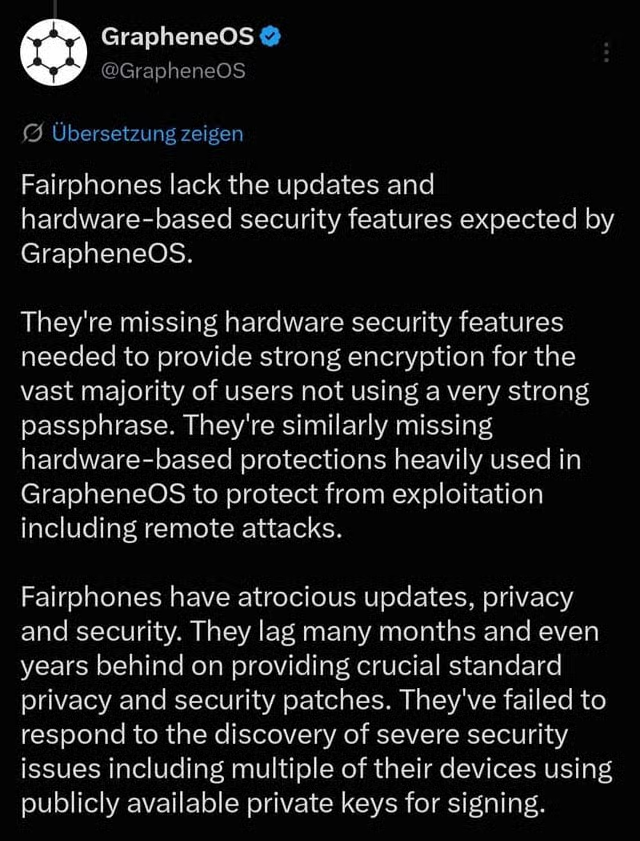
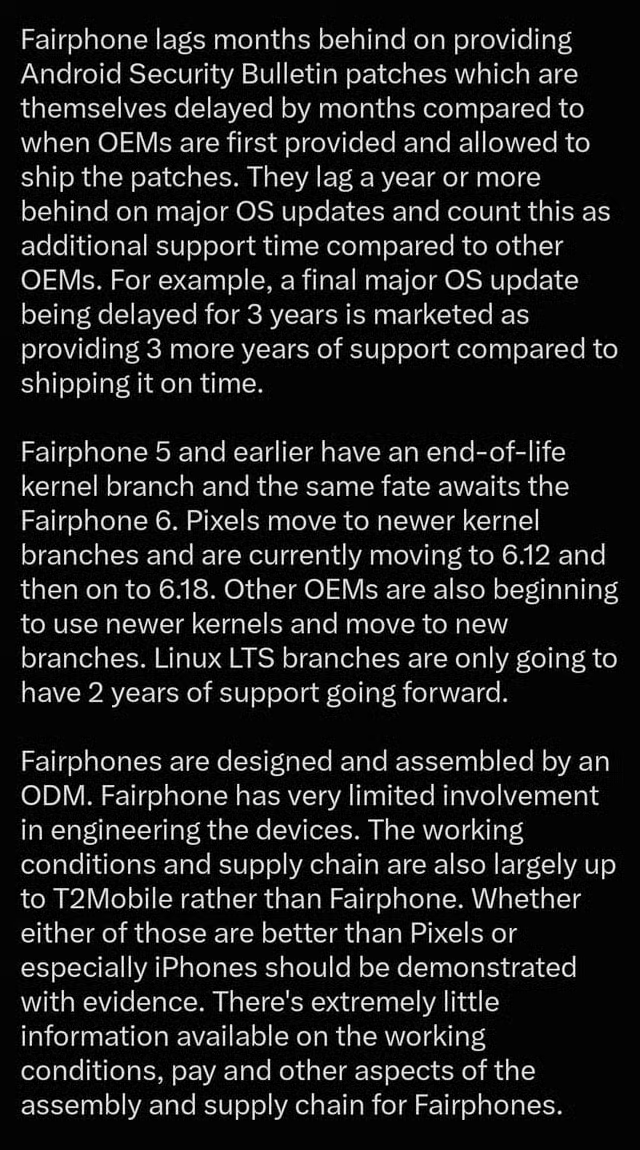
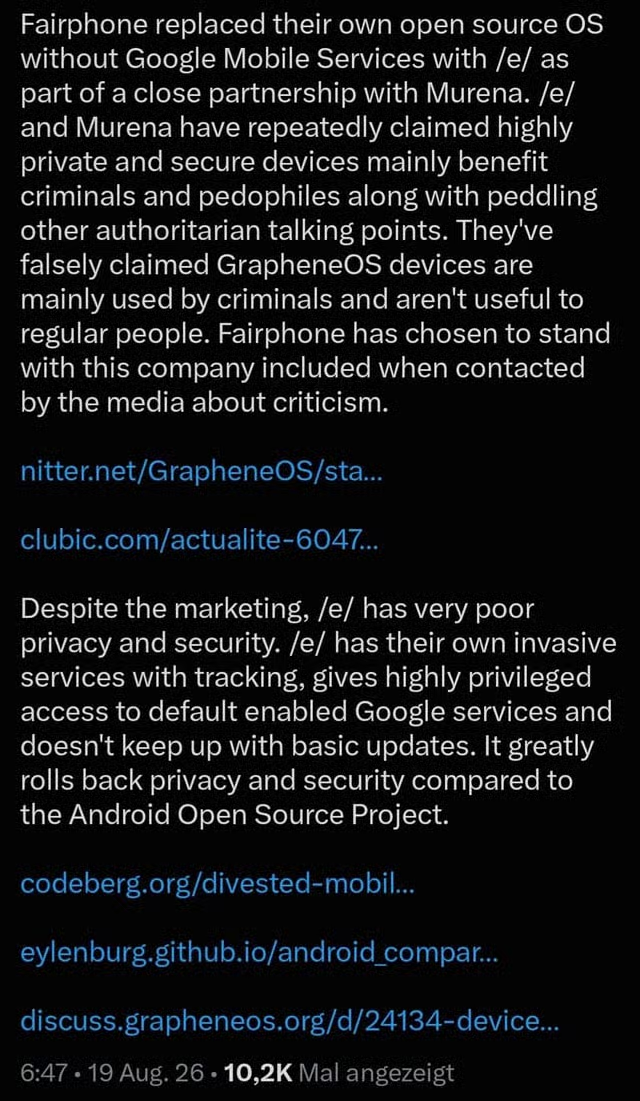
Yeah I am aware of their hardware requirements. I’m not sure if Fairphone has this on their roadmap
Replying to @Hiro8811@lemmy.world
Shoot me down for this, but I think GOS is melodramatic. They need to think like a tech partner. If they get asked so many questions about other phones, they need to de-obfuscate their requirements and exchange a dialog with phone manufacturers like FairPhone! Gave you an upvote though.

I personally think that the GOS team is intentionally not wanting to, not due to the requirements, but due to the water so to speak.
There was a lot of bad blood between a company that Fairphone closely partners with, so therefore they don’t want to even think about the concept of it. I think that shows quite well when you look at their post considering that their post goes into detail on the supply chain aspects of it and who they’re partnered with instead of focusing on the actual issues with the device.
Being said, I understand their points on the software updates and the hardware requirement. But, ostensibly I don’t think they are rejecting it due to those concerns.
Mannn, I wanted them, but Motorola took too long. I gotta go Fairphone+.
I AM BUYING IT NOWWWW!!! LESSSS GOOOO!
Fairphones seem okay from a hardware POV but the software is a bit lacking in terms of security and support.
See I keep reading this, especially here on Lemmy but since owning one, I’ve had more frequent updates than I think any phone I’ve previously owned, and definitely more than family who go with bigger brands.
I don’t know why they have this reputation, perhaps it was true in the past
This comes from the people who run GrapheneOS e.g. …grapheneos.org/…/24134-devices-lacking-standard-…. Maybe they’re opinionated for some reason that extends beyond the hardware/software.
 GrapheneOS Discussion ForumDevices lacking standard privacy/security patches and protections aren't private - GrapheneOS Discussion ForumGrapheneOS discussion forum
Honestly, the only thing that stopped me from going them this time around was the ip55 rating. I do too much stuff that involves my phone getting wet. So, realistically, I can’t look at anything that has less than IP68 because I need that full immersion rating. The quest for repairability doesn’t need to compromise that, you can have an IP68 rating with a battery that is removable by screws. The Samsung X-Cover Pro proved that. It’s just not financially incentivized for consumer devices, which is why you normally only find it for dedicated corporate device lines