posted in Technology
We Tracked a Shipment of Rare Books. It Ended at an Amazon AI Training Facility

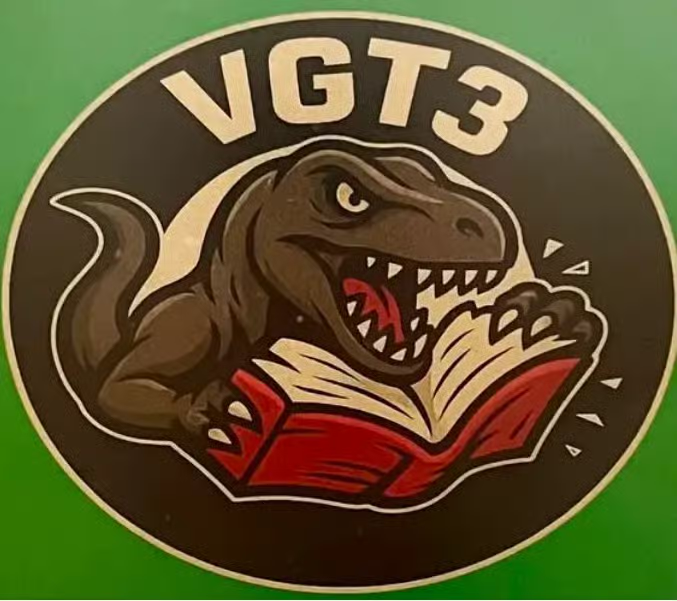
The symbol for Amazon’s VGT3, the Las Vegas facility where it scans book for AI training data.

Amazon is buying massive quantities of books, scanning them for AI training data, and destroying them in the process.

A 404 Media investigation was able to reveal Amazon’s book buying operation, which hasn’t been previously reported, by placing a tracking device in a rare book we suspected would be acquired by an AI company for training data, and following it around the country to its final destination.

That final destination was an Amazon warehouse in Las Vegas, Nevada. Amazon employees who work at this location say all they do is receive massive shipments of printed books which they then cut the bindings off in order to scan the books more quickly. The printed book is destroyed in the process. The logo of the Amazon team that works at this warehouse, called VGT3, is a dinosaur, brandishing its teeth and with a book in its hands.

“Amazon purchases books through commercial channels to help develop and improve the products and services our customers use,” an Amazon spokesperson told me in a statement.

The world’s AI companies are constantly looking for, and spending extreme resources to locate, more material to train their AI models. With books, that sometimes means destroying them in the process, something that large parts of the public have spoken up against, and which we can now confirm Amazon is doing.

In July, I published a story about booksellers who reported a historical spike in sales starting in the past year. They suspected this spike in sales was due to AI companies acquiring any books they can in search of new training data. Printed books are valuable as training data because a lot of the text they contain is not readily available on the internet, which AI companies have already scraped. The data is also conveniently organized and, if the book was printed before 2022, is guaranteed to be free of AI-generated text, which can make any AI model that is trained on it worse via a recursive process called “model collapse.”

📖 Do you know work at a facility where you scan books? I would love to hear from you. Using a non-work device, you can message me securely on Signal at @emanuel.404. Otherwise, send me an email at emanuel@404media.co.

These booksellers suspected AI companies were behind these large bulk purchases because of the high number of books they were buying, the seemingly random choice of books, and the fact that these buyers, unlike libraries and universities, did not seem price sensitive at all. But booksellers couldn’t say for certain who was behind the large purchases because the marketplaces where they sell their books keep the buyers anonymous. When an order comes in, a bookseller ships the sold books to a warehouse operated by the marketplaces, where books are sorted and then sent to the buyer.

In July, one bookseller told me they received a very large order of around 1,000 books on Biblio, one of these marketplaces. The seller agreed to put an Apple AirTag provided by 404 Media in one of the books included in this order so we could see where the book was going. And by extension, which company, AI or otherwise, was behind this massive order. 404 Media granted the bookseller anonymity because they worried sharing this information would harm their business. Biblio did not respond to a request for comment.

Another article to provide some clarity on the types of books: …biggo.com/…/37a2899b-5f1a-4571-9bb5-1156c0ac4605

www.404media.co/we-tracked-a-shipment-of-rare-books-it-ended-at-an-amazon-ai-training-facility

Edited ⁨⁨Aug⁩ ⁨20⁩, ⁨2026⁩, ⁨11:47⁩⁩enPage

Replying to @⁨Geode998@lemmy.ml⁩

What’s their standing?

Edit: FYI in the United States we have a legal precedent called the first sale doctrine. Once you buy a book it is yours and you have the right to do what you want with it including selling it. And while they probably never anticipated a bunch of super wealthy narscisists buying a bunch of books so they could hoard the knowledge and then destroy them, we have no laws here that could prevent it.

Replying to @⁨SnailMagnitude@mander.xyz⁩

Without details it feels, like a fear, uncertainty, doubt strategy just for the clicks, to me. I’m missing crucial information for an informed decision. The article is not suitable for much more than igniting anger.

LLM and AI companies rise a lot of valid criticism, besides its undeniable pros. I don’t like a witch hunt just because it is AI and someone tells me to be angry. I need more facts before I go fetch my pitchfork.

I.e. I dont get why they destroy the books. Google Books did fine without unbinding/ destroying books. It would help to know what kind of books are processed. And what their process is.

I don’t have information if the OCRed data is made available to the public. Which would be nice, since the article talks about data that is not yet digitally available.

en.wikipedia.orgGoogle Books - Wikipedia

Replying to an earlier post

The witch hunt vibes seems apt, the maleficarum got really grim in the wake of the printing press and we’ve got new meme makers now and the pitchforks are being sharpened.

The article kinda hits it home, it’s generic hysterical slop and a solid treatment of the matter will likely be available to the public for £300 from an academic press in a year or three if they promise not to share it. Then an llm will eat it and I will be able to get a summary, mixed in with lemmy comments, for my daily token ration from China: the circle of life.

Afaiu it’s somewhat easier to wreck the book and one would imagine there’s a few books cutting about that whilst not yet fully digital are also not on the endangered species list.

Sharing the knowledge for the greater good is a no go I think, especially in the USA. Me or you can do it on slsk but if a rich corp tries to do it they’ll get shafted fast & hard and the massive academic presses will not tolerate upskilling the poor.

Replying to an earlier post

This is what I believe they are doing:

…biggo.com/…/37a2899b-5f1a-4571-9bb5-1156c0ac4605

_**The owner of MW Books in Ireland also reports that since May, the shop has been receiving large orders with wildly varied content. “The orders are piecemeal, presumably machine-driven, and there’s very little thematic rhyme or reason to them: everything from 18th-century African agricultural implements to biographies of 1950s racing drivers,” he says. “Personally, I don’t think we have the right to dictate what customers do with books after they buy them, but the selection is certainly intriguing.”

Another anonymous UK used bookseller reveals that some seemingly random orders, possibly from different buyers, all end up being shipped to the same address. He provided a delivery postcode used by different buyers, which corresponds to a cluster of freight warehouses near London Heathrow Airport. The bookseller says that since January, he has received orders covering 6,000 books from similar buyers, amounting to thousands of pounds. These buyers are willing to pay “top prices” and haven’t asked for discounts even when purchasing large quantities at once. “That doesn’t happen very often. It’s disruptive to the used book trade.”**_

They are probably buying books that don’t have any digital copies since they are perfect for training AI. As for why they are using destructive scanning, I believe it is because either destructive is cheaper and faster or they don’t want the competition to have access to the training data. Since these are not easy to find books, Amazon sells books, any book they try to obtain is probably extremely hard to find anywhere.

Replying to @⁨themachinestops@lemmy.dbzer0.com⁩

Thank you. That article gave me some insights.

  • AI firms fear AI generated content and train their models with books from before. The fact that AI waters down the source data quality, because AI generated data becomes part of the source data. It’s worrying, let’s see where it leads and how the AI effects can be mitigated.
  • Lawsuits seem to be an issue for anthropic and a driver for the scanning program too. Because illegal copies are problematic.
  • The books are destructively scanned and disposed afterwards.
  • In rare cases a 18th century book might be lost. But the ordered books seem to include anything and nothing. The term rare book seems to refer to the fact that a small amount of copies have been printed and only a few copies are available for sale (and the larger part is stored in libraries).
  • Booksellers are both worried and happy at the same time.

Replying to an earlier post

Textbooks are not “rare”, nor are they something that universities and libraries would be price sensitive about. The books are being bought from booksellers who make a living buying and selling rare books. So, while I doubt that they are all going to “masterpieces”, they are going to be books valuable enough to support an industry of people and expensive enough that universities and libraries would be price sensitive about them.

Replying to an earlier post

If this was done by trustworthy organizations as an effort to digitize and preserve all the books, I would appreciate it. Maybe an association of libraries should do that and, to get the cost back, sell the digital versions / ebooks to the AI companies for an additional price). Then, at least, we would not loose the contents of those rare books to the AI conpanies and prevent them from obtaining a monopoly on the data. And each book would only get destroyed once.

But libraries/bookshops are probably not allowed to sell digital versions, and AI companies are not allowed to use borrowed ebooks.

Replying to an earlier post

That exists already. Archive.org has a digitization service, but then archive.org would put a public copy up and the AIbros wouldn’t be the sole owners of that training data.

digitization.archive.org

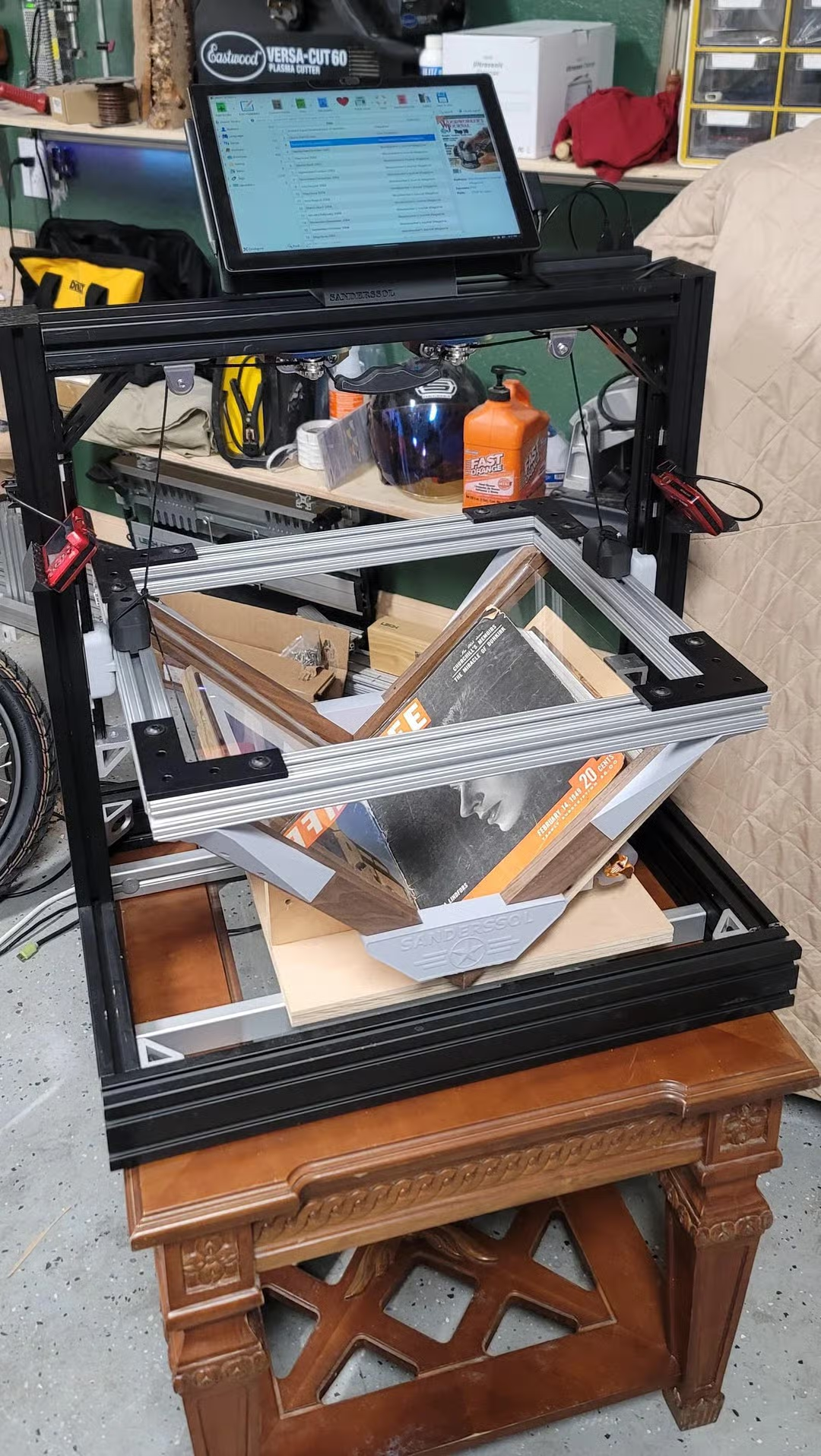
There’s also methods to digitize books without destroying the book and for the purpose of AI training that should be more then sufficient. AIbros are just so arrogant to think that other people haven’t solved the problem already or that their time is too valuable to be slowed by proper methods.

www.diybookscanner.org

Replying to an earlier post

While writing my other comment, I thought of a way that might be a little bit closer to a solution for the AI use of copyrighted material. In Germany, afaik we are allowed to make and keep a copy of copyrighted material obtained in any legal way (even borrowing, streaming, etc.) for strictly private and personal noncommercial use. As a compensation, when buying a device that can store or process data (e.g. USB-stick, phone, computer), a small part of the money goes to copyright collectives (“Verwertungsgesellschaften”). Copyright holders can be members of those and get compensation or their work via them (those collectives are also the entities that sell you a license to e.g. play music at public events).

I can imagine a similar system for AI: A part of any subscription, fee, etc. for AI could go to those copyright collectives as a compensation for the material used in training. Compared to obtaining a license once for training (like buying physical books), this has the advantage that the compensation would scale with the actual use of the AI and also the revenue of the AI companies.

I think those systems are far from perfect, but that’s probably a much better approximation to fairness than what we currently have

Replying to an earlier post

At least some money is currently paid for AI and eventually the business has to become profitable. The environmental problem ist of course not approached by this. For the creatives this would give at least some compensation. Problems due to future (creative) work taken over by AI is also not covered by this; that’s “just” what happens when a new technology arises that obsoletes certain work. My suggestion is trying to copensate for creative work somewhat proportionally to its use.

Replying to @⁨queermunist@lemmy.ml⁩

There are many ways a book can be rare. First editions, signed copies, and books with little demand. Can’t fire up the printers and make those again.

In the case of little demand, I have a book “Two thousand leagues under the seas” not the more common “Twenty thousand leagues under the sea”. It’s rare in that it’s very difficult to find more literal translation than the version we are accustomed with. I suspect search engines simply think I’ve made a typo. Either way, why print it if there is little demand or can’t find the book?

Replying to @⁨Leomas@lemmy.world⁩

Huh, good question. I remember a forward in the book about the difference translations, but I will admit that was back in middle school. I still have the book. Perhaps I’ll try to dig it up tomorrow.

I did however find a new translation online that sounds interesting. I remember all the scientific names suuuucked back then and even my copy said something along the lines of “abridged for sake of brevity” on one of his journal entries. Even my translation noped out of that.

Replying to @⁨KairuByte@lemmy.dbzer0.com⁩

A first edition has no value to me. The value comes from the words on the page, not the paper it’s printed on. I could see value in a book that was hand transcribed or something, but the fact that it was the first book out of a printing press is worthless.

I should say being signed is important, but that’s not really a rarity issue. That’s now a unique historical artifact because it was interacted with by a specific person. That’s basically the same as a bible having historical value because of who owned it.

Replying to @⁨Tollana1234567@lemmy.today⁩

I know that in disciplines such as math there are very often have books with less than 50 copies in circulation. The LLM companies buy maybe 2 of a given book which are subsequently destroyed with no backup data. You’re now at 48 in circulation, that is a significant reduction. Rinse and repeat a couple of million times and this starts to have a major influence on knowledge.

What’s perverse about it is that the data from the books is stored extremely badly within the models. So not only are you destroying sources, you are also necessarily falsifying them.

Replying to an earlier post

I also wanted to know what the rare books are and this is what I Found:

…biggo.com/…/37a2899b-5f1a-4571-9bb5-1156c0ac4605

I also heard that they are also scanning old outdated medical books.

So are not really aiming for rare, they are just gathering at random and getting their hands on any old book they can find. Some rare books might or might not be in the books they scan.