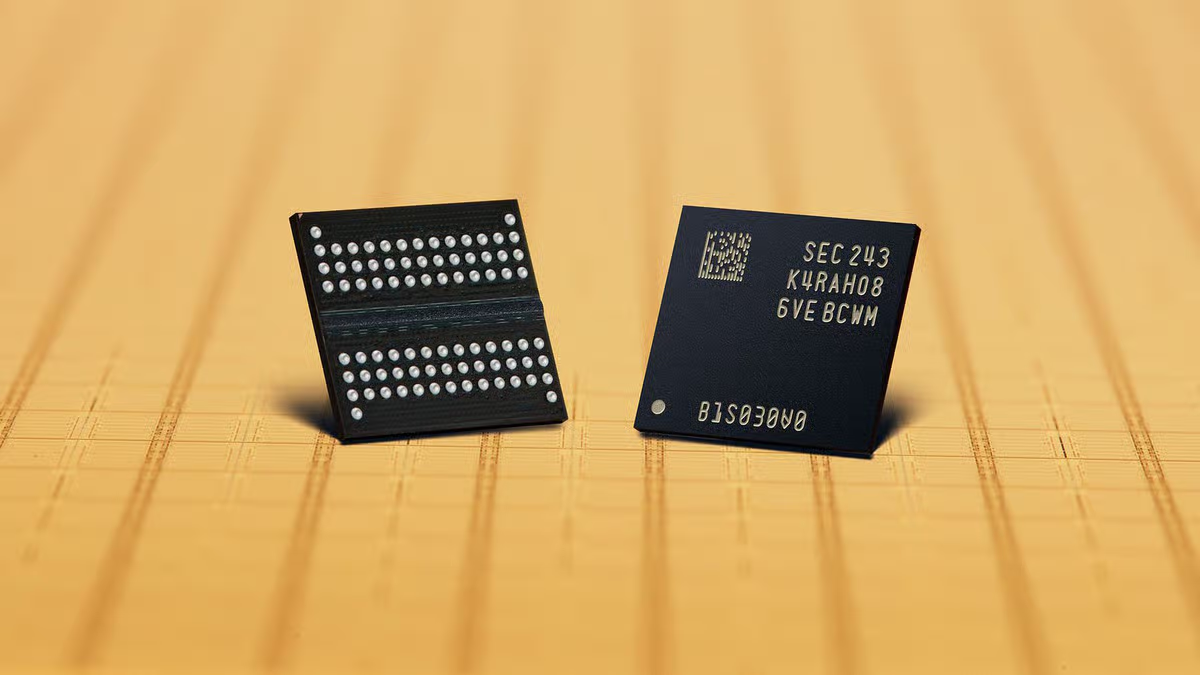
Keep it as long as possible, the new shit suuuucks, is built to break & riddled with adware.
Back in my day ;) we had to worry about keeping up with the newest tech because you needed it for the best games or whatever.
These days, my desktop from 2014 can run all of the new games that I want to play (yes, even the demanding ones) It has 32 gigs ram and a 1660 Ti. That’s really all I need, especially since most of the games I enjoy AREN’T new.
You’re not going to get adware drivers on a Linux system unless you’re using stuff that’s supremely sketchy and also installing things you shouldn’t be. What you’re thinking of is 3rd party windows drivers.
Android depends on who gave it to you. If you install Linux from a parking lot flash drive it doesn’t mean the Linux project is compromised, it means you got pwned.
I’d make the same argument about installing pre-compromised pirated windows but…windows kinda just is malware now.
It’s actually scary how wrong you are while being so confident. It’s not even just wrong but also so incredibly dumb. Doesn’t matter if you’re drunk or not, you’re clearly an ignorant fucking idiot.
well, that article disagrees with you though. That "feature" is only going to do anything to Windows installations.
Also, OS doesn't matter if it's a bios update.
The ASUS UEFI firmware exposes an ACPI table to Windows 10, called "WPBT" or "Windows Platform Binary Table". WPBT is used in the pre-built OEM industry, and is referred to as "the Vendor's Rootkit." Put simply, it is a script that makes Windows copy data from the BIOS to the System32 folder on the machine and execute it during Windows startup - every single time the system is booted.
The BIOS just take care of the basics, but Windows do have an API allowing the BIOS to ask for the installation of additional drivers. That process was abused (and continue to be) by multiple hardware vendors to install spywares or adwares.
Linux doesn’t have that API, and just ignore such requests.
honestly, i kinda agree to this, the current gaafets and mbcfets designs are like fuses on a nano scale if it doesn’t have REALLY good power management. Unlike with finfets where the channels/source are still connected firmly on base to dissipate heat in case of a nasty power draw.
I got 3 6+ year old thinkpads that are all chugging along just fine. got them all for dirt cheap.
But as another person said keep that shit for as long as possible and learn how to properly maintain it. New stuff is absolutely horrible. I recently had an ASUS laptop that fried itself after 3 years. was getting really wonky 2 years in.
they really are horrible laptops, especially the ROG ones. Those things on day one you turn it on are like “alright, time to start killing myself”. you can keep all the fans constantly clean, repaste them every few months, and they’ll still cook themselves alive. and the AC adapter will die on you faster than the laptop itself. I had to replace the AC adapter on mine 3 times in 2 years.
This is wild to hear? What year(s) are we talking on these Asus laptops? Everything Asus I’ve bought has been rock solid, and I go out of my way to get their hardware. I haven’t really bought any new systems or components in about 5 years though…
Asus laptops are such trash. Same with Acer. I kept seeing people recommend them but every time I bought one it came with a major manufacturing defect or some important component failed almost immediately.
That happened to me three times and I had to return each laptop. So now when I buy a laptop, I only go for ThinkPads and MacBooks. And tbh it’ll only be macs going forward because Lenovo can’t be trusted.
Say what you will about apple but their hardware quality can’t be beaten and going forward there are people building Linux distros for them. So even when apple stops updating them you should have options.
Only thing that sucks is MacBooks are crazy expensive. So I buy them used/refurbed from good sellers on eBay. Haven’t had an issue yet.
My steam deck has become my all in one. Sucks memory card prices have leaped the past year. But I got a couple terabytes, so I’ll be alright, just going to have to shuffle them around. But I’m cool with not having 240 hz 4k on Powerthirst settings. I got a back log anyways and a yard to get back into shape.
Luckily two and a half years ago I decided it was time for a new computer. I go more than a decade between new PCs so it was just really dumb luck that I got a new computer when I did. And the reason I can go so long between computers is because I always get way more RAM than I need when I get a new one.
So given the current state of things, it’s a little awkward to admit how much RAM is in my computer.
To build chips that are used as collateral for datacentres that have yet to be built, so the chips can’t be used, and they’ll just age out of usefulness.
Nah, we’ll stall on this generation. Even if a new one is released, very few will pay the extra when games would alreadyhave to start becoming RAM optimized again. Even Windows just dropped their 32GB recommendation.
Without the recommendation being met, people weren’t buying windows PCs, so lower the requirement and people will buy more computers and more copies of windows. Which means they always could have just optimized better if they felt pressure.
Games will 100% do the same.
Which could be a huge thing for rational companies right now.
The big hurdle to domestic production is you’ll spend billions and by the time it’s built it’s “last gen”.
Instead of useless data centers, we could be building up domestic chip production, confident it will still produce top of the line chips when it goes live.
A literal golden opportunity, more so if China goes after Taiwan finally, you’d be the only international supplier.
I know you know this, but PC RAM is useful for a lot more than games. Workstation PCs are where I find this situation really hurts. I suppose that to an extent, some of what you describe might apply to development and design tools.
Before this shortage took off, I got a rock-5-itx (ARM computer) with a whopping 32GB of RAM which was definitely overkill for the home server I use it as, but now it feels insanely decadent. I’m looking for ways to utilize it, like running Immich with the full AI facial recognition features and whatnot, Nextcloud with the full text search, etc.
You’re right about domestic production but I think the situation is much worse. We’ve tried to make advanced chips domestically and we can’t do it. Taiwan has had decades to perfect the resource allocation, supply chains, knowledge, and work culture to make those damn things.
It should be an executive order to make them domestically, and put up with the years of failure and low output. It’s a matter of national security to be able to create and maintain computers and other advanced tech.
Taiwan has had decades to perfect the resource allocation, supply chains, knowledge, and work culture to make those damn things.
…
Uh, Apple taught them from scratch in less than 20 years.
Now they have a proven plan on how to do it, what to look out for.
Like, the on part Apple didn’t understand is that China was ok with Apple employees being treated as disposable, because they’d burn out, quit, (maybe) recover, and by then alreybe replaced.
Now an Apple trained employee needs a job and Apple won’t hire them back. Repeat that tens of thousands of times and before Apple releazied all they were doing was training their competition, it was too late.
It wouldn’t be “years of failure and low output”. It would be years of nothing to build the infrastructure and then flip a switch.
As a bonus this makes chips for weapons in parallel, something we desperately need to do.
This ain’t just a crackpot idea, and it’s not just mine.
It’s just any country that does it, risks kissing off the only manufacturer till up and running. It’s fucking with trillions of dollars. We need an arms race scenario with multiple countries trying to be first.
Apple uses TSMC’s services because there’s a huge difference between what Apple does (chip design) vs what TSMC does (chip manufacturing).
It wouldn’t be “years of failure and low output”. It would be years of nothing to build the infrastructure and then flip a switch.
No, the failure and low output come AFTER the switch is flipped, unless you get a TON of industry know-how from TSMC. First you have nothing, then you have low yields until you figure out the processes.
There’s no problem with ‘last gen’ right now. The “ai” bullshit and global rise of fascism has slowed tech progress to a crawl, and even ten or fifteen year old systems are pretty good right now.
Odd to think that the Windows Vista days are coming around again.
Wasn’t that one of the reasons that people didn’t like it? A lot of manufacturers basically just crammed it onto XP-spec machines, so it ran horrendously, and was generally awful to use.
And also everyone was running garbage Windows XP applications which wanted administrator permissions and to save it’s data in the Program Files folder.
For years the accounts software we used at work required you to install it in C:\ because it couldn’t handle keeping it’s data and executable in different places.
None of the chips built for datacentres are useful for gaming. None of the RAM in these chips is useful for normal computing - even servers - much less home gaming.
AI compute believes it’s still in a “race” so they won’t want to be using previous gen chips unless forced to in some way.
This isn’t the “dark fibre” of the AI bubble. It’s just a future pile of trash.
None of the chips built for datacentres are useful for gaming. None of the RAM in these chips is useful for normal computing - even servers - much less home gaming.
…
Yes, literally everyone knows that…
If you ask why the production of two different form factors that use the same infrastructure could effect the quantities produced, I can probably explain that for you.
But it’s like being surprised you have to wait in line at checkout despite being the only person in Costco buying a single can of grape soda, so hopefully you can figure it out from here.
Next time you feel like you’re missing something though, it’s easier to just ask first rather than hoping someone else takes all this time instead of just ignoring you and not explaining what you’re missing
SODIMM ram is still cheap. You could build them a ddr4 intel system with integrated graphics (ideally Arc cores or plenty of EUs) that will run some older or simpler games at 40-60fps with a little upscaling, and the whole thing could be done for 500-700 I reckon.
Either that or maybe build an AM4 if you find a used GPU at a good price.
Microcenter or some similar physical store is probably your own hope. They run pretty decent deals to bring you into the store.
I’d recommend visiting one for Black Friday/cyber Monday. It’s probably your only hope for things not to be ridiculously overpriced. Instead you’ll just pay for very overpriced items.
It’s frustrating to see the tech industry take this path, because there were alternative paths that didn’t lead us here. We are in a selfish and shortsighted time.
OpenAI is likely to be the first domino to fall that causes the whole bubble to pop. They’re burning over $10-15 billion a year in losses, and have shown that any attempts to scale only increase that burn rate. They’re running out of investor money to toss into the fire.
And they just announced a last ditch free unlimited for everyone plan to…I dunno drum up interest or hope it converts to paying customers or something. So their costs are about to skyrocket even more, accelerating their death spiral
Check the level1 forums, where some electronics gurus are trying to get a single adapter MI250X to even boot. The problem isn’t the adapters, but firmware that makes it difficult.
HBM and Vera Rubin are not useful for PC Gaming, at least not for current architectures. Main issue is that DDR5 production simply got cut to make more HBM. But there will be a huge amount of LPDDR, NVME / SSD drives and refurbished Hard Drives available, and hardware for running inference at home for pretty powerful models will become cheap as fuck, liberating us all from the hyperscalers; the open weights models from china are available for everyone.
If the memory wafers are largely HBM, so they can’t be used for gaming hardware.
If you’re thinking of HBM gaming GPUs, the chip design pipeline is too long. If Nvidia/AMD/Intel started making one right now, and rushed it, it would still be many years away.
…However, a lot of LPDDR5 is being made too.
Hence the rumors of AMD hedging their bets and using LPDDR for some future GPUs.
I’m not sure I worded this right before, but it takes ~half a decade to plan and produce a GPU.
They can’t just switch out the bus or memory on an existing design.
So they could make a HBM gaming GPU. But they would have had to have started ~2 years ago.
…That’s extremely unlikely.
It’s unlikely they’ll even plan one now.
AMD did indeed try making HBM gaming GPUs, and it turns out it’s supremely uneconomical; they immediately pivoted to the opposite extreme (narrow bus + larger cache).
However, LPDDR GPUs appear to already be in the pipe, so that will provide some GPU market relief.
I’ve never heard of uncut wavers hitting storage or the market. These things are made to be used for whatever is needed at the moment. If you hear this news regarding “Ram cap sold out”, it means all available wavers they expect to be produced for that year have been allocated to whoever paid for them. If 50% of the wavers go into HBM, 30% into DDR including LPDDR and 20% go into NAND storage (i do not have the exact numbers, but i know that HBM needs around 3x the amount of silicon compared to DDR), then you are done selling your capacity - whatever happens afterwards does not make DDR5 appear magically on the market.
Only thing that could change that would be that the AI bubble crashes before 2027, then the allocation numbers will be changed.
Not sure what you mean with the wafers hitting the market. I was only referring to the specific deal that OpenAI made with Samsung and SK hynix to purchase a metric boatload of 900,000 undiced DRAM silicon wafers per month.
That means they have bought out the wavers - with a specific allocation for HBM/DDR/LPDDR/NAND as they need it. they know what percentages of what they need to reach the balance they use in their racks, and that will be what was ordered in detail.
The DDR5 can be used in common PCs, but it’s a different story with LPDDR. I have heard of an adapter to make LPDDR useable in common PCs, while i haven’t seen anything like that for HBM - and i wouldn’t bet on such an teck being available for the consumer market amytime soon, the architecture is quite different.
Even in this hardware hellscape you can get some pretty decent handhelds for $200. I think the low end segment can stay pretty strong with devices like those and indie games.
But yeah I think high end gaming is going to be pretty stagnant for at least the next few years.
“High-end” gaming had no future either way, with how larger (in size and power need) GPUs slowly got and most of it being wasted on penny-pinching of developer time (e.g. atrocious performance) of AAA studios.
Not long-term. No computers, phones, TVs? No consumers of cloud services. Including 90% of businesses. At some point, regulators have no choice (even if they are colluding), if they don’t want to strangle their economy.
The point with dissidents being on the cloud-rope still stands though. Especially on closed platforms like Apple, Android.
They are buying up capacity from manufacturers who are stopping production of DRAM and pivot to HBM which is more profitable. Abandoning DRAM which affects a lot more than just “consumer grade RAM”
But isn’t it kind of a game of chicken then for the consumer markets? Whoever gambles the other way, can win in both volume and availability, being able to cut the others off market just by pricing, enabled by the prior two points, get brand points by the ladle while at it, and kind of become a staple of the consumer market. When the bubble pops and others return, the market isn’t the same and everyone else sits at a disadvantage?
You can’t organize against billionaires online if walled garden censored posting to the cloud is the only thing available to anyone. You can’t pirate media if you can’t store media locally. You can’t run a ad blocker if they’re not allowed on their app store. You can’t install linux if your tablet can’t be jailbroken.
You have too much freedom. They must have control back. We allowed them to have enough money to take it, they just had to fool the rubes with the promise of utopian robotic labor via addiction.
This is it. Add in that AI is a 1-way filter of information, substituting web search engines. The AI companies will get all the questions and queries from people instead of search engines, you will not find information unless through the black box service of an AI company. The death of the open web, for the billionaires benefit.
its nvidia and AI creating a bubble on the belief they’ll be able to get profit and get out before it pops.
But all it is… is imaginary money going around in circles. nvidia invests a trillion in AI, AI buys a trillion dollars of nvidia videocards from some nebulous point in the future where they arent made yet, nvidia invests that trillion back into AI, AI uses it to buy ridiculous amounts of ram that wont be made for years, RAM invests it back into AI, and on and on they go, generating imaginary money and value, by buying imaginary things.
under a sane government this would be investigated as raw stock manipulation and fraud
I really hope when this bubble pops nvidia is destroyed in the process along with the AI companies.
Then Nvida financed more shovels to the speculators in the hopes that enough of them will strike gold it will get paid back, but also created a shortage in the shovel market so the price of shovels is going through the roof.
If by “pinky promises” you mean contractually binding letters of intent, then yes. This is standard procedure in any manufacturing industry when dealing with orders of massive quantities, because it normally also requires investment from the manufacturer in equipment which they don’t make on non-binding "pinky promises).
It will take ages for them to build capacity and they will probably be wary of growing too fast since demand and prices could drop quickly when the AI boom goes bust. Likely CXMT is already supplying a lot of the consumer market under the stickers. China will be the big winners in the long term. This will be a gift for them.
Don’t count on ages, though, just recently it was revealed they can build manufacturing buildings twice as fast compared to the West. But you are right, there are other factors in play, it’s not that simple. Still, more the merrier I guess.
Putting aside assembly code gets compiled as well, the bottle neck is always validation of these systems. Making the systems more opaque makes the already difficult task of ensuring it works even harder.
Assembly code isn’t ”compiled”. To quote wikipedia:
Assembly code is converted into executable machine code by a utility program referred to as an assembler. […] The conversion process is referred to as assembly, as in assembling the source code. The computational step when an assembler is processing a program is called assembly time.
My point is that people are already trying to replace compilers with LLMs, and yes, it is stupid as shit, but still real.
Also, maybe see if an LLM can help you detect sarcasm without explicit content tagging.
low-level compilers can output very ugly-looking assembly. he probably did this and then used LLM to super-optimize it. may be perfomant, but id guess that theres a risk that its unsafe.
Who cares about ugly-looking assembly ? No one’s gonna actually look at it, that’s, like, the whole point of C. And I really doubt the plagiarism machine can somehow do better than a compiler. I’m gonna look this up
I was about to get insulted but I almost closed the lid on the laptop by accident and now have to make sure my cloude still operational on the task I gave it, so I can’t be rerouting my attention span resources
I am astounded that games like Crash Bandicoot, Tomb Raider and Abe’s Oddysee with their massive sprawling worlds were crammed into such relatively tiny file sizes.
Things don’t add up. I see articles about computer parts becoming unavailable along with articles about data center plans being cancelled or not getting built. I assume the data centers ARE getting built and those second articles are lies to calm people down.
My take is more of a:
1000 DCs were planned
200 are getting cancelled
800 are yet to be built, built, supplied with products
and of the 800 remaining DCs, some are buying the stock that is now free or the orders are rerouted by the ordering company to other locations that also need more hardware.
It’s because it’s a Ponzi scheme. Huge amounts of investment dollars are being dumped into AI and anything related to AI. If you build any kind of chips that are used in AI datacenters, you suddenly have a bunch of money invested in your company. What do you do with it? You make a deal with OpenAI (or one of the other ones) that you’ll invest that money into them if they agree to buy a bunch of chips from you. Now you have revenue on books and are showing a reasonable return on that investment.
If you were a chip manufacturer and actually believed that there was a big future in AI, you’d be using those investment dollars to build some more chip fabs. And some of these companies are doing that. But overall, moving money to another company so they will order chips for datacenters that aren’t built yet (and may never be built) is just bubble ponzi shenanigans.
Computer hardware depreciates in value very quickly. You don’t buy hardware today so you can install that hardware in a datacenter that won’t be online for another year.
If you were a chip manufacturer and actually believed that there was a big future in AI, you’d be using those investment dollars to build some more chip fabs.
Major new semiconductor fabrication plant projects are expanding across the United States, led by a $16.8 billion SpaceX and Tesla “Terafab” project in Grimes County, Texas, massive expansions by TSMC in Arizona, and Samsung’s ongoing fab development in Taylor, Texas.
Computer hardware depreciates in value very quickly. You don’t buy hardware today so you can install that hardware in a datacenter that won’t be online for another year.
Hardly unusual for speculators to buy up a hot commodity the day of release and then resell it into an inflated secondary market a few days or weeks later.
Sure there’s plans, maybe even some ribbon cutting with some gold shovels to “break ground” or whatever. These are things you do when running a Big Store type of scam.
Capitalists wet dream is to make more money without investing any new capital. Chip fabs are in a situation like that where they can make buttload more money without changing anything except charging more.
Nothing will change because the alternative is investing billions just to keep the price down. They’d rather pocket the billions now.
I guess that I should use Klarna or the like to buy enough RDIMMs to let me use Qwen 3.8 122b, at the very least. The $606 I spent on buying 32gb of 5600 memory is looking like a bargain these days, and that was just a couple months ago.
I can’t tell if you’re actually asking or if your question was rhetorical but I’ll go ahead and answer. This is over simplified but this is basically what is being reported:
The RAM companies know how much RAM each of their factories can make in a given hour, day, month, year, etc.
To keep math simple, let’s say the RAM company owns 1 factory. They can make 100 chips in that factory per year. In January 2026, Company A orders 50 chips, Company B orders 50 chips, Company C orders 50 chips, and Company D orders 50 chips. It’ll take 2 years to complete those orders. Maybe each company gets some chips every month for 2 years or maybe it’s first come first serve. Regardless, 2 years. The factories are at max capacity, they physically can’t make them faster.
The only way to make more chips is to build another factory which takes time. But what if you make a lot of money overcharging customers? What if you think AI might be a bubble and demand will go down? Speaking as a company, building a new factory might not be worth the investment.

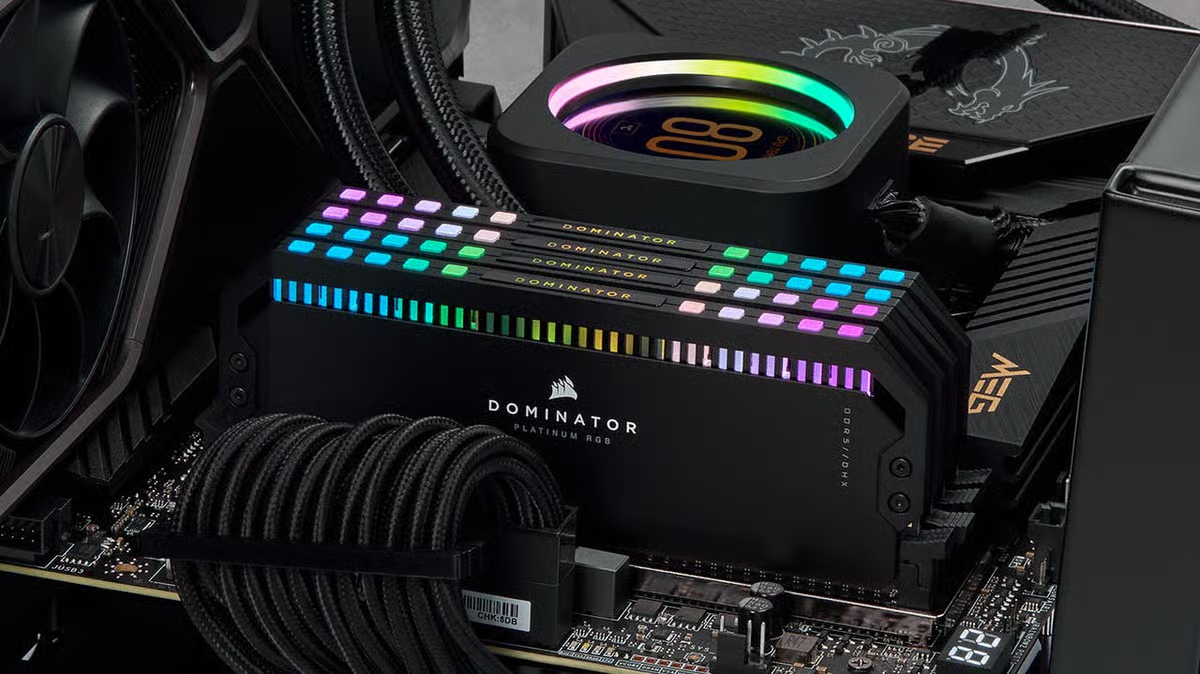 IGNNow That 2027 RAM Manufacturing Capacity Has Reportedly Been Sold Through, It's Hard To Imagine the RAMageddon Ending Any Time SoonA new report suggests that all three memory manufacturers — Samsung, SK Hynix, and Micron — have collectively sold through their 2027 memory manufacturing capacity to AI companies.