To be fair, a duress pin is definitely a good thing to have if you’re being mugged, but using it to deliberately destroy data when it’s been seized by a lawful authority is guaranteed to land you in serious trouble pretty much anywhere. Whether the border agents were, in fact, a lawful authority, and whether they had a lawful reason to seize his phone are very different questions.
The much more sensible approach is to either have a separate phobe for travelling, that has nothing you care about on it, or wipe your phone before you travel, and spend a little time building up an innocuous history on it, without putting anything you care about on it. Anything you absolutely must have access to while you’re away can be stored, encrypted, online, and you can remember the details to retrieve it.
That wouldn’t avoid the destruction of property charge, just (possibly) make it harder to notice. It sounds like it was the screen flashing and the phone restarting, which is probably necessary for a full wipe, that tipped them off.
The man was in duress and being forced to hand over his PIN while being denied access to legal counsel, that is the very reason for a duress PIN. I don’t think the charge is even going to make it to real court, his defense has a great case for it to be thrown out.
The fact that he’s in the news is a VERY good sign. In a real 3rd world shithole he would just disappear because he pissed off an unaccountable field goon.
Whilst, yes, he probably did feel under duress, he had a choice to make; hand over the phone, or wipe it and face the repercussions from doing so. Bear in mind, that from the agent’s point of view, they had the lawful right to search his phone, so arguing duress will be tricky at best. In his position, I’d like to think I was comfortable handing over the phone because I’d wiped it before travelling.
Having said all that, yes, I agree that his defense has some strong arguments. However, if they decide to make an exame of him, those arguments wont do him much good.
While I am not entirely disagreeing, I have to a bit for anyone that can’t bring themselves to say it (all sides should be heard).
I may have misread but I don’t think he typed the PIN, as far as I understood they had already taken the phone and were insisting he give them the PIN without any access to a lawyer. Not only did he not wipe it, he only gave them the ‘I’m in duress’ PIN because he felt he was, if I’m on the jury it’s innocent until proven guilty beyond a reasonable doubt.
I don’t think the difference between him physically triggering the wipe and him giving them the code that triggered the wipe would have much effect from a legal point of view. In both cases he deliberately took an action he knew would lead to the destruction of the data. I think his defense’s approach of challenging the legality of the stop is probably much safer.
I suspect that the prosecution would like to set precedent that you can’t claim to be under duress when a lawful authority is performing a search, so the defence staying away from that area is probably a good idea.
As far as I understand, from their point of view they have the lawful right to seize and inspect your phone. You could certainly refuse to hand it over, but that would certainly lead to incarceration or worse, with no positive outcome for you or society. It’s one of those things that you’re bot going to beat at the point of application, vut needs to be cut off at the root.
they have the lawful right to seize and inspect your phone
Sure. They can look at the outside of the hardware all they like. But if they can’t access the data on it, that’s (Constitutionally-speaking) purely their problem, not ours.
My understanding is that, for the purposes of inspections during border crossings, that is not the case. Also, remember that the border agent can decide, for pretty nuch any reason, that you’re not getting on the flight, and, I’m sure, can add a note to your record to suggest to agents on other flights that they stop you too.
US citizens have an unequivocal right to re-enter the county regardless of where they have been, how they returned, how long they were gone, or what they were doing. This was already determined by the Supreme Court in United States v. Wong Kim Ark (1898).
The other two issues are that he was allegedly repeatedly denied access to a lawyer when asked and not read his Miranda rights. Given how border patrol has acted lately, this is incredibly plausible and will hopefully lead to the motion to throw out the case being granted.
Absolutely, my initial comment was in relation to the duress code only, hus defence has some seemingly solid points tgat I hope will get the case tossed.
US citizens have an unequivocal right to enter the country, eventually, just not necessarily on a flight they booked (or any flight in the next few weeks, until the goons are done with them…)
The guy from the article was referred to as “a US man,” so I’m assuming he has US citizenship.
The border cannot legally deny US citizens from entering the US. But they can do all sorts of other things, like detain or delay or prosecute people for not complying.
Unless they’re going to see real repercussions for doing so, get definitely can do whatever they want. Rules and laws only matter if people care enough to follow them and enforce them. All they have to do is pretend the person didn’t comply, and now they’ve got all the authority in the world to anything they want, regardless of what it says in the law books. Just look at what ICE is doing to US citizens; border patrol knows they can do all of that, too.
He’s a US Citizen. Legally they cannot deny him entry into the country.
Central to these protections is the absolute right of a U.S. citizen to return to their country. This right is unequivocal. No matter where an individual has traveled, the duration of their absence, or their personal or legal background, a U.S. citizen cannot be denied entry into the United States. This principle is supported by both statutory and constitutional law. A landmark Supreme Court case, United States v. Wong Kim Ark (1898), established that citizenship includes the right to reenter the nation. Unlike lawful permanent residents or visa holders, U.S. citizens are exempt from admissibility criteria.Consequently, even if a U.S. citizen lacks proper documentation or is subject to further questioning, the government is obligated to permit their entry once their citizenship is verified.
This is the correct take. Its common across various business contexts: destroying evidence after you learn you are being investigated is big time illegal. If you destroy data, you better be able to demonstrate you did so beforehand (I.e. an expiration policy), or you don’t have it in the first place (because sensitive data doesn’t touch a given mobile device and all.). Dedicated device for travelling is the best idea.
You could also take a video of yourself wiping the device before travelling for security in case it gets stolen. (Not a lawyer disclaimer).
The fifth amendment applies to this because he was a US citizen. He had every right to not give them his pin and it would only be destroying evidence if charges had been pressed. In this case some butt hurt border guard just really wanted to look at his vacation pictures or some shit.
The charge wasn’t destruction of evidence, but destruction of property, probably for exactly the reason you mention. He could certainly have arguwd with the agent, but he certainly wouldn’t be getting on the flight if he did, and I suspect he’d be lucky to walk out of the airport without being arrested. As I said in another comment, this isn’t something you can beat at the point of application, it needs to be cut off at the root.
Ooo so wiping data is destruction of property now?
That means data is property.
Let’s apply that to Microsoft for the times their updates wiped user data, to apple when you take the phone in for a screen repair and they “had” to wipe your data, to Sony for deleting movie collections, and all the data collectors for stealing property…
The much more sensible approach is to either have a separate phobe for travelling, that has nothing you care about on it
and people have gotten in trouble for that, too, for having a travel phone, a phone that was too clean, etc etc.
Because its not about the phone. Its about stealing data. pictures for facial recognition, contacts so they can map groups, communications so they can search for whatever bullshit excuse they want to string people up.
This isnt about law. its not about protection people/the country.
Its about being fascist dicks to undesirable groups of people. Aint seen one motherfucker on the epstein list, one motherfucking CEO, or any trump cockface have their phone seized by border patrol to steal any data.
The fact that we’re discussing ways to sneak past the fascist border guards, by getting very lawyerly with a bunch of fiddly rules they don’t actually give a hoot about, is kind of a big hint that we’ve already lost our liberties to a degree we are reluctant to acknowledge.
This guy was singled out for his political opinions. Border patrol held him as a political prisoner, and when we read the story about him, we all see only too clearly that this could be any one of us.
As far as anyone knows, the CP thing was an excuse, a lie. The authoritarians aren’t following the rules, the rules exist to serve as excuses to hurt us. There isn’t going to be some magic combination of smartphone hygiene and “I know my rights” phrases that will let us escape targeting by the most corrupt cops in the country.
…they’re not subject to US law, and it’s fair to search his possessions without a warrant. In which case he’s also not subject to US law so destruction of evidence is fair game.
…everyone is subject to US law and it’s an illegal search.
US border patrol are considered a lawful authority as they are granted their powers by the federal government and are federal law enforcement officers. They are charged with enforcing US laws, including immigration laws, at the border and in any US state or territory.
From their point of view, they are well within their rights to seize and search his phone, and he interfered with their duties by destroying the data on the phone. Whether that should be the case is a different matter.
Pretty much. A compketely blank phone is a clear sign that it’s wiped, and why would you do that, unless you have sonething to hide, hmm? A phone with a couple of weeks of boring use, maybe a few photos of nice sunsets, a few messages, a take-out ordering app, some boring history in the web browser, and maybe a login to a social media account that follows some celebs and an old school friends or two who don’t seem to post any more, just says you got a new phone a while back and you’re fairly boring.
Obviously, if they actually have something on you, or they want to pin something on you, those precautions won’t actually help much.
Parallel construction is a way to present evidence illegally obtained by coming up with a plausible-seeming other way it was found.
So, rather than saying “we illegally stopped and searched the defendant” they’ll get an “informant” (sometimes paid, sometimes coerced) to swear that they tipped them off beforehand.
It’s a form of lying, but with a specific meaning.
Like how the 9th (or 8th, depending on how you’re counting) Commandment says to not bear false witness. That doesn’t mean that people following an Abrahamic faith cannot lie… just that they can’t lie in that one specific way.
Those of us who have asked to avoid the cancer box and been subjected to a subjectively punitive pat-down and fashion show experience are already anticipating just that. Yay!
(And for added fun, call it a cancer box. Wow, when you get that one TSA who only has bad days will you get a great speech as well)
Why do you call it a cancer box? I’ve been through plenty of them and never seen anything to indicate they’re unsafe. Then again, we also used to let people x-ray their feet in shoe stores, soo…
Fun fact: Logan TSA asked the FAA for paperwork showing those things are safe. Anything.
FAA said fuck you.
That’s kinda all I need.
I know the anecdotes say it’s good. But with anything introduced hurriedly and without clear need - we know the TSA doesn’t have good track record anyway - the hype-to-utility ratio is too high.
that was the issue I was going to bring up. If the officer wants to try varuous pin numbers how is it the owners responsibility as to what the phone does.
My phone is set to automatically wipe after X number of incorrect pin attempts. If I just kept telling law enforcement the wrong pin number because I cant remember it exactly, what is the difference if the phone wipes. Once the phone is out of my hands how can I be responsible for what the phone does? (Assuming I dont issue a remote wiping command)
This is fucking stupid. If I delete something on my phone while I’m on vacation am I going to prison because the border patrol might have wanted to look at it?
It’s bullshit but with the current laws. Back up your phone before you head home wipe it before going through border control, and restore your backup when you get home.
We don’t need hyperbole here …. If authorities have a legal reason to search and you interfere with that, destruction of evidence is a crime. Delete all you want …. Right up until authorities claim the legal reason to search. Usually that takes a warrant: investigators must convince a judge there is a good reason
This also includes “when entering the country”. It always has. There’s nothing new here. There are so many things the current administration does to violate rights and due process, but this isn’t one of them.
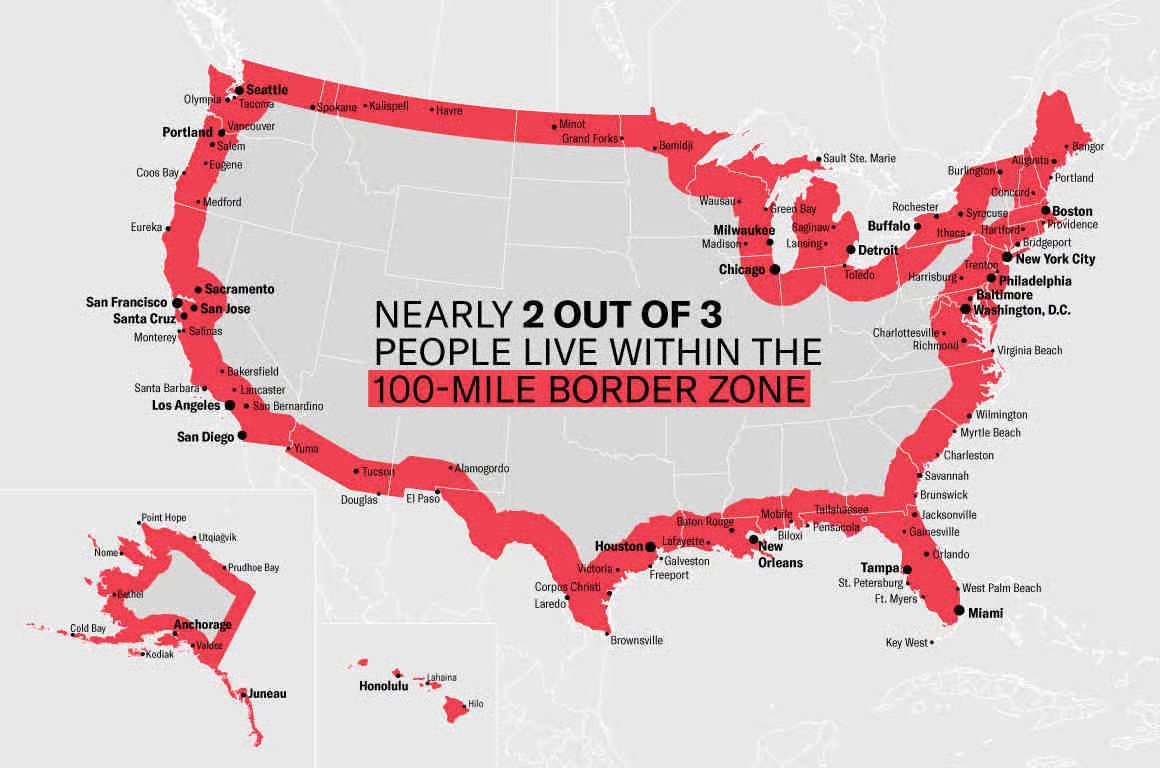
The slippery slope here is “or within 100 miles”, but that wasn’t a factor here either
as far as I understand, they were not there to serve a warrant. he was crossing a border and the feds are claiming that the 4th amendment doesn’t apply because he hadn’t yet crossed into America.
border patrol was essentially using a loophole to preemptively collect potential evidence (they’ll figure out what to charge him with after they see his phone contents). he’s a political activist against a cop city, they were obviously trying to do him dirty.
they were not serving a search warrant. they were abusing what should be an illegal search at the border in order to silence those who speak out against govt overreach.
The US claims jurisdiction over its citizens wherever they are.
Which isn’t necessarily a bad thing, because it means you can be prosecuted in the US for stuff like going to Thailand and sexually abusing children there.
So the law applies, but protection under the law does not.
Isn’t all law essentially derived from powers granted by the constitution?
If the powers granted by it to enforce a law are applicable when not within the US then then it very reasonably ought to apply to any and all amendments.
But, reason is on the extinction list with the magafascists. (And all LEO)
In addition, the law that he’s charged with relates to knowingly destroying property that the police have a warrant to sieze.
There is no precedent of it being applied to border searches where they may not even have reasonable suspicion of a crime and can stop people for questioning on a whim.
The State has absolutely no claim over your personal property at that point and destroying property that the police hope and dream of siezing isn’t the same as destroying property where they’ve demonstrated probable cause to a judge.
This argument from the border patrol that you can be arrested for destroying data that is in your possession without ever been given due process and 4th amendment protections isn’t supported by precedence.
These fucking conservatives crawl out of the woodwork like cockroaches anytime the government does something heinous and use their piss poor understanding of EVERYTHING to try to justify the heinous actions. It happens every time, and I wish just once to see one of them use real and relevant facts, just so I can pretend that these people live in reality for just one second.
This also includes “when entering the country”. It always has. There’s nothing new here. There are so many things the current administration does to violate rights and due process, but this isn’t one of them.
Have to disagree with that one. Simply entering a country is not justification for searching someones phone. I don’t care what the law says. People have a right to privacy.
Nah, they just lube up the rubber gloves and fist you, checking in case there’s a micro SD stashed up there. You should still make your flight if you relax.
That’s not really how the law works. You’re not making a comparable analogy. You sitting at home or in a hotel room is legally not remotely the same as when you’re being actively searched by a federal agent.
This is more like if the a police officer is about to do a pat-down search of someone, and they reach into their pocket, grab something, and rapidly swallow it.
You can destroy your property in normal circumstances whenever you please. If you delete a file in the privacy of your own home, odds are you’re not doing so for the purposes of evading law enforcement. However, if you do it literally seconds before law enforcement is about to get a hold of it, it’s pretty unambiguous that you’re trying to destroy evidence.
That’s the crucial difference here legally. Plausible deniability does not exist when you’re destroying something because a police search is imminent.
I am explaining how the law works and the assumptions behind it. The law assumes that if you were embarrassed about your dick pics, that you would delete those before the officer is right about to search you.
This guy has no fucking idea how the law works. Destruction of evidence requires a primary crime, the one you’re destroying the evidence for. There is no crime, therefore no destruction of evidence. Only an incompetent or corrupt judge would let this even go to trial.
It’s a good idea to know the possible implications of your actions. That’s just being reasonable. However, the 4th amendment says police need a search warrant, do there is nothing to prosecute.
The cops were trying to search him under duress, while denied legal representation, without being read his Miranda rights, and without a warrant. Why are you trying to blame the victim of this bullshit?
He’s a US Citizen. He should be able to re-enter his own country without being subjected to this bullshit.
Some are saying cops, others are saying border agents. You consent to be searched if you cross the border in either direction. He should have consulted a lawyer prior so he knew what his rights were.
Can they prove there was data on the phone beforehand? Who entered the code? Can they prove they entered a duress code or did they make a mistake? Was a device search legally required and justified?
I like this option, save a snapshot and restore that snapshot deleting everything else. So it looks like a regular profile but won’t contain anything you want to remain private.
The profiles are independently encrypted with a key derived from the user’s profile PIN. If the other profiles are not logged in then their keys are not in RAM (and they get zeroed beforehand so they can’t be read out of unallocated memory).
Even if the bad guys get root via a LPE in a dummy account there are no keys to find and the profiles’ storage are not mounted.
You couldn’t trust the device after that however, who knows what kind of persistent spyware they could have installed.
Without a warrant, it’s literally his phone to do with it what he pleases. Baffled that that’s not the end of the conversation.
Assuming we lived in a rational world with a fair and impartial justice system, and not one that exists to funnel money from the working class into the Epstein class and kill or imprison everyone that makes that less easy.
Thanks but I live here and it’s not basically ever.
Cops either use a pretense tools like a drug dog to establish probable cause for the search they want or do parallel construction after they’ve already built the general structure of a case, usually tracing things to a valid cause for search, usually via coached informant.
Or its ice and they can just do whatever they want.
You’re living in a fantasy world and your delusional ignorance is real danger is worrying. Please never approach or speak to me in person.
So I’m completely on the outside of the debate you guys are having, but I’d like to but in and ask anyway
Please explain what you were trying to say with that comment because I’ve been staring at it for like 20 minutes trying to make sense and I’m so lost 😂 just str8 stunlocked and I’m really curious please translate pleeeeease :D
‘These are viable alternatives to the thing you’re insisting exists, on the assumption that the thing exists. Notably a thing that is a piece of SciFi tech from ‘star trek’ and something that obviously doesn’t exist as evidenced by my personality.’
The point being that warrants are equally a thing to the star trek stuff.
I was saying ‘the cops aren’t avoiding anything. They’re just doing it the normal way that isn’t fantasy bullshit’ because warrants are basically unicorns over here except for parallel construction style cases.
With GrapheneOS you can enable the setting that requires you to use biometric identification to get to the passcode screen, which means you’re always protected by both.
well they have the “border search exception” so at the border, no, they generally do not need a warrant for “routine searches” of electronic devices. Fucked up, but that is the law on the books and US courts have virtually always upheld it when it comes up.
Huh, you seem to be correct. I’m finding plenty of pages that claim that “international ports of entry” includes airports, but none of them source it or seem like very trustworthy sites.
Genius. Flips the script. In the process of conducting an illegal search, you deleted my phone causing considerable financial and emotional damage. Lawsuit time.
It probably won’t work, at least (US)domestically. The requirement for obtaining a warrant before searching a phone is part of training because there is a clear Supreme Court ruling to that effect.
That being said, what the law says and what some random asshole does during a stop are not always the same thing.
Their way around it is they say that the border crossing technically isn’t 100% normal US territory and therefore some constitutional rights are suspended under the concept of “sovereign self-protection”. You could then say any law in the US could be used to justify this concept, in fact it was used to forcibly intern thousands of Japanese and Japanese-Americans during ww2.
He was targeted for purely political reasons, the cop-city environmental protest in Atlanta GA, and I’m wondering why the border officials were even aware of them. Is there some sort of “we don’t like what you think” list run by the gov?
His device was threatened with seizure even though he posed no threat, no visible threat or spoken one, no suspicion of a crime, and they had no idea what the contents were. His 5th Amendment rights were violated by the threat to seize it. They want to establish a precedent, that the very existence of a possibility of criminal contents, regardless of any reason to suspect any, is sufficient for search and seizure. Based on this a little kid deleting the contents of their ipad would be a crime.
In addition, how can you show intent to destroy evidence when you have no expectation of being detained or charged on any specific occasion, and have no idea what evidence they might be seeking?
Legally this might be the same as intentionally deleting evidence. Rigging up evidence to be destroyed could be considered as intent of evidence misconduct, and some judges might not consider there to be a semantic difference given the intended end result to be the same (IANAL but the US judges are crazy)
Back up and wipe your phone before you cross the border. That way if they want to look at it, feel free to hand it to them. When you get back home, restore the backup.
My understanding is you can’t actually be forced (legally) to give up your phone’s PIN or password as part of a police search, because it violates the 5th amendment against self-incrimination, even at the border. Now will they still find a way to fuck up your day if you refuse to unlock your phone, sure, but I feel like saying “I have a right under the 5th Amendment to not reveal my password” is going to be a lot easier to defend than “I intentionally wiped/locked/bricked my phone when you asked to look through it.”
Most phones can be accessed by forensic software. The more secure phones are protected as long as they’ve just been restarted but before they’re unlocked for the first time.
Some phones, like an up-to-date GrapheneOS on a supported Pixel, may resist forensic imaging after first unlocking but the information is in memory so there could potentially be zero days or other exotic methods of obtaining the data.
A duress wipe lets you know 100% that the data is not accessible.
According to the article, this guy’s legal team claims he did, in fact, tell them they should show a search warrant, and he won’t talk without a lawyer.
But they were ignoring those requests, and pressuring him further till he realized it’s a lost cause, and handed them over the Duress pin
If the duress pin makes obvious it’s the duress pin then it’s not really doing its job. It should instead open a profile with not much in it while erasing the other profile and files in the background.
They asked to unlock his phone, he entered the wipe instead personal pin, and the wipe starts, with no possible reversal.
I mean yeah they discover it when he hands them the phone and it shows something other than an unlocked screen… But he is still in detention? Making a fake homescreen will fool them for like 30 secs tops until they open literally any app and sees it’s either completely empty or that it doesn’t work.
What would that solve? It just drags out the procedure
The purpose of a duress code is plausible deniability.
There is an encryption product for Windows called VeraCrypt (aka TrueCrypt). You can create a hidden decoy volume inside an outer encrypted volume which has all your stuff in it. When mounted an observer cannot tell the difference between the hidden volume and the real volume since they are mounted the same way with different passcodes. You can put files in the decoy for plausibility but not the things you actually want to hide.
The same should be true of a duress code in a phone. It should be possible to put files, apps and stuff in the decoy that show activity e.g. email, pictures etc. Providing the other profile is wiped while this screen is showing then there is no immediate way of proving it was a duress code.
It would have to at least convince the border guard, but it should withstand forensic analysis too. So it might be necessary to do what VeraCrypt does.
“The duress PIN doesn’t give you a second chance and will trigger anywhere you enter it: on the lockscreen, while enabling Developer options, or even while unlocking an app that requests authentication. And unlike a regular factory reset, a duress PIN will erase all encryption keys and your phone’s eSIM partition as well. This makes it impossible for an attacker to access my data just by having physical possession of your device and knowledge of the PIN.
I think the real strength of GrapheneOS’ duress PIN lies in its subtlety. There are no confirmation prompts, no announcements, and no obvious signs that the wipe was intentional on your part. Of course, GrapheneOS is no longer a fringe operating system these days — it has even attracted the ire of law enforcement in some jurisdictions. In other words, a professional attacker might be aware of the existence of a duress PIN. But if you can enter it quickly enough, it achieves its intended effect: no data can be lifted from your phone.”
Pretty plainly stated:
Main purpose - delete all data
A nice bonus - the process is semi hidden, no way to confirm mistakes or not
Purpose is NOT - Fool any attacker to think they have your phone even though it’s wiped
So it’s most definitely doing it’s job. You think that job is not enough, fair, but it’s living up to it’s own stated purposes.
On the Linux box I travel with, my main account is not shown on the list of user accounts when you login. There is a dummy account on the list. When I log into that, it has a full complement of apps and data, and the online email account it connects to is a secondary account I use for travel bookings, random notifications and other throwaway purposes. Financial data, important passwords, personal correspondence, etc, are not on that account. Just the usual stuff a non-computer-savvy guy my age would have: browsing, email and Facebook. If they ever comment on it being Linux, I’ll just say “my son set it up for me, I kept having problems with Windows.” But so far, the most they’ve ever done is ask me to show that the laptop can boot up. There’s also full-disk encryption so scans won’t tell them anything worth knowing.
The passwords I use are high-entropy. There’s no duress PIN, though I could set one up if so inclined. So far, I haven’t felt the need to.
From reading up on the laws and if what this article says is true, even if they unlocked his phone and found evidence of crimes on it, his case would be kicked to the curb as it was all an illegal search and correct procedures weren’t followed.
I’m not an expert, but I don’t believe that applies to airport points of entry. Regardless, if you’re going to something as suspicious as wiping your phone while at a point of entry, consulting a lawyer beforehand is just a reasonable thing to do.
You may think some laws are bullshit, (ie: sovereign citizens) but you are still governed by those laws.
The 100 miles extends inward from the exterior border, not around every airport. But every international airport is a port of entry over which they have jurisdiction and can perform warrantless searches. And, in my opinion, warrantless searches for everyone by virtue of simply entering into the country is a violation of the 4th amendment. Which is why it’s bullshit and shouldn’t be allowed. It can and often is abused, especially when tied to another equally (should be) unconstitutional “law”, civil forfeiture, even before the bullshit policies Trump and the SCOTUS have deemed reasonable suspicion for illegal status (i.e. appearing Hispanic, speaking Spanish, displaying a flag from another nation, etc.) I’m aware of the laws, but that doesn’t make them just or even constitutional.
Under the border search exception, federal officers may generally conduct routine, warrantless searches of persons and items entering the United States without reasonable suspicion or probable cause of unlawful activity. However, stops and searches conducted in areas farther from the border may require at least heightened suspicion or probable cause of unlawful activity to withstand Fourth Amendment scrutiny.
They can do warrantless searches. Just not within the entire 100 mile border. A fair distinction, but they definitely can at the border and ports of entry, and do so routinely.
Yeh that’s very different to saying they can in the whole 100mil area.
At an airport or actual border crossing yeah, I can understand that. They’d only be doing it when they have a big suspicion of something, at least you’d hope. According to them it’s like 0.01% of people a year.
Yeah it’s like having never had a single sip of alcohol but doing a u-turn and driving off when you see police doing mobile breathalysers. It looks suspicious as fuck, and the police will treat it as such until they’ve investigated and found you didn’t do anything wrong. You’re basically giving them “probably cause”.
You mean probable cause, not “probably cause”. And what you described, evading a sobriety checkpoint, gives them reasonable suspicion, not probable cause. Reasonable suspicion amounts to articulable facts of observation that reasonably lead them to suspect you may be committing/have committed/were about to commit a crime (like apparently fleeing from a police breathalyzer check). It grants them the power to detain you for a reasonable time for the purposes of investigating to confirm or assuage their suspicion.
Probable cause requires actual evidence that a specific crime has been committed, that you committed it, and that evidence is secured. It is the standard needed to A) arrest you or issue a warrant for your arrest, and B) issue a search warrant for your property if evidence connects it to the crime in question in order to gather more evidence. (Note: They may do an inventory search of your person if arrested, and an inventory search of your vehicle if towed due to your arrest. This is limited in scope. A full search requires a warrant.)
Reasonable suspicion is a much lower standard than probable cause.
An immigration officer also cannot search you or your belongings without either “probable cause” or your consent. If an agent asks you if they can search your belongings, you have the right to say no.
In this case the probable cause was that his name was on a terrorist watch list. something that the TSA and the FBI wouldn’t have known was done out of spite with no real justification. The search was as legal as it could be under the circumstances. Though access to the phone gets murkier because it falls into the bullshit reasons cops claim all the time to search or arrest you. They admit that they had no real evidence to hold him. claiming CSAM was likely to scare him into opening the phone for them. But the core issue is that he was on a terrorist watchlist and that is just cause. I’m not saying he should have been there but the issue is ultimately with the police department not the FBI or the TSA.
It’s a whole lotta bs and I hope he makes it through unscathed to sue the police department for their actions.
That Probable Cause standard requires a reasonable and articulable suspicion of wrong doing to exist too. Merely crossing a boarder alone doesn’t give rise to that.
You guys are looking at the wrong thing. Airports have their own set of bullshit rules. According to the government choosing to fly automatically implies consent to be searched. Domestic flights have more protections, but international flights basically wave your right to privacy under the 4th.
They only require explicit consent or probable cause if they want to do an advanced or forensic search of your phone. You can deny the search if you’re a citizen, but if you choose that option they can take your phone into custody for several weeks to attempt to crack it if they choose to do so.
ngl, in his position I would have wiped it too. Not because I had anything illegal, but because I have a signal chat with the bros where we sometimes bitch about politics and I don’t need this administration’s FBI arresting me as a terrorist for stupid memes about socialism and queer jokes.
I’m half-expecting for it to turn out that he was being wholly compliant, and he’s being accused of destruction of evidence because they were looking for something that never existed to begin with.
The charge treats the alleged wipe as destruction of property intended to prevent a government seizure.
He is being charged with destroying “evidence” but he was never charged with anything in the first place. That is like saying deleting any files at home is a crime. I’d think forcing you to present evidence necessary to charge you with something would fall under the constitutional right against self-incrimination.
Unfortunately according to the federal government you automatically consent to limited 4th amendment protections when you choose to fly. Domestic flights have more legal protections, but international flights basically wave your right to privacy.
They are allowed to ask for your phone’s password and do a “non-forensic” search of your phone for just about any reason. A more extensive “forensic” search where they plug your phone into another device can be made if they present reasonable suspicion. If you refuse a search they can hold onto your phone for several weeks.
The smarter move would have been to just refuse to give the password and trust that they wont want to go through the hassle of cracking your phone once it’s in custody.
Basically the only real way to protect yourself is to not keep any incriminating information on your phone. The courts have ruled that these searches only extend to data that can be physically accessed on your device and things like social media and cloud storage are not subject to the search. So it’s just best to save everything on the cloud and then restore it once you are done traveling.
I didn’t know android could do that. I wanna turn one on! But, I can’t find it. I’ve looked under Security and Privacy. I have a pattern to get in (they can physically force you to unlock your phone with fingerprints), no facial recognition, and my security and privacy is all green checkmarks. I’ve tried to find it under my Samsung account’s security stuff. Its not there. It doesn’t even show up when I search for it on the settings search bar. What am I missing?
i’m dumb but i installed it on my pixel last month and it took about an hour and they walk you through it on the website :)
i couldn’t get google messages working but in the end i realized i dont really care about google’s propriatary rcs implementation and just use fossify messages and signal/fluffychat for other chats.
Yes, it’s a different Android based OS. It’s privacy focused, hence having this feature, and only supports Google Pixel devices.
Android is just a version of Linux, so anyone can make a fork of it. Most Android device manufacturers do this, including your device having Samsung’s rendition of Android and my OnePlus having OxygenOS (soon to be ColorOS), but anyone can do the same if they’d like. LineageOS is another super cool Android project.
Idr if this was a feature that made it into a real OS or just a concept that never came to be, but…
I recall reading about a duress pin that instead of deleting stuff, just booted up normally… but to basically a separate user profile. From the non-duress profile you could choose features that would be shared between the two, like texts or call history of specific people, browser history, photo albums, etc.
So “sure officer, it’s 5224” would open up a phone profile that looks convincingly used, with nice long trails of cat memes and chatter with your gaming buddies about your favorite franchise enshittifying, and so on.
Punch in your real pin to unlock it though, and it’s got full access to everything, including data you want to keep private.
…and, uh, if any of you are designing a mobile OS right now, here’s your feature suggestion!
I would wager that this is going to become a test case that is intended to appeal it’s way to the SCotUS. The SCotUS has already ruled that many constitutional protections are waived at the border, so it wouldn’t be surprising if that is the intended outcome.
Why would you not just take a secondary (read: wiped) phone going somewhere problematic instead of relying on features like this?
You know US border security under Trump plays fast and loose with your rights.
Maybe somebody’s asked this already but how come, in this day and age, there isn’t a way to snapshot your entire phone into some sort of encrypted blob for storage in a location of your choice? You could wipe your phone and setup a throwaway profile with some basic apps before traveling, and then restore the snapshot once safely through customs.
Border issues aside, it would be very handy to be able to snapshot a phone like that anyway…
There isn’t such a feature on android because they can’t scan your stuff for advertising if it is an encrypted blob. Apple let’s you do this with an iphone, iirc.
Samsung has encrypted profiles, apps have no problem advertising to you from knox.
To do a complete phone backup like that all you need is Android root access. Root access on Android is, in fact, a little iffy. Any app given root access can basically read anything on the phone anywhere, keylog, remote execute, yada yada. The security landscape on android is a lot more flat than ios.
Some ISP Vendors do have apps that let you sync android phones and back them up, it’s just not common and they go through a LOT less work to make sure your restores will work later.
Seedvault doesn’t backup apps whose developer chooses not to let you back them up. It doesn’t backup the encrypted keystore or the tee. It misses a lot, because Android fundamentally puts developers above users.

 Android AuthorityGrapheneOS duress PIN could land a man in prisonA US man is being prosecuted after allegedly using a GrapheneOS duress PIN to wipe his Pixel during a border search.