posted in Technology

Motorola's 2027 flagships will officially support GrapheneOS
www.gsmarena.com/motorolas_2027_flagships_will_officially_support_grapheneos-news-74312.phpposted in Technology
Motorola's 2027 flagships will officially support GrapheneOS
www.gsmarena.com/motorolas_2027_flagships_will_officially_support_grapheneos-news-74312.php
Replying to @sundray@lemmus.org
I love graphene, but I hope they’re planning to also roll out some very strong stock software - or else this will make for a very rough first impression on a large audience of normies and hurt graphene’s long run chance of success. The camera, gallery, and app store in particular will not come up to many users’ standards.
My impression from the article is that the Motorola phones ship with default Android, but flashing to GrapheneOS is officially supported. So it would only be people who would be flashing GrapheneOS anyway.
Yeah by “switch to” they probably do mean flash. I could have sworn they had plans to ship Graphene phones but maybe that’s a later phase.
There are some third party vendors online that ship pre-flashed GrapheneOS phones iirc, but I don’t believe there has ever been on with it factory installed.

I would never trust a pre flashed Graphene phone. Always flash yourself for security.
I agree, you should always flash it yourself. Though GrapheneOS does have the Auditor app to attest the integrity of the operating system against another GrapheneOS device. It’s always going to be best practice to do it yourself, however.

I could have sworn they had plans to ship Graphene phones
They do. They say it in their roadmap:
Hardware and firmware security are core parts of the project, but it’s currently limited to research and submitting suggestions and bug reports upstream. In the long term, the project will need to move into the hardware space.
Would you trust a pre-flashed phone though?
I guess with GOS they have integrity checkers.
At least for right now I would trust one that had the backing of the Graphene devs. Them and Signal are probably the two most rock solid trust sources right now. (Of course this must constantly be reevaluated)
There are some really talented people working on the camera systems for Apple and Google etc. what I don’t get is surely there are some equally talented engineers (in image processing) who love open source so why aren’t they working on an open source camera platform?
It seems an itch that’s not getting scratched.

idk if this is the case here but on a firmware level, interfacing with these camera chips almost always requires an NDA that they’ll only sign with very large minimum orders
This is also why open source wearables can’t have the best PPG heart rate/SPO2 tracking.
There are only about 4 PPG analog front ends still in production that don’t require an NDA and the Max86141 is the only one worth anything it seems.
You can’t do analog front ends with any small FPGAs that I know of and it is simply to large to do it (well, at least) on a small wearable with discrete components.
Motorola should be able to lead them into the right direction for this. Moto controls their own drivers and while i don’t know, i don’t expect they’re using stock android camera, they can probably just provide the camera app to graphene
I guess aosp needs more open source love what with Google treating it like a bastard step child
How about 6 camera lenses, so it doesn’t wobble?
I’m waiting for the “whoops!! All Lenses!” Version
The onion needs to do for phone cameras what it did for Gilette razors:

I was hoping that when Apple released thr iPhone 17 with a horizontal island it would end the wobble on a lot of phones, as others tend to copy Apple.
Unbelievably and fucking annoyingly, the iPhone 17 still has one of it’s fucking camera lens jut out enough to fucking wobble still. Which fucking engineer okayed this fucking shit.
I still want a google pixel for the visor, but last year I bought a S24 Ultra as it was cheaper and I don’t like the performance of the Pixle 9 overall. (I always buy the previous gen of current year, when I need to). Oh well, after my S24U breaks maybe when pixel 14 or 15 comes around I’ll get a pixel. Or some other phone with a visor camera island like it.
They need to support it on the Moto G phones so people can actually afford them.
Exactly. Graphene is not for the poors, still. Even used phones that can run it can be pricey.
What are the odds that it filters down?
I’ll pick up a cheap android and put Lineage on it before I buy another flagship phone.
Not for awhile as the cheaper chips don’t have the features required.
What are those features? I thought avoiding Google stack would be entirely software based. Send me a link if you don’t want to write it all down.
GrapheneOS is not about avoiding the google stack, but comprehensive security hardening intended to address a wide variety of threat models.
They are listed there: grapheneos.org/faq#future-devices

I was looking at the lowest end pixel for Graphene (Pixel 7) and they are still nearly $400 on the aftermarket. It’s insane.
Where are you looking? I see Pixel 8s, used and unlocked, on ebay for $200-300.
Anecdotally I bought a used pixel 9a last year for ~$350, could be regional or due to ongoing inflation though
I’m guessing inflation and the tech related bullshit. Everyone marking shit up.
Replying to @NewOldGuard@lemmy.ml
I bought a new in box old stock Pixel 9a for $350 USD a couple months ago from eBay. This was just before that Cop City protestor gave a duress password to border patrol, I wonder if that caused a bit of a spike in demand for old Pixels?
Most of the Pixel 7s on Swappa are just under US$200 at this moment.
I got a 7 Pro around 6 months ago for $280 CAD. Surely there are other less expensive sources you could find.
Damn, the market’s crazy. You could get a Pixel 7 brand new, unlocked, for less than $400 when it was still current, 3 years ago.
The only things Pixels have going for them are the aggressive sales and GrapheneOS.
I got a deal on a new 9 from my carrier for $5 a month for 24 months.
$120 CAD.
But, in canada, the phones come carrier unlocked and had no issue flashing it. Though i only ever powered it on once before it was flashed - to turn on oem unlocking. The sim was not used until then. So it didn’t do any auto downloads that might have caused a problem.
Long short: you can find them cheap if you look.
What is your plan price though. I see lots of thee x a month for phone but they also have a really high base price.
In canada it’s all high. But i have 120GB data, unlimited calling and text in north America, free roaming, for 45$/mo
So my bill is 50 + tax.
I’ve had the phone for lver a year now.
Replying to @masterofn001@lemmy.ca
Is this available for non-canadians? Sincerely An American who pays more then that for less.

Yeah, there are very few cases that would make me fork hundreds of Euros for a frigging phone.

iirc, as of right now, its only the expensive processors that meet the security standards GrapheneOS has. Therefore only being available in the future high-end Motorola phones.
Yup its exactly this. And with supply shortages, itll take a while to filter down in price unfortunately.
it would take a while without shortages. with shortages, it will take a long while
Yeah the signature phones cost around $1.500 here in my country, my budget is $400 tops, no way I can afford that, my hopes are lost.
Replying to @sundray@lemmus.org
Interestingly, Motorola itself is doing “a large portion of the work of porting GrapheneOS to their devices”.
…and Motorola is owned by Lenovo, which is effectively controlled by the Chinese state.
I love GrapheneOS but jumping into bed with the CCP is bad, bad idea.
Edit: I’m not a fan of US tech either, and this isn’t an “I hate China” post. They are both awful countries.
Damn the CCP for building secure hardware!
You think they could do something on the hardware level after flash grapeneos?
I think Lenovo would’ve been prevented from teaming up with Graphene if there wasn’t a way around its security measures, be that hardware or software.
Replying to @jobbies@lemmy.zip
You believe GrapheneOS is not able protect against Motorola? Or do you think GrapheneOS is weaking the OS specifically for Motorola? Do you believe that’s also the case for Google with their Pixels and the USgovt? Are you saying stay on stock Android? Is there another mobile OS you are recommending? Your message is not clear and you seem to be making unsubstantiated claims with no evidence to back it up.
If you read what I originally wrote I mentioned that Motorola had done most of the work in porting GOS to their hardware. To me that sounds like Motorola/Lenovo having oversight of both hardware and software. I’m not an expert in the capabilities of the Chinese state but I’d put money on them using their influence to give them an advantage on GOS.
Again, I’m not a fan of US or Chinese tech. I’m not a fan of either regime. I don’t know what the alternatives are. I’m on an older Pixel running GOS but I won’t be upgrading to Motorola - once this phone dies I’ll probably get a dumb phone or give up mobiles entirely.
Good luck, dumb phone means no encryption, SMS and MMS are stored plaintext and freely shared with US three letters and phone convos have been spied on en masse since the 80s.
For that to be effective you’d have to give up phones, smart, dumb, even carphones and landlines. Not only that, you’d have to reliably know your contacts are never contacting you through their phones, windows PCs, etc, that all themselves have that compromised HW as well. Realistically you’d need to fall back on the postal service, but people can steam open letters, so you’ll need directly employed couriers, but can you really trust anyone else? So you need to hand deliver it, but can you really trust your contact to burn after reading? Better say it face to face, if you can be sure they (or third parties) aren’t recording, but then Flock knows they were with you and they could be tortured later.
Good luck, dumb phone means no encryption, SMS and MMS are stored plaintext and freely shared with US three letters and phone convos have been spied on en masse since the 80s.
That wouldn’t be an issue, if say, the dumb phone existed for emergencies only.
you’d have to give up phones
I did mention that as a possibility
Realistically you’d need to fall back on the postal service, but people can steam open letters
Well there’s always carrier pigeons and jungle drums.
Even jungle drums, you’d need your own drum-language. If the rest of the tribe knows it…
You could book cypher all of your comms, I guess.
I think you’ve overestimated how much I want to communicate with other people 😅
You believe GrapheneOS is not able protect against Motorola?
Um yes? How do you protect against someone who literally controls the hardware?
Ask GrapheneOS. Thats literally their mission.
Devices are carefully chosen based on their merits rather than the project aiming to have broad device support. Broad device support is counter to the aims of the project, and the project will eventually be engaging in hardware and firmware level improvements rather than only offering suggestions and bug reports upstream for those areas. Much of the work on the project involves changes that are specific to different devices, and officially supported devices are the ones targeted by most of this ongoing work.
Hardware, firmware and software specific to devices like drivers play a huge role in the overall security of a device. The goal of the project is not to slightly improve some aspects of insecure devices and supporting a broad set of devices would be directly counter to the values of the project. A lot of the low-level work also ends up being fairly tied to the hardware.
Non-exhaustive list of requirements for future devices, which are standards met or exceeded by current Pixel devices:
- Support for using alternate operating systems including full hardware security functionality
- Complete monthly Android Security Bulletin patches without any regular delays longer than a week for device support code (firmware, drivers and HALs)
- At least 5 years of updates from launch for device support code with phones (Pixels now have 7) and 7 years with tablets
- Device support code updated to new monthly, quarterly and yearly releases of AOSP within several months to provide new security improvements (Pixels receive these in the month they’re released)
- Linux 6.1, 6.6 or 6.12 Generic Kernel Image (GKI) support
- Hardware accelerated virtualization usable by GrapheneOS (ideally pKVM to match Pixels but another usable implementation may be acceptable)
- Hardware memory tagging (ARM MTE or equivalent)
- Hardware-based coarse grained Control Flow Integrity (CFI) for baseline coverage where type-based CFI isn’t used or can’t be deployed (BTI/PAC, CET IBT or equivalent)
- PXN, SMEP or equivalent
- PAN, SMAP or equivalent
- Isolated radios (cellular, Wi-Fi, Bluetooth, NFC, etc.), GPU, SSD, media encode and decode, image processor and other components
- Support for A/B updates of both the firmware and OS images with automatic rollback if the initial boot fails one or more times
- Verified boot with rollback protection for firmware
- Verified boot with rollback protection for the OS (Android Verified Boot)
- Verified boot key fingerprint for yellow boot state displayed with a secure hash (non-truncated SHA-256 or better)
- StrongBox keystore provided by secure element
- Hardware key attestation support for the StrongBox keystore
- Attest key support for hardware key attestation to provide pinning support
- Weaver disk encryption key derivation throttling provided by secure element
- Insider attack resistance for updates to the secure element (Owner user authentication required before updates are accepted)
- Inline disk encryption acceleration with wrapped key support
- 64-bit-only device support code
- Wi-Fi anonymity support including MAC address randomization, probe sequence number randomization and no other leaked identifiers
- Support for disabling USB data and also USB as a whole at a hardware level in the USB controller
- Reset attack mitigation for firmware-based boot modes such as fastboot mode zeroing memory left over from the OS and delaying opening up attack surface such as USB functionality until that’s completed
- Debugging features such as JTAG or serial debugging must be inaccessible while the device is locked
In order to support a device, the appropriate resources also need to be available and dedicated towards it. Releases for each supported device need to be robust and stable, with all standard functionality working properly and testing for each of the releases.
The expectation is for people to buy a secure device meeting our requirements to run GrapheneOS. Broad device support would imply mainly supporting very badly secured devices unable to support our features. It would also take a substantial amount of resources away from our work on privacy and security, especially since a lot of it is closely tied to the hardware such as the USB-C port control and fixing or working around memory corruption bugs uncovered by our features. We plan to partner with OEMs to have devices produced meeting all our requirements, providing additional privacy/security features beyond them and ideally shipping with GrapheneOS rather than massively lowering our standards.
Replying to @9tr6gyp3@lemmy.world
That’s all very nice but not many of us are willing to buy a $1000 phone (or an obsolete Pixel) to get Graphene. They soon won’t be able to run it on new Pixels, and also the stuff about AOSP updates stops mattering since AOSP itself is nearly dead. The obsession with security chips (fighting the seized phone attack while comparatively ignoring much more relevant threats) is another misplaced priority. It’s the old notion of “fence post security”, putting a 100 foot fence post in the middle of the desert expecting the attacker to try to climb over it instead of going around it.^1^ And again, I’m amused at the idea of the US and Chinese governments allowing a Motorola (Lenovo) Graphene to be sold if it’s really that secure.
We need a de-googled Android fork (maybe Lineage is that) on mass market phones using the hardware that those phones have. Otherwise we’re acquiescing to the notion that Elon Musk deserves more privacy than Joe Schmoe when it should be the other way around.
^1^ hpmor.com chapter 115.
That’s all very nice but not many of us are willing to buy a $1000 phone (or an obsolete Pixel) to get Graphene.
Pixel “a” series phones typically sell for under $500 and support GrapheneOS.
They soon won’t be able to run it on new Pixels, and also the stuff about AOSP updates stops mattering since AOSP itself is nearly dead.
Source for this?
The obsession with security chips (fighting the seized phone attack while comparatively ignoring much more relevant threats) is another misplaced priority. It’s the old notion of “fence post security”, putting a 100 foot fence post in the middle of the desert expecting the attacker to try to climb over it instead of going around it.1
The obsession with security chips is what allows Pixels and iPhones to be the most secure devices on the planet. They have some of the most researched technologies being used here. You’re literally just throwing it away based on…your link to a harry potter book? Seriously, look at the source you just shared. Its not even relevant 😂
And again, I’m amused at the idea of the US and Chinese governments allowing a Motorola (Lenovo) Graphene to be sold if it’s really that secure.
What are they going to do, ban security chips like they tried to ban encryption in the 90s?
We need a de-googled Android fork (maybe Lineage is that) on mass market phones using the hardware that those phones have. Otherwise we’re acquiescing to the notion that Elon Musk deserves more privacy than Joe Schmoe when it should be the other way around.
GrapheneOS and LineageOS are already degoogled… LineageOS is extremely subpar when it comes to security since they dont enforce it onto their hardware. GrapheneOS actually enforces it and wont work unless it has those specific security features. LineageOS doesnt solve the problem you were concerned about in your post.
Source for this?
This is a start: grapheneos.social/@GrapheneOS/117140352254892456
The obsession with security chips is what allows Pixels and iPhones to be the most secure devices on the planet.
I remember the govt trying to muscle Apple into unlocking someone’s iphone, til they suddenly stopped because they found Cellebrite could unlock it instead. There have been several new iphone generations since then but I haven’t heard about govt muscling anytime recently. So I have to infer they can still unlock iphones. As for Pixels, this is in Dutch but very recent: omroepbrabant.nl/…/drievoudige-moord-in-oosterhou…
Machine translation of main paragraphs:
The Netherlands Forensic Institute (NFI) has unlocked the Google Pixel phone belonging to 29-year-old Veronica K., according to the prosecutor. “A large number of images of weapons and stacks of cash were found on her phone. There are also a large number of chat messages that can now be read.” K. is alleged to have facilitated the murder by supporting the perpetrators.
The prosecutor expects to receive the first results from the NFI on Thursday. During the hearing, the prosecutor also said there is good reason to hope that the NFI will be able to unlock the Google Pixel phones belonging to the other two suspects as well.
So I think you’re putting too much faith in this stuff. I will ask my crypto homies if they have any recent info about phone attacks though.
More relevantly, most secure devices AGAINST WHAT? You’re talking about a locked phone attack which is the absolute least of most users’ worries. The phone is so insecure in everyday use that the border patrol is near irrelevant. Plus users including paranoids like me don’t have any opsec to speak of. When was the last time you crossed a border with an Android phone anyway? I don’t think I’ve ever done that. Like most people I don’t leave the country that often. Last time I did was before I switched to Android, IIRC. I might have had an analog or 2G flip phone or something. If I travel somewhere again it’s not that big a deal to leave my Android phone at home, as I mentioned before.
Even in the border patrol picture, Graphene and TPM won’t protect you from what used to be called rubber-hose cryptanalysis (xkcd.com/538). They’re defending from the wrong threat.
Look, I understand the advantages of crypto hardware. I’ve programmed it and written simulators for it. But, the way to really keep cryptography in people’s hands is to make it not require special hardware. Thus I’m skeptical that the government hates Graphene, but it really did hate PGP back in the day.
If I get to add new hardware to phones, TPM would be on my list but not at the top. First might be something like POCSAG (plus build out the pager network again) so you can receive text messages without transmitting anything or revealing your location. Second, third, etc. would be in a similar vein.
Your TPM concern here…
If I get to add new hardware to phones, TPM would be on my list but not at the top. First might be something like POCSAG (plus build out the pager network again) so you can receive text messages without transmitting anything or revealing your location. Second, third, etc. would be in a similar vein.
…is literally addressed in your post here:
This is a start: grapheneos.social/@GrapheneOS/117140352254892456
They mention all the secure enclave type of stuff needed. They have the verified boot. They have the MTP. Its all there.
As for Pixels, this is in Dutch but very recent: omroepbrabant.nl/…/drievoudige-moord-in-oosterhou…
Were they using GrapheneOS?
Also, keep in mind that Cellebrite slides were leaked and they show that they arent able to tap into GrapheneOS on modern Pixel devices.
androidauthority.com/cellebrite-leak-google-pixel…
Until GrapheneOS breaks away from AOSP, which they have mentioned they could potentially do so once they have a solid hardware platform, we seem to at least be in a good place where even the DoJ is upset about people using GrapheneOS.
Replying to @jobbies@lemmy.zip
I’ll take my chances with the CCP over ICE any fucking day of the year.
We are always under more threat from our own governments than a foreign one and I do not live in China or China-aligned country. I’m safer with my data in Beijing than in Redmond.
And that’s the worst case scenario. Likely, it’s enough of a win for China to have an OS that the US doesn’t have backdoors into without China needing their own.
You know the two aren’t really the same, right?
That’s the point: I don’t even know the name of the Chinese agency I would even theoretically need to worry about.
Back when Grindr was owned by a Chinese company there was concerns that data from the platform could be used to blackmail western politicians and civil servants.
I can’t remember the details but my point is - just because you don’t live in China it doesn’t mean you’re risk free.
Replying to @jobbies@lemmy.zip
I’m neither a politician nor a civil servant, and if I were, as a leftist, I’d be more threatened by Trump having my data than Xi Jinping.
Do I just keep repeating this or…?
Edit: yeah, as yourself point out: the threat China poses is giving your data to your government. lol
That’s worse, not better. Ignorance of the danger is not an advantage.
I find your inability to understand why an American is more afraid of ICE than a Chinese government agency really perplexing.
But, in honor of your concern, I will forthwith carry a rock that keeps away Chinese agents.
I find your inability to understand why an American is more afraid of ICE than a Chinese government agency really perplexing.
that’s. not. what. you. were. saying.
you are just ignorant and proud of it.
Honestly, that was the sum totality of my intention. If you would like to review the logs and tell me where my language reflected differently, I would love to know about it because I never had an intent to say anything else.
are you proud of not knowing something?
Not proud, not ashamed. I’m just using my ignorance of something to evaluate a risk, which is certainly a flawed and lazy algorithm, but probably operates better than chance.
Your data is going to the US government and data brokers, even if you don’t know it.
Source that China is using its backdoors to share information with the US? I mean, it very well might be, at least it’s an extra step. I’m saying I’d rather not share my information with anyone, but if i had to choose, it would be a foreign government ahead of my own.
I’m not sure where I’m going wrong, there.
Not what I meant, the US is grabbing all the information on their own, don’t think they aren’t. Maybe some of you more sophisticated computer heads can avoid it, but I wouldn’t expect it.
They have everything compromised on a basic level, basic levels. China could sell your information back to the US too though in some kind of deal.
But yeah I agree, I’d rather have foreign governments having it than mine own. But it’s near impossible for a layman, or person without substantial resources, to keep their information out of the hands of the NSA and data brokers, I strongly suspect, as Edward Snowden informed us.
Replying to @bedwyr@piefed.ca
Yup. And if I were a foreign government interested in collecting data, I’d definitely start up a low-cost VPN. You can’t trust anyone.
Canadian here, I’ll take CCP over GOP.
I don’t really want either. Its not a binary choice.
What’s enslaving hundreds of millions of people to work 6 days a week 12 hours a day compared to the US president that says mean things eh?
Source: made it the fuck up
Homie, ITS ALL China, Vietnam, Taiwan, south korea or maybe malaysia made. I’m speaking to the level of spying I want on my phone.

And jumping into bed with the NSA?

…and Motorola is owned by Lenovo
Huh, you’re right. I had not realized that had happened.
It looks like it’s just their phone division, Motorola Mobility.
Your argument is extrapolating way too much. You constructed this overcomplicated chain of thought that supposedly proves GOS sold out because… They got a manufacturer to build hardware that meets GOS requirements?
This is no different from ZOG, deep state or Blackrock conspiracy theories.
Replying to @late_pessimistic@slrpnk.net
You constructed this overcomplicated chain of thought that supposedly proves GOS sold out
Actually, that’s not what I’m saying. GOS is a small team, and they’ve confirmed that most of the work has been left to Motorola/Lenovo. Given what we know about the Chinese state, its not a stretch to imagine that interference has happened.
And I’m not arguing anything. All of what I’ve said is possible based on what we know (through verifiable information in the public domain) about the activities of the Chinese state. If you choose to call that a conspiracy theory thats up to you.
Replying to @late_pessimistic@slrpnk.net
There’s not much to conspire about with BlackRock, really. They are just evil assholes.
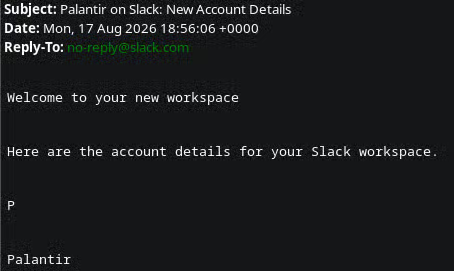
Anyways, check your email inbox, it should look like this.
Replying to @jobbies@lemmy.zip
I’m more concerned with the contributions eventually resulting in corporate decisions creeping into copyleft software, as is tradition. The kernel drivers and stuff already are just corporate decisions, tho if they contribute to the user facing stuff…
Oh, I don’t trust any AOSP fork btw. I like my computer. Just worried about friends.
Most people will still use Instagram TikTok and such. Having GrapheneOS will just hurt the quality and hurt the sales. Most people don’t care about privacy, best this will do is satisfy a small minority (who will flash better hardware with GrapheneOS anyway)
What better hardware? Google is getting increasingly hostile to Graphene. Pixel hardware also seems to be getting worse. And since Pixel is currently the only hardware you can install Graphene on, this is a beneficial thing that provides an alternative that doesn’t give money to Google.
Most people will still use Instagram TikTok and such.
The beauty of Graphene is it’s sandboxing and exploit protections are built precisely on assumption that the user will install every single piece of malware out there. The OS doesn’t trust anything by default.
And they function normally in this sandbox? I’m assuming sandbox is just compartmentalization. I’m interested in these mainly because when I use an app, browser, whatever… I want it seeing only what I give it with regular use, I don’t want it digging through my contacts, messages, location, microphone, other programs, yada yada. Instagram should only see what I’m scrolling. The play store should only see what I choose to download.
Replying to @JamesTBagg@lemmy.world
Yes.
GOS has compatibility issues, but they are unrelated to the sandbox and can be fixed with some tweaking.
I use Instagram to keep up with some friends and family on GrapheneOS AMA
Threat modeling and compartmentalization are a thing

It doesn't ship with GrapheneOS.
Yeah, why bother doing things? Just give up everything to the Google.

Man, I would be all over the is of it was on lower end models so I can run graphene as my sketchy international travel phone. But I don’t really want to pay flagship prices for that. And I still believe in having a curated primary digital fingerprint.
And I still believe in having a curated primary digital fingerprint.
Could you please elaborate? I know what digital footprint is, minimizing and compartmentalization techniques, but not primary and curated digital footprint.

Having no footprint is as obvious as having a unique one. It’s easier to hide in the crowd.
Functional and hypothetical only example usage of a curated digital footprint, for story purposes:
You keep, use, maintain, and preferably daily drive technology interfacing gizmos in a manner that results in a footprint where the conclusions drawn from it resolve to a “curated” set of… whatever the beholder is looking to ID from the footprint.
Functional example:
You keep and use devices in a manner that is at most “normie+”.
You own a Pixel Phone but keep stock android on it and add just enough to it not make you hate your life. You use a couple of normal sub services.
You still show some of your silly, like use an account on a porn website that federates with the world you care to socialize with. You still post how The Man better watch out.
Same as everyone else. The fingerprint looks like what you want it to look like.
So that it remains separate from what could happen/be happening elsewhere inside a Faraday cage with other devices there. How they are configured like, or who they talk to, the networks you utilize and the level of silly you display in your other accounts that have never so much as shared a trace route in passing together.
That’s hypothetically separate from the curated digital identity, depending on how careful and good at it your set up was.
So when the friendly folks with the mass surveillance pull up your file, it’s composed of what you wanted there to begin with.
It’s just another implementation layer of minimizing and compartmentalization, really.
Hypothetically. For a friend.
Replying to @Aqivex@fedinsfw.app
Thanks, this makes sense

On lower end you could go with lineageos, it’s not as good as graphere but it’s good enough IMO
You could still buy a second hand pixel series a.
You could probably find something under 300€ with 5-6 years of updates left if you seek for a pixel 9a.
whistles
They make a $2,600 smartphone?
I think the foldables are all somewhere along those lines. New tech, and double the screen and such adds up.
I’d bet that about half the price is just the RAM soldered onto the thing
It’s gonna be a premium for the folding feature or some other feature on that particular model — they list two other models that are considerably less expensive and have the same amount of RAM.
Can confirm recently got a box of 440 unsoldered Micron DDR5 memory ICs at work.
It was $140k. Not DIMMS but the chips soldered to the DIMM.
Inb4 Motorola CEO “falls” out a 30 story building window.
Okay good, they clarified that they won’t ship with it. I’ve seen people saying they will but I never read anything from Graphene or Moto stating that.
Wouldn’t it be better if it DID? Wouldn’t that get around all the “tamper” detection stuff?
Right now I have Google Play disabled in my owner profile, but it would be nice if apps in secondary profiles could pass the full Play Integrity checks… even though I’m actively trying to transition away from them.
For example Cisco DUO says my device with GrapheneOS installed has been tampered with, and I was hoping that would go away if I could just buy the phone with GrapheneOS installed.
Replying to @OpenPassageways@programming.dev
It wouldn’t go away. It will only go away if Google signs grapheneos images. Grapheneos on all supported devices support the required attestation already. It is just Google pettiness.
Yes sure. I was merely commenting on the misunderstanding surrounding this.

Replying to @OpenPassageways@programming.dev
I believe the play services agreement Motorola Lenovo signs to get the play store on their devices would forbid that.
In the long term, yes it would be better if it shipped.
However, if someone went to a phone store with a stock graphene on display and anything else next to it, which one do you think they’ll choose?
Until Graphene’s stock experience (i.e stock apps and launcher) mature enough to not look out of place next to google and apple, the average Joe will pick the more polished phone. I hope improving that is a task Motorola will be able to help with, while graphene keeps doing their thing.
Additionally with the app/play store dualopoly, Motorola would be shooting them selves in the foot if they didn’t ship with the play store.
Getting an option beside a pixel for Grapheneos is pretty cool and a big step forward. I hope new demand will be high enough to show the decision makers that its an endeavor worth continuing.
However, if someone went to a phone store with a stock graphene on display and anything else next to it, which one do you think they’ll choose?
Given the past couple years I’d like to think the fraction to choose graphene would be multiple times what it would have been 5-10 years ago. But not close to a majority.
I’m not sure about that. I have been using Graphene for a bit, and its surprising due to Google just how much stuff breaks and simply doesn’t work or fails silently under Graphene. It feels like one of the old school Custom ROMs which is great, but not on your daily driver phone.
Until Graphene’s stock experience (i.e stock apps and launcher) mature enough to not look out of place next to google and apple
why, what’s the problem with it? that it’s not filled with promotional apps?
Additionally with the app/play store dualopoly, Motorola would be shooting them selves in the foot if they didn’t ship with the play store.
they could just ask in the setup flow whether to install the play store
Honestly I can’t tell the difference with the launcher compared to what shipped on the phone, not that I used that very much - but I upgraded from an LG G8 and the whole thing looks very familiar. The camera app feels very much like the one on my LG but I suspect someone who is more into photography than me would be frustrated by it. But the standout awful stock app has got to be the clock, the ui is clunky and feels awful to use, the tones are obnoxious, and it has all the visual flair of a C student project.
I’ve mostly just replaced it with the alarm on my smart watch.
if someone went to a phone store with a stock graphene on display and anything else next to it, which one do you think they’ll choose?
People consider the phone features too. For example Huawei has built a really solid following due to their phones’ quality and that following didn’t go away when Google started sabotaging their phones. Eventually banking apps started releasing versions for Huawei AppGallery (the Huawei Android app store).
So the Google monopoly can be bent if there’s sufficient demand.
It doesn’t even need to be in the store, just let me order one online and check off a “GrapheneOS” box, the same way that I can order a Framework laptop with either Windows or Linux.
But I get your point, I can see how someone could get confused when their phone arrived and required some extra tinkering to get Google stuff to work.
This is great and all, gives more device options for GOS. However, being only flagship, this will put GOS out of reach for alot of people due to the cost of flagship phones and the current economy. Especially if Google starts making future Pixels unable to have GOS flashed onto them.
Replying to @sundray@lemmus.org
Sign me up for a graphene razr ultra please and thank you. Dont have any issue with self install if it doesnt ship that way
Honestly? Kinda prefer it.
Hope an updated clicks keyboard comes out for it.
Would be the most interesting usable android phone since the LG V20 IMO
The goat since the og razr.
Replying to @korendian64@lemmy.world
Not the same company. Lenovo bought only the name of the mobile division and slapped it on their products. Google bought Motorola Mobility first, stripped it bare of all the people and IP of value and sold the name to Lenovo.
Ok…
I’ll believe it when the roms hit xda.
Excited, sure, just hesitant. No buy until it’s truth.
I wouldn’t mind it coming to an updated ThinkPhone.

I’m still looking for a solution after https://keepandroidopen.org/
About 50% of my apps are from F-Droid (the others are specific local apps and especially bank apps, which is difficult …)
Will this affect graphene os?
if developers stop developing apps, that will affect GrapheneOS, yes
Oh yes, that makes sense.
I think apps will still be developed however they will reach only the custom ROM audience which I expect will grow massively.
I think the second part is correct, but the first one is not because lots of developers don’t use a custom ROM, and neither does a large part of their intended audience. Sadly, many people are not ready to give up the bank’s app, perhaps literally cannot give up the government app, but also hardware compatibility with most phones is not there, because of missing drivers.

Replying to @jeena@piefed.jeena.net
I’m pretty sure this is wrong. Like obviously it’s a bad thing that they are making it harder to distribute apps through 3rd parties but they aren’t stopping you from sideloading unsigned apps. They are introducing an additional step to unlock your phone to allow unsigned apps. Yes it is annoying and no I do not agree with what they are doing. But they are not removing unsigned app support from all android devices.
The new step will be deciding how long you wish to allow unsigned apps to be installable on your device (either 7 days or indefinitely) and then it requires you to wait 24 hours before you can start to install apps without Google developer signing.
These rules do suck, and it is a bad thing, but lying or exaggerating what is happening will not make them reverse course. It only justifies them when they say “it’s not that bad and it’s for your protection.”

I would agree, but that flow is through google play services not through the system itself, so google can just remove it whenever they want.

yeah i need my banking, only thing stopping me from using a non-googled phone. everything else can fuck off

i dont think you need google play services for banking.
furthermore, i disabled play services. i dont need it for 99% of apps.
sometimes theres one cool heavily proprietary app that forces you to use it.
sucks. and i just gotta uninstall it.
yes you do. my bank doesnt work without google play services
ok. my mistake.
either way…
i would think you could just use a web browser. but sometimes app is more preferable
there is no web app anymore, all mobile

Replying to @1985MustangCobra@lemmy.ca
my bank app works well within a containerized user with google play services installed

Signature? So when - In January?
Probably
personally i think Moto G Power is gonna be a beast with GOS
Dual sim slots sd card headphone jack insane battery

AFAIK they’re only targeting their flagship models first. Guess we’ll see, but I don’t think the Moto G series will get it. At least not initially.

This will apply to 2027 flagship Motorola devices, starting with a regular non-folding device, according to GrapheneOS developers who hinted at it being the successor to the Signature.
Thank goodness it won’t just be one foldable. I was worried for a bit.
Replying to @DupaCycki@lemmy.world
All of them are foldable, many times, some just get the power button jammed at like 4 degrees and break a bit around 12 or so.
I 100% understand and support why the moved away from google.
And Motorola was a good choice. But they really should have supported some budget phones.
A pixel series a could easily be found for under 500€ new. These flagship motorola phones are all way over 1000€.
And the developer clearly said they had currently no intention to support cheaper motorola phones. Among other things because Motorola won’t offer 7 year updates for anything but these flagships.
So, I get it. But let’s face it that people on a budget will keep using pixels for GOS while they are maintained.
The 2027 models will likely be flagship only however Graphene has tweeted that they plan to support cheaper Motorola phones in the future.

they didn’t abandon pixels though. they just take a little extra time because they have to manually update the old device trees now.
These flagship motorola phones are all way over 1000€
Yes. And now it’s not going down. See, the corporation cannot make any money off of ads and analytics if there are none.
I have a Moto phone, as far as I know they have made $0 from me in analytics or ads.
Moto phones in my experience are some of the most debloated phones out there.
They didn’t specifically disregard budget phones. The budget phones just won’t have the hardware required to meet GrapheneOS requirements. They’ve states that as the next gen flagship hardware trickles down to the budget phones, there’ll be more options.
I keep hearing this thing about the necessary hardware.
What is this exotic piece of hardware that the GrapheneOS needs? Please, someone tell me what it is.
Replying to @willington@lemmy.dbzer0.com
Searching would probably have been quicker than commenting :)
Replying to @FrogOnShark@programming.dev
(nothing I am about to say is necessarily personal; I am genuinely grateful for the link!)
Is there a table of these requirements as columns and vendors as rows?
I think most of this list is acquired by having a modern CPU or SoC, no?
Much of the list is software requirements.
There is one item that sticks out:
Just how much of the hardware list is satisfied by say having a Snapdragon SoC?
I would prefer if people said such and such vendor is missing such and such feature which we need. Always NAME the SPECIFICS. A link to a web page with the exact specifics missing for the most popular phones would help, imo. This is clear and educational. Instead we get “they don’t got no good hardware maaaan.” It’s annoying. Looks handwavy even when it is not.
Replying to @willington@lemmy.dbzer0.com
I haven’t seem anyone respond in the way you’re complaining about.
There’s a long list of requirements, with a big one being hardware memory tagging.
techtimes.com/…/grapheneos-expands-motorola-bette…
The Snapdragon 8 Elite Gen 5 — the chip inside the 2026 Motorola Signature — introduced MTE support, but only in the Elite variant. The Foundation has characterized MTE in the non-Elite Snapdragon 8 Gen 5 as effectively broken for GrapheneOS’s purposes. This is why even Motorola’s current flagship lineup cannot qualify: the chip is close but the specific hardware feature GrapheneOS treats as non-negotiable is not reliably present across the Snapdragon lineup.
 Tech TimesGrapheneOS Expands to Motorola: Better Snapdragon Radio Isolation Than Google PixelGrapheneOS Motorola support is confirmed for 2027, but current Motorola flagships miss two silicon-level requirements: broken MTE in non-Elite Snapdragon chips and an inadequate secure element. Here is what next-gen Snapdragon must deliver, and why Motorola devices could beat Pixels at defending
this is bullshit. i need a new phone but the price of flagship phones are outrageous.
My question is, what support will there be for NFC contactless payment? The convenience of being able to not have to carry a wallet full of cards is one of the biggest things holding me back from fully embracing GrapheneOS.

Graphene supports NFC, but Google wallet goes out of its way not to work on it.
If you’re in the EU you have other wallet options, in the US you’re pretty much fucked.
I thought I would miss digital wallets way more than I actually do. Bought a slim wallet, carry just what I need, and get all the privacy benefits of not being on mainline android.
There’s problems with the eu ones too. I barely used them anyway before but did test after installing and it errored out.
Though yeah that could have just been google pay, now i think about it…
For me they did not work for a while but recently they updated their apps and now it works fully.
Amazing news

Replying to @natecox@programming.dev
What are the other wallet options?
I keep hearing about curve, and I saw something about walt.is just the other day… But I’m in the US without access to any of them, so I wouldn’t trust my references.
NFC pay is not ubiquitous enough in my area so I use a phone case that has room for cards. I still need to carry a physical health insurance card and a physical ID as well so my wallet case is not going away. I actually bought a pixel 9 instead of 10 just because my favorite wallet case was available.
I’m considering just getting a Garmin watch that I keep disconnected from my phone to use for NFC pay. Seems like I would be able to set up my cards in Garmin Pay app and then just disconnect it.
Replying to @OpenPassageways@programming.dev
I didn’t know that’s an option. What models are you looking at if I may ask?
Replying to @zqps@sh.itjust.works
The Garmin vivoactive 5 is the one I was considering since it seems relatively affordable and apparently once the card is on the watch through the Garmin Pay app then it works without the phone being connected.
Please Moto, make a not gigantic 6in slab of a phone. Please make one ~5in with good specs.
Replying to @bitwolf@sh.itjust.works
Please ALSO make a giant 7" one, Moto. Thank you!
And I want a midsize one, thanks

I’m voting for 4". Something only barely large enough to use
7" table, 5" phone please, pretty please, pretty please with cherries on top!!!
Replying to @Aceticon@lemmy.dbzer0.com
Yes yes yes! I really miss my old Nexus 7, that form factor was incredible.
I don’t care that much about size. Not nearly as much as the “flagship” designation bullshit. How about we don’t have to pay 5x as much, because it’s a flagship and still let us have Graphene?
Replying to @BigDanishGuy@sh.itjust.works
Most Motorola phones in the U.S. were cheaper, but post sanctions I’m not sure.
www.motorola.com/us/en/p/phones/…/pmipmjb42mv?pn=…
Wish I could get it without the free watch and earbuds and take those out of the price. "Free $299 value buying a $399 phone. Can I just buy the phone for $150 please lol.
Edit: (Apparently the developers are just supporting flagships for now, so the normal phones I guess won’t be supported)
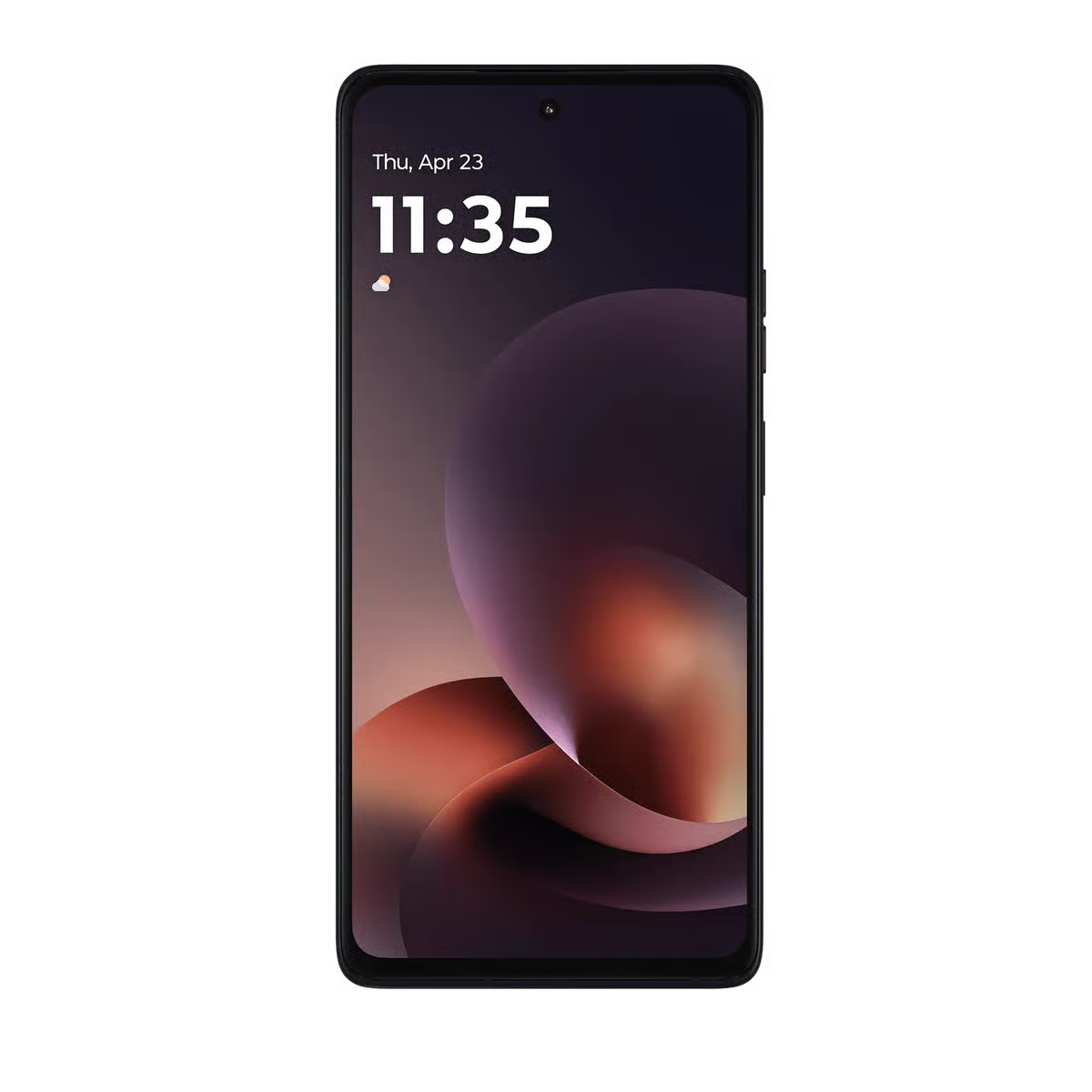 www.motorola.comLong Battery Life Smartphone with 50MP AI Camera | moto g power - 2026 | motorola CA | motorolamoto g power - 2026 has 2-day battery life, a low-light camera for clearer night shots, and a large screen smartphone design that makes every moment feel bigger and brighter.
This isn’t a brick wall TV interview.
6 inches is gigantic?
That’s what I have and it doesn’t feel quite big enough. Close but not quite.
Never once thought it felt too big in my hand or my pocket…
Yes.
Your hands are large.
Maybe your hands are just smol
Yep. Sick of giant phones. Crazy hard to find a small phone with decent specs.
Replying to @holy_scroller@lemmy.zip
I want a new take on the Pixel 4a. Slim, light, reasonably rugged just by the nature that it’s plastic all around and weighs nothing. I miss that phone still…
Replying to @zqps@sh.itjust.works
Same! The only reason I moved to an 8 is bc the port ended up getting so worn it stopped charging and wireless charging took forever.
I just got a pixel 9 refurbished for 350CAD and, a part from the irony of needing a phone made by google to have a degoogled phone, Graphene is a great OS. It just does what any basic phone os should do, and that’s make it gold in the current dystopia.
I ain’t trustin no company with shit !

Great news, but what’s with that absolute serial killer smile in the main photo?

I just want a flip phone that has 3rd party ROM support lol.
We’re like half a decade into the flip scene and we’ve been stuck on OEM slop for too long.
Google pixel fold
Replying to @LodeMike@lemmy.today
*that’s not made by Google’s shitty dev team and is a flip style, not tablet fold
What will US do if lenevo is Chinese and owns Motorola and now the US doesn’t have backdoors like they do on Apple and Google devices.
Replying to @ironpangolin29@lemmy.ca
Sanctions and tariffs?
Replying to @pineapplelover@lemmy.dbzer0.com
Google buys Motorola, strips all the parents, then sells the hardware to China. Company makes a potentially profitable decision and gets banned from selling in the U.S. That would suck. I would have really liked to have them here.
Edit* -Motorola, accidentally typed Lenovo, the company they sold tol
Replying to @LifeInMultipleChoice@lemmy.world
I thought google already bought Motorola back in the day…
Replying to @spicehoarder@lemmy.zip
Yeah I meant to say bought Motorola not Lenovo. They bought it, took all the patents and resold it to Lenovo
Sorry to be the party pooper but they’re also expected to be above 1200$
What if I agree to let them spy on me? Can we work out a deal?
Which flagship isn’t though?
Replying to @lemmelemmy@feddit.org
The first goal is to threaten Google’s monopolistic goals. This does that. Of course cheaper would be better, too.
Replying to @sundray@lemmus.org
Will Motorola have support for eSIMs? Will Google Pay work? … I’m not making judgments on whether they should, but asking about practical considerations.
Replying to @fodor@lemmy.zip
Honestly man, I’m worried than regular Sim is eliminated, not if eSim will work. Google play will work yeah
Replying to @fodor@lemmy.zip
Don’t think google pay works on graphene anyhow
Replying to @Onlooker4994@lemmy.zip
I don’t think that google pay is useful anyhow