The ap-next developer guide was removed from the https://activitypub.rocks website: https://github.com/swicg/activitypub.rocks/issues/63 (by the father of the Fediverse, no less).

The reason:

It's a fork outside the SocialCG.

This is utter nonsense. The guide refers to the original ActivityPub specification and even to SocialCG reports covering Webfinger and HTTP signatures. The other ap-next project is NomadPub - a collection of FEPs that significantly expand the capabilities of the protocol but don't diverge from the original spec.

However, since dissenting opinions about the present and the future of ActivityPub are now openly censored, a fork may indeed be necessary.

Summary card of repository ap-next/ap-next, described as: ActivityPub NextCodeberg.orgap-next/guide.md at mainap-next - ActivityPub Next

Replying to @⁨silverpill@mitra.social⁩

@silverpill it does seem weird they would use that justification to remove the link. thought at first they might be consolidating for W3C-only resources, but there are non-W3C guides under the `Documentation` section (which is where I would guess the `ap-next` guide would also fit).

outside of clarifying underspecified pieces of the protocol, and highlighting some useful FEPs, how is the `ap-next` guide a "fork"?

Replying to @⁨rimu@mastodon.nzoss.nz⁩

@rimu @elle I think the real reason is the association with another thing I am working on: nomadic identity. Some people don't like it, although it is not clear why. It is an optional protocol extension, and similar features in ATProto protocol don't cause any controversy.

When working on ActivityPub, a major goal for me was making sure that the protocol wasn't so HTTP-based that we couldn't add content-addressing. So I believe this is possible to add in a spec compa...GitHubContent-addressed ActivityPub messages · Issue #573 · w3c/activitypubWhen working on ActivityPub, a major goal for me was making sure that the protocol wasn't so HTTP-based that we couldn't add content-addressing. So I believe this is possible to add in a spec compa...by cwebber

Replying to @⁨silverpill@mitra.social⁩

@silverpill @rimu @elle

I agree that ap-next is not a fork, and might have stayed on that website. That said I don't think there's deeper politics to this removal, just that the links on the site are rather arbitrary and in need of good curation. E.g. fedify is nice to mention, but also just but one such project where there are multiple.

The entire online presence of SWICG/SocialCG including the AP.rocks website are a mess that almost seems designed to discourage ecosystem participants.

It saddens me as 3 years ago, when AP.rocks was still considered to be part of SocialHub, I had a whole initiative prepared to once and for all create a great developer portal at this domain name.

socialhub.activitypub.rocks/t/

In particular that top-level aggregator site would need to serve as an entry point to drill down into the entire grassroots ecosystem, help people find their way around..

socialhub.activitypub.rocks/t/

The SWICG took over that initiative without consultation, and then let it languish.

SocialHub🚀 ActivityPub Rocks Portal: From Standards Movement to Grassroots Fedi🫂 Participate in rebooting activitypub.rocks Welcome contributor. We have exciting work to do! For a long time activitypub.rocks only provided marginal information, and was infrequently updated. That is now about to change. We want to turn this website into the Portal that our beloved Fediverse deserves. What is the plan? A portal for and by the developer community, That guides people to discover standards & practices, And gives an overview of many grassroots initiatives, Encour...

Replying to @⁨smallcircles@social.coop⁩

@silverpill @rimu @elle

As for authority. I think at this point there truly are no authoritative bodies driving the fediverse.

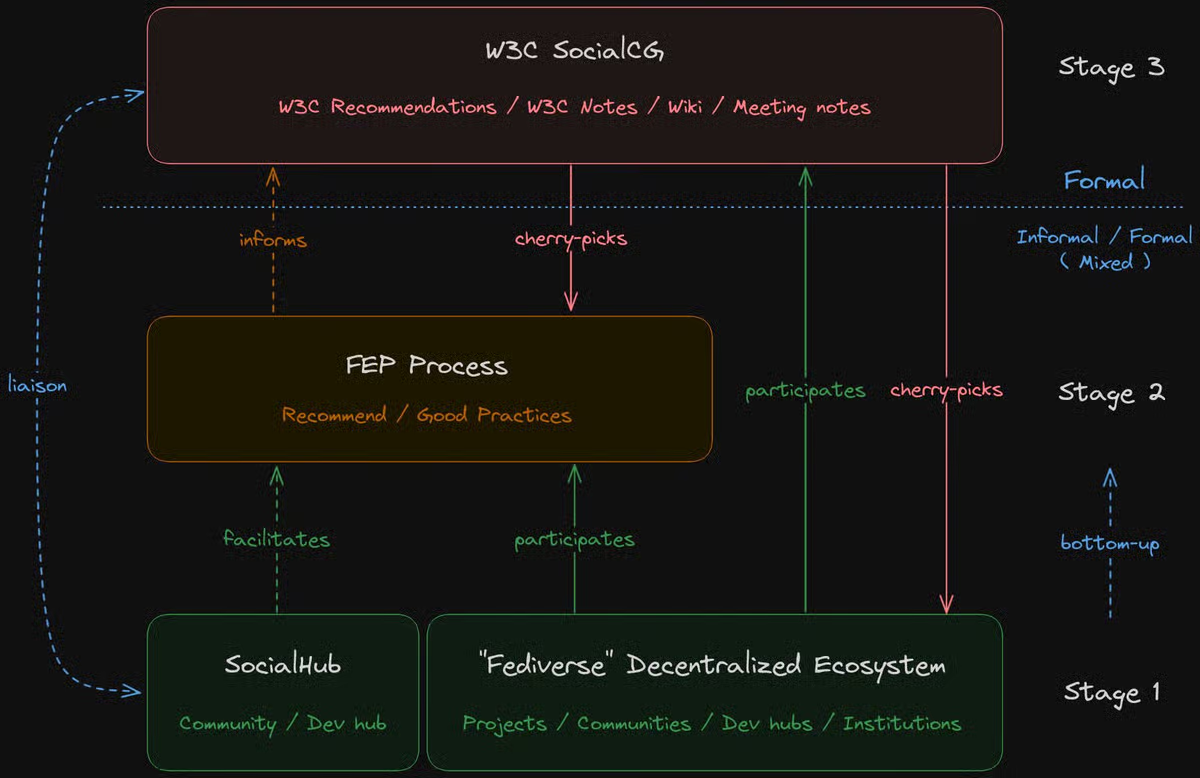
In the 3-stage bottom-up standardization process I discussed at the time at SocialHub, the level of authority was highest at the W3C, lowest at individual FOSS projects, with the FEP process inbetween as a place where good practices and protocol mechanisms bubble up from the ecosystem as good candidates for further standardization.

This process in reality doesn't exist. The connections aren't there. The SWICG operates alone, the FEP does too, and so do all the various independent developers when they invent new things.

In that setup I'd say the SWICG has the same level of authority as the FEP Process does, or any other focal point for collab between fedi devs (e.g. code forges, podcasts). Just another party at the grassroots level figuring out best practices.

socialhub.activitypub.rocks/t/

SocialHub3-Stage Standards Process: Guaranteeing an open and decentralized ecosystemFurther clarifying 3-stage Standards Process In FEP Process - Clarity on positioning: open and inclusive - #8 I collected feedback on the FEP process. The way I picture the FEP Process’ role as the 2nd-stage in a 3-stage standards process is: Just one way how things from the ecosystem permeate bottom-up to further standardization. The FEP process need not be used. Entirely optional. Ecosystem can directly participate with W3C. Ecosystem can define their own practices & standards (think e.g. <span class="hashtag-icon-placeholder"></span>S...

Replying to @⁨smallcircles@social.coop⁩

@smallcircles I probably already said that - I don't like the idea of 3-stage process. This proposal was accepted and now reflects how SocialWG operates in practice:

https://swicg.github.io/charters/stage-process

According to the document, FEPs are at the same level as blog posts. Even a successful and widely implemented FEP needs a "champion" who will sign CLA and will present the FEP to the community group, which will bikeshed it to death. Even if it passes the initial filter of the community group, the document still needs to be reviewed by the working group, which is invite-only.

This is a ridiculous amount of red tape.

Compare this to the promise of the FEP process: you publish a FEP -> you convince other developers -> it becomes a de-facto standard.

@rimu @elle

chartersCG/WG Proposal StagesDiscussion of potential CG and WG charters

Replying to @⁨silverpill@mitra.social⁩

@silverpill @rimu @elle

Having looked in more detail at the #SWICG document. That's not the 3-stage process I advocated for at the time, and I agree with you: It will not work. Such top-down formal ceremony just does not fit a grassroots ecosystem.

Generally speaking I don't think #W3C as a standardization body is up to the task of being a good host for the ActivityPub specification. It is a) not organized for our environment, and b) only takes care of the technical aspects. Our social media landscape has a huge social component, and this is wholly underrepresented in our app-centric fediverse, where people are merely "users" and #FOSS culture is the only driving force.

Today I think SWICG should focus on the 'Protocol implementer' stakeholder: How can they offer compliant #ActivityPub protocol implementations.

Then #FEP can focus on the 'Solution developer', relieved from the plumbing: What interoperable designs do they use to serve the needs of participants on the social network.

Replying to @⁨smallcircles@social.coop⁩

@silverpill @rimu @elle

I wrote a comment in the open issue on the 3-stage process, in the SWICG charters repo..

github.com/swicg/charters/issu

#ActivityPub #SocialWeb #fediverse

This should be clearly one option. I don't think we should adopt this wholesale.GitHub3-stage Standardization Process Proposal in staging proposal · Issue #33 · swicg/chartersThis should be clearly one option. I don't think we should adopt this wholesale.by evanp

Replying to @⁨smallcircles@social.coop⁩

@smallcircles @rimu @elle It won't be very useful because the specs are too vague and incomplete, you can have a perfectly compliant implementation that can't talk to any other fediverse software. I think such test suite should be aligned with real ActivityPub, as implemented in fediverse. However, the document describing real ActivityPub was just removed from the official ActivityPub website, that is all you need to know about their priorities.

I think the closest thing we had to a useful test suite was helge's funfedi project.

Replying to @⁨silverpill@mitra.social⁩

@silverpill @jupiter_rowland @elle @rimu

Your perspective is "that what app / FOSS projects do, and works, is a good thing". And that is a very pragmatic, workable approach in this difficult grassroots ecoysystem we have.

It also leads to a fediverse that is wholly app-centric, evolving by FOSS culture. Fediverse is 'ruled' by app devs as it were, and a "user" can only hope that the app they chose will fit their needs. This is not an ideal social networking environment, and not very different than Web 2.0.

But I am the first to admit that it will be very hard to rise to a more non-technical solution-oriented fediverse evolution process, where fedizens have more say in how the social network evolves.

Replying to @⁨smallcircles@social.coop⁩

@smallcircles @silverpill @jupiter_rowland @elle @rimu

>It also leads to a fediverse that is wholly app-centric, evolving by FOSS culture. Fediverse is 'ruled' by app devs as it were, and a "user" can only hope that the app they chose will fit their needs.
>...

So far Fediverse app devs showed that they are more competent at making ActivityPub work than W3C is. A "rule by consensus of Fediverse devs" so far has been better than "rule by a few privileged in W3C", which so far does almost nothing else other than bikeshed on non-issues (the whole as:Public URI being non-compliant) or work on issues that should have been abandoned years ago (ActivityPub C2S). Meanwhile Fediverse devs are working on documenting the current state and making extensions that users actually care about (through user demand of individual server implementations).

And besides all that, there's so much choice on the "Fediverse server market", that almost anybody will find what they want. From forum-like experiences, to micro-blogging, blogging, and even event organization.

Replying to @⁨phnt@fluffytail.org⁩

@phnt @jupiter_rowland @rimu @silverpill @elle

I spent years as SocialHub facilitator and know the frustrations. The W3C is also populated with app devs, albeit with different opinions wrt the future of social networking. The sad thing is that we have a fragmented ecosystem today and that is not good for the fediverse as a whole.

Ideally a whole end-to-end community-driven grassroots standardization effort would exist now, able to evolve fedi both in technical, socio-technical, and socio-cultural aspects.

What fediverse is, and importantly what it can be, is imho insufficiently discussed. Fediverse is merely an open technology space now, where devs build their apps.

But the stakes are much higher. Beyond our fedi there's an Epstein class, owners of AI and Social Media, who are building a technofascist society, using these technologies as their weaponry.

Fediverse can be our answer. An innovation by the people, for the people. But it won't be if its merely an open technology space.

Replying to @⁨silverpill@mitra.social⁩

@silverpill @phnt @jupiter_rowland @rimu @elle

It is mostly a social challenge, not a technological one. We had a technology standard, ActivityPub, developers built apps with that, and the fediverse-we-have formed by emergence.

It might have been beneficial if there was a technology vision based on what ActivityPub is capable of, and project 5 to 10 years from now on where we could be.

Even better would be a socio-technical imagining of the future of social networking and how it might serve and benefit people.

As guiding lights for the development of the grassroots ecosystem. As a means for people to put their noses in the same direction, and cocreate that future together. As a means to establish grassroots chaordic organization that enables us to get there.

That can all still be done, although I doubt if the fediverse as a whole can still be course-corrected. More likely are either continue as-is or forks in the road ahead. Or new technology that ultimately takes over the field.

Replying to @⁨smallcircles@social.coop⁩

@smallcircles @phnt @jupiter_rowland @rimu @elle My vision of what ActivityPub is capable of is in this picture: https://mitra.social/objects/01a0400f-fa18-7310-bbfe-4486928136c0. To put it in words: it supports a wider range of applications, provides strong privacy, it is easier to host and develop for, it scales to billions of users, can survive a nuclear war and can be used to communicate with colonies on Mars.

I don't know if a shared vision of social aspects could exist. I guess it is "most of us still want to be on the same network"?

silverpill@silverpill@mitra.social

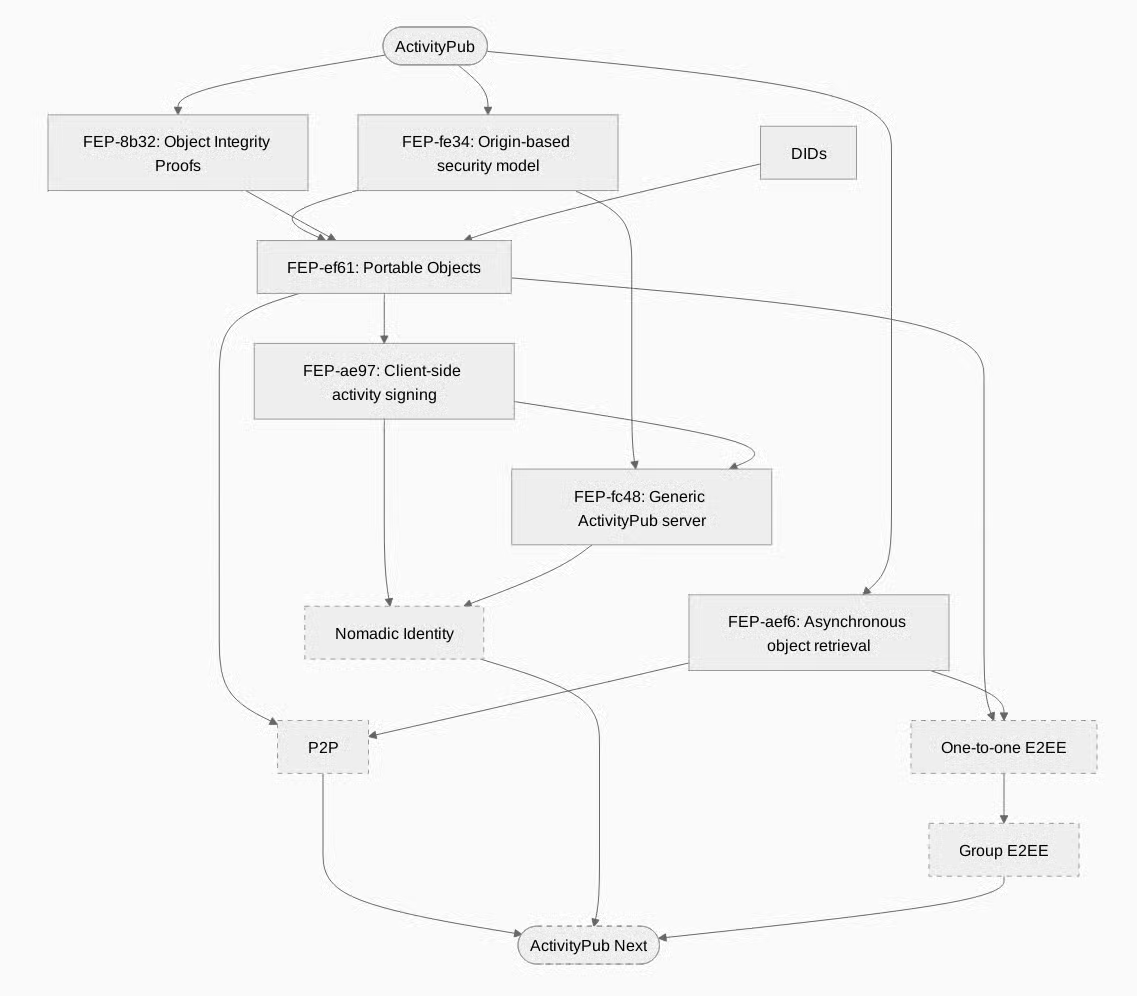
Have you ever wondered how FEP-ef61: Portable Objects and related FEPs fit together?

I drew a technology tree.

NomadPub tech tree
ALT

Replying to @⁨silverpill@mitra.social⁩

@silverpill @phnt @jupiter_rowland @rimu @elle

On the social side its more about perspective shift than defining shared vision.

For Social coding commons and Social experience design (SX) I use the following definition for Social networking: Any direct and indirect human interaction between people. I consider Social media a subset of social networking that's more focused on publishing of content.

This definition considers ALL human interaction, both online and offline. And it provides the scope to think of when designing solutions. Social networking is everywhere. And importantly it flows seamlessly together, forming our day-to-day social experience. Everything is integrated.

To translate that to technology, the fediverse would be a unified online space, where we consume services that are introduced to the network by developers.

As solution developer I'd be shielded from the terms in your technology tree. I'd be focused on designing business domains for my solution: a new service.