partial_accumen

@partial_accumen@lemmy.world · Joined ⁨Jun⁩ ⁨2023⁩

Replying to an earlier post

Fair enough. I admit, as someone who can’t drive IRL, I like things like Slow Roads too, or other driving sims that are generally not fantasy - just ‘cozy’ experiences.

When I was forming my original question, I did consider an audience this might appeal to for those that couldn’t drive (for whatever reason). I appreciate you sharing your POV on this.

I always considered Rideshare driving as the opposite of relaxing because of the physical dangers to drivers as well as the stress the drivers have from trying to make their money against rising fuel costs, insurance costs, and competion from platforms forcing down fare rates. Perhaps the Rideshare game masks all of these elements of the actual rideshare business and simply presents it as a task/goal game with a social aspect which would be far more appealing.

Replying to @⁨Endymion_Mallorn@kbin.melroy.org⁩

Crazy Taxi (and Simpsons: Road Rage") were largely about driving poorly, crashing into things, and performing automobile jumps that would be considered suicidal if done for real. It was a fantasy driving game with the taxi business as the thinnest excuse to be driving. Unless I’ve drastically mistaken what Rideshare Simulator is, I don’t think Crazy Taxi example is applicable.

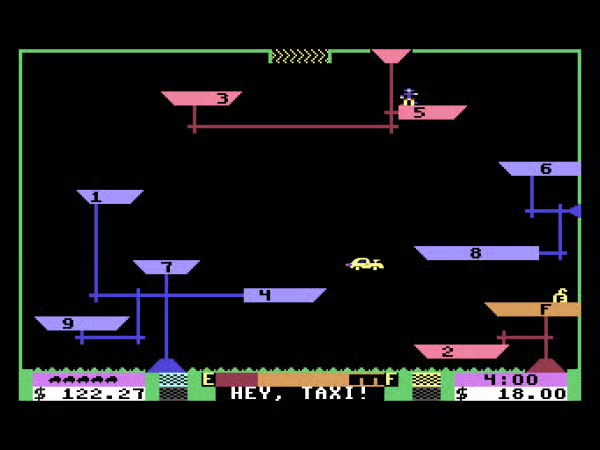
Fifteen years before Crazy Taxi, we had Space Taxi for the Commodore 64:

I’d say Space Taxi and Crazy Taxi had equal amounts of relevance to the taxi industry in the sense that they were an excuse to fly/drive in fantasy settings instead of an actual business simulator.

Replying to an earlier post

I read the article just to confirm this wasn’t a The Onion article. I understand there are games that simulate work like farming and even powerwashing. Even though I don’t play those, I can mildly see the appeal as you’re creating something (farming) or making something better than it was before (powerwashing). However, I see zero appeal for a game that simulates gig work like ridesharing. Can someone explain it to me, or have I reach a pivotal “too old” moment in my life?

Replying to @⁨BC_viper@lemmy.world⁩

We do lots of things wrong here, but our power bill is based on usage. If you only use this much, this is your rate and the more you use the higher your rate goes.

At the residential level that can exist too in the USA, but its not nearly that simple here in the USA, and I doubt its entirely that simple in your country either. Electricity isn’t like a tank of fuel that is drawn down and refilled. Besides maintaining the infrastructure for generation and delivery, electrical capacity at any given moment has to be built into the system, not just pure total consumption over time. So simply paying for electricity consumed doesn’t capture all of those costs in the system to make that electricity consumption possible to the consumer.

Commercial/Industrial customers in the USA don’t just pay for “amount consumed” but also “demand charges” which means “at any given point how much electricity will you be pulling from the grid?”. Its not uncommon that the demand charges for businesses can be larger than the charges for amount of electricity consumed. Additionally, some European governments give large breaks in electricity rates to incentivize certain industries. Germany for example gives 50% discounts on electricity for chemical production, glass producers, or semiconductor producers if those companies invest in decarbonization efforts.

Many European commercial/industrial electricity consumers have variations on what I described above in addition to wholesale electricity purchases for a given period which also breaks away from your described “pay for what you use with higher rates for more consumption”.

Can I ask you what country you’re in (or another country that you know uses your country’s same system)?

Replying to @⁨kayazere@feddit.nl⁩

No I wasn’t suggested it be forced or companies be nationalized.

My mistake then. So in your proposed system private companies would continue to exist.

I was saying governments could provide incentives and support for workers to form worker owned companies.

If that’s the case, I’ll go back to my first statement then. Tech workers will likely choose the higher risk but higher reward private company rather than one that my only have a modest return. If the private companies exist along side the co-ops, the boom and bust cycles will still exist except the co-ops won’t be the beneficiary, but will certainly be on the losing side of cycles.

Replying to @⁨kayazere@feddit.nl⁩

In order to transition to worker owned companies, it would be difficult as you mention, but governments could provide financial to help to get worker owned companies started.

Hang on. You’re proposing seizure of existing private companies and forcing the creation of the worker co-ops? Thats a very different thing. Should I assume your system would ban future private companies then?

I wouldn’t agree either of those approaches. Choice is important. Forcing people into co-ops because you think its better for them isn’t a system I’m interested in being inside.

Replying to @⁨kayazere@feddit.nl⁩

Tech work can be highly volatile in the business environment. Maybe its different for new tech workers entering the work force, but for a worker owned company, this can mean large losses of revenue for months. I don’t know many tech workers that are willing to take a massive pay cut to continue to stay and commit to a worker owned company if they personally can find better paying work elsewhere.

From the article:

"The playful atmosphere of tech offices flush with investment, enjoying luxe catered lunches to attract programming talent, has been replaced by a looming fear that layoffs are just around the corner "

This boom-and-bust cycle of tech growth and devastation has happened three times during my IT career. Its even more frequent in specific IT niche industries.

Replying to @⁨FlashMobOfOne@lemmy.world⁩

There are better targets for the anger for not paying enough taxes:

Alphabet (Google parent company) earned $132.17 billion in profits in 2025 and paid $26.656 billion in US taxes for an effective tax rate of 20.1%. Sure this could be, and historically was, higher before trump cut the corporate tax rate from 35% in 2017.

Tesla, on the other hand at the same time in 2025, paid $0 in US taxes in 2025 on profits of $3.794 billion for an effective tax rate of 0%.

Replying to @⁨SalamenceFury@piefed.social⁩

Google isn’t in financial trouble from this spending. Cash Flow Negative just means in a specific period they’re spending more than they bring for that period. Google and other tech giants have been sitting on mountains of unused cash at $242.5 billion for years. This is a rare time where they’re finally dipping into it to the tune of $5.9 billion.

Replying to a post on ⁨discuss.tchncs.de⁩

Although less integrated with the vehicle’s systems, aftermarket telematics and diagnostic-port (OBD) solutions offer limited cloud connectivity to fill the gap left by OE services when they’re phased out. Unfortunately, most are engineered for fleet services

No mention of Open Vehicle Monitoring System (OVMS) here? Its mostly focused on older EVs where the manufacturer has abandoned the cloud portal for remote management of the car. However, that’s nearly the exact problem the article is calling out for other non-EV cars.

www.openvehicles.comOpen Vehicle Monitoring System | Open Vehicles