You talk as if they don’t already have customer facing implementations in effect,
Mind pointing to where I talk like that? I knew these have already been used in other customer-facing environments before ever commenting, so I’m happy to try to clarify, if needed.
and that those all suck and don’t work worth shit.
Got any sources from within the last year? I ask for the last year because “AI” (LLMs and the overall ecosystem) has become much more capable over the last ~year (maybe a little less, but close enough).
I’ve already seen some reports that are older and, unsurprisingly, terrible. Those earlier generations of LLMs definitely don’t seem like they’d be up to the task – and some cities even had the balls to adopt this tech back in 2023 😬
This is an issue of not having enough 911 dispatchers
Correct, but it’s not like they can just go to the 911 dispatcher store and pick up some dispatchers. The widespread shortages have been a problem since before transformer-based LLMs even existed.
This triage system is a mitigation, not a solution. It makes the bad problem less bad – not solved. Maybe someday there will be enough dispatchers. Unfortunately, we have not reached that “someday” yet.
due to the unwillingness to pay for them.
Source? Not saying you’re wrong – I’m only aware of the shortage because I was friends with a dispatcher. I just never really looked into why there’s a shortage, and now I’m curious.
The idea of putting in a chatbot, that can not even speed up diction
The goal is not to speed up diction – that would be more like “vertical scaling,” or “scaling up.” AI a bad choice for scaling that way, in most cases. AI is much better for “horizontal scaling,” or “scaling out” – so like 20 bots concurrently answering 1 call each, not 1 bot trying to speed-run through 20 calls serially.
The fact is that these LLMs will (like in current deployments)
By “current deployments,” do you mean current 911 deployments, or just things like customer service lines? There’s a huge difference in product requirements between those two. If done the same, then yes, that would be an absolute disaster. That’s not what this is though.
most of the time have to pass the call to a person, drastically increasing time on the phone before action is taken.
Where is this information from? I thought the problem was the surge of calls going to the call center to report the same thing (for example, people calling 911 when driving past a burning car). When that happens, the AI agents actually don’t have to pass most calls to a person, because most calls are about the same emergency (e.g. the car fire example). Did I misunderstand this?
911 dispatch is not a telecom company and more time on the phone is more death, injury and suffering.
Exactly. This system reduces hold times by filtering out the spam about the car fire, freeing up some operators in the understaffed team to deal with more emergencies.
The AI system is obviously slower than a well-staffed team of operators who can handle the call volume surges, but faster than an understaffed team that has to get through the spam. Unfortunately, they’re faced with the latter, so they found a way to at least mitigate the problem a bit.
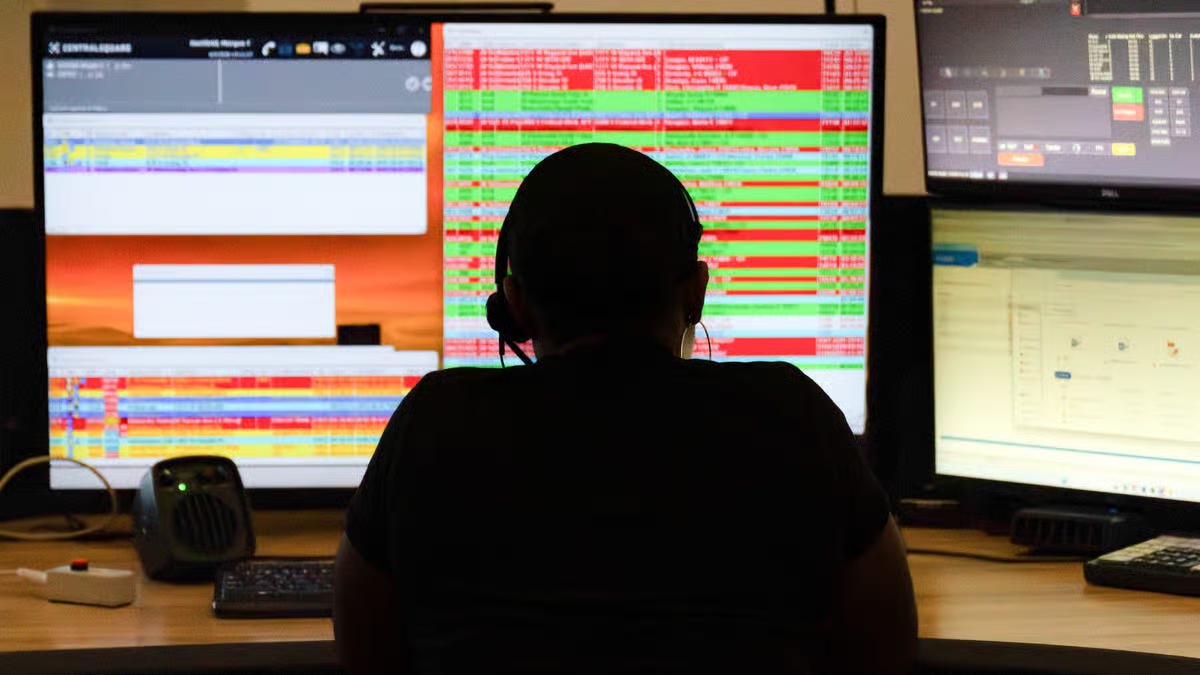 Shreveport TimesNew Orleans will use AI to answer 911 calls instead of a humanNew Orleans is using AI to answer 911 calls instead of human dispatchers. What does this mean for crime and emergency response?