Reintroducing Catodon (after 6 months of active development)
A little bit of history
Some of you may know that I was in the core team of Firefish, which is now an abandoned project, but made a splash back in 2023. I loved the project and its community, but as months were passing I got confused by its (lack of) direction and leadership, so in late 2023 we decided to fork Firefish with another core team member, Namekuji, as the lead dev. The new project drew attention and raised expectations at first, but lack of time (and loss of interest) led to the lead dev resigning, leaving the project without a dev (my passion is UX, not coding). Since then I tried finding another dev to continue the project, but without any luck. So by late 2025 I had kinda accepted that Catodon is a dead project, and closed our catodon.social server. This is a very short summary of the project's first chapter.
Enter 2026, and to be honest, I couldn't let go of the idea of Catodon - but still couldn't find a dev who wanted to dedicate the time and energy to maintain a project. Then a friend (who works as a full-time dev) told me that I could even do it on my own, with the help of LLMs. Initially I kinda laughed at the idea, but then I thought that maybe it's worth a shot. The results were much better than I expected, so I set up catodon.rocks and got the project rolling again - this time, on my terms, and based on the latest Sharkey instead of -now outdated- Firefish (but porting its best features). And, six months and several stable releases later, we have a growing community, and recently two more people joined the core team - AntoineÐ, who, unlike me, is an actual developer, and Sproid, who helps with testing and QA - I firmly believe that open source projects do not need only devs, and we should find ways to welcome and involve more people in a meaningful way.
In defence of our choice to use LLMs
I know AI is a sensitive subject on fedi, and I understand the arguments against it. But here's what it's actually done for us: First of all, the project wouldn't exist without it. But even now that we have a dev on the team, we're keeping it in our workflow. In six months, it's helped us ship features that projects with several full-time devs would need years to build: forums with full Lemmy compatibility, an RSS timeline, federated blogs, a dedicated Direct Messages page with a chat-like interface, New/Hot/Active sorting for forums and microblogging timelines, a WYSIWYG editor for Pages and Blogs, native Mastodon API support, and multi-protocol login that lets you use Catodon as a client for your Mastodon, Pixelfed, or Misskey account too. It also recently helped us catch a vulnerability in upstream Misskey, which we reported and which has now been patched - meaning every Misskey fork will benefit. We've also used it to spot 13 Misskey security patches that hadn't been merged into Sharkey yet, which we flagged to the Sharkey team as well. And to be clear, AI isn't magic - we spend hours of real work on every feature, and everything is tested and reviewed before it ships. We also keep a close eye on Misskey and Sharkey upstream, so we can pull in security patches as soon as they land.
We're not going to pretend this settles the debate about AI, and we don't expect it to. More and more projects (including the Linux kernel) are utilizing LLMs - and there are actual, valid reasons for this. All we can do is keep being transparent about how we use these tools, and let our work speak for itself.
Why "Catodon"
When Catodon was announced, some people found it odd that we chose a name that resembles Mastodon, since we are essentially a Misskey fork. But I think that our latest additions make our vision clearer: we now have Mastodon-compatible quotes, you can follow hashtags in your Home feed (one of the most demanded features in Misskey forks), we use the same verification system as Mastodon, we have implemented a similar feature for automatic post deletion, and native Mastodon API support which allows Catodon to use Mastodon apps - but also to be used as a Mastodon client itself. We love Misskey, but it's a project that is not always very fedi-oriented, with many features (which we have removed in Catodon) being local only. We are big fans of the Fediverse and want to pay attention to interoperability. You will never hear from us about a "Catodon network" - our network is the Fediverse, and we are providing software for people and collectives to set up their own federated communities. We have improved interoperability with Peertube, Lemmy, ActivityPub Articles, and we intend to keep this direction, hopefully supporting features from other fedi platforms too. We are trying to unite, not fragment. And since Mastodon is still the most popular fedi software, interoperability with Mastodon is crucial for our project.
Home is whatever you want it to be
In 26.9.0, we introduced customizable timelines, which let admins reconfigure the default timelines for their whole server, or let individual users do the same for their personal timelines - including replacing Home entirely. Set Forums as your Home timeline, for example, and Catodon becomes less of a Mastodon alternative and more of a Reddit or Lemmy alternative. Or set the Media timeline (a masonry-style photo grid, like Pinterest) as Home, and it starts to feel like an Instagram or Pixelfed alternative instead - all on the same install.
Screenshot of Catodon's masonry layout, while logged in with a Pixelfed account.
What's next
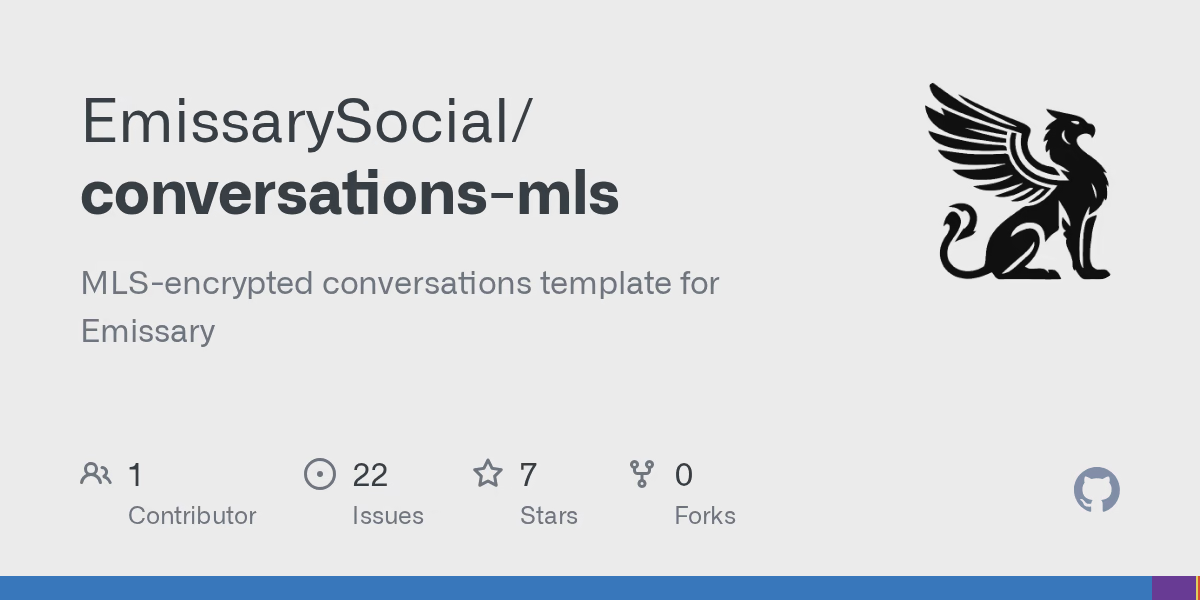
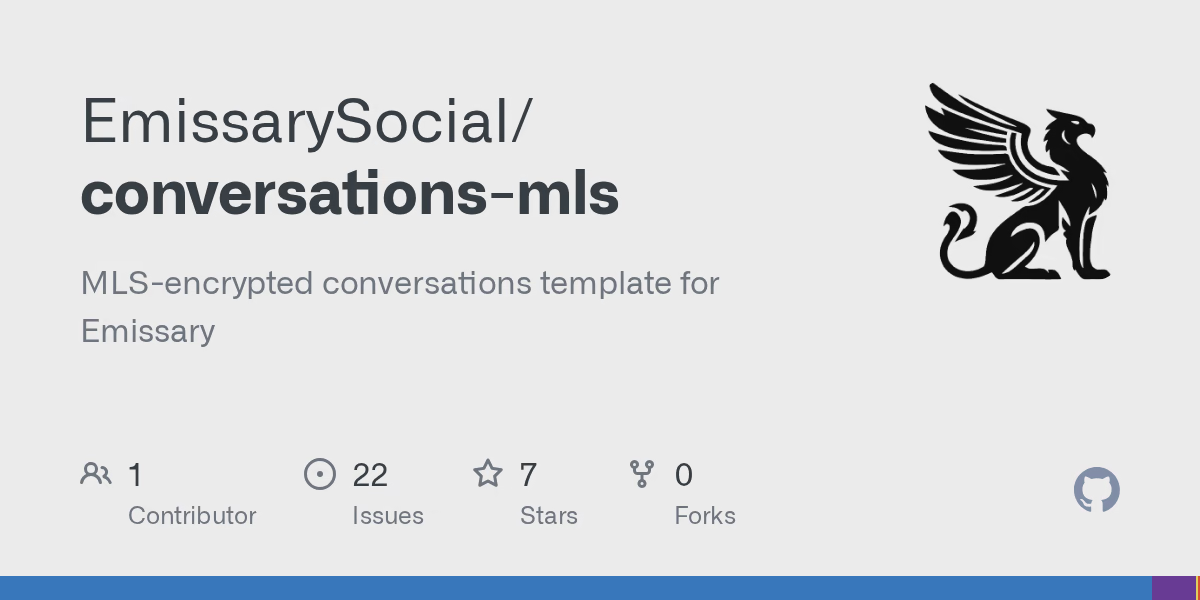
With the recent expansion of the core team and our repo on Codefloe getting much busier, it feels like we're just warming up. Our next moves include defaulting to plain Markdown, which we feel is a better standard for fedi, while keeping MFM support. This way you'll be able to see posts the way they were intended to be viewed, no matter what platform they were sent from, and compose your posts either with Markdown or MFM. We will also implement language setting and filtering for posts, and we're keeping an eye on the E2EE messaging protocol being built by Emissary and Bonfire, and intend to support it as soon as it's ready.
On the technical side, Catodon was initially based on the latest Sharkey stable, which is now almost 18 months old (based on Misskey 2026.4). We have since cherry-picked commits from Sharkey's develop branch that apply to Catodon, keeping us reasonably current with Sharkey's develop - but we'll soon go further and merge selected fixes and changes from upstream Misskey, all the way to the latest version.
We will also implement the ActivityPub C2S API, alongside the Mastodon and Misskey APIs. Most platforms implement only the S2S (Server-to-Server) part of the ActivityPub spec, and use their own API for Client-to-Server communication - which has resulted in Mastodon's API becoming the de facto standard. We don't think this is ideal: the Mastodon API is owned by Mastodon and designed for its own use case. Since there is already an API spec in the official protocol, we think we should support it, even though it is not currently widely supported, and we'd like to encourage other projects to do the same. As we said above, we want to unite, not fragment.
Besides those plans, we are always open to new suggestions, so why not join our Matrix rooms (#catodon:matrix.org and #catodon-support:matrix.org) and our Codefloe repo (where we recently added a roadmap kanban) and help co-shape the direction of Catodon? We want this to be a project that brings people together - and makes us feel excited for fedi again!
See you on the free, self-organized webs =)
Panos, for Catodon
 — Open image attachment 1 of 1