TheFogan

@TheFogan@programming.dev · Joined ⁨Jul⁩ ⁨2023⁩

Replying to an earlier post

I guess I understand your overall point It’s probably valid to say that phones shouldn’t be (though I suppose not against the law due to the laws not keeping up with the evolution of celphones).

I’d say smart glasses are in their current form, currently just a shock, because it’s their primary purpose. That’s basically why google glass flopped so spectacularly and the term “glasshole” followed their release almost instantly. Celphones do absolutely have the capacity to be turned into a spy device, even by accident or outside the owners control much like smart glasses. But I suppose the transition from snap shut flip phones to smart phones was kind of the slow burn that kind of made it not heavily thought up.

I do agree with the initial key point, IE smart glasses inherently make people feel uncomfortable and it’s basically waving in their face that they could be recorded at a moments notice if they aren’t already. It’s like technically I know that anyone I talk to, could have a concealed carry permit and may have a gun hidden on their person… but I’d feel far more unsafe being around someone with an AR15 strapped on him.
Replying to @⁨joe@lemmy.world⁩

The point is, say Meta, Amazon, google… etc… are known for collecting video and audio at times the owner has not intentionally triggered it to do so. Sued for what should be HIPPA violations, to my knowledge HIPPA is pretty darn strict, even if there hasn’t been an actual breach. Like say, leaving a computer open and logged in to your medical record system unguarded near your waiting room, is still a huge breach of HIPPA laws, even if no patient has ever walked up and looked at the screen.

Replying to @⁨joe@lemmy.world⁩

The fact that they own the device? From the article it’s implied that the doctor wasn’t recording.

That’s the thing though, it’s multiple levels of trust required. Point is the device is connected to his phone, You don’t just have to trust the doctor not to hit the button to record (either intentionally or accidentally) but you also have to trust facebook not to have set the device to do some stealth recording outside of permission (again either intentionally or some sort of “accidental” system). Or also cyber attacks (IE doctors phone or glasses could have been infected by a virus that quietly enables the camera and sends the footage to some shady extra site). The presence of a cloud capable camera adds multiple layers of issues, beyond just the owner of the camera itself.

Replying to @⁨joe@lemmy.world⁩

I get the concept you are after, but also pretty widely disagree. Early adopters are either researched people that knows what it is and really want it… or they are really rich people that drop lots of money at the drop of a hat at anything that sounds shiny. As someone who used to do IT work for medical practices, I have to say, doctors more often are the latter. I got lots of really cool stuff that I could never afford from helping doctors with their personal stuff and them going “I bought this but realize I don’t know how to use it, and it’s too much work, do you want it”.

Replying to @⁨NotMyOldRedditName@lemmy.world⁩

well my thought is, more the botnet side of it, IE pushing less on individual machines, but more on massive distribution. IE it not needing one computer strong enough to run it, IE expecting 90% of the machines it infects to be average consumer PCs, but making more use out of 1000 systems that can handle 1% each, rather than 1 computer that handles 100%, however yeah I do suppose also allowing it to do the bulk of the work when the computer is likely unused etc… and I don’t know much on the concept of communication etc… IE most major botnets were crushed by a command center being shut down. Imagining a different form that has, basically makes C&C’s on the fly.

Replying to @⁨mushroommunk@lemmy.today⁩

The same way Windows is “fixing bugs” with AI? Large volumes of dubiously tested code is never a good idea

I think the point is the bugs are being FOUND with AI. Not fixed with AI.

It’s basically the same concept as open source in general. IE the average layman hears open source and they think “oh so every moron, malicious person etc… can add his own back doors into the code”, of course not, the official version is gated and reviewed. What’s happening is AI is basically serving as millions of idiots looking through the code for security flaws, and it’s finding them. Which then means the humans fixing it need to go into overdrive to fix them before they become zero days.

Replying to @⁨Damage@feddit.it⁩

I think there are physical and economic limits. Neural networks may improve in software, but they still need more and more hardware, at some point that hardware resource curve is going to be to steep to climb at the current rate.

It’s true, but think like the crypto miner bugs. I don’t know enough on AI’s working, but is a distributed computing LLM possible, or is the need for super close super low latency between nodes eliminate the risk of a distributed computing, learn as it travels botnet powered AI worm, that continues evolving even if it’s home is shut down.

Replying to @⁨beep@piefed.world⁩

So… while congress is attacking the hell out of a guy, because they think he might have known something about the possibility of people slightly modifying a disease in china… and not wanting to put it as the primary way the disease spread. Meanwhile we’re doing something 100x worse, on systems that the owners claim to have multiple cases of it accidentally reaching out and launching attacks on other companies undirected. I don’t see the problem here.

Replying to @⁨gedaliyah@lemmy.world⁩

For me the main point is, syncronization. Point is I want to read on my phone, or if i go to another computer catch up on it. If I set up a seperate RSS reader on each, then I’d have to figure out what’s read and what’s not. Honestly that’s a feature that google reader really had me spoiled in, I loved being able to use a work computer, browse through my rss feeds, star articles that I thought I may want to come back to, go home look at the starred ones and then go back.

Then google reader shut down, and I wanted to be able to do the same again, while also not being vulnerable to another shut down.

Replying to @⁨beep@piefed.world⁩

I think we are about hitting the AI pocolypse now. Just like when most the free video sites started imploding or getting swarmed with ads. The “give it away free and super well, while hemoraging money”. step is starting to run out… investors are tired of pouring money into the black hole, and telling these companies “figure out how to opperate in the green or give up”, and the fact is this ponzi scheme is about to run out.

Replying to @⁨iopq@lemmy.world⁩

I’ll agree, but what I’ll say is it’s a chain… were we to put it

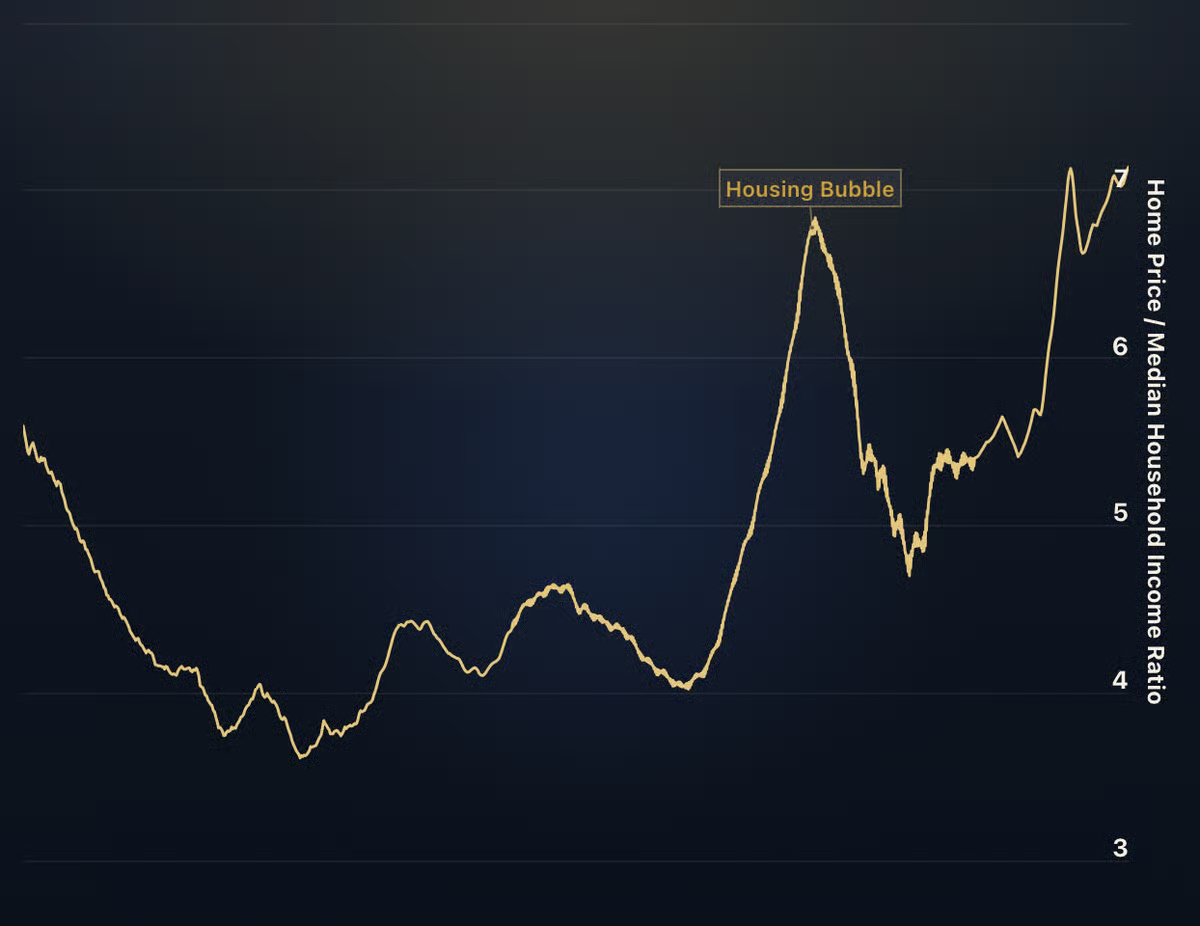
longtermtrends.com/home-price-median-annual-incom…

so bottom line is it’s right, it was actually a minor peak in 1970, dropping to 1975, going up to 1980… balooned like crazy in the 2005 housing bubble, and is currently sitting way above that.

but yeah I’d say key overall trend is, starting around 1970… it’s on the whole progressively gotten worse over time.

www.longtermtrends.comHome Price to Income Ratio - Updated Chart | LongtermTrendsHow affordable are homes in the US? Historically, a typical house in the US cost around 5 times the yearly household income. The ratio in this chart divides the Case-Shiller Home Price Index by the US median annual household income.

Replying to @⁨tal@lemmy.today⁩

To date, what has consistently always happened over time is that as our productive capacity increases, someone finds some way to create a higher standard of living using that productive capacity. That higher standard of living has always been more-appealing than the leisure time.

The frustrating part is what the upper class misses, They describe it as the “standard of living” going up… They are talking as if getting a house is the same as always, but we all want netflix and video games now so we are struggling to keep up. When the obvious situation to anyone not at the top is, what used to be expensive luxuries are getting cheaper, new luxuries are being added, but essentials are ballooning out of control.

If we had the choice to live like the 80s, where we could casually afford a home for a family with a single income etc… but facebook were more expensive… their analogies would make sense. but the reality is, we’re all forced into the work large hours, not because we want more luxuries, but because the basic human needs for food, water and shelter are where the requirements are going up.

Replying to @⁨eicker@lemmy.world⁩

A bit of both though. In house models don’t need the power and process of a small city, they need the power to power what their business needs. Also it would seem to me that has a huge advantage on the whole as a model would be more efficient, if it’s focused on the companies needs rather than being a jack of all trades, from poetry to law to code. Cut out the being everything to everyone and you can do far more with far less hardware.