Self-Hosting Survey 2026: What are your favorite self-hosted apps?
I’m not affiliated with this in any way but saw it posted at the other place & thought fellow Lemmyzens might like to take a look.
I always find it quite hard to answer “favorite” apps as some infrastructure critical self hosted apps aren’t as sexy as others which sit front & centre so I feel they often don’t seem to get as much credit or attention (such as NGinX/DuckDNS compared to Immich/Jellyfin etc)
Hi everyone,
Like in previous years, I’m running a survey about self-hosting. The focus is on your favorite self-hosted apps, but there are plenty of other (optional) questions too. The top five app lists are free response fields, you don’t have to select the suggestions.
The survey is anonymous. Like last year, results will be published in aggregated form. I’m currently planning to publish them in December.
It takes about 10-25 minutes.
Some of you asked for more questions in the comments. I added a lot at first, then realized it took 45 minutes to fill out properly. So I threw some out again, but there are still quite a few. The survey now has a core section that mainly covers the MVPs (your 5 favorite apps), and you can switch on other modules if you want. Almost every question is optional and can be skipped. If you answer everything at a reasonable pace, it takes around 20 minutes.
The proprietary survey tool caused new problems every year, so last year I switched to HeyForm while the survey was already running. That wasn’t ideal for my purposes either, so this year the survey runs on a new app. It should also make entering your apps faster.
It’s still easier to fill out on a desktop computer.
yunohost + ebay or old office desktop (or literally any computer you can get your hands on for cheap). There’s a lot of people with very strong opinions but you really don’t need much.
I didn’t know anything about self-hosting when I started either. There is a learning curve but it’s not difficult, just takes some time and is totally worth it to own your data, have a little more privacy and to stop shelling out money for subscriptions, etc. Totally worth it. I’ve been self hosting for almost 2 years now and have learned alot but still learning every day.
I’m a year or so longer on my self-hosting journey than you, but also get humbled like a noob on a regular basis. I was a Linux user for over a decade when I first started self-hosting but I knew nothing about networking because I always lived places where someone else managed the internet. I’ve learned a lot since then, but I have a lot left to learn. It really does take time to get a comprehensive understanding of what you are doing and why, but the good news is you can learn a lot through osmosis and we are already doing it just by being here.
Exactly. I’m actually the opposite. I was a Windows user for years and years since the days of 3.1. When I started my self-hosting about 2 years ago, I switched my pc and server to Linux and have been using Linux fully now. Aside from Linux being better for self-hosting, I wanted to finally get away from the mess that Windows has become and the dirty crap Microsoft pulls now.
Did you have any exposure in Linux before eventually switching, or did you just step straight from the Windows world into the great Linux unknown?
Windows 3.1 has a bit of a fond spot in my heart. Even though we didn’t have 3.1 at home, the school computer lab used it. We used to scare the teacher by typing “dir stat” or something like that into the terminal to make the text scroll like we were hacking stuff in a movie 🤣 (she didn’t know anything about computers, just there to make sure we didn’t run off with them). I also recall those colorful all-in-one Macintosh computers making an appearance at a different school.
I had very little exposure and knowledge of Linux. Tried it years ago but it didn’t stick. So basically when I moved the PCs to it, it was pretty much jumping in and just going for it and learning. I chose OSes that still had a bit of a Windows feel so I didn’t feel completely lost. But, as mentioned before, still alot to learn using the terminal, etc.
Yeah, I miss the old Windows OSes and the way they were. Those were my very fun and nostalgiac days on a computer. Newer versions just aren’t good anymore. 🤣 ahhh yes, the Macs that were bright oranges and greens and reds lol, definitely remember using those in schools.
Whether you think you are or aren’t smart enough, you’re right!
If you want to do it, read up and just try it. Throw a Linux install on an old desktop or laptop and try to follow a guide and make it work. It seems daunting, but most anyone can follow a guide and get to a usable product.
A lot of it is doing what other people tell you to do. This may be encouraging or not, but I consider myself fairly versed in tech and there is still troubleshooting where it feels like trying things at random rather than any skilled insight to a solution. The take-away is it’s okay to skip an app that has terrible documentation and you can’t figure out. Start with something that has good tutorials and if that doesn’t work, try something else. If you can get that up and running those skills will carry over.
Right, $14-30/m actually adds up to hundreds and is less reliable.
I know, I know super duper clouds, six nines of availability for cloud services etc., yet github (for example) fails more often then my media/git/file/print server on 10 y.o. laptop with tens of terabytes of media and data, that is less maintened and exists in a far worse conditions (comparison is incorrect but the fact stays).
You likely spend more than that a year on what you host (I know my power alone is going to run higher than that), but the monetary cost doesn’t cover the joys of the hobby, the knowledge aquired, and the fact that your shit still works even after the Internet goes out
Initial cost may be high. But I have calculated that my system. Would cost me 9 euros a month at 12tb of cloud storage. Something that I can’t achieve if I pay for cloud storage to a big man.
What brings me from clouds back to earth is current hard drives prices. Fuck AI.
My wife spent about $130 for a year subscription to a service that she figured would always have her favorite show on it, because they own that show. Then like 10 seasons of it left for an exclusivity deal on another service. This was a contributing factor to pushing me into self hosting. Some of it is saving money, but some of it is also making sure you actually got what you paid for.
That’s $14 to $30 a month per subscription per user. I’ve got close to a dozen people using mine, most of which can very much not afford those kind of subscriptions.
Absolutely. I refuse to rely on cloud anything after being bitten too many times: company gets purchased, unstable pricing or service changes/discontinuation, data trapped in someone else’s server, internet or service instability… 100% self hosted is the safer, saner, more predictable option.
Motivation: Independence from Big Tech & subscriptions, Fun / the hobby itself, Customization & full control
My MVPs: Homepage, homelable.net, healthchecks.io, ntfy.sh, WireGuard
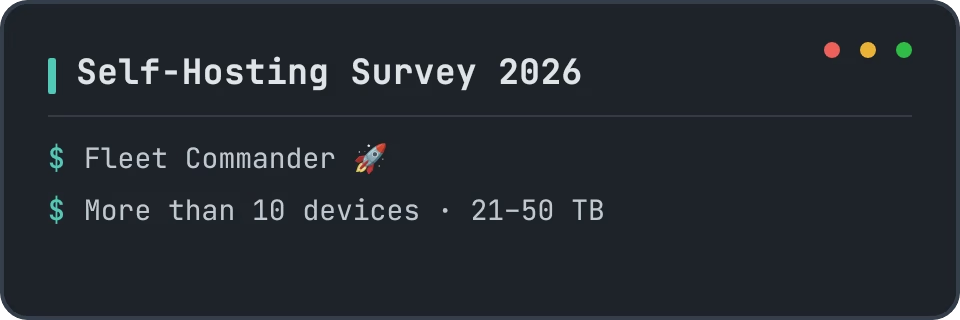
My fleet sounds bigger than it is since theyre all small or older and also small underpowered devices (repurposed laptops, low end chromebox, various pis).
Do you operate a webserver on them with software service(s)?
I would consider WRT management self hosting, personally. Pi-hole also, but you aren’t running paperless-ngx, pihole, or HomeAssistant on your lightbulb/Shelby switch.
I mean. A zigbee lightbulb is hosting a service that is communicating with a server. How “large” does a service running on a device ned to be to be considered? Take tasmota running on some sonoff devices. Is that supposed to be in the list?
Another example. I am running OpenWrt. Should i them add a router to the list? What if I have a router from my internet provider that I manage some DNS or port forwarding in? Should that be included?
This survey definitely looks vibe-coded as heck lol but I hope the results will be good.
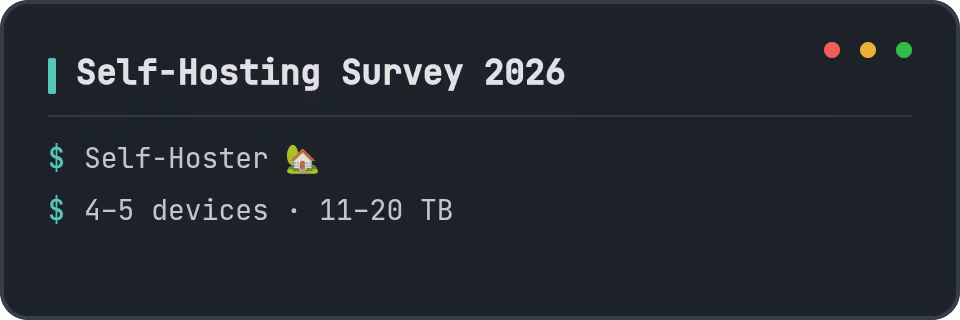
My results :)
Data Hoarder 💾
Fleet: 2–3 devices · More than 50 TB
Motivation: Privacy & data ownership, Independence from Big Tech & subscriptions, Customization & full control
My MVPs: Immich, Baikal, Forgejo, qBitTorrent, Home Assistant
God knows I wasn’t going to put cost as a motivation… I am actively losing money running double the storage I am using and 100+ GB of RAM on a Xeon chip, but having the headroom is certainly nice and has allowed me to expand as much as I want. Getting a good deal a couple of years back before the price explosion was a huge stroke of luck. If this server ever failed I could figure out a smaller operation with more confidence.
Cost was one of my motivations, but it wasn’t cost to me. Most of the people using my server definitely can’t afford to subscribe to all those streaming services.
Glad you mentioned that. A lot of folks are saying costs isn’t a good reason (for valid reasons), but I don’t think the other users costs are typically thought of. I don’t host to a lot of people, but they are active and use a few different services I host. That easily multiplies the cost savings imo.
I tried it first and swapped away. I know I didn’t like how Radicale required editing text files to add accounts, that’s for sure, but the main reason I swapped was that the Docker environment kept freezing and using up 200% CPU until I manually restarted it. Rinse repeat every few hours. This was on a new install with 1 user. No issues since I moved to Baikal and the web UI is much nicer.
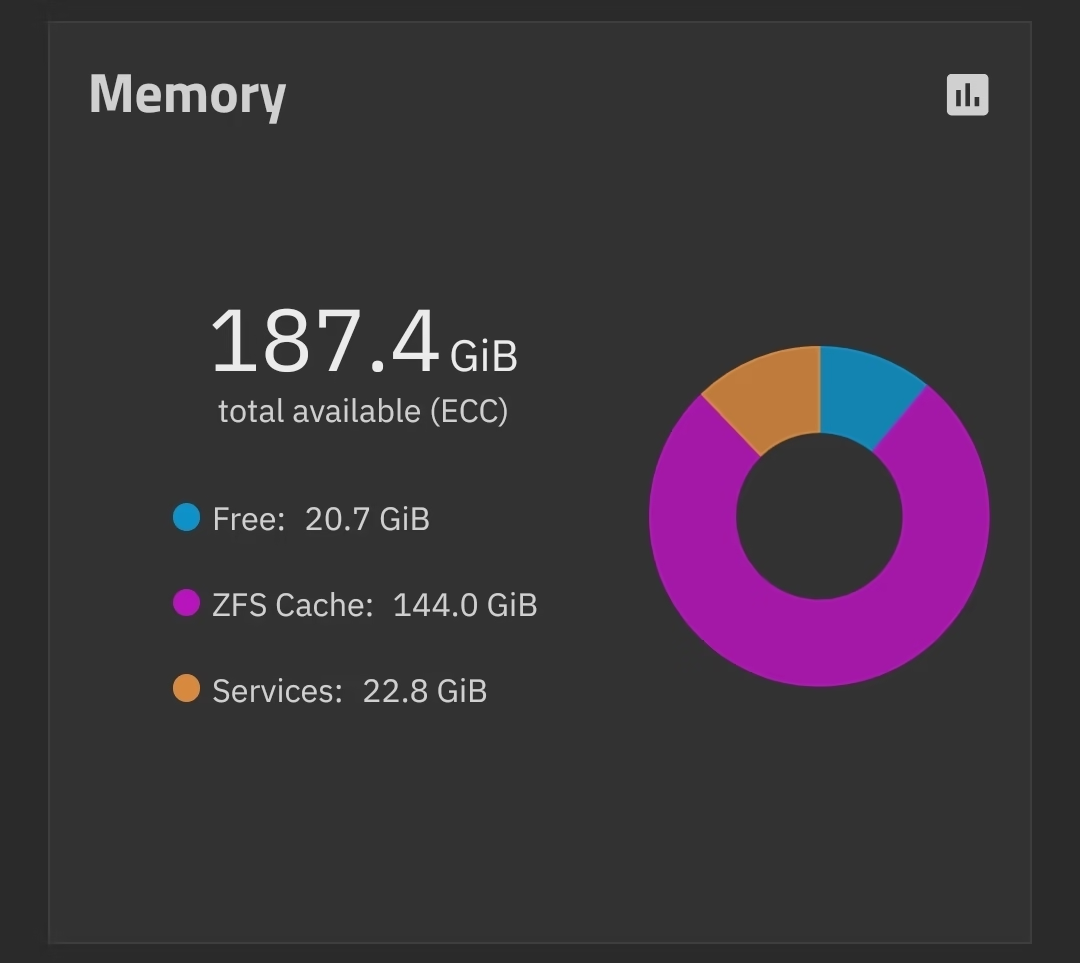
Need is a strong word lol. I definitely don’t need as much as I’ve got as I only use 20-50GB on services (Docker and TrueNAS) with the rest being used as ZFS cache. I would not have bought this much normally but I got it as a package in a PC with an RTX 3080, Xeon Gold 6150, and the RAM for $1000 CAD (750 USD ish?). No way was I passing that up.
Acronyms, initialisms, abbreviations, contractions, and other phrases which expand to something larger, that I’ve seen in this thread:
Fewer Letters
More Letters
DNS
Domain Name Service/System
Git
Popular version control system, primarily for code
NAS
Network-Attached Storage
NUC
Next Unit of Computing brand of Intel small computers
Plex
Brand of media server package
ZFS
Solaris/Linux filesystem focusing on data integrity
Looking at last year’s survey, the number of self-hosted devices has 2-3 first. And Raspberry Pi is most popular.
I wonder about this, because I have Pi for Pi hole, and one for Home Assistant, each dedicated. Then almost everything I self host is on a different server. But this still represents Raspberry Pi twice as much as the main server. I think Pis may be most popular because there’s many single-purposes uses for them.
I feel like (mostly because of my own path) Pi is a great platform to get started with self hosting because of projects like pihole, homeassistant, and osmc. Projects where someone has put together simple, all-in-one solutions where you can just download an image and go. That same approach, and the Pi’s hardware limitations, make it harder to co-host multiple services, while the price point of Pi’s, at least pre-2023, made it reasonable just to run a handful of them. Only once you start wanting larger or more compute intensive stacks does the pressure to use containers/VMs on ‘real’ hardware appear. If you’ve already got pihole and ha running on Pis, there’s no pressure to move them to the big server.
If it’s the path I followed, it must be the path everyone follows :)
I was thinking the same thing. My path was self hosting on old desktops for the longest time then the pi came out and I ended up doing a birdnet project, then home assistant and now I’ve got about a half dozen data collectors on pi zero 2 w machines. They are pretty much set and forget. I use an orange pi for my instance of Solar Assistant because I wanted something that was not affected by anything but the network and the inverter and I know how rock solid these little machines are.
But in the last few years I’ve started embracing docker and NUCs and have pulled apps off Synology, making it just a file server at this point.
So technically I have more raspberry pis than anything else but they are really just edge devices, except for Home Assistant. And it will probably stay that way until there is a good reason to switch. I don’t see that happening for years.
Also love the pi-0-2w, but I’ve started to use ESP32 for those edge sensors. You can get those for like $1-2 each on aliexpress, where real world prices on Pi zero is upwards of $20 now. Truly embedded systems like arduino were always intimidating to me, but esphome reduces ‘programming’ to a YAML for any of the many supported devices. The Pis that are working now aren’t likely to change any time soon, but I bought a handful of ESP32s for $10, and I’ll probably buy another handful before I buy another zero. Maybe convert a zero to ESP32 if I really need a whole OS for something new.
Oh yeah, I’ve got a box of esp32s and mmwave sensors waiting for me to get my soldering iron out. I’m with you, they’re great. I suppose I could somehow figure out out how to do SDR with an ESP32, but I’ve got plenty of unfinished projects waiting for me as it is. ESPHOME makes edge devices so easy to create. And it gives me an excuse to do a little soldering and 3d printing.
The ESP32s are also really good for making old devices smart. One project in my queue is turning a bunch of air purifiers into smart devices that HA controls. They were super cheap and there’s nothing to them but a fan, and a filter but they’re loud. I’m going to make it so they only run when no one is in the room.
Admittedly, no, but this is slowly improving. Stepfun published their SFT dataset, smaller labs are publishing their datasets for task specific tunes. I believe there was another Chinese lab that published bulk pretraining data, but I can’t find it in my history at the moment.
And, notably, these comparatively tiny labs generally aren’t scraping the internet so abusively like OpenAI/Meta. They don’t need as much. Going by statements in their papers, they tend to use existing archives of web data, buy commercial data, or (more recently) generate a lot synthetic data.
Oh my god I need LubeLogger. I only looked it up because of the… questionable… name but I currently use Fuelio and I hadn’t even thought to look up a self hosted thing.
Looked at this before and forgot about it. Thanks for the reminder, I’m going to try it.
I love the honesty and boundary-setting of their Annual Hiatus wiki page - I really feel for OSS devs dealing with user entitlement : docs.lubelogger.com/Misc/Annual Hiatus/
Motivation: Fun / the hobby itself, Customization & full control, Independence from Big Tech & subscriptions
My MVPs: Immich, PeerTube, Ghost, Actual Budget, Home Assistant
I create videos for YouTube/PeerTube and backup all of the raw footage. The actual storage count is currently 130TB in my main NAS with about 250TB for an offsite cold storage backup (as most of my data doesn’t change much) and on-site live-ish backup. I also have the benefit of being able to get reputable used commercial grade HDDs from work for $10/TB, even right now, it makes it way too easy. Shameless plug of my PeerTube instance: joeltube.com or @JoelKalich on YouTube.
Motivation: Privacy & data ownership, Learning & experimenting, Fun / the hobby itself
My MVPs: Plex, swag, pihole, Navidrome
I realized that I actually have just over 50TB now after replacing a failed hard drive. I’ve been using retired enterprise hardware and slowly replacing it all with stuff that is MUCH lower power consumption and I recently got a DGX Spark so I could work on some self-hosted ML work for physics modeling and helping me fix all the code I manage to break. (read: catch typos and formatting)