posted in Technology

OpenAI Is Pissing Off a Bunch of Mathematicians—Again
www.wired.com/story/openai-is-pissing-off-a-bunch-of-mathematicians-again/posted in Technology
OpenAI Is Pissing Off a Bunch of Mathematicians—Again
www.wired.com/story/openai-is-pissing-off-a-bunch-of-mathematicians-again/
Replying to @Mustachius_Grumpius@thelemmy.club
archive.is/…/openai-is-pissing-off-a-bunch-of-mat…
TLDR:
Most of the “mathematical breakthroughs” from AI have been done by loading all available recent research from humans solving the problem, and then collating it while skipping reviews and telling the humans who did the work it would literally be “too complicated” to explain the AI didn’t actually do anything…
It’s all just lies to drive up stock prices, what they release appears to be stuff that would be released shortly anyways, it’s just being dumped at once 99% of the way done before it’s verified.
Replying to @givesomefucks@lemmy.world
Doing 10%, or less, of the work and taking credit for it. Add this to the bucket for “Reasons AI can replace the C-suite”
Replying to @13igtyme@startrek.website
I know people always say that, but there still needs to be executives so there’s still humans to be held accountable.
The vast amount of middle management are useless, but there has to be a human sitting in a chair above the chatbot for legal liability. Otherwise the board will just blame the chatbot for everything.
That also doesn’t mean they should be paid so much, just that a human needs to be above the chatbot as far as final authority
Replying to @givesomefucks@lemmy.world
With a structure like that the board would be the ones responsible for the AI output. Lol, I think your suggestion just means inserting a fall guy between the board and the ai
Replying to @Cort@lemmy.world
…
Saying we’ll hold the board responsible if chatbots get to run corporations is almost as ludacris of a prediction as billionaires saying they’ll support a socialist utopia if we let chatbots take everyone’s jobs…

Replying to @givesomefucks@lemmy.world
Saying we’ll hold the board responsible if chatbots get to run corporations is almost as ludacris
I dig how you went with the rapper spelling.
The idea that CEOs would be held accountable for anything is just wishful thinking at this point.
Replying to @givesomefucks@lemmy.world
Of course that logic requires that executives actually be held accountable… for instance, due to illegal behavior…
Replying to @NaibofTabr@infosec.pub
Yes…
Holding people accountable, means we have to hold people accountable…
The solution to not holding people accountable, isn’t to make it harder to hold people accountable. The solution is actually holding the right people accountable.
I’m glad we can get on the same page
Replying to @givesomefucks@lemmy.world
I mean, yeah, I’m not arguing with your conclusions, I just think you’re overly optimistic.
Nobody is talking about putting Altman in jail for violations of the Computer Fraud & Abuse Act, even though that’s exactly what should be happening. Instead they’ve got investors lining up around the block to buy a piece of it.
Replying to @NaibofTabr@infosec.pub
Nobody is talking about putting Altman in jail for violations of the Computer Fraud & Abuse Act, even though that’s exactly what should be happening.
Republicans control the House, Senate, and Oval right now…
Do I really need to explain why they’re not doing anything?
You can’t figure that one out on you’re own?
I just think you’re overly optimistic
Midterms are in a month…
You seem a bit defensive though.
Because midterms are in a month, and a shit ton of people are pushing really hard that nothing can ever be done so it’s pointless to try.
Be a doomer after midterms and I won’t give a fuck. But right now trump and the AI techbros are spending a shit ton of money to convince the left not to vote.
Don’t do their work for them.
Replying to @givesomefucks@lemmy.world
Who said anything about not voting?
Replying to @givesomefucks@lemmy.world
When was the last time a CEO or board member was held accountable? Or any time? Apart from that dude that caught a bullet.
Replying to @Almacca@aussie.zone
Who is saying they shouldn’t be held accountable?
Like, it’s like you’re arguing we need to disband the fire department because we keep having house fires…
Replying to @givesomefucks@lemmy.world
I said no such thing. They should be held accountable. They just never are.
Replying to @Almacca@aussie.zone
Buddy…
I didn’t say you said they shouldn’t be held accountable…
I’m saying I wasn’t saying that, that no one was saying that…
But I don’t think trying to clarify any of this is gonna be productive
Replying to @givesomefucks@lemmy.world
When was the last time a CEO or board member was held accountable?
Bankman-Fried. Elizabeth Holmes. Martin Shkreli.
There should be far more, but on occasion, it does happen.
Replying to @givesomefucks@lemmy.world
Why though? If you needed the CEO to be held accountable, isn’t that because their role implies accountability for their actions?
If you outsource those actions to a tool, then accountability falls on whoever is using the tool. So the board, or whoever, gets the accountability. That sounds reasonable to me.

Replying to @13igtyme@startrek.website
I hate AI, but I’d much rather work for an AI over the idiot higher leadership at my company. They use AI for everything anyway, including literally answering emails.
Replying to @givesomefucks@lemmy.world
Your understanding of what they did is not correct. But also fuck OpenAI I am not going to explain their bullshit for them. So anyway put Sam Altman in prison is all I am going to say.
Replying to @nialv7@lemmy.world
If you really thought that, you could have just typed what you thought I was wrong about instead of a literally useless comment…
Replying to @givesomefucks@lemmy.world
I do not want to appear like I want to defend them because I don’t.
Replying to @nialv7@lemmy.world
Objectivity does not work with the average person. You will trigger people and will get downvoted. I understand what you mean, but… yeah, just don’t
Replying to @givesomefucks@lemmy.world
The way modern models prove theorems is with the help of a proof assistant like lean. They provide solutions to unsolved problems, not ones that have already been solved.
Replying to @wrinkle2409@lemmy.cafe
In conversations with WIRED, the academics say they feel the field has become a playground for OpenAI and its rival Anthropic to show off their models as both prepare for blockbuster initial public offerings. In their rush to outdo each other, mathematicians say, traditional scientific processes for releasing and attributing results have been cast aside.
The most striking case so far came in September. OpenAI deployed thousands of agents to solve a legendary million-dollar Millennium Prize problem after hearing “rumors” that others were closing in on solutions. Tristan Buckmaster, a mathematician and professor at New York University, accused the company of front-running the work he had done toward solving an element of the problem in a personal collaboration with Anthropic employee Levent Alpöge. The pair hadn’t published their work but had been using OpenAI’s tools to help them.
Humans stole human work for their bots…
During an attempt to negotiate credit, Buckmaster claims, OpenAI researcher Sébastien Bubeck seemed to imply that Alpöge should be excluded from any paper, since that would make things complicated. (In response to a request for comment, Bubeck pointed to a previous public statement in which he denied asking for Alpöge to not be listed as an author.) Buckmaster said he refused. In a call, Bubeck claimed that there is some worry about what Anthropic is doing, according to meeting notes seen by WIRED. Levent must be talking to his leadership right now letting them know fucking OpenAI can get a Millennium Prize problem, he said, per the notes. What’s to stop Anthropic from giving all their compute to get a Millennium Prize problem?
The humans stole the credit from the other human to give it to chatbots…
According to the notes, Bubeck also seemed to suggest that Buckmaster would be ruining his career when Buckmaster threatened to tell the press about his belief that OpenAI had stolen his work. If you don’t want me to be nice, then I don’t have to be nice, Bubeck said, according to the meeting notes.
The humans at OpenAI threatened the human if he tried to claim credit.
But you really should read the full article
Replying to @givesomefucks@lemmy.world
Yes, I am aware of this one. I’m talking about models specialized at theorem proving.
Replying to @wrinkle2409@lemmy.cafe
I’m talking about models specialized at theorem proving.
That’s not what the article is about or anyone is talking about…
They’re talking about something much worse and you’re ignoring it and trying to get everyone to talk about something else.
I don’t know why you’re doing, but I’m already doubting you’re going to stop. Either in this thread or any other place you want to shove an uninformed opinion about an unrelated topic.
Replying to @givesomefucks@lemmy.world
As I said in another reply there’s a paywall, so I just joined in with what I already knew, and I don’t think it is that far off topic to be considered an “unrelated topic” as I’m still taking about AI proving theorems.
I don’t know why you’re doing
Humans like to join in conversations about a topic they like from time to time. It’s a social thing, you should try it.
Replying to @wrinkle2409@lemmy.cafe
about a topic they like from time to time.
That’s not what you did…
You saw a headline, and replied to a comment that provided a non paywall link…
Talking about something completely different than the article…
And got kind of upset when the person tried clarify that you weren’t talking about the article.
Maybe this will help:
Imagine you and your friends are talking about Pokemon, and I walked up and started talking about Yugioh, then yelled at you and all your friends when they didn’t want to talk about Yugioh with me and instead continued your existing conversation.
Hopefully that helps, I’ll never know. Because I have a feeling I’m not the first to try and you’ll do this again later.
Replying to @givesomefucks@lemmy.world
You sure like gaslighting and taking with ellipsis. I didn’t notice the link you posed was different than the title of the main article. Also, I don’t see why your analogy portrays my side as “yelling at you”, I think you’re feeling too threatened over a mishap. Your initial comment made me think you were assuming no AI can prove solved theorems on its own, which is why I joined to correct, I just wasn’t expecting to get here.
Replying to @givesomefucks@lemmy.world
If you skip peer review I don’t give a shit about what you “publish.”
I’m not vetting your bullshit when I write.
Replying to @givesomefucks@lemmy.world
sidenote: why do people still use archive.today and archive.is, even after it tampered with archived snapshots, and used website visitors to DDOS other websites: en.wikipedia.org/wiki/Archive.today
Why not just use archive.org?
Replying to @hirihit640@sh.itjust.works
Super fucking sorry that my finding a way around the paywall wasn’t good enough for you.
But of course, you couldn’t even link it either for some reason.
So here’s what I say we do:
You block me so you never see me putting effort in, you’d have came here, not seen my link or any discussion.
And then maybe you’d actually provide your paywall removed link for everyone instead of bitching.
Now I’m doing something to, don’t worry.
I’m going to block you, because obviously it’s hard for me to put up stupid shit like this.
And I just never want to see anything from you again.
Everyone wins champ.

Replying to @givesomefucks@lemmy.world
Super fucking sorry that my finding a way around the paywall wasn’t good enough for you.
@hirihit640@sh.itjust.works could have probably worded their comment in a less aggressive tone, but this is not about not being “good enough”. This is about archive.is running malicious code on users’ browsers.
Replying to @AeonFelis@lemmy.world
Cool.
You should put the time in to find a better link then, and post it for people.
That would be productive. But I’ll never know if you figure that out or not
Replying to @givesomefucks@lemmy.world
Whoa holy overreaction batman.
My comment wasn’t directed only at you, which is why I used the broader term “people”. I was just wondering if people had a legitimate reason to use archive.is over archive.org, considering I overwhelmingly see the former over the latter nowadays.

Replying to @givesomefucks@lemmy.world
I don’t have an English source, but on this trustworthy French public service radio scientific podcast, 2 researchers (from reputed organizations, including one Henri Poincaré Prize) are discussing the Navier-Stokes AI solution. radiofrance.fr/…/ia-et-mathematiques-quand-la-sol…
They say that the results are legitimate and proven through mathematical proof software. It did build on recent progress by humans, but it would still have taken years for humans to get there, because AI could explore so many paths in a much shorter time than a few human specialists can.
They explain the help from AI is technically remarkable, and people who don’t recognize it are in denial. They think research without AI will not make any sense soon. There’s also some hope that it will allow focusing on new interesting problems that the current AI cannot solve yet. They also discuss the problem of AI being owned by foreign mega corporations and that’s a risk for public research produced for the common good.
I’m probably going to get downvoted for this unpopular opinion here, just know that I also hate the social and environmental impact of AI, but denying its effectiveness is clearly irrational now.
Because the AI contribution was so huge was surely the reason openAI did not want to give any credit to the researches that worked on the foundation for that breakthrough.
Replying to @Jiral@lemmy.world
My server contribution is huge too, hosting shit all the time. Given as much, I wonder if I can void the licenses of the software I use.
Replying to @partofthevoice@lemmy.zip
Depends. Are you an AI company?
Assume all that is true, AI can really do well in these fields, but there are some other fields it can’t do well in.
Now who is going to work on those fields? Who is going to take the risk of studying for it, practicing for years, being an expert in the field that takes maybe a decade, and the AI can suddenly solve your field too, and you don’t get anything.
Replying to @thevoidzero@lemmy.world
Yeah, we also need to solve the attribution and retribution for the people who contributed to the result, and we can’t expect this to happen from mega corps alone.
How the robot proves these statement is by writing LEAN code that represents the math. If the lean compiles, the math was valid. If it doesn’t, it tries again.
It will do this forever until it finds a solution.
Goedel predicted this in 1933, btw. From his work on formal systems, he ascertained that since every mathematical statement is trivially true following from the rigorous application of the axioms of mathematics or entirely false, theorems could be checked and proven automatically.
These systems are able to prove statements at a scale beyond humans, because they have effectively infinite time to exhaustively explore applying every rule.
Unfortunately, this isn’t all that helpful for the various fields of math as a whole. Effectively they have a list of statements and a second column with ‘true’ or ‘false’, but the actual route taken by the models to get that answer is often incredibly indirect and therefore difficult to gain insight from and apply to new areas. The approach taken to produce an answer is often more valuable to the field than the answer itself.
The field moves forward when the people in it understand the new results and techniques sufficiently to begin asking new questions, simply giving the answer isn’t all that useful. The robots cannot (yet) do this. Someone has to, at a minimum, pose the question in formal mathematical language. There are an infinite number of true statements in mathematics ( trivial example 1=1, 2=2, …) asking the interesting questions is the important part. The field will still only advance as fast as the people in it are able to digest results.
Further, results in pure math do not generalize to the more applied fields that directly affect our ability to do things. Most engineering formulae are NOT rigorously true - they are weak approximations with envelopes of applicability. The same is true even in base physics. So while a robot can crank through ten million lines of lean to prove an obscure theorem, it cannot think about physics for a week and come up with a theory of quantum gravity.
Replying to @skibidi@lemmy.world
Well written and agreed. I think suddenly having many new statements that are proven true, with probably some of them being unexpected, will have serious impact on research directions, even if it still takes time to digest and find useful applications.
I am more skeptical. Even with Navier Stokes, I never heard anyone actually internalize the result and have trust in it. I just heard vague lean-dih waving.
Supposedly it’s 26000 subtheorems of goobledigook, feels untameable.
Mathematicians seemingly: Axioms are correct, we trust lean => Result correct.
As a physics, CS thinker: AI probably found a bug in our axioms. And/or usual self-referential math issue. And/or connected to Goedel’s incompleteness. Also I wonder why I even trust lean as much, havent even read its code. Most software works great until somebody starts poking at its limits.
Replying to @Eximius@lemmy.world
Even if it’s finding bugs in those, it would be progress. Imagine we can find bugs like that in many other problems, that’s pretty valuable. Agreed it will take time to digest proofs and produce something new out of it.
Ok but actual practical real world use case exists for this? So we know that in theory an imaginary thing that doesn’t exist could create a singularity event?
Honestly seems like it’s not useful but I’m not a mathematician so I don’t really know.
Replying to @LePoisson@lemmy.world
I think many theoritical researchers do not care about practical applications (from physics university time, I even remember a disdain from some students about applications because it’s “dirty”, meaning badly approximated).
In any case, it’s hard to predict, but sometimes theoritical results have real world impact eventually. Crazy theories like quantum physics and Relativity are used to for computing (semiconductors and newer quantum computers) and GPS now.
Having this proven solution will probably motivate new research directions, and it could improve the understanding of this fluid mechanics equations, which has applications everywhere fluids are used…
Replying to @givesomefucks@lemmy.world
I’m assuming this is about the 372 math “breakthroughs” they recently posted. The top “discoveries” seem to be trivial cases that don’t give much insight into the broader conjectures and many of them don’t even have a lean proof so they can’t remotely be trusted as correct (and having a lean proof isn’t necessarily proof that it’s correct either). They basically crapped out everything the AI did and said you figure out!
Replying to @givesomefucks@lemmy.world
It’s a 20/80 rule thing.
Coming up with a proof is the first 20% of work. Actually checking and validating the proof is the next 80% of work.
Replying to @NotAnOtter@lemmus.org
I learned it as 80/20 rule where the first 80% of progress is made with 20% of effort, and the last 20% of progress takes 80% of the effort.
It’s true im many layers deep in it help
Replying to @pigup@lemmy.world
Yeah same idea. Another good one along the same lines is
“We didn’t do this because it’s easy. We did it because we thought it would be easy”
Replying to @Mustachius_Grumpius@thelemmy.club
Hinestly, AI can be a great tool to further evolve mathematics,but you still have to understand every gory detail it did to solve the problem. If you can’t do that, it’s not solved.
Replying to @abbadon420@sh.itjust.works
Also all ML models have some accuracy less than 100%, that means you can’t trust it. The whole point in the proof is perfection
Replying to @deeprlyeh@lemmus.org
The proofs are written in Lean so, like in all mathematics, you don’t have to trust the person because you can independently verify the proof.
Replying to @FauxLiving@lemmy.world
That’s not how Lean works.
Replying to @Mustachius_Grumpius@thelemmy.club
Several employees within OpenAI believe their technology has rendered math dead anyway, according to people who have spoken with them.
They do believe a lot of things about their magic word machine.
Replying to @thesohoriots@lemmy.world
Reminds me of the Mechanicus in 40k. “We just worship the machine and it does what we want it to. How does it work? No one knows!”
Replying to @thesohoriots@lemmy.world
Wait, it can finally count how many letters are in a word?
Replying to @thesohoriots@lemmy.world
they trying to live vicariously through other more successful people in that subject, by projecitng.
Replying to @Mustachius_Grumpius@thelemmy.club
@FauxLiving@lemmy.world has assured me that all the proofs are correct and complete.
Replying to @Mustachius_Grumpius@thelemmy.club
If the proofs hold, then they hold.
Replying to @Grimy@lemmy.world
Unfortunately, just because a proof holds doesn’t mean the problem is solved. It just means that the proof proofs. The proof can still be utter nonsense if it isn’t structured properly and actually modeling the right thing. Moreover, even if it is a real proof, that doesn’t actually do anything for us until we understand it.
Replying to @ImgurRefugee114@reddthat.com
Spot on, this is the thing people often miss out.
These problems aren’t actual problems in the way most people think about. They are problems in the way that they are exercises. Like the Navier Stokes problem is reporting in the news like one of the biggest problems in maths ever. Leading people to think we are stuck on it and can’t progress in some way without a solution. But in reality the limitations of the equation are well known and don’t impact normal every day use. And in cases where they would, we have other tools at our disposal.
The goal of these problems is to challenge mathematical people and push boundaries. Having a proof pop out of nowhere is like having someone tell you the answer to a question, where the whole goal was to formulate the answer yourself. The answer itself is meaningless, that’s why you get 0 points on the exam unless you show the workings out. It’s like having a movie spoiled for you, the goal wasn’t to know the outcome, the goal was the experience the story yourself.
Working backwards from some proof might lead to insights, but it also might not and be harder than working forwards. It also might pick a certain path, where there were multiple and we would be blind to the other paths. Those other paths might lead to more insights, if we had explored them.
The way OpenAI specifically has approached this is also very weird and awful in my opinion. Like they set their sights on yet again ruining some aspect of the world with AI and then throwing billions of dollars at it to make sure it’s properly ruined. For what purpose exactly? Not to make any money, that’s for sure, they are 2 trillion in the hole and counting.
Replying to @ImgurRefugee114@reddthat.com
Looks like you have a misunderstanding of what a mathematical proof is. I have but a mere bachelor’s in applied mathematics and employed as a statistical engineer for a couple decades now. If a proof is successful at showing a mathematical statement is true, it’s a done deal. It doesn’t work like science which relies on mathematical models to explain its anecdotes.

Replying to @Mustachius_Grumpius@thelemmy.club
It pains me to say this, but we are in the midst of a revolution…
Replying to @Mustachius_Grumpius@thelemmy.club
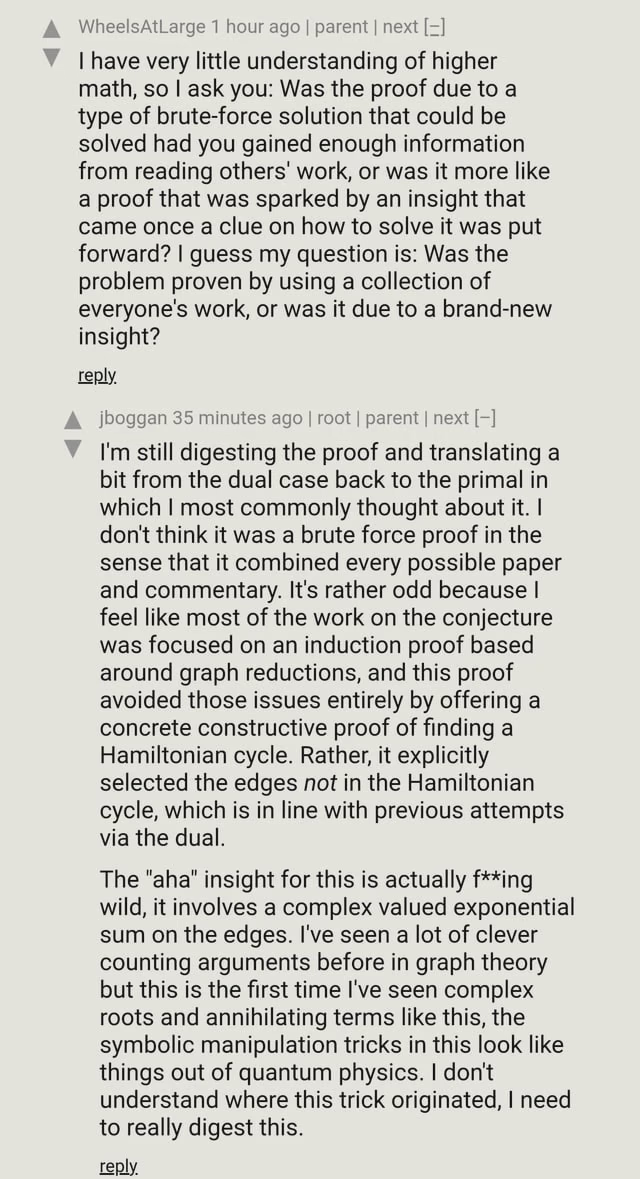
Now, after release, here’s an example of the initial thoughts of someone who had spent time on one of the solved problems:
Replying to @kromem@lemmy.world
Making things very obscured is not a proof.
The guy is politely saying it’s nonsense
That is not at all what he just said
Replying to @ImgurRefugee114@reddthat.com
it’s a pretty inconclusive statement , and can be interpreted.
Post here when he and others say it’s correct
I don’t think that’s what’s being said. More like the complexities of the solution are taking a while to understand because it is a complex solution using complex math. Even the smartest people in their fields can’t always look at a solution and at a glance understand everything without truly digesting what they’re seeing.
Replying to @BassTurd@lemmy.world
complex solution using complex math.
Not sure if “really complicated” or “√-1”
Can you expand on how you came to this conclusion?
It sounds more like when AI won in Go for the first time. People were looking at the game and saying “humans don’t play like that, we don’t understand those moves”.
I think it’s more that he’s saying “interesting approach, but not verified yet.”
Replying to @kromem@lemmy.world
I think people really need to understand the “it just took a bunch of public work and connected the pieces” isn’t a gotcha for LLMs: it’s one of the sales pitches. The cross-discipline general knowledge combined with the ability to churn huge datasets to find connections across already-known work, and extrapolate to or derive novel findings, is exactly one mode of superhuman success that AI companies have been trying to achieve.
The bigger issue is that they may be camping human efforts then kill-stealing the last hit on the boss by burning millions of dollars to get a proof a few days/weeks/months earlier than when it would have happened without AI.
Replying to @ImgurRefugee114@reddthat.com
The cross-discipline general knowledge combined with the ability to churn huge datasets to find connections across already-known work, and extrapolate to or derive novel findings, is exactly one mode of superhuman success that AI companies have been trying to achieve.
Exactly.
Like in the quoted picture, there’s not a huge amount of people who have deep knowledge of Number Theory and the number of them who are also similarly versed in the math behind Quantum Physics could probably be counted on one hand and those people only have so much time.
Meanwhile, the only limitation in creating these AI systems is in how much RAM/compute we can manufacture.

Replying to @FauxLiving@lemmy.world
Meanwhile, the only limitation in creating these AI systems is in how much RAM/compute we can manufacture.
You need large volumes of high quality training data too, which are btw much harder to come by now
Replying to @demonsword@lemmy.world
There are massive libraries or repositories of scientific/mathematical published research throughout higher education institutions and across various technological industries. The required training data exists.
Replying to @kromem@lemmy.world
In other words, this person doesn’t yet know if it’s correct.

Replying to @Mustachius_Grumpius@thelemmy.club

Replying to @Mustachius_Grumpius@thelemmy.club
There’s a paywall. All that I can say is that some models are capable of proving theorems via theorem provers like Lean4, which validates proofs without requiring human feedback. The issue is real and it is a bit of an existential problems to how mathematics will evolve.
I’d say that even with the field potentially getting completely automated in the future, I would still find joy in doing it as much as someone would enjoy playing chess even though a machine can do it much better.
Replying to @wrinkle2409@lemmy.cafe
We don’t have to compete with the machines.
The problem is, the billionaires are very much in favor of machines competing vs the humans for employment.
It’s one of those situations where even if you don’t care about competition with the machines, the system you depend on cares about it. It’s like if you don’t care about politics but politics cares about you.
Replying to @willington@lemmy.dbzer0.com
Yeah, we definitely need a proper restructuring of economic incentives. Rewarding this competition towards existential crises isn’t doing much good to humanity. I think people are in a desperate need for treating philosophical problems seriously.
Replying to @willington@lemmy.dbzer0.com
In other words, it’s a political problem of control, not a technological problem of capability.

Replying to @Mustachius_Grumpius@thelemmy.club
What if it does some wrong or fake equations ? Like who cares? USA is putting AI first, not mathematicians.

Replying to @roserose56@lemmy.zip
If you can’t follow the logic of the steps of the proof, it’s not a proof.
Granted, you may not be skilled in logic, but some of us, mathematicians, specifically, are.
If no mathematician can follow the logic, it’s not a proof.
Replying to @Mustachius_Grumpius@thelemmy.club
Replying to @RabbitBBQ@lemmy.world
It should be basic babymath with him and that stressed face.
Replying to @dontbelievethis@sh.itjust.works
Compared to what OpenAI is claiming its word machine has solved (without any human verification for the claims so far, not even in OAI), the scribbles kinda are (just highschool math).
Replying to @Mustachius_Grumpius@thelemmy.club
ChatGPT, prove to me that Sam Altman is an idiot.
Replying to @obbeel@kbin.earth
prove to me that Sam Altman is an idiot.
I actually did this and it returned 8 pages of examples.

Replying to @Mustachius_Grumpius@thelemmy.club
OpenAI researchers are all dirtbags.
Replying to @rounding_error@lemmy.today
OpenSI*
Replying to @Mustachius_Grumpius@thelemmy.club
Of course, Open AI isn’t going to cite references for all the sources it spudered through to assemble the proof, and likely will be borrowing on a lot of work already done by mathematicians.
So, breaking the rules maintained by all institutions of academic research.
Incidently, LLMs can’t logic. We’ve discovered this when they screw up simple logic problems. They have to depend on human explanations of logical processes, usually when someone else reported on the solution to the logic puzzle.

Replying to @Mustachius_Grumpius@thelemmy.club
Paradoxically speaking people will tend to make their knowledge closed source if its not too late. Have you ever heard if Microsoft paid fine for their Copilot training?