Replying to an earlier post

When I was younger, every time I’d attend a women leaders in STEM panel, they would inevitably ask them about hurdles and if they ever faced gender discrimination etc. Most often their answer was some version of “no”. And it’s relevant to point out they were most often tomboy/autistic coded af. I still think about how it never occurs to them that they were perfect examples of survivorship bias, and I’d rather hear the stories from the women who weren’t so lucky.

Replying to @⁨ScoffingLizard@lemmy.dbzer0.com⁩

that is gender agnostic. as s man i can tell you I’ve been excluded from most opportunities because i am not socially skilled.

on the flip, I’ve neen told by appartment owners that i can’t live there because he felt the other renters (women, all) eould be uncomfortable with a man as a neighbor.

i did not go to the equal opportunity organization to complain. besides, as a man i’d be laughed at and dismissed anyway.

Women currently dominate the job market and educational institutions both as students and teachers. women get the vast majority of grants and discounts for college.

it’s really men who are being discriminated against because “patriarchy”. i am an ex-feminist, btw.

Replying to @⁨ScoffingLizard@lemmy.dbzer0.com⁩

It absolutely is, and it works against anyone not in the club. I was once told by a GM in my company whom I knew outside of work, “you will apply for this job and get it. Then you will apply for that job’s manager’s job and get it. After that I won’t be able to help you.” Once I got outside his sphere of influence, I no longer had anyone advocating for me and haven’t been able to get any new jobs, lateral or promotion, since. To be fair, I’m not a great employee and have risen to the level of my incompetence; but I’ve seen other people get promotions who were not as good at the job as me because they do more of the company social stuff.

And I know that those networks definitely favor men in my industry. So you’re right, even if there isn’t outright, noticeable discrimination against women; strong bias exists.

Replying to @⁨hperrin@lemmy.ca⁩

I mean more than average. Your anecdotal experience is higher than the number in the study, so the most likely explanation is that you’ve worked in companies that have a higher incidence than the average company. The study could also be of companies with less sexist behavior than average, but their sample size is almost certainly larger, so that’s less likely. Or maybe their methodology is bad, or maybe you misinterpreted the behavior, or maybe the whole thing is an LLM hallucination and I’m screaming into the void, but the first explanation is the most likely.

Replying to @⁨beep@piefed.world⁩

I have experienced the oposite in one of my previous jobs, multi-national company. Hiring just based on sex. In my current job for local company, male colleague who was terrible at his job was sacked within 2 months, female coleage was sacked for the same reason after 2 years. My current boss is a woman (and she is a good boss). We have ratio of 70:30, but past 3 hires were women. So these titles are just clickbait to make people angry because they are simplifying or straight disinforming.

Replying to @⁨multi_flexi@lemmy.world⁩

which industry? tech is heavily Male dominated, although the confrences around me have a ton of female conference go-ers, that maybe a unique situation, since its people from all over the country and other countries descending on this area.

i tried to get into one where is heavily biased in favor of woman, biotech, health. even the buildup while in college was benefiting them way more than men, most of the voluntary labs are dominated by women solely, and have a sole preference, and i heard down grapevine the male lab manager was preferentially only choosing women. even during job hunts, they are pretty much hiring them all the time, since it fits with the 6:4 ratio in bio degrees earners, and up to masters level, but not PHD, at least for younger women than millineals, since i know some women who have bio or try to get bio at this generations couldnt get into it right away.

Replying to @⁨multi_flexi@lemmy.world⁩

One doesn’t exclude the other. Discrimination of women in tech is more widespread and hence more talked about.

But it must be noted that workplace discrimination of men exists as well: in some cases, it’s because many jobs are women-dominated, in the others, it’s because of the bosses pushing their stuff. Latter seems to be your case, and it’s valid and shared by many men.

Replying to @⁨beep@piefed.world⁩

Meh, I admit I shrug more and more when I see these sorts of pieces with these gender nagging titles. It doesn’t feel like you’re comparing apples to apples when we talk about things like gender discrimination / issues, in many cases, and the article doesn’t really address the potential bias in the data.

eg. Ask men if they’ve ever been woken up by a BJ from a partner. You’ll likely find it a very common experience most have likely had, if they’re sexually active. Then ask them if they’ve ever been raped. Remind them that if they had a partner initiate sex while they were sleeping, they couldn’t consent, so it’d be rape. Few will actually register it, and fewer still would bother reporting it. Or take something like workplace inappropriate touching. I’ve known women in every office I’ve worked in over the past ~15 years, who were “huggers”, or who felt it perfectly fine to touch guys biceps etc. Men shrug and don’t report it, but swap the genders and it gets reported to HR pretty quick.

For another easy example of workplace discrimination targeting men/benefiting women – it’s incredibly common for women in an office to have things like women-only chat groups, and women-only networking outside of work. Fit bit groups, yoga/after work exercise, etc. Men aren’t invited/included, nor given that opportunity to network. Any man who’s worked in such an office, and has been excluded/overlooked for those groups, has been the victim of workplace gender discrimination.

Women are often in victim bubbles, that train them continuously to find fault with men’s actions, and to credit it as gender discrimination, and that most of their faults/mistakes are the result of biased systems which everyone else needs to fix. Men are in bubbles that say they’re lucky/doin good if they have any neutral/positive interaction with other people, and that all the man’s faults/mistakes are their own doing, that they need to pull themselves up by their bootstraps. And we see articles/studies like this one, feeding into that pattern.


Replying to @⁨wampus@lemmy.ca⁩

IMO you and your partner should always communicate prior about whether it would be okay to wake each other up with sex, and not doing so is irresponsible.

I don’t think being woken up with a sexual act you couldn’t consent to is a good way to define rape. A good definition is whether the act was wanted or unwanted. There’s a subtle difference here.

If being woken with a BJ was wanted, then it’s not rape. But it could have been rape if it was unwanted. It’s extremely irresponsible to pray and hope that the contact was wanted without establishing anything prior. Basically: it’s possible to consent to something during/after the fact. But it’s dangerous, and why risk being a rapist by doing it that way when you can simply have a conversation about whether it would be okay?

Replying to @⁨lenz@lemmy.ml⁩

Yes, you should communicate before, etc.

The point is more that if men were viewing themselves as “most likely victims” because they’ve been told repeatedly that men get raped a bunch, and that acts such as wakeup BJs count as rape in the eyes of the narrative, then they’d be mass reporting themselves as being raped for an act that, at present, most guys shrug at. It’s the societal ‘norm’ that says “all men should always want sex” that underpins it in a way, in that men almost never consider themselves victims in this regard – that, paired with the norm that men’s bodies are completely disposable. And it’s partially the societal norm that women’s bodies are inherently desired/wanted/to be protected, that makes them view a lot more scenarios as ‘rape’ – and allows them to decide if its rape years after the event even, if they later realise they felt some sort of pressure to go through with it. Much different measurement methods for the same concept, so it seems really disingenuous to compare them directly.

Similarly, women have been told repeatedly that they’re discriminated against at work. If they see a group of guys going out after work to a pub, and they don’t get invited, they’d likely report that as gender discrimination – it’s networking opportunities that they’re being denied. I’ve even heard COO women on Freakonomics before commenting about how the choice of activities/conversation topics, being not the ones that women typically do/talk about, isolates/discriminates against them. Meanwhile guys, seeing a group of girls going to the girl only gym, are not meant to see that as gender discrimination / not ‘trained’ to view it as gender discrimination. When a group of women is discussing women-centric topics, men aren’t trained to see that as isolating. So when you later ask both groups if they’ve been discriminated against, “Surrpise!” the women will claim it more regularly, while the guys will be oblivious / nonchalant about it.

Replying to @⁨wampus@lemmy.ca⁩

…tbh though, I think you’re not framing the situation correctly:

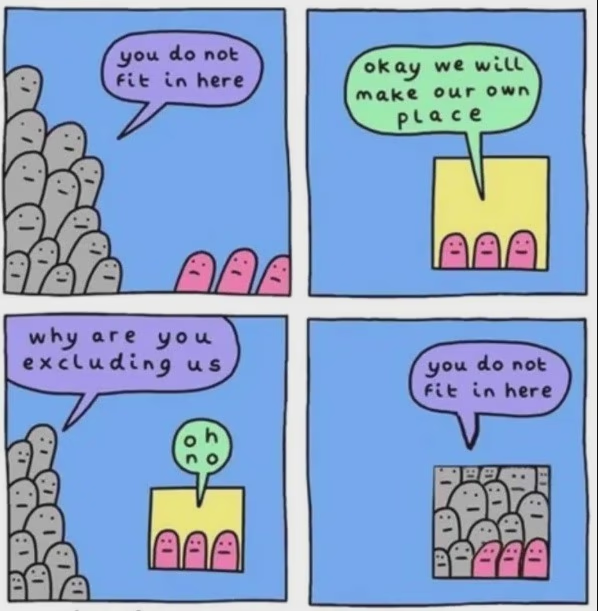
Women for a long time were excluded from male dominated spaces. So they ended up having to form their own groups and spaces. Now you imply that women having those spaces is the exact same thing as men excluding women from their spaces.

Yes, the loaded word patriarchy is a thing that hurts both men and women. But trying to frame men and women’s situations as analogous is ignoring a loooot of history. You’re looking at the end result and measuring it without seeing the past circumstances that created it.

This is like looking at the Black Lives Matter and being upset that they didn’t name themselves All Lives Matter. When their creation was a direct result of black people losing their lives at the hands of police, and the name was meant to bring attention to that.

Women’s groups and spaces, similarly, are a direct result of wanting to escape the discrimination and exclusion that comes from being in male-dominated environments. This is not 1:1 with men excluding women from things. Not when historically, women have been excluded from: voting, having paid jobs, having their own bank accounts, owning property, the choice whether to have kids, the choice of who to marry. Not to mention, literally being considered property to be bought and sold through dowries. For hundreds of years up until very recently this was the case. And the scars of that still exist in society. You cannot look at those scars and be blind to the history.

Men are definitely less likely to report rape if they’ve experienced it. In part rape is still seen as something to be ashamed of being a survivor of. I’m not arguing against that. But idk man, I think you’re making a lot of black and white assumptions here about why things are the way that they are.

Replying to @⁨wampus@lemmy.ca⁩

Men who get legit raped don’t get outrage and empathy, they get a high five or called a ‘pussy’ for not enjoying it. A woman gets allegedly raped and people want to roll heads and commit murder. The blood-thirst for Cornell case is insane… even though the real world evidence points to it being another false accusation… which is precisely why it was never prosecuted…

Same with other forms of sexual assault/harassment. Men are expected to just enjoy it and ‘you’re so lucky’ is what folks will say.

this a great analysis. Also why our culture is so insane right now. People increasingly live in bubbles of gender bias and they bias each other into horrible double standards. The people who scream the most about ‘rape culture’ are the ones most likely to have committed sexual assault on men or other women, IME.

And any male support group is viewed as inherently anti-woman. Which is insane.