posted in Technology

When No ID Means No Internet: Age Verification and the Right to Access Information

Age verification proposals are often presented as a simple tradeoff: sacrifice a little privacy to better safeguard children online. But that framing overlooks a more fundamental question. What happens to people who cannot verify their age at all? This is particularly a problem when users are required to prove their age with identity documents.

www.eff.org/deeplinks/2026/10/when-no-id-means-no-internet-age-verification-and-right-access-information
enPage

Replying to @⁨technocrit@lemmy.dbzer0.com⁩

I’m payin $25/mo to join an online community by a YouTuber I follow and everyone is using their real names and real photos (or simulacra thereof). It’s pretty crazy.

But I think what will happen is communities will be based on trust, and that trust will eventually be enforced by siloed environments.

Like, right now, I’m guessing that the site’s software is probably hoovering up information and it’s all centralized somewhere… but maybe in the future, if small communities become the norm, providing real privacy will be a thing.

Replying to @⁨schipelblorp@sh.itjust.works⁩

Basically describing what happened with Lemmy. What started out as Reddit Minus Shitbag Mods became a screaming match between .world and .ml, while everyone on .hexbear retreated into exile.

You still won’t have any real trust, because the accusations of “bot” and “shill” will follow anyone who violates a taboo. But you’ll at least have a few people you recognize, who you can have well-defined opinions on.

Replying to @⁨UnderpantsWeevil@lemmy.world⁩

I’m thinking more the opposite.

I’m thinking, “How do I keep my information out of the hands of centralized database looking for people spreading discontent?”

Lemmy succeeds only so far as it is anymous, but absent that, anyone can plug in and siphon the database.

A siloed server with good security could lack anonymity, but because the data is not centralized, the feds would have to take a special interest to create an account, and because there would be so many of these instances, it would be a very time consuming process.

But maybe SI, which is what the fascists are calling the fascism machine, would make a mockery of that.

Replying to @⁨schipelblorp@sh.itjust.works⁩

I’m thinking, “How do I keep my information out of the hands of centralized database looking for people spreading discontent?”

On a public forum?

A siloed server with good security could lack anonymity, but because the data is not centralized, the feds would have to take a special interest to create an account, and because there would be so many of these instances, it would be a very time consuming process.

Kinda depends how it’s hosted. You don’t need an account to mine AWS if you can just pick through the backend.

Replying to @⁨schipelblorp@sh.itjust.works⁩

I think small communities should be the norm.

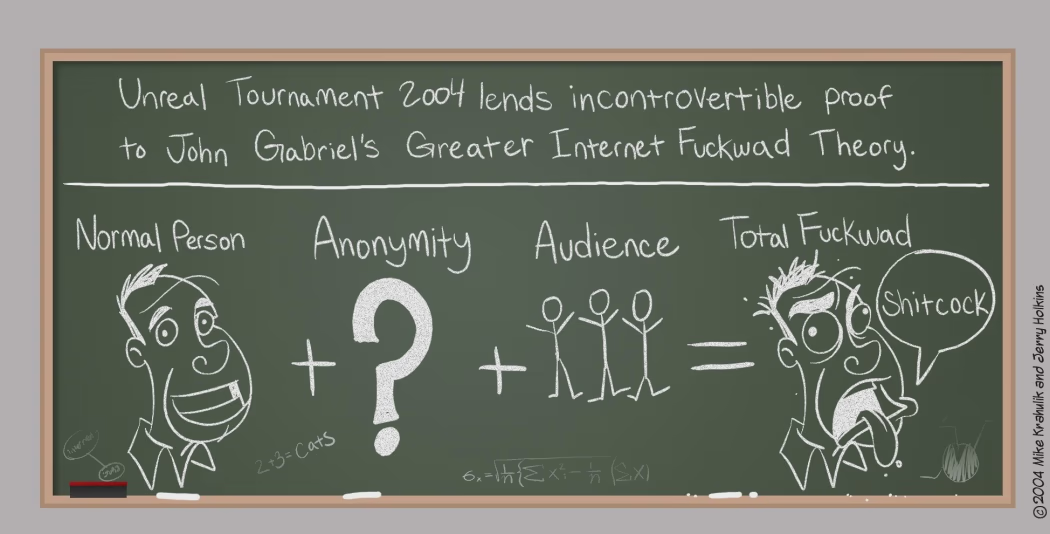
Social media that makes it so that you’re always anonymous and always speaking to strangers creates a lot of problems (Internet Fuckwad Theory)

Recognizing other users and knowing that your behaviour will result in a negative reputation goes a long way towards creating higher quality discussions. Moderation isn’t as needed and it’s harder for outside actors to manufacture a consensus by spamming bot accounts.

I think that’d go a long way towards resolving a lot of problems created by social media.

www.penny-arcade.comGreen Blackboards (And Other Anomalies) - Penny ArcadeVideogaming-related online strip by Mike Krahulik and Jerry Holkins. Includes news and commentary.

Replying to @⁨technocrit@lemmy.dbzer0.com⁩

What our glorious ill informed leaders do not seem to have realised as yet is that it will apply to them too. So everything they look at online will be linked to their actual identity and is thereby more easily discerned, to be spewed all over the internet when the time is right. Or maybe that is the point, delivery of prosecution or blackmail in neater and more convenient packages.

Replying to @⁨lIlIlIlIlIlIl@lemmy.world⁩

That’s the fun part - they don’t! There are no special 1s nor 0s

Yea, it was what was being discussed. Your assertion is that it’s impossible for the ruling class to have an exception. You seem to think a technical limitation exists where none does.

You’re factually incorrect, and show neither an understanding of how networking/websites function, or understanding of how the ultra wealthy and the politicians they buy have a very long history of giving themselves loopholes so the rules don’t apply to them.

Stop moving the goalposts

Replying to @⁨Miller@lemmy.world⁩

t will apply to them too.

No it won’t. That’s not how The Network State functions.

You have a very clearly designated In-Group and Out-Group. Just stay in the In-Group and you’ll be fine.

You’re not going to beat segregation by telling a bunch of coked up white boys “One day you won’t be allowed to drink from a water fountain”. Everyone knows that’s not true. That’s not how these barriers function.

Replying to @⁨technocrit@lemmy.dbzer0.com⁩

Age verification laws reshape who can speak, who can access information, and who gets excluded from the digital public sphere. In other words, age verification is not a neutral safety measure: it presents a structural barrier to disproportionately exclude certain groups—particularly those in the global majority—and alters the architecture of global online expression. Some of these groups are already marginalized offline, and age verification extends that exclusion into digital spaces.

For instance, 850 million people globally do not have ID. Most of these individuals exist in primarily low and middle income countries in Sub-Saharan Africa and South Asia. The World Bank points out that many are members of marginalized groups and more than half of those lacking access to identity documentation also have children whose births have not been registered. Women are particularly vulnerable and are 8% less likely than men to have an ID. Other vulnerable groups, such as adults in low income countries, are less likely to have an ID when they fall below 25 years, as are those with a primary school education or less or those in rural areas.

Replying to @⁨Maeve@kbin.earth⁩

It’s very telling that these “humanitarian” globalist groups consider people not having documents and papers some problem that needs to be solved when it’s really just about their desire for total control and domination. People are not meant to be tied to certificates and IDs and the idea that they are is born from an absolute lust for control by the ‘system managers’ and nothing more.

Replying to @⁨technocrit@lemmy.dbzer0.com⁩

IMO, because this all centers on access to social media platforms, it’s also a restriction on freedom of speech. Kids can’t talk to other people just because of the form of communication? Fucking bullshit and does absolutely fuck all to fix the true underlying problems. The lack of ID also just puts the restriction on many unhoused adults and is very likely to be an intentional side effect.

Replying to @⁨Dryad@lemmy.world⁩

I was just checking that out here: reticulum.network

Their docs link to this related project: github.com/markqvist/NomadNet

Why does this README suggest modifying the system to allow pip to break system packages?

Then it goes on to say you might need to reboot, when simply closing the terminal for a new one should work.

Who wrote this?

reticulum.networkReticulum Network

Replying to @⁨technocrit@lemmy.dbzer0.com⁩

Like most people here, I’m generally opposed to the current push for age and identity verification across the internet. I don’t particularly like the idea of handing over my personal information just to visit a website, participate in a discussion, or read something somebody considers inappropriate.

But I think there are two larger conversations we’re avoiding, and both are going to become increasingly important.

The first is something we complain about constantly: the toxicity of the internet.

How often do we hear people complain about trolls, harassment, misinformation, and the general hostility of online discussions? One of the explanations that comes up repeatedly is anonymity.

People can say things online that they would never dream of saying to someone standing in front of them. They can be deliberately cruel, spread nonsense, or spend their evenings antagonizing strangers with relatively little fear of consequences reaching their everyday lives.

There’s an old expression about people behaving differently when there’s a chance they might get punched in the mouth. I’m certainly not advocating violence, but there’s a legitimate observation buried in that expression. Social consequences influence how people behave.

And online, we’ve removed quite a few of those traditional consequences.

Yet when someone suggests introducing greater accountability through identity verification, many of the same people who complain about online toxicity immediately object.

And I understand why. I’m one of them.

But it does present an interesting contradiction. We recognize the problems associated with anonymous behavior while fiercely defending the conditions that can sometimes enable it.

Of course, anonymity isn’t the only reason people behave badly online. Plenty of people spread misinformation and harass others under their real names. And anonymity protects whistleblowers, vulnerable people, and those expressing unpopular opinions just as much as it protects trolls.

Which makes me wonder whether we’ve been framing this whole discussion incorrectly.

Maybe anonymity and accountability don’t actually have to be opposites.

There’s a considerable difference between being anonymous to the general public and being completely unaccountable for your actions. A person could maintain a persistent pseudonymous identity, build a reputation, and face meaningful community consequences without ever publishing their legal name.

The second conversation is about where technology is taking us.

For most of human history, knowledge and capability have been separated by practical barriers.

You could learn everything available about nuclear physics, but that didn’t mean you could walk down to the corner store and pick up two pounds of plutonium.

Actually doing something dangerous generally required specialized equipment, materials, training, or substantial institutional resources.

But we’re entering an era of increasingly capable AI, biotechnology, advanced manufacturing, and automation. Technology is steadily reducing some of those barriers.

What happens when someone with very little specialized knowledge can use advanced systems to accomplish something that previously required an entire team of experts?

At some point, unrestricted access to certain capabilities may become a genuine public safety concern.

And this is where I think we’re making a fundamental mistake with the current identity-verification debate.

We’re treating three very different questions as though they’re interchangeable:

  • Are you old enough to access something?
  • Who are you?
  • Should you be authorized to perform a particular action?

Knowing someone’s age doesn’t establish their competence or intentions. Knowing their legal identity doesn’t necessarily make them responsible. And neither question necessarily determines whether they should have access to a potentially dangerous capability.

More importantly, reading about something isn’t the same as being able to do it.

I don’t think we should be constructing a universal identification system just because certain corners of the internet have problems with behavior, or because future technologies might introduce serious risks.

But I also don’t think we can assume that unrestricted, completely unaccountable access to every future capability will always be sustainable.

We need to start separating privacy from impunity, knowledge from capability, and identity from authorization.

Maybe that means persistent anonymous identities with meaningful reputations and community accountability. Maybe it means privacy-preserving credentials that establish qualifications without revealing personal information. Maybe genuinely dangerous capabilities eventually require narrowly defined authorization and independent oversight.

Any such system would also need safeguards against abuse, because whoever controls the authorization process gains considerable power over everyone else.

I don’t pretend to have a complete answer.

What concerns me is that we’re currently arguing over whether everyone should have to identify themselves, when the more important questions are what information is actually necessary, who gets access to it, what behaviors require accountability, and who has the authority to impose restrictions.

We shouldn’t have to choose between an internet where nobody can be held accountable and one where everybody has to surrender their privacy.

So I’m curious what other people think.

Can we preserve meaningful anonymity while still creating meaningful accountability? And as technology makes increasingly powerful capabilities available to ordinary people, where should we draw the line between the freedom to learn and the authorization to act?

If a system could make a person accountable for specific harmful actions without revealing their identity to the public, would that address your concerns, or is even that degree of traceability unacceptable?


Replying to @⁨Zexks@lemmy.world⁩

Pussy ass bitch. Me saying you say dumb dumb stuff doesn’t give you the right to my identity. Nor you having it will change anything cause I dont know and dont care about you. The fact you think that ppl should be held accountable for what ppl can claim is perceptible toxicity is really dumb. We have freedom of expression. And it isn’t conditioned to having an identity.

Your are a cancerous facist that juste want more power to impose his visions while wanting to know who are what saying cause you could potentionaly end up pervieve toxcitity online.

My stance is online isn’t for ppl like you.

Replying to @⁨Zexks@lemmy.world⁩

U dont held people accountable cause it s the internet and we are 8 billion on earth. And who are you to decide what is and what is not perceive fault that should create consequence ? It s a nightmare to abord that issue this way except if you need full control. In my country we have an agence that s independant and can launch pursuit and put ppl on watching. It work cause they are qualified to know what is and what is not worth of being concern by online. They work with public tips. This work cause they are working this issue while respecting civils right and while not being big corpo playing the cops. Nobody argue u shouldn’t have consequence for your actions. Ppl argue that treating everybody as potential criminal to violate their right isn’t a good approach to legislation.