GrapheneOS imposes a set of restrictions on how generative AI can be used in our project and community. It isn't forbidden but rather we imposed rules based on actual issues.

Posts made in our forum, chat rooms, issue tracker and the rest of our project must be written by humans. There's an exception from this rule for translation and accessibility features. That means commit messages, pull request messages, bug reports and feature requests are expected to be written by humans, not a machine.


Replying to @⁨GrapheneOS@grapheneos.social⁩

We largely disallow making posts entirely based on AI model output. For example, we get a lot of forum threads from people with concerns based on AI model output and will typically provide a quick answer followed by locking the thread and then eventually removing it.

It isn't permitted to submit pull requests or issue reports created by an AI model without fully understanding it. It's fully allowed to file issues found by an AI model if there's a human who understands it and writes the report.

Replying to @⁨GrapheneOS@grapheneos.social⁩

We do not want issue reports entirely generated by an AI model or which were written by a human and passed through an AI model to provide analysis. It's usually incredibly inaccurate and we would greatly prefer the user's explanation of what's wrong. We want a description of what happened, a crash traceback if one is available and optionally a subset of logs emailed to logs@grapheneos.org if people are comfortable doing that after triggering the crash or another issue. We sometimes request it.

Replying to @⁨GrapheneOS@grapheneos.social⁩

It can sometimes be useful to analyze an issue with an AI model but it usually isn't. It also definitely isn't useful to do it with a free or cheap model available without either paying for it or running it on very expensive hardware. In general, users do not have access to anything useful to analyze it. We don't want people to keep converting their issue reports into slop. We want what a user pasted into the AI model interface rather than what an AI model produced as output from that.

Replying to @⁨GrapheneOS@grapheneos.social⁩

Frontier models are very good at finding bugs but it requires an experienced developer to babysit it and extract the useful portion of the output. Important bugs are often found but mixed in with a bunch of low quality output. The details on the issue and especially proposals to fix it are often wrong. It's still very useful and finds many real issues. The volume of real vulnerabilities being found this way in Linux, Chromium, Firefox, Postfix and countless other projects is quite scary.

Replying to @⁨GrapheneOS@grapheneos.social⁩

It isn't a good idea for people to point a model at an open source project and then start submitting bug reports to it. People need to be able to confirm the issues themselves with relatively high confidence before reporting it. It's okay to make some mistakes but it should not be the majority of what's reported. We do want people to report these kinds of security bugs to us but the signal to noise ratio is far too low right now. Even frontier models spew out contrived nonsense and fabrications.

Replying to @⁨GrapheneOS@grapheneos.social⁩

We want people to report very serious Android Open Source Project security bugs to us but we can't handle a lot of minor issues. We don't generally need Chromium security bugs reported to us because they handle those far more quickly and have a far better system for releasing it. Linux kernel security bug reports are useful if they refused to fix it (arm64 kASLR) or it didn't get backported to the LTS. GKI LTS being behind the LTS is a separate problem we'll be addressing ourselves again soon.

Replying to @⁨GrapheneOS@grapheneos.social⁩

We have high standards for code being merged into GrapheneOS, especially for code in critically important parts of the project. Most of the changes made to the OS are to critically important parts of the code. It takes a long time to get features to meet our standards. There's usually a lot of back and forth review with many improvements requirements for anything significant. External contributors shouldn't try to take on major features without talking to us and planning that out with us first.

Replying to @⁨GrapheneOS@grapheneos.social⁩

Going from having a working implementation of a feature to code we can merge often takes a long time. It can take months or even more than a year. It doesn't always work out. Sometimes we decide a feature ended up being too invasive or risky for other reasons and don't want to include it. We'll often do rewrites. Contributors need a full understanding of what they've submitted and need to be prepared to make substantial changes including fully rewriting it multiple times. AI slop isn't accepted.

Replying to @⁨GrapheneOS@grapheneos.social⁩

We don't forbid using AI models for writing code but pull requests largely created that way will typically be rejected or skipped due to not meeting our requirements. It needs to be well written code which appears to be regular code written by a human regardless of the level of AI assistance involved in making it. It should not look like AI generated code. We do want to know if AI models are being used and how they're being used rather than people using it but not telling us they're using it.

Replying to @⁨GrapheneOS@grapheneos.social⁩

GrapheneOS is based on projects heavily using AI including the Linux kernel. Cellebrite, NSO and other exploit developers are using it to exploit these projects. They currently have a major advantage thanks to AI which will likely be turned into a major disadvantage over the long term. It's getting a huge backlog of bugs fixed and creating enormous pressure to make systemic improvements.

Here's what Debian adopted, which is a similar idea but much more permissive:

debian.org/vote/2026/vote_002#

www.debian.org/vote/2026/vote_002#texte

Replying to @⁨bekkaboo@girlcock.club⁩

@bekkaboo Linux itself is heavily using AI models. Therefore, every Linux distribution moving to recent kernel versions is heavily built on top of using AI models. Creating a Linux distribution not heavily using it would require a hard fork of the Linux kernel and many other projects.

It's unclear what would be accomplished by banning AI for a tiny portion of the code while continuing to use Linux, AOSP, Chromium and hundreds of other projects heavily using it. We'd still be benefiting from it.

Replying to @⁨GrapheneOS@grapheneos.social⁩

@GrapheneOS
> Creating a Linux distribution not heavily using it would require a hard fork of the Linux kernel and many other projects.

The pitfalls of using LLMs are well known and documented. Hard forking everything would probably be for the best really. Leaning into it, out of pear pressure is really the bad move here (unless you think there's more to it than "pear pressure")

Replying to @⁨zm@kolektiva.social⁩

@zm We're using it to raise the quality of our code. Our current usage for the core OS is entirely for extra passes of code review and to find issues in our existing code. We began doing it after receiving a bunch of valid reports from external contributors of issues found with AI models. Several issues we fixed due to external contributors scanning our code with AI were serious issues including crashes and bypasses for protections. A lot of that was reviewed by over a dozen people already.

Replying to @⁨GrapheneOS@grapheneos.social⁩

@zm Our Camera app was originally written in Java with the Android Views framework. It was ported to Kotlin years ago using Android Studio which was a non-AI machine translation. It has never been idiomatic Kotlin. It was written by a junior developer and we didn't apply strict enough code review or standards due to lack of resources.

It's ridiculous to portray experienced developers overhauling the app with everything going through a lot of review as writing slop because one uses AI tools.

Replying to @⁨GrapheneOS@grapheneos.social⁩

@zm Our initial Camera app needed to meet the bar of being better than AOSP Camera which was horrible and the codebase was a huge mess. It succeeded in providing that and has been a decent camera app since then.

Camera needs a massive overhaul to meet our much higher current quality standards for the user interface, features and especially code quality.

We're doing the same for the incredibly outdated AOSP apps. Those are being nearly entirely overhauled with far higher quality code.

Replying to @⁨GrapheneOS@grapheneos.social⁩

@GrapheneOS
I still think you have to look at what this means from a cultural perspective.

Even if this is all true (i.e. you were getting amazing quality output from LLMs), it doesn't answer for all of the negative externalities of AI use (just look at why Codeberg banned it). You have for the most part called balls and strikes on a lot of the controversy and misconceptions surrounding this project and other similar projects.

It's given you a good enough reputation to get the user base you have and even land you in the news because of how secure it is. AI companies on the other hand have a terrible reputation and many people are jumping ship to something like GrapheneOS because of AI (and how it's being forced on their users)

If you can understand the reasons that people want to use GrapheneOS then you'll understand why people don't want you to allow AI use in this project. None of the technical challenges you're facing will even matter if your users can't trust you

Replying to @⁨zm@kolektiva.social⁩

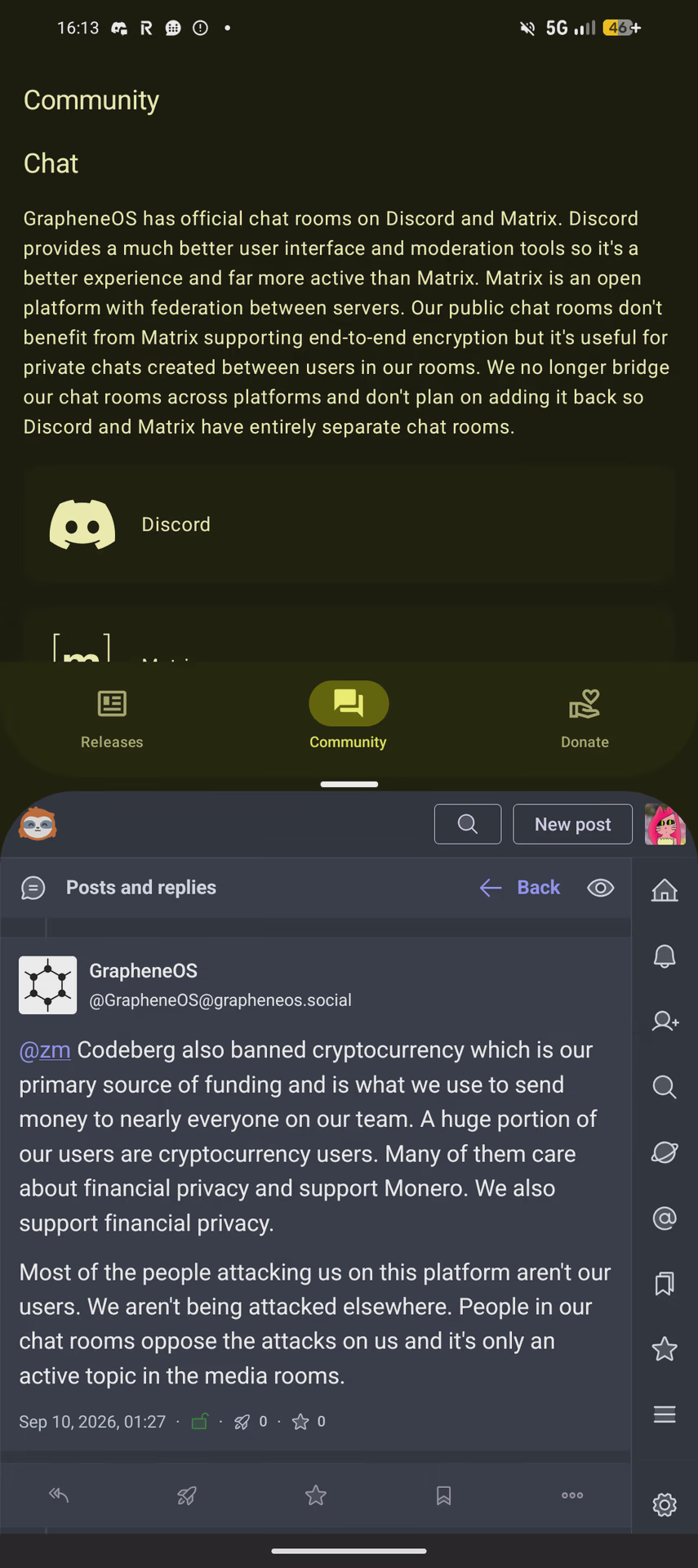
@zm Codeberg also banned cryptocurrency which is our primary source of funding and is what we use to send money to nearly everyone on our team. A huge portion of our users are cryptocurrency users. Many of them care about financial privacy and support Monero. We also support financial privacy.

Most of the people attacking us on this platform aren't our users. We aren't being attacked elsewhere. People in our chat rooms oppose the attacks on us and it's only an active topic in the media rooms.

en

Replying to @⁨GrapheneOS@grapheneos.social⁩

@GrapheneOS
Keep up the fantastic work GOS team. I like most of the decisions you've made, and I'll financially support the project once I'm capable of it. You lots have the sanest approach to a lot of technical issues. Most people complaining about AI use in production are just virtue signaling because muh AI slop muh evil corps muh environment muh losing jobs. Purely performative because hating the evil AI is a bandwagon everyone especially the normies are jumping on.

Replying to @⁨GrapheneOS@grapheneos.social⁩

@GrapheneOS
There's no neutral stance. You either join the AI hate cult or the AI worship cult. Bloody hilarious.
BTW a lot of folks who complain about AI slop create human slop themselves. AI creates slop because it feeds on human slop. Classic GIGO that is. So is AI even the right thing to hate? AI can write higher quality code than a lot of these mediocre software "engineers" anyway.

Replying to @⁨xerz@masfloss.net⁩

@xerz @zm There are a lot of GrapheneOS users on the fediverse but it's hardly representative of the overall userbase.

Most people using GrapheneOS do not use social media accounts. The vast majority of our userbase does not have these super strong feelings for or against AI. The vast majority wouldn't want cloud AI in the OS and also largely dislike anything storing or learning stuff about their behavior. Details of what people want varies a lot. Many people want a lot of local AI features.

Replying to @⁨GrapheneOS@grapheneos.social⁩

@xerz @zm Our discussion forum and chat rooms are a much better representation of our overall userbase than looking at the fediverse, X, Reddit or another platform. It's still only the subset of it willing to make those accounts. We get a good idea of the major differences in what people believe and want from their devices from our own platforms.

Nostr very likely has a higher proportion of GrapheneOS users. We don't have a project account for it but they can see a lot of our posts from here.

Replying to @⁨GrapheneOS@grapheneos.social⁩

@GrapheneOS @zm

Codeberg has banned cryptocurrency projects, not the use of cryptocurrencies. Codeberg e.V themselves have never accepted cryptocurrency to begin with.

What lead to the decision:
codeberg.org/Codeberg/Communit

The vote they had about it:
codeberg.org/Codeberg/org/pull

codeberg.org/Codeberg/Community/issues/794

Replying to @⁨ozzelot@mstdn.social⁩

@ozzelot @zm We're aware they started by banning projects tied to the development of cryptocurrency which are what we rely on to accept donations and pay our developers around the world. We never said they banned GrapheneOS from using it for hosting. It shows we couldn't reliably use it for hosting since the bans may be greatly expanded in the future.

We brought up the other ban because it's another way that we're not at all on the same page. We care about preserving the privacy of cash.