posted in Technology

One of AI’s Fiercest Critics Says All the Doom Talk Is ‘Meant to Distract Us’
www.wired.com/story/one-of-ais-fiercest-critics-says-all-the-doom-talk-is-meant-to-distract-us/posted in Technology
One of AI’s Fiercest Critics Says All the Doom Talk Is ‘Meant to Distract Us’
www.wired.com/story/one-of-ais-fiercest-critics-says-all-the-doom-talk-is-meant-to-distract-us/
Replying to @Wurzl@lemmy.zip
(I want to preface by saying I don’t support AI, I don’t want to hype AI, I want AI research and development to stop immediately.)
Timnit Gebru argues that AI companies are stoking fears of extinction to avoid discussing actual harms, like autonomous weapons.
Huh? Pretty sure autonomous weapons are part of the fears of extinction. It’s very hard to imagine an AI safety advocate doing “all the doom talk” would in any way support AI autonomous weapons. She and other AI safety researchers are on the same side! They don’t need to and shouldn’t fight each other.
Timnit Gebru: Why are they choosing certain disciplines? Somehow these subjects, like programming and chess and math, were elevated to mean, OK, you solved this and thereby you’ve solved intelligence.
Well that’s simple. Because the output of chess, programming, and math can be easily checked mechanically. Chess has win or loss, programs either pass tests or not, math proofs can be checked with Lean, etc. This makes these discipline very easy to train an AI on with reinforcement learning.
I thought an AI researcher would know this?
Replying to @nialv7@lemmy.world
She answers that question right after the question in the same article, making it a rhetorical device rather than an open question.
Focusing on human responsibility for using a tool sounds like a good way to proceed in my opinion.
When AI steal open source code who is responsible? When an AI powered drone kills a civilian who is responsible? When the AI is shown to hire and fire in racist ways who is responsible? Someone has to be, AI is just a tool after all.
In my book I write, “Can a bridge decide to collapse?” The whole “Oh no, our models went rogue” thing … When a bridge collapses, you don’t analyze whether the bridge was ethical or sentient or why it decided to collapse. You ask, who is the person who built this bridge to be so flimsy? There are permits you have to acquire. There are supposed to be tests. When you ask about the bridge collapsing itself, you’ve lost the thread.
Meanwhile, what’s really existential is AI powering autonomous weapons, killing machines, that are actually being used in warfare. The climate catastrophe is a real thing that could be exacerbated by what these tech companies are building. Bosses are using AI as an excuse to get rid of their pesky workers. This machine-god narrative is, in my opinion, meant to distract us from these.
Replying to @anamethatisnt@sopuli.xyz
Focusing on human responsibility for using a tool sounds like a good way to proceed in my opinion.
Absolutely! If AI hurts humans then the AI company CEOs should be put in jail (in fact I believe they should be in jail right now for developing AI at all).
When a bridge collapses, you don’t analyze whether the bridge was ethical or sentient or why it decided to collapse. You ask, who is the person who built this bridge to be so flimsy?
Right, when a bridge collapses, we analysis the physics of it so the next bridge we build won’t collapse. From my perspective analysis why an AI “went rogue” is the same process. The difficulty is when talking about AI we can’t help but use some anthropomorphizing languages. If anything, talking about when an AI “thought” is a lot less verbose than talking about how the transformer’s weights multiplies together and how the random sampling process produced a sequence of tokens that resembles natural language. But ultimately, it’s not that far from analyzing a bridge collapse. We need to understand why an AI “went rogue” to stop the next AI from going rogue (or, in my opinion, just stop building the next AI altogether).
This machine-god narrative is, in my opinion, meant to distract us from these.
I don’t see why personally. AI is dangerous enough even if it doesn’t become “machine-god”. Absolutely we shouldn’t use AI to develop autonomous weapons. If AI can indeed somehow become “machine-god”, then oh my god that’s a million times worse and we should stop immediately.
Replying to @nialv7@lemmy.world
The difficulty is when talking about AI we can’t help but use some anthropomorphizing languages
I can. And the tech ceos choose that language because it makes them more money.
That’s what this is about, it’s about humans making choices and avoiding responsibility for those chioces by blaming machines.

Replying to @nialv7@lemmy.world
The only difference is that AI is a black box and a lot of what's going on inside isn't fully understood. They're learning as they go, and accepting they don't know some of the whys as they go to the next step. Unlike the bridge analogy. Which actually makes the problem even more serious, because they don't fully know why it ends up doing some of the things, and now the newest models are having the processes partially hidden from view. Where only a version back we were being assured they could watch the chain of thoughts and intercept what could be problematic, claiming they're practicing AI safety in development, now there's pieces that are not viewable. And they went with it anyway and released it to paying customers. Again with the bridge analogy, some of the parts that might have failed go missing and we don't know how they broke, what they were made of, etc.
Humans are building AI, but in a sense they are also growing them, while not knowing what seeds they're throwing together. There's science and theory behind it, they understand a lot, but they're getting results back that would prevent a bridge being approved to be built if it had the same uncertainty. So I stand behind holding the people accountable, but more for the recklessness of following profit over scientific research and ethics, as well as using the excuse that if they don't get there first, someone else will. They aren't wrong about that, only wrong about it needing to be that type of race.
Replying to @anamethatisnt@sopuli.xyz
The problem is AI is created by rich people and rich people cannot be held legally liable. The Hugging Face hack is clear evidence of this legal principle.
Replying to @schipelblorp@sh.itjust.works
And "AI gone rogue" headlines support the narrative that the AI did things by itself and no human could expect this so they can't be responsible (nevermind that they built the thing in the first place).
Replying to @SkavarSharraddas@gehirneimer.de
they turned off the safeguards. This shit is 100% idiot humans + marketing
Replying to @lIlIlIlIlIlIl@lemmy.world
And they gave it unlimited compute, I heard, though I can´t find the source on that. Imagine sandboxing something that has the knowledge to get out of a sandbox, telling it to hack a server, giving it unlimited compute, and then just walking away for several days. It is absolutely insane.
Replying to @schipelblorp@sh.itjust.works
They didn’t walk away. They sat there and watched it. All this is to sell “the ultimate hacking machine” to the government.
Right, but that’s precisely the problem. We don’t need to be going around fearmongering about how dangerous AI itself is. We need to be regulating it and fining the actual people who are making decisions to use AI in ways that result in harm. Whether that harm is direct human injury, injury through negligence (like denying a health insurance claim that should have been approved), financial injury, reputational, whatever.
They need to be held accountable exactly the same as if a human had done it. Humans have been driven to suicide by the criminal response to hacking for far more noble a reason than “cheat on an AI evaluation test”. The weight of the law should be brought down on the executives responsible for the Hugging Face hack, too. But fearmongering about how this shows how amazeballs advanced the AI has become doesn’t accomplish that.
Replying to @Zagorath@quokk.au
Yes, but what I’m telling you this has absolutely nothing to do with AI and everything to do with the impunity of wealth.
All these AI companies MASSIVELY pirated the internet for training data, all very clearly illegal by the letter and spirit of the law, and they have not even been charged for it. The most that happens is that content companies sue in the hopes to get some shares in AI, or sue one AI company because their daddy owns a competing AI company, and those suits seem to ignore the piracy and instead are about whether they needed a separate license to train.
Meanwhile, AI companies are very carefully trying to put liability sponges between it and any lawsuits. Tesla tried (and recently failed) to dump 100% of liability on drivers of it’s “self-driving” cars, and every mission critical AI service is likely to have a human mindlessly rubber stamping AI decisions as fast as they can just so they can be held liable instead of the employer or the AI company.
All these AI companies MASSIVELY pirated the internet for training data
I think it’s worth being a little more careful with our phrasing here. AI companies definitely did illegal piracy to train their models, but that is a separate and distinct process from them trawling the web en mass. Anthropic, for example, recently settled a case with book publishers because it had pirated their books illegally. (Frustratingly, the second article that popped up when I searched to verify this was one that highlighted the fact that the TERF-in-chief is among the beneficiaries of that settlement.) But there is no clear legal answer to the question of whether crawling websites and training from their data constitutes even a civil tort, let alone illegal behaviour.
Other than that detail though, I think we’re in furious agreement. You’re simply restating my point, Cory’s point, and the subject of this article’s point, while doing so in a tone that implies disagreement. The problem isn’t the tech, it’s the humans using and creating the tech and the sociopolitical environment in which it happened.
Replying to @schipelblorp@sh.itjust.works
If they do go the route you describe, it seems like that would make operating an AI for an employer adjacent to a criminal enterprise, as your unspoken job title is “company scapegoat”. I imagine we’d begin to see refusal to perform those jobs if that becomes widespread enough to become publicly known, as people risk incarceration for essentially performing their assigned jobs.
Replying to @badgermurphy@lemmy.world
No, you wouldn’t go to jail probably, but you could be sued and you could lose your license.
My experience is that people are willing to take all manner of risks to get a pay check. I used to work in an industry so obsessed with metrics, that the only way to get promoted was to cheat, so people cheated, and some got caught & fired, and others got promoted, then caught, then fired, and still others got promoted into positions cozy with leadership and were immune.
Replying to @anamethatisnt@sopuli.xyz
In the discussions our project are having about how to approach LLM use in the community there has been a lot of consensus in the human taking ownership. Ultimately it’s the human who has to direct the tool and if they have little interest other than blindly hitting accept then we’re not interested in the contribution.

It’s a matter of scale though.
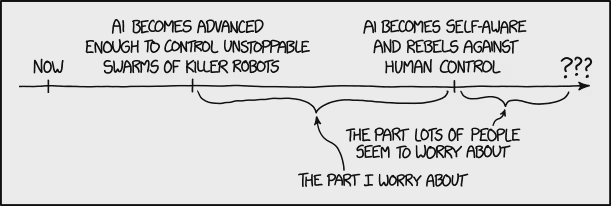
Pushing the idea of “AI will make TERMINATOR CYBORGS!!!”
distracts from
“AI is analyzing a zillion cameras so ICE gestapo goons can abduct people.’
Replying to @nialv7@lemmy.world
She’s not an AI researcher, she is a grievance studies major.
Replying to @qt0x40490FDB@lemmy.ml
There is no need to downplay her credentials like that. She is an AI researcher, she has a M.S. in EE and a PhD in computer vision, and her PhD advisor is Fei-Fei Li!
Replying to @Wurzl@lemmy.zip
Archive link: archive.ph/D2uB0
Replying to @Wren@lemmy.today
True hero
Replying to @Wurzl@lemmy.zip
Are they saying that we can trust salesmen to tell us the truth?
Cory Doctorow shared the exact same opinion in this interview he gave this week. I personally don’t think his “reverse centaur” idea is nearly as catchy or worth adopting as enshittification was, but the intent behind it is spot on.
Reverse centaur is a terrible term. Even having heard it explained, repeatedly, I could not even explain what it means. It’s not catchy, too many weird syllables; the word “centaur” makes it sound nerdy as fuck for any casual use, I doubt most normal people even remember what a centaur is; and it just does not immediately convey it’s meaning as a result.
Replying to @AmyAye@nord.pub
What is it even supposed to mean?

Replying to @davetortoise@reddthat.com
centaur: brain of a man, speed of a horse. reverse centaur: brain of a horse, speed of a man.
but the horse is the computer.
The horse is the computer…?
Replying to @davetortoise@reddthat.com
The computer is the horse
Replying to @Imgonnatrythis@sh.itjust.works
Ah, of course.
Replying to @davetortoise@reddthat.com
of course
Replying to @davetortoise@reddthat.com
you do the manual labour while the computer makes the decisions.
Yeah, basically. lime’s summary was rather curt, but basically accurate. He explains his intent really well in the interview I linked above, or I assume you can find his writing or text-based interviews somewhere online. Here’s a mostly-good summary of the idea in a review of his book on the topic:
A centaur, in automation theory, is someone assisted by a machine, whether using a hearing aid or driving a car. A reverse centaur is someone whose freedom is diminished by the demands of a machine, like an Amazon warehouse worker. The technology of AI theoretically allows every worker to be a centaur, but the business model demands the reverse. Take radiology. In the centaur scenario, a human radiologist works with an AI radiologist to produce more accurate analysis, but that costs the hospital money. In the reverse centaur version, the AI radiologist demotes the surviving humans to the level of results-checking drones who are more likely to make mistakes. Much cheaper, but you see the problem.
In the centaur scenario, the human radiologist is basically doing their job as they do now, but occasionally the AI might pop in and say “hey, check that one a bit closer”. It helps them find possible errors they’ve made. The reverse centaur reduces the human’s job to in theory validating the AI’s results, but because of a phenomenon called “cognitive surrender"—which has been talked about since before AI but has become very popular over the last year or two—they end up just ticking “yes”. Think Homer Simpson in that episode where he works from home and uses a drinking bird toy to just press “y”. The human is providing the “leg work”, so to speak, for the AI’s thinking.
(and before anyone comments on it. alt+0151. I’ve been using em dashes regularly since like 2009, and I refuse to let AI steal that from me.)

Replying to @davetortoise@reddthat.com
It’s in the computer?

brain of a horse, speed of a man.
This is wrong on so many levels. We wouldn’t bother even using LLMs if they are were merely the “speed of a man”. And anybody who’s bothered to actually use the technology can tell you that’s it doesn’t have the “brain of a horse”.
Human review is still important, but the depth of knowledge they have is pretty damn advanced. The moment you completely remove the human element is where everything falls apart.
Replying to @p03locke@lemmy.dbzer0.com
it’s simplified for a comment on lemmy made to be funny. i didn’t want the get into the mentality of the human-tool gestalt here. read doctorows explanation instead.
Aren’t we just repeating what Cory Doctorow said? How is this just a Lemmy comment made to be funny?
Replying to @AmyAye@nord.pub
It’s very simple: a computer controlling a human as a flesh robot instead of the other way around.
Think Amazon drivers, for instance. No autonomy whatsoever, no thinking, no decisions, just eyes, feet, and hands for the machine.
Late stage capitalism existential / body horror, and a wet dream for corporations.
I have no doubt our generation and later will never retire. They’ll just plug a chip into our nape and keep our corpses working until they fall apart. 40K was off by 38 centuries.
Replying to @leftzero@lemmy.dbzer0.com
I liked the term “meat puppet” more; though it’s a little morbid
Replying to @leftzero@lemmy.dbzer0.com
I think the movie black hole is more accurate, it’s about the year 2130 or something. It also was before 40k was out.
Replying to @AmyAye@nord.pub
Robot’s bitch?

Replying to @Zagorath@quokk.au
Doctorow tries to coin shit all the time and most times it doesn’t stick. This goes faaaaaar back in his personal history.
Replying to @Wurzl@lemmy.zip
The doom talk gives AI user base a hard-on and Anthropic knows it. It’s like saying, your web browser is now equipped with the power of plutonium. You are controlling something powerful and dangerous as you work to nudify your neighbor or slop out of your term paper.
Replying to @Imgonnatrythis@sh.itjust.works
we absolutely need to separate people who LARP AI safety and people who sincerely care about AI safety. there are absolutely a ton of people who doom talk AI as a way to hype it, or as a way to regulatory capture to secure their position. what they do is in some sense poisoning the well cause now when people who really care about AI safety talk about existential risks, they get lumped together with the disingenuous LARPers and dismissed.
listen to what they advocate. do they really want to stop all AI development, or just a so-called “slow-down”? do they want to ban all AI models, or just the “open-source”/“Chinese” ones?
Replying to @nialv7@lemmy.world
At this point, there’s so much bullshit from both sides on this issue that I don’t trust any of them.
Replying to @nialv7@lemmy.world
One easy way is if they work for an Ai company or stand to make money in any way from an AI company they are absolutely full of shit.
Replying to @Wurzl@lemmy.zip
Probably true. It’s like this administration and gas prices. 'Just ignore how high gas prices are now because it could be a lot worse.
Replying to @Wurzl@lemmy.zip
It’s fearmongering intended to push regulation to ban foreign models (i.e., competition) and locally run ones, and to prevent new AI companies from gaining traction, thus guaranteeing a monopoly for the current subscription based ones.
Also to “place limits on how powerful the models can be”, so they have an excuse when they reach the limits of what LLMs are capable of or model collapse starts making them worse, whatever comes first.
In both cases, futile attempts at ensuring their survival once the bubble bursts.
Also, astroturfing. Marketing. Making their models look more powerful. Dangling forbidden fruit in front of their customers and their competitors’ in order to entice them, feed their AI psychosis, and strengthen their addiction.
Replying to @Wurzl@lemmy.zip
Since when is Howard Stern one of AIs fiercest critics?
Replying to @the_crotch@sh.itjust.works
Also, who fucking cares about Howard Stern’s opinion on AI?

Replying to @Wurzl@lemmy.zip
This one never seems to get stale.
The other fun AI project is processing mass surveillance data to route out and dispose of dissenters capable of organizing an effective resistance.
Since they ultimately intend to do to the world population what the US did to Native American tribes and the slaves imported from Africa, we’d best hurry up and get organized.
This new batch of ultra-wealthy regard commoners as non-person NPCs even more than antebellum plantation owners or Nazis in the German Reich.

Replying to @Wurzl@lemmy.zip
Your mountain dew and Doritos extreme are too bold and dangerous for you, you’d better not buy any right now, on sale!
Replying to @Wurzl@lemmy.zip
This feels like it has been obvious for years to anyone paying attention.
Replying to @Wurzl@lemmy.zip
I think this the way the powers that be control many narratives. Many distractions running all over.
People aren’t critical enough about what they’re echoing from what they think is coming from their own side.
Replying to @Wurzl@lemmy.zip
beyond paywall archive.is/DMknL
Replying to @Wurzl@lemmy.zip
Literally stop trying to pretend that executing LLM output in a loop with no supervision makes sense.
Replying to @Wurzl@lemmy.zip
In my book I write, “Can a bridge decide to collapse?” The whole “Oh no, our models went rogue” thing … When a bridge collapses, you don’t analyze whether the bridge was ethical or sentient or why it decided to collapse. You ask, who is the person who built this bridge to be so flimsy? There are permits you have to acquire. There are supposed to be tests. When you ask about the bridge collapsing itself, you’ve lost the thread.
Quite a good quote.
I also like her observations about lawmakers reacting to media coverage of AI breakthroughs and not listening to people from the fields where the supposed breakthroughs have happend (like with the maths problem recently).
Replying to @Wurzl@lemmy.zip
I’m trying to read the actual article but it seems like it is only for subscribers. Yet it seems like everyone has an opinion on the matter. Either all of you have subscription on the site, or you are pretending you know what you are talking about, no offense. To me this proves that people don’t care about what really happened, they just read the clickbait headline and move to the next one. Which is alright if your intention is not to publicly express your conclusions.
Replying to @divinesteel@lemmy.world
If you disable javascript the article is readable or you can use the archive.is link shared in the comments.
archive.is/DMknL
Replying to @divinesteel@lemmy.world
There is a 10-hr old comment with a link to the archived article, i.e. past the pay wall.
Replying to @Wurzl@lemmy.zip
It’s my baseless conspiracy theory, but I am starting to believe all these AI “whistleblowers” are just being paid a secret severance bonus to get cut loose and drum up fear/interest in AI.

Replying to @Wurzl@lemmy.zip
Let’s say the AI doomers are right.
This is still like, 7th or 8th in line of “currently dangerous existential threats to human civilization.”
There is ZERO sense in feeling threatened by autonomous rogue killbots when we’re going to have unaccountable, non-rogue ones supplementing the unaccountable, sentient HUMAN killbots we already have in just a few years, and even if THOSE don’t get you, the 50 degree temperatures will, since you can’t run your AC because the AI data centers have made your electric bill $500, and you can’t go to the pool because the clouds of ash from the uncontrolled wildfires have made the air unbreathable.
Replying to @mycodesucks@lemmy.world
This has big “I have to eat some food to live, so I suppose there’s no point in counting calories” energy.
Replying to @isleepinahammock@lemmy.blahaj.zone
More like “the building is on fire but I’m worried about tripping over the loose carpet on the second floor landing.” Yes, it WOULD be a serious problem to worry about if everything else was fine. Right now, it is not the thing that’s most likely to kill you.
Replying to @Wurzl@lemmy.zip
World’s crappiest Frankenfurter cosplay.