posted in Technology

U.S. Citizen Who Deleted Phone’s Data Says His Prosecution Puts Privacy at Risk
www.nytimes.com/2026/08/21/us/politics/samuel-tunick-deleted-phone-felony.html?unlocked_article_code=1.8FA.T83N.rt6VsIiSCYb2&%3Bsmid=url-shareposted in Technology
U.S. Citizen Who Deleted Phone’s Data Says His Prosecution Puts Privacy at Risk
www.nytimes.com/2026/08/21/us/politics/samuel-tunick-deleted-phone-felony.html?unlocked_article_code=1.8FA.T83N.rt6VsIiSCYb2&%3Bsmid=url-share
That privacy was already long gone by the time of this case.
www.law.cornell.edu/uscode/text/18/2232
(a)Destruction or Removal of Property To Prevent Seizure.—
Whoever, before, during, or after any search for or seizure of property by any person authorized to make such search or seizure, knowingly destroys, damages, wastes, disposes of, transfers, or otherwise takes any action, or knowingly attempts to destroy, damage, waste, dispose of, transfer, or otherwise take any action, for the purpose of preventing or impairing the Government’s lawful authority to take such property into its custody or control or to continue holding such property under its lawful custody and control, shall be fined under this title or imprisoned not more than 5 years, or both.
If he hadn’t used duress and had just refused, he’d have been fine. Graphine is secure and would have had his back
If he hadn’t given them the code and instead left it in his wallet, and they did it themselves, he’d have been fine.
All he had to do was plead the 5th.
He’s going to get hit with a felony for destroying data to prevent a search. There are tons of precedents in the 11th Circuit for searching without a warrant.
A duress password is only useful if what you’d be facing is worse than 18 U.S. Code § 2232a, and then only if they don’t have enough to convict you already.
www.youtube.com/watch?v=_2rokxux5cU___
Dude is just protesting the construction of a large cop training facility near him. I don’t know what the fuck he did to get on the FBI radar, but I wish him good luck; he’s gonna need it.
Replying to @rumba@lemmy.zip
Here is my problem with this interpretation…
Is data property? Sure, ideas, concepts, photos, etc can be trademarked/copy-write protected and have some degree of ownership, but I’m talking at a much lower level here… Is the particular configuration of memory on your phone a piece of property? If no, then no property was destroyed by wiping the phone. All of the storage and memory is still intact and functional. If yes, then we must look further…is the position (not the switch itself) of a binary switch (like a light switch) a physical thing that you can own? Would you consider it destroyed if it was switched away from it’s original position?
I don’t think you could charge him with destroying property… Destruction of evidence maybe, but the property is undamaged and functioning normally.
Other arguments. The cop actually destroyed the data. Or, defendant claims he did not know the cops would use the pin to wipe the phone, and that they just wanted to know what the PIN was.
I wouldn’t say there is enough evidence here to prove beyond a reasonable doubt that this guy destroyed any property in response to a search. He didn’t destroy anything, what was destroyed is arguably not property, and he may not be aware that his duress pin was going to be used on the device in the first place.
Replying to @Bytemeister@lemmy.world
If yes, then we must look further…is the position (not the switch itself) of a binary switch (like a light switch) a physical thing that you can own? Would you consider it destroyed if it was switched away from it’s original position?
the light switch is not something intended to store data, but the memory in your phone is. wiping the data destroys all the photos, media, logins, configuration on your phone, making them permanently and irreversibly inaccessible. and all of that is my property.
Replying to @WhyJiffie@sh.itjust.works
Light switches can store data. You can have open equal 1, and closed equal 0. Tada! You’re storing data on a light switch. All you need to do, is allow an electrical signal to control the position of the switch, and you essentially have 1bit of data storage right there.
Replying to @Bytemeister@lemmy.world
anything can store data in some abstract sense, I don’t think that is a valid argument here
All you need to do, is allow an electrical signal to control the position of the switch, and you essentially have 1bit of data storage right there.
besides, most light switches cannot do that
Replying to @WhyJiffie@sh.itjust.works
anything can store data in some abstract sense, I don’t think that is a valid argument here
You know that hard drives don’t literally store the number 1 or 0 right? We arbitrarily assign a value to a specific configuration of a material or circuit.
besides, most light switches cannot do that
Most hunks of silicon can’t do that either.
Replying to @Bytemeister@lemmy.world
You know that hard drives don’t literally store the number 1 or 0 right? We arbitrarily assign a value to a specific configuration of a material or circuit.
that’s besides the point. hard drives are very commonly used for large scale data storage. that is its intended use, and people are storing legible data on it, in practice. light switches? who the hack stores data on light switches, bit by bit?
this discussion is not productive. you have already decided that destroying user data is a nothingburger.
Replying to @WhyJiffie@sh.itjust.works
that’s besides the point.
It’s not besides the point. It exactly is the point. Functionally, computer storage is a stable binary state circuit, just like a light switch. When we wire billions of them together and automate the switching process, and throw in a few layers of abstraction, you get functional data. Changing the state of those switches does not destroy them, therefore changing the state of those switches is not destruction of property, unless by extension, flipping a light switch counts as destruction of property. It may be destruction of evidence, as the state of that memory or the position of the switch could be considered evidence, but it is a far cry from actual destruction of property.
who the hack stores data on light switches, bit by bit?
This is exactly how early computer programs were stored/written.
you have already decided that destroying user data is a nothingburger.
Correction: I am arguing that the alteration of computer storage is not destruction of property as written in the law that prevents you from destroying property to in response to or as the result of a lawful search.
Replying to @Bytemeister@lemmy.world
good. get back to me once people are using light switches to store data.
Replying to @WhyJiffie@sh.itjust.works
This uses 7 services to store a base-10 numeric value on a 7 segment display.
electronics-tutorials.ws/…/7-segment-display-tuto…
Here is a picture of a power switch for a power strip
upload.wikimedia.org/…/500px-Socket_5.jpg
It’s can store any two data values people assign to it. In this case, power on, or power off.
We’re using binary switches (literal just different types of light switches) to store data all the time. That’s the whole fucking point. You’re having trouble differentiating between the two because the data they store the same fucking thing just at different scales.
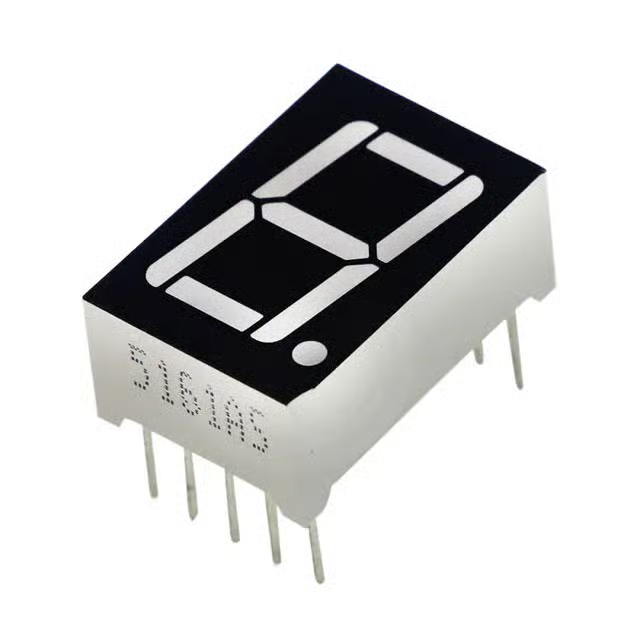 Basic Electronics Tutorials7-segment Display and Driving a 7-segment DisplayAn Electronic 7-segment Display Tutorial about how the 7-segment LED display can be used to display numbers, letters and characters in a digital system
Replying to @Bytemeister@lemmy.world
sure, people are storing images and passwords on light switches and power strips. you have lost your fucking mind.
Replying to @WhyJiffie@sh.itjust.works
You absolutely can though. A 16x7 grid of light switches can store any 16 character password that uses the ASCII character set. Images would require many more switches (depending on the color quality and resolution) but it’s the same thing. Like I said, earlier, you are having an issue making a point to differentiate between the position of a binary switch and a single bit of data because there is no fucking difference in the first place.
You make it sound ridiculous, but we’ve stored data as a magnetic polarity for decades at this point, we’ve stored data on rocks, laser etched as dots and dashes at a microscopic level on thin bits of foil. Whole programs have been written and stored on stacks of cards. Heck, the programs to get a spacecraft to the moon were written on paper and then literally knitted into the onboard computers. Regardless of the medium chosen, (almost) all computer memory and storage is simply the representation of an array of binary states, something that can be done, and has been done with a simple array of light switches.
Replying to @Bytemeister@lemmy.world
like I said,
good. get back to me once people are using light switches to store data.
in practice. on the daily.
you are trolling. I’m out.
Replying to @WhyJiffie@sh.itjust.works
Exactly!
Maybe you finally get it. The premise that altering the position of a switch is legally destruction of property is patently ridiculous. Altering the position of a 16x7 array of switches and calling it destruction of property is also ridiculous. So why is altering the position of an array of billions of tiny switches suddenly destruction of property?
Replying to @Bytemeister@lemmy.world
lets demonstrate why. Because I would alter the structure of your atoms, and that would not be criminal, because why would it be. I would alter the structure in a very specific way, but that’s not a crime.
Replying to @WhyJiffie@sh.itjust.works
Because I would alter the structure of your atoms, and that would not be criminal, because why would it be.
On it’s bacsic premise, no, you’re allowed to move my arms or person (to the extent that it is not assault, kidnapping, etc) but say, altering the state of my atoms in a way that ends my life or does me physical harm is criminal.
So your point is not explicitly correct there, more detail is needed. You’ve also (either knowingly or unknowingly) built and argued against a strawman. My claim is that altering the position of a switch is not destruction of property, and that as the law as written explicitly criminalizes the destruction of property in response to a lawful search. Altering the position of a switch could be considered destruction of evidence, and by extension so would wiping the phone. I don’t know if there is a law that explicitly bans the destruction of evidence during a lawful border search though. So it could still be criminal, but there is significant reasonable doubt that any property was actually destroyed.
Replying to @Bytemeister@lemmy.world
On it’s bacsic premise, no, you’re allowed to move my arms or person (to the extent that it is not assault, kidnapping, etc) but say, altering the state of my atoms in a way that ends my life or does me physical harm is criminal.
see! there’s nuance! not everything is a useless sea of light switches. there is no problem with squishing a grape, but there is a problem with causing similar physical harm to living beings
My claim is that altering the position of a switch is not destruction of property,
switches are like grapes. digital storage in your phone is like living beings. something that is not easy or possible to reproduce the same way it was before the damage.
Replying to @WhyJiffie@sh.itjust.works
No, digital storage in your phone is like ghosts playing a interdimenional clarinet when you look at the quantum tunneling aspects of an infinite universal wrap-up around rejected improbabilities of unstable bilateral states.