posted in Technology

Android users can't remove nude-scanning app as Google opens the feature to app developers
cross-posted from : lemmy.zip/post/70348978
cybernews.com/security/android-content-safety-manager-api-privacy-concerns/posted in Technology
Android users can't remove nude-scanning app as Google opens the feature to app developers
cross-posted from : lemmy.zip/post/70348978
cybernews.com/security/android-content-safety-manager-api-privacy-concerns/Reportedly, the app uses an on-device machine learning model to classify the content.
Using your shiny new phone to train AI…
For now its only supposed to check Google Messages, so not if you use a different text app.
But one vulnerability already is side loaded versions with super high version numbers so they won’t be auto updated. Those will scan everything and do whatever with it. Considering the apps point is to scan for nudes, likely sending all your nudes to the hacker.
The dummy version is an empty app.

This is why I’m not buying a new phone until my current one literally breaks down. It’s in the hardware nowadays.
For now its only supposed to check Google Messages, so not if you use a different text app.
Shameless plug for Textra as a much, much better alternative.
No RCS (not their fault, but still).
Replying to @water@lemmy.world
Does Textra support RCS?
The RCS interfaces (APIs) on Android are currently only available for Google internally to use, no other third party developer has access.
We are hopeful Google will make these RCS interfaces available in the near future to all developers (in the spirit of Android open source), so that Textra SMS can also offer RCS functionality.
TIL
Reportedly, the app uses an on-device machine learning model to classify the content.
Using your shiny new phone to train AI…
I would think the models are already trained, and then deployed to phones to do on-device inference. The models should be fixed and static by the time they end up on a phone (in large part because phone hardware is just not technically suitable for training, whether pre training or post training).
I’ve got a Pixel 9 I keep for development and uninstalled that system app a few months ago. It’s still gone. Maybe updates are reinstalling it but saying that it cannot be uninstalled or removed is a lie.
It says in the article title that it keeps reinstalling itself, not that it can’t be removed.
I removed it using Canta early on when I got my Pixel 9 and it hasn’t ever reinstalled itself in the year or so since I removed it.

Sphynx cats trigger it and you get an unwarranted alert that Google is very disappointed.
Replying to @schizoidman@lemmy.zip
Where’s the “android is more free than iOS” people now‽
Edit: Still salty I see (from the downvotes).
We’ve been quiet for years now. Google’s been on a path to turn Android into a locked down system for many years at this point.
It’s gonna be as bad as Apple soon.

I mean at least Apple sells less of your data, no real point in using Android at this point
If I’m learning a new OS, its not gunna be the other evil one.


Replying to @Ithral@lemmy.blahaj.zone
AOSP sells zero of your data, no point in using Apple at this point
Using GrapheneOS.
I’ll be switching to GrapheneOS myself soon.
Quick question: can I use the default camera that comes with Pixel on GrapheneOS? I’m going to be using a Pixel 7
Do you mean the Pixel Camera app? You can install that like a normal app from the Play Store. I’m using Open Camera instead though.
You can install that like a normal app from the Play Store.
Wait, you serious?
Losing camera functionality is really the only thing that’s been holding me back at this point!

I mean, GrapheneOS comes with a stock camera app
Replying to @SpookyBogMonster@lemmy.ml
The Pixel camera is different. It has features that I use regularly.
Google/Pixel Camera is in the GrapheneOS App Store, you don’t even need the Play Store or Google account to install and use it

It is lol.
Guess again.
Replying to @W98BSoD@lemmy.dbzer0.com
No, despite Google’s gradual loving down of Android, it’s still leagues ahead of Apple in terms of openness.
Edit: I meant “locking”, but the original is funnier
Open…… for now.
Replying to @W98BSoD@lemmy.dbzer0.com
No, open forever. The core of android is open source. It’s the reason that projects like GrapheneOS exist.
Replying to @CeeBee_Eh@lemmy.world
Sure.
Read the article
Now Apple devices use a similar nudity-blur system called Communication Safety – it uses on-device machine learning to analyze potentially unsafe photo and video attachments and is enabled by default.
Apple has the exact same tech
Replying to @Nerdulous@lemmy.zip
Yes, but the android people are annoyed because they can’t remove it from their precious customizable OS.
Edit: there they are.
Replying to @W98BSoD@lemmy.dbzer0.com
Android people are annoyed because it’s an invasion of their privacy. Apple people should be annoyed by this too. This isn’t a team game it’s a political issue.
Replying to @Nerdulous@lemmy.zip
Ok.
Edit: Nice. Downvotes for a one word answer.
I assume you can with LineageOS and GrapheneOS
Know what they say about assumptions.
I don’t use any Google products or services but you’re completely insufferable lololol troll so funni
Ok.

Please go back to reddit
Guy who is willfully ignorant:
Where‽

Have you considered that the down votes are because your comment adds nothing to the discussion except ragebait?
Nope!
Replying to @schizoidman@lemmy.zip
I can see a promising market for ‘dumb’ point-and-shoot digital cameras reemerging.
Doesn’t automatically upload your pictures to train AI on, no internet-based privacy risks whatsoever
No AI nanny telling you that your pictures are too naughty
Never needs updates, can never be enshittified by new updates
No risk of the government getting their hands on your pictures, unless they physically confiscate the device
Can never be hacked without physical access to the camera
Doesn’t listen to you or watch you or otherwise spy on you
Most models have easy to change user-replaceable batteries
Most models are compatible with SD cards for easily upgradeable storage
Can take advantage of a larger lens and more adjustable focus/zoom to take better pictures (Even a relatively cheap digital camera could potentially take better pictures than the ultimate flagship phones that cost 4-figures.)

Replying to @OwOarchist@pawb.social
Yeah, I can tell that since I do tests for Amazon (Amazon Vine).
There is more and more camera being put to test, ranging for cheap bellow €100 ones to miniaturized keyring sized ones (with tiny screens).
I tested some of them (and have another one coming next week), the quality of the pictures are good, but the build quality of sub-100 ones are kinda bad (cheap plastics, no optic zoom, no hardpoints for better lenses, sd cards smaller than their advertised size)
Replying to @Dremor@lemmy.world
Eh, they are alright. Issue is they dont get better than smartphones until the cameras are expensive.
Replying to @brucethemoose@lemmy.world
Anyone who has paid over $500 for a phone, if they did it for the camera, they wasted money. For the same amount of money one can get an old second hand pro camera and a more basic phone.
The camera will be infinitely better and the smartphone will still smartphone just fine.
Replying to @dustyData@lemmy.world
Old “pro” cameras like full-frame SLRs are bulky though. That’s not always ergonomic to have.
And honestly, modern phones/gadgets with a lofic sensor (like Xiaomi or Hisense now, Apple soon) are absolutely crazy. They blow the dynamic range and shadow noise of old full frame sensors out of the water, and give new ones a run for their money:
cined.com/dji-osmo-pocket-4p-lab-test-rolling-shu…
Don’t get me wrong; you are preaching to the choir here. I love cameras. I am trading in my Canon and buying a Fuji or Panasonic ILC soon.
But I think its a mistake to underestimate modern smartphones based on how bad older phones were. The sensors have gotten big, their sensor tech is a few years ahead of dedicated cameras, and you can bypass the overprocessed look with 3rd party apps. That, and lofic is the biggest jump in sensor tech in a decade+, and its only coming to small sensor cameras for now.
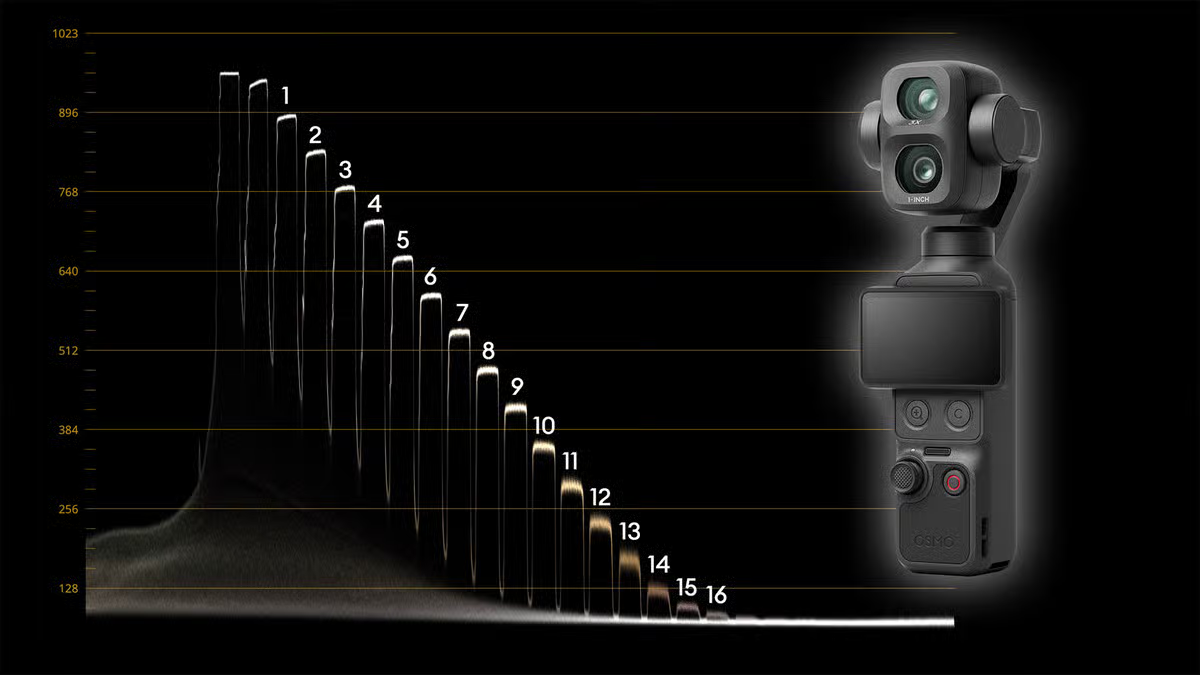 CineDDJI Osmo Pocket 4P Lab Test: Rolling Shutter, Dynamic Range and Exposure Latitude | CineDDJI Osmo Pocket 4P Lab Test by CineD, testing rolling shutter, dynamic range and exposure latitude in D-Log and D-Log2.
Replying to @brucethemoose@lemmy.world
Ricoh, Leica, Olympus. There are pro level compact alternatives. Ricoh’s are almost as small than a smartphone while being more ergonomic to use and better featured. The reason there needs to be such technologies as LOFIC for tiny sensors is precisely to compensate the size and achieve what larger sensors already achieved decades ago by shear force of being larger. But you don’t need to go that much larger, just a micro four thirds camera with mediocre glass from a decade ago already blows away anything that big tech put last year on flagship phone cameras.
Replying to @dustyData@lemmy.world
Well each has its quirks. Leica is hilariously expensive. Ricoh is fixed lens, fixed focal length. I nearly got an OM-3 myself, but honestly it is big, and M43 lenses and sensors are starting to show their age.
I’d probably point the average person to an L10, an X-E5, an S9, or the A6700 with a pancake lens if they can swallow the price.
I think the S9 in particular is a glorious “smartphone replacement.” Its a full frame ILC, its connectivity app is fantastic, yet with a pancake lens it is no bigger than an OM or Leica.
Replying to @brucethemoose@lemmy.world
MFT is far from dead though. Their glass is top tier even in the plastic bodies. And the point of buying a second hand old cameras is to not have to swallow the price. For most people just trying to replace a smartphone camera, even a fixed lens is a massive improvement. There’s a reason dedicated point and shoot like the PowerShot are coming back en force. I recently kit up with an old EM-1 and a pancake lens, and the thing is not only pro level features with good quality glass. All in all, it cost me less than $500 including postage. And though it won’t fit in my pocket, it weighs almost nothing and is absolutely tiny for the power it packs.
Replying to @dustyData@lemmy.world
I dunno. The flood of cheap 3rd party lenses (Viltrox airs, Sirui snipers, Thypoch 24-50, Tamron…) kinda put old M43 lenses to shame, for less money, while being smaller and built for bigger sensors.
Native OM lenses are expensive. Sync IS doesn’t work with Panasonic.
I’m not sayings its a terrible mount like RF, but they are starting to lose the value and size advantage because there is so little R&D done for M43. You could get a much sharper image out of an old sony/nikon/fuji body + a $150 Viltrox Air.
Replying to @brucethemoose@lemmy.world
Yeah, then do that. My point is that it doesn’t take a lot of money to surpass flagship smartphone cameras anymore. Plus Google is not obsessively looking at your dick pics that way.
Replying to @dustyData@lemmy.world
My point is that it doesn’t take a lot of money to surpass flagship smartphone cameras anymore.
…It will soon though. Thats what Im saying.
Current Xiaomis and Hisense, and the next iPhone, are gonna be straight up better than a $1800 OM-3, hand down. At least outside of the supertelephoto range. Loifc is a HUGE deal, it is coming to most smartphones, and OM’s processing is stuck in 2015.
Replying to @brucethemoose@lemmy.world
That’s where my doubt lies. Is it really gonna be better than a pro doing exposure bracketing? Because my point is that you don’t have to buy a brand new $1800 camera from last year. When a camera from a decade ago will excel that performance with only a tiny bit of practice and skill for a third of the price of a new phone. Phone cameras have gone a long way, but they are physically limited in ways that no new sensor can overcome. New material tech is not going to surpass basic light geometry.
Are 8 extra stops of performance going to justify a new AI riddled, surveillance and privacy nightmare device? When you can get 24, 30 or more stops of performance with a decade old tech. I don’t think so. The average hobbyist who wants better technical specs for photography would be misled if they looked at new smartphones and not into the recent past of digital cameras. And stop obsessing over OM, that’s a tangent on my comment and just my personal preference. A Sony, Canon or Fuji would fit just as well into the argument if that’s the buyer’s preference.

Or you could use an open camera app
Replying to @Magnum@infosec.pub
For now. Until Google says those apps aren’t “verified” or whatever and blacklists them. Until the next Android update makes it scan and upload every photo file anywhere on the device, not just ones used or made in particular apps.
Replying to @OwOarchist@pawb.social
We should consider divorcing Goggle from Android via something like GrapheneOS or /e/OS.
It has already reemerged as part of the retro trend among young people.
Replying to @detren@sh.itjust.works
Instant photo cameras are pretty popular
And that market will destroy itself because “investors” want MRR and so you’ll have to plug your camera into your computer so proprietary software can send the images to the cloud to get “processed” so you can actually view them. You’ll be thankful for the opportunity to pay $9.99USD for that.
Replying to @anon_8675309@lemmy.world
You may come off as hyperbolic, but this is exactly what Canon is trying to do.
They already try to funnel users into a canon.cloud subscription with cloud editing features, and a DPP editing software subscription. Their HDR mode uses a weird curve that makes using anything but their software annoying. They made their crappy free webcam app subscription only, and neutered many cameras so that’s the only option to use.
Not to speak of locking the RF mount out of third parties…
But to be fair, Canon is only doing that because they are #1 in marketshare, though. Panasonic, Fuji, OM aren’t behaving so badly. And the Chinese pocket cam makers are rapidly catching up (though obviously they have their own enshittification issues).

Replying to @OwOarchist@pawb.social
I still use my Canon SD1000. 20 years and it’s still going! The resolution is lower (only 7.1MP), but the photos still look really nice. And that was a relatively cheap camera for the time.
Replying to @bcgm3@lemmy.world
It has a resolution advantage with a long zoom, or going very wide.
I went on vacation with an ancient Rebel XS and a 50-250 lens, and 250mm shots are still better than the iPhone 17 Pro.
Replying to @OwOarchist@pawb.social
Those kinds of cameras didnt disappear.
But Canon already enshittifies their bodies some, with links to the canon.cloud subscriptions in-camera (which is a front for RAW training if you read the ToS), a subscription for linked editing software, and some feature crippling to push them.
There is actually healthy competition in the space, though.

Time to start shooting nudes on film I guess.

You can develop black and white film at home using coffee. Developing nudes this way sounds kinda hot.
Replying to @kadu@scribe.disroot.org
I like my coffe cold
Replying to @crunchpaste@lemmy.dbzer0.com
That does sound fun actually, maybe make a thing of it with some other women…

I once stumbled upon this app automatically installed on the phone I happen to have paid for (because at this point I doubt I could call this piece of metallic tile "my phone" and suing Google Inc. for them to refund me this phone would be as successful as if I tried to push and move a certain Mountain View building from its place with my own muscles). Shortly after that, it seems to have vanished from the list of apps as mysteriously as it initially appeared, either it uninstalled itself or it was changed names.
In any case, as soon as I realized that presence and realized I wouldn't have an "uninstall" option without turning on options that would straightforwardly break banking apps and government apps (gov.br the Brazilian app for everything citizen-related) I was compelled to use, I started filling the phone's gallery with all sorts of potentially-triggering stuff I either find online or (mainly) make myself: dark art including FNAF-like jump scares, haunted/cursed artifacts and occult/ritualistic imagery, photos and videos depicting snakes and scorpions, lots of Memento Mori including photos of cemeteries and tombstones, archaeological skeletons, buzzards eating animal carcasses in the wilderness, as well as media of my own cut wr... I mean, uhm, media of my own cute wrathful owl I sculpted on Blender. Yeah, several different 3d rendered scenes and short animation videos as well, especially scenes in which she's performing chases and huntings... Not to mention the plethora of owl photos and videos, many of which are birdwatching of them catching and eating prey on nature, in potentially gory settings (i.e. the unfiltered, untamed nature who doesn't care about our anthropocentric definitions of good and evil).
So if Google decides to start "protecting me from (my own) sensitive imagery", their clanker is essentially going to have a hard time having to go through gibibytes of media and potentially wiping the whole device as I made sure to fill the entire storage (even non-media things too, such as using provoking nicknames for fictional contacts like a contact card for "Inanna", as well as odd descriptions for bank transactions such as "my soul belongs to Ereshkigal") with purposefully sensitive content. If they do that, I'll then have something more concrete to sue them for: religious intolerance, as it's all representing of my left-hand path spirituality.
And with all this I leave this one absurdist idea on how to try and boycott the corporate nanny (and surveillance). A phone gallery full of sensitive items (not nudes, but dark/provocative art purposefully built to trigger similar nannying responses) will hopefully overwhelm their servers, shall they offload the computing to their data centers. If this doesn't overwhelm their servers, at least the techbros and their clankers are going to have an interesting time when scrolling through legal-yet-disturbing content they hoarded from Android users' phones.
!technology@lemmy.world
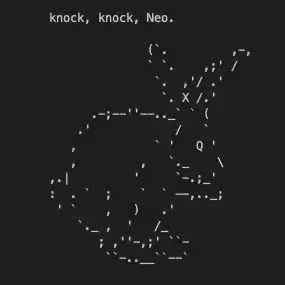
It’s not looking for stuff like you’re describing, skeletons, graves, birds, whatever spoopy “dark” stuff you put on there. It’s looking for nude people, then actioning/alerting if it thinks minors are in the images. You definitely don’t want to honeypot this ai bro.
That's the thing: they're looking for something, and in order to look for something, they must look, and lots of computation (AI inference) must happen, especially when it involves nonindexed files (my own private art, from digital drawings and handmade sketches, going through photos of my own ritualistic installations, all the way to Blender 3D renders and animations, all of which is yet to be crawled). And if this involves gibibytes of data, on a smartphone whose hardware can barely run 1B parameter clankers locally without hiccuping, I can see my private files going to Google's servers for "efficient inference", files of which will likely end up seen by (and sowing some interesting inspirations for nightmares in the subconsciousnesses of) Google's employees during server maintenance/audits or, mainly, end up training their clanker.
As for the latter, hopefully Google Gemini would end up "seeing" enough of my digitized psyche to randomly start silly infodumpings about, for example, different owl taxonomies and their diets down to the very gory microdetails about how owls make a tasty dinner out of mice, and/or the different interpretations by historians and archaeologists regarding the figure (Ereshkigal or Lilith) depicted in the Burney Relief, a Mesopotamic plaque of which, by the way, is part of the phone's gallery too (including my own artistic works inspired on it) and seemingly an efficient trigger for nudity detection algorithms, which will likely put the rest of the gallery under automated scrutiny (because there was a positive, albeit a false one) and, thus, serving as the semantic Trojan Horse for my dark artistic private content to make its way to their servers.
I mean, how else Google Gemini would've taken the "inspiration" to suddenly start telling people to "eat rocks" and "add glue to pizza"? Its training data is crowdsourced so there's nothing much Google can do to avoid sources poisoning the well (and I must nod at the Nephentes algorithm which I praise as way more efficient than Anubis to hurt the western AI corps) other than:
1. Adding said poisoned sources to their .gitignore equivalent if they know they'll likely find poison they don't want messing up with their expensive AI training.
2. Doing manual curation of people's personal files, which is time-consuming and potentially unfeasible when dealing with billions of phones.
3. Trying to improve the detection algorithms to avoid poisoned sources (which requires training data, which requires them to rely on potentially poisoned sources, which defeats the whole purpose of improving the algorithms in the first place).
4. Stopping to put everything else into scrutiny when the detection algorithms stumble upon (potentially false) positives, risking false negatives, which will likely attract some heat from regulatory agencies worldwide and fines for failing to comply with things such as age checking laws (and there it goes the GOOG stocks, together with the entirety of NASDAQ, like a Titanic as investors realize they're paying for fines not theirs; be it GOOG or other stock, the popping of the ongoing AI bubble will inevitably be something in this regard, Western corporations having their clankers failing on them).
At best, this will consume some portion of Google's resources (including but not limited to human resources), albeit as infinitesimal as my silly existence can get to a worldwide corporation, but it's still something I guess...
!technology@lemmy.world
Replying to @dsilverz@catodon.rocks
Image classification is old tech that existed long before ChatGPT and similar huge models became the new norm. These models are already embedded in many data flows and run within milliseconds on non-specialized hardware.
You were talking about 1B models. More modern image classification are in the mere millions. Yolo v10 has like 7M, MobileNet, which Google often uses, has around 4M parameters depending on the version. Image classification is not why there are data centers being built everywhere.
Camera apps, image and video filters and content moderation (the app in question) all use them for live processing. I can guarantee you this runs flawlessly on your phone unless it’s older than 10 years.
You’re employing AI guerilla warfare against pre-LLM technology. It’s not effective.
Replying to @benjirenji@slrpnk.net
Machine translation is also pre-ChatGPT tech, yet Google have been outsourcing their Translate to their Gemini, as in, Google Translate became yet another Gemini interface, just like many Google "products" nowadays.
But I'm aware of and I agree that "protoclankers" such as Image Classifier models (e.g. MobileNet) are lightweight enough to run on low-end devices like the one (Nokia 5.4) I use... although, even in this case, when protoclankers are employed in place of clankers, one of my main points stays the same: the steps being performed whenever there's a (false) positive for a pre-instructed pattern.
A false positive is particularly likely for protoclankers due to their higher compression. If even full-fledged clankers such as Mistral can misread my owl drawings as "a cat" or (because we're talking about Google) Google Lens/Gemini can misread my digital art of a solar eclipse silhouetted by a Bubo virginianus as "a viral photo showing a Spanish professional skateboarder Danny León performing a mid-air trick perfectly aligned with the August 12, 2026 total solar eclipse" (when it's far from being a photo), I can only imagine how awfully a million-parameter Image Classifier protoclanker can perform with deeply-symbolic and carefully-drawn art which even humans can struggle to understand.
There's no magic when it comes to how much data can fit within a mathematical representation of a dataset larger than the representation itself, especially when Zipf's law gets applied to said dataset in order to try and remove hapax legomena while also accounting for repeated data.
And what happens after a false positive happens? Even if it's a locally-ran image classifier, the whole thing isn't fully local; if the locally-running protoclanker detects something matching the pre-instructed pattern, then a set of online tasks will likely be performed: uploading the file(s) to Google servers or, if the pattern being searched for is criminal imagery, preemptively filing a report to the authorities.
In the latter case, if the protoclanker is filing reports without humans in the loop doing the due-diligence of double-checking (which is very likely what's happening due to how employees cost money and how Google et al have been prioritizing their budget to the ongoing AI hype), then Google, legally responsible for their protoclanker, would be committing the crime of false accusation (e.g. misreading my derivative mashup between Burney Relief and Éliphas Levi's Baphomet as "CSAM" as it incorrectly labels the flanking owls as "minors").
And given how my artistic content is anything but criminal (the most shady aspects being the psychological horror and the depictions of blood in vampire contexts, aspects of which, given how there are Hollywoodian horror movies depicting the same, are perfectly legal), stemmed from a legitimate religious expression which (at least on paper) is protected by law (Article 5, item VI from Brazilian Federal Constitution as I'm someone under the umbrella of Brazilian laws) and done in a private space, the potentially unsupervised filings of false criminal accusations by Google's protoclanker, be it against me or any other law-abiding person, will hopefully result in Google shooting themselves in the foot.
The guerrilla tactic here is me being bold enough not to care about the consequences of using a surveillance device (a phone running stock Android) to register, record and manifest my faith in a very verbose and unfiltered, artistic manner, fully aware that the phone will phone home (pun intended; I don't even bother to use VPNs and PiHole, I'm raw-doggin their surveillance when I'm not on my Linux laptop); and in the meantime, hoping Google will hoard fragments of my dark psyché to train their Gemini (thus poisoning the well in the process; it would be fun to see Google Search/Gemini, out of nowhere, randomly spitting invocation texts written in Akkadian/Sumerian cuneiform, infodumping owl taxonomy and their diet, spitting random ramblings against the Demiurge, quoting pessimist philosophers such as Phillipp Mainlander, and/or having Nano Banana to produce images with glitched artifacts resembling the Seal of Lilith).
!technology@lemmy.world
So…
As I said to borari, when stuff involves lots (GiBs) of nonindexed files (my private art) and a smartphone whose hardware can barely make a distilled Llama/Gemma to spit out a "The sum of the squares of the sides is the square of the hypotenuse" (yes, I did try local LLMs so I'm aware of my hardware limits), they would have no choice other than phone home, and thus carrying haunting voices through the ongoing call.
Also, they have some inner desire to hoard people's data for training their clanker. Except the data can (and will) be poisoned, thus poisoning the well.
!technology@lemmy.world
Replying to @dsilverz@catodon.rocks
I appreciate the spirit of reistance, also +1 for the left hand path, however, the broader society needs a more solid solution to these privacy-invading and covertly installing apps. I get it you’re doing the best you know how. I am in the same boat. But we need something more solid for the long term.
Came for technology news, stayed for the Mesopotamian undergods.
Replying to @schipelblorp@sh.itjust.works
It’s always nice to see Mesopotamian deities around
You can uninstall it and install this so that Google can’t get it back on your system.
Replying to @vala@lemmy.dbzer0.com
Won’t install for me
Replying to @CeeBee_Eh@lemmy.world
Uninstall the existing app first
Replying to @vala@lemmy.dbzer0.com
Already did. Even rebooted to be safe.
Replying to @CeeBee_Eh@lemmy.world
Open an issue on GH
Replying to @vala@lemmy.dbzer0.com
kicks can
If we weren’t so fucking weak and unorganized, we’d be burning their companies and their homes to the fucking ground.
what the fuck? I had no idea about this. I never opted into this.
Replying to @mrgoosmoos@lemmy.ca
No shit. The billionaires at the top worry about public safety, would you believe it? (giant fucking sarcasm tag goes here for all my asperger ftiends)
Who owns the (fully paid up) phone that’s in my hands right now? I try to tell myself I do, but…
Yea, I am not a happy camper.
Aren’t viruses and spyware illegal?
Replying to @sik0fewl@piefed.ca
If you are rich and powerful, everything you do becomes legal. Because rich and powerful people are all trustworthy and would never do something for only their own interests.
Replying to @sik0fewl@piefed.ca
Technically it’s neither. Viruses spread and spyware sends your data to an attacker. This app does neither. The third party feature however does make it easier for spyware to identify sensitive content on your phone, but then you have a problem anyway because you gave a spyware app access to all your media.
Replying to @benjirenji@slrpnk.net
I can see actual digital cameras are going to become popular again…
Replying to @schizoidman@lemmy.zip
Apple already uses machine vision for photo searching, that weird auto categorization it does and such. They have for years.
I would bet the photos app already classifies nudes, but silenty, mostly so it doesnt add your nudes to an auto album.
Replying to @schizoidman@lemmy.zip
hey folks i got graphene, do i need to worry about this or is this what the sandbox is for?
Replying to @story@lemmy.zip
Google cannot install apps in Graphene without explicit, app by app permission (due to the sandboxes Google play). We are safe

Replying to @schizoidman@lemmy.zip
just hoping my current phone survives ling ebough that my next one can be a linux phone
Replying to @glitchdx@lemmy.world
Meanwhile, in 2357 AD…

Replying to @glitchdx@lemmy.world
2027 is year of the Linux phone for sure
Replying to @schizoidman@lemmy.zip
Thankfully, I switched to Droidian at the start of this year. I am NOT looking back.

Replying to @roundabout@feddit.org
What phone do you have
Replying to @bizzle@lemmy.world
Motorola ThinkPhone.
Replying to @roundabout@feddit.org
Never heard of Droidian, but I’ve been loooking into the status of Linux phones lately. Mind giving a run down of your experience with it?
Replying to @imminent_nebula@lemmy.ca
I am very pleased. It runs all the apps a desktop GNU/Linux runs. There are many apps from GNOME which have a small enough window, they aren’t very advanced, but the only way to get better apps is to actually use the phone with them (I am actually planning on writing some apps, whose GUI should fit this small screen too). However:
Yes, there are disadvantages, but I am enjoying the vastly greater freedom and it’s the first time I can say that my phone isn’t working against me.
Replying to @imminent_nebula@lemmy.ca
Oh, and I am on the Moto/Lenovo ThinkPhone, by the way.
Replying to @schizoidman@lemmy.zip
Okay, thinking on this more, I have a very hot take here.
What’s the big deal?
Google is seemingly offering a locally processed machine vision API to other apps, as far as I tell. This might manifest as some messaging service nagging you if you try to send nudes to someone, or filtering porn out of a feed. Or other “safety” features I suppose, like classifying slur-laden messages as abusive.
…But Google was most certainly doing this with Google apps already. Like the stock photo library most apps use.
If people are already using unprivate services for this kind of thing, honestly, they were digging their own grave, and this hardly moves the needle. All it does is make the spying/censorship more apparent.
I say those users need a cold bucket of water to the face, and this may provide it.
…But otherwise, it wont affect apps that dont use the API, right?
Replying to @brucethemoose@lemmy.world
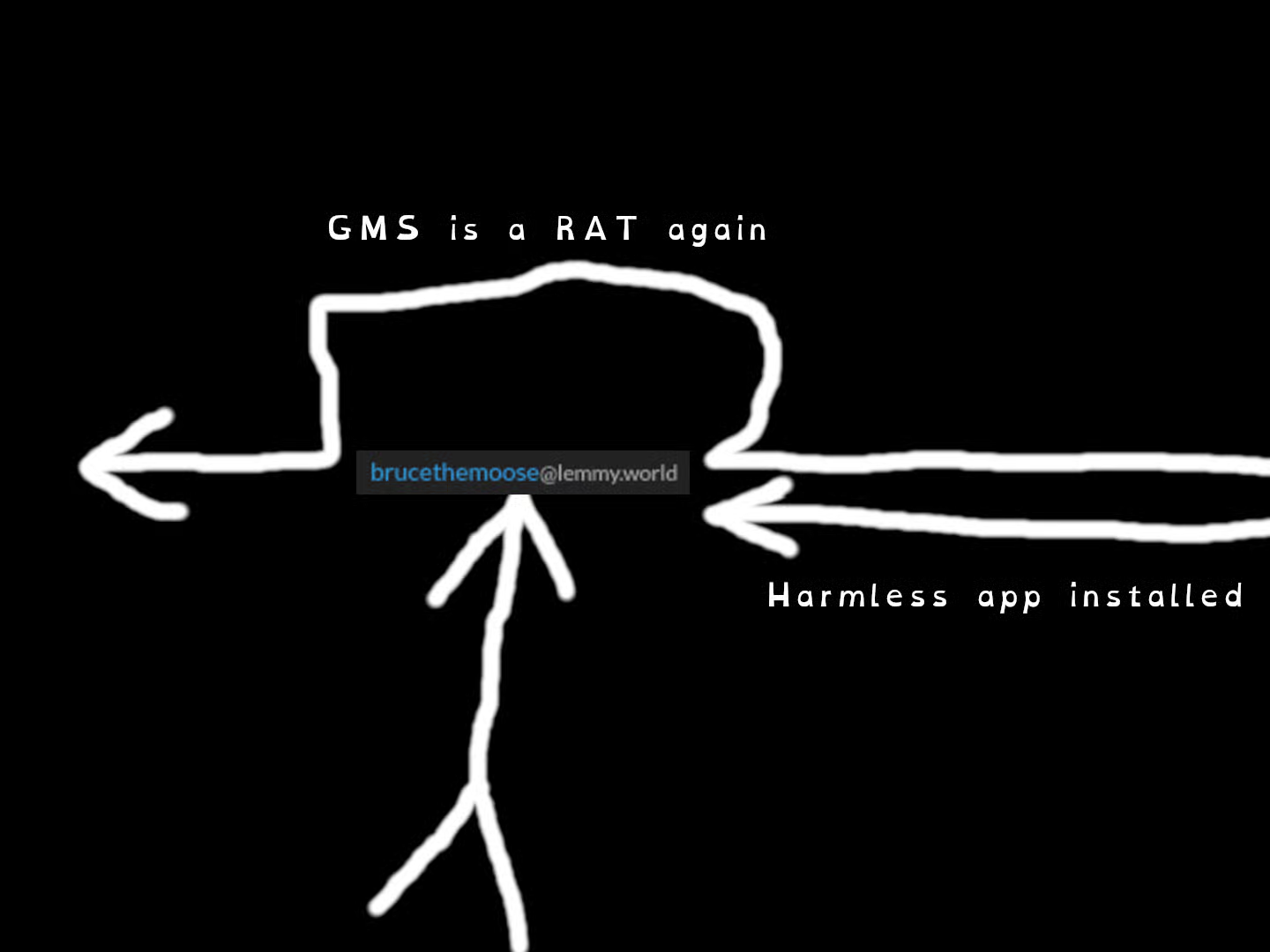
Replying to @diaphragmwp@discuss.tchncs.de
Not gonna lie, this is a great meme…
I did say it was a hot take. I am not caffeinated yet.
Replying to @brucethemoose@lemmy.world
I don’t want the infrastructure built and forced onto users, even if it’s supposedly for benevolent reasons.
Software forced on me should manage necessary services for the functionality that I bought the hardware for.
Forcing this functionality through my phone means you’re dedicating some of my phones compute, memory, and storage toward something I don’t want.
Not to mention the fact that the actor in question, Google, isn’t trusted. I don’t want to help them beta test their shit on my hardware. I don’t want to help them succeed in whatever vision they have for this things future. I don’t trust that it won’t eventually be used to infringe on me.
If I wanted this functionality, I’m sure I could have downloaded it. That option wasn’t given, though… so I have to wonder why. Why am I being forced to have this shit?
Replying to @schizoidman@lemmy.zip
I think it can be removed, at least for my phone, in the settings > Google or just use adb.
If they really care about users’ security, they should make Graphene OS’s GMSCompact and explicit permissions the new standard instead of restricting what apps can they use and forcing invasive system apps. And centralized censorship and requiring an account is not what makes apps secure. Source available and reproducible build is.

Replying to @schizoidman@lemmy.zip
pls post at least 1 paragraph of the article into the post body, to get a quick overview what it’s about.