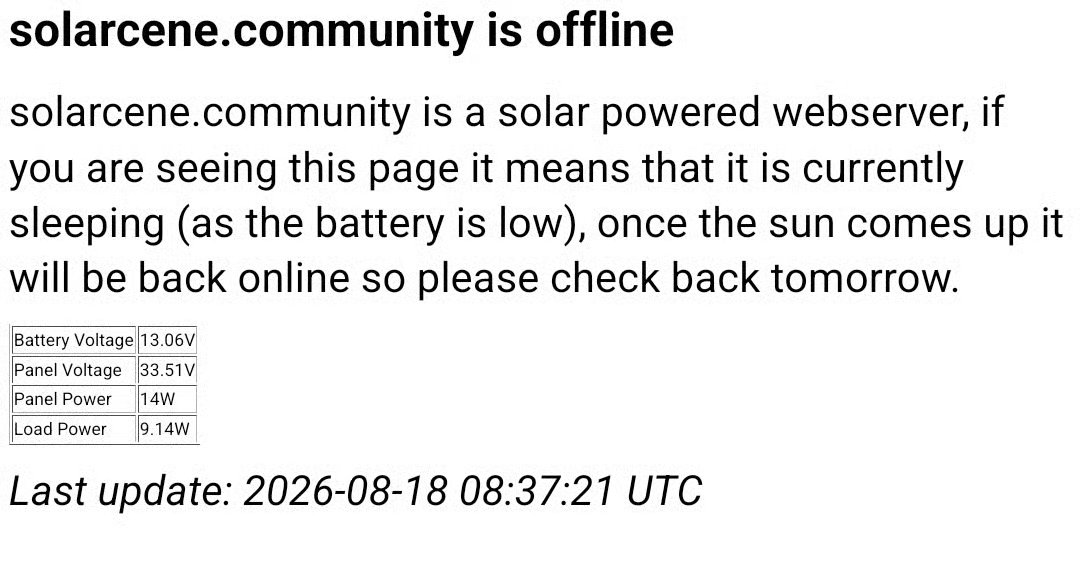
A solar powered website that goes offline when there's no power
This website made me reconsider if 99.9999% SLA and always online is really that important for lots of websites. I used to self-host my own server in my own apartment, but gave up on that after my internet provider had their first major outage that lasted almost a week. Also I didn’t want to worry about the fire hazard, or the server going down when I was traveling etc.
But a solar powered server seems interesting, if the batteries could be made fire safe.
I agree, but the number of business that have actual need for extreme uptime is insignificant compared to the number of businesses that don’t but think for some stupid reason they do.
Those do actually go down. Hospitals have to be evacuated after an earthquake, airports force all aircraft to divert or the grid has the sort of outage that gets it’s own Wikipedia page and needs to be black started.
That’s the point I’m making: when those examples go down unplanned, in particular hospitals and the power grid, in particular the examples you gave, those can be catastrophic events. I.e., if we ignore planned downtime, then these businesses really need five lines of reliability during the times they are expected to be up.
I agree with the overall point that the average business doesn’t need five nines of availability, but I wanted to point out that there are definitely businesses that do.
My brother is an air traffic controller at one of the world’s busiest international airports and I can assure your their system uptime is no where close to 3 9s.
There are plentiful scenarios where 10 minutes of sequential downtime would be a critical issue. Say you’re a telecoms or internet provider - even a one minute delay to a life-saving message can be enough for someone to die.
Furthermore, lots of things are interconnected now. Your business might be able to handle 10 minutes of downtime, but lets say my business relies on 12 different service providers like you, who each have 10 minutes of downtime during a week using your rationale. That could up being 2hrs of downtime each week.
Yes, there are some that do, I should have said that. But the number of orgs that need extreme uptime is so small compared to business that think they do need it but really don’t.
You’re better off with the LiFePO4 batteries even if you don’t care about weight. A lead acid battery will wear out quickly when you cycle it daily. Lithium also has a higher charging efficiency, so you get more usable power from the solar panel.
Companies claiming 99.9999 uptime is an absurd goal for a SLA, and wouldn’t even survive a small internet outage like a DDoS attack or Akamai outage. I remember in the 90s selling the idea of 5 9’s - 99.999% on my resume until some manager who Interviewed me asked me to state the expected downtime. I stopped claiming that number because it’s impossible without full active redundancy in different locations and not dependent on external providers like cloudflare ever going down.
And please don’t argue maintenance windows “cover it” because that’s not how they work in the real world today.
Downtime per year:
99% ~3.65 days (5,256 min)
99.9% ~8.77 hours (526 min)
99.99% ~52.6 min
99.999% ~5.26 min
99.9999% ~31.5 seconds
For my home lab I’m happy my stuff is online and content I hardly lose access when there’s a power outage thanks to my ups. But if I tracked I’d be closer to 95%. Good enough but I can’t wait till I just don’t care to run anything.
I worked for a “99.999%” up time facility. No one talks about the exceptions that don’t effect that number. Some are out of our hands like weather or a knob w/ a backhoe.
Others are just made up by upper management to hit the numbers for their bonuses.
Also, any non-trivial system has failure modes that are not binary. Like, if your convertible car has the roof stuck down you can drive it, but you will be sad if it rains. So, is the car “up” or not? Similarly, if your site has writes offline for a database upgrade, but reads work fine, is it “up”?
The concept is just advertising and something that makes sense to senior management, but provides no actual useful metrics.
There’s a nifty project on Mastodon where someone is running an instance entirely on solar (and I think a battery?). They’ve been tinkering with some of the code to do things like optimise images for reduced weight or CPU cost.
It’s late summer now, best possible time to measure solar-powered uptime. Roughly 5 months, i.e. since mid March, i.e. springtime in Spain. Many daylight hours.
garage is a software project made for communal home hosting. Tech literates will talk about its S3 API but that’s the least interesting part: the most interesting is that it has been purposely built to be hosted on (actual) commodity hardware like second-hand nucs, running on flaky home power and internet and linked together through usual isps. Nodes may come up and down but the cluster withstands all of that.
Garage would be a pretty nice project to run a solar-powered mini-cluster. If sufficiently far from each other, you could even run without polluting batteries !
Use a gell cell lead acid battery (the kind that go in regular UPSs). No fire hazzard, ans bonus, they can survive freezing temperatures just fine if outdoors. Downside is replacing a cheap battery every 3 years.
This was cool 5 years ago, now you can get solar panels and a home battery big enough to power this thing 24x7 without an issue, even if the sun was fully blacked out for a week
edit: a 40kwh battery would last with the power draw:
There’s a lot of articles about supply based usage vs demand based energy production on that website. The idea that it turns off every now and then is sort of part of the authors’ intention of showing “we can live with some outages”.
Now they can get better hardware, but should they? They take seriously the low tech part, and part of being low tech is fighting against consumerism culture and keeping with what they have, which is wotking fine
A 40Kwh battery is like 10 grand, I’m not sure why you brought that up. I’d be more likely to invest in a second battery and solar panel. It’s been up for over 23 weeks right now, I’d guess a second solar panel and battery could keeping it up nearly 100% of the time, and it’d cost under $100 for a 200wh battery and 30w panel.
Does anyone remember when businesses would operate their websites only during business hours and then take most of the functionality offline after hours?
I’m possibly also mis-remembering my early internet years and just talking shit.
IIRC, the USA Social Security Administration’s website operates somewhat like this, because they seem to still do batch processing (a la mainframes) during the evening hours. As a result, they prevent people from logging in so that they don’t get interstitial data about their public pension.
Over a period of roughly one year (351 days, from 12 December 2018 to 28 November 2019) the server was up for 95.26% of the time. This means that we were offline for 399 hours (which corresponds to 16.64 days).
Not bad at all really, at least for non-mission critical sites. I have solar and I really like it. Solar power on two barns, and a lot of my security cams run on solar. I’m not sure if it’s the formatting of this site, or the grainy pictures, but it oddly reminds me of the Trojan Room coffee pot.
95% isn’t great. I run my own servers on solar and I don’t think I’ve had more than a hourof unexpected downtime in the last 3 years, excluding the usual update reboots.
Well, the article did go on to provide better stats once they changed out the panel and battery:
Since then, the uptime has been 100% (March to September 2020), even though we have added a lot of content by making the website multilingual. This is due to the larger (brand new) battery but also to the better orientation of the smaller solar panel. The battery’s capacity will decline over time, so the higher storage capacity will make it last longer. If the uptime remains 100% through the winter 2020/2021, we will probably downgrade to a 20W solar panel.
The part I quoted was one of their many tries. It seems now, after changing out the solar panel and battery, that they have greatly improved over 95.2%.
The part I quoted was one of their many tries. It seems now, after changing out the solar panel and battery, that they have greatly improved over 95.2%.
This is actually great!
Social media sites should do this. There’s never a good reason to be on [Insert Corporate Slop Social Media Website here] at 3AM.
It’s not like those major social media sites don’t have some kind of data center (or rent one) in every “major” (population wise) timezone they operate in. Your other arguments still hold true, but I think even then it would be better for all of us if those websites went down every now and then.
But why would they be talking about using batteries for their non-solar setup, which was the context.
Also it still seems like a weird concern. Again. Unless we were talking about the solar setup and they’re worried they fucked something up or something. And even still. You don’t need much battery for an rpi or whatever.
Interesting concept. I haven’t seen lowtechmagazine before, going to have to definitely check it out.
I spin down our development environments when they have sit idle for a period of time, not at all the same but makes me think deeper about the entire concept.
Update: This is a really cool website. I see some fun projects here too that I could have my kids work on!
On that site: Communal Luxury: The Public Bathhouse - Throughout history, people have bathed in public rather than in private. Should we bring back the public bathhouse for the sake of sustainability?
The max amount of people I want in a bathtub is 2.
Your shock or mine? The problem is akin to females that protest the patriarchy by taking off their clothes in public. I never seems to be any of the beautiful people.
I used to work on the website for a utility company that insisted on ridiculous uptime. Our major deployments risked taking the system down for a few seconds, though in practice that never happened.
As a result, they made us do deployments starting at 3:00 in the morning since that was the least active time on the site. Fuuuuuuuuck that place.
Grid scale batteries are only a solution for transients, if that. Actual energy storage needs to be scalable like pumped storage hydro which accounts for 95% of all storage capacity worldwide.
That is literally the opposite definition to scalable. Scalable things don’t require twice the resources for twice the capacity.
Buy two instead of one is exactly the worst case scalability you can have.
95% of the world grid storage capacity is pumped storage hydro and batteries will literally never be able to compete because water is the cheapest energy storage medium we could possibly have at grid scale. North America was the world leader on PSH in the 1970-2000 but now China is eating our lunch and our governments no longer have the ability to start real infrastructure projects because of crony capitalism.
I can’t believe we’re watching China become the world leader in renewables while we pretend like batteries are a smart way of storing GWhs of power because that’s the most profitable solution to the private sector.
I host my personal site at home with a 15-min battery backup. After that, I accept the downtime. Rarely happens and I haven’t had a single complaint when it does.
Having everything open, on and available 24/7/365 sounds nice until you realize the human toll for things which aren’t that necessary and can be planned around. Down time is a good thing.