posted in Asklemmy

What are world-changing creations made by a country other than the US?

Almost all the global society-altering creations i can think of FROM THE PAST 100 YEARS are from America. I highly doubt that’s true, so I’m looking for counter-examples.

To clarify, I’m looking for items on the level of:

  • the internet
  • rock music
  • nuclear weapons
  • ai
  • airplane flight (older than 100 years)

And clearly I’m not just including things that improved the world.

The best ones i can think of are (I think):

  • Rocketry (Germany)?
  • Cheap tech manufacturing (Asian countries)?

EDIT:

Actually rocketry has been around much longer than 100 years. Even the category of “modern rocketry” begins in the late 1800s. Source: www.grc.nasa.gov/www/…/history_of_rockets.html

EDIT 2:

A further explanation of what level I’m talking about.

There has to be a clear before and after, and it has to directly and quickly effect most of the world. For example the Internet. There’s life before the internet, and there’s life after the internet, which are both very different.

As opposed to for example if someone makes a groundbreaking foundational research discovery that effects the entire realm of their field of study, but doesn’t quickly and directly create a difference in most people’s lives, then it doesn’t fit the category.


Edited ⁨⁨Aug⁩ ⁨12⁩, ⁨2026⁩, ⁨19:46⁩⁩enPage

Replying to @⁨Glowstick@lemmy.world⁩

It does begin to feel a bit like you’re moving the goal posts for what you consider “world-changing” as you comment more on this post. If the first man in space and high speed rail are “just incremental progress”, then why do rock music and AI count for you? Everything humans have ever done is accomplished incrementally using the accomplishments of prior human ingenuity.

Replying to @⁨Cowbee@lemmy.ml⁩

Again, first satellite! Great example! And an absolute first achievement in rocketry!

First man in space is close, but it’s not as world changing, more of a synthetic goal post that was reached. There’s no actual border between space vs not space, it’s just a synthetic line we drew arbitrarily at exactly 100 km.

But a satellite is an altogether different thing. That’s the first thing humans ever pushed up that didn’t immediately fall back to earth after it stopped being pushed upward. A true and massive achievement, and that achievement created brand new world-changing technologies in communications, created breakthroughs in almost all branches of sciences, changed how we humans live through gps, and all the zillion other world-changing advanced that flowed as a direct immediate consequence

Replying to @⁨Cowbee@lemmy.ml⁩

I did some reading and learned a bunch of stuff, and now i see that you’re right and I’m wrong. Yuri’s first spaceflight does in fact totally qualify, completely. I was under the misunderstanding thinking that he was the first to cross the synthetic goal line into space but i assumed that previous attempts were close-ish but not quite to the same altitude. Nope. I just learned that he DEMOLISHED the previous altitude record by an order of magnitude, 32 km vs 320 km, and that all previous flights were using atmosphere conditions to power their flight. You’re totally right, Vostok1 was a totally world-changing achievement

Replying to @⁨Glowstick@lemmy.world⁩

LEDs - Japan

Quantum physics - international but Germany is fair attribution early on

As you indicated, most recent advances in manufacturing - Japan, China, Taiwan, Korea

China’s recent battery tech I think could be amazing, and I wouldn’t lump that under manufacturing. This is the biggest imho.

GLP-1 (we’ll see where this goes) - Denmark but also USA

We’re definitely still missing so many :)

Replying to @⁨Glowstick@lemmy.world⁩

There's a Brazilian saying, "Catapulta não é motor" ("catapult isn't an engine"). While the Wright brothers surely contributed with substantial knowledge to the field of aviation, airplanes are a Brazilian invention, invented by Alberto Santos-Dumont.

There's even a joke only Brazilians (or non-Brazilian people very knowledgeable of the cultural uniqueness across Brazilian regions) could readily understand: one of the major proofs that airplanes are Brazilian is the naming "TREM de pouso" (landing gear). For context: Santos-Dumont was born in the Brazilian state of Minas Gerais, a state very known for its unique accent and dialects such as using "trem" (train) for "thing", as in "pode pegá ess-trem fazenfavô?" being "Mineirês" for "Posso pegar essa coisa, por gentileza?" ("can I have this thing, please?"), so whenever something lacks a proper name/definition, Mineiros (those born and/or living in the state of Minas Gerais) are very likely to call it a "trem" (e.g. "eita trem bão", "oh, what a nice/good thing!"). Source: I'm Brazilian and also been residing in the state of Minas Gerais.

!asklemmy@lemmy.ml

Replying to an earlier post

The main contribution of the Wright brothers is the controls used on aviation (pitch, yaw and roll). About being the first, Santos-Dumont is recognized by Fédération Aéronautique Internationale as the first flight with witnesses. Splitting hairs here, the english word “airplane” is less specific than the french word “avion”. All avion are airplanes, but to be an avion the machine needs to be able to take off and land by its own means, and that’s the point where the first flight of the Wright brothers are missing. And as they kept secrecy on what they were doing, we don’t know exactly when they introduced each innovation on their machines. But to me, that doesn’t matter much actually. Heavier-than-air flights are more like a collective effort IMHO with the Wright brothers, Santos-Dumont and many others contributing to create the aviation.

Replying to @⁨umbrella@lemmy.ml⁩

Origins of the weekend are over 100 years. And the sources I can find place the modern concept of the weekend either as coming from America or as developing concurrently in multiple countries.

daysoftheweek.org/history-of-the-weekend

Social security is way older than 100 years.

en.wikipedia.org/wiki/Welfare_spending

daysoftheweek.orgHow the Weekend Was InventedA short history of the modern weekend, from religious sabbaths to the industrial five-day week — and why Friday, Saturday, and Sunday are all 'the day of rest' somewhere.

Replying to @⁨Glowstick@lemmy.world⁩

I’ve looked into some things I could think of, and alot of them are partially invented by Americans or the first viable design was patented by an American…

For example: The interaction of light hitting something an creating electricity was first observed by someone from France, but the first viable design of a solar panel was patented by an American.

Similar for carbon fibers, or handheld power drills. Computer tomography was first realized by two people, one of them African-American.

Or the things where invented more than 100 years ago. (Cars, for example)

Replying to @⁨Glowstick@lemmy.world⁩

Sorry but i dont think America has given the world all that much in he grand scheme of things. 100 years seems an arbitrarily short timeline - even my local pub would be a long way from qualifying for that.

Arpanet was American, leveraging a lot of research, particularly from the UK and France. The internet though? you have the thank a Brit for that; Tim Berners-Lee was responsible for the birth of the interconnected hyperlinked network we called the internet.

The US did however invent many other recent and society altering things like enshittification, the rot economy, surveillance capitalism, felony contempt of business model, fake taxis, fake hotels, the billionaire class, and social media, the privatised prison system and its legalised slave labour force, and Epstein island. I’m sure i could think of more if i put my mind to it.

For some things invented elsewhere you could start in Scotland.
Some of these will predate 1926, but pretty much all are still pretty important in daily life.

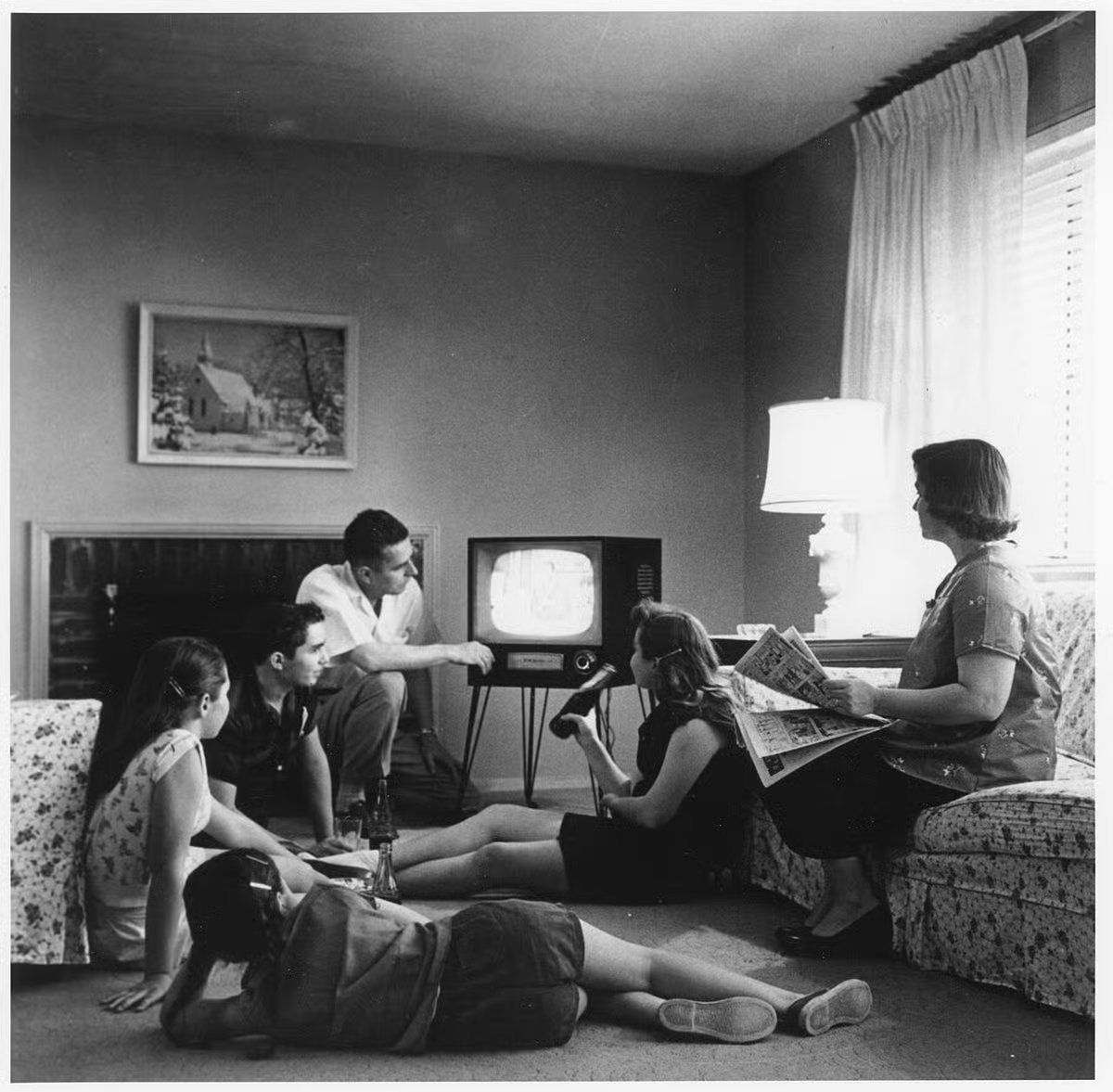
Scots invented television, the telephone, mri machines, refrigerators, mammal cloning, penicillin, disposable contact lenses, ATM machines, colour photography, the flushing toilet and the s-bend that stops it stinking, hypodermic syringes, steam engines, fingerprinting, vacuum flasks, pneumatic tyres, tarmac, and lightbulbs.

Replying to @⁨GMac@feddit.org⁩

Regarding your last paragraph list, you seem to be under major misapprehensions. I looked through the initial 3 items and none of them were invented by a scot, and so there was no reason to even check the rest.

And of those 3 I looked into, they all either had multiple countries involved in its creation, all of which had Americans as prime participants, and or had Americans as the sole originator.

en.wikipedia.org/wiki/History_of_television

en.wikipedia.org/wiki/History_of_the_telephone

en.wikipedia.org/…/History_of_magnetic_resonance_…

en.wikipedia.orgHistory of television - Wikipedia

Replying to @⁨Glowstick@lemmy.world⁩

Piggybacking on Gmac’s excellent comment, here’s some additional detail:

Alexander Fleming (Scottish) - penicillin

John Shepherd-Barron (English) - ATM (although this was a synthesis of many previous inventions/ concepts from other countries)

James Clerk Maxwell (Scot) - colour photography

Da Vinci (modern day Italy) - contact lenses

Alexander Cumming (scot) - S-bend

Various nationalities helped develop the internal combustion engine

Robert William Thomson (scot) - pneumatic tyre

Replying to @⁨Glowstick@lemmy.world⁩

My apprehensions are fine thanks. You’re just not looking very hard.

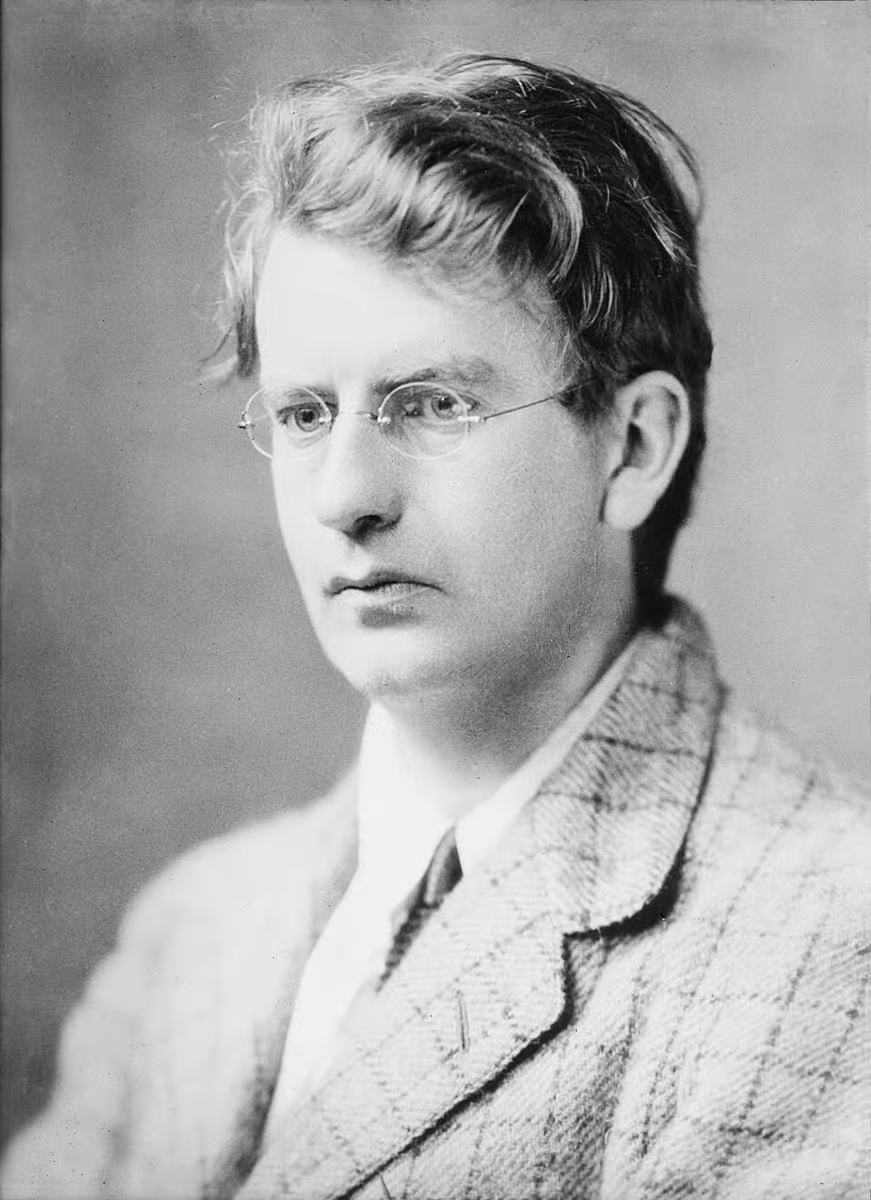
Inventor of the television - John Logie Baird en.wikipedia.org/wiki/John_Logie_Baird

Inventor of the telephone - Alexander Graham Bell en.wikipedia.org/wiki/Alexander_Graham_Bell

On the MRI - per the wikipedia link you posted but may not have read thoroughly. “During the 1970s, a team led by John Mallard built the first full-body MRI scanner at the University of Aberdeen.” I’ll grant I could have been more specific.

If you want to argue invention exists at the point of theory instead of physical creation, then i suspect you will struggle find much that wasn’t posited, theorised, described or conceived in some way before America was colonised.

American exceptionalism is a thing…

en.wikipedia.orgJohn Logie Baird - Wikipedia

Replying to @⁨Glowstick@lemmy.world⁩

Since many other comments have focused heavily on technological inventions, I think it makes sense to add some notable cultural impacts on society as well. As with most of the technological inventions mentioned, cultural forces also don’t come out of nowhere and arguably have been around for a lot longer than 100 years, but I think it’s pretty obvious that society within the past 100 years has been and still is being massively affected by the following concepts that did not originate in the USA:

  • feminism
  • civil rights movement (usually seen through a US-focused lens, but is happening everywhere)
  • gay rights movement (esp. in the 1990’s and beyond)
  • gender-spectrum concepts
  • widespread influence of evolutionary theory (even the word “meme” came from a British biologist’s book about evolution)

Replying to @⁨Glowstick@lemmy.world⁩

Invented in Japan in 1999, i-mode is a remarkable technology for connecting mobile devices to a wide range of web services.

It’s well-known in Japan that this invention, not the iPhone, was the first to enable games, email, emojis, and selfies on mobile devices.

I believe that the Japanese girls of the early 2000s who created this culture are the greatest hackers who shaped the smartphone era.

Super Galapagos - Matt Alt’s Pure Invention blog.pureinventionbook.com/p/super-galapagos

blog.pureinventionbook.comSuper GalapagosIn a world driven mad by tech disruption, Japan’s having fallen behind is a superpower

Replying to @⁨Glowstick@lemmy.world⁩

Capilliary democracy,
or whatever it’s called that Deng Xioaping has introduced.

I’m talking about layered elections + civic exams.

Liberal democracy has campaign fraud in it practically by design,
thus the will of the people becomes the will of the oligarchs right after every election,
and not even the will of domestic oligarchs for most countries.

Marx’ idea of democracy hardly got off the ground.
Lenin’s idea of democracy had the unintended consequence of turning the General Secretary of the communist party as its most powerful position soon after he died.

Replying to @⁨Nonconfrontational@lemmy.ml⁩

I don’t understand how a few of you are so completely misunderstanding this post. I’m literally asking for specific examples that are counter to my current understanding which i assumed was wrong, specifically so that i could learn a LESS biased us-centric view.

But frankly, overall y’all didn’t do a great job, and I’m somewhat disappointed. There were a small number of HUGE ones people listed which were fantastic examples, but a lot of people listed a TON of incorrect items that when i looked it up turned out not to be from the country they claimed, or obviously weren’t on the same world-changing level as the topic was about, or were over 100 years old.

I’m literally asking for information to learn to be LESS us-centric

Replying to @⁨bstix@feddit.dk⁩

Penicillin IS an antibiotic. They aren’t two different things. But yes, that’s a fantastic one.

Bluetooth, although not quite on the same level as i was asking about, still is a decent one to list.

C++ was created by a dane, but was created by an American company in America - techhistorylab.com/complete-history-of-cpp-from-1…

Dvd was a multi-national creation - see history section en.wikipedia.org/wiki/DVD

Electric clock is over 100 years

Graphene is a cool material with a lot of potential but so far isn’t close to changing the world - en.wikipedia.org/wiki/Graphene

Helicopter is a good one. Interestingly it was a step-wise multinational evolution, but which doesn’t seem to include the US. en.wikipedia.org/wiki/Helicopter

Linux is made by an American as a personal project for himself while he was in Finland for a few years. Definitely not a Finnish creation. en.wikipedia.org/wiki/History_of_Linux

TNT is over 100 years

Wegovy wasn’t created by a Dane, but glp-1 was first discovered by a dane. Discovering it is obviously a crucial first step, but that’s an entirely different thing than turning it into a medication which happened decades later by other people. See history sections en.wikipedia.org/wiki/Jens_Juul_Holst and en.wikipedia.org/wiki/Glucagon-like_peptide-1 and en.wikipedia.org/wiki/Semaglutide

The image illustrates the History of C++ with a vibrant orange-themed design on a clean white background. A large C++ logo and modern geometric elements symbolize the evolution of the programming language from 1979 to today. Bold typography highlights the timeline and growth of C++ in software development. The minimalist layout emphasizes innovation, programming history, and technological advancement. Ideal for articles exploring the History of C++, its origins, milestones, and lasting impact on computer science.techhistorylab.comThe Complete History Of C++: From 1979 To TodayExplore the complete history of c++ from its 1979 origins at Bell Labs to modern standards. Discover how one language reshaped the entire programming world.

Replying to an earlier post

If you nitpick your own suggestions the same way, you’ll find that nuclear weapons were made by Germans in America and that rock music is a rip off of blues which is from Africa, and so on.

All inventions are based on knowledge that comes from somewhere else. It’s the exchange of knowledge that pushes inventions forward. It is very rarely the country of where that person had his or her ass situated at the time of the patent application that caused the invention.

Replying to @⁨bstix@feddit.dk⁩

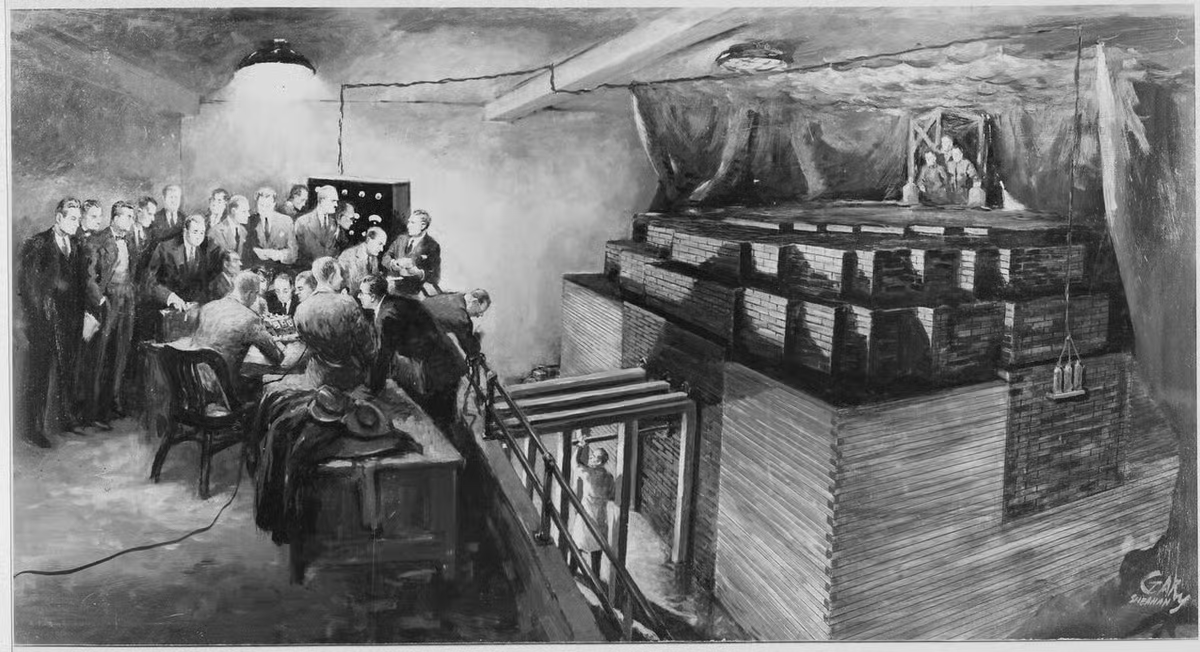
What? No. Nuclear weapons were made directly by the American government (The Manhattan Project), lead by an American scientist (Oppenheimer), directed by an American general of the US army corps of Engineers (Leslie Groves), and assisted by top level scientists that included some immigrant American citizens (such as Enrico Fermi and Albert Einstein).

en.wikipedia.org/wiki/Manhattan_Project

en.wikipedia.org/wiki/J._Robert_Oppenheimer

en.wikipedia.org/wiki/Leslie_Groves

en.wikipedia.org/wiki/Enrico_Fermi

en.wikipedia.org/wiki/Albert_Einstein

And omg, blues is not from Africa. It is FAMOUSLY a creation that originated in America.

en.wikipedia.org/wiki/Blues

Obviously everything that’s created builds on things that already exist, but that doesn’t mean nothing is a new creation. That’s a silly argument.

en.wikipedia.orgManhattan Project - Wikipedia