Replying to @⁨ryannathans@aussie.zone⁩

1 C is defined relative to 1 hour for full discharge and 3 C means a 3x faster discharge rate (full capacity can safely be discharged in 1/3 hour, or you can discharge 3 cells sequentially in an hour). Good lithium cells tend to be above 5C, can reach 10C for peak load or if cooled.

For a large enough battery it doesn’t really matter, but for dense portable ones a lower C rating means you have to discharge from more cells simultaneously to maintain a given output. That makes it more complicated, and you have less headroom to the battery’s maximum Watt output if you need to accelerate a car hard suddenly.

Replying to @⁨ryannathans@aussie.zone⁩

Kind of, yes. But more importantly, it also means it can only push enough power to run at 3c. And that’s probably not for the full charge of the battery.

So a 100 amp hour battery rated at 3c can push out 300 amps. Which also means that if the grid needs a short spike in power, it might be limited.

It shouldn’t be too hard to get a 15c LiPo battery, which could push 5x as much energy at peak demand.

You’d probably kill the battery if you charged it from 0-100 at 15c, but for short bursts of charging and discharging, it should handle it just fine.

Replying to @⁨LastYearsIrritant@sopuli.xyz⁩

Honestly curious: I’m not a battery or even energy person, but this is interesting.

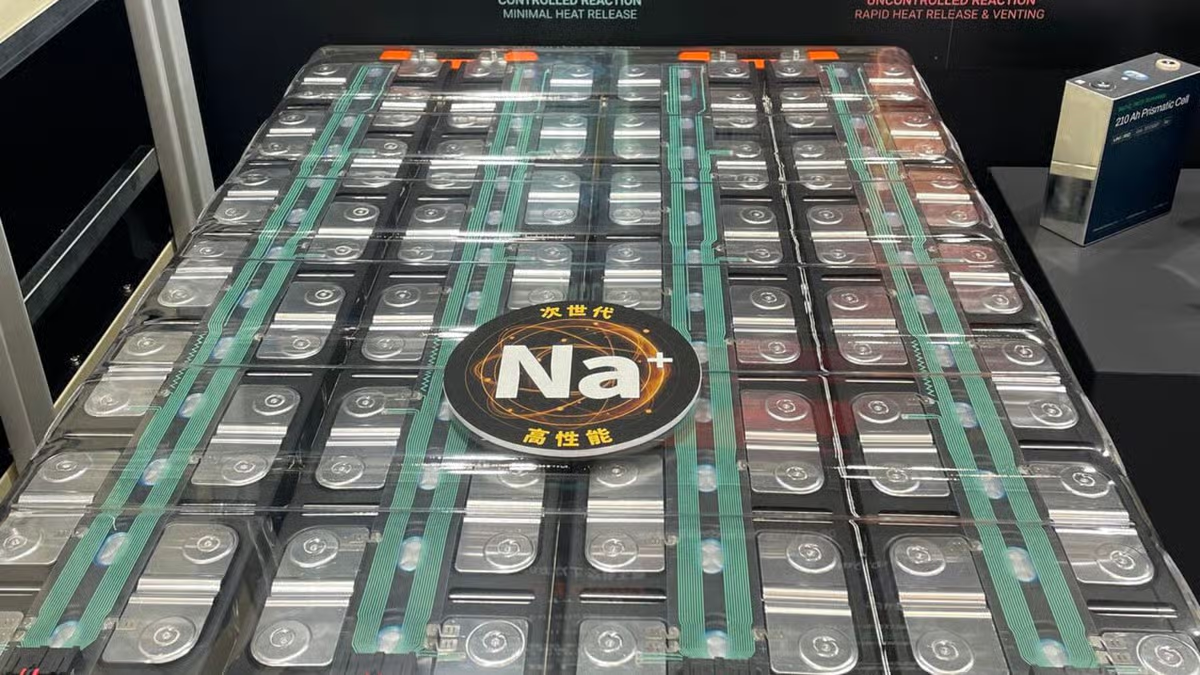
The charge/discharge efficiencies and rates could just mean we build networks of mixed types? “Trickle” charge/discharge via a slower battery that handles more cycles and is probably way cheaper to build (that’s the premise of Na+, right?), but have those batteries back up a more expensive high-rate bank for when power is needed in a burst? Probably a switching problem at that point, which I imagine we already deal with having solar/hydro/fossil/etc.

A Na+ bank sized to handle regular use and charge a Lithium bank when underused so that one is ready for spikes seems like a way to go.

Replying to @⁨lime@feddit.nu⁩

which could be a pretty big obstacle to grid-scale deployment.

Well, on a grid scale if you’ve got a 100MWh battery and you want to charge it at 3C, then you’re looking to find a spare 300MW out on the grid somewhere for 20 minutes.

That’s not impossible, but you’ll buy that 100MWh a lot cheaper if you’re willing to get it over the course of a few hours. For example, buying power in the middle of the day when there’s excess solar, to then drop it back into the grid in a one hour burst during peak times in the evening for 10 times the price.

That kind of thing is where the battery will make the most profit, so slow charge rates don’t really matter.