Replying to @⁨sanitation@lemmy.today⁩

Everyone should read before reacting:

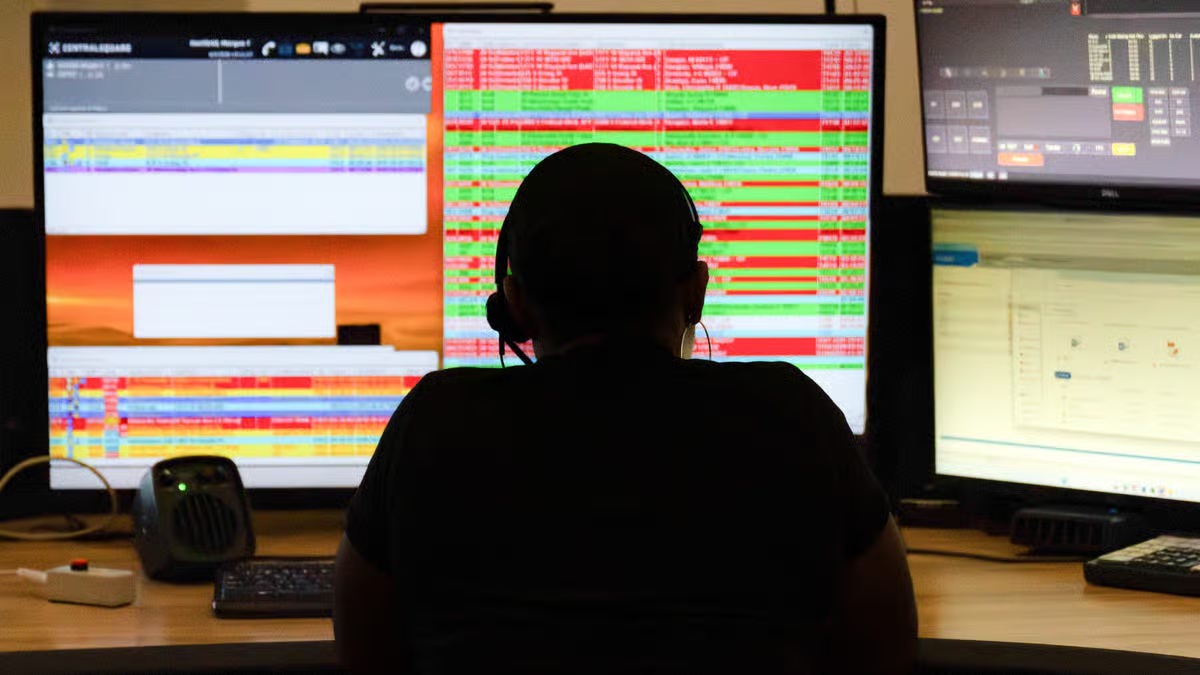
This is intended to handle the increase of calls that are related to one incident, so callers get automatically routed to an AI agent who asks if they are calling regarding the incident. If the answer is yes, then callers can receive information or updates, and if it’s no, then the callers are transferred to a human.

This makes sense. A big thing happens that you are aware of. Geolocated calls from that area flood in. An operator, who could be getting useful info, has to handle a flood of “Guess what I just saw!”

Note that I think they should spend the money on more operators instead, but at least this seems like it has good guardrails.

Edited ⁨⁨Aug⁩ ⁨9⁩, ⁨2026⁩, ⁨01:28⁩⁩en

Replying to @⁨teolan@lemmy.world⁩

My understanding from other articles is caller satisfaction is greater with the TTS system, and it uses voice IVR to triage of they have additional information. AI is not bullshit in and of itself. This product seems barely diffeent from what they provided with APEX.

Recordings also can’t auto respond with updates to the caller like this can, which is a pretty nice feature, even if it’s just TTS.

Replying to @⁨Fmstrat@lemmy.world⁩

How many operators to handle say 100 calls in 5 minutes? Now imagine the cost to staff a small 911 center to ensure your can handle those calls 24/7. The money doesn’t exist.

Butts in seats don’t exist right now either. As long as the fancy ivr allows the caller to reach a human with minimal effort, this seems like a scary sounding but neat assistant solution to a problem without a real solution.

Replying to @⁨mikesizachrist@lemmy.world⁩

Listen to yourself. Have a large team of trained staff on call. How much do you think that costs? No go on guess. Do some calculations. The people do not exist to fill the seats. The money does not exist to pay the non-existent people. This is an attempt to make an already shitty situation better.

I work in this industry and I read the article. I understand what they are doing. I hate AI but this seems reasonable.

Replying to @⁨mikesizachrist@lemmy.world⁩

So, say a tower block fire happens at 2 am. You’re getting 50 calls a minute, 20% from residents and the rest from people calling to say they see a fire.

How long would it take for your trained staff to spring into action compared to an on demand AI? And are you paying your on-call staff to wait, or only when they’re on the phone?

edit: I’m thinking about the Grenfell Towers. I listened to the BBC’s coverage of the enquiry, and it was rough. Gave me a new appreciation for what emergency responders do.

Replying to @⁨Fmstrat@lemmy.world⁩

And if someone tries to call with new unreported information about an already reported incident? Decision tree or geolocation routes caller to recorded information. No way of knowing if information is important or not without talking to the caller first. Possible downside is far greater than possible benefits.

Edit Multiple calls about shots in neighborhood, if victim is last to call are they forced to listen to an update before triage allows transfer? No sir I don’t like it.

Maybe this is an improvement in this location, but as many have said a staffing issue.

Functional societies have costs, often those costs are far less than dysfunctional societies.

Replying to @⁨DupaCycki@lemmy.world⁩

Just hire more operators dawg. It’s really not that complicated.

Have offered your recruiting skills/services to them? The nationwide 911 operator/dispatcher shortage has been a problem for years, so if you find it easy or uncomplicated to recruit them, then your services might be very valuable.

(Yes, I’m giving you the benefit of the doubt here by assuming that that was an informed opinion.)