posted in Technology

The return of supersonic flight hinges on the race to solve one big hurdle | CNN

The skies of Oklahoma City roared for six months in 1964 as military aircraft intentionally rattled the population below with a daily barrage of thunderous sonic booms. It was a controversial test — the consequences of which have lingered to this day.

Two approaches in the works could revolutionize air travel by making future supersonic passenger planes compliant with the FAA’s new noise rules: Colorado-based company Boom Supersonic, which is specifically mentioned in the FAA proposal, plans to use physics to prevent sonic booms from ever reaching the ground, regardless of plane design. NASA, on the other hand, is flying an experimental plane called X-59 that is specifically designed to reduce the intensity of the boom.

www.cnn.com/2026/08/06/science/supersonic-flight-comeback-sonic-boom
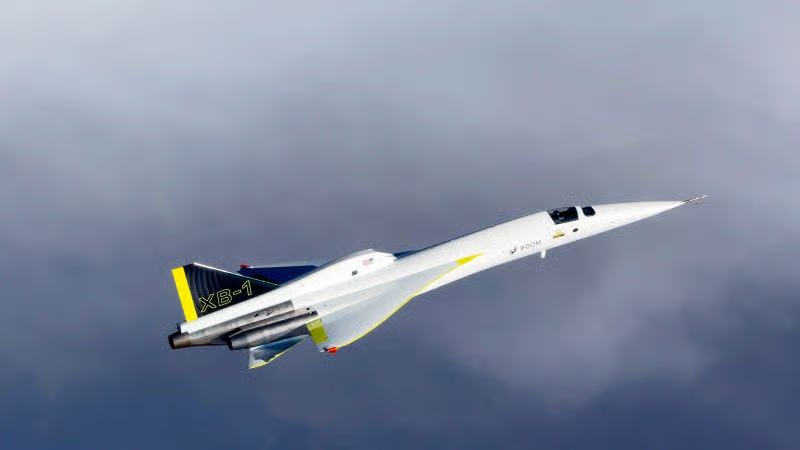
CNNThe return of supersonic flight hinges on the race to solve one big hurdle | CNNFifty years after a US ban, the door is cracked open again to faster-than-sound travel over land. And experts think they finally have an issue that killed it.

enPage

Replying to @⁨LibertyLizard@slrpnk.net⁩

There are legitimate materials science, atmospheric sound propagation physics, and climate science modeling questions that are being answered by these tests. I believe it extremely short sighted to think the application of this technology and enhanced fluid dynamics to be limited to “rich people fuck the planet faster”.

I’m not saying that it is never fair to criticize a scientific endeavor, but enhancing our understanding of quickly transporting things through a dense atmosphere is not a bad thing.

Replying to @⁨LibertyLizard@slrpnk.net⁩

If we can reduce the shockwave from sonic booms that could directly lead to more efficient plane engines. The main current impediment they have is the tips of the turbine blades can only get so close to the speed of sound before they explode from the forces they’re experiencing.

Which could have knock-on effects for anything involving an airfoil moving through a fluid. Helicopters, boats, wind turbines, hydro-power, etc.

Better understanding and control of the physics / materials science at the sound barrier would be very good news.

Replying to @⁨testaccount372920@piefed.zip⁩

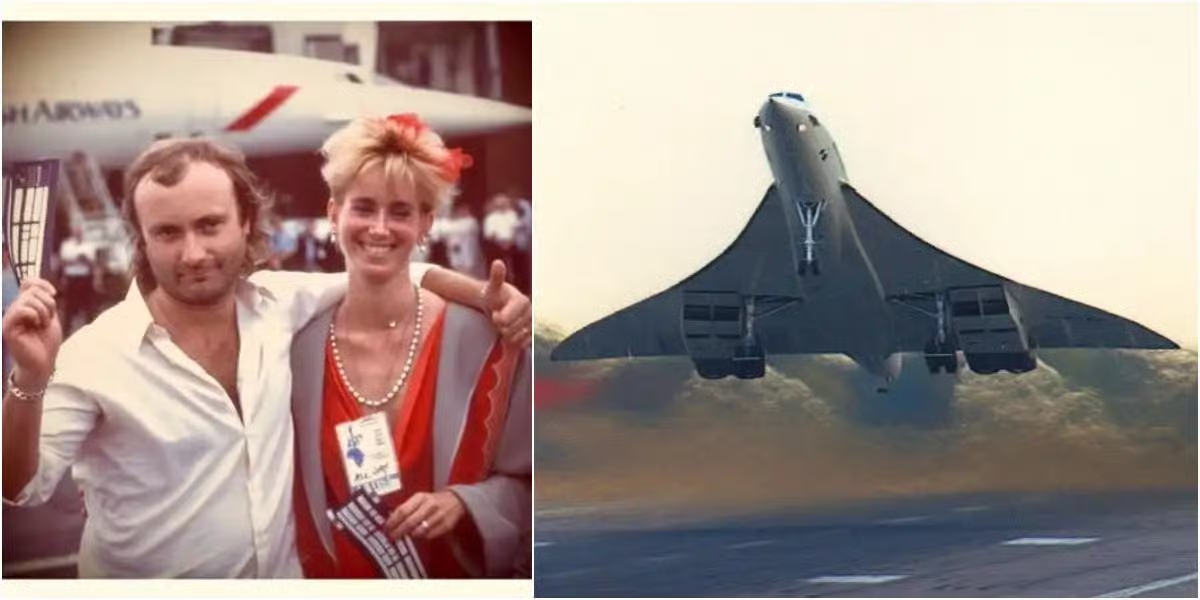
I’m reminded of when Phil Collins flew the concorde so he could perform at both Live Aid concerts in 1985.

theaviationgeekclub.com/…/amp/

The Aviation Geek ClubWhen Phil Collins Played at Wembley Stadium Hopped a flight on the Concorde and landed three hours later to play at JFK Stadium in PhiladelphiaWhen Phil Collins Played at Wembley Stadium Hoped a flight on the Concorde and landed three hours later to play in Philadelphia

Replying to @⁨spaghettiwestern@sh.itjust.works⁩

but I’d guess that some of the technologies that make SS travel possible may make subsonic travel more efficient.

I wouldn’t count on that. if a plane is optimized for efficiency during the longest part of its flight, which would presumably be supersonic cruise at high altitude, a bunch of things that make modern airliners as efficient as they are (blended winglets, and turbofan engines where the fan generates more thrust than the actual turbine engine exhaust) are directly counter to that

It’s an entirely different kind of flying. All together!

Replying to @⁨spaghettiwestern@sh.itjust.works⁩

That one big hurdle is “What’s the fucking point”? The number of people who need to get halfway around the world six hours faster and who are willing to pay ten times as much for the privilege is vanishingly small, and frankly, that’s not a problem that needs solving.

I mean Boeing can’t even build subsonic airplanes any more and Airbus. . .well, they have “Bus” in their name. Who needs a supersonic bus?

Replying to @⁨daikiki@lemmy.world⁩

Sure that was why there was never really a business case for Concorde, but ……

  • I would pay a little more to get there a little faster. Research is not only trying to quiet the boom but also trying to make it more economical.
  • I believe the company listed there is focusing on private jets. Someone who can afford a private jet might be more likely to pay a premium to get there faster

Replying to @⁨AA5B@lemmy.world⁩

You might be able to make it less uneconomical, but air resistance is a bitch. You wanna go twice as fast, you need four times as much power, and now you need a heavier plane to carry all that fuel. Which uses more fuel because of how heavy it is. Diminishing returns kicked in before you even got airborne, and now you’re just throwing thrust at the problem and you’re throwing fuel at the thrust.

Sure, there are some people who don’t give a fuck, and would be willing to expend whatever in fuel and emissions to build a plane that will use as much fuel as a commercial liner that carries hundreds to get six people to Dubai a couple hours faster, but no sane government would allow that kind of plane to be built or even land on their territory because of how plainly awful that math is for everybody not richer than god.

Right?

Replying to @⁨daikiki@lemmy.world⁩

There are people who DGAF, and there are people who don’t mind flying at a higher altitude, where the air is thinner and the resistance is less.

Oh, about the fuel thing… I go fishing with my Uncle, he’s got a little V8 inboard, probably spends $10 per day to go out and catch our licensed limits of fish. He’s got a friend who won the lottery and bought a big 1200hp outboard open fisherman, he’ll go blow $1000 in fuel in the same time to catch half as many fish, but he does get to go farther, faster.

Replying to @⁨spaghettiwestern@sh.itjust.works⁩

Why are there so many grammatical errors in this article?

But the test was a major catalyst would eventually spell doom for commercial supersonic journeys over the United States.

Now, some 50 years on from the ban, a new era of supersonic flight seems within reach. The FAA in June for reimagined rules on supersonic flight.

Jacopo needs to step up the proofreading because it’s distracting having to reread a sentence.